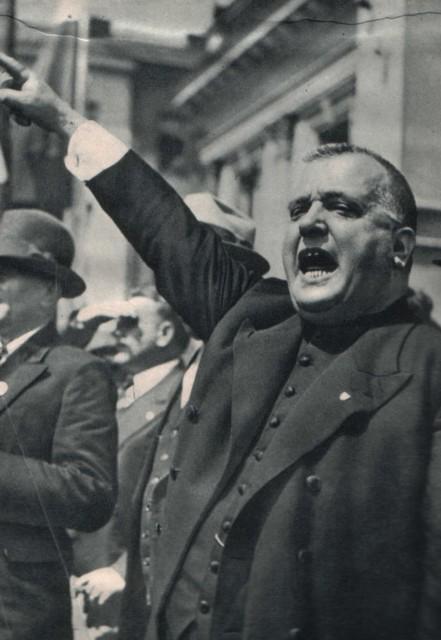
Tiso was a Slovak politician and Catholic priest who served as president of the First Slovak Republic, a client state of Nazi Germany during World War II, from 1939 to 1945. Tiso collaborated with Germany in deportations of Jews, deporting many Slovak Jews to extermination and concentration camps in Germany and German-occupied Poland, while some Jews in Slovakia were murdered outright. Deportations were executed from 25 March 1942 until 20 October 1942. An anti-fascist partisan insurgency was waged, culminating in the Slovak National Uprising in summer 1944, which was suppressed by German military authorities, with many of its leaders executed. Consequently, on 30 September 1944, deportations of Jews were renewed, with additional 13,500 deported.
When the Soviet Red Army overran the last parts of western Slovakia in April 1945, Tiso fled to Austria and then Germany, where American troops arrested him and then had him extradited back to the restored Czechoslovakia, where he was convicted of high treason, betrayal of the national uprising and collaboration with the Nazis, and then executed by hanging in 1947 and buried in Bratislava.
Jozef Tiso became the first President of Slovakia. Tiso, a priest, is also a fervent German sympathizer. He appoints Vojtech Tuka, a fellow right-wing radical who formed the Hlinka Guard paramilitary force in Slovakia, to replace him as Prime Minister. Slovakia may now be considered a German satellite.
Jewish males between the ages of 14 and 60 in Nazi-occupied Poland were forced to perform forced labor.
Hans Frank, former Reich Minister of Justice and a high-ranking Nazi official, was given rank of SS Obergruppenführer and appointed Governor-General of the General Government for the occupied Polish territories.
Berlin confirms that Hitler wishes to “return” ethnic Germans to the Reich, a program that has been in place for some time.
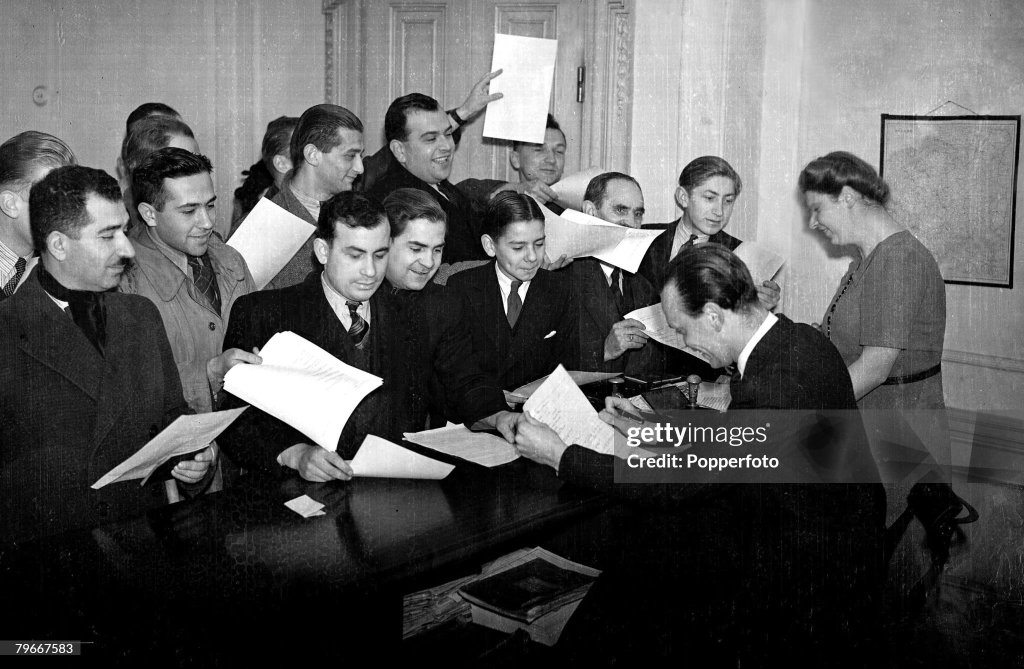
The Reich sends Czech Jews to Poland. Nearly the entire Jewish population of Moravska-Ostrava, with the exception of the aged and infirm, have been transported to Poland.
Nazis tighten censorship; telephone calls and telegrams abroad are restricted.
Wintry conditions prevail with much rain and snow on the Western Front. Minor encounters between patrols and artillery fire from both sides is reported.
Nazi troops mass along a 650-mile front. Positions face Belgium, France, Switzerland, and the Netherlands; the German forces are placed to attack at any point.
Chamberlain responds to claims made by the Nazi Foreign Minister Ribbentrop that Britain sought and plotted for war with Germany. He says “the whole world knows that this is not true.”
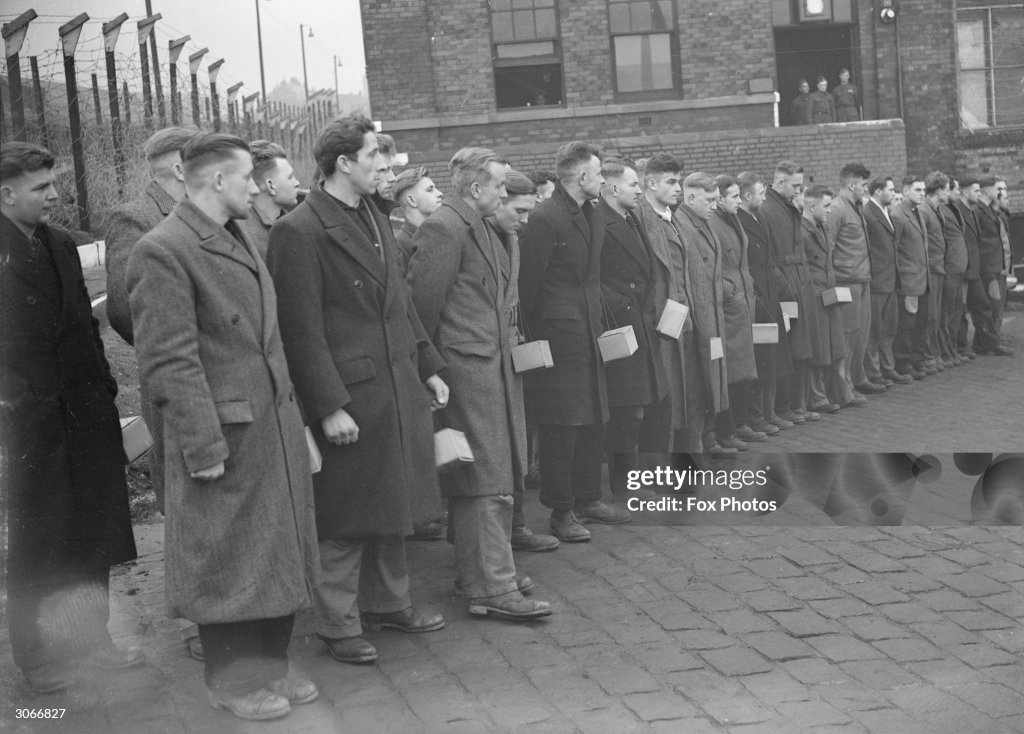
The Auxiliary Military Pioneer Corps is formed in the United Kingdom.
In a radio broadcast to the United States, King Leopold III of Belgium declared that Belgium was determined to defend its neutrality.
The Finnish government seeks Swedish support in their diplomatic battle against the Soviets.
The Soviet government denies the British claim to have a right to stop Soviet merchant ships bound for Germany. Great Britain and the Soviet Union, of course, are not at war. The Soviets also challenge the expansive definitions of “contraband” the British are applying. In fact, several nations are casting a leery eye at the British over this heavy-handed practice, but few are in a position to protest.
Perhaps coincidentally echoing the Soviet protest on the same day, U.S. Consul at Gibraltar William E. Chapman informally questions the British officials there about their detainment practices regarding U.S.-flagged ships. Some of the ships are being detained for lengthy periods and having their cargo removed before release. In addition, U.S. mail is not being delivered to the Continent.
Murmansk authorities (no doubt in communication with Moscow) are mulling over what to do with the City of Flint. The German prize crew remains in detention. The Soviet issues with the British over detentions of neutral vessels may be affecting this vaguely similar issue, too.
Ahmad Matin-Daftari becomes Prime Minister of Iran.
The Southern Rhodesia Air Force (SRAF) offers to contribute three air squadrons to British defense.
Kriegsmarine U-boat U-24 laid a field of 9 mines in Hartlepool Bay, resulting in one ship sunk on 9 November.
The U-16, lost yesterday, washes up on Goodwin Sands with 50 crew dead inside.
U.S. Consul at Gibraltar William E. Chapman confers informally with British naval authorities there concerning protracted delays in detention of American merchantmen.
U.S. freighter Black Eagle is detained by British authorities.
Convoy OB.25 departs from Liverpool. Convoy OG.4 forms.
The War at Sea, Thursday, 26 October 1939 (naval-history.net)
Battlecruiser REPULSE and aircraft carrier FURIOUS, escorted by destroyers FORESTER, FEARLESS, FOXHOUND, FORESIGHT, FIREDRAKE departed the Clyde at 0430 to cover the Atlantic convoy routes, including Halifax convoys already at sea. Following these convoys’ safe passage, they were stationed to the south and the east of Newfoundland to continue covering the route, the destroyers arriving back in the Clyde on the 28th.
Two cruisers were on Northern Patrol between the Orkneys and the Faroes, three cruisers between the Faroes and Iceland, and one cruiser and AMC TRANSYLVANIA in the Denmark Strait. Meanwhile, light cruiser SHEFFIELD was returning to Sullom Voe. From the 13th to 26th, Northern Patrol sighted 56 eastbound ships, sent 53 into Kirkwall for inspection and dealt with six German merchant ships.
Light cruiser BELFAST arrived at Clyde for Refitting completed on 8 November.
Anti-aircraft cruiser CALCUTTA departed Harwich and arrived at Grimsby on the 27th.
Destroyer KASHMIR (Cdr H A King) completed, and after working up at Portland, joined the 5th Destroyer Flotilla operating with the Home Fleet on 12 November.
Convoy FN.27 departed Southend, and arrived at Methil on the 28th. There was no FN.28.
Convoy FS.27 departed Methil, escorted by destroyers JUNO, WALLACE, WHITLEY and sloop STORK, reaching Southend on the 28th.
Swedish steamer JUPITER (2152grt) was seized in the Baltic by German warships and taken to Kiel.
Greek steamer MARIETTA NOMIKOU (5241grt) was seized in the Baltic by German warships and taken to Pillau.
Convoy OG.4, totaling 40 ships, was formed from OA.24G, escorted by destroyers ESCORT and ELECTRA, and OB.24G which departed Liverpool escorted by destroyers WARWICK and VANOC. The convoy safely arrived at Gibraltar on 1 November, escorted by French destroyers CHACAL and MISTRAL, which departed Brest on the 26th and joined on the 27th.
Destroyer DUCHESS abandoned her Kithera patrol 24 hours early to take an injured man to Malta.
Convoy Blue 6 of 15 ships departed Port Said and proceeded without escort.
MTB.11 was accidentally hit by a round from a 6-inch shore battery at Hong Kong, fired to warn her to keep clear of a newly mined area. She was towed into harbor between MTB.9 and MTB.10.
President Roosevelt is quoted in the New York Herald Tribune Forum, October 26, 1939: “The United States of America, as I have said before, is neutral and does not intend to get involved in war.”
On the eve of the Senate vote on amending the Neutrality Act, President Roosevelt delivers a radio address: “In and out of Congress we have heard orators and commentators and others beating their breasts proclaiming against sending the boys of American mothers to fight on the battlefields of Europe. That I do not hesitate to label as one of the worst fakes in current history. It is a deliberate setup of an imaginary bogy.”
In an address broadcast from the White House to the closing session of the ninth annual New York Herald Tribune Forum on Current Problems at the Waldorf-Astoria Hotel, President Roosevelt denied that any responsible Administration official had ever suggested “the remotest possibility” of sending American boys to fight in Europe. Reaffirming the country’s policy of neutrality, the President added: “The fact of the international situation — the world situation — the simple fact, without any bogey in it, without any appeals to prejudice — is that the United States, as I have said before, is neutral and does not intend to get involved in war.”
Earlier in his address President Roosevelt had launched an attack against the proponents of “nostrums,” some of whom, he said, were honest and sincere, but others, “too many of them,” seekers of personal power. He left no doubt that he had in mind his predecessor in the White House when he included among such nostrums the proposal “to put a chicken or two in every pot.” Mr. Roosevelt expressed the wish that news in the domestic field might be presented by radio and press on a basis as “unbiased and factual” as recent international news.
President Roosevelt’s gains are at a five-year high; 64.9 percent of voters approve of the President.
In Washington today, President Roosevelt received Representatives Sirovich and O’Toole of New York, talked with Paul Van Zeeland of Belgium, conferred with Norman H. Davis, chairman of the American Red Cross, and entertained at luncheon Colonel T. H. Barton of Arkansas, a close friend of the late Senate majority leader, Joe T. Robinson of Arkansas.
The Senate agreed to a limitation of debate, holding each member to a 20-minute discussion of the Neutrality Bill or amendment; Administration forces established a 2-to-1 majority on three test amendments and appeared to be well entrenched for the final vote which may come before the week ends. The Senate recessed at 7:15 o’clock until 11 AM tomorrow.
The House again listened to speeches, transacting no legislative business. Among speakers was Representative Martin J. Kennedy of New York, who advocated that the job of protecting the country against Communists be turned over to veterans’ organizations. The Celler bill to penalize those who distribute defamatory matter through the mails was received. The House adjourned at 3:28 o’clock until noon tomorrow.
In three successive tests, involving directly the issue of arms embargoes against belligerent nations, Administration forces in the Senate established today the prospect of a majority of more than two to one for passage of the Pittman neutrality resolution. The final vote is regarded as certain tomorrow, under a new and stricter limitation on debate which the Senate, obviously wearied with the whole embargo question, fastened upon itself by unanimous consent early tonight.
Becoming operative when the Senate meets at 11 AM tomorrow, the agreement provides that no Senator may speak in the aggregate longer than twenty minutes on the bill and twenty minutes on any amendment. Although isolationist Senators objected to fixing a time for the final vote, Senator Barkley, the majority leader, confidently predicted that it would come in ample time tomorrow for Senators to have a good night’s rest in preparation for a holiday on Saturday. Senators of all persuasions seemed eager to dispose of the matter.
In the tests today the Senate rejected by impressive majorities amendments which, first, would have retained an embargo on poisonous gas and flame throwers; second, would have placed a separate ban on the shipment by manufacturers in the United States of bombing planes to belligerents, and third, would have established a permanent embargo on the shipment of arms and munitions from the United States to any country except to nations of the Western Hemisphere waging a “defensive war” against an aggressor.
The principal embargo vote is yet to come, however. It will center on an amendment offered late today by Senator Clark of Missouri, incorporating in the Pittman “Cash-and-Carry” resolution the arms embargo of the present law. A showdown will result, first, on another amendment proposed by Senator Clark to place armed merchantmen in the same class with submarines or naval surface vessels so far as the privileges of American territorial waters are concerned. Under another part of the unanimous consent agreement, further debate on this amendment will be limited to 40 minutes.
On the basis of today’s developments, isolationists and Administration leaders alike put the final line-up roughly at 64 to 30 in favor of repealing the embargo, after making allowances for absentees and pairs and last minute switches. Although an amendment offered by Senators Danaher of Connecticut and Vandenberg of Michigan to bar the shipment of poison gas from the United States to belligerents drew an affirmative vote of 36 as against 54 in the negative, this was not considered the most revealing test.
A more accurate line-up, in the view of those who have followed the contest from the start, was the vote on the proposal of Senator Downey of California, establishing a permanent peacetime and wartime embargo on the shipment of all arms, except to Western Hemisphere countries for defensivé purposes. In this case, the Administration forces triumphed by a vote of 55 to 27. Senator Vandenberg, who unquestionably will vote with the isolationists on the final issue, cast his ballot against the Downey amendment, as did Senator Townsend of Delaware, who also is expected to show up in the isolationist column in the end. Senator Clark of Idaho, another arch-foe of embargo repeal, was paired with Senator Mead of New York on the Downey amendment, but is expected to be free to vote tomorrow.
A formal complaint charging the American League for Peace and Democracy with violating federal laws requiring the registration of agents of foreign governments was prepared tonight for submission to the Department of Justice by Representative Martin Dies, chairman of the Committee to Investigate Un-American Activities. Mr. Dies set forth his complaint in the form of a letter which he made public coincident with mailing it to Attorney General Murphy.
He requested action by the Department of Justice in view of the state of limited emergency declared by President Roosevelt for protection of the United States soon after the outbreak of the European war.
“The evidence in possession of the committee,” Mr. Dies wrote, “shows not only that the American League was organized in the first instance by the Communist party acting under instructions of the Communist Internationale and that the league has shifted its policies whenever changes have been made in strict accordance with the changing policies of the Communist Internationale but also shows that the league is today the instrument of the Communist Party of the United States for the carrying out of the decisions of the Communist Internationale.”
The White House indicated displeasure today with the statement made yesterday at San Francisco by Secretary Wallace that wartime conditions and considerations of national safety made it necessary for President Roosevelt to succeed himself in 1940.
Hadassah asks the United States to aid Palestine. The government is urged to use its influence after war to get justice for minorities.
In a Navy Day letter to Charles Edison, Acting Secretary of the Navy, President Roosevelt declared today that the upbuilding of the navy must go forward.
The submarines USS Narwhal and USS Dolphin arrived off Wake Island on simulated war patrols.
Brooklyn Dodger exec Larry MacPhail proposes that a new World Series format be used in which, as now, the top 2 teams in each league compete against each other; at the same time the 2nd place teams play each other; the 3rd place teams play each other, and so on. The results of these games are added up and a trophy or money presented to winners. The idea doesn’t reach first base.
Claire Chennault returns to San Francisco to tour aircraft factories as he continues reorganizing the Chinese air force.
The recent Chinese defeat of Japanese troops in Northern Hunan and Western Kiangsi Provinces undoubtedly was one of the most important events of the war so far. This conclusion is reached after a ten-day trip by this correspondent into the zone of hostilities north of Changsha. An outstanding factor in the repulse of the Japanese army attacking Changsha was the proof given that the Chinese regulars had developed a technique of defense and could balk further Japanese advances into the interior of China.
This technique consists in the thorough destruction of roads and pathways and the removal of food and people from the area of possible Japanese operations, then the employment of a warfare of movement, marked by luring tactics, for assaults on the Japanese rear by small, well-armed units and simultaneous frontal and flank attacks.
The destruction of roads and pathways northward of Changsha amounted to obliteration and obliged the Japanese to prove themselves as able as the defenders in bayonet, rifle, and machine-gun fighting. The Japanese air force was of relatively minor value in the type of fighting that the Chinese forced upon the Japanese. The Chinese tactics northward of Changsha were similar to the guerrilla methods long utilized by Chinese in Shansi Province, but in Hunan and Kiangsi the methods were carried out by regulars, who demonstrated their ability to engage in warfare of quick maneuvering, in which they used only mountain guns, machine-guns or other light arms.
The Chinese claim that the tanks and large guns that the Japanese had planned to employ remained aboard lighters in Tungting Lake throughout the recent fighting. The Japanese had failed to find any terrain over which they might move these weapons. The Japanese thus were placed or an equal footing with the Chinese as regards arms. The Hunan and Kiangsi battle showed that the Japanese would be unable to advance against the technique used by the Chinese without greatly increasing the numbers of the attacking forces. The Chinese state that their 90,000 on the actual front were only half the number used by the Japanese in these operations.
All four Northwestern provinces of China — Shensi, Kansu, Ningsia and Sinkiang — are being “sovietized” and the Chinese Communist Army now is moving into Shensi, the Japanese Domei news agency said today.
An Australian radio station begins beaming anti-German content.
Dow Jones Industrial Average: 154.05 (-1.43)
Born:
Vladimir Mikhailovich Beloborodov, Russian cosmonaut (Never flew; Failed his final examinations for political reasons), in Oloviyanna, Chita Region, Russian SFSR, Soviet Union (d. 2004).
Naval Construction:
The Kriegsmarine (German Navy) Type VIIC U-boats U-355, U-356, U-357, and U-358 are ordered from Flensburger Schiffsbau-Ges, Flensburg (werk 474-477).
The Royal Fleet Auxiliary fleet support tanker RFA Blue Ranger (A 157) is laid down by Harland & Wolff (Govan, Scotland, U.K.).
The U.S. Navy small seaplane tender USS Barnegat (AVP-10), first of her class of 31, is laid down by the Puget Sound Navy Yard (Bremerton, Washington, U.S.A.).
The Royal Navy Flower-class corvette HMS Anemone (K 48) is laid down by Blyth Shipbuilding & Drydock Co. Ltd. (Blyth, U.K.); completed by Clark.
The Royal Navy Flower-class corvette HMS Campanula (K 18) is laid down by Fleming & Ferguson Ltd. (Paisley, Scotland).
The Royal Navy Flower-class corvette HMS Crocus (K 49) is laid down by A & J Inglis Ltd. (Glasgow, Scotland); completed by Kincaid.
The Royal Navy Flower-class corvette HMS Honeysuckle (K 27) is laid down by Ferguson Shipbuilders, Ltd. (Port Glasgow, Scotland).
The Royal Navy M 1-class minelayer HMS M 1 (M 19) is commissioned.
The Royal Indian Navy auxiliary patrol vessel HMIS Hashemi is commissioned.
The Royal Navy “K”-class destroyer HMS Kashmir (F 12) is commissioned. Her first commanding officer is Commander Henry Alexander King, RN.

 History Diaries