President Ford has agreed to meet with Leonid Brezhnev, the Soviet leader, on November 23 and 24 in the Vladivostok area of the Soviet Far East. The announcement came at the end of three days of talks between Mr. Brezhnev and Secretary of State Kissinger in Moscow on the limitation of strategic offensive weapons. The meeting is considered a gain for Mr. Brezhnev, who will also meet Chancellor Helmut Schmidt of West Germany and President Valery Giscard d’Estaing of France in the next six weeks as he builds contacts with the new leaders or the three Western countries. Mr. Kissinger arrived on Wednesday hoping to lay the groundwork for Mr. Ford and Mr. Brezhnev to reach a consensus on joint instructions to their arms negotiators. The Secretary of State and Mr. Brezhnev began personal discussions at 4:30 PM today before adjourning to a larger working meeting at 7 PM. They were joined in their private meeting by Foreign Minister Andrei A. Gromyko and Mr. Kissinger’s deputy. Helmut Sonnenfeldt, as well as Mr. Brezhnev’s interpreter, Viktor M. Sukhodrev. The negotiations ended close to midnight. In the last hour and a half, Mr. Kissinger and Mr. Brezhnev met in private with an interpreter.
In a luncheon toast to Mr. Gromyko today, Mr. Kissinger declared that the talks here had “made good progress in a number of fields.” American officials said that they hoped the Vladivostok meeting would give new impetus to the arms control talks so that an agreement might be reached by the time Mr. Brezhnev goes to Washington in June. The officials said they expected no dramatic agreement on strategic weapons to come out of the Vladivostok meeting itself. The selection of Vladivostok as a site is likely to irritate the Chinese, some Western diplomatic observers believe, because of its proximity to the Chinese border. Mr. Gromyko, in his toast replying to Mr. Kissinger at luncheon today, struck a somewhat pessimistic note on the progress of the negotiations with Mr. Kissinger. e Foreign Minister spoke of the “exceptional complexity” of the issues and conceded that “certain differences of views” existed between the two sides.
Vladivostok, which was first mentioned by the Russians in advancing privately the idea of a meeting, poses some logistically awkward problems because it has been closed to foreigners. It is the home base of the Soviet Pacific Fleet, including a naval flotilla that operates in the Indian Ocean. Vladivostok has controversial overtones as a site because it lies in a region that the Chinese say was taken by Czarist Russia through unequal treaties in the 19th century, though Peking does not specifically lay claim to it. Mr. Kissinger has said that he plans to visit China before the end of the year. He may do so immediately after Mr. Ford and Mr. Brezlinev conclude their meeting.
At the Scheveningen Prison in the Hague, four convicted terrorists took 22 people hostage, including several children, during a Roman Catholic Mass. Two of the criminals had been convicted for the March hijacking of a British Airways jet. Four armed prisoners, including a Palestinian hijacker, raided the chapel of Scheveningen penitentiary during mass and took 22 hostages, the police at the Hague reported. The four demanded that they be put in touch with an ambassador or consul of an Arab country. The hijacker, Adnan Ahmed Nuri, also demanded that a colleague from an earlier hijacking, Sami Houssin Tamimah, be released and allowed to join the prisoners at the penitentiary chapel. Mr. Tamimah is under postoperative care. After the terrorists had released all of the children and several adults, Dutch Marines and Hague police stormed the prison chapel on October 31, rescued the remaining hostages unharmed, and arrested the four terrorists.
Secretary of State Henry A. Kissinger, apparently skeptical of U.S. Embassy reports from Lisbon minimizing the peril of a Communist takeover in Portugal, initiated two missions to the country to make independent evaluations — one involving a deputy director of the Central Intelligence Agency and the other a group of State Department officials. Details of the evaluations were not available, but sources in Lisbon said that Kissinger and others were obsessed with fear that Portugal would go Communist, leading to similar changes in Spain, Italy and Greece.
Italy’s Christian Democrats agreed to continue seeking a center-left government, forestalling a bid by the strong Communist Party to take a hand in governing Italy. Amintore Fanfani, designated to try and reunite the four parties of the outgoing coalition under his premiership, had announced failure Friday. But Christian Democratic leaders emerged from a two-hour Saturday meeting apparently confident that the old coalition formula can be renewed.
Britain bowed to public pressure, and announced action to get around its own tax laws to help the 340 children born deformed because their mothers took the tranquilizer thalidomide. The government will pay $12 million in taxes on a $46 million trust fund set up for the children by the company that made and distributed the drug in Britain. The fund was established to settle lawsuits and end lengthy negotiations with the parents.
Helmut Schmidt is to make his first visit as West German Chancellor to the Soviet Union next week. The visit is expected to be a test of the practical results of détente: the Russians want huge investment in pipelines, nuclear vestment in pipelines, nuclear power plants, and steel works from West Germany, and the Germans want Moscow to recognize their right to protect the interests of West Berlin. Since Moscow and Bonn have both hardened their public positions in recent weeks, officials of both nations here say that the meetings Monday, Tuesday and Wednesday between Chancellor Schmidt and Leonid I. Brezhnev, the Soviet leader, may produce new resules.
U.S. participants in the U.N-sponsored World Food Conference in Rome starting November 5 are warning against any expectation that ways will be found to feed all the world’s hungry in the next few years. They also said they didn’t want to build false hopes that the United States will bankroll an international food welfare system. Support will be given to the idea of a system of nationally held food reserves of 30 million to 60 million tons of grain but international details would have to be worked out, they said.
Arab heads of state, at the start of the Arab summit conference at Rabat, Morocco, are making last-minute efforts to keep King Hussein of Jordan from breaking away from the conference. The three-day meeting opened with an attack on American policies in the Middle East and an appeal to King Hussein and the Palestinian Liberation Organization to bury their differences.
The Soviet Union and Pakistan declared in a joint communique that they now hold identical or close positions on many international positions. The communique followed a two-day visit to Moscow by Pakistani Prime Minister Zulfikar Ali Bhutto for talks with Kremlin leaders.
Anguished scenes are unfolding in northern and eastern India, with children eating grass, leaves and even rats to stay alive. Hunger is spreading in five Indian states as a result of spring and summer droughts, isolated floods and a spiraling population. Government bungling, hoarding and black-marketeering have also contributed to severe scarcities.
A Shell Oil Company subsidiary in South Vietnam announced today that it had struck oil and gas in its second wildcat well in the South China Sea. A terse press release issued by Pecten Vietnam, a wholly owned Shell subsidiary, said that one zone in an exploratory oil well drilled to 13,285 feet “has been tested at a rate of 1,514 barrels a day.” A spokesman for the company, Dennis Lohse, emphasized that the find did not establish that commercially exploitable oil had been discovered. The news, however, was clearly a morale booster for South Vietnam, whose economy is in deep difficulties. On August 28, the government announced, amid, enormous jubilation, that Pecten had found traces of oil in its first test well, 190 miles south of the coastal resort of Vũng Tàu. But that well proved to be what oilmen call a “dry hole” and was abandoned for exploratory drilling elsewhere. The second site, 214 miles south of Vũng Tàu, is evidently much more promising. The claimed tested rate of 1,514 barrels a day would be roughly comparable with that of some commercial wells in Indonesia, though nowhere near the Middle Eastern production levels.
Japanese sources have revealed that a secret agreement permitting the United States to bring nuclear arms temporarily into Japan was concluded without a Japanese text so that it could be denied in that nuclear-sensitive nation. The New York Times reported that in 1960 then Japanese Foreign Minister Aiichiro Fujiyama made a secret, oral agreement with U.S. Ambassador Douglas MacArthur II to allow the United States to introduce nuclear weapons into Japan. The Times said the agreement was recorded by American officials but no Japanese text was made — to allow them the option of a denial. A Japanese Foreign Ministry spokesman said no such agreement exists — “whether in English text or not.”
Canadian income taxes will be reduced by $50 million next year and about 225,000 people will be dropped from the tax rolls, Finance Minister John Turner announced. All taxpayers will receive a 10% increase in personal exemptions under a plan designed to prevent wage-earners from being pushed into higher tax brackets due to an inflationary rise in income. Under the plan a married taxpayer with two dependents and earning $15,000 a year will pay $2.793 taxes in 1975, compared to $2,996 this year.
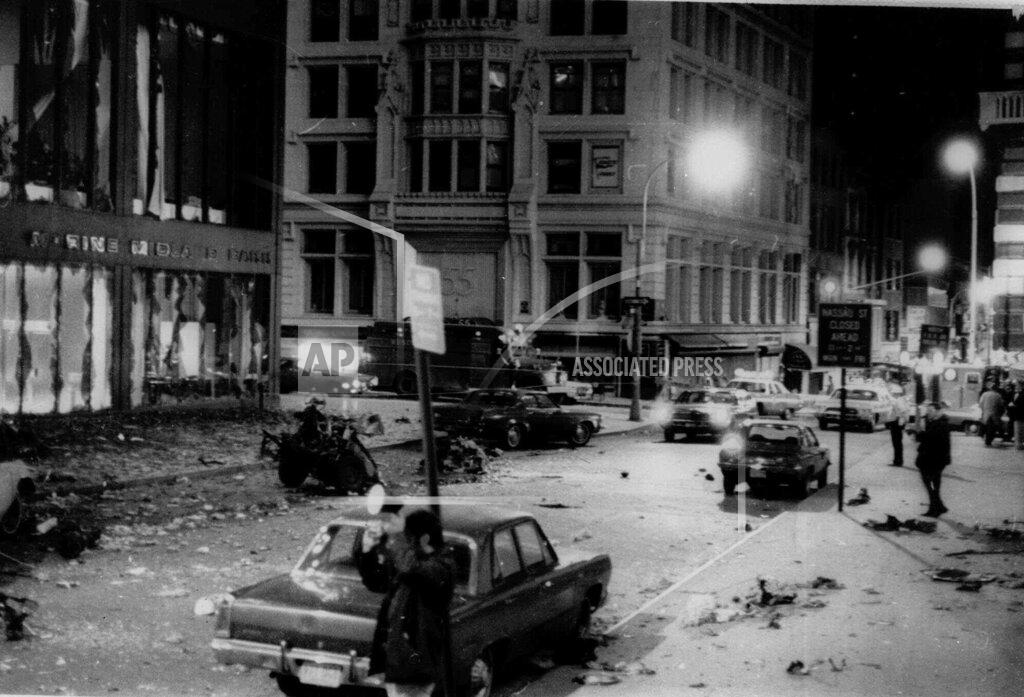
In the early morning hours between 2:55 and 3:35, Puerto Rican separatists of the Fuerzas Armadas de Liberación Nacional Puertorriqueña (FALN) terrorist group set off five bombs in Manhattan, with the largest bomb set off in New York’s Financial District. Despite the damage, there were no injuries. One bomb exploded in an auto in the financial district, two exploded in Rockefeller Center and two exploded on Park Avenue north of the Waldorf-Astoria Hotel. The downtown blast, which occurred in an automobile, blew a two‐foot‐wide hole two feet deep in the street between the Marine Midland Bank and the Chase Manhattan Plaza headquarters of the Chase Manhattan Bank. It scattered debris for a block and a halt. In one of the Rockefeller Center blasts, windows 31 stories high were broken by shock waves.
All the blasts tore out building fronts, smashing windows and glass walls. The Exxon and Banco de Ponce buildings in Rockefeller Center and the Union Carbide and Lever Brothers building on Park Avenue were damaged, as were the Marine Midland Bank and the Federal Reserve Bank of New York buildings downtown. “This is a new name,” said Assistant Chief of Detectives James T. Sullivan, referring to the F.A.L.N. group. “But we feel it is affiliated‐ with Puerto Rican independence groups in the past that are continuing into the present.” The last terrorist organization that said it was involved lin bombings here was a group that called itself M.I.R.A., whose letters stood for revolutionary independence movement. “Mira” means “look” in Spanish.
The Gallup Poll reported voter sentiment still solidly Democratic in the races for the 435 seats in the House of Representatives. In surveys of likely voters among 3,113 adults, 55% of those interviewed said they favored the Democrat in their congressional district, while 35% favored Republicans, 2% favored candidates of other parties and 8% were undecided. The findings indicate a landslide in the making, the Gallup organization reported, with Democratic gains likely to be considerably in excess of the normal off-year gains for a party out of power.
Senator Henry Jackson (D-Washington) predicted Democrats will gain 40 seats in the 435-member House of Representatives and pick up a net of six seats in the Senate in the upcoming election. Campaigning for Democratic candidates, Jackson said President Ford made “a foolish statement” when he declared that a veto-proof Congress of Democrats would be a threat to world peace. As for his own plans for 1976, he said, “Well, I want to be President, period.” He added, “I will decide at the proper time when I will make that ultimate decision, but I’ve not made it yet.”
Secretary Caspar Weinberger of the Health, Education and Welfare Department will offer President Ford a $21.6 billion “cash transfer” plan to replace the nation’s major welfare programs. The plan would terminate such programs as food stamps and Aid to Families with Dependent Children and, in exchange, would give a jobless family of four $3,600 a year.
Henry Ruth became the third special Watergate prosecutor as he was officially sworn in to succeed Leon Jaworski, who resigned to resume private law practice in Texas. In brief remarks after the ceremony in the United States Court of Claims, Mr. Ruth pledged the independence of his office. Attorney General William Saxbe was at the ceremony.
President Ford, in his first interview after 10 weeks in office, talked of “tougher measures” if necessary to reduce American dependence on Arab oil; of wage and price controls in the event of a “very major international crisis,” and of how it feels to be President. “I love it,” he said, “It’s sort of got my adrenalin going again.”
President Ford spent a relaxing fall weekend at his Camp David, Maryland, mountaintop retreat. He went for a swim, this morning in the heated pool, and walked amid the fall foliage of the surrounding woods. Mrs. Ford came along for her first outing since undergoing breast cancer surgery September 28. White House spokesmen said she took the new family dog out for a walk.
College students from middle-income families are beginning to get increased scholarship help because of new policies that in some cases reverse the decade-old theory of basing monetary help on need instead of academic promise. The new move has been hailed by many as a much-needed response to the pressure imposed by inflation on middle-income students.
The Veterans Administration said that former servicemen were “taking a chance” by seeking emergency care at a VA hospital because staff and space shortages had compromised the agency’s ability to offer medical care. The VA asked Congress for an immediate $190 million increase in this year’s budget and a $236 million hike next year so the agency could enlarge its staff. The VA health care budget is $3.2 billion this fiscal year and it maintains 171 hospitals. Dr. John D. Chase, chief VA medical director, said no lives had been endangered by the staff situation but that the quality of care should be improved.
The ousted head of Miami’s Cedars of Lebanon Hospital was convicted on 64 counts involving $862,750 in missing hospital funds. Sanford K. Bronstein, 57, was found guilty of grand larceny, forgery and conspiracy. His defense attorney said the money had been used to bribe public officials for help in getting $62 million in federal loans for the facility. The loans were used for expansion and modernization, but the hospital is now under the supervision of the U.S. Bankruptcy Court.
Three big dairy cooperatives, which had trouble giving away political money earlier this year at the height of public disclosures on the milk fund scandal have donated $90,105 to candidates and political committees since September 1, records indicate. Their reports show that they are giving away funds at a brisker pace than they did earlier this year, when a dozen candidates returned dairy donations and others sent word that they would not accept money if offered. However, donations are still less than half of the total for the same period in 1972, when the co-ops gave $241,425.
A delay in, and ultimate reversal, of a federal judge’s order appointing three special prosecutors to try the case of milk lobbyist Jake Jacobsen in Texas is being sought by the Justice Department. Government attorneys asked the 5th U.S. Circuit Court of Appeals in New Orleans to stay the order issued by U.S. District Judge Robert M. Hill. Hill had denied the government’s request to dismiss charges against Jacobsen in an $825,000 fraud case in exchange for Jacobsen’s testimony against former Treasury Secretary John B. Connally. Connally is accused of accepting a $10,000 bribe from Jacobsen when Jacobsen was a lobbyist for Associated Milk Producers, Inc., a Texas-based dairy cooperative.
Amtrak fare increases averaging 10% will go into effect November 15, the railroad passenger corporation announced. Hardest hit will be routes in the East. The Seattle-Los Angeles fare will not be raised but other West and West Coast rates will be. The Seattle-Portland coach fare will go up $1.50. Other fares will be raised 5% to 20%. The corporation blamed inflation for the increases.
The prototype of the controversial manned B‐1 bomber — like the taxpayers who financed it, a victim of inflation — was rolled out of its assembly hangar here today in traditional pomp and circumstance. Secretary of Defense James R. Schlesinger told a, gathering of Air Force officials, Congressmen, defense contractors and the press that the newest component of the nation’s nuclear triad would have to prove itself technically” in nearly two years of testing before a decision would be made to mass produce the plane. Inflation, rather than cost overruns that stirred widespread criticism of defense projects in the nineteen‐sixties, has produced increasing Congressional sentiment toward cancellation of the project. Total program costs have soared from $9.8‐billion, when the project was let to the Rockwell International Corporation in late 1969, to an estimated minimum of $13‐billion. Develop ment costs so far approach $2‐billion. The swing‐wing, supersonic craft, designed to replace the Strategic Air Command’s 20‐year‐old B‐52 fleet, would supplement the nation’s so‐called Triad nuclear force of landbased Minuteman 3 intercontinental ballistic missiles and the submarine-launched Polaris missiles.
The Cleveland Coliseum opens for the NBA’s Cavaliers and the MISL’s Crunch.
Born:
Marty McLeary, MLB pitcher (San Diego Padres, Pittsburgh Pirates), in Kettering, Ohio.
Lisa [Elizabeth Sakura Narita], Japanese musician (M-Flo), in Tokyo, Japan.
Died:
Bidia Dandaron, 59, Soviet Buddhist author and teacher, died in a Soviet labor camp.
Thomas J. Herbert, 79, American politician, former Governor of Ohio.
Bennett E. Siegelstein, 93, Romanian-born American lawyer and politician.





 History Diaries