Secretary of State Kissinger and the Soviet Communist party leader, Leonid Brezhnev, talked for more than five hours in Moscow about the key problem of placing further curbs on each side’s arsenal of offensive strategic Weapons. In a communique issued at the close of the session, both sides said they regarded the exchange of views as “useful.” Mr. Kissinger is scheduled to leave for New Delhi Sunday on the second leg of his three-week trip to more than a dozen countries. Officials from both sides declined to go into details on today’s discussions, which lasted two hours 45 minutes in the morning and two and one‐half hours tonight. They limited themselves to saying that Mr. Kissinger, Mr. Brezhnev and their aides “gave detailed consideration to matters relaed to possible further measures on the further limittation of strategic arms.”
An American spokesman added that the atmosphere had been “very friendly and very cordial,” in keeping with the tone set in yesterday’s first day of talks, which were devoted primarily to issues other than limiting strategic arms. The noncommittal nature of the joint statement shed little light on whether Mr. Kissinger had made much progress with the “fairly concrete ideas” that reporters were told he had brought with him from Washington on how to accelerate the talks on limiting strategic arms. Mr. Kissinger hopes to get the Russians to accept certain concepts that could be announced by the time President Ford and Mr. Brezhnev hold their first meeting, widely believed here to be all but set for next month somewhere in the Far East.
After eleven, days of arduous negotiation, Premier-designate Amintore Fanfani tonight abandoned his attempt to reconstitute the Italian center‐left coalition. Calling on President Giovanni Leone at the Quirinale Palace, Mr. Fanfani returned his mandate. The President then announced that he would begin talks with political leaders Monday afternoon to determine the next move. The previous coalition of Christian Democrats, Socialists and Social Democrats, with Republicans supporting the Government in Parliament, resigned October 3, following dissension between Socialists and Social Democrats. That disension flared up again today when the Social Democrats secretariat unanimously approved and made public a letter to Senator Fanfani insisting on conditions that had the effect of undoing his efforts to achieve agreement on a basic program.
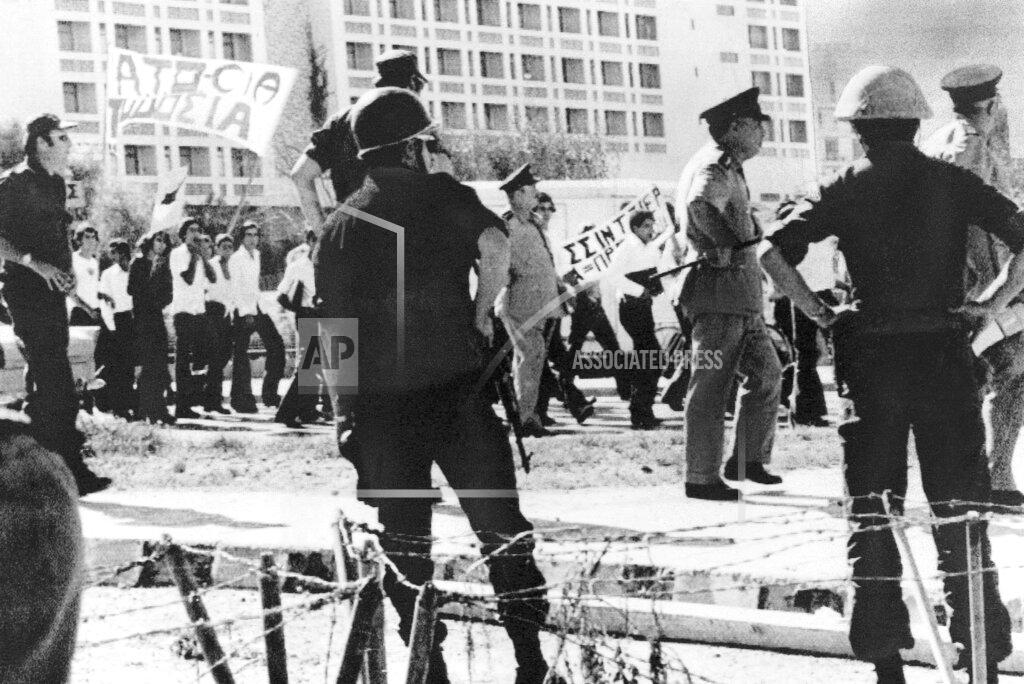
The Government accused Turkey today of breaking the cease‐fire for the second day in succession by advancing to occupy positions south of the east‐coast port of Famagusta. A Government spokesman said Turkish troops advanced 500 yards toward the Greek Cypriot township of Paralimni, sparking an exchange of fire with Greek Cypriot national guardsmen. There were no reports of casualties. The accusation that Turkey violated the cease‐fire yesterday involved an advance of a mile in the same area. Thousands of Greek Cypriotes staged demonstrations today to protest the continuing occupation of nearly half the island by Turkey. Every embassy was picketed.
Medical services in Spain’s public hospitals and clinics returned to normal today after the Government yielded to 4,000 striking doctors and dropped its requirement that they have a “good conduct” certificate. The certificate, delivered by the police, in effect amounted to an attestation of political acceptability. The successful rebellion against it was another sign of the mounting pressure to liberalize political life here. A majority of the internships available in the country are in health establishments run by the social security system, but the number is limited. The fact that the competitive examinations included qualifications that had nothing to do with medical ability had long been resented among medical school graduates.
The growing interest of a petroleum‐famished world in Poland’s coal fields has convinced the Polish miner that he can demand and get the best, even in a somewhat threadbare Communist society. Earlier this month, Poland’s 350,000 miners got a big raise, on the order of the party leader, Edward Gierek. The average miner, who had been earning the equivalent (at the official exchange rate of 33 zlotys to the dollar) of $10 a day, got raises ranging from $1 to $2 a day, depending on tenure. His night differential was raised from 10 percent to 30 percent. By Polish, and even by West European, standards, this is big money, but the controlled press of this country has thus far avoided all mention of the raise for miners.
Israeli officials tightened security at the international airport here today because of reports that Arab guerrillas planned attacks on foreign airliners as Arab leaders gathered in Morocco for a summit conference. Airport sources said that the West German Embassy and the West German airline, Lufthansa, had been warned of planned strikes by the Popular Front for the Liberation of Palestine. The sources did not indicate where the attack was to take place but said it was to be today. The summit conference opens in Rabat tomorrow.
At Rabat, Morocco, foreign ministers of 19 Arab countries voted to support the claim of the Palestine Liberation Organization to control all territories on the West Bank of the Jordan River that might be evacuated by Israel. The ministers also re-affirmed the right of the Palestinians to set up a “national authority in the liberated area” — a state of their own.
King Hussein of Jordan is being guarded by a small army of security men, the telephone number of President Anwar el‐Sadat of Egypt is classified top secret, and not even the Moroccan Information Minister can get into the conference hall without the proper lapel button. Security — rigid and uncompromising — is the dominant theme on the eve of the Arab summit conference here. The Moroccan authorities have gone to extraordinary lengths to prevent any assassination attempts or violence during the three days in which 19 Arab heads of state and scores of Government ministers will confer in this picturesque North African capital. Some 6,000 security men and policemen have been brought in from all over the country to protect the 850 delegates. The atmosphere surrounding the conference is tense and nervous.
Anthropologists in Ethiopia, members of a joint American-French-Ethiopian expedition, reported finding fossilized human remains believed to be more than three million years old that could revolutionize thinking on the origins of man. Preliminary dating indicates the fossils may be as much as 1.5 million years older than those discovered in Kenya by American anthropologist Richard Leakey.
Nearly three years after India’s relations with “the United States were strained by the anger surrounding the India-Pakistan war, U.S. Secretary of State Kissinger is set to arrive in India Sunday for a three‐day visit that is expected to buoy the friendship between the nations. Indian officials say that Mr. Kissinger’s long‐anticipated visit at New Delhi’s invitation, will include meetings with Prime Minister Indira Gandhi and an effort to settle the “misunderstandings” of the past. These focus mostly on Washington’s support of Pakistan before and during the December, 1971 war, which resulted in the creation of Bangladesh, formerly East Pakistan. Informed sources say that Mr. Kissinger and his aides will also discuss further trade and economic links with India, probable food aid for the stricken nation, India’s persistent fear that Washington will sell arms to‐Pakistan and Washington’s uneasiness about nuclear proliferation in Asia and the Middle East in view of India’s surprise nuclear explosition on May 18. American officials fear that India, a poor country, could decide to barter her nuclear material and personnel to a Middle Eastern nation for oil or wheat, thus setting off a dangerous arms race.
The resignation yesterday of one of South Vietnamese President Nguyễn Văn Thiệu’s closest confidants appears to be a tactical victory for Premier Trần Thiện Khiêm, who suggested the move three weeks ago, well‐placed sources said. But as an effort to defuse the mounting Opposition movement against Mr. Thiệu, the resignation of Information Minister Hoàng Đức Nhã appeared to have fallen well short of the mark. Opposition politicians and newspapers insisted that the departure of Mr. Nhã, a cousin of the President’s, would not subdue them. The resignation of Mr. Nhã and three Cabinet ministers was followed today by a Defense Ministry announcement that 377 field‐grade officers had been dismissed from the army on charges of corruption. There were 20 colonels among the dismissed officers, but no generals. The majority were majors.
National daily newspapers and press agencies in South Korea today closed their ranks and pressed the Government of President Park Chung Hee to end press restrictions. All seven national papers published in Seoul and three commercial radio stations today carried and aired statements by their editors and reporters, calling on the Government to stop meddling with their reporting. Such a display of unity by South Korean journalists is unusual, and it sent a wave of surprise over the country today, but Government spokesmen refused to offer any official comments. “I have nothing to say at this moment because I don’t know what the matter is,” the new Information Minister. Lee Won‐Kyong, was quoted as having said.
The Canadian Government announced today that income taxes would go down next year as a result of legislation, passed last year, linking levies to the consumer price index. Finance Minister John N. Turner said that about 225,000 Canadians in the lower brackets would be spared from paying any tax under the system, which is aimed at combating the effect Of inflation on the taxpayer. The purpose of the legislation was to prevent taxpayers from being pushed into higher brackets by increases in income caused purely by inflation, such as raises given to compensate for a higher cost of living.
Six years ago, a new military Peruvian Government marched its troops into the installations of the International Petroleum Company — the Peruvian subsidiary of Exxon — and handed the company a claim of $690‐million in excess profits. While the nationalization of American copper holdings by the ill-fated Marxist government in neighboring Chile is a far more controversial affair, it was the expropriation of the Exxon holdings in Peru that set off a wave of aggressive economic nationalism still in evidence throughout Latin America. The Chilean government of the late Salvador Allende Gossens never managed to regain the confidence of foreign and local investors and slowly sank into an economic morass that paved the way for a right‐wing military coup. But in Peru, the expropriation of the International Petroleum Company has receded into the background, and the military Government has managed to entice a broad range of American, European and Japanese companies into investments of several hundred millions of dollars to develop the vast, uncharted oil reserves in the Amazon basin around the steamy jungle town of Iquitos.
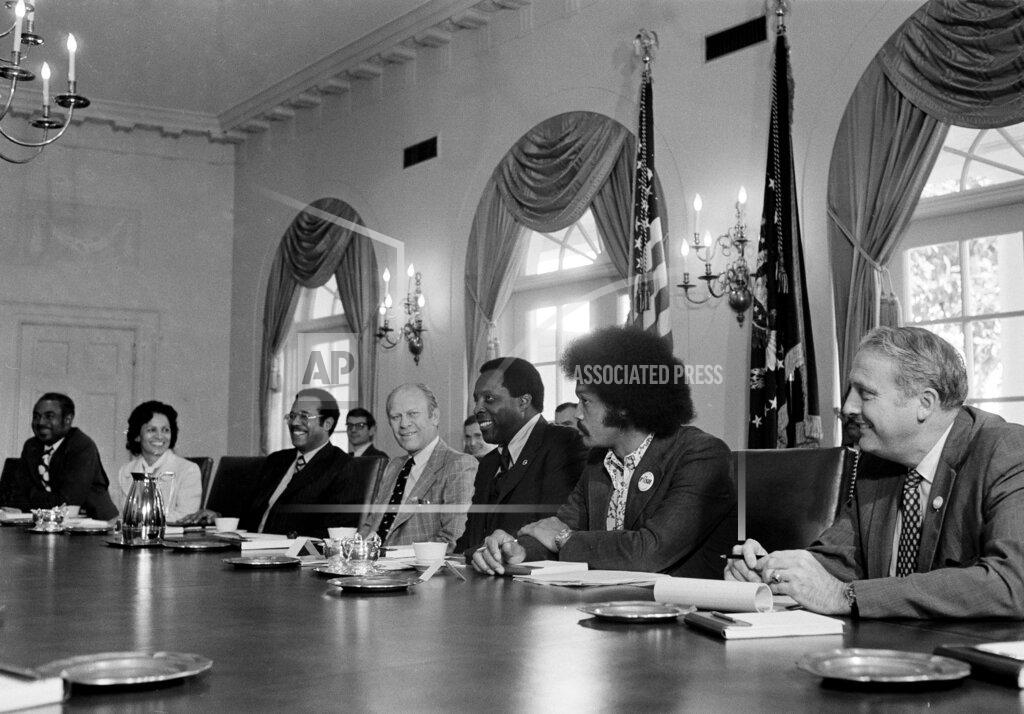
A group of black civil rights leaders told President Ford that his recent public statement on the Boston school violence had the effect of encouraging whites to violate the law. Mr. Ford, in reply, said he understood their concern and promised there would be full enforcement of the civil rights law that makes it a federal crime to interfere with court-ordered school desegregation.
Judge John Sirica thinks the Watergate cover-up trial defense lawyers have done a “pretty good job” at making the prosecution’s chief witness, John Dean, out as a liar. After saying this in the presence of the jury, he appeared to regret it and seemed to be amending his remarks to limit them to the fact that the defense lawyers had brought out Mr. Dean’s admitted participation in the cover-up case.
Leon Jaworski, whose resignation as the special Watergate prosecutor takes effect tomorrow, said today he thought that the American public should hear the Nixon White House tapes, but said obscene language might ketp some of them off radio and television. He also said he “certainly” thought President Nixon had participated in the Watergate cover‐up and he denied that the prosecutor’s office had made any plea bargain with former Commerce Secretary Maurice H. Stans. Mr. Stans was chairman of the Finance Committee to Re‐elect the President, which raised funds for Mr. Nixon’s 1972 campaign. Mr. Jaworski specifically denied that his office had reached an agreement with Mr. Stans for a guilty plea to possible charges of minor campaign law violations. But Mr. Jaworski did not deny that the prosecutor’s office had been talking with Mr. Stans’s attorneys.
The General Motors Corporation has reported that its third quarter profits dropped 94 percent from the same period last year. Net income for G.M. for the quarter fell to $16 million, or 5 cents a share, from 1973’s third quarter net income of $267 million, or 92 cents a share.
The United States Air Force, moving a step forward in the development of a mobile strategic missile, has successfully test-fired an intercontinental ballistic missile after it was dropped from an airplane. The Defense Department has announced that a Minuteman 1, normally launched from an underground silo, was fired after being dropped from a C-5A transport flying high over the Pacific Ocean.
The Department of Housing and Urban Development has improperly increased the interest rates that Congress established in its new housing program, Senator William Proxmire, Democrat of Wisconsin, said today. H.U.D. responded that the additional fees were the same as the ones under other Government mortgage programs and that the effective interest rate was 9.15 percent—still higher than the level Congress established — “not 9½ per cent, as charged by Senator Proxmire.” President Ford signed a law last week providing additional Government‐insured mortgages for homes not covered by Federal Housing Administration and Veterans Administration financing. Such mortgages totaled $19‐billion last year. The law allows the Government National Mortgage Association to spend $3‐million more to back private mortgages. Mr. Proxmire said that Congress had established an 8¼ per cent interest rate for these mortgages but that H.U.D. had raised the rates to 9½ per cent.
The national commander of the American Nazi Party was arrested today when he tried to force his way into a Federal courthouse. A second member of the party was arrested by the Boston police, on a traffic violation. Matt Koehl, head of the Virginia‐based Revolutionary Voice of National Socialism, was arrested by United States marshals and charged with impeding access to a Federal building. The arrests, at the end of Boston’s sixth week of court-ordered busing for school integration, came when the Nazis tried to deliver a letter to Judge W. Arthur Garrity of Federal District Court, who issued the busing order. Three other Nazi party members were arrested yesterday on state charges of attempting to incite a riot as they handed out racist literature in South Boston. The charges were later reduced to disorderly conduct.
Former President Richard M. Nixon experienced “a small amount of bleeding from the gums” and “spent a comfortable night with a minimum of pain” at Memorial Hospital Medical Center here, Mr. Nixon’s doctors said today. Dr. John C. Lungren, Mr. Nixon’s physician, did not elaborate on the kind or location of tin runner President’s pain. Mr. Nixon is receiving injections of heparin, a blood‐thinning drug, under the skin. Such injections can be uncomfortable and are presumed to be the cause of Mr. Nixon’s pain. Bleeding from the gums can be an early sign of toxicity to blood‐thinning drugs. But Dr. Lungren said in a medical bulletin that the bleeding was minor and “is not of sufficient magnitude to” stop Mr. Nixon’s blood‐thinning therapy. Dr. Lungren said he was pushing ahead with another round of heparin anticoagulation treatment in hopes of avoiding an operation. Such surgery would seek to prevent clots in Mr. Nixon’s phlebitisdamaged leg from breaking off and traveling with the swiftly moving blood to a lung. Such a clot, or pulmonary embolus, was detected during, Mr. Nixon’s previous hospitalization, which ended October 4.
James Earl Ray, who had pleaded guilty to the assassination of the Rev. Dr. Martin Luther King Jr., took the witness stand today in federal court to ask for a new trial. The early hours of his testimony did not provide senseas one of his sawyers had predicted. Instead, Mr. Ray was led through the circumstances surrounding a maze of publishing contracts. The court adjourned late this afternoon until next Tuesday while Mr. Ray was still recounting how he had not been consuited about contracts for books and magazine articles that his lawyers had arranged. Only once in his testimony today did Mr. Ray come close to alluding to the circumstances around the assassination that plunged the nation into a week of rioting.
The Federal Bureau of Investigation today charged a suspended guard of the Armored Express Corporation with burglary, larceny and the use of explosive devices in the looting of $4‐million from the company’s vault. Richard Held, special agent in charge of the Chicago FBI office, said that Ralph Marrera, 31 years old, a guard who had been questioned frequently since the looting last weekend was charged in a complaint before a United States magistrate. The FBI said that Mr. Marrera was being sought.
Wade Burger, the 39-year-old son of Chief Justice Warren E. Burger, received his $26,671-a-year job in the General Services Administration in violation of merit system requirements, and he should be removed from it, a House Civil Service subcommittee has concluded.
Certain species of fish are disappearing from the oceans of the world — the haddock off New England and Canada’s Atlantic coast, the sardines off California and the herring from the Atlantic and North Sea coasts of Europe — indicating that over-fishing is threatening the abundance of food from the sea. In various ways, at a time when world food needs are sharply increasing, mankind is putting unprecedented strain on the resources of the seas and showing them to be finite.
The northeastern U.S. railway network Conrail was incorporated in Pennsylvania, officially as the Consolidated Rail Corporation, to take over the operations of Penn Central Transportation Company, Erie Lackawanna Railway, Ann Arbor Railway, Lehigh Valley Railroad, Reading Company, Central Railroad of New Jersey, Lehigh and Hudson River Railway and Pennsylvania-Reading Seashore Lines. The U.S. government owned 85% of the company and its employees owned the other 15%.
A team of six mountaineers became the first persons to climb the 20,512 ft (6,252 m) high mountain Swargarohini I West.
Over 6,000 people attended the opening of the Sarah Mellon Scaife Gallery at the Museum of Art, Carnegie Institute, in Pittsburgh.
Dmitri Shostakovich’ 15th String Quartet premieres in Leningrad, USSR.
The pop band Wings release the single, “Junior’s Farm.”
Dow Jones Industrial Average: 636.19 (-0.07, -0.01%).
Born:
Frank Middleton, NFL guard (Tampa Bay Buccaneers, Oakland Raiders), in Beaumont, Texas.
James Hill, NFL tight end (Seattle Seahawks), in Dallas, Texas.
Shonn Bell, NFL tight end (San Francisco 49ers), in Waynesboro, Virginia.
Nathan Parks, NFL tackle (Oakland Raiders), in Chico, California.
Joe Nelson, MLB pitcher (Atlanta Braves, Boston Red Sox, Kansas City Royals, Florida Marlins, Tampa Bay Rays), in Alameda, California.
Chris Murray, Canadian NHL right wing (Montreal Canadiens, Hartford Whalers, Carolina Hurricanes, Ottawa Senators, Chicago Blackhawks, Dallas Stars), in Port Hardy, British Columbia, Canada.
Katja Endemann, German jazz saxophonist, flutist and composer, in Munich, West Germany.
Lee Byung-Kyu, South Korean baseball player, in Gimje, North Jeolla Province, South Korea.
Died:
Harriot Curtis, 93, American amateur golfer and skier and civil rights activist.
Leon Kroll, 89, American painter, muralist and lithographer, referred to as “the dean of U.S. nude painters”
Rodney Young, 67, American Near Eastern archaeologist known for his excavation of the city of Gordium, capital of the ancient Phrygians and associated with the legendary King Midas.



 History Diaries