Joachim von Ribbentrop made a speech in Danzig blaming Britain for the war and indicating that fighting would begin on a large scale now that Chamberlain had “refused the hand of the Führer stretched out in a peace gesture.” London swiftly provided an official reply saying the speech “introduces no new element into the situation nor is it considered as having any particular importance.”
London almost immediately dismisses the speech, saying that it “introduces no new element into the situation nor is it considered as having any particular importance.”
German RSHA organization noted that generally no prisoners would be released from “protective custody” during the war.
Germany’s future soldiers, Hitler Youth members from 16 to 18 years old, are calied up for six months’ semi-military training, it was announced today.
Nazis requires Jews to wear the Star of David.
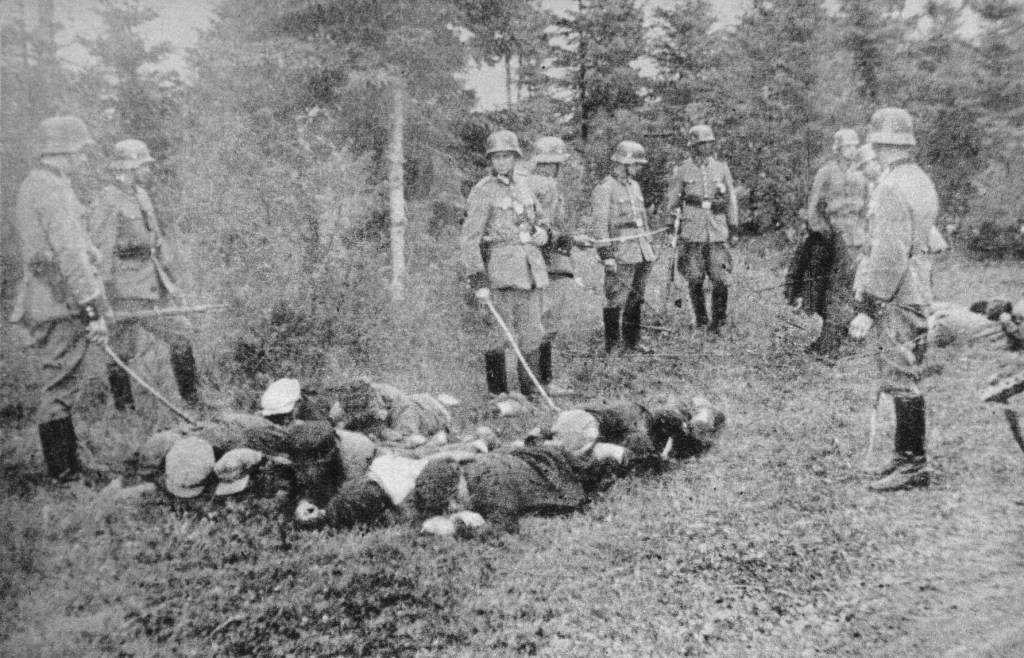
The Rudzki Most massacre begins in Poland. On October 24, 27 and 30, and on November 2, 6 and 10, 1939, at the beginning of the German occupation of Poland, Germans carried out mass shootings of local Poles, mainly of the intelligentsia as part of the larger Intelligenzaktion Pommern, in the surrounding forests. In Tuchola County German authorities had tried to find a convenient pretext to execute the arrested members of the Polish intelligentsia. On the night of 21 October 1939 a barn which belonged to Hugo Fritz – a local ethnic German – was burned to the ground in Piastoszyn village. In the same night shocked Fritz died of a heart attack. It was commonly known that drunken Fritz left a lit cigar in the building. However Nazi authorities accused the local Poles of setting fire to the barn and the “murder” of Fritz.
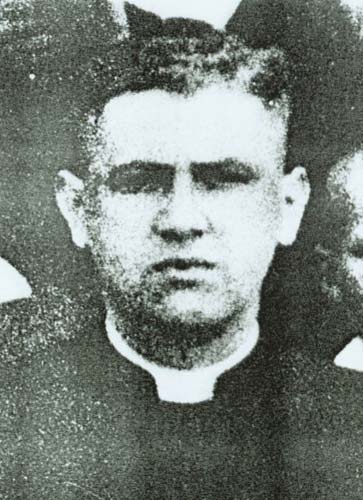
On 24 October 1939 the first group of 45 hostages – among them Nogalski – was taken to the place of execution in the forest near Rudzki Most. The massacre was to be carried out by members of the so-called Volksdeutscher Selbstschutz, a paramilitary organization of ethnic Germans who were previously Polish citizens. Before the execution, local Selbstschutz leader, Kurt Gehrt, made a speech to the Polish hostages. He claimed that “Poles murdered Hugo Fritz, the best German man in the area” and then promised that the hostages would be released if the arsonist identified himself. Hearing this, Nogalski stepped forward and said that he was the one who set fire to the barn. Confused and angry, Gehrt said to his comrades: “This bloody priest is looking for an excuse to save the others. We must hang him!”. However, they did not find a suitable tree so they violently beat the priest and then shot him. Nogalski’s sacrifice did not stop the massacre. Between 24 October and 10 November 1939 about 335 Poles were executed in Rudzki Most. Nogalski has been accorded the title of Servant of God. He is currently one of the 122 Polish martyrs of the Second World War who are included in the beatification process initiated in 1994, whose first beatification session was held in Warsaw on 17 September 2003.
Japanese Ambassador Oshima meets with Hitler in Berlin.
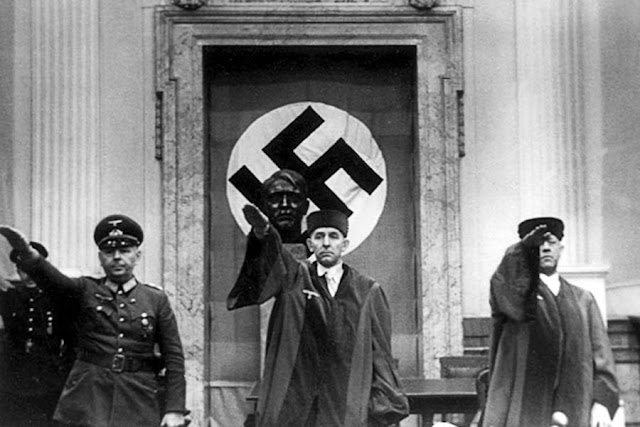
Nazi State Secretary Roland Freisler of the Reich Ministry of Justice discusses “special courts,” or Sondergerichte. He characterizes them as the “tank corps of penal law” which will be used to eliminate those who “stab the dagger in the people’s back.” In practice, they will constitute show trials, with Freisler shouting at defendants and berating them in open court. The defendants invariably are polite and respectful as Freisler hectors them and sentences them to concentration camps or death (sometimes the same thing). The trials are popular, and in a macabre way constitute the first use of courts as entertainment.
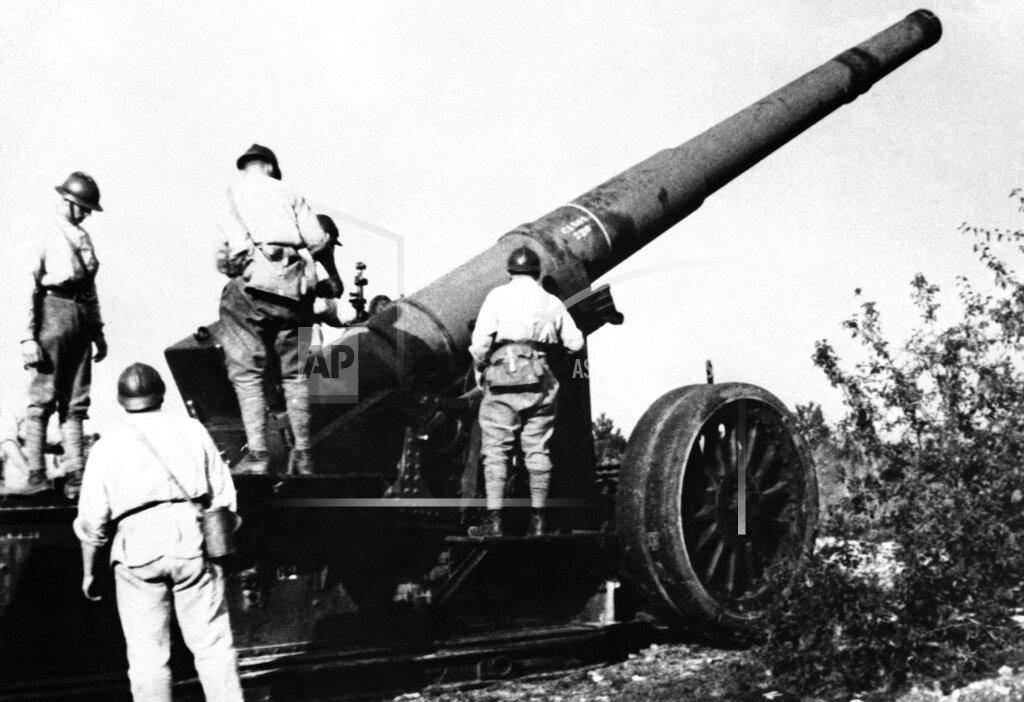
A fairly sharp small engagement takes place towards the southeastern border of the Forest of Warndt on the Western Front, where a German attack on a French outpost is driven back. The Germans mount a minor attack on a French outpost in the Forest of Warndt in the Saar region. There are scattered raids all along the Front, but no concerted troop movements.
The French expect new tactics. A stalemate on the western front is believed likely to force new German action. There is a general feeling that a turning point of the war has been reached though no one is venturesome enough to predict how it will turn.
Soviet authorities intern U.S. freighter City of Flint’s German prize crew from armored ship Deutschland at Murmansk. The American crew of the City of Flint were detained by Russian authorities and prevented from communicating with the U.S. embassy in Moscow. The Soviets are still confused about what to do with the City of Flint and its crew. Today, they send the crew, which the day before were going to return to their ship, into informal custody. The Americans are not allowed to contact the US embassy in Moscow but technically are not under arrest because of a highly technical reading of the international law of ship seizures. Nobody knows what the next step will be. There are conflicting reports, in fact, as to who exactly is being interned.
A Soviet-German trade agreement is signed. The USSR agrees to supply 1 million tonnes of grain and fodder to Germany. Meanwhile, the Finnish delegation leaves to consult with their government on new proposals put forward by the Soviet government, concerning boundary revisions.
The Finnish delegation once again returns to Helsinki to review border proposals made by the USSR.
Rapid Sovietizing occurs in Poland; living standards are lowered, which is caused to a great extent by the mass shipment into the interior of the Soviet Union of goods of all sorts. These are the main features of life in the Russian-occupied areas of Poland, according to a Polish university professor who left Vilna recently and arrived in Paris today.
The Polish Consul-General announces that Poles in Britain will be mobilized for service in the Polish Army in France.
The Polish gold reserves arrive in Paris, having traveled via Rumania and Syria. The value of the gold is estimated at over £15,000,000.
The authorities in Constanta, Rumania have arrested three German citizens on a charge of espionage. The Germans have been under the observation of the Rumanian police for a long time. One claimed to be a journalist and two asserted they were commercial travelers.
The Danzig speech of Joachim von Ribbentrop, German Foreign Minister, today, like Chancellor Hitler’s recent speech before the Reichstag, has convinced Italians that there is no hope of stopping the war and that they should increase their efforts to keep out of it.
Britain’s Queen Elizabeth today visited mass-production clothing factories turning out battle and dress greatcoats and other military clothing on an unprecedented scale.
British authorities at Kirkwall remove 468 bags of U.S. mail destined for Gothenborg, Sweden and 18 for Helsinki, Finland, from Finnish freighter Astrid Thorden.
U-37 (Korvettenkapitän Werner Hartmann) has a big day. It sinks the British freighters Ledbury (3,528 tons), Menin Ridge (2,474 tons) and Tafna (4,413 tons). The successes are all against independents and about 90 miles west of Gibraltar.
The unescorted British steam merchant Ledbury was sunk by gunfire by the U-37, commanded by Korvettenkapitän Werner Hartmann, approximately 100 miles west of Gibraltar in the eastern Atlantic Ocean at 36°01’N, 07°22’W. Of the ship’s complement, all 31 survived and were picked up by the American motor merchant Crown City. The 3,528-ton Ledbury was carrying bauxite and was bound for Burntisland, Scotland.
The unescorted British steam merchant Menin Ridge was torpedoed and sunk by the U-37 approximately 90 miles west of Gibraltar. Of the ship’s complement, 20 died and 5 survivors were picked up by the American motor merchant Crown City. The 2,474-ton Menin Ridge was carrying iron ore and was bound for Port Talbot, Wales.
The British steam merchant Tafna was torpedoed and sunk by the U-37 approximately 85 miles west of Gibraltar. Of the ship’s complement, 2 died and 31 survivors were picked up by the destroyer HMS Keppel. The 4,413-ton Tafna was carrying iron ore and was bound for London, England.
The Greek steam merchant Konstantinos Hadjipateras struck a mine and sank near Inner Dowsing Light vessel off the eastern coast of England in the North Sea. Of the ship’s complement, 4 died and the survivors were picked up by the Gorleston lifeboat Louise Stephens. The 5,962-ton Konstantinos Hadjipateras was carrying scrap iron and was bound for Tyne, England.
U.S. freighter Iberville, detained by the British since 13 October, is released after cargo due to be discharged at Antwerp and Rotterdam, Holland, is seized as contraband.
U.S. freighter Wacosta is detained by British authorities.
Convoy HXF.6 departs from Halifax for Liverpool.
The War at Sea, Monday, 23 October 1939 (naval-history.net)
Aircraft carrier FURIOUS and battlecruiser REPULSE with destroyers BEDOUIN, PUNJABI, FORESTER, FIREDRAKE left Loch Ewe for the Clyde, arriving on the 25th.
Anti-aircraft cruiser CURLEW and destroyers FURY, FOXHOUND, FEARLESS and MASHONA departed Loch Ewe for Scapa Flow. The destroyers were assigned for convoy escort.
Light cruiser SHEFFIELD departed Loch Ewe for Northern Patrol and arrived back on the 26th.
Light cruiser AURORA sailed from Loch Ewe and destroyers SOMALI, ASHANTI, TARTAR and FAME from Scapa Flow to escort an iron ore convoy from Narvik.
Light cruiser EDINBURGH departed Rosyth to rendezvous with Commodore D in light cruiser AURORA 20 miles north of Muckle Flugga.
Anti-aircraft cruiser CAIRO departed Grimsby on escort duties, and arrived back on the 25th.
Destroyer GALLANT attacked a submarine contact 90° off the Lizard, and was joined in the search by destroyers KANDAHAR, ACASTA, ARDENT, which made an attack 20 miles south of Portland. At 0828/23rd, ACASTA was missed by a torpedo in 49-48N, 5-22W, and on the 24th, she and ARDENT were searching for a reported submarine in 49-30N, 4-45W.
Convoy OA.24G departed Southend escorted by destroyers ESCORT and ELECTRA, while OB.24G departed Liverpool escorted by destroyers VANOC and WARWICK. They merged on the 26th as OG.4.
Convoy SA.14 of two steamers left Southampton, escorted by destroyers VANSITTART and VENOMOUS, and arrived at Brest on the 24th.
A Roc fighter of 803 Squadron from aircraft carrier FURIOUS, but based ashore and flying from Hatston, failed to return from patrol off Wick. Petty Officer L R Tregillis and Naval Airman R E Eason were lost.
Convoy SL.6 departed Freetown escorted by destroyers HYPERION and HUNTER, which left the convoy at 0400/26th to take twelve ships into Dakar where they arrived at 0700/27th. Before then, on the 26th, French light cruiser DUGUAY TROUIN left Dakar to join SL.6 on the 27th, not arriving back until 2 November, while destroyer GRIFFIN left Gibraltar on the 30th and joined on 8 November in Home Waters, escorting the convoy to the UK. In the Western Approaches, the convoy split into SL.6, escorted by destroyers ELECTRA and ESCORT, and SL.6B, escorted by WALPOLE and VANOC, the latter transferring to SL.6 on 8 November. Dispersed ships of the main convoy arrived at Liverpool starting on the 10th.
German steamer CURITYBA (4969grt) sighted Norwegian destroyer DRAUG off Bergen where she arrived on the 24th. Setting out again, she arrived via Drogden, at Hamburg on the 30th.
Heavy cruiser BERWICK departed Bermuda, and arrived back on the 26th for docking where she underwent repairs until 3 November.
Heavy cruiser SHROPSHIRE departed Capetown on escort duty, and arrived back on the 24th.
U-37 conducted a reconnaissance of the Straits of Gibraltar during the night of the 23rd/24th.
In Washington today, President Roosevelt proposed $50,000,000 aid to drought and flood sufferers in various sections of the nation, endorsed the State compact method for oil production control and indicated a view that a better spirit of cooperation had been exhibited between government and private power agencies.
The Senate, under the spur of Vice President Garner, moved nearer a vote on the Neutrality Bill. Perfecting amendments were adopted easily and administration forces beat down attempts to put Congress members on the Munitions Control Board. The Senate recessed at 5:29 PM until 11 o’clock tomorrow.
The House heard Representative Hendricks oppose any mediation of the European war by President Roosevelt. The Dies Committee decided to make public names of government workers who are members of the American League for Peace and Democracy, which, according to some members of the committee, is a Communist “front” organization. The House adjourned at 12:55 PM until noon tomorrow.
Pushing ahead under complete control of the Administration and the whip and spur of Vice President Garner, the Senate brought the Pittman neutrality resolution so near the finish line today that leaders predicted a final vote tomorrow, or Thursday at the latest. Caught up in a burst of speed after agreeing unanimously at noon to a limitation on further debate, the Senate adopted without roll-call every amendment offered by Administration spokesmen to perfect the measure, and bent down one after another, and by decisive majorities, changes not wanted by the White House and State Department. By 5:30 PM, practically every important issue had been settled except repeal of the arms embargo, which is expected to come to a vote tomorrow on a motion from the “Isolation bloc” to strike out the repealer. Administration spokesmen contended that they had a majority of more than two-to-one to withstand this attack. They were encouraged, moreover, by reports of increasing repeal sentiment in the House, so much so that they set a new goal — final action on neutrality legislation and adjournment of Congress by November 4.
On few occasions in recent years has the Senate moved so fast as it moved today in acting upon amendments to the “cash-and-carry” sections of the proposed Neutrality Act. Action on major proposals included:
- An amendment by Senators Pittman and Connally to strike out provisions authorizing the President to grant up to ninety-day short credits to belligerents was accepted.
- A revision was approved as offered by the Senators Pittman and Connally to allow American merchant ships to transfer passengers and goods, except arms and munitions, to belligerent ports in the Pacific Ocean and tributary waters, and the Atlantic from Bermuda south in the Western Hemisphere.
- A further relaxation of the shipping ban was approved to permit American ships to enter Bermudian ports and points in New Brunswick and Nova Scotia reached through the Gulf of Maine and the Bay of Fundy.
- Amendments by Senators Connalby and White were accepted to include belligerent ports on the Tasmanian Sea and the Port of Cape Town, South Africa, as among those which American ships might serve.
- A relaxation of the “title-and-carry” provisions as proposed by Senator Brown of Michigan was approved to the extent that title to goods shipped to Canada would not have to be transferred before consignments left this country.
- A further relaxation of the “title-and-carry” requirements was accepted, as offered by Senator Connally of Texas, to provide that title to goods shipped in American bottoms to permissible belligerent ports in the Western Hemisphere, South Atlantic, Pacific and tributary waters would not be required to be transferred before they left these shores.
- An amendment by Senators Pittman, Connally, George and Gillette was voted. It prohibits the extension of credits by American nationals to private citizens or companies in belligerent States for the purchase of arms and munitions such as described in the President’s proclamation of last August.
- The Senate rejected an amendment by Senator Taft of Ohio declaring all waters within 300 miles of the Continent of Europe, Great Britain and Ireland, as combat areas where American ships might not travel.
- A proposal of Senator Danaher, which would prevent the licensing for export of any American-built airplanes until a minimum of 3,000 had been produced for the United States Army and Navy, was voted down.
- An amendment by Senator Clark of Missouri which would provide for a member each from the Senate and House on the Munitions Control Board was rejected.
The House committee investigating un-American activities voted in executive session late today to make public tomorrow the Washington membership list of the American League for Peace and Democracy. Decision to publish the list, which was reported to contain the names of 500 to 800 government employees, was announced at the end of two days of testimony which seemingly convinced Representative Dies, chairman of the committee, that the league was a “front” for the Communist party. Mr. Dies promised a statement amplifying his reasons for labeling the league as a Communist front.
Earlier in the day he had read from several league documents, in the course of examination of two former officials of the league. These, he said, made it appear to him “a systematic effort to penetrate the government by an organization under the Communists.” When Representative Mason of Illinois attempted in the public hearing to put the membership list in the record he was blocked temporarily by Representative Voorhis of California, who asked that the matter be reserved for private discussion.
Mr. Mason, one of two Republican members of the committee, said in the open session: “I see no reason why we should protect them. We have been showing how the Communists run this organization for more than a year, but they stay in it.” Mr. Voorhis agreed that there was sufficient evidence to show at least partial control of the league. by Communists, but protested that it did not necessarily follow that the whole membership was “cognizant of it.”
In reply to this argument Chairman Dies called publicly for the resignation of all non-Communists from the league, while protesting at the same time the formation of “pressure organizations,” designed to exert influence on the government, composed largely of government employees. The chairman put in record a circular issued by the executive board of the league’s Washington branch which lauded the Nazi-Soviet pact as an instrument of peace. He recalled, as he did so, that Dr. Harry F. Ward, national chairman, had testified yesterday that the league. took no stand on the pact.
Elliot Roosevelt says the Dies Committee deserves lasting gratitude.
Speakers at the ninth annual New York Herald Tribune Forum on Current Problems who had vigorously warned of Communist-NaziFascist “termites” boring from within yesterday heard Mrs. Franklin D. Roosevelt explain that she was “not afraid of meeting and talking with a Communist” if she could talk of democracy.
Herbert Hoover, writing in this week’s issue of The Saturday Evening Post, says the “voice of experience” warns that, whether or not we take part in the present European war, “we face a further quarter of a century of difficulty ” and if we do partcipate “we can expect another quarter of a century of impoverishment.”
Nylon stockings go on sale for the first time, in Wilmington, Delaware. Stores report being sold out of their stock within hours. It is perhaps the biggest fashion moment of the decade.
While one of the two main demands upon the Chrysler Corporation by the CIO-United Automobile Workers Union was agreed upon today at a secret ali-day conference, arranged by James F. Dewey, conciliator of the Federal Department of Labor, the union announced that strikes in three additional Detroit plants and one in Muncie, Indiana, owned by the Borg-Warner Company, manufacturers of automotive parts, had been authorized. These strikes will become effective tomorrow, R. J. Thomas, international union president, stated. They will affect 1,700 workers in Detroit and 3,800 in Muncie.
U.S. Teachers are asked to retire at age 65.
A female pilot, Laura Ingalls, is found guilty of flying over prohibited areas in the capital, dropping anti-war leaflets. A reprimand is recommended.
Army enlistment reaches a seven-year high under the President’s recruitment program.
The president of the U.S. Olympic Committee says that if the 1940 Olympics cannot be held in Finland because of the European crisis, they will not be held at all.
The Carnegie Science Center was established in Pittsburgh.
Benny Goodman records “Let’s Dance.”
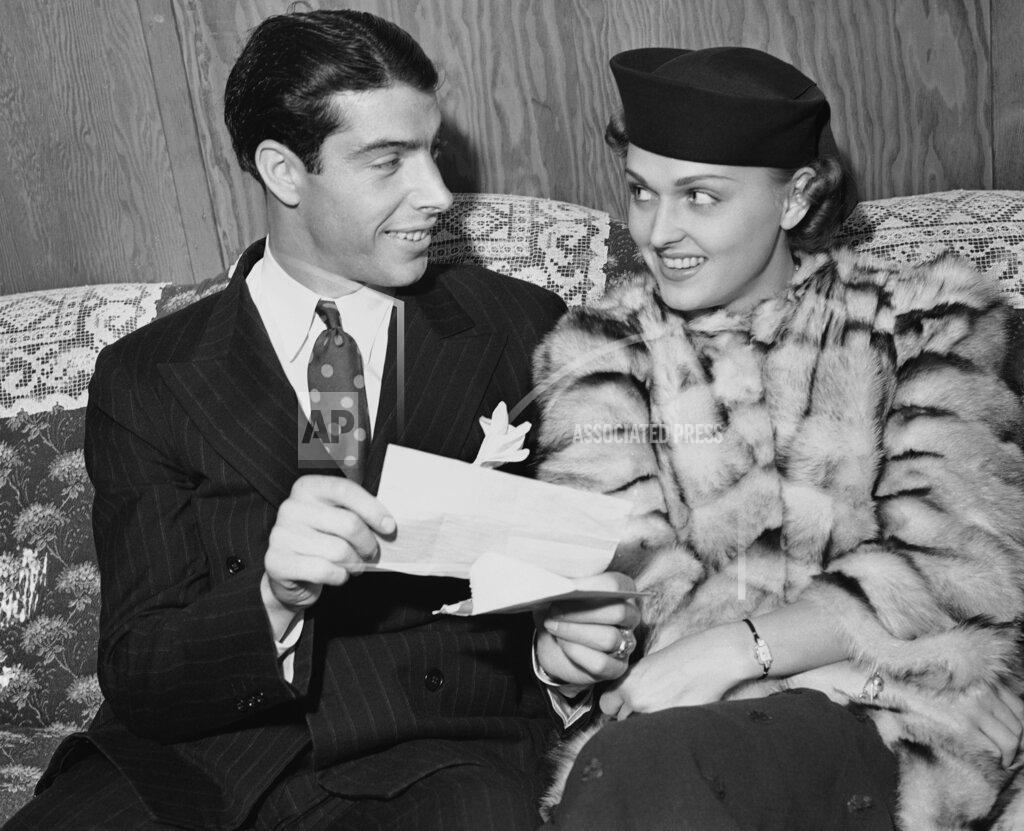
Despite missing 32 games, the American League MVP is Joe DiMaggio, who fnished with a batting average of .381. Jimmie Foxx is the runner-up in the BBWAA poll. DiMaggio has 280 points, while Foxx draws 170.
Domei, official Japanese news agency, in a dispatch from Shanghai, said today that arms and munitions had been flowing into Szechwan Province in large quantities since early this month from Sinkiang, Chinese Turkestan, in Russian truck trains. No fewer than 300 motor trucks have been arriving nightly at Chengtu, east of Chungking, the report said. On their return trips to Sinkiang Province, according to Domei, the Soviet trucks carry loads of silver bullion, silk, wood oil, skins and hides. The total number of vehicles plying between Szechwan Province and outlying Russian trading posts, the dispatch added, was estimated at about 10,000, and the personnel of the Soviet trading agency at Chungking has recently been raised to more than 300. General Volkov, chief of the Soviet military mission in Chungking, is in almost daily conference with Chinese Generalissimo Chiang Kai-shek, the report said, and Soviet officers and men now stationed at Chungking are estimated at more than 1,000.
Americans arriving from the interior of China reported today that anti-Christian campaigns were becoming increasingly menacing both in sections dominated by the Japanese Army and others controlled by Chinese Communists. American missionaries were said to be among those affected. The informants said the purpose of the campaigns apparently was the same, to drive Christians of all foreign nationalities out of China. Japanese authorities at Sinsiang, in Northern Honan Province, were reported to have confiscated ground belonging to the American Catholic Mission Society of the Divine Word and to have begun construction of their own building. The Japanese were said to have promised to compensate the society, but the date of payment was not specified.
Missionaries in Chinese Communist-dominated Shansi have been isolated in small communities and allowed only subsistence rations, said one missionary leader reaching here. “If the present situation continues (throughout China) all foreign educational, medical and evangelical institutions will be ousted within five years,” he said. Some improvement in conditions was reported at Kaifeng, where Americans had prepared to depart in August, but the Japanese anti-American pressure was said to have been relaxed when the foreigners’ plans became known. Kaifeng is Japanese-occupied.
Sharp criticism of French policy regarding the trans-shipment of war supplies for China through Indo-China was voiced by General Chunghsi, deputy chief of staff of the Chinese Army and commander of the Chinese forces in the war areas. south of the Yangtze, in an interview with foreign correspondents visiting the Hunan war front here today.
The Japanese cargo ship Izan Maru was driven ashore at Okha, Soviet Union. She was refloated on 24 January 1941 and towed in to Iloilo, Philippines. She was declared a constructive total loss.
A plebiscite was held on an amendment to the Philippine Constitution that set up export tariffs for goods like sugar.
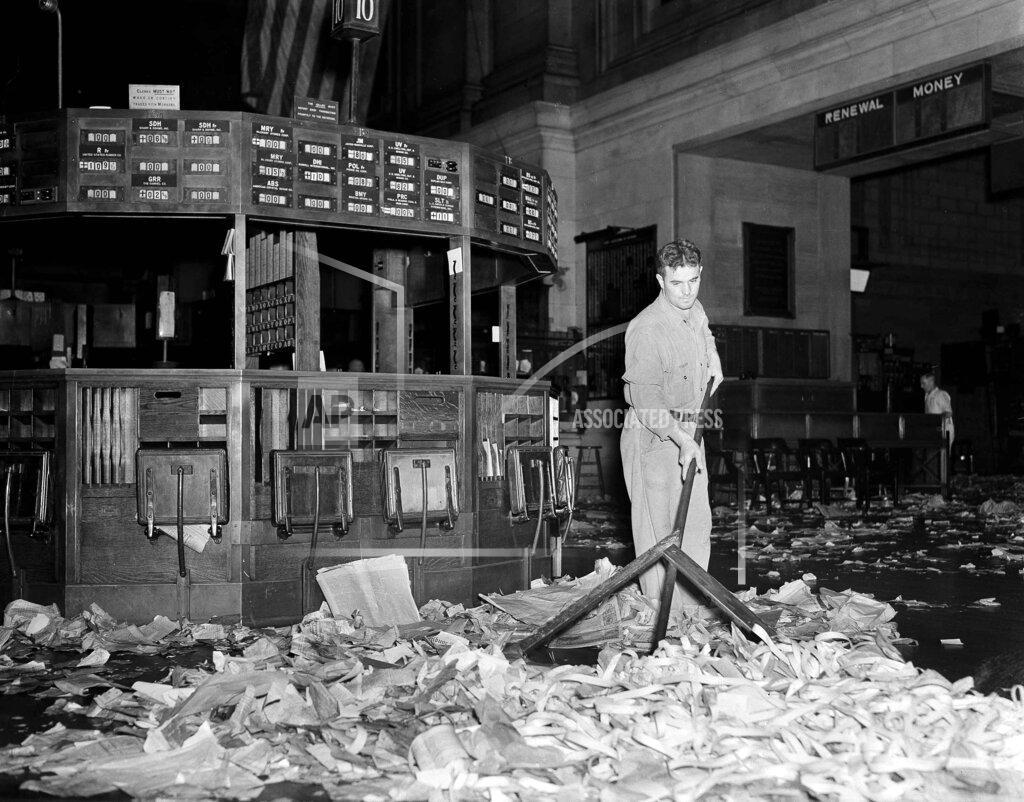
Dow Jones Industrial Average: 154.07 (+0.36)
Born:
F. Murray Abraham, American actor (Academy Award, Best Actor, Antonio Salieri – “Amadeus”), in Pittsburgh, Pennsylvania.
Jim Evans, AFL wide receiver (New York Jets), in Big Spring, Texas.
Naval Construction:
The Kriegsmarine (German Navy) Type VIIC U-boats U-563, U-564, U-565, U-566, U-567, U-568, U-569, U-570, U-571, U-572, U-573, and U-574 are ordered from Blohm & Voss, Hamburg (werk 539-550).
The Royal Navy Dance-class ASW trawlers HMS Fandango (T 107) and HMS Foxtrot (T 109) are laid down by Cochrane & Sons shipbuilders Ltd. (Selby, U.K.); completed by Amos & Smith.
The Royal Navy armed boarding vessel HMS Fiona is commissioned. Her first commanding officer is Lieutenant (emergency) Arthur Arnold Stanley Wartnaby, RN.
 History Diaries