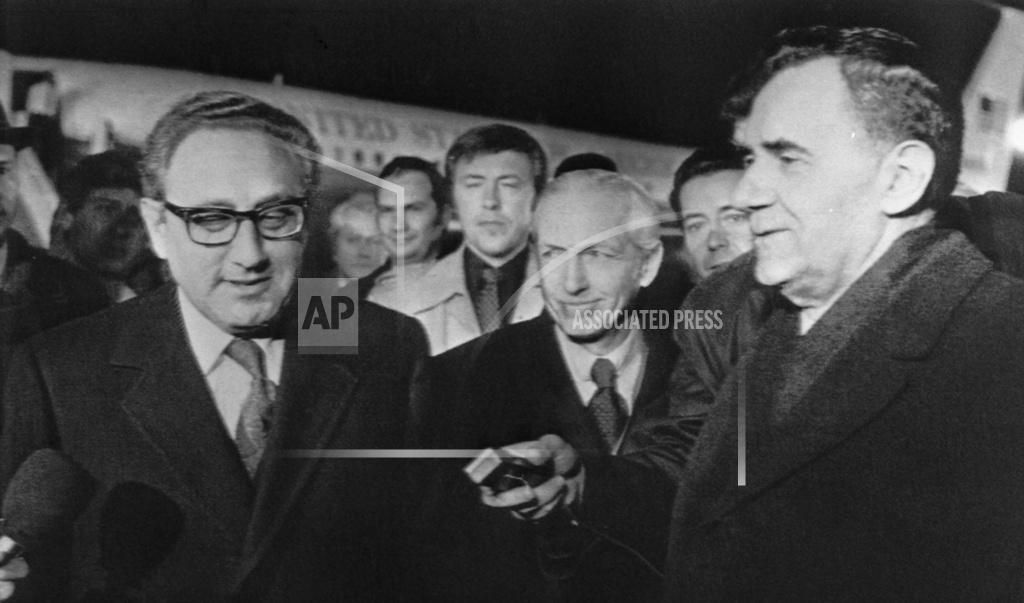
Secretary of State Kissinger arrived in Moscow with “fairly concrete” ideas on strategic arms limitation to explore in three days of talks with Soviet leaders. Accelerated progress would prepare the way for a meeting between President Ford and Leonid Brezhnev, possibly next month. Other subjects on the agenda include detente and Middle East issues. Mr. Kissinger, who was greeted by Foreign Minister Andrei A. Gromyko at Vnukovo Airport, plans to explore the ideas with Mr. Brezhnev, the party leader, during the next three days. Upon arrival, after, a 12‐hour flight from Washington, including a one‐hour refueling stop at Copenhagen, Mr. Kissinger was whisked to a guest house in the Lenin Hills section, where he usually stays.
On the first leg of a three‐week trip to more than a dozen countries in Europe, South Asia and the Middle East, Mr. Kissinger said at the airport that he expected the Soviet talks to be “very full, very friendly, and very constructive.” He was scheduled to meet with Mr. Brezhnev tomorrow morning. Mr. Kissinger’s visit coincides with the arrival tomorrow of President Zulfikar All Bhutto of Pakistan. Hanging over Mr. Kissinger’s first trip to Moscow under the new Administration is uncertainty in the areas of arms control and other problems. The two sides have affirmed their commitment to pursue détente, but the Kremlin has raised questions about President Ford’s ability or desire to improve relations.
The Greek government arrested and exiled George Papadopoulos and four other leaders of the military coup against the democratic regime in 1967. Georgios Papadopoulos, the former President of Greece, and 4 other leaders of the 1967 Greek coup d’état — Stylianos Pattakos, Nikolaos Makarezos, Ioannis Ladas and Michael Roufogalis — were arrested and sent into exile on the island of Kea in the Aegean Sea. It accused them of “conspiratorial activities.” With the first elections set for November 17, opponents of Premier Konstantine Karamanlis had been criticizing him for indecisive action against the former military dictators.
The British army announced it captured a two-truck arms convoy rumbling through Belfast in a move described as a major blow to the Irish Republican Army. The war material found in the back of the trucks after they were stopped in the Springfield Road area included 3 mortars, 28 mortar rounds, three submachine guns, 3,500 cartridges, 18 primed incendiary bombs and a sizable amount of explosives. “It represents one of the biggest coups we have had so far against the IRA,” a British officer said.
An IRA time bomb exploded shortly before midnight in the basement of the caretaker’s house at Harrow School in England. It was the second explosion in the London area in 24 hours. There were no injuries. It damaged the basement and wakened 700 boys from 11 to 18 years of age who live at the 400‐year‐old institution. Past pupils included Lord Byron, the poet, and the British wartime leader, Sir Winston Churchill. An anonymous caller telephoned the Press Association, the British domestic news service, 10 minutes before the blast to warn that a bomb had been planted at the school. The explosion was the latest of more than 160 reported in British cities in the last two years. The bombings generally are regarded as an extension to Britain of the Irish Republican Army’s campaign to drive the British from Northern Ireland.
Britain’s Labor government is drawing closer to the Common Market and, despite threats of withdrawal, is expected to advocate a national vote to stay within the community. The agreement on sugar negotiated Tuesday in Luxembourg will be particularly helpful in persuading the British that the market has its good points.
A 74‐year‐oid wartime opponent of Yugoslavia’s President Tito and the Communist Partisans was sentenced by a Belgrade court today to five years in prison on charges that he wrote anti‐Tito articles for foreign publications five years ago. The sentence imposed on the ailing defendant, Djura Djurovic, was the latest in a series by Yugoslav courts against persons holding widely divergent political views but with a generally common position of opposition to the 82‐year‐old President and the system he heads. During World War II, Dr. Djurovic served as a chief aide to Gen. Draja Mihailovic, leader of the Yugoslav Chetniks. The Chetniks, supporters of the exiled Royal Government, were supplied and assisted by the United States and Britain in the first years of their resistance to Germany, Italian and other Axis forces occupying Yugoslavia.
Czech President Ludvik Svoboda has been in Prague’s Central Military Hospital for more than two months, kept alive by an American heart machine, diplomatic sources report. The lingering illness is causing political problems, the sources say, because nobody wants his largely ceremonial job. “Politically, it’s a damp squib,” said a diplomat. “Whoever takes it would end up being pictured drinking tea with visiting foreign dignitaries.”
The International Olympic Committee awarded the 1980 Winter Olympics to Lake Placid, New York, and the 1980 Summer Olympics to Moscow. The vote for the Summer Olympics was reportedly 39 for Moscow and 22 for Los Angeles, while Lake Placid was the only location that had offered to host the Winter Olympics.
Three kidnappers grabbed an 8-year-old son of a rich Italian family as he waited for companions at his school, doped him with ether and whisked him away, police reported in Milan. The kidnapping of Daniele Alemagna was believed to be for ransom. He is the son of Alberto Alemagna, president of the Alemagna catering company.
The trial in Jerusalem of Greek Catholic Archbishop Hilarion Capucci before a three-man district court on charges of smuggling arms from Lebanon on behalf of Palestinian guerrillas was recessed suddenly when he shouted he wanted to dismiss his defense counsel and absent himself from the rest of the trial. The outburst came when the prosecution tried to present a notebook said to be in the archbishop’s handwriting and taken from him in prison. When court resumed, however, both the archbishop and his lawyer were in their places.
The U.N. Security Council, after feverish last-hour negotiations behind the scenes, tonight extended for six months the mandate of the United Nations buffer force between Egyptian and Israeli troops in the Sinai peninsula.
Syria proposed today to the Arab countries the creation of a joint military command comprising the Palestine Liberation Organization as well as Jordan, Egypt and Syria. In a proposal for a joint Arab strategy, the Syrian delegate to a preparatory meeting here before an Arab leadership conference was pessimistic about chances of a negotiated settlement in the Middle East. Abdel Halim Khaddam, Syria’s Foreign Minister, called on the Arab countries to focus their efforts on increasing their military potential against Israel. Mr. Khaddam’s proposal came on the second day of talks by delegations from 20 member countries of the Arab League and the Palestine Liberation Organization, which is the main grouping of guerrillas.
About 1,000 Kurdish refugees, who crossed into Turkey from war-torn northern Iraq, were handed back to Iraqi authorities at their own request. The refugees told reporters at the Habur Bridge crossing point that they were members of the Herki clan, which is largely opposed to the Kurdish rebels fighting government troops in the Iraqi mountains.
The paternalistic employment policy Japanese workers have enjoyed in two decades of boom is threatened in the slump as many companies reduce production. “Temporary home rest” at 90 percent of salary is one formula; another company this week agreed with its union on “voluntary retirement” of 10 percent of its 2,330 employees in the textile industry.
Five convicts shot their way out of the visitors’ room at Montreal’s St. Vincent de Paul Penitentiary and fled in two cars to the downtown area where police staged a massive manhunt. A prison spokesman said the five had congregated in the visitors’ room along with another inmate and 10 visitors when they were handed “a bag of arms” apparently smuggled in by an unidentified visitor.
Three persons died in two separate shooting incidents and an industrialist was kidnaped as violence continued to sweep Argentina. Terrorists gunned down an army colonel in a town near Buenos Aires, two men died and a woman was seriously wounded when a Peronist party headquarters at San Martin was raked with machine-gun fire from a passing car and the president of one of Argentina’s largest vegetable oil manufacturing companies was kidnaped at his home in an exclusive suburb of Buenos Aires.
A landslide on São Tomé Island, off the coast of western Africa, killed over 30 people.
William Seidman, Assistant to President Ford for Economic Affairs, hinted at a news conference that if the economy worsens the administration might revise its proposed tax surcharge and budget reductions. In a separate statement, Paul McCracken, an unofficial adviser, said the nation is in a recession and officials are “ill-advised” to say it is not. He predicted a very sharp decline and a very swift recovery.
The President’s press secretary sought to tone down Mr. Ford’s charge in campaign speeches that Democratic gains in Congress could jeopardize world peace, disclaiming the intent to call the Democrats a party of war. The Democratic National Chairman, Robert Strauss, expressed resentment of the President’s remarks and called that kind of rhetoric “irresponsible.”
The former White House counsel, John Dean, a witness in the Watergate cover-up trial, admitted joining in a plan to have former Attorney General John Mitchell, a defendant, take the blame for the Watergate break-in. Mr. Dean admitted doing so to save himself and conceded that he had no evidence that Mr. Mitchell had approved the bugging plan that led to the break-in. John Sirica, the presiding judge, said that former President Richard Nixon might be called as a “court witness,” in which case, the judge added, “nobody would have to vouch for his credibility.”
Former President Richard M. Nixon was readmitted unexpectedly last night to Memorial Hospital Medical Center of Long Beach, California, because of complications in his phlebitis treatment. Dr. John C. Lungren, Mr. Nixon’s physician, said in a telephone interview that the complications were not of an emergency nature. If Mr. Nixon does not respond appropriately to therapy, Dr. Lungren said, surgery might be necessary. Dr. Lungren said that although Mr. Nixon felt well and was recuperating without evidence of complications, blood tests done in two laboratories disclosed that the former President was not responding properly to high doses of Coumadin. Mr. Nixon has been taking Coumadin, a blood‐thinning pill, while recuperating at La Casa Pacifica, his estate at San Clemente, California.
Declines in sales, profits and stock prices have spread gloom throughout the automobile industry. Lynn Townsend, chairman of the Chrysler Corporation, said that if President Ford did not take immediate steps to restore consumer confidence, the automobile and housing industries would go into deep recession. If their present decline is not stemmed, he predicted that it could “spread generally throughout the economy.”
FBI Director Clarence M. Kelley asked trial lawyers and judges for help in tightening loopholes that enable “career” criminals” to get off with little or no punishment. “The welfare of our society demands that there be prompt, impartial and resolute handling of career criminals by prosecutors and the courts,” he said in a speech for the Dade County (Miami) Bar Association. Kelley said he was “confident that any fair-minded lawyer will be willing to balance his client’s interest against interests of his community, his country.”
The National Cancer Advisory Board has called for federal regulation of cigarettes high in tar and nicotine in its annual report, which President Ford sent to Congress. The President, however, carefully dissociated himself from the potentially controversial cigaret regulation proposal. “It should be pointed out that there is considerable dispute as to whether there exists adequate scientific evidence on which to base safe levels on tar and nicotine…” said Mr. Ford’s letter accompanying the report.
The Environmental Protection Agency ordered 70,000 heavy trucks to install quieter tires and mufflers as part of a $455 million anti-noise campaign that the agency said eventually will result in trucks that make no more noise than an accelerating car. The American public should begin to notice a change in highway noise levels within the next 12 months as a result of the new regulations, the agency said. However, a spokesman for several environmental groups criticized the new rules as too weak, claiming they would actually result in “legalized noise pollution.”
The federal government dismissed charges against five men arrested in the 1971 bombing of school buses in Pontiac, Michigan. Assistant U.S. Attorney William Ibershoff said key prosecution witness Charles Sims was severely beaten by another inmate at the federal penitentiary in Terre Haute, Indiana, and no longer has the mental capacity to testify. Ibershoff said the assault was not connected with the Pontiac case. Two of the five defendants in the August 30, 1971, bombing — former Ku Klux Klan leader Robert Miles and Dennis Ramsey — were convicted earlier of conspiracy in the bombing.
Agriculture Secretary Earl L. Butz said that retail meat prices should hold steady or even drop a bit this year, although pork and poultry prices might rise again early in 1975. Interviewed on the NBC Today program, Butz said he expected beef prices to remain “pretty” stable” even after the turn of the year.
Thirteen prospective jurors for the trial in Cleveland of eight men accused in the shooting of Kent, Ohio, State University students stepped down after being challenged by both defense and government attorneys. Four students were killed and nine wounded when national guardsmen fired on a crowd demonstrating at the university on May 4, 1970, against President Nixon’s decision. to send troops into Cambodia. A guardsmen and seven former guardsmen are now standing trial, accused of violating the civil rights of the dead and wounded. The final composition of the jury was expected to be settled some time today.
Three days before the ceremonial unveiling of its new B-1 bomber, the Air Force announced a significant change in the emergency escape system for later models. Air Force Secretary John L. McLucas said a planned escape capsule would be replaced by four ejection seats for the crew. An Air Force spokesman said tests of the capsule showed that it tended to roll when it was separated from the plane at about 300 m.p.h. or faster. The B-1 already is under attack in Congress because its price has soared to about $76 million each, or $18.6 billion for a fleet of 244. The Air Force so far has spent $117 million on development of the escape capsule.
In New Jersey, Governor Byrne announced that he would require all members of public authorities from his state to make financial disclosures. The move was in reaction to the disclosure of a $550,000 gift to Dr. William Ronan, chairman of the Port Authority of New York and New Jersey, from his former chief, Nelson Rockefeller.
In Aragon, Georgia, a maintenance train backed into a school bus, killing 7 children and injuring 73 other people. The bus, carrying children to three elementary schools in the area, began to cross the railroad tracks when the driver thought the work train had stopped. Instead, the train, loaded with railroad ties, lurched into reverse and struck the bus. Thirty children were treated for injuries immediately after the crash and, as the day wore on, the injury figure reached 73, including the driver, according to Donald Tate, administrator of Rockmart‐Aragon Hospital. Four of the injured were hospitalized. One, Cecil Wigley, whose brother was killed, was in critical condition. A spokesman for the National Transportation Safety Board said the Federal Government would investigate the accident.
Superior Court Judge Merritt Lane Jr. today ordered striking Long Branch, New York, public school teachers to return to work tomorrow. He also ordered a resumption of contract negotiations the teachers have demanded. The return‐to‐work order was sought by school board officials. In granting their request, he set November 6 for a hearing at which the teachers must show cause why they should not return to work.
Pacific Gas & Electric Co. said its nuclear generating plant at Diablo Canyon in San Luis Obispo County will not go into service until the spring of 1976. The plant had been scheduled to begin power generation next September. The company said the delay in startup of the nuclear facility was the result of strikes at the site.
Lake Isaac in Cleveland Metroparks’ Big Creek Reservation dedicated.
Wally Yonamine, an American of Japanese descent, becomes the only non-Japanese manager ever to win the Japan Series when his Chunichi Dragons beat the Lotte Orions.
The Cubs trade sweet-swinging Billy Williams, a fixture at Wrigley for 16 years, to the A’s for second baseman Manny Trillo and pitchers Darold Knowles and Bob Locker.
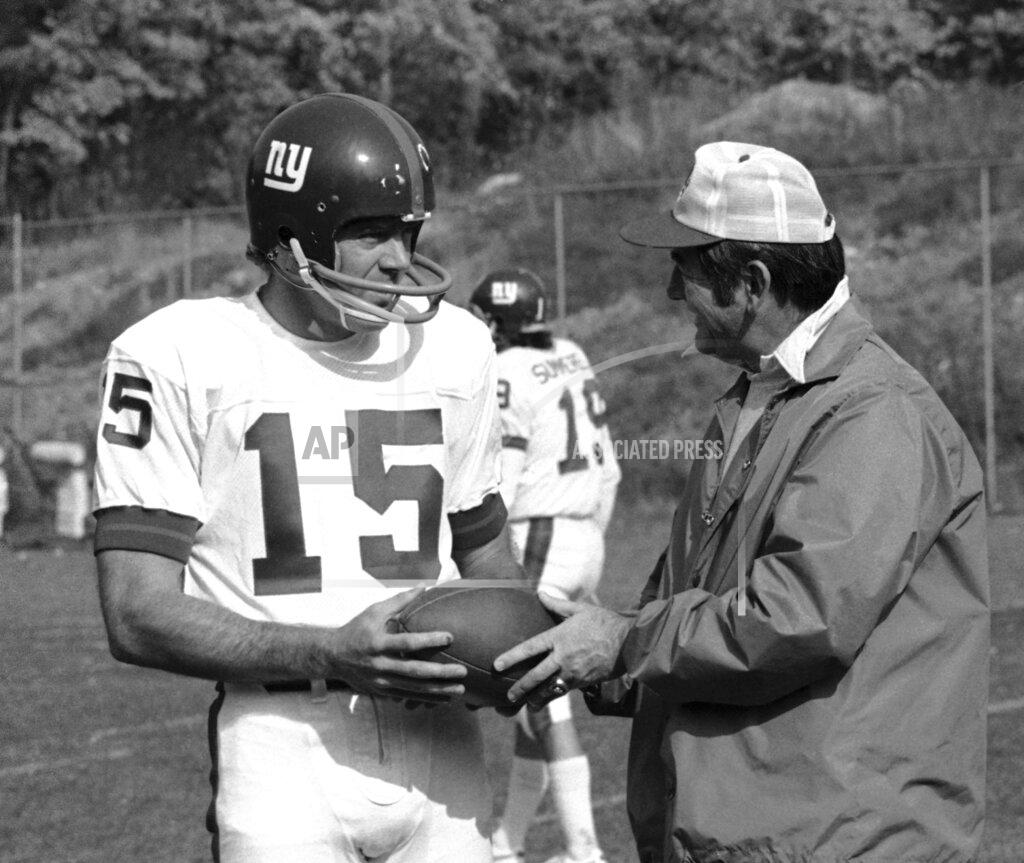
The New York Giants send quarterback Norm Snead to the San Francisco 49ers for two draft choices, and then acquire quarterback Craig Morton from the Dallas Cowboys for two high draft choices.
The Green Bay Packers acquire quarterback John Hadl from the Los Angeles Rams for five draft choices.
Dow Jones Industrial Average: 645.03 (-17.83, -2.69%).
Born:
Dani Tyler, American softball infielder (Olympic gold medal, 1996), in Denver, Colorado.
Jody Littleton, NFL linebacker (Chicago Bears, Detroit Lions, Cleveland Browns), in Littleton, Colorado.
Sander Westerveld, Dutch soccer player and coach; in Enschede, Netherlands.
Beatrice Faumuina, New Zealand discus thrower (Olympics, 1996), in Auckland, New Zealand.
Kaleena Kiff, American actress (Patti-“Love Sidney”), in Santa Monica, California.
Derek Landy, Irish author (“Skulduggery Pleasant” series), in Lusk, Ireland.
Aravind Adiga, Indian-Australian author; in Madras, Tamil Nadu, India.
Died:
Melchior Lengyel, 94, Hungarian writer, dramatist and film screenwriter.




 History Diaries