A number of clashes between Nikita S. Khrushchev and his colleagues in the Communist party hierarchy going back to 1962 preceded his removal last week as Soviet Premier and party chief. In one of these incidents, according to reliable sources, he is reported to have proposed last summer that his son‐inlaw, Aleksei I. Adzhubei, be elevated to the rank of a party secretary. According to the London Daily Worker, British Communist organ, the post would have had special responsibility for agriculture, United Press International said. The majority of the party Presidium overruled Mr. Khrushchev in the Adzhubei case. During the bitter debate on the issue, the charge of nepotism apparently was raised against; the Soviet leader for the first time. This charge has been mentioned prominently in the indictment preceding his ouster.
In another of the clashes, in the winter of 1962-63, a change in the regime’s policy toward nonconformist artists and intellectuals was imposed on Mr. Khrushchev against his will, according to reports. This change turned the policy from reluctant toleration to sudden hostility toward these artists and intellectuals. In one incident in late 1962, a speech Mr. Khrushchev made in the party’s Central Committee was never made public, presumably because a strong group of his colleagues disapproved. Mr. Khrushchev was understood to have been overruled again early this year when he wanted to make public immediately a confidential report given to the party by Mikhail A. Suslov on the Chinese‐Soviet ideological conflict.
Unofficial reports, though more numerous as time goes on, are still tentative and in some cases contradictory. As nearly as it can be pieced together from a variety of sources, including Western specialists, the picture that emerges is the following: The ouster of Mr. Khrushchev was not a sudden decision. Nor was it brought to a climax by any single, sudden event. Leonid I. Brezhnev was the key man in the power shift, according to the best available evidence, even though at the height of the drama in the Central Committee meeting it was Mr. Suslov who acted as the chief spokesman of the anti-Khrushchev majority. Dmitry S. Polyansky also delivered an accusing speech. Mr. Suslov is said to have concentrated on foreign affairs, especially on Mr. Khrushchev’s handling of relations with foreign Communist parties. Mr. Polyansky, sources said, denounced Mr. Khrushchev’s agricultural policies.
The French Communist party called today on the Soviet party to explain why and how Nikita S. Khrushchev was removed from the Soviet leadership. The demand was regarded here as the most dramatic expression thus far of dissatisfaction with the manner of Mr. Khrushchev’s overthrow. The dissatisfaction has been evident among Communists in Western Europe and in the East European countries. It was viewed also as the most striking expression of independence from Moscow in the history of the French Communist party, largest in Western Europe after the Italian party. The French party polled nearly four million votes in the 1962 elections. The French party announced its decision to ask for a Soviet explanation after a meeting of its Politburo this afternoon. The demand for information was in blunt language.
Senator Barry Goldwater said tonight that the removal of Nikita S. Khrushchev from power portended a reconciliation of the Soviet Union and Communist China. He declared that, as a result, “the Communist threat to our security has become more grave.” The Republican candidate for President expressed this view in a television address over tha national network of the American Broadcasting Company. Mr. Goldwater’s speech was in the nature of a reply to President Johnson’s televised report to the nation last Sunday night on the significance for the West of the shift in leadership of the Soviet Union and the explosion by Communist China of its first nuclear device.
The Senator described these as “momentous events” that presented “both a challenge and an opportunity to this country.” “You deserve a straight and honest explanation from each candidate for the Presidency on how he proposes to meet this challenge and exploit this opportunity,” Mr. Goldwater said. The Senator asserted that the policy followed by the KennedyJonnson Administration toward the Soviet Union and other Communist countries “has been an utter failure.” By differentiating between some Communist countries and leaders and others, by acting on what he called the belief that there are “good” and “bad” Communists, the Administration has failed “to halt the march of Communism and the testing of nuclear weapons and the spread of nuclear power through the Communist world,” Mr. Goldwater said.
He argued further that the Administration had sold grain to Russia on favorable credit terms because it regarded Mr. Khrushchev as a “good Communist.” As a consequence, Mr. Goldwater went on, the Administration “helped the Communist world through a time of trouble and allowed it to emerge as a greater threap than ever” now that, in the Senator’s view, the Soviet Union and Communist China are about to be reunited.
Pravda, the Communist party newspaper, repeated today earlier assurances by the new Soviet leaders that the policy of “peaceful coexistence” would continue. This has been one of the principal themes of statements made by Leonid I. Brezhnev, the party’s new First Secretary, and Aleksei N. Kosygin, the new Premier, in public speeches. They and their associates have also made the point in private talks with Western diplomats. The Pravda editorial declared that the Soviet Union would continue its “tireless effort” to strengthen peace and reduce international tension, andnthat it wanted to have “better relations of friendship and cooperation with all countries.”
The editorial also asserted that “imperialist forces” were still a threat. Therefore, it said, the party and the Government “had always taken and will always take all the measures necessary to strengthen the defense of our great country and to guarantee the inviolability of its borders and the security of the entire Socialist camp.” This was a verbatim repetition of a phrase used in the first Prava editorial following the leadership shake‐up last week. Its principal significance appeared to lie in the possibility that it might be intended as a positive gesture toward Communist China.
A preliminary analysis of the Chinese Communist nuclear test last week indicates that the device was built of enriched uranium and used a relatively advanced explosive trigger. In yield and design, the device was basically the same as the atomic bomb that the United States dropped on Hiroshima in 1945. But in some respects, particularly in the explosive trigger, the Chinese device was more advanced than the Hiroshima bomb. As officials considered the signs of greater technological advancement in weaponry than had generally been credited to Communist China, Premier Chou En‐lai sent a message to President Johnson urging a world summit conference to outlaw nuclear weapons. The message was disclosed by the State Department.
A report on the preliminary analysis of the radioactive debris of the Chinese explosion last Friday was made public tonight by the Atomic Energy Commission. Through chemical analysis of the radioactive debris, it is possible to draw a conclusion about the nature and design of an atomic device. The analysis contained two surprises for United States officials. Both indicated a greater degree of technological advancement in weaponry than had generally been credited to Communist China. First, the device used enriched uranium as the fissionable material, rather than plutonium as had been generally presumed. This fact throws a whole new perspective on Communist China’s capability to produce weapons material. The second surprise was that Communist China used the relatively advanced and difficult technique of implosion to trigger the explosion.
Cambodia proposed today that the 1964 session of the General Assembly give China’s seat to Communist China. According to reliable sources, Algeria, Mali and several other African neutrailists also had intended to submit the Chinese question for inclusion on the agenda. But Cambodia acted first by calling for the “restoration of the rights of the People’s Republic of China in the United Nations.” Adiai E. Stevenson, the United States representative, predicted today that Nationalist China would retain its seat at the 1964 session of the Assembly.
The military rulers of the South Vietnamese Government and the civilian High National Council prepared today for the orderly transfer of power in South Vietnam to a civilian government. The council, which presented the charter of a new Government yesterday, was formally authorized to name a chief of state, thus setting the wheels in motion for a new ministerial team to be ready by October 27. Major General Nguyễn Khánh has promised to step down as caretaker Premier by that date. Major General Dương Văn Minh was considered the leading candidate for the chief of state post in the Government although the council also considered other candidates at its meeting today, according to reliable sources. It will be up to the chief of state to name a premier, who is supposed to be a civilian.
President de Gaulle, unanimously supported by the Cabinet, declared today that Prance would withdraw from the European Common Market unless there was an agreement on its agricultural program. This threat, directed principally at West Germany, was accompanied by a warning that there could be no useful negotiations between the United States and the six‐nation market on a reduction of tariffs until the Common Market members had settled the agricultural issue. The crux of the matter is a gap in wheat prices—the high prices paid for German wheat because of Government supports and the relatively lower French prices. The French assert that they are prepared to raise their price if there is a comparable reduction in the German price. The West German Government has refused to lower its supported price. The French maintain that Chancellor Ludwig Erhard’s Cabinet is worried over the effect of this step on the farm vote in next year’s national election.
Students at the University of Khartoum in the Sudan began protests against the nation’s government after being inspired by the Muslim Brotherhood, leading to the downfall of President Ibrahim Abboud.
Gheorghe Gheorghiu-Dej, the President and Communist Party chief of Romania, broke relations with the Soviet Union’s new leadership, and told the Soviet Ambassador in Bucharest to withdraw all KGB spies and officials from the country. The move would trigger an angry reaction from the Soviets, who ultimately agreed to pull their agents out of Romania in December, marking the first time that a Warsaw Pact member to get rid of the USSR’s intelligence agency.
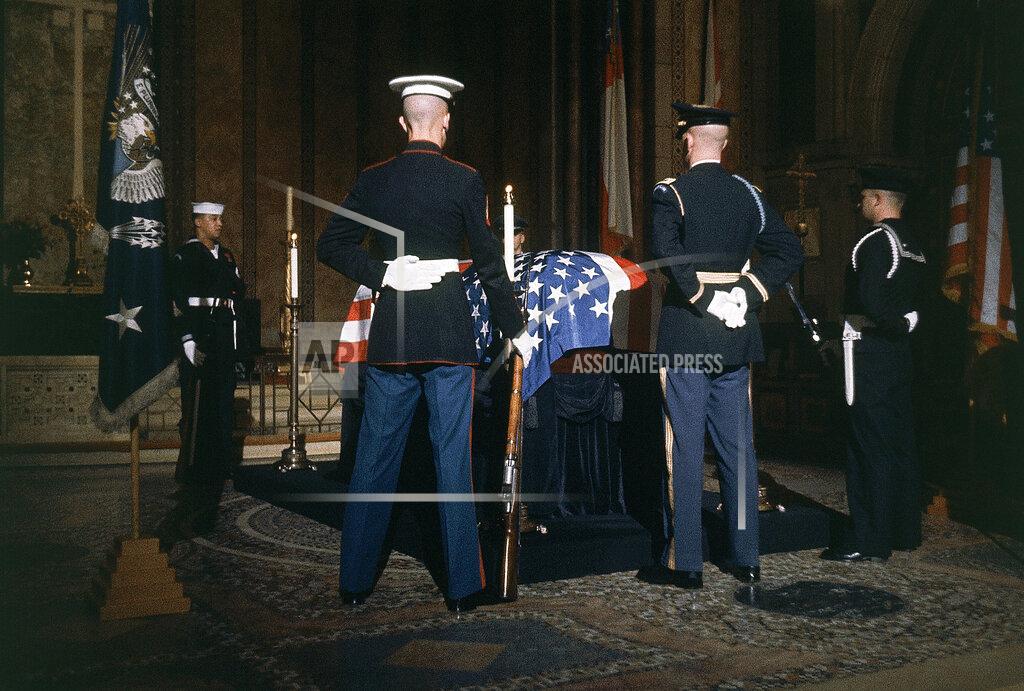
About 17,500 persons moved slowly through New York’s St. Bartholomew’s Episcopal Church on the first of five days of national tribute to the memory of Herbert Clark Hoover. This afternoon the national political campaign will come to a standstill as its central figures — President Johnson and Senator Barry Goldwater — fly to New York to attend a brief funeral service in the 1,250-seat church at 4:30 PM. Former President Dwight D. Eisenhower and both Vice‐Presidential candidates, Senator Hubert H. Humphrey and Representative William E. Miller, are also expected to attend. The only other living former President, Harry S. Truman, will be unable to attend. He is recovering from injuries suffered in a recent fall at home.
The body of the 31st President lies in state, with a military honor guard, in the chancel of the church between the choir stalls, directly in front of its green marble altar. Mr. Hoover, who occupied the White House from 1929 through 1932, died here Tuesday at the age of 90. Mourners streamed past the flag‐covered coffin yesterday at the rate of 2,500 an hour from 9 AM through 4 PM, an hour longer than had originally been allotted for public viewing. Again today, the public will be admitted to the church from 9 AM to 3 PM, and again from 5 PM to 9 PM. Admission to the funeral, which starts at 4:30, will be by invitation only. There will be no seats for the public. The Rev. Dr. Terence J. Finlay, rector of the church since 1955, will conduct the 25-minute service from the Episcopal Book of Common Prayer. It is not customary in the Episcopal funeral service to include euloIgies, and the service for Mr. Hoover will be no exception.
Former President Harry S. Truman told President Johnson today that he wanted to see Mr. Johnson elected even more than he wanted to win in 1948. The remark was made when President Johnson paid a hospital visit to Mr. Truman to receive the “advice and counsel” of his friend and predecessor from Independence, Missouri. The President interrupted a campaign swing through Ohio and Missouri to call on the 80year‐old Mr. Truman who came to the Presidency as Mr. Johnson did — through the line of succession — and then went on to win it in his own right. This, Mr. Johnson hopes and expects to do in November. Mr. Truman received the President in his suite at Research Hospital here, where he is recovering from two broken ribs and a head cut suffered in a bathroom fall in his home eight days ago. The meeting lasted 25 minutes. Others in the room were Mrs. Truman, Mrs. Johnson and Governor John B. Connally of Texas, who was accompanying the President today.
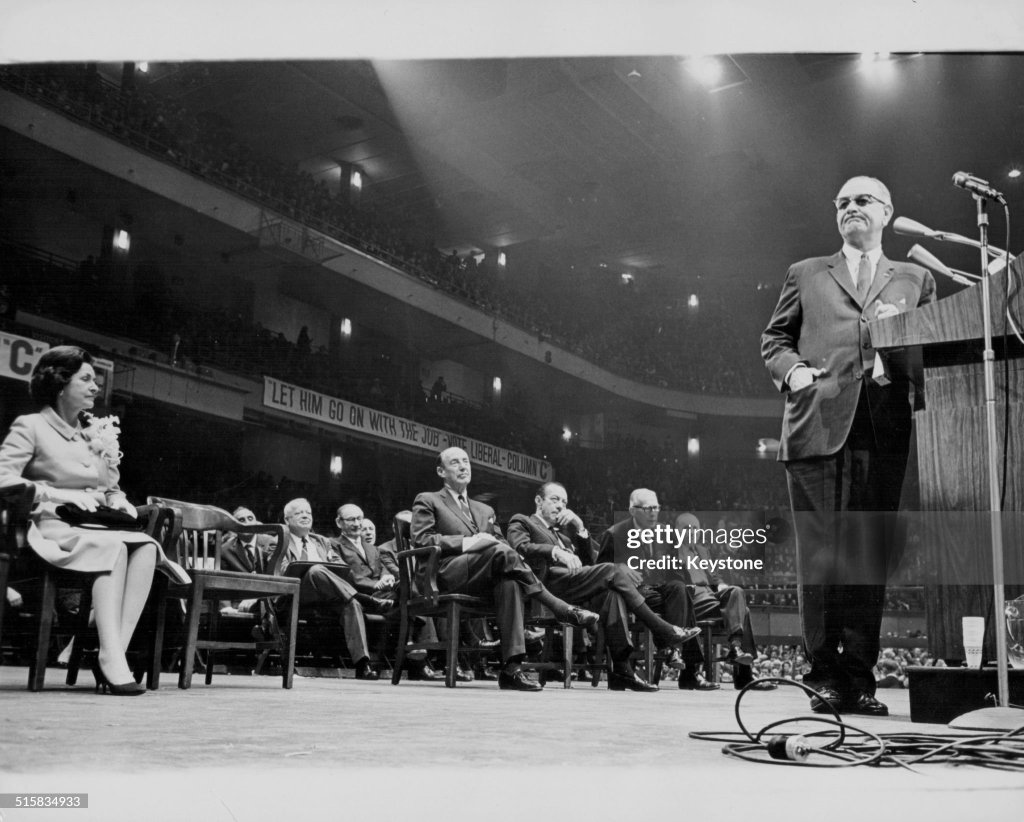
President Johnson said tonight that a “smearlash” was beginning to draw Republicans away from their own party and the Presidential candidacy of Senator Barry Goldwater. Mr. Johnson coined the “smearlash” term — referring to revulsion against smear campaign techniques — in an impromptu retort to hecklers during a speech to 25,000 Missourians in downtown St. Louis. Mr. Johnson first told the hecklers: “Now you folks come on and be happy.” To the crowd he added: “You will find a few like this in any big crowd, but they’re getting fewer and fewer as time goes on.”
The President then said he had been told by a political leader that he had “noticed a trend in the last 48 hours away from” the Republican Party. “It’s not the backlash,” the President said. “That’s gone. It’s not the frontlash. It’s the smearlash, because when some people get desperate they get dangerous, and when they are dangerous they are not cautious; and when they get to smearing and fearing, some of their own people do not want to go along with them.” The President’s observation came at the end of a one‐day campaign swing through pivotal Ohio and into Illinois and Missouri. The trip took him back onto the campaign trail after he had canceled his campaign schedule last Friday in order to attend to international problems, in conferences in Washington. In Akron, Ohio, Mr. Johnson said earlier today that he “was not going to say anything ugly” abou this opponent.
Representative William E. Miller of New York stepped up his assault on President Johnson over the Jenkins case tonight. In a statement about Walter W. Jenkins, who resigned as a special Presidential assistant after the disclosure of two arrests on morals charges, Mr. Miller said: “Police records show that the President’s close friend and chief White House aide has been involved for five years in a pitiful, sordid situation which made him a ready subject for blackmail and compromise as to the highest secrets of government.”
Mr. Miller, the Republican Vice Presidential candidate, repeated the same theme in a speech tonight at the Wamplers Ball Arena in Dayton In both the speech and the statement issued on the way here from San Francisco, Mr. Miller reiterated the charge that President Johnson’s involvement with figures in various scandals made him unworthy of a voter’s trust. “The President’s No. 1 lieutenant in the Senate, Bobby Baker, amassed a fortune by abusing the influence of his official position,” Mr. Miller charged. He said that “the President’s great friend from Texas, Billie Sol Estes, stands exposed as a swindler and influence peddler.” “Hasn’t the time come to ask ourselves how much longer we can trust the judgment of this President, or how much longer we can rely on the integrity of his Administration?” he asked.
The South, long considered Senator Barry Goldwater’s chief source of strength, appears likely to give him less than half its support in the Presidential election. A decline in popular sentiment for the Republican candidate that began more than three weeks ago has become apparent even in such Goldwater strongholds as Alabama, Mississippi and Louisiana. The Arizona Senator is still expected to carry those states and possibly one or two of the eight others in the former Confederacy. But his once‐promising prospects for winning a majority of the region’s 128 electoral votes now seem dim.
While the trend in the South to President Johnson roughly parallels that indicated elsewhere, the balloting on November 3 may reverse the pattern set heretofore by Southern voters. There is increasing evidence that Mr. Johnson will run more strongly than past Democratic Presidential candidates in such traditionally Republican areas as the Appalachians. Senator Goldwater’s greatest support, on the other hand, is expected to come from the once heavily Democratic areas of the Deep South, where Blacks account for a large part of the population.
Senator Humbert H. Humphrey piled labels right and left — but mostly right — on Senator Barry Goldwater and his associates tonight. Amateur, radical, irresponsible and extremist were some of the names he tossed out. “The choice is a simple one — this choice is between recklessness and responsibility,” the Democratic Vice-Presidential nominee charged in this steel city on Lake Michigan after a day of campaigning in downstate Illinois where the Republicans traditionally give their party substantial leads. He spoke at the Marion Airport and in Carbondale.
The United Automobile Workers moved today to speed the end of the nationwide strike against the General Motors Corporation. Leonard Woodcock, U.A.W. vice president and director of the union’s General Motors department, announced that union members would vote at meetings Friday and Sunday on whether to accept new contracts with the company and return to work. Mr. Woodcock expressed confidence that most local unions would vote to end the strike, enabling General Motors to resume at least limited auto production next week. But some locals with unresolved local contracts were likely to remain on strike beyond the weekend, and that would restrict the company’s ability to resume operations.
An important group of non operating railroad unions were said today to be prepared to reject labor contract terms recommended by a Presidential emergency board. The board’s suggestions were understood to have been criticized at a meeting in Chicago today of top representatives of the six shopcraft unions — the machinists, electrical workers, boilermakers, sheet metal workers, carmen and firemen and oilers. An informed source said that the general chairmen of the six railroad unions, who will meet in Chicago tomorrow; were expected to reject the board’s recommendations on wage increases and the retroactivity of the proposed wage settlement.
Society Hill Towers, a complex of three 31-story skyscrapers designed by I. M. Pei and Associates, inaugurated in Philadelphia, Pennsylvania.
The asteroid 1930 Lucifer, roughly 21 miles (34 km) in diameter, was discovered by astronomer Elizabeth Roemer from the observatory in Flagstaff, Arizona. Roemer was given the honor of naming the asteroid, and gave it the name “Lucifer”, Latin for “light-giver”, but also associated in literature with the fallen angel who became the Devil, most notably by Dante Alighieri in his 13th century epic The Inferno, and by John Milton in his 17th century epic Paradise Lost. Lucifer was mentioned in the King James Version of the Bible in Isaiah 14:12, though subsequent translations of the original Hebrew refer to the “morning star”.
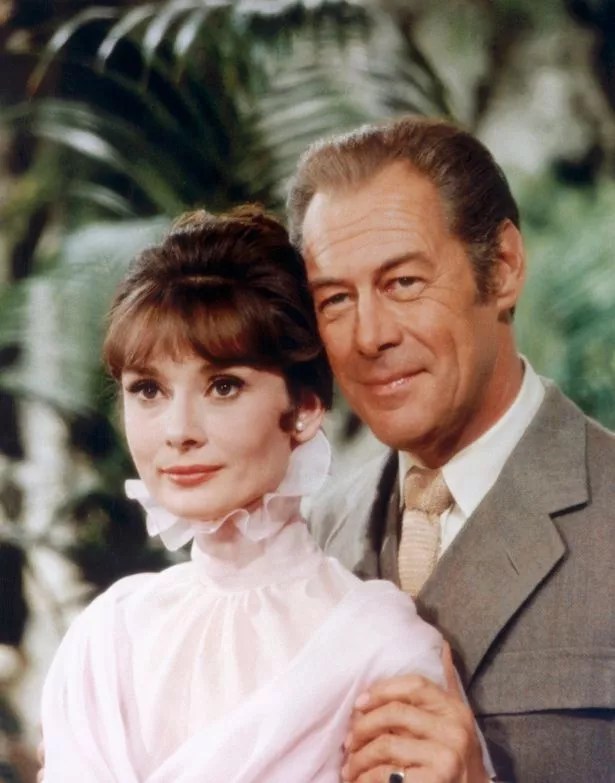
The film version of the hit Broadway stage musical “My Fair Lady” had its world premiere, projected at the Criterion Theater in New York City on Broadway. It would then be released in other major cities during the autumn before being distributed nationwide Rex Harrison reprised his stage performance as Professor Henry Higgins, a role which would win him the Academy Award for Best Actor. Harrison’s Broadway co-star, Julie Andrews, had been passed over in favor of Audrey Hepburn for the role of Eliza Doolittle. “My Fair Lady” would win eight Academy Awards in all, including Best Picture, but Hepburn would not even be nominated; the award for Best Actress would go, instead, to Andrews for her performance in “Mary Poppins.”
New Zealand athlete Peter Snell wins the 1,500m at the Tokyo Olympics; his second gold medal of the Games (800m); 3rd career gold.
Polish 4×100m women’s relay team runs a world record 43.6 to beat the U.S. by 0.3s and win the gold medal at the Tokyo Olympics; Teresa Ciepły, Irena Kirszenstein, Halina Górecka & Ewa Kłobukowska.
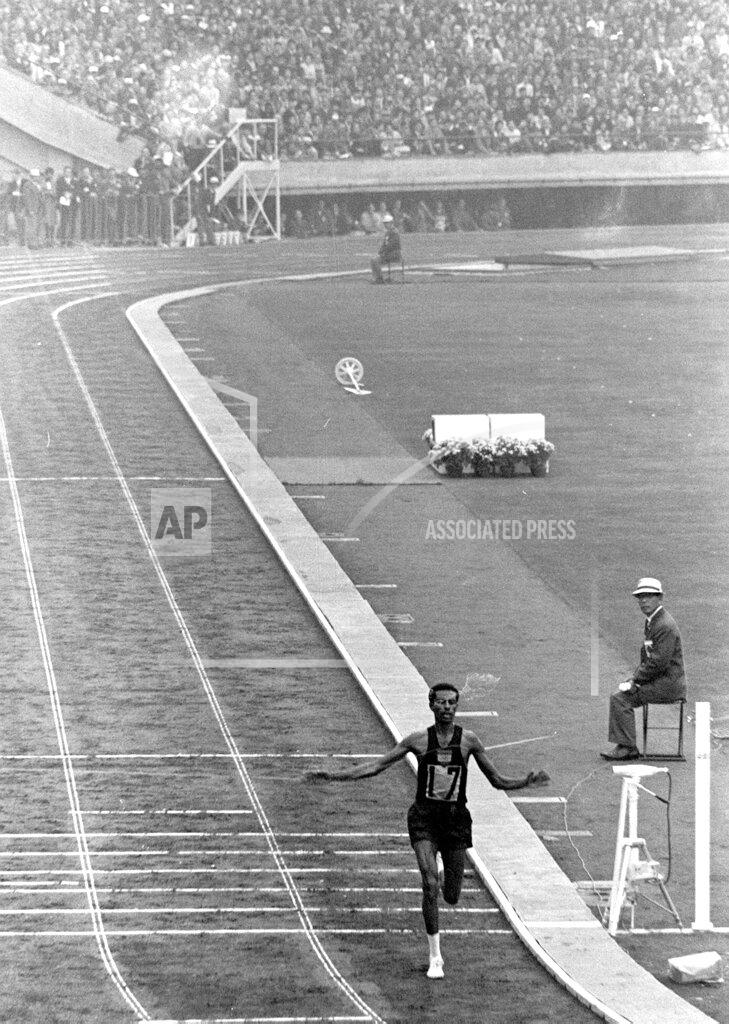
Ethiopian athlete Abebe Bikila won the Olympic Marathon, only 40 days after he had undergone surgery for an appendectomy. Abebe Bikila of Ethiopia runs a world record 2:12:11.2 to beat Briton Basil Heatley by more than 4 minutes and win the men’s marathon at the Tokyo Olympics; first athlete to win Olympic marathon twice.
American men’s 4×400m relay team beats Great Britain by 0.9s to set world record 3:00.7 and win the gold medal at the Tokyo Olympics; Ollan Cassell, Mike Larrabee, Ulis Williams & Henry Carr.
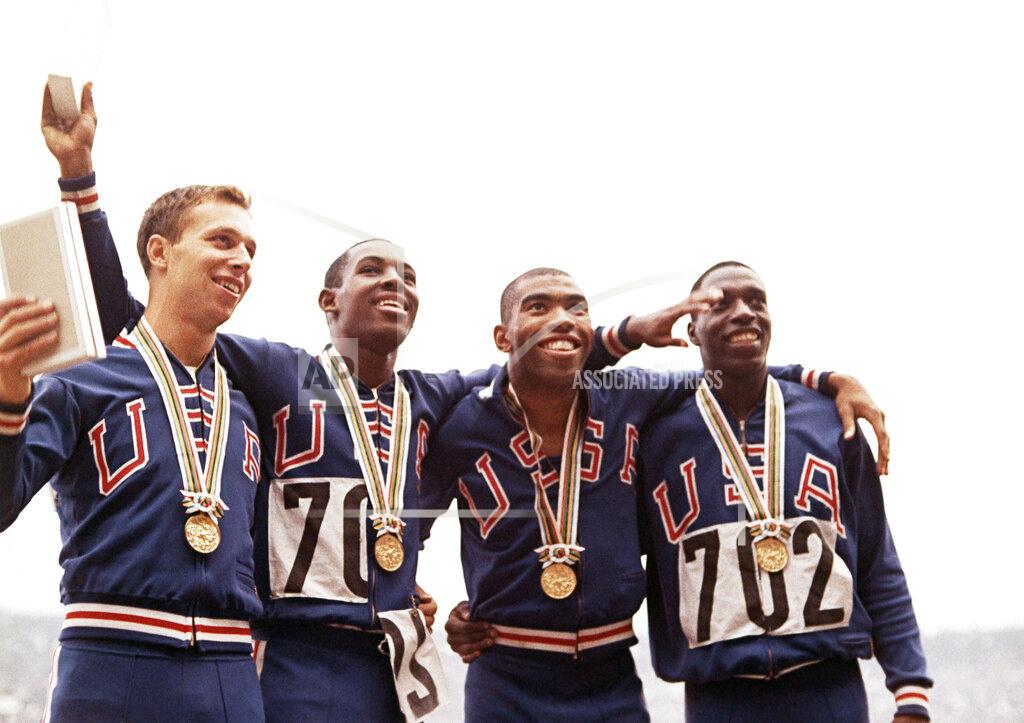
US 4x100m men’s relay team of Paul Drayton, Gerry Ashworth, Richard Stebbins & Bob Hayes run world record 39.0s to beat Poland by 0.3s and win the gold medal at the Tokyo Olympics.
After just 11 years in Milwaukee, the Braves’ Board of Directors votes to ask the National League for permission to move to Atlanta. Milwaukee County officials sue to block the move.
The New York Yankees sold Ralph Terry to the Cleveland Indians as part of their home‐stretch deal for Pedro Ramos. The exchange ended a Yankee career for Terry that began in 1953, when he was a 17‐year‐old pitcher claimed by both the Yankees and the St. Louis Cardinals. The commissioner of baseball, Ford C. Frick, decided that he belonged to the Yankees. He won 56 games over three seasons starting with 1961, including 23 victories in 1962 and two in the World Series against the San Francisco Giants.
Dow Jones Industrial Average: 879.72 (-1.78)
Born:
Jon Carin, American session and touring keyboardist and guitar player (Pink Floyd; The Who), and producer, in New York, New York.
Carlton McKinney, NBA shooting guard (Los Angeles Clippers, New York Knicks), in San Diego, California.
Cliff Hanneman, NFL linebacker (Cleveland Browns), in Duarte, California.
Died:
Margaret Gibson, 70, American silent film leading lady
 History Diaries