[Bastards.]
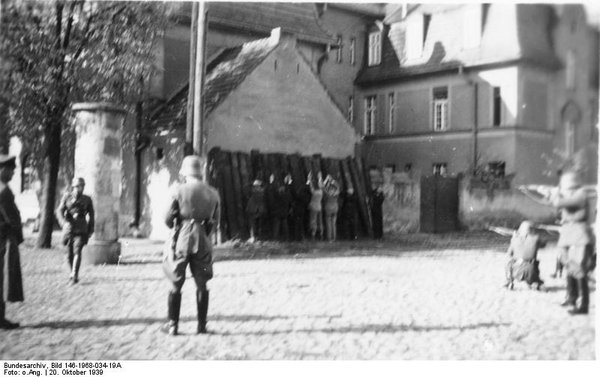
Mass public executions of Poles are perpetrated by the German police and SS Einsatzgruppe VI in various towns in the region of Greater Poland in German-occupied Poland, i.e. Kostrzyn, Kórnik, Książ Wielkopolski, Mosina, Śrem, Środa, in attempt to pacify and terrorize the Polish population. Operation Tannenberg (German: Unternehmen Tannenberg) was a codename for one of the anti-Polish extermination actions by Nazi Germany. The shootings were conducted with the use of a proscription list (Sonderfahndungsbuch Polen) targeting Poland’s elite, compiled by the Gestapo in the two years before the invasion of Poland. The secret lists identified more than 61,000 members of the Polish elite: activists, intelligentsia, scholars, clergy, actors, former officers and others, who were to be interned or shot. Members of the German minority living in Poland assisted in preparing the lists.
Following the orders of Adolf Hitler, a special unit dubbed Tannenberg was created within the Reich Security Main Office (Reichssicherheitshauptamt). It commanded a number of Einsatzgruppen units formed with Gestapo, Kripo and Sicherheitsdienst (SD) officers and men who were theoretically to follow the Wehrmacht (armed forces) into occupied territories. Their task was to track down and arrest all the people listed on the proscription lists exactly as it had been compiled before the outbreak of war. The plan was finalized in May 1939 by the Central Office II P (Poland). The first phase of the action occurred in September 1, 1939, and was perpetrated by the Einsatzgruppen, with assistance from the Volksdeutscher Selbstschutz and local SA militias. Many listed targets were killed. Some officials were beaten and mutilated. Pregnant women were also not spared.
Operation Tannenberg was followed by the shooting and gassing of hospital patients and disabled adults, as part of the wider Aktion T4 programme. After the extermination of the Polish elite, patients from Polish hospitals were murdered in Wartheland (Wielkopolska) by Einsatzgruppe VI men. They were led by Herbert Lange, who was under the command of Erich Naumann. He was appointed commandant of the first Chełmno extermination camp soon thereafter. By mid-1940, Lange and his men were responsible for the murder of about 1100 patients in Owińska, 2750 patients at Kościan, 1558 patients and 300 Poles at Działdowo who were shot in the back of the neck; and hundreds of Poles at Fort VII where the mobile gas-chamber (Einsatzwagen) was first developed along with the first gassing bunker.
According to the historian Peter Longerich, the hospital massacres were conducted on the initiative of Einsatzgruppen, because they were not ordered by Himmler. Lange’s experience in the mass killing of Poles during Operation Tannenberg was the reason why Ernst Damzog, the Commander of Sicherheitspolizei (Security Police) and SD stationed in occupied Poznań (Posen) placed him in charge of the SS-Sonderkommando Lange (special detachment) for the purpose of mass gassing operations which led to the eventual annihilation of the Łódź Ghetto.
King George and the Turkish President exchange telegrams congratulating each other on the Anglo-French-Turkish Treaty of Mutual Assistance.
Some 2,000 Jews were ordered deported from Nazi-controlled Vienna to Lublin in the General Government.
The Germans edge toward unrestricted submarine warfare, as in World War I, with the announcement that merchant ships in convoys will be given no notice before the attack as required by international law. This is a significant change in policy in just a matter of weeks.
Germany has “taken up the gauntlet” where Britain and France threw it down and there will be a war to the finish on the Western Front, an official statement said tonight in angry denial of reports that Chancellor Hitler was contemplating a new peace offer.
Maximilian von Weichs is made the commanding officer of German 2nd Army.
There is patrol and reconnaissance activity on the Western Front between the Moselle and the Saar rivers. There are Minor patrols and reconnaissance flights along the length of the line, which is still waterlogged from yesterday’s rains.
The British war office recommends that soldiers at the front read both Mein Kampf and the Communist Manifesto.
German aircraft perform a reconnaissance of the Firth of Forth. Nazi scout planes fly over Scotland. They escape British pursuers as alarms sound.
King George and the Turkish President exchange telegrams congratulating each other on the Anglo-French-Turkish Treaty of Mutual Assistance.
Finland has meetings to figure out a strategy toward the Soviet Union. A long meeting of the Finnish Cabinet was held today immediately after the return of Foreign Minister Eljas Erkko from the Scandinavian four-power conference at Stockholm.
Pope Pius XII published his first encyclical, “Summi Pontificatus,” critiquing ideologies such as racism, cultural superiority and totalitarianism.
The German prize crew of the City of Flint (disguised as a Danish ship named Alf) entered the Norwegian port of Tromsø to get fresh water. The Norwegians supplied the water but ordered the ship to have its proper name and marking restored and to leave the next morning.
The neutral Swedish steam merchant Gustaf Adolf was stopped by gunfire and after the crew abandoned ship was torpedoed and sunk by the U-34, commanded by Kapitänleutnant Wilhelm Rollmann, approximately 50 miles northeast of Sullom Voe, Shetland Islands in the North Sea (61°00′N 0°48′E). The survivors were picked up by the Norwegian ship Biscaya and taken to Moss, Norway. The 926-ton Gustaf Adolf was carrying wood pulp and was bound for Bristol, England.
The British steam merchant Sea Venture was shelled and then torpedoed and sunk by the U-34 approximately 50 miles northeast of the Shetland Islands (60°50′N 0°15′E). Of the ship’s complement, all 25 survived and were rescued by the Lerwick lifeboat. The 2,327-ton Sea Venture was carrying coal and was bound for Tromsø, Norway.
U.S. freighter City of Flint, under prize crew from German armored ship Deutschland, puts in to Tromsø, Norway, for water. Norwegian government, however, orders the ship to leave; she sails for Soviet waters.
The British Thames barge Azariah sank in the North Sea off Burnham-on-Crouch, Essex.
U.S. freighter Scanstates, detained at Kirkwall, Orkneys, by British authorities since 14 October, is released.
The War at Sea, Friday, 20 October 1939 (naval-history.net)
Light cruisers COLOMBO and DELHI departed Sullom Voe for Northern Patrol.
Light cruiser DRAGON departed Sullom Voe for Northern Patrol and arrived back on the 25th.
Two light cruisers were on Northern Patrol between the Shetlands and the Faroes, light cruiser COLOMBO and AMCs AURANIA, CALIFORNIA, CHITRAL between the Faroes and Iceland, and light cruiser SHEFFIELD and AMCs SCOTSTOUN, RAWALPINDI, TRANSYLVANIA in the Denmark Strait.
While escorting convoy BC.10S with destroyer VIVACIOUS from Quiberon Bay to Barry, destroyer MONTROSE attacked a submarine contact in 52 16N, 4 36W.
Convoy FN.24 departed Southend. Shortly after, escorting sloop PELICAN was damaged when she struck submerged wreckage. The convoy arrived at Methil on the 22nd.
Convoy FS.24 departed Methil, escorted by destroyer BROKE, sloops BITTERN and ENCHANTRESS, and arrived at Southend on the 22nd.
U-34 sank steamer SEA VENTURE (2327grt) east of the Shetlands in 60 50N, 00 15E and Swedish steamer GUSTAF ADOLF (926grt) 50 miles NE of Sullom Voe in 61 00N, 00 48E. All the crew of GUSTAF ADOLF were rescued, while the survivors from SEA VENTURE rowed in their lifeboats to a nearby island.
German auxiliary patrol boat Vp.701 (trawler ESTE, 426grt) was sunk on a mine between Moen and Falsterbo.
German steamer BIANCA (1375grt) had departed Rotterdam pre-war for Lisbon, called at El Ferrol and refueled in an attempt to return to Germany before the start of the war. She reached Reykjavik on 7 September and remained there until 18 October when she made her attempt. At 1150/20th in the Denmark Strait, in 67 29N, 22 15W, she was captured by armed merchant cruiser TRANSYLVANIA, taken to Kirkwall by a prize crew commanded by Lt Cdr D M MacLean RNR, and renamed EMPIRE WARRIOR in British service.
Greek steamer OMONIA (3699grt) was seized in the Baltic by German warships, taken to Swinemünde and later renamed OLSA for German use.
Light cruiser CARADOC arrived at Bermuda, and left the same day for Kingston, Jamaica.
Light cruiser DESPATCH departed Bermuda and arrived at Kingston on the 26th.
Light cruiser GALATEA departed Alexandria, reached Malta on the 27th, left again on the 28th and arrived back at Alexandria on the 30th.
Light cruiser DURBAN departed Mauritius for Colombo to examine the Cargados, Caarajos and Chagos groups for German activity.
The Admiralty ordered destroyers HOTSPUR and HAVOCK from the South America Station to the West Indies.
President Roosevelt said today at Hyde Park, New York that his proclamation barring belligerent submarine operations within the three-mile limit was not intended to define “territorial waters” of the United States and that the nation would continue to assert its jurisdiction as far to sea as its interests required. Discussing international implications of his submarine proclamation shortly after his arrival from Washington today, the President also differentiated between undersea and surface craft of combatant nations and indicated that the naval and military arms were prepared to do whatever was required to enforce his order regarding submarine operations.
Territorial waters of the United States meant one thing for submarines and quite another for surface craft, Mr. Roosevelt told his press. conference. Nothing in his submarine proclamation was to be construed as modifying his previous declaration that the government’s jurisdiction would extend a thousand miles to sea if necessary, he said, adding that it was all a question of neutrality and national defense requirements. Mr. Roosevelt refused to be drawn into a discussion of what might happen to belligerent submarines sighted within the maritime no man’s land outlined in his proclamation. Neither would the President reveal the nature of orders given to naval and military authorities in the matter except to say that their instructions were to do whatever was necessary to provide rigid enforcement of his proclamation.
Asked whether there was any thought of bringing armed merchant ships within the purview of the submarine ban, Mr. Roosevelt said the two types of vessels had to be considered separately and that to do otherwise was like trying to add apples and pears. As President Roosevelt explained it, the territorial waters of the United States could not be fixed arbitrarily at three miles as under international law for every set of circumstances. In such an important matter as national defense, all such rules had to be flexible, he said. There is, he continued, a three-mile limit for submarines; there was a 150-mile limit for rum runners in prohibition days, and there is a 300-mile limit for neutrality patrol of naval and coast guard vessels, coinciding roughly with the zone prescribed by the conference of Western Hemisphere nations at Panama City recently.
If any Latin-American nations contemplated following the President’s lead in banning submarine operations within their territorial waters, Mr. Roosevelt said he was unaware of it. The President was back at his boyhood Hudson River home here after an overnight trip from the capital. He was planning a quiet week-end with few, if any, official callers. As usual, however, the President will be in easy reach of Washington by direct telephone and telegraph wires.
Reporters sought to lead President Roosevelt in his press conference today into a discussion of the idea that restrictions on submarines involved German naval operations primarily, whereas restriction on surface vessels would affect the Allies more than Germany. They started out by inquiring on what basis he had differentiated between submarines and surface warships.
Mr. Roosevelt replied that there simply was a difference under the language of the Neutrality Act. The act gives him power to order submarines or armed merchant vessels or both to stay out of American harbors or territorial waters. The Chief Executive spent part of a clear, sunny afternoon driving around the countryside, glowing with Autumn colorings; on his estate he looked at some of the prospective Christmas trees he hopes to market in December and dropped in at his cottage retreat on a hilltop overlooking the picturesque Hudson Valley.
Today in Washington, the Senate continued debate on the Neutrality Bill, and its Monopoly Committee received recommendations of the Commerce Department and Geological Survey for preventing oil production waste. The Senate adjourned at 5:08 PM until noon tomorrow.
The House heard Representative Hoffman urge administration action against communist labor organizations, received the Hare resolution for investigation of the farm machinery business, and its Dies committee continued its investigation of the Communist party and German-American Bund activities. The House adjourned at 2:02 PM until noon tomorrow.
A charge that Colonel Charles Lindbergh had dealt a “gratuitous insult to a sister nation” in his recent radio criticism of Canada’s part in the European war was made in the Senate today as it apparently neared the close of general debate on the neutrality resolution. The accuser was Senator Prentiss M. Brown, Democrat, whose home State of Michigan borders nearly 700 miles on Ontario. Mr. Brown said that Colonel Lindbergh’s “unasked advice” concerning Canada’s connection with Great Britain in the European struggle, made in a radio speech a week ago tonight, was not only an insult, but was based on “a wholly erroneous concept” of the Monroe Doctrine or any other continental American policy.
“I condemn his remarks because they lend encouragement to the spirit of nationalistic imperialism that has cursed the world for centuries and which is the potent poison that has killed peace,” Senator Brown said. “I would have the world know that he did not speak for America.” Senator Brown’s speech, devoted almost entirely to the Lindbergh remarks, was one of a half dozen for the day which Administration leaders regarded as practically concluding the “major” debate on the neutrality measure and its highly controversial purpose of repealing the American arms embargo.
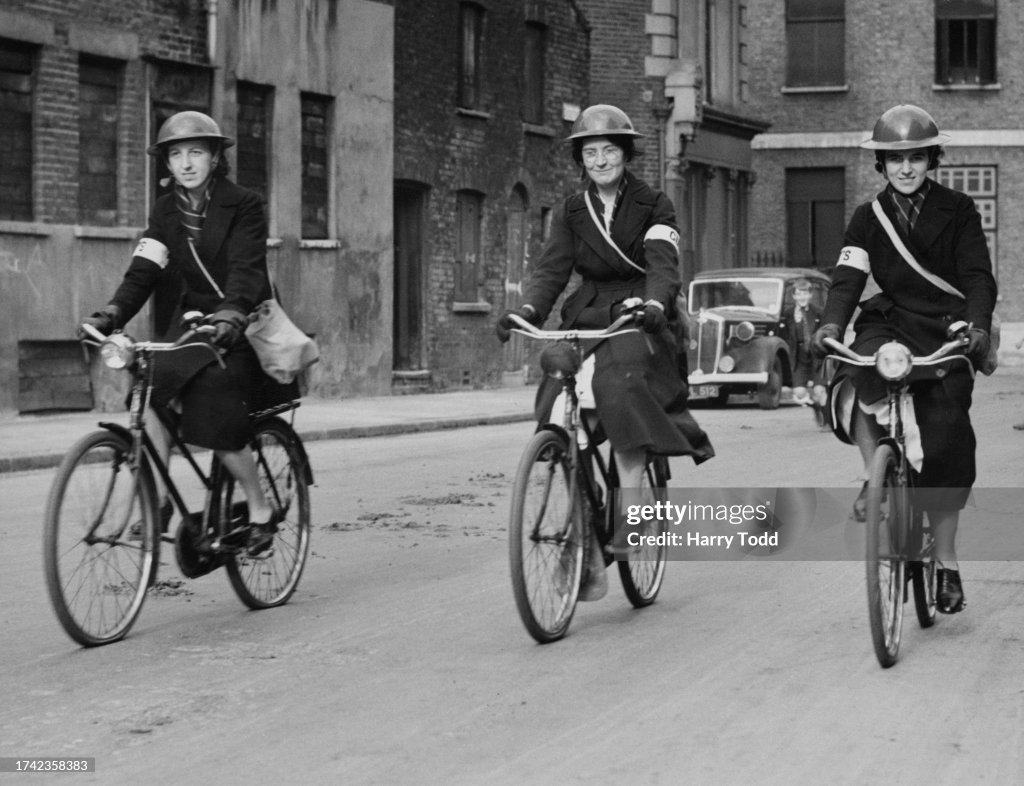
Safety men study the problem of bicycles. They find many hazards due to the phenomenal increase in the use of this vehicle for transportation. The dashing cyclist of the “horse-and-buggy days,” whose popularity was eclipsed temporarily by the advent of the motorist, has once again pedaled back into favor to such an extent that he is presenting an ever-increasing traffic safety problem, the National Safety Congress was told here today at its closing session.
The Chrysler Corporation plunged into the heart of its controversy with the C.I.O.United Automobile Workers today by offering to write into the next agreement provision for determination of production schedules. This the union rejected as unsatisfactory.
U.S.N. Commander Atlantic Squadron informs his ships to use plain language radio reporting of contacts.
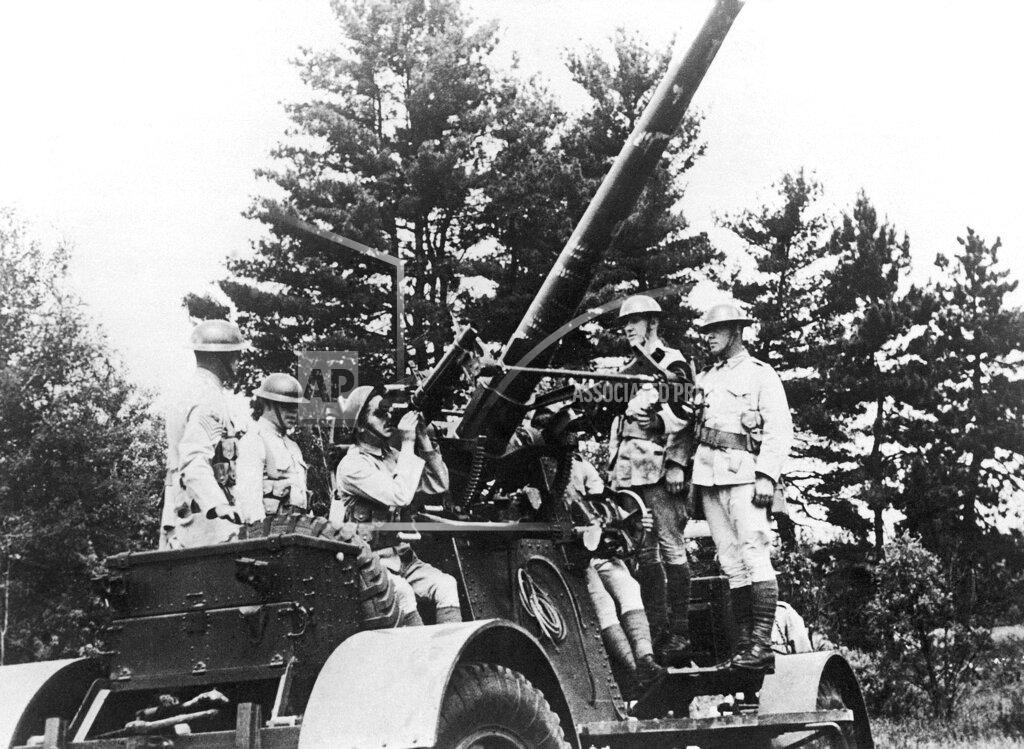
Reorganization of the U.S. Army to form nine highly mobile corps of more than 40,000 troops each is contemplated by the War Department, reliable sources said today.
The French Government has placed an order for 2,000 two-and-a-half-ton trucks with the General Motors Truck Company of Pontiac, Michigan.
Douglas starts work on 270 DB-7As (A-20A Havocs) ordered by France.
The comedy film “At the Circus” starring the Marx Brothers was released. It introduces the classic Groucho tune “Lydia the Tattooed Lady.”
“All the Things You Are” recorded by Tommy Dorsey Orchestra.
The India Congress party prepared tonight to call for resignation of eight of the eleven provincial governments of British India in protest against Britain’s decision to defer action on a central government until after the end of the war.
A visit to Changsha, China, in territory recently regained from Japanese troops, leaves no doubt that the Chinese achieved a major victory in repulsing the invaders, who were bent on capturing the city. The prisoners of war, the captured guns and the ruined villages all attest to the Chinese success and the intensity of the fighting, while evidence is available on every hand from the participants to provide further proof.
General Kuan Lient-sing, the commander of this sector, today said the Japanese casualties in his area, which was the scene of the heaviest fighting, totaled 25,000. He declared the Japanese discipline had been the worst encountered. since the beginning of the war and asserted that atrocities against civilians had reached a new extreme of barbarity. Chinese generals, including General Hsueh Yueh, commander of the Hunan-Kiangsi war area, asserted the blow to the Japanese here had been so shattering that they would need three months to replenish their ranks, to obtain supplies and to reorganize for a new offensive into Hunan Province.
The Chinese commanders said the proportion of Japanese who surrendered when hard pressed was the highest in the war so far. Many additional captives were taken as the result of the distribution of “immunity tickets” promising prisoners good treatment. Travel to this sector from Changsha is possible only by foot, sedan chair or horse. Highways and even small paths have been so completely destroyed for 100 miles north and northeast of Changsha that it would be impossible to move a two-wheeled vehicle of any size for a quarter of a mile in any direction without taking it apart. Highways have been crisscrossed by ditches and in some places the roads have returned to farmland. Bridges have been torn up and pathways obliterated. This destruction of communications was a major factor in balking and repulsing the recent Japanese drive.
There was similar destruction for fifty miles south of Changsha. Transport in Changsha itself has been reduced to primitive means. The only automobile in the city, owned by Dr. Philip Green of Montclair, New Jersey, head of the Yale in China Hospital, is for sale. The fifty foreigners in Changsha now find themselves more isolated than ever. There are a number of American missionaries and businessmen. All are still trying to shake off the fear, held three weeks ago, that they would be in a city occupied by Japanese. Dr. Green and a depleted hospital staff are treating several hundred wounded Chinese soldiers. He is trying to get appropriations of American relief funds to care for thousands of destitute refugees.
Changsha, after last year’s big fire, is only the ruins of what was China’s seventh city with a population of more than 500,000. It was evacuated completely when the Japanese threatened its capture recently. Already 30,000 have returned.
Chinese Government spokesmen today denied Japanese reports that a Russian military mission had made demands in return for continued aid in the Sino-Japanese war. The Chinese also denied Japanese assertions that United States and British diplomats were urging China to halt hostilities.
Japanese detachments in Shansi Province operating against an estimated 10,000 Chinese soldiers of the Communist Eighth Route Army killed 290 of the Chinese and captured 178 prisoners between October 10 and 15, the Japanese news agency reported today. It was claimed that 1,390 Chinese were killed in a single battle near Fengsin, Kiangsi, and that a detachment of 1,200 men of the Chinese 141st Division suffered heavy losses in fighting near Tsingan, Kiangsi.
Japanese Foreign Minister Kichisaburo Nomura declared today that the “determination of the entire Japanese nation to bring about a new order in East Asia is too strong to be changed or affected by the interference of a third power.” Diplomatic observers regarded this statement as an answer to the strong speech of United States Ambassador Joseph C. Grew yesterday in which he said American public opinion opposed Japan’s military program in China. Admiral Nomura was interviewed here while en route to the grand shrines at Ise to make devotions to the sun goddess Amaterasu, a traditional pilgrimage customarily made by Ministers after assuming a Cabinet post. He became Foreign Minister September 22.
Referring directly to Mr. Grew’s speech, despite the reported government attitude that it needed no response since it was an unofficial utterance, Admiral Nomura said: “I am planning on having a talk with Mr. Grew. I am glad to hear that he said he would work for American-Japanese goodwill. “We are engaged in the reconstruction of East Asia from a broad viewpoint and we hope the United States understands both our aim and our determination.”
The Australian prime minister, Robert Menzies, announces the reintroduction of compulsory military training, for home service, in January 1940.
Dow Jones Industrial Average: 153 (-0.36)
Born:
Jay Siegel, American rock bassist (Tokens – “The Lion Sleeps Tonight”), in Brooklyn, New York, New York.
Raymond Jones, British keyboardist and songwriter, in Oldham, England, United Kingdom.
Naval Construction:
The Kriegsmarine (German Navy) Type IXC U-boats U-507, U-508, U-509, U-510, U-511, and U-512 are ordered from Deutsche Werft AG, Hamburg (werk 303-308).
The Royal Navy Bangor-class (Turbine engined) minesweeper HMS Llandudno (J 67) is laid down by William Hamilton & Co. (Port Glasgow, Scotland); completed by Whites M.E.
The Royal Navy Flower-class corvette HMS Asphodel (K 56) is laid down by George Brown & Co. (Greenock, Scotland); completed by Kincaid.
The U.S. Navy Sims-class destroyers USS O’Brien (DD-415) and USS Walke (DD-416) are launched by the Boston Navy Yard (Boston, Massachusetts, U.S.A.).
The U.S. Navy Benson-class destroyers USS Madison (DD-425) and USS Lansdale (DD-426) are launched by the Boston Navy Yard (Boston, Massachusetts, U.S.A.).
The Royal Navy armed yacht HMS Alice (FY 003) is commissioned. Her first commander is C J Illingworth, RNR.
 History Diaries