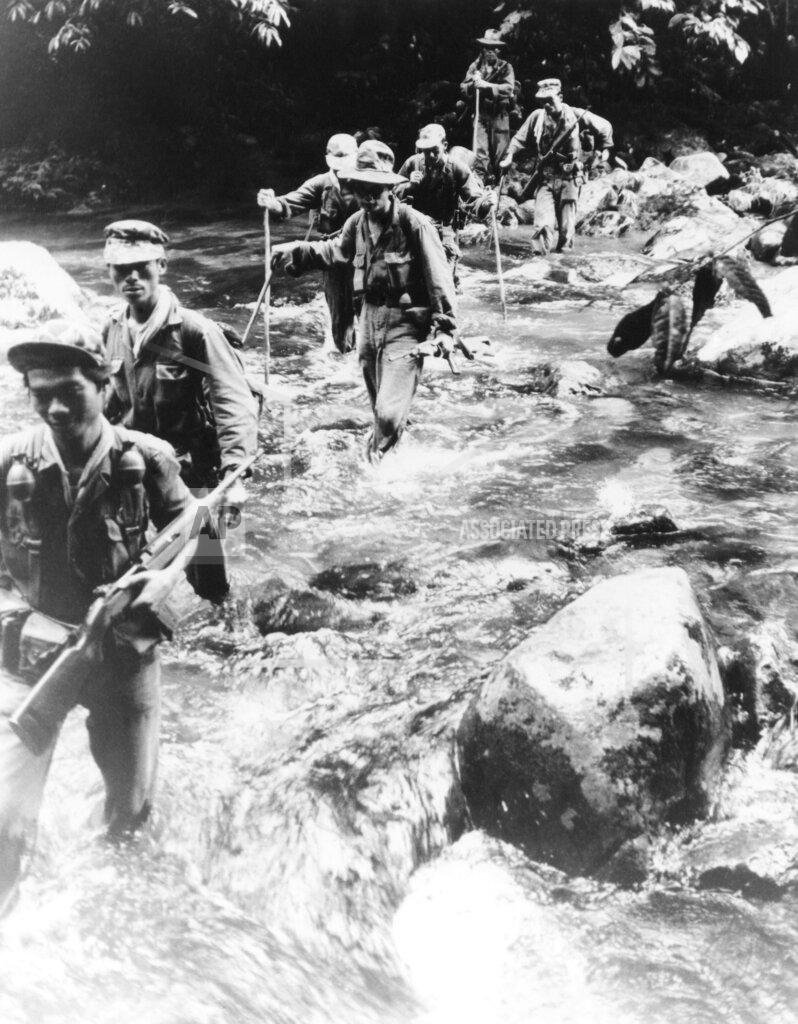
In South Vietnam, the High National Council (established on 26 September) issues a new draft constitution providing for a chief of state, a premier, a cabinet and a legislative assembly; its preamble explicitly states that “the armed forces have rightfully asserted that they would return to their purely military duties and gradually hand over the power to a civilian government.”
The constitution for a civilian government in South Vietnam was officially presented today. It is designed to replace the caretaker setup under which Major General Nguyễn Khánh has been governing for two months. Completing three weeks of work, the 17-man High National Council published its constitutional document, the “Charter Establishing a Governmental Framework to End Legal Anomalies and Uncertainties Remaining From Saigon’s Political Crisis of Late August.” In August General Khánh took presidential power, and this led to riots. Many questions remained unanswered. The charter calls for a chief of state, with largely formal functions, for a Premier to head a Cabinet and for a national legislature. But no one was named to any posts. Informed officials expect Dương Văn Minh to be designated chief of state, resuming the functions he held from February until Aug. 16, when General Khánh introduced his shortlived presidential system. General Minh had started the High National Council on the job of drafting a constitution. The all‐important post of premier was still very much in doubt. It seemed unlikely that General Khánh would be selected.
The charter also reaffirmed South Vietnam’s opposition to Communism and to neutralization as a means of ending the military struggle against the Communist guerrillas. Until the members of the new government have been named, diplomats were unwilling to speculate on its effectiveness. The 4,000-word document left unsettled many of the political differences that have held center stage for the last month. A request by General Khánh for the “place of honor” for the military branch was not acknowledged in the charter. Officials understood, however, that a de facto arrangement could be worked out with a premier, mainly because the armed forces are able to overthrow any government they dislike.
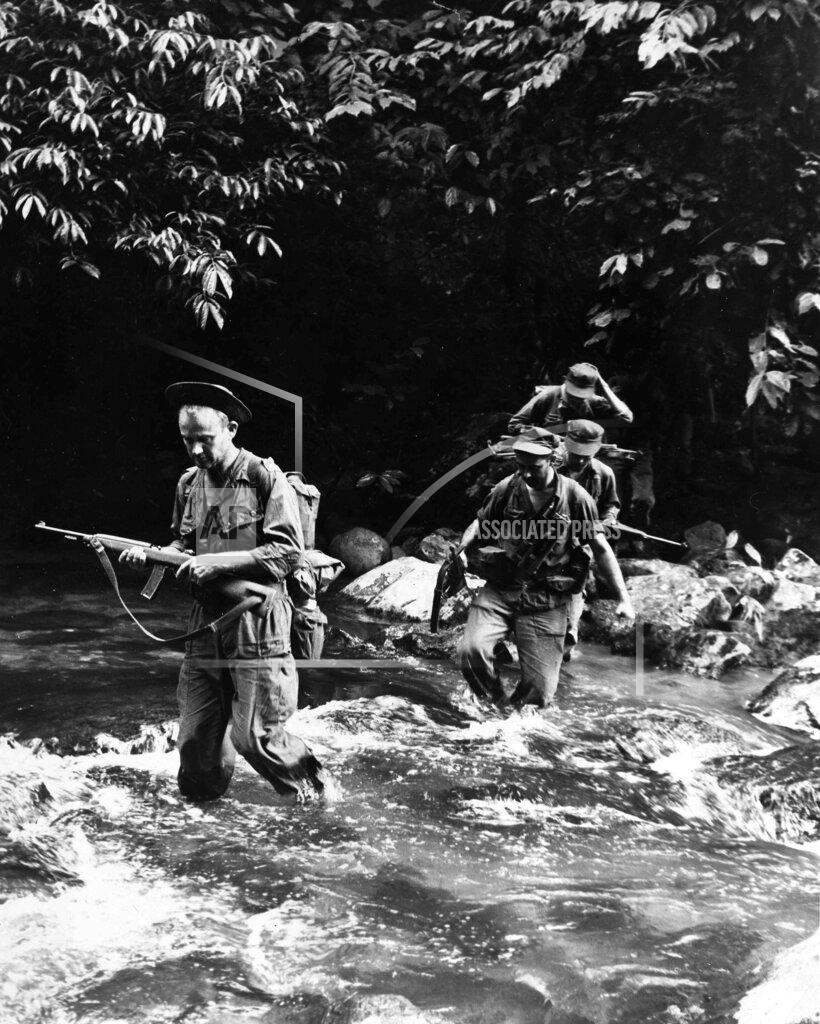
The United States reports that a helicopter operation, 80 miles southwest of Saigon, killed 34 Việt Cộng guerrillas.
Aircraft flown from South Vietnam flew into neighboring Cambodia and bombed the village of Anlong Chrey killing seven civilians. Cambodia protested to the United Nations, then shot down a U.S. transport plane four days later.
A series of incidents and charges this week bring relations between Cambodia, South Vietnam and the United States to their lowest point, but all three back away from a complete break. South Vietnamese planes strafe a Cambodian village on the 20th. When Cambodia protests, South Vietnam replies by charging Cambodia once again with providing refuge for Việt Cộng forces. On the 22nd, the United States charges that Cambodian troops crossed over into South Vietnam and seized a U.S. officer advising ARVN forces; on the 25th, the officer’s body is recovered just inside South Vietnam and Cambodia is accused of placing the body there to allow the rescue force to be fired on. Then on the 24th, a U.S. Air Force C-123, loaded with ammunition for a Special Forces camp, is shot down by Cambodians; eight U.S. servicemen are lost. By the 28th, the U.S. admits that the plane did stray over Cambodian territory by mistake, but the United States argues that such incidents arise because of the poorly defined border and the activities of the Việt Cộng in the area. Despite the charges and threats from Sihanouk, and despite the U.S. losses in personnel and planes, neither side pursues the matter.
Richard M. Nixon, stumping in Augusta, Maine today, charged that the Administration was preparing “for action, after this election, in Vietnam.” That action, he said, will be “the withdrawal from that country, or at least, a deal similar to the Laotian deal.” Mr. Nixon, appearing here before a crowd estimated at between 1,500 and 2,000, expressed concern over America’s image abroad. “Right now, respect for America is at an all‐time low,” he declared. Mr. Nixon declared that the Republican Presidential candidate, Senator Barry Goldwater, “can restore honesty, dignity and integrity into the highest office of our land.” “We should not put back into office for four more years, the same team that failed to handle even old Khrushchev in his final days,” he also said.
Twenty‐four nations have provided or promised aid to the South Vietnamese Government in its war against the Communist rebels, according to a report today from the Foreign Ministry. The number of contributing nations has doubled in the two months since United States officials here issued a similar study. Israel, India, Spain, Brazil and Austria are among the nations that have recently pledged some form of assistance.
The new Soviet leaders face deep problems in attempting to restore Communist unity in Eastern Europe, according to experts on Soviet affairs. The specialists reached their conclusion on the basis of reports from all of the East European countries that once constituted a solid Communist bloc. Not one of the East European capitals in the Russian bloc reacted to the ouster of Nikita S. Khrushchev with enthusiasm.
In each case the reaction has been reserved or even somewhat hostile. In almost every case, pro forma recognition of the new Moscow leadership has been accompanied by tributes to the contributions of Mr. Khrushchev. In a number of cases, direct questions have been raised about the manner and method of the Moscow shake‐up. The East European Communist reaction has been almost as cool as that of Western Communist parties.
The reserved attitude in East Europe casts in relief the task facing Mr. Khrushchev’s successors in seeking again the kind of unity the Communist world had before the death of Stalin 11 years ago. At that time East Europe was a solid Stalinist preserve, with the exception of Yugoslavia, which broke away from Moscow’s control in 1948. Stalin’s successors — Premier Georgi M. Malenkov, Foreign Minister Vyacheslav M. Molotov and Security Chief Lavrenti P. Beria — were acclaimed without reservation in Eastern Europe.
The leaders of the Soviet Communist Party and Government approached the United States Ambassador in Moscow for a brief friendly chat at a Kremlin reception last evening. A State Department spokesman reported today that Leonid I. Brezhnev, First Secretary of the Soviet Communist party, and Premier Aleksei N. Kosygin noticed Ambassador Foy D. Kohler at the party for three Soviet cosmonauts and approached him to exchange a few words.
The substance of their greeting was that they were interested in improving relations with the United States and that the quest for peace would be one of the main efforts of the Soviet Government, the spokesman said. Officials here said that the discussion was general and that they did not interpret the conversation as promising any new policy initiatives by either side.
President Johnson, after briefing members of his Cabinet at the White House today, reiterated that the changes in the Communist world did not at this time “indicate sharp or sudden changes in the policies of the United States.” “It is of the utmost importance that there be continuity and stability in the United States’ policies and purposes during this period of international change,” the President said. His comment was taken to have both diplomatic and political meaning.
The Soviet Union disclosed tonight that a decline in its rate of industrial growth continued in the third quarter of 1964. The decline has been evident for some time. The slowdown of economic growth, reflected in official statistics, has been interpreted here as a key grievance behind the overthrow of Nikita S. Khrushchev last week by his associates in the Kremlin. One of the Soviet Union’s high‐level planning agencies announced today that a third of the nation’s apparel and footwear industries would be converted to a consumer‐oriented production and marketing system by the middle of next year. The decision meant the adoption of a proposal, under discussion in the Soviet press for the last few months, that the market should determine the quantity and quality of consumer goods.
The system, proposed originally by Prof. Yevsei G. Liberman, a Ukrainian economist, was publicized during Mr. Khrushchev’s rule as party chief and Premier. His successors have made it clear that they intend to continue policies to improve the lot of the Soviet consumer. The continued fall of the Soviet industrial growth rate emerged from a summary of the economic report covering the first nine months of this year, made public by the press agency Tass. Tass said that the rate of increase in the first three quarters compared with the same period of last year was “more than 7 percent.” The rate in the first quarter was “about 8 percent” and in the first half of 1964 7.5 percent, suggesting a steady decline of the rate from quarter to quarter.
Nikolai T. Fedorenko, the Soviet representative, reiterated today the refusal of his Government to pay the $52.6 million it owes for the United Nations Congo and Middle Eastern peace‐keeping forces. Mr. Fedorenko said after a talk with U Thant, the Secretary General, that “our position, on this question is clear and principled and unchaneed.”
Air Marshal Vladimir A. Sudets, a Soviet deputy defense minister, arrived here today at the head, of a three‐man military delegation to attend ceremonies marking the 20 th anniversary of Belgrade’s World War II liberation. They replaced the seven highranking Soviet officers, led by Marshal Sergei S. Biryuzov, chief of the Soviet general staff, who were killed yesterday when their plane crashed into a hill south of Belgrade during a fog.
Secretary of State Dean Rusk emphasized today the United States’ determination to proceed with its project for a nuclear-armed allied fleet manned by crews of mixed nationalities. Speaking at ceremonies marking the visit here of the guided-missile destroyer Claude V. Ricketts, a “demonstration ship” for the project, Mr. Rusk cited the visit as “tangible evidence” of the United States’ intentions. The Ricketts, which has a crew of Americans, Britons, West Germans, Dutchmen, Italians, Greeks and Turks, tied up at the Washington Navy Yard yesterday. Her home port is Norfolk, Virginia. The Secretary of State stood on the fantail of the warship as he addressed an audience of allied diplomats and military attaches sitting on the quay. After the ceremonies, the Ricketts was open for public inspection. The audience was composed of representatives of the countries that have been negotiating in Paris and London a proposed treaty establishing the force. The United States hopes to have the treaty signed by the end of the year.
The new Soviet government announced, by way of the official newspaper Izvestia, its approval of an experimental profit-based economic system that had been recommended by economist Yevsei Liberman of the Kharkov State University. On September 20, Liberman had noted in the Communist Party newspaper Pravda that two textile factories had increased productivity by allowing factory managers to depart from government-mandated production quotas and had relied instead on direct communication from retail stores and distributors concerning consumer need.
Herbert Clark Hoover, former President of the United States, died today at the age of 90. Death came at 11:35 AM in his suite on the 31st floor of the Waldorf Towers, following massive internal bleeding that began Saturday. His two sons were with him as he slipped into a deep coma that kept his final hours free of pain. Physicians and nurses had worked ceaselessly since he was stricken to prolong his final days. They arrested the bleeding in the upper intestinal tract and gave him frequent transfusions. But toxins poisoned his weakened system and, when bleeding recurred early yesterday, his heart could no longer take the strain. By 8 AM, it was apparent that his illness was terminal, as a medical bulletin put it.
The medical bulletin had been issued at 8:30 AM, signaling the end. Noting that Mr. Hoover had lapsed into a coma, the bulletin said: “Early this morning, bleeding from the upper gastrointestinal tract recurred, placing an unbearable burden upon his already strained vascular system. His heart, which has borna up magnificently throughout the illness, has begun tc fail and its rhythm has become totally irregular. Renal [kidney] function is inadequate for the demands of his system and toxic products are accumulating in his blood stream. The emphasis in this terminal phase of his illness is upon keeping him comfortable and free of pain.”
Mr. Hoover, born in an Iowa village, the son of a Quaker blacksmith, was an exponent of a credo of personal initiative that he summed up as “rugged individualism,” and his life exemplified it. His parents were poor and he was orphaned at 9, but he amassed a fortune as a mine engineer and owner. With the start of World War I, he directed the evacuation of 200,000 Americans from Europe. It was the first of a series of massive economic, evacuation and food relief activities that spanned half a century. He was Secretary of Commerce in the Administrations of Harding and Coolidge and was elected President on the Republican ticket in 1928. The crash of the stock market on October 29, 1929, plunged the nation into its worst economic crisis in history. His policies were attacked as insufficient to spur economic revival. He was voted out of office in 1932 under the cloud of the Great Depression, called the “Hoover Depression” by his opponents.
Some later judgments, however, have suggested that he was the victim of events that coincided with his tenure. And 30 years of public service, including tasks for two Presidents after he left the White House, restored him in the affections of millions. At news of Mr. Hoover’s death, President Johnson proclaimed a 30-day mourning period and ordered the flags lowered to half‐staff at the White House and on all Federal buildings and grounds in the nation, on Navy vessels at sea and at embassies and military stations abroad.
The Treasury reported today that the Federal Government had spent $41 million less in the first three months of the present fiscal year than in the same period a year ago. This was the first decline from the previous year in Federal spending in five years and only the second in 10 years. According to current estimates the reduction from the spending level of the previous fiscal year will continue, meaning a reduction for the fiscal year as a whole. The decline in spending in the. first quarter of the fiscal year 1965 occurred despite recently enacted Federal civilian and military pay increases and largely reflects the recent downward trend in defense spending. Secretary of Defense Robert S. McNamara told reporters today, after seeing President Johnson, that military spending in the current year would be $700 million to $800 million less than the original estimate last January of $51.2 billion, foreign military aid included. Mr. McNamara’s figure today was essentially a confirmation of an earlier, highly tentative estimate made last May.
Speaking of next year’s budget, which will go to Congress in January, covering the fiscal year 1966 beginning next July 1, Mr. McNamara said it was too early to say whether there would be a reduction from this year’s level. However, he said he was “quite confident” that! defense spending would decline as a percentage of the nation’s total output; or gross national product. The President told him, he said, to set levels of military strength in light of the nation’s security needs, not on the basis of fiscal limitations. However, Mr. Johnson also emphasized his desire that every dollar of waste and inefficiency “be squeezed out of the department,” Mr. McNamara said.
[Ed: Vietnam and the entitlements of the Great Society are about to put an end to these savings.]
The Pike County grand jury in Magnolia, Mississippi disclosed four indictments involving eight persons today after investigating racial bombings in the area. The eight men named in the indictments brought to nine the number of white men indicted. The grand jury previously returned four indictments that named some of those accused in the latest ones. The new indictments came to light as the trial of Ernest Zeeck, 25 years old, an appliance store employe, was rescheduled for Friday. Mr. Zeeck, among the original defendants, had been slated to go to trial today. The four new indictments named:
- Paul D. Wilson, Billy Earl Wilson, Hilton Dunaway and Gerald Lawrence, charged with illegal use of explosives at the home of Charles Bryant on July 26.
- Paul D. Wilson and Billy Earl Wilson, charged with an incident at the James Baker house Sept. 9.
- Jimmy Wilson, Paul D. Wilson and Murphy J. Duncan Jr., charged with attempted arson July 18 at the Sweet Home Missionary Baptist Church.
- Paul Wilson, Jimmy Wilson, Billy Wilson, John Paul Westbrook, Emory Allen Lee and Murphy J. Duncan Jr., on charges of conspiracy to set off an explosion at the home of Mrs. Alyene Quin September 20.President Johnson will make campaign appearances tomorrow in three states and visit former President Harry S. Truman in a Kansas City hospital. These plans, announced tonight, revised a previously announced program so that Mr. Johnson could attend on Thursday in New York a memorial service for former President Herbert Hoover, who died there today. President Johnson also plans to be at Union Station here on Friday when Mr. Hoover’s body arrives to lie in state in the rotunda of the Capitol.
Mr. Johnson will call on Mr. Truman at the Research Hospital in Kansas City, where the 80-year‐old former President is recuperating from injuries suffered in a fall in a bathroom at his home in Independence, Missouri, one week ago. Mr. Truman broke two ribs and was cut over the eye. No agenda for the meeting with Mr. Truman has been announced, but the President has made it known for some time that he would like to visit with the former President “to hear his advice and counsel.”
Senator Barry Goldwater; said in Pikesville, Maryland tonight that President Johnson “doesn’t understand the President’s job.” The Republican Presidential candidate charged that in the field of foreign relations, Mr. Johnson and his “curious crew” had followed a “policy of drift, deception and defeat” until the nation’s affairs abroad “are in a shambles — and you know it.” “I charge that this Administration has a soft deal for Communism,” he said. The situation in Cuba, Berlin and Vietnam is the product of this “soft deal,” Mr. Goldwater contended. “Lyndon Baines Johnson has sowed the wind of weakness,” he said. “He has reaped the whirlwind of war.” He then promised to put an end to “the soft deal for Communism.”
Senator Hubert H. Humphrey threw some of the hardest punches of the campaign at the “radical right” today. In territory that is Republican‐oriented — Tulsa, Oklahoma, Peoria and Decatur, Illinois — he questioned Senator Barry Goldwater’s Republican credentials. In terms of support for President Eisenhower’s foreign policies, “I think I’m a better Republican than Senator Goldwater is,” the Democratic Vice-Presidential nominee told an enthusiastic crowd that almost filled a half‐block parking lot in Tulsa. He described John Birch Society members as “despicable” people who shrank from the sunlight and played upon the fears and frustrations of Americans. “If the price of political victory is to divide this nation, to breed suspicion and distrust, it’s too high a price and we won’t pay it,” Senator Humphrey declared.
Mrs. Barry Goldwater was the guest of honor today at a reception and luncheon of the Republican Women of Huntington Township on Long Island, in New York. Two thousand women and the county’s Republican candidates attended. Speaking briefly Mrs, Goldwater said she had one favor to ask. “On November 3, vote for my husband. I think you know him. His name is Barry.”
Miss Ann Ellen Christensen of Newell, Iowa, a 20-year‐old business college student, admitted today that she threw an egg that hit Senator Barry Goldwater during the Republican Presidential candidate’s visit here last Friday. Miss Christensen pleaded guilty to a charge of disorderly conduct and was sentenced to serve 15 days in the county jail or pay a $50 fine. Municipal Judge John Hutchinson gave her until Friday tq pay the fine.
Lee Adams and Charles Strouse’s musical adaptation of Clifford Odet’s “Golden Boy”, starring Sammy Davis Jr. opens at Majestic Theater, NYC; runs for 569 performances.
A riot at a Rolling Stones concert in Paris leads to 150 arrests.
Mad Dog Vachon beats Verne Gagne in Minneapolis, to become NWA champ.
Johnny Keane pulls another shocker by signing to manage the Yankees. Keane, three days after resigning as manager of the World Champion St Louis Cardinals, replaces Yogi Berra as the New York Yankees’ field boss. The new skipper of the Bronx Bombers will not fare well next year, leading the aging team to their first losing season since 1925. Keane resigned because he felt he was going to be replaced by team owner Gussie Busch with Leo Durocher. He will be replaced 20 games into the 1966 season after starting 4 – 16.
Red Schoendienst is appointed manager of the Cardinals. Schoendienst, a favorite former player, is named as the Cardinals new manager, replacing Johnny Keane, who resigned the day following the team’s Game 7 Fall Classic victory over New York. He will compile a 1,041-955 record for the Cardinals during 12 full seasons and two stints in 1980 and 1990 as interim skipper, capturing a World Championship in 1967 and an NL pennant in 1968. Schoendienst will be inducted into the Hall of Fame as Player in 1989 (Voted by Veteran’s Committee).
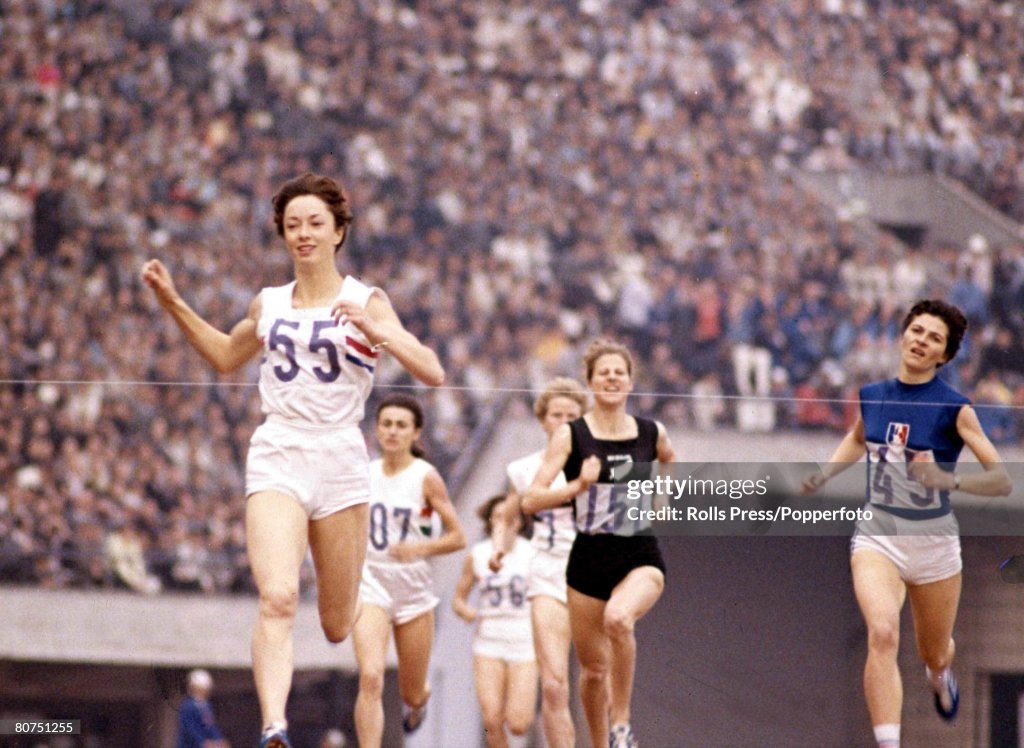
Ann Packer of Great Britain runs a world record 2:01.1 to win the women’s 800m gold medal at the Tokyo Olympics.
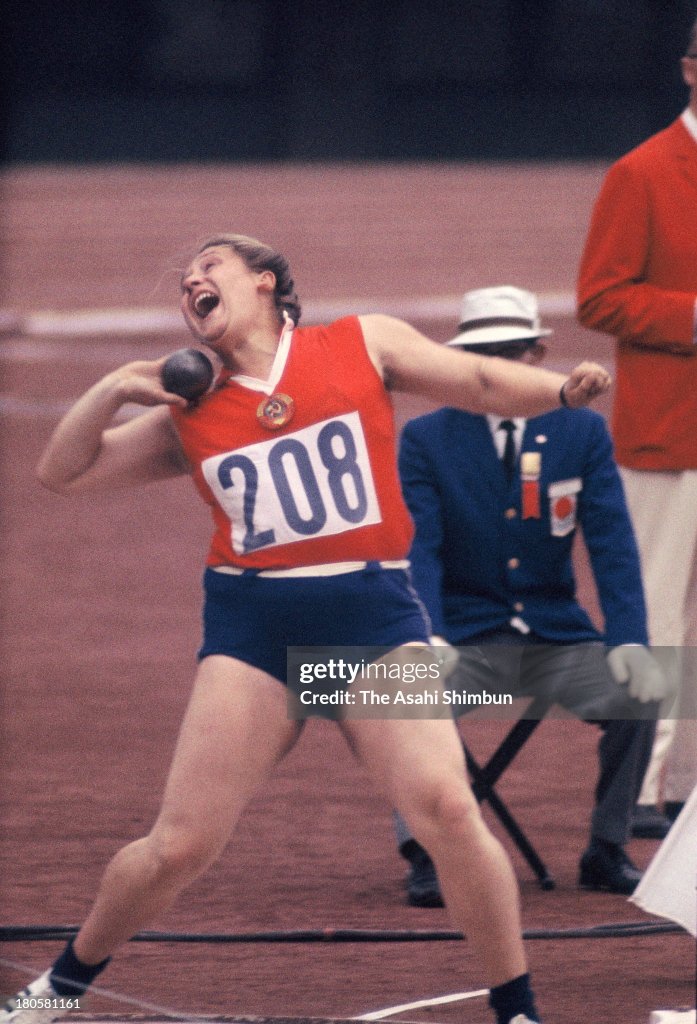
Tamara Press of the Soviet Union wins her second gold medal in 2 days by taking out the women’s shot put at the Tokyo Olympics; Press’ second consecutive Olympic shot put title.
Dow Jones Industrial Average: 881.5 (+5.29)
Born:
Kamala Harris [Kamala Devi Harris], U.S. Vice-President (2021–), previously Senator from California (2017–2021); in Oakland, California.
Manny Hendrix, NFL cornerback (Dallas Cowboys), in Phoenix, Arizona.
Zap Mama [Marie Daulne], Belgian-Congolese Afro-pop and world music singer-songwriter, born in Isiro, Democratic Republic of the Congo.
Died:
Herbert Hoover, 90, former President of the United States. Hoover, the 31st President, had served from 1929 to 1933, and expired at 11:35 a.m. in the Waldorf Towers in Manhattan, where he had retired after leaving the White House. U.S. President Johnson ordered flags to be flown at half mast for 30 days. At the time, Hoover was the longest-lived former U.S. President, a record that would be broken by Ronald Reagan in 2001, who was 93 years, 120 days, when he died in 2004; Gerald Ford would exceed Reagan’s record six weeks before his death in 2006, living 93 years, 165 days.
Miles Lampson, 84, first Baron Killearn, British diplomat (High Commissioner of Egypt and the Sudan)
Ben Simpson, 86, Canadian Football HOF running back, placekicker (Queen’s University, Hamilton Tigers)

 History Diaries