The new Soviet leadership lined up in Red Square today to show itself to the Soviet public for the first time since the overthrow of Nikita S. Khrushchev. In a giant homecoming celebration for the Soviet Union’s three latest astronauts, the leaders repeatedly stressed the collective character of their leadership. They announced their intention to assure the continuity of Soviet policies in foreign and domestic affairs. They pleaded for unity in the international Communist movement and refrained from polemical statements of any kind against the Chinese Communists.
Their restraint in this respect appeared to confirm the impression prevalent here that one of their first major efforts may involve improving relations with the Chinese, the Rumanians and other Communist groups with which there was friction under Premier Khrushchev. Throughout the day of celebration and speeches for the three astronauts who made a joint flight last week, the leaders conducted themselves as if Mr. Khrushchev had never existed.
In the line of leaders, The Associated Press reported, were Leonid I. Brezhnev, the new party leader; Aleksei N. Kosygin, the new Premier; President Anastas I. Mikoyan and Mikhail A. Suslov and Nikolai V. Podgorny, members of the party Presidium. Tens of thousands of Muscovites who paraded through Red Square waved and smiled at the new leaders in a single row atop the Lenin Tomb. If the crowds were thinking of Mr. Khrushchev, there was no way of knowing. “Collective leadership” was the principal theme of all the speeches and even of the slogans on the red banners above the route the motorcade took from the airport.
The role of the Communist party, the Soviet people and the workers of the country was emphasized. The role of the leaders and of individuals was not mentioned. “Long live the glorious Communist party founded by Lenin “ one slogan said. “Long live the Soviet people, builder of Communism,” said another. The astronauts each made a speech atop the Lenin mausoleum. Each concluded by hailing the Communist party and its “wise” and “Leninist” Central Committee.
Valery F. Bykovsky and Valentina V. Tereshkova, the astronauts from an earlier space flight, both ended their speeches on that occasion by hailing the party and the Central Committee “headed by Nikita S. Khrushchev.” The new Soviet leaders have accused Mr. Khrushchev of pursuing a Stalin‐like cult of personality. Even the invitation to the evening reception in the Kremlin made little of personalities. The reception was given in honor of the unidentified “scientists, designers, engineers, technicians and workers” who made the space flight possible, and only in the last place was there a reference to the astronauts.
In spite of the emphasis on “collective leadership,” it was clear throuhgout the day that Leonid I. Brezhnev, the new First Secretary of the party, had gained a dominant position, at least for the time being. He was the first to greet and embrace the three astronauts at the airport. More important, it was he who delivered the day’s principal speech, a televised address from the Lenin mausoleum to the cheering crowd. Mr. Brezhnev said that the foreign and domestic policy that had been in existence for the last eight years would remain “the only, immutable” line of the Soviet Government and the Communist party.
Marshal Sergei Semyonovich Biryuzov, Chief of Staff of the Soviet Army, was killed today in the crash of a Soviet airliner a few miles from Belgrade, Yugoslavia, which he helped to liberate 20 years ago. Six other senior officers of the Soviet Army and 11 crew members were killed with him. They were on their way from Moscow, 1,100 miles away, to participate in celebrations tomorrow marking the anniversary of Belgrade’s liberation. Marshal Biryuzov, 60 years old, had been commander of the 37th Army, which punched its way through German Wehrmacht units into Serbia in the fall of 1944 after crossing Rumania and Bulgaria.
The plane that took him to his death was an Ilyushin-18 turboprop. According to Tanyug, the official Yugoslav press agency, the pilot called the tower of Surcin airport, eight miles west of here, at 11:30 AM. The tower control operator said later that the pilot had told him he was at an altitude of 5,000 feet. It was raining hard, a 30-mile‐an-hour wind was blowing, and there was a heavy mist. The operator told the Soviet pilot to descend to 3,500 feet and make his approach from the west. The Ilyushin apparently approached too low and off course, for it slammed straight into Avala Hill, whose peak is 1,700 feet. The time was 11:34 AM. The plane smashed into the wooded hillside from the west about 120 feet below the peak. It tore through 130 feet of beech trees and then caught fire and exploded. One engine landed on a road that winds to the top of Avala.
The Novorossiysk Sheskharis Oil Terminal, one of the largest such terminals in Russia, provided its first shipment of crude oil, with the delivery of 37,000 tons of petroleum to the tanker Likhoslavl at the harbor on the Black Sea.
Thirteen U.S. servicemen and four U.S. civilians believed to be held as prisoners by the Việt Cộng for over two years have not been allowed to contact their families and the Red Cross has been unable to make contact with them. Seventeen Americans, including one woman, are believed to be captives of the Communists in South Vietnam. Nor have there been confessions of guilt issued in the prisoners’ names. The pro‐Communist Pathet Lao had broadcast a confession statement last summer from Charles F. Klusman before his escape last month in Laos. At the American Embassy officials dealing with the cases of the four civilians will not discuss them except to say that all are believed to be alive. The United States and Vietnamese military are similarly guarded about attempts to rescue the nine enlisted men and four officers held by enemy forces. Five American pilots are officially listed as missing in action, but the prospect that they are alive and in VViệt Cộng prisons is considered remote.
The South Vietnamese Ministry of Defense reported today that 749 men died last week in the war with the Việt Cộng. Communist casualties were nearly double those of the government forces, the ministry said. The fighting, which ranged from near the North Vietnamese border to the Mekong delta in the south, involved more than half a dozen battalion‐size clashes. The Ministry said 524 Việt Cộng soldiers had been killed and 149 captured, contrasted with 225 dead and 239 missing on the government side.
James Pickerell, a 28-year‐old freelance photographer who has worked in South Vietnam for about a year, was shot through the leg today by a Việt Cộng soldier while on an operation in the Mekong delta town of Vĩnh Long. The photographer, a resident of Wilmington, Ohio, was on assignment for The Associated Press when he was hit. Mr. Pickerell accompanied a series of helicopter operations from Vĩnh Long this morning.
Leaders of the Roman Catholic minority in South Vietnam are quietly making preparations to defend their faith under the difficult circumstances that they could face under a Communist-influenced regime. Books and pamphlets circulated among parishes in recent weeks as well as articles in the offical Catholic press resemble guidance material given to churchgoers in North Vietnam in 1954 when the Communist Việt Minh Army moved toward victory in the war of independence against France. Catholic leaders avoid open expressions of defeatism when discussing the present war against the Communist guerrillas. But their fears point to an increase of discreet instruction and discussion about how Catholics can preserve their faith when confronted with a hostile government.
The fears do not seem to be directed against the rising Buddhist influence in South Vietnam because Catholics and Buddhist leaders are making progress toward interfaith cooperation. Rather, in common with moderate Buddhist leaders, prominent Catholics are fearful of Việt Cộng infiltration into Buddhist ranks, of Communist gains through unauthorized agitation under the Buddhist flag. Catholic newspapers have printed articles lately discussing the problems of evacuating Catholics from South Vietnam if the need should arise. Australia, Canada, and Latin-American countries have been cited as desirable points of refuge if they would admit the Vietnamese.
The National Liberation Front has maintained an office in Havana, Cuba for over two years to propagandize its achievements. The Communist Việt Cộng have set up. a propaganda and training mission in Cuba, Senator Kenneth B. Keating says in an article in Look magazine, published today. Writing in the November 3 issue of the magazine, the Republican candidate for the Senate declared that the first Việt Cộng mission from North Vietnam arrived in Cuba, in August, 1962, to establish “a political base in Havana.” “Our Government still will not admit that the Việt Cộng guerrillas have a base in Cuba,” Mr. Keating said: The task of the mission, he said, is to propagandize for the achievements of Communist guerrillas in Asia and to attack the policies of the United States in Asia.
Chancellor Ludwig Erhard said today that the new regime in Moscow would be no more responsive to Germany’s desire for reunification than was former Premier Khrushchev. The sober forecast of the immediate consequences for Germany was the central point in the Chancellor’s first measured appraisal of the change in Soviet leadership. Dr. Erhard spoke in private before a caucus of Christian Democratic Deputies and his remarks were later summarized by a party spokesman. He is understood to have based his expectation of continued Soviet support for Communist East Germany and partition on an analysis made by Soviet specialists here.
There has been little enthusiastic response abroad to Communist China’s first nuclear test. There were no congratulations from most Communist Governments and parties, including those that support Moscow in the ideological dispute with Peking and those that tend to remain neutral. In the first 48 hours after the detonation of the Chinese nuclear device last Friday, the only nonaligned government that publicly welcomed the test was the Southeast Asian kingdom of Cambodia. In a message to Foreign Minister Chen Yi, which was distributed abroad by Hsinhua, the Chinese Communist press agency, the Cambodian Government “warmly greeted the nuclear success.”
Prime Minister Lal Bahadur Shastri said tonight that India was “confronted with a nuclear menace in Asia, something new for this peace‐loving continent.” Communist China, he said, is “trying to build up a mighty war machine and thus create fear in the minds of all.” The Chinese atomic explosion is a “step further,” he said. In an apparent allusion to the change in Soviet leadership, which has worried India because of a possible rapprochement between Moscow and Peking, he added: “In recent days we have seen events of greater significance happening in other parts of world.” In a radio address on the eve of the second anniversary of the Chinese Communist incursion in Northern India, Mr. Shastri called on the Indian people “to realize that the preservation of the freedom and territorial integrity of the motherland calls for incessant efforts, vigilance and alertness.”
Several West German technicians working on missile development in the United Arab Republic have been persuaded in recent months to leave Cairo. Competent sources said, however, that a government‐sponsored effort to lure German missile scientists and technicians out of the United Arab Republic had had only limited success so far.
Eight young East Germans escaped from their Communist homeland to West Germany by various means over the weekend, the border police in Hof reported today.
Two Swedish Army officers were sentenced today to two years at hard labor for abuse of their official status and dereliction of duty while serving with the United Nations force on Cyprus. The defendants, Lieutenant Helge Hjalmarsson and Lieutenant Lars Lindh, admitted in a Stockholm court that they had tried to smuggle arms for Turkish Cypriotes. The officers were arrested last month. Lieutenant Hjalmarsson said his sympathies “were absolutely on the Turkish side.”
President Johnson gave a “highly classified briefing” on recent international developments to the Congressional leaders of both parties today. It brought forth no criticism of the Administration’s foreign policy or suggestions for changes in it. The President outlined the world picture in the light of the shake‐up in the Soviet Union and the Chinese Communist atomic test. He said at a news conference later that a “thorough discussion” had followed the briefing. In the discussion, he said, he reaffirmed to the group that the new developments in world affairs required a careful watch, but “they only reinforce the need for continuation of our basic bipartisan foreign policy.” One of the principal subjects of campaign attacks by the Republican Presidential candidate, Senator Barry Goldwater, has been the Administration’s conduct of foreign affairs.
The President, who canceled several days of campaigning to deal with recent international developments, said that he was eager “to go out and have some visits with people.” Soon afterward his office scheduled political appearances at noon Wednesday in Akron, Ohio, at noon Thursday in Memphis and at 8 PM in Baltimore. After today’s two‐and-a‐halfhour meeting in the Cabinet room of the White House, the Republican leader, Senator Everett McKinley Dirksen of Illinois, said that the briefing had been “very thorough,” but he added that there were “still a lot of questions, a lot of problems, a lot of unresolved matters.”
The House Republican leader, Representative Charles A. Halleck of Indiana, called the briefing “very interesting and informative.” On the Democratic side, the House whip, Representative Hale Boggs of Louisiana, said that he felt “very encouraged,” and Senator George A. Smathers of Florida, the secretary of the Senate Democratic Conference, said: “This was as full a briefing as we have ever had.” None of them gave any substantive report of the discussion.
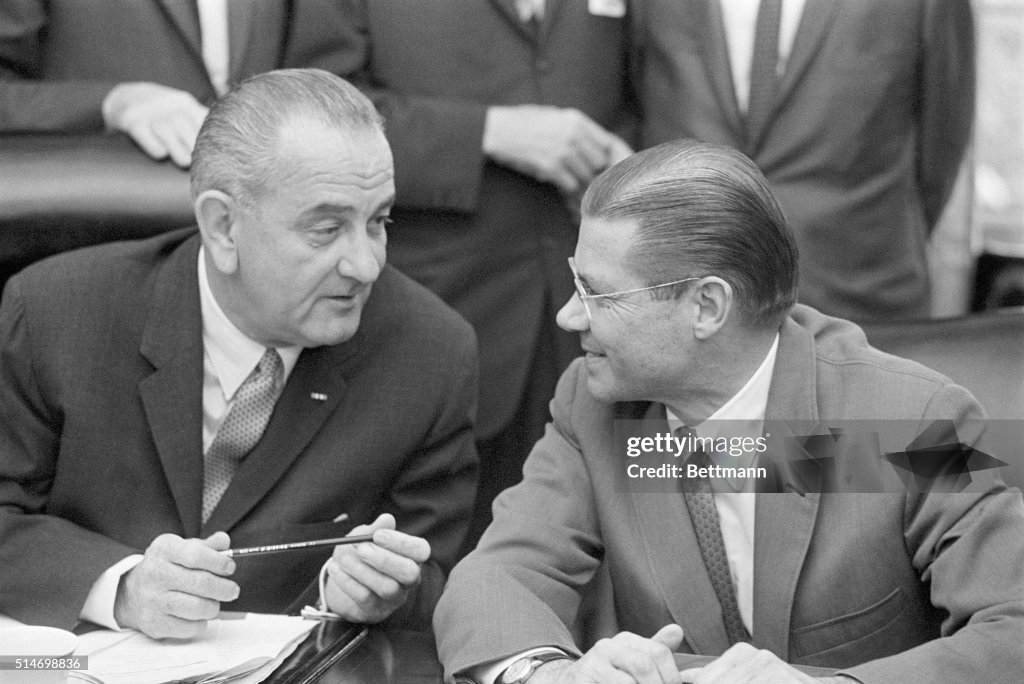
John A. McCone, Director of Central Intelligence, and Dr. Glenn T. Seaborg, chairman of the Atomic Energy Commission, discussed the Chinese nuclear effort. Secretary of Defense Robert S. McNamara, according to the President’s resume of the meeting, reported on defense plans and deployment, and said that they “take full account of the Chinese effort now and for the future.” “He emphasized as well,” Mr. Johnson said, “the enormous cost to all mankind of any nuclear holocaust, and he showed how the heavy strategic superiority of the United States deters and will continue to deter all possible opponents.” The President said that Llewellyn E. Thompson, Acting Deputy Under Secretary of State, gave a “very excellent review” of the probable causes and the meaning of the removal of Nikita S. Khrushchev es Soviet Premier.
Former President Herbert Hoover remained in critical condition last night. The 90-year‐old statesman had rallied slightly from a “state of unresponsiveness,” according to his physicians. Mr. Hoover was stricken Saturday with a “sudden and massive internal hemorrhage from the upper gastrointestinal tract.” His large losses of blood were replaced by transfusions. A medical bulletin issued yesterday morning at the Waldorf Towers, where Mr. Hoover occupies a 31st‐floor suite, said that the internal bleeding had been arrested and his blood count had been restored to normal. But toxic products, accumulated in his bloodstream as a result of the loss of blood, had induced the state of unresponsiveness. There was no elaboration on this, but it seemed to indicate a mild coma.
The Federal Communications Commission turned down today a Republican demand for free air time equal to the time used by President Johnson in his address to the nation last night. The three national networks also rejected the demand. But the National Broadcasting Company, in what it termed “a spirit of fairness,” gave 15 minutes to Dean Burch, Republican National Chairman. Although Mr. Johnson’s talk lasted slightly more than 15 minutes, Mr. Burch used only 12 ½ minutes of the time allotted him. In his broadcast tonight over N.B.C. facilities, Mr. Burch repeated almost verbatim the statement he read to reporters this afternoon, charging that the President last night had demanded free time for what had been billed as an address of “national significance,” but which was a “patently political” broadcast.
Senator Barry Goldwater has asked J. Edgar Hoover to explain why Walter W. Jenkins, former aide of President Johnson, did not get “a thorough security check and investigation upon moving into a highly sensitive position in the White House.” In a letter written and released today, the Republican Presidential nominee said to the director of the Federal Bureau of Investigation: “It certainly is apparent from what has already been disclosed that no such check was asked for or made.” Mr. Jenkins’s resignation was requested and received last Wednesday after it was disclosed that he had twice been arrested on morals charges — on January 15, 1959, and last October 7.
Mr. Goldwater told Mr. Hoover that “around 6:30 A.M.” last Saturday “I was visited in Chicago, Illinois, by two of your agents to ask whether I knew anything of the personal habits of Mr. Walter Jenkins, former top assistant to President Johnson.” Mr. Goldwater said he had informed the agents that his limited knowledge of Mr. Jenkins was “based on the fact that he is a member of my Air Force Reserve squadron on Capitol Hill.’“ Mr. Goldwater is a major general in the Air Force Reserve.
The Republican candidate then told Mr. Hoover that it seemed curious to him that two agents had called on him; that the “unusual hour” had reflected “apparent urgency,” and that during the interview of a few minutes, the agents had not asked his opinion of Mr. Jenkins’s “loyalty to the country.” His sole interest in the affair, he told Mr. Hoover, “has been confined to the possible security factors contained therein.” He said he would regard himself as “remiss” if he did not acquaint Mr. Hoover with his concern over one central issue. This, he went on, was: “Why was Mr. Jenkins not subjected to a thorough security check and investigation upon moving into a highly sensitive position in the White House?”
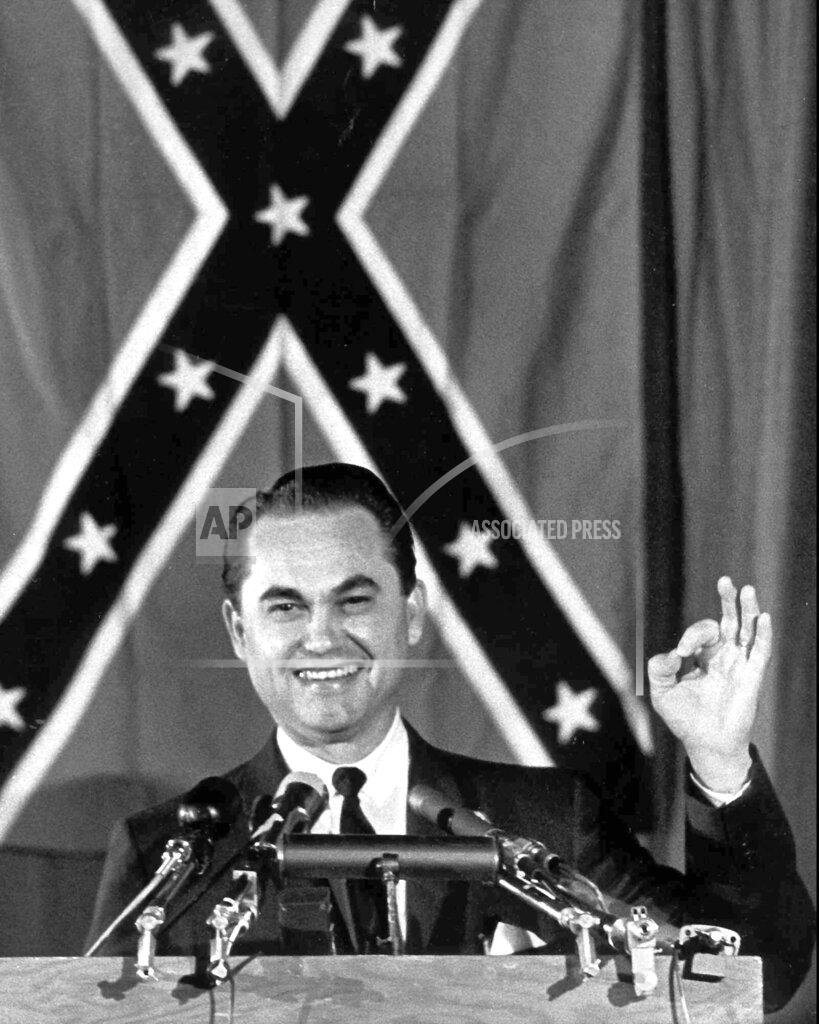
Governor George C. Wallace of Alabama resumed his campaign here tonight against “trends in our country.” The segregationist Governor still maintained that his speeches in the North against the Civil Rights Act and against school integration were not designed to help Senator Barry Goldwater, the Republican Presidential candidate. However, the Governor’s appearance here was sponsored by officials of the Anne Arundel County Democrats for Goldwater Committee. They are the same persons who staffed the “Wallace for President” drive last spring in the Democratic primary. Mr. Wallace told a capacity audience of about 1,100 in the National Guard Armory here that “millions of Americans like you who stand with us are going to put the Liberals back where they belong.”
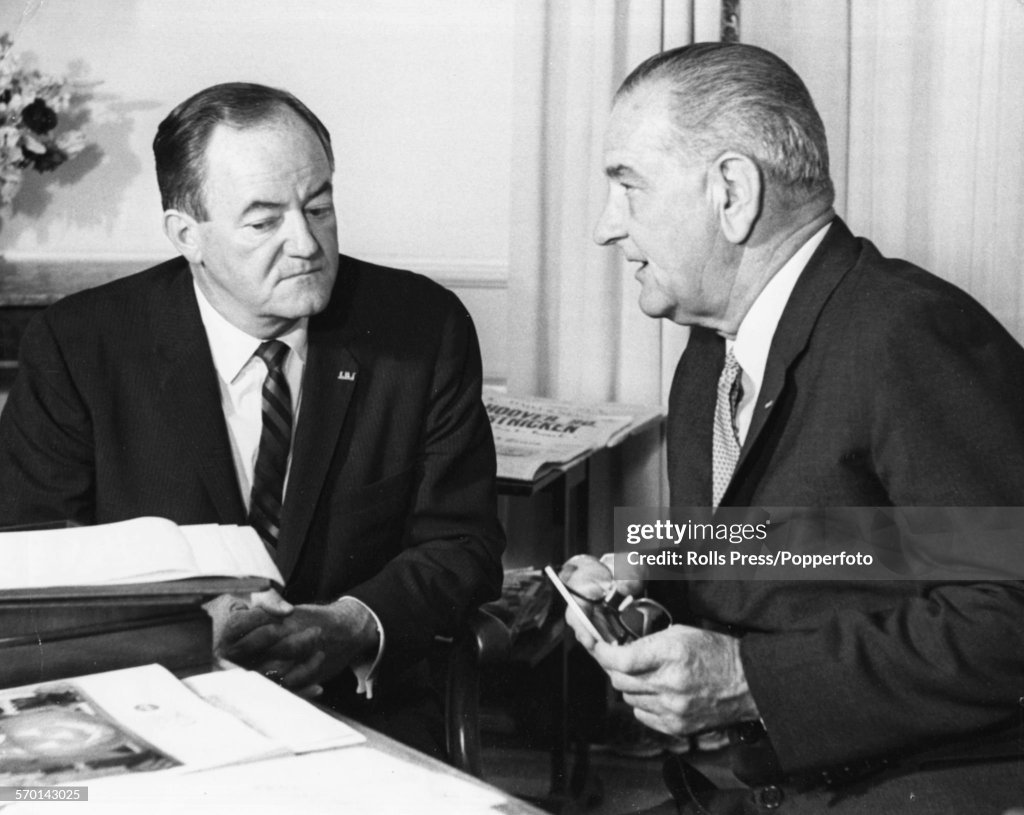
Senator Hubert H. Humphrey said tonight that Senator Barry Goldwater was an “unhappy warrior” who could find nothing good to say about the nation or its future. The Democratic Vice‐Presidential nominee told a frequently cheering crowd of 1,500 in the Ardmore Civic Auditorium that the Republican Presidential nominee “is neither a conservative, nor a real Republican, but a radical.” Mr. Humphrey interspersed his prepared speech with ad lib statements that drew cheers from the partisan crowd. He said Mr. Goldwater had voted 25 times against items contained in the 1960 Republican platform.
Senator Barry Goldwater is losing where he was strongest — in the rock and sage desert of the mountain West. Even in his native state and political stronghold of Arizona, the Republican Presidential nominee is thought to be running behind President Johnson. There is no indication this last week that Mr. Goldwater had benefited from the disclosures about Walter W. Jenkins, a close associate of Mr. Johnson.
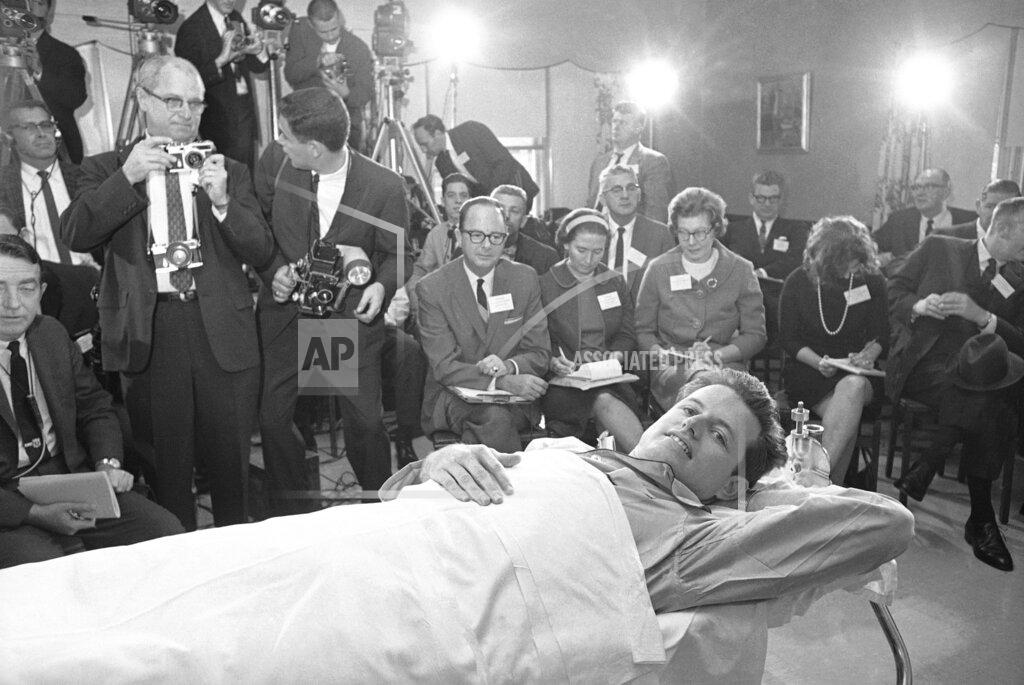
“Then there was complete silence…” Senator Edward M. Kennedy, strapped to an orthopedic bed, paused briefly today in an account of the plane crash four months ago that left him with a broken back. There was also a momentary hush in the hospital directors’ room as the Massachusetts Democrat folded his hands to study them before he went on. With his wife, Joan, at his side, Mr. Kennedy faced about 80 reporters and cameramen in his first news conference since his accident. He joshed with them and they called him by his nickname, Teddy, and Mrs. Kennedy by her first name. Mr. Kennedy expressed confidence that he would walk out of the hospital before Christmas and take his seat in the Senate some time in January. Clad in light blue pajamas and white socks, the 33-year‐old youngest brother of the late President, John F. Kennedy, spoke into a microphone from the frame in which he has been confined since June 19. The Senator could move his arms and legs but he remained supine throughout the conference. He was asked to recall the crash in his own words. By the time he finished, he was shaking and his voice quavered. But he quickly recovered and began to relax as he adroitly replied to political questions.
Republican women by the thousands jammed the corridors of the Waldorf‐Astoria Hotel yesterday to welcome Mrs. Barry Goldwater to the city. The women — estimated by the sponsoring group at 12,000 — waited up to an hour and a half in some cases to extend their greetings to the wife of the Republican candidate for President. Mrs. Betty Milbum, a press aide to Mrs. Goldwater, said it was the largest crowd that had turned out to greet the Republican Presidential candidate’s wife.
The nearly intact bones of a woolly mammoth (Mammuthus primigenius) were discovered near the town of Kyle, Saskatchewan, where William MacEvoy was working with a construction crew on the building of a new road. When the scraper blade on an earthmover exposed large bones, MacEvoy recognized its significance and work halted until the rest of the skeleton could be found. Radiocarbon dating determined that the mammoth had died sometime between 10200 and 9800 BC.
NASA and the National Academy of Sciences announced the taking of applications for NASA Astronaut Group 4, the first to be chosen from scientists rather than pilots. According to the announcement, a candidate had to be a U.S. citizen, no taller than six feet (183 cm), born on or after August 1, 1930, and to have an M.D. or a Ph.D. in natural sciences or engineering. Three physicists, two physicians and a geologist would ultimately be chosen as the six candidates.
Ailing Fred Hutchinson (60-49) resigns as manager of the Cincinnati Reds. Hutchinson, who compiled a 443-372 (.544) record and won the 1961 National League pennant during his six seasons with the team, formally resigns as manager the Reds. The 44 year-old much-respected skipper, after a courageous battle against lung cancer, will die three weeks later in Bradenton, Florida.
Harry Walker is named manager of the Pirates. Walker becomes the skipper of the Pirates replacing Danny Murtaugh, who will return to the field as an interim manager during the 1967 season replacing his fired successor. During his two-plus years in the Pittsburgh dugout, ‘Harry the Hat’ compiles a respectable 224-184 (.549) record but is let go after his team plays .500 ball after competing for the National League flag the previous two seasons.
Branch Rickey is fired from his $65,000 per year consulting job with the Cardinals. Two days after manager Johnny Keane announces his departure from the Redbirds to join the Yankees, Cardinals general manager Bob Howsam announces the resignation of team consultant Branch Rickey, stating he has no explanation for the 83 year-old’s decision to leave the club. The move is seen as the continuation of the front office shakeup for the World Champs, that also includes the resignation of Eddie Stanky as the director of player development and the dismissal of former GM Bing Devine.
In a blanket finish in the 80m hurdles at the Tokyo Olympics, Germany’s Karin Balzer and Teresa Cieply of Poland both record 10.5 seconds with Pam Kilborn of Australia 10.6 seconds; Balzer is awarded the gold medal.
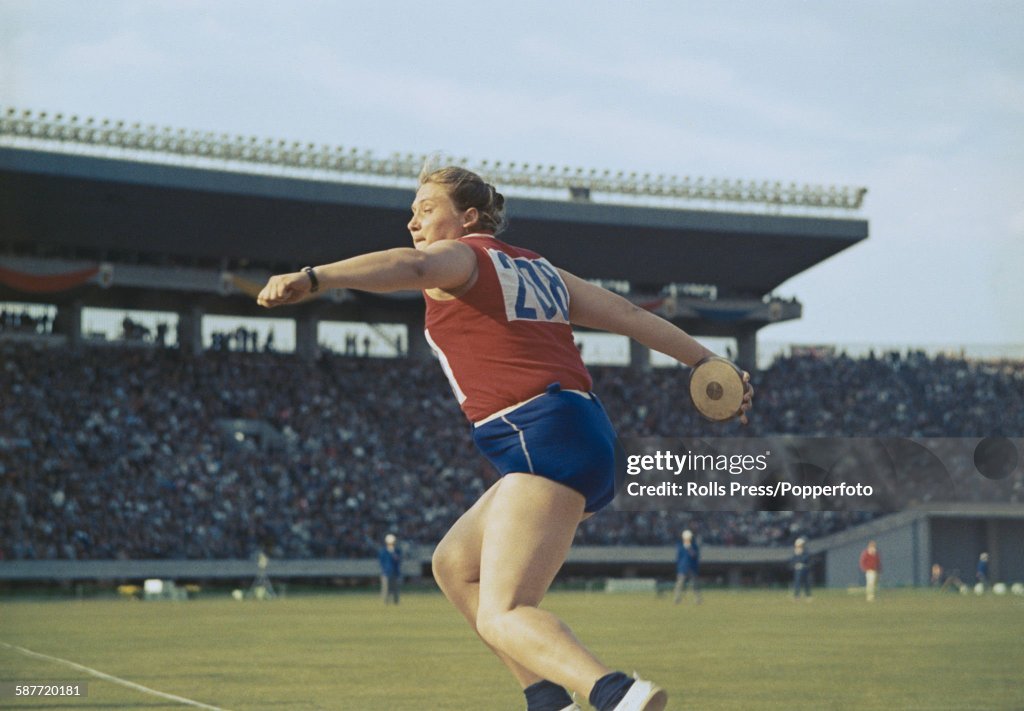
Tamara Press of the Soviet Union wins the women’s discus with an Olympic record throw 57.27m in Tokyo; first of 2 gold medals at the Games (the other in shotput).
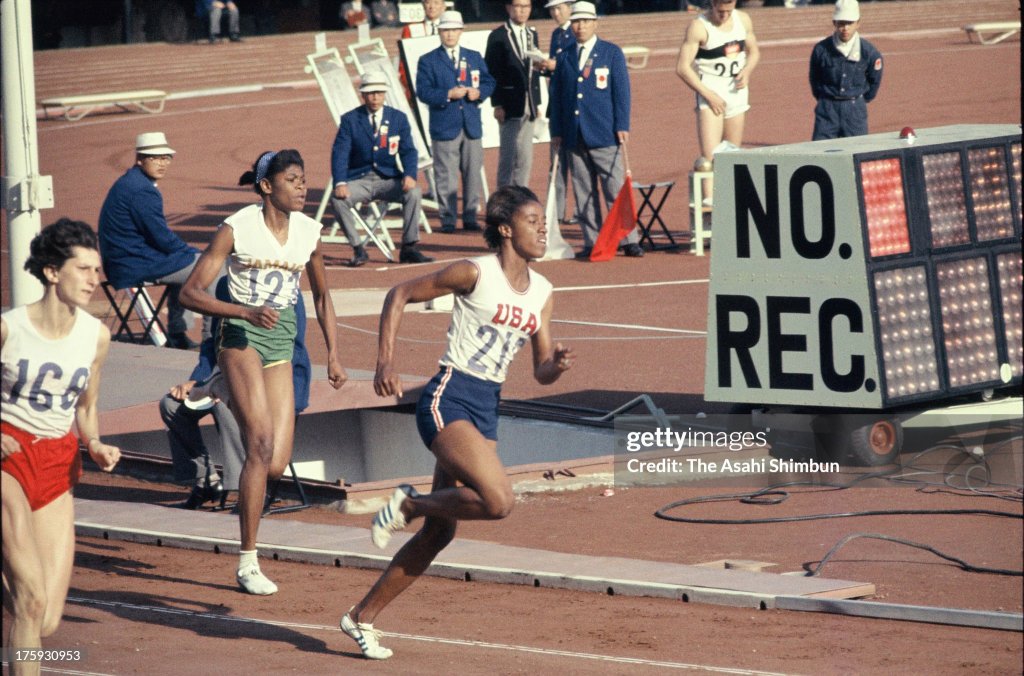
American sprinter Edith McGuire runs an Olympic record 23.0 seconds to win the women’s 200m gold medal in Tokyo; second- and third-place medallists Irena Szewińska of Poland and Australian Marilyn Black both record 23.1 seconds.
Dow Jones Industrial Average: 876.21 (+2.67)
Born:
Webster Slaughter, NFL wide receiver (Pro Bowl, 1989, 1993; Cleveland Browns, Houston Oilers, Kansas City Chiefs, New York Jets, San Diego Chargers), in Stockton, California.
Martin Rudolph, NFL defensive back (Denver Broncos), in San Pedro, California.
Mike Pérez, Puerto Rican MLB pitcher (St. Louis Cardinals, Chicago Cubs, Kansas City Royals), in Yauco, Puerto Rico.
Ty Pennington [Gary Tygert Burton], American television host (“Extreme Makeover: Home Edition”), in Atlanta, Georgia.
Agnès Jaoui, French actress, director and screenwriter, in Antony, Hauts-de-Seine, France.
Died:
Marshal Sergei Biryuzov, 59, Chief of Staff of the Armed Forces of the Soviet Union and the nation’s highest-ranking military officer, was killed along with six other Red Army generals and the airplane’s 11 member crew, when their Ilyushin-18 turboprop crashed into the side of Mount Avala in Yugoslavia’s Serbian Republic. The officers were on their way to a celebration of the 20th anniversary of Yugoslavia’s liberation from Germany in 1944.
Russ Brown, 72, American stage actor who won a Tony Award for the musical “Damn Yankees.”
Maurice Gosfield, 51, actor (Doberman-“Phil Silvers Show”).
Nettie Palmer, 79, Australian poet and essayist (“Henry Handel Richardson: A Study”).
 History Diaries