
Secretary of State Kissinger, will carry to Moscow next week “c oncrete propositions” on how to break the deadlock in the Soviet‐American talks on strategic nuclear arms, according to Administration officials. The officials acknowledged that the propositions were not new. Basically, they said, the idea is to “stabilize” competition in nuclear arms by allowing each side to maintain its different advantages in the context of overall equality and by slowing and limiting the deployment of new weapons. Nevertheless, the officials said they hoped that the specific totals of missiles, bombers, warheads and explosive power to be proposed by Mr. Kissinger could narrow the negotiating gap. Soviet diplomats have said — and American officials expect — that Moscow will make specific counterproposals, although neither side will present formal treaties.
Soviet and American diplomats spoke of the forthcoming talks with a mixture of anxiety and optimism. Their optimism was based on agreements reached in Moscow last July to seek a 10‐year accord rather than a permanent one, and to make the treaty as broad as possible, not just limited to controlling the numbers of multiple independently targeted re‐entry vehicles —known as MIRVs. These agreements, it is hoped on both sides, will leave more freedom to maneuver politically and to make more trade‐offs between different kinds of weapons systems than has been possible in the last two years. Their anxiety is tied to the belief that détente is in trouble politically in both countries and that an accord on strategic arms could provide needed medicine. This is coupled with a realization that it will be difficult to reconcile positions on strategic arms.
A Soviet diplomat said President Ford plans a summit meeting with Soviet Communist Party chief Leonid I. Brezhnev in Vladivostok next month, the Japan Broadcasting Corp. reported in Tokyo. A Soviet Embassy official in Tokyo was reported to have said that Ford is expected to go to the eastern Russian port city for two days after visits to Japan and South Korea.
The United States will permit the Soviet Union to buy 2.2 million metric tons of American grain between now and next June 30, it has been announced by Secretary of the Treasury William Simon. An aide to Mr. Simon, who estimated the Soviet purchases at $380 million, said the Russians have agreed to receive shipments in regular phased increments, so as not to disrupt the market.
Nearly 500 Greek and Turkish Cypriot prisoners of war were exchanged in an operation supervised by the International Red Cross and the United Nations. It was the second in a series of exchanges that will bring freedom for 3,400 prisoners on Cyprus. Many of the Turks chose to stay in northern Cyprus, the zone occupied by the Turkish army after its invasion of the island in July. More than half the released Greek Cypriots also chose to remain in Turkish-occupied areas, where their families are living in villages cut off by the Turks’ advance.
Sixteen Croatians have been charged with trying to overthrow the Yugoslav Government through assassinations and other terrorist acts and set up an independent Croatian state, crimes that could bring the death penalty, officials said today. Fifteen members of the group, which include professors and students, were arrested in June and the 16th is still at large, Public Prosecutor Zdravko Dragic said. The trial will take place next month. Mr. Dragic said they organized an illegal Croation Liberation Army, acquired guns and ammunition, planned robberies, fires, mining of industrial and military installations, and the assassination of political leaders.
A serious labor shortage is playing havoc with Czechoslovakia’s consumer and service industries. Many shops in Prague, the capital, although well‐stocked compared with those in other Communist nations, frequently shut down or close early because of a lack of manpower. Notices on store windows here read: “Closed because of the labor shortage.” Factories, transport, and postal and cleaning services are feeling the pinch, too.
The Roman Catholic World Synod of Bishops elected Archbishop Joseph L. Bernardin of Cincinnati to a new 15-member council of bishops that may help choose the next Pope. Msgr. Bernardin, a moderate, was the only bishop chosen on the first ballot by delegates to the Vatican City conference. The synod’s 209 bishops will elect 11 more members to the council next week. The remaining three are to be appointed by Pope Paul VI, who has said he is considering giving the council a role in the election of his successor.
Hundreds of anti-government protesters pelted police with rocks, set a jeep on fire and rushed up the steps of the National Assembly building in downtown Saigon. Police hurled rocks back at the demonstrators, who took to the streets demanding the ouster of President Nguyễn Văn Thiệu, an end to the fighting and the immediate release of all political prisoners.
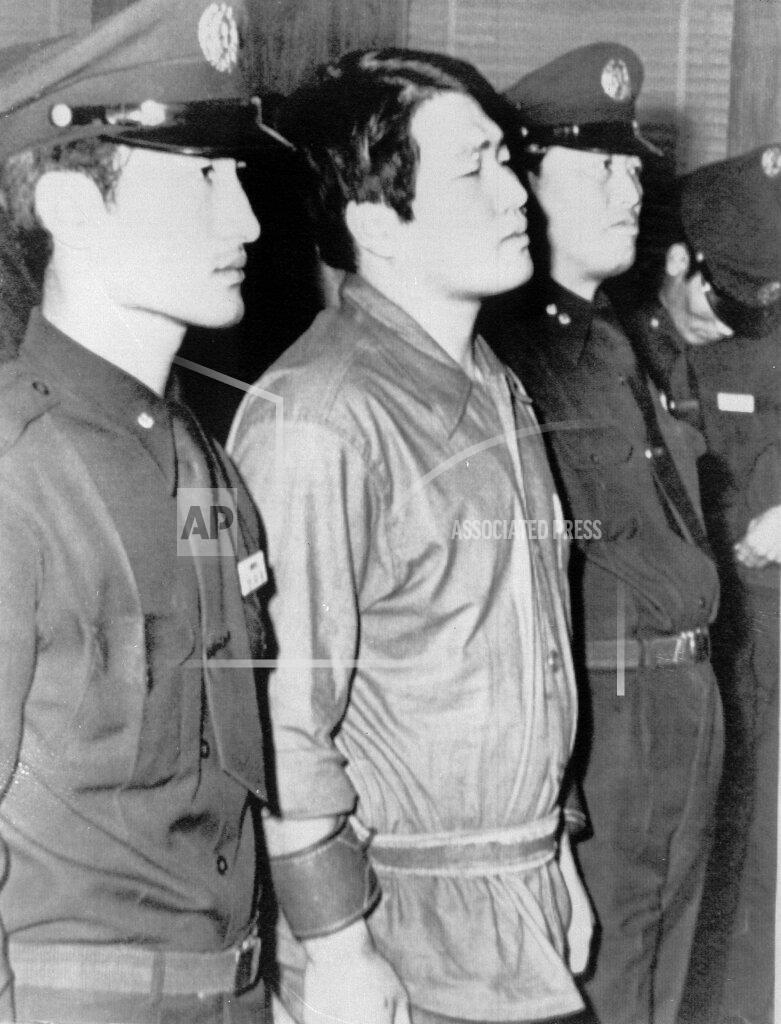
Japanese-born North Korean sympathizer Mun Se-gwang was sentenced to death for the murder of Yuk Young-soo, the First Lady of South Korea, during the attempted assassination of her husband, President Park Chung Hee, on August 15.
Typhoon Carmen with wind gusts up to 100 m.p.h. slammed into Hong Kong shattering windows, washing but roads, touching off minor landslides and spawning floods that forced thousands of persons from their homes and into government relief centers. Later, the storm headed for mainland China to the southwest, but most of its punch was lost. Only a few injuries-all of them minor-were reported. A benefit to Hong Kong was partial restoration of reservoirs, severely depleted in an unusually dry monsoon season.
Chinese Premier Chou En-lai, ill far five months with a reported heart problem, met in a Peking hospital with visiting Danish Prime Minister Poul Hartling. It was the first meeting the 76-year-old Chinese leader has had with a foreign visitor in two weeks. Despite his illness, Chou has continued to meet with important guests but reliable sources say the meetings have amounted to little more than an exchange of civilities.
Philippine government forces killed 26 Muslim rebels and. wounded 40 in what was called the biggest anti-dissident offensive launched so far in the southern province of Davao del Sur, according to a Manila newspaper. Military officials in Manila said they had no information on the report. A rebel camp was taken and rebels fled into the neighboring province of Cotabato, the paper reported.
The tiny South Pacific island of Niue attained self-government as an “associated state” within the Realm of New Zealand (which was 1,500 miles (2,400 km) away), after voters approved the arrangement in a referendum on September 3.
A major United States oil company, through the use of off-the-record phone calls and selective distribution of an internal memorandum, has brought international attention to the discovery of what the company describes as a major oil field in Mexico. The Mexican government has said that newspaper estimates of a field containing up to 20 billion barrels of oil were exaggerated, but did not release any estimate of its own. If the estimate proves true, the field would be about twice the estimated volume of the Prudhoe Bay oil field in Northern Alaska.
Now that the long drought is over, Timbuktu is the beautiful, changeless desert city of old once more. On the Muslim feast day marking the end of month-long fast of Ramadan, the regional governor, Capt. Korcissy Tall, received visits from dignitaries of the area, dressed in their finest robes. Afterward the elders took an afternoon promenade in the market square. And on the edge of town, where last year thousands of nomads camped for handouts of grain or medical attention — or waited for death from cholera, measles or starvation — now all is quiet and peaceful, with only a few hundred orphans or homeless elderly persons left living in the nearly deserted tent city.
A state of emergency was declared in the southern Sudan regional capital of Juba today following two days of student rioting that left two people dead, it was officially announced here. A statement by the regional government of southern Sudan said the two died in clashes between policemen and the rioters, who burned more than 60 cars and damaged a number of buildings. The riots started over rumors that 2,500,000 Egyptians were to be settled in the area of a planned irrigation canal project at Jonglei, about 150 miles north of Juba, the statement said. Two hundred people, Including three members of the southern Sudan regional assembly, were arrested following the riots and a dusk‐to‐dawn curfew has been imposed, the statement added.
The year 1974, the first to have double-digit inflation in peacetime, the year of Watergate reckoning and of the first presidential resignation in American history, is also a campaign year in which national issues, in the conventional sense, barely exist. Pulse takers and candidates agree that anxiety about the economy has driven other issues out of the public mind without giving voters a clear choice of economic remedies. And the Watergate scandal has given rise to the “politics of full disclosure,” called by some analysts “the politics of character.”
The traditional flow of basic foodstuffs from American farms to world markets has been radically altered by President Ford’s recent moves to monitor grain and soybean exports. With shortages of food confronting millions abroad with the specter of starvation, American grain traders believe the President’s action is the first step toward apportioning food exports and curbing food consumption in the United States.
In Washington, a leading tax lawyer has said that one argument used by Nelson Rockefeller to reduce his federal income taxes conflicted with an established Internal Revenue Service ruling. The service has overturned Mr. Rockefeller on this and other issues and will assess him $903,718 in delinquent taxes plus interest charges of $122,875, a total of $1,026,593 covering the period since 1969. The disclosure that his choice for Vice President had underpaid his income tax by 21 percent over the last years brought from President Ford a re-affirmation of his confidence in Mr. Rockefeller.
President Ford ordered federal departments and agencies to limit their energy consumption to levels 15% below the amounts used in the 1973 fiscal year, saying it would save the equivalent of about 55 million barrels of oil. The President said that he had instructed the Federal Energy Administration and the General Services Administration to recommend a long-range program to make the most efficient use of energy in all federal operations.
Vice President-designate Nelson Rockefeller has disclosed that since 1957 he has given approximately $24.7 million to 193 organizations. The gifts ranged from $10 to Phillips Academy at Andover, Mass., to $6.6 million to the Museum of Primitive Art in New York City. The donations to charitable, educational and other tax-exempt organizations include a wide range of such institutions as well as $6,500 to the United States government and $656,393 to New York state. Mr. Rockefeller said he was making the list of charitable contributions public because of the delay in reopening Senate hearings on his confirmation as Vice President. The gifts, a Rockefeller spokesman said, are only the personal donations of Mr. Rockefeller and his wife and do not include contributions from the family foundations.
Margaretta Rockefeller is reportedly making a rapid recovery from her breast cancer operation last Thursday, and physicians report an “excellent range of motion” in her left arm. Her husband, Vice President-designate Nelson Rockefeller, after a two-hour breakfast visit, spoke of the attention directed at breast cancer by Mrs. Rockefeller’s operation and that of Mrs. Betty Ford, wife of the President. “If Happy can help other people like she’s been helped, she’ll be happy,” he said.
Browner lawns are the prospect for next year if suggestions of the chairman of the Fertilizer Institute are carried out. “If we all have browner lawns and greener gardens we’ll be a lot better off,” said Joseph Sullivan, chairman of the institute and president of Estch, Inc., a Chicago fertilizer producer. He wants more fertilizer freed for food production. It is not known how much fertilizer goes annually to nonfarm uses such as green lawns or golf courses, Sullivan said. But even if it’s just a small amount it would be useful in meeting farmers’ fertilizer needs, he said.
The death of a mother of three who scalded soul singer Al Green with hot grits after he had rejected her marriage proposal was officially ruled a suicide by a Memphis medical examiner. Dr. James Bell made the ruling after performing an autopsy on Mrs. Mary Woodson, 29, of Madison, New Jersey, who was shot with a .38-caliber revolver. Green remained in a hospital in good condition with second-degree burns.
A $1 million extortion letter was received by the FBI after 11 high-voltage transmission line towers had been blown up in Oregon during the last month. The Bonneville Power Administration said that the FBI’s Portland office received a 22-page typewritten letter Friday night that was signed “J. Hawker.” Officials refused to pay the money and the power agency offered a $100,000 reward for information leading to the arrest of those responsible for the blasts.
Hearing aids sold over the counter often do not help the buyer and should be available only by prescription, according to a government study obtained by United Press International. The 50-page report, prepared under the direction of the Food and Drug Administration, supported recent charges by Senator Charles H. Percy (R-Illinois), himself a hearing-aid user, that the industry suffered from fast-talking salesmen who peddled inferior and overpriced goods.
Repayment of about $4.5 million to more than 300 persons, including some former Vietnam prisoners of war, victimized by a fraudulent bond sales scheme was ordered by a federal judge in Miami. U.S. District Judge Charles Fulton, calling the scheme “a horrible, vicious fraud,” ordered the assets of R. J. Allen and Associates held in trust and a receiver appointed to disburse to the bond buyers whatever money could be recovered. The Securities and Exchange Commission had sought the action in a civil suit. Testimony during a five-day trial disclosed that the firm had offered for sale bonds that it contended were insured and guaranteed against loss of either principal or interest. Interest from the bonds and, in many cases, the bonds themselves were never received by the investors, including at least four ex-POWs.
One inmate was killed and a dozen were injured in a cellblock brawl between black and white prisoners at Georgia’s maximum security prison at Reidsville. Living quarters at the prison were integrated in April, and prison department officials had been warning publicly that it was only a matter of time before crowded conditions would cause a racial clash.
More than 1,000 spectators were on hand in Sacramento for the formal dedication of the largest commercial nuclear power plant west of the Mississippi River. A small band of demonstrators passed out leaflets questioning the potential radiation hazards of the $375 million plant. Rep. Chet Holifield (D-California), former chairman of the Joint Committee on Atomic Energy, said at the dedication of the 913-megawatt facility, “A plant like this saves 12 million barrels of oil a year.” The Rancho Seco plant, located about 25 miles southeast of Sacramento, is owned by the Sacramento Municipal Utility District and is scheduled to reach full power next March.
[Ed: Unfortunately, Rancho Seco was continually plagued with problems due to design flaws, and was eventually shut down in 1989.]
Ronald F. Piskorski and Gary B. Schrager, members of a motorcycle gang, murdered 4 men and 2 women during a $300 robbery at the Donna Lee Bakery in New Britain, Connecticut.
A half dozen winners of Nobel Prizes and many other prominent figures in science gathered at the Massachusetts Institute of Technology in Cambridge issued a spate of ideas at a two-day symposium honoring Victor Weisskopf, a professor of physics, who is retiring. Although not a Nobel laureate, Dr. Weisskopf’s influence has been strongly felt in physics for the last several decades.
The Detroit Pistons beat the Trailblazers in Portland. They won’t win there again until June 1, 1990.
Detroit Red Wing Mickey Redmond scores his first hat trick against the Washington Capitals.
Virginia Slims Circuit WTA Tour Tennis Championship, Los Angeles Sports Arena; Australian Evonne Goolagong wins her first title, beating American Chris Evert 6–3, 6–4; Billie Jean King and Rosemary Casals win Doubles.
Born:
Leonard Little, NFL defensive end (NFL Champions, Super Bowl 34-Rams, 1999; Pro Bowl, 2093; St. Louis Rams), in
Percy Ellsworth, NFL safety (New York Giants, Cleveland Browns), in Drewryville, Virginia.
Cedric Harden, NFL defensive end (San Diego Chargers), in Atlanta, Georgia.
Joy Bryant, American actress (“Parenthood”; “Antwone Fisher”), in The Bronx, New York, New York.
Died:
Nick Licata (born Nicolò Licata), 77, Italian American mobster, boss of the Los Angeles crime family.
Frank L. Stanley Sr., 69, American civil rights activist and newspaper publisher (Louisville Defender), died of a heart attack.
William Tabbert, 53, American stage actor and singer known for the Broadway musical South Pacific, died of a heart attack.

 History Diaries