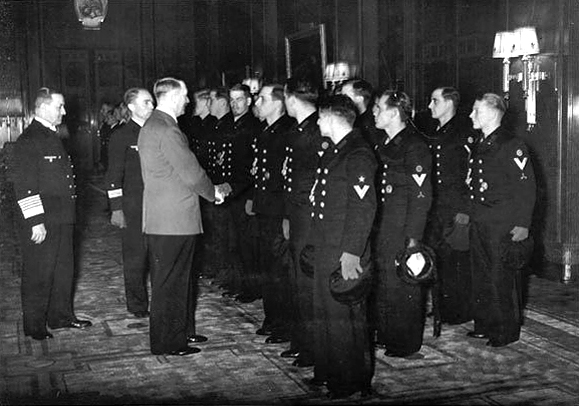
Hitler issued Directive No. 7, Preparations for Attack in the West.
The Supreme Commander Of The Armed Forces.
Berlin. 18th October, 1939. 8 copies
Directive No. 7 For The Conduct Of The War
For the prosecution of the war against the western enemy, until the beginning of the attack as planned, existing Directives are hereby amplified as follows:
- The following are permitted with immediate effect: The Army may cross the French frontier with patrols, but only in so far as this is necessary for reconnaissance, and to maintain contact with enemy forces in withdrawal. The Air Force may send fighter escorts over French territory in so far as this is necessary to protect reconnaissance aircraft. It may also attack English naval units in naval bases. (Verbal notice to be given.) The Navy may attack passenger ships in convoy or proceeding without lights. The Leader will decide on all further measures to intensify the trade war against England as soon as their political and economic effects have been considered by the High Command Of The Armed Forces. The attacks on English naval units at sea and in naval bases are to be kept up whenever a suitable opportunity offers and in close liaison between Navy and Air Force.
- Should it be necessary to oppose an Anglo-French invasion of Belgium (Directive No. 6 paragraph 6) the Army may also enter Luxembourg territory. The Air Force will, in this event, give direct support to the Army and will prevent attacks on the Army by the Anglo-French Air Force and the advance of enemy forces. It will also prevent the establishment of Anglofrench Air Forces and the landing of English troops in Belgium and Holland. For this purpose flights may be made over any part of the western frontier of Germany. Attacks on industrial targets, or such as might highly endanger the civilian population, are forbidden in Belgium, Holland, and Luxembourg. For the Navy, the principles set forth in Directive No. 6 paragraph 5 apply in this case also.
- In order to conceal our own plans for attack, authorities immediately subordinate to the High Command Of The Armed Forces (and in particular the Inspector Of Signals and the Security and Propaganda Divisions) will work in close collaboration, as will the Staffs of individual arms of the services. Proposals and requests in this connection will be made as soon as possible to the High Command Of The Armed Forces, Operations Staff (Defence Department).
(Signed) Adolf Hitler.
The crew of the U-47 was brought to the Reich Chancellory in Berlin where they all received the Iron Cross 2nd Class and the personal congratulations of Hitler. Captain Günther Prien was awarded the Knight’s Cross. Prien and the crew of the German submarine which is reported to have sunk the HMS Royal Oak at Scapa Flow flew to Berlin today in Chancellor Hitler’s private four-motored Condor airplane. They received a tumultuous reception from the population and were received by Herr Hitler in the new chancellory this noon.
Adolf Hitler institutes a new decoration for heroism, the War Merit Cross second class bronze with swords (Kriegsverdienstkreuz 2. Klasse mit Schwertern), also know as the KVK 2. It is an award for bravery by anyone who is not on the front lines.
The French notice signs of activity behind the German lines, but no renewal of their recent attacks.
Adolf Hitler ordered the German military to begin planning for the invasion of the Soviet Union, using Poland as a staging point.
General Johannes Blaskowitz sent a message to Adolf Hitler, complaining of SS atrocities in Poland.
Jews in Wloclawek, Poland were forced to wear the Star of David. On the same day, the first Jewish ghetto was established in Lublin, Poland.
The Kriegsmarine lays more mines along the English Channel.
Prime Minister Chamberlain reports that eight Luftwaffe planes have been downed by the RAF so far. First Lord of the Admiralty Winston Churchill estimates that the Germans have lost a third of their U-boats. In addition, Churchill reports that there were 24 officers and 786 men lost on the Royal Oak.
The British attempt to bomb Emden. The attack on Germany’s base for minesweepers is beaten off, the mayor of the town says.
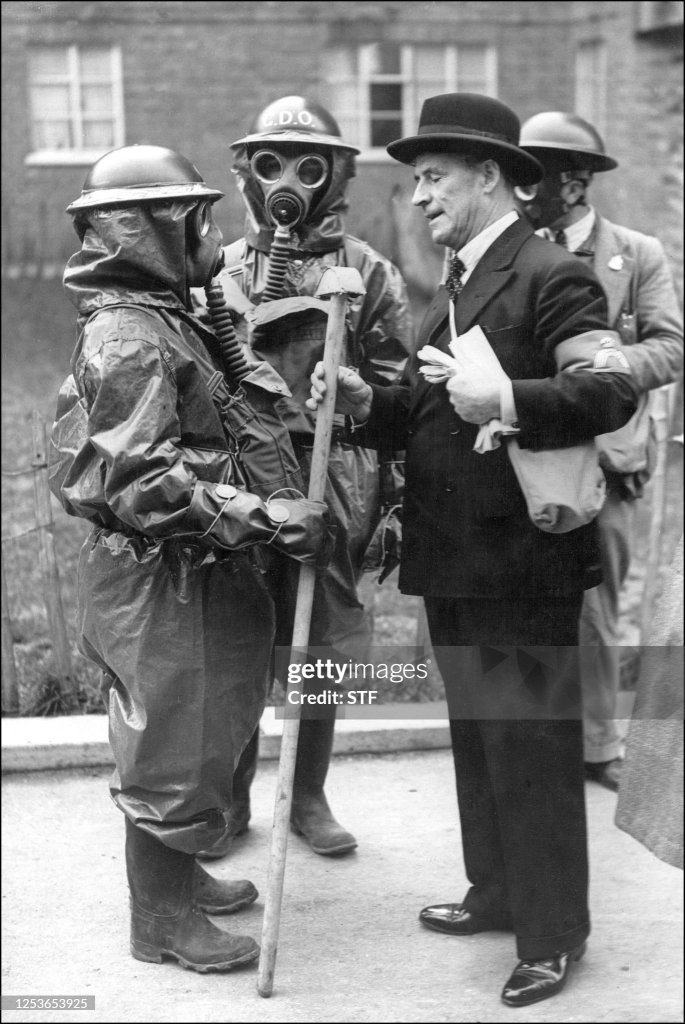
Death by accident doubles in Britain, but ministers are opposed to easing up on the blackout.
After the attacks on the Home Fleet in Scapa Flow, the Admiralty transfers the Home Fleet to safe anchorage on the Clyde. This move significantly weakens the Fleet’s strike effectiveness against any German naval unit that might put out to sea in the Atlantic or approach the eastern coat of Great Britain. The Germans fail to act upon this strategic advantage. The German aerial operations against the fleet also reveal the ineffectiveness of the German SC 550-lb bombs. Göring orders the development of heavier bombs.
Italian hopes to maintain influence in Southeastern Europe were thought tonight to be encouraged by the breakdown of the Turkish-Russian talks. Political circles believed the negative result of Foreign Minister Shukru Saracoglu’s visit to Moscow meant at least a temporary setback to expanding Soviet influence in the Balkans.
The Soviet Union set up military bases in Estonia, as Red Army troops entered the country and cut off all communications outside Estonia.
A protest is filed by the Polish government-in-exile over the transfer of Vilnius to Lithuania.
Moscow claims it is receiving reports of the presence of Polish “spies and agents provocateurs” in the former Polish parts of the Ukraine and White Russia. Tass calls for vigilance” and “special activity” by the NKVD.
The president of Finland meets with the kings of Denmark, Norway and Sweden in Stockholm to consider the threat resulting from Soviet demands for a revision of the Finnish-Soviet border. Hitler has already assured the Swedes that Germany will remain neutral in a war between Finland and the USSR and strongly advised the Swedes to do the same.
A firm declaration that the Catholic Church would not become involved in political controversies and territorial competitions now taking place but that it would, if necessary, defend Europe’s Christian heritage, was made by Pope Pius XII today.
Francisco Franco appoints his brother-in-law Ramón Serrano Suñer to be Spain’s Foreign Minister.
General Wavell, commander of British land forces in the Middles East, and General Weygand, former chief of the French General Staff, arrive by air in Ankara for talks with the Turkish General Staff. Meanwhile, the German Ambassador to Turkey, von Papen, is recalled by his government.
Dutch liner Simon Bolivar struck a German magnetic mine in the English Channel 10 miles east of Harwich, England, United Kingdom at 1030 hours; the mine was laid in this shipping lane without warning on the previous day; 86 were killed. The Netherlands made an official protest to Germany regarding this violation in international shipping law.
The German cargo ship Gonzenheim was intercepted in the Denmark Strait (63°25′N 12°00′W by HMS Rawalpindi (Royal Navy) and was scuttled by her crew.
British armed merchant cruiser HMS California stopped and captured German merchant ship Borkum in the Denmark Strait.
German armored ship Admiral Graf Spee transfers crews of British freighters Newton Beech and Ashlea to tanker Altmark. The two German ships then part company for a time.
U.S. freighter West Hobomac is detained by British authorities.
Convoy SL.5F departs from Freetown for London.
The War at Sea, Wednesday, 18 October 1939 (naval-history.net)
Destroyer AMAZON, which departed Plymouth on escort duty on the 17th, was damaged in collision with steamer ARACATACA (5378grt) at 1448 in convoy OG.3 in 47-38N, 08-08W. AMAZON had closed to pass information and the steamer altered course without warning. She was under repair at Portsmouth from 20 October to 28 November.
Destroyer BOREAS was attacked north of the Goodwin Sands by a German seaplane, but no damage was done.
Light cruiser CALEDON departed Kirkwall, and arrived at Sullom Voe on the 20th.
Destroyer AFRIDI attacked a submarine contact 3.2 miles 61° off St Abb’s Head. Destroyer WHITEHALL was ordered to stand by the location where AFRIDI had buoyed the “sunken submarine.”
Steamer IMPERIAL STAR (10,733grt) was attacked by a U-boat, 60 miles west of the Scillies in 49 54N, 7 52W. Destroyer INTREPID was sent to assist.
In submarine operations against convoy HG.3, steamers SAGAING (7968grt), GARBRATTAN (1811grt), CITY OF GUILDFORD (5157grt) and CLAN MCBEAN (5000grt) reported they were attacked on the 18th but undamaged. Destroyer ESCORT joined SAGAING and escorted her from the area.
Convoy Blue 5 departed Port Said on the 18th, but was dispersed and travelled without escort.
Light cruiser DANAE departed Lagos for St Helena, where she arrived on the 22nd.
Convoy SLF.5 departed Freetown, unescorted, and arrived at London on the 30th.
Today in Washington, President Roosevelt issued a proclamation banning submarines of belligerent nations from ports and territorial waters of the United States, and sent a message to King Gustav V of Sweden giving the moral support of the United States to efforts of Scandinavian countries to maintain Baltic neutrality. He conferred with Louis Johnson, Assistant Secretary of War, on national defense, and with Colonel E. O. Thompson, chairman of the Seven-States Oil Company.
The Senate continued debate on the Neutrality Resolution, hearing Senator Holt condemn the proposed repeal of the arms embargo, and recessed at 4:42 PM until noon tomorrow. Democratic members of the Foreign Relations Committee accepted a tentative formula for modifying shipping restrictions in the neutrality program.
The Horse appropriated $2,500 to obtain a bust of Thomas Brackett Reed, former Speaker; heard Representative Martin J. Kennedy pay tribute to the late Mgr. Michael J. Lavelle, and adjourned at 2:43 PM until noon tomorrow.
President Roosevelt banned all belligerent submarines from American ports and territorial waters except in cases of force majeure. The use of the ports and territorial waters of the United States by submarines of the belligerent powers was forbidden by President Roosevelt in a proclamation today. It was issued under provisions of the Neutrality Act designed to “maintain the peace” and “promote the security of the United States.”
The action was taken after reports had been received on numerous occasions of submarines of unidentified nationality off American coasts. Similar steps are expected to be taken by eighteen of the Latin-American governments, as the plan was discussed informally at the recent Panama conference on American neutrality and won widespread approval. It is believed that only two Latin-American governments may fail to follow the lead of the United States. These are Argentina and Uruguay, who are understood to feel that submarines should be treated as other war vessels under international law and not placed in a special category.
The proclamation issued by President Roosevelt did not take in the safety belt of 300 miles around the Western Hemisphere that was endorsed at Panama, but only the well established three-mile belt of territorial waters. That is deemed sufficient to serve the purpose of keeping submarines away from American shores, inasmuch as they will find it more difficult to operate on this side of the Atlantic if the chances of their refueling are reduced. With ports and territorial waters barred to them, they will be more than ever dependent on mother ships for replenishing their fuel supplies.
The Panama Canal Zone was exempted by the President and no official explanation was given for that action. Last month, however, President Roosevelt issued an executive order placing Major General David L. Stone in supreme command of the Canal Zone and giving him “exclusive authority and jurisdiction over the operation of the canal.” Under this authority General Stone would be enabled to prescribe any regulations as to movements of submarines or other vessels which he might deem necessary to the safety and proper operation of the canal, subject to obligations contained in treaties with other countries.
Submarines will be permitted to enter ports and territorial waters of the United States by force majeure, but must do so running on the surface and flying their flags. Any now departing from our territorial waters must also follow this procedure. Under international law force majeure means conditions of distress, but not attack by an enemy force, so that vessels fleeing a superior force would not have right of entry.
The authority contained in the existing neutrality statute permits the President to impose restrictions on submarines and armed merchant vessels of belligerents in United States ports and waters. No restriction was placed on the operations of armed merchant vessels.
A formula for amending the Pittman Neutrality Resolution in a manner to relax its stringent provisions on American shipping and to tighten further the requirements for “cash” trade between the United States. and warring nations was agreed to “in principle” today by the Senate’s Democratic authors of the measure. Meeting in closed session while Senator Holt of West Virginia made from the Senate floor another bitter attack against the embargo repeal and all forces behind it, these Senators authorized Senator Pittman of Nevada and Senator Connally of Texas to draft the amendments and present them at another gathering of the group tomorrow.
Under the principle as agreed on, American seacraft might not transport passengers and goods to or from any port in the North Atlantic Ocean, roughly, north of Latitude 30 degrees North. All the remaining waters of the earth, however, would be open to trade, except as to shipment in American vessels of arms, munitions and implements of war to possessions of belligerent nations. The open area would also be subject to the authority of the President to designate “combat areas,” as carried in another section of the Neutrality Resolution.
The effect of this plan would be to prevent American ships from plying to and from any of the ports involved in or near the hostilities in Europe. The prevailing opinion in the informal committee seemed to demand also that sea trade by American ships be prohibited between the United States and ports in Canada on the eastern seaboard. Senators contended that certain Canadian ports in the Atlantic now served by American ships protruded too far out toward war-torn Europe to make continuation of this traffic safe from the standpoint of our neutrality aims.
All ports in the Pacific, even those of Canada, Australia and New Zealand, would be left open to American ships, so far as the new amendment might control the situation. All ports in the Western Hemisphere south of Canada, regardless of nationality, would also be legal points of call for ships of United States registry. The Pacific and Western Hemisphere would be left entirely free for American air commerce. There was some thought among the Senators that a relaxation should be granted for American air services now carried on between the United States, Bermuda, the Azores and Portugal.
A preliminary draft of a report by the War Resources Board, forecasting a final report to be issued in about ten days, was submitted to President Roosevelt today by Louis Johnson, Assistant Secretary of War.
The United States liner President Harding was laboring through heavy seas toward New York last night after having received from the Coast Guard cutter Hamilton, far out at sea yesterday afternoon, a replenished store of medical supplies for seventy-three of her passengers and crew who were injured, twenty-three of them seriously, in a hurricane which swept through the North Atlantic in the last few days.
The C.I.O.—United Automobile Workers began “sabotaging” production two months ago, even before its contract with the Chrysler Corporation expired on September 30, it was asserted tonight by Herman L. Weckler, vice president in charge of operations, in a letter to Arthur E. Raab, chairman of the State Labor Mediation Board.
Cadillac-LaSalle orders increase by 40 percent over one year ago.
Fred Erwin Beal, an organizer of the Gastonia (N.C.) textile strike, testified under the watchful eye of a prison guard today that Communists had fomented the strike to promote a new textile union.
Deliveries of sugar increase, the largest total since March, 1937.
Retail sales increase by 7.3 percent, led by sales figures in San Francisco.
A shortage of scotch whiskey is feared because of the war and because of shortages during the Depression. There are two ships on the Atlantic tonight with 231,000 cases of eight-year-old Scotch whisky on board. If the Germans get it there is going to to be a shortage of aged Scotch before long.
An art exhibition titled “Contemporary Unknown American Painters” opened at the Museum of Modern Art in New York. The exhibition made 79-year old folk artist Grandma Moses famous.
Richard Rodgers and Lorenz Hart’s musical “Too Many Girls” opens at the Imperial Theatre, later transferring to the Broadway Theatre, NYC; runs for 249 performances.
The British tell India to develop unity; then, after war, it can become a dominion. While Indian leaders complained bitterly that Great Britain expects them to fight for democracy but denies democracy to India, the British Government declared today that until the war is finished and the people of India attain a greater measure of unity no material change could be made in their status.
Telegraphic reports from Chungking, received by usually reliable foreign circles in Shanghai, report that a large Soviet military mission arrived in the Chinese capital today from Moscow in five airplanes. They bring Red Army experts to aid the Chinese.
Naval landing force from gunboats Asheville (PG-21) and Tulsa (PG-22) and destroyer Whipple (DD-217) is withdrawn from Kulangsu, China, where it had been protecting the American Consulate and the Hope Memorial Hospital since 17 May.
Representatives from Britain, Japan, and the United States reached an agreement regarding to the presence of troops of all three powers in and near the Kulangsu (now Gulangyu) island international zone near Xiamen, China since May 1939; all three pledged to withdraw troops from the international zone and to suppress anti-Japanese activities in the international zone. United States and Japanese marines were withdrawn today from the international settlement on the island of Kulangsu off Amoy, China, after the Municipal Council had agreed to cooperate in the suppression of anti-Japanese agitation, to appoint Japanese policemen and to enfranchise Formosans. British and French marines withdrew at the outbreak of the European war. Traffic between the mainland and Kulangsu has been restored.
An adjustment of the Kulangsu incident was announced today by the head of the Municipal Council and the Japanese Consul General there, according to official reports to the State Department. The adjustment apparently closes the incident, which had its inception last May when the Japanese moved in after a pro-Japanese Chinese administrative official in the settlement had been killed. An American naval unit of forty-two men was sent there for protective purposes. Great Britain and France added their protests to that of the United States. The Western powers insisted that the international zone should remain undisturbed.
The agreement, which was reached locally after many diplomatic exchanges, appears here to reflect the more moderate temper of the new Japanese Cabinet and its desire to improve relations with other nations since Japan was stunned by the announcement of the Russian-German accord. It is believed that it foreshadows a more cooperative attitude by Japan in relationship with the Western powers concerning the status of the international settlements at Shanghai and Tientsin. When Japan moved on Kulangsu it was widely regarded as the first step in a plan to oust Westerners from all international zones in China. Under the agreement the rights of Britain and France at Kulangsu are said to be respected.
French authorities today turned over to Japanese officials Wang Jo-hai, former director of the Chinese Telegraph System and regarded as the most important Chinese Nationalist official remaining in Tientsin after the Japanese occupation. He had been detained in the French Concession since September 28.
Dow Jones Industrial Average: 153.54 (-1.02)
Born:
Lee Harvey Oswald, assassin of U.S. President John F. Kennedy, in New Orleans, Louisiana (d. 1963, killed by Jack Ruby after the Kennedy assassination).
Mike Ditka, NFL tight end (NFL Champions-Bears, 1963; NFL Champions, Super Bowl VI-Cowboys, 1971; Pro Bowl 1961-1965; Chicago Bears, Philadelphia Eagles, Dallas Cowboys) and head coach (Bears, Super Bowl XX Champions, 1985), in Carnegie, Pennsylvania.
Viktor Lisitsky, Russian gymnast (5 x Olympic silver USSR 1964, 68; World C’ship silver team 1962, 70), born in Magnitogorsk, Russian SFSR, Soviet Union (d. 2023).
Flavio Cotti, Swiss politician, member of the Swiss Federal Council, in Prato-Sornico, Switzerland (d. 2020).
Died:
Henry Halcro Johnston, 83, Scottish botanist, physician, rugby player and Deputy Lieutenant for Orkney.
Naval Construction:
The Nihon Kaigun (Imperial Japanese Navy) food supply ship (reefer ship) HIJMS Nosaki is laid down by Mitsubishi Heavy Industries, Shimonoseki shipyard (Shimonoseki, Yamaguchi Prefecture, Japan).
The Royal Navy Lake-class ASW whaler HMS Buttermere (FY 205) is commissioned. Her first commander is Chief Skipper George Stewart, RNR.
The Royal Indian Navy auxiliary patrol vessel HMIS Satyavati (FY 073) is commissioned. Her first commanding officer is T/Lieutenant Shri Krishan Kumarhia, RINR.


 History Diaries