A German counterattack begins driving out the few remaining French troops in Germany, and by the following night, no French forces remain on German soil. Initially, German forces strike along a 4-mile frontage immediately east of the Moselle River. French gunfire is credited with ending this advance. Later in the day, German forces attack on a 20-mile frontage east of the Saar River. The French “covering forces” retire, according to plan. Within 48 hours, the Germans push the French back from the gains of the Saar offensive in September. There are few casualties on either side though the Allies claim German forces suffer 5,000 casualties in the operations.
Nine planes of the Luftwaffe conducted an air raid on the Firth of Forth, damaging three British ships, the cruisers Southampton and Edinburgh, as well as the destroyer Mohawk, and killing sixteen Royal Navy crew before Supermarine Spitfires arrived and shot down two of the enemy aircraft, the first to be downed over British territory. The first strategic bombing of Britain took place as nine Junkers Ju 88s of the 1st Group of the Luftwaffe’s 30th Bomber Wing under Captain Pohle, dive bombers attacked British warships at Rosyth on the Firth of Forth in Scotland. The bombers slightly damaged the cruisers HMS Southampton and HMS Edinburgh and the destroyer HMS Mohawk. British Spitfires of the No. 602 and No. 603 Squadrons shot down two Ju 88s. The first German aircraft destroyed over Britain during WWII, a Ju 88A, is credited to Spitfires of No 603 squadron. A third German aircraft crashed later in Holland from damage received in the battle.
While providing escort for a North Sea convoy, destroyer HMS Mohawk was attacked by a German Ju88 aircraft. Before the dive-bomber was destroyed, it released two bombs which fell to starboard (abreast of the bridge) and to port (abreast of the torpedo tubes). The bombs exploded on the surface of the sea well before most men had time to reach their action stations. Machine gun bullets and jagged metal splinters decimated the mooring party on the focsle, slashed through the bridge, the wheelhouse, the director and the communications system. The personnel manning the machine guns, the search light position and after control position were mowed down by the projectiles. Fifteen men were killed and thirty injured, mostly experienced executive officers. On the bridge, Commander R.F. Jolly suffered a mortal stomach wound. While denying the comfort of medical attention, and in great pain and suffering, he commanded his ship for 35 miles until she was safely in port. After being taken to hospital at South Queensferry, England, he died several hours later. For his gallantry, the Captain was awarded the George Cross posthumously. The ship was patched up at Rosyth then made her way to the Hawthorn Leslie Yard on the Tyne River for permanent repairs and a refit.
The Battle of the River Forth was an air battle on 16 October 1939 between Supermarine Spitfires from No. 602 and No. 603 Squadrons of the Royal Air Force and Junkers Ju 88 bombers of 1. Gruppe Kampfgeschwader 30. It resulted when twelve Ju 88s attacked Rosyth naval base at the Firth of Forth. The raid was the first German air raid on Britain during World War II. At the time, Luftwaffe recorded loss of two aircraft, the RAF none; Fighter Command considered it a victory. After the war, it was discovered a third Ju 88 had been badly damaged and limped to the Netherlands, where it made a forced landing in which all the crew were killed. It is unknown how this aircraft was damaged, whether by Spitfires or by anti-aircraft fire. The two German aircraft shot down into the water were the first brought down in an attack against the British homeland. The German airmen who were captured were treated with courtesy and respect and their injuries attended to. Ultimately they finished up as prisoners of war in Canada. Those who had been killed and whose bodies were recovered were buried with full military honours.
German Grand Admiral Erich Raeder issued new orders concerning merchant ships. “All merchant ships definitely recognized as enemy ones (British and French) can be torpedoed without warning. Passenger steamers in convoy can be torpedoed a short while after notice has been given of the intention to do so.” The new orders also freed surface raiders to attack French ships; previously they have been restricted to British vessels. This marked the beginning of unrestricted submarine warfare by the Germans.
The German High Command announces the official end to the Polish Campaign. Some Polish regulars continue to resist in remote areas.
The Polish embassy in Paris claims that Polish troops continue to hold out against German and Soviet invaders in Suwalki, in the Carpathian Mountains, and in the Pripet Marshes at Bialowieza.
The Nazis ordered all Poles out of Gdynia.
Rarkowski, bishop of the German army, declares in a pastoral letter that “the Almighty God had visibly blessed the struggle against Poland that has been forced upon us.” (The average German soldier had no way of knowing for sure whether Poland had indeed mistreated its German minority, or fired the first shots as claimed by Hitler.)
RAF bombers drop leaflets over Germany during the previous night. The British are learning from feedback: Germans are afraid to be seen stooping to pick up the literature, so the British propaganda office makes the typescript big enough to read from a standing position.
The Duchess of Windsor has accepted the honorary presidency of an international committee at Versailles that has begun the work of sending to the front parcels for soldiers of the French Army, hundreds of thousands of whom are in need of comforts and warm clothing as the cold weather nears.
France’s largest munitions and armaments factory, which was nationalized under the Blum Administration in 1937, will be operated in war time as a corporation.
Sugar rationing begins in the Netherlands.
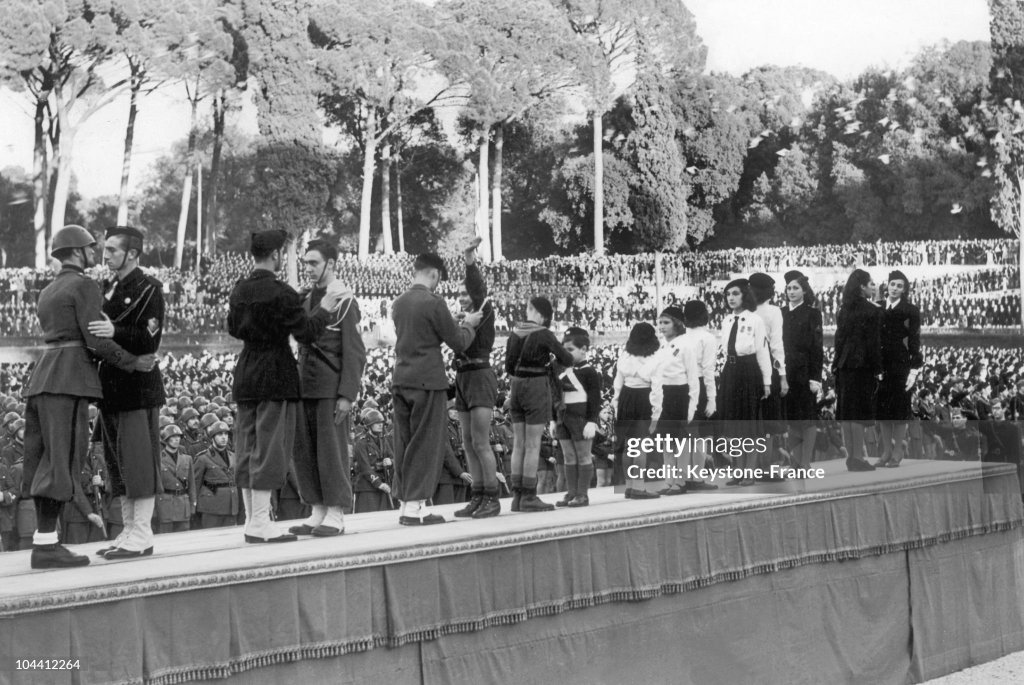
The youth of Fascist Italy moved upward one rank today as the thirteenth “Fascist Levy,” which coincides with the opening of the school year, took place in all the cities of the empire. It is a military ceremony, for in Italy “the book and the musket” go together.
A projected Putsch by Hungarian Nazi extremists, which was said to have included the proposed assassination of seventeen members of Parliament, today was reported crushed with the arrest of 140 members of the outlawed Hungarist “Death Legion.”
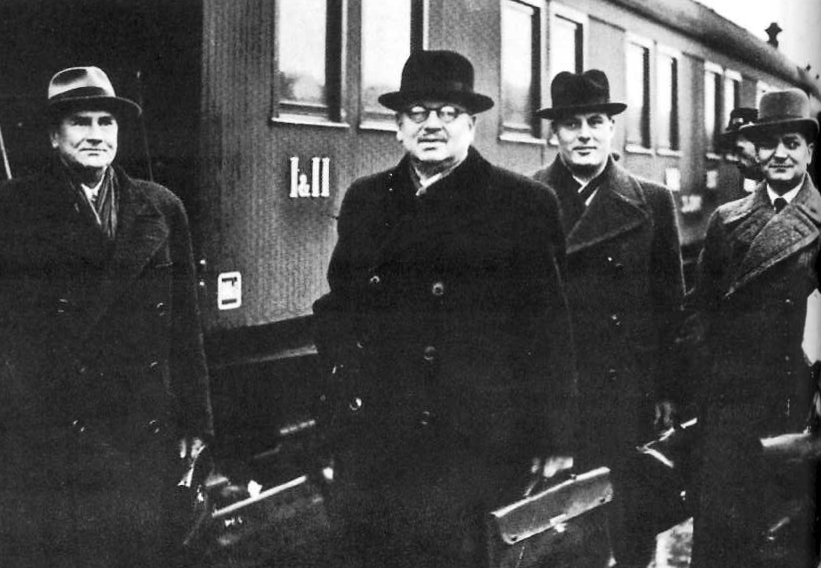
The Finnish negotiators return from Moscow. Finland weighs the Kremlin’s demands. The reply to secret terms awaits the session of Nordic kings in Sweden tomorrow. A readiness to give up islands is indicated. Spokesmen for the Finnish Foreign Office declared tonight that while the questions being discussed in Moscow were serious, there was every hope that a practical solution would be found.
It is understood in London that in the background of the Russo-Finnish negotiations lurks the desire of Joseph Stalin to obtain the exclusive right to work the extensive Finnish nickel deposits, thus freeing himself of dependence on the British Empire for the metal.
Russian pressure on Iran is revealed. Washington hears the Soviet Union is seeking concessions and possibly a sea base. It also is interested in the oil-rich fields of Iraq.
The Grand Mufti arrives in Baghdad following his escape from the French.
The British cargo ship Ionic Star ran aground in Liverpool Bay off Southport, Lancashire. Her cargo was salvaged but the ship was a total loss.
French light cruiser Duguay-Trouin intercepted German merchant ship Halle 320 kilometers southwest of Dakar, French West Africa; Halle was scuttled by her own crew to prevent capture.
U-19 laid a field of 9 mines; this field was responsible for the loss of three ships some days later.
German tanker Emmy Friedrich, whose cargo includes refrigerants needed for the magazine cooling systems in armored ship Admiral Graf Spee, then on a raiding foray into the Atlantic, departs Tampico, Mexico. Neutrality Patrol assets, including carrier Ranger (CV-4) and heavy cruiser San Francisco (CA-38), are mobilized to locate and trail the ship if the need arises.
U.S. freighter Black Heron, detained by the British at Weymouth, England, since 7 October, is released.
U.S. freighter Gateway City is detained by British authorities.
The War at Sea, Monday, 16 October 1939 (naval-history.net)
German aircraft attacked anchored ships in the Firth of Forth. Light cruiser SOUTHAMPTON was hit by a 1000 pounder that passed through three decks and came out of the bottom without exploding, but injuring three crew, one rating dying of wounds. Light cruiser EDINBURGH was slightly damaged by splinters from the near miss of three 500-pound bombs with eight crew wounded and Gunner G J Mitchell and one rating dying of wounds. SOUTHAMPTON’s damage required only three days to repair while EDINBURGH remained in service. Destroyer MOHAWK, just arriving in the Firth from convoy duty, was bombed one and a half miles from May Island and sustained much topside damage. Commanding officer Cdr R F Jolly was fatally wounded (and awarded the Albert Medal), the ship’s first officer Lt E J O’Shea and ten ratings killed and 33 crew, including her navigator, Lt A L Harper, wounded. MOHAWK berthed at Rosyth for temporary repairs and then repaired at Newcastle from 22 October to 9 December. Battlecruiser REPULSE was still at Rosyth on the 16th boiler cleaning, but German bombing restrictions forbidding bombing that endangered civilian lives were still in effect.
Four light cruisers were on Northern Patrol between the Orkneys and the Faroes, four AMCs between the Faroes and Iceland, and three AMCs in the Denmark Strait.
Destroyer AFRIDI attacked a submarine contact in the Firth of Forth off Inchkeith Light, and was joined by destroyers WOOLSTON, VALOROUS and sloop HASTINGS.
Destroyers INGLEFIELD and IVANHOE attacked a submarine contact in the Western Approaches in 51 00N, 18 00W.
Destroyers INTREPID and ICARUS attacked a submarine contact in 49 42N, 9 59E.
Destroyer MOHAWK and sloop STORK attacked a submarine contact ESE of Scarborough.
Destroyer COSSACK attacked a submarine contact north of Blyth.
Destroyer BEAGLE attacked a submarine contact in 51 20N, 01 40E.
Destroyer BROKE and sloop FLEETWOOD attacked a submarine contact off Blyth.
Minesweeper/escort ship GLEANER attacked a submarine contact 17 miles 184° from Great Ormes Head.
Convoy OG.3, totaling 33 merchant ships, was formed from OA.20G which departed Southend on the 15th escorted by destroyers KELLY and KINGSTON, relieved by destroyers AMAZON and ANTELOPE, and OB.20G which departed Liverpool on the 16th escorted by destroyers WHIRLWIND and WALPOLE.
AMAZON was damaged in a collision on the 18th and the other destroyers remained with the convoy until the 19th. French destroyers FOUGUEUX and L’ADROIT, which departed Brest on the 17th, joined the convoy on the 19th which arrived at Gibraltar on the 23rd.
Convoy BC.11 of steamers ADJUTANT, BALTARA, BARON CARNEGIE, BARON KINNAIRD, BLACKHEATH, BOTHNIA, COXWOLD, HARMATTAN, JADE, KINGSBOROUGH, LOCHEE, LOTTIE R, MARSLEW, NIGERIAN (Commodore) and SODALITY departed Bristol Channel, escorted by destroyers EXMOUTH, ESK, WESSEX, and arrived safely in the Loire on the 18th.
Convoy SA.13 of two steamers departed Southampton, escorted by destroyers ACHATES and VENOMOUS, and arrived on the 17th.
Convoy FN.22 departed Southend and arrived at Methil on the 18th. There was no convoy FN.22, nor convoys FS.22 and FS.23.
U-23 laid mines off Cromarty near Invergordon.
French destroyer CYCLONE with destroyer MISTRAL on escort duty in support of convoy KJ.2, attacked a U-boat in the Bay of Biscay, but without success
Light cruiser DAUNTLESS departed Suez for Colombo.
Convoy Green 5 departed Gibraltar escorted by destroyer DUCHESS and sloop FOWEY until the 17th, when convoying in the Mediterranean was abandoned and the escorts withdrawn. DUCHESS arrived at Malta on the 20th.
French destroyers MILAN and ÉPERVIER departed Marseilles with three troopships for Beirut.
French light cruiser DUGUAY TROUIN encountered German steamer HALLE (5889grt) which had departed Bolama, Portuguese Guinea on the 12th and Bissao on the 14th for Las Palmas. HALLE scuttled herself to avoid capture SW of Dakar. Large destroyers LE FANTASQUE and LE TERRIBLE, operating from Dakar, had been searching for her from the 15th to 17th.
German steamer UHENFELS (7603grt) departed Lourenco Marques on the 13th, shadowed from off the port by sloop EGRET which had to give up because of shortage of fuel. Light cruisers LIVERPOOL and DURBAN, also in the area were unable to find her, but because of the naval activity, UHENFELS returned to Lourenco Marques.
German steamer TIJUCA (5918grt) arrived off Kopervik, Norway, encountered Norwegian submarine B.3 but continued on, reaching Hamburg on the 25th.
In Washington today, President Roosevelt received numerous official callers and issued his annual Armistice Day proclamation.
The Senate continued debate on the neutrality resolution, received proposed amendments to the legislation, and recessed at 5:30 PM until noon tomorrow.
The House heard Representative Daniel A. Reed of New York discuss the neutrality issue and adjourned at 2:12 PM until noon tomorrow. The Dies committee continued its study of Communist party activities.
Administration forces in the U.S. Senate decided today to eliminate the ninety-day credit clause from the Neutrality Resolution and put commerce between the United States and belligerents strictly on a “cash-on-the-barrel-head” basis. This move was directed toward bringing repeal of the arms embargo to a successful vote within the next ten days or two weeks.
Senator Pittman, chairman of the Foreign Relations Committee, announced he would offer an amendment to remove the credit clause. He was engaged also with Senator Bailey, chairman of the Commerce Committee, and others in working out an amendment to soften the proposed restrictions on American shipping-this too, with the idea of winning more enthusiastic support for the resolution.
Meanwhile, and as Senator D. Worth Clark, Democrat of Idaho, led off the day’s Senate debate with a bitter attack on Great Britain and France as the “aggressors” in the present war, amendments seeking to change details of the pending resolution began to pour into the legislative hopper. Many of these amendments would be obviated, however, by addition of Senator Pittman’s proposal to eliminate the ninety-day credit allowances, and by a plan being framed by Senators Bailey, Johnson of California, and others, for “localizing” the statutory belligerent ports from which American ships would be barred.
Interest lagged decidedly in the Senate’s discussions of the embargo issue following Mr. Clark’s castigation of England and France and the part which he asserted they played in events leading up to the current European conflict. Other speakers included Senators Shipstead and Capper, opponents of repealing the embargo; Senator Gillette of Iowa, who criticized backers of repeal but wound up by expressing the “hope” that he might vote for the resolution as a means of keeping the United States out of war; and Senator Thomas of Utah, who devoted his second speech of the debate to citing misquotations and misconstructions which he said were drawn from his radio address of early September.
The lack of interest was by no means confined to the public, which left the galleries hardly more than one-third filled for most of the afternoon, but extended to the Senate as well. When Senator Thomas arose to speak shortly after 4 PM, there were hardly a dozen Senators on the floor. A quorum call demanded by Senator La Follette only brought in a total of twenty-two. A second quorum call produced only twenty more, making a grand total of forty-two or seven short of a quorum.
Senator Barkley, reddening with annoyance at the absence of so many Senators, demanded that business stand suspended until the Sergeant-at-arms could round up a quorum. Officers and pages then got busy and finally, by telephone and personal messages, brought in the necessary seven.
Sentiment was strong in the Senate today for winding up the special session as soon as action has been completed on neutrality legislation.
Proclaiming November 11 as Armistice Day, President Roosevelt asserted today that it was appropriate for the American people to reflect upon the hour “when the voices of war were silenced and to look forward even now to a time when a just and enduring peace shall be established among all the peoples of the earth.”
The Nazi-Soviet pact bolsters the Dies investigation. The committee, sharply criticized a year ago, finds itself in public favor with witnesses ready to tell all.
New York Mayor LaGuardia charges that milk farmers have been betrayed by a federal-state agreement on pricing. A milk strike looms.
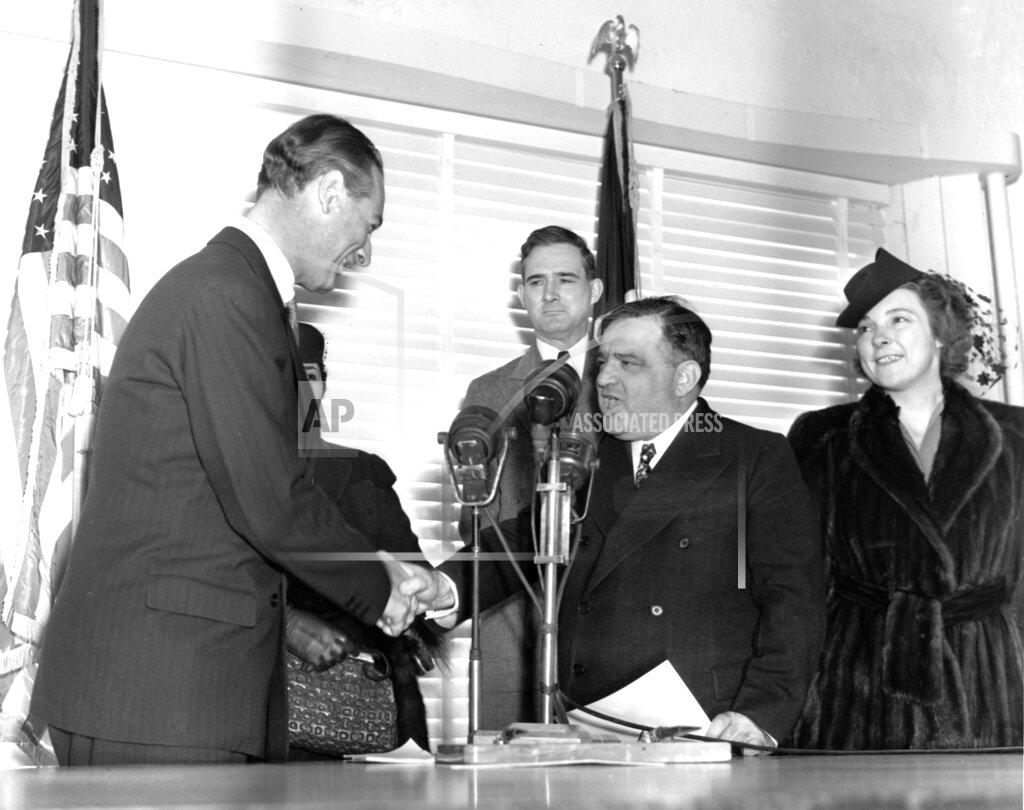
With Mayor Fiorello La Guardia on hand, Lou Gehrig is sworn in as a member of the New York City Parole Commission. Although the term is for ten years, the former Yankee slugger will eventually become too ill even to sign his name and will ask for a leave of absence next year.
John L. Lewis is supposedly determined to rid the Congress of Industrial Organizations of all Communist influence in the next year, according to reports here today concerning the crusade which he set in motion Saturday at the meeting of the executive committee which followed the close of the C. I.O. convention in San Francisco.
No agreement on a contract to replace the one which expired September 30 was in sight tonight when conferees representing the Chrysler Corporation and the C.I.O.-United Automobile Workers of America adjourned. They will resume negotiations tomorrow.
A surgeons’ convention in Philadelphia reports that the lives of many patients suffering from lung cancer, until recently impossible to cure, are now being saved by modern surgical technique that makes it possible to remove an entire lung.
Parents in Oklahoma give up triplets, saying that they cannot provide them with appropriate care. The children were born in a river-bank dugout in Caddo County. The father is a WPA worker with a paralyzed left arm.
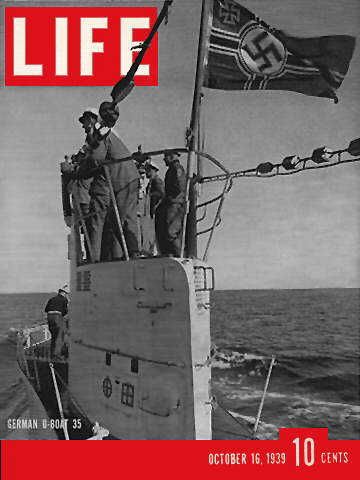
U-35 appears on the cover of LIFE Magazine for its rescue of Greek sailors in the Diamantis incident.
The comedy play “The Man Who Came to Dinner” by George S. Kaufman and Moss Hart premiered at the Music Box Theatre on Broadway; runs for 739 performances.
The Chinese Army today reported an attack on the walled city of Hangchow, capital of Chekiang province and only ninety miles southwest of Shanghai, which left the city in confusion. The Chinese said they attacked Sunday night, killing numerous Japanese soldiers, destroying the power plant and firing an ammunition dump and the headquarters of the Japanese puppet regime. They reported that they cut off communication from Shanghai by tearing up railroad tracks and dynamiting bridges, thereby establishing Chinese control of the surrounding countryside. Hangchow was captured by the Japanese on December 24, 1937, and since has been attacked periodically by guerrilla bands.
The recent Chinese victory over the Japanese attackers north of Changsha was called the biggest Chinese success since the beginning of the war with Japan by General Chen Cheng, field commander in chief of the Chinese forces in Hunan and Kiangsi, in an interview here today. General Chen asserted that the Japanese losses in this recent fighting exceeded 30,000. Foreign journalists, en route from Chungking to the front north of Changsha, were received by General Chen at this South Hunan village, which for a time after the fall of Hankow last year was headquarters for Generalissimo Chiang Kai-shek. Nanyo nestles at the foot of the sacred Heng Mountains, to which thousands of pilgrims came this Fall despite wartime conditions.
General Chen reported that Chinese troops were continuing their successes at the front. Three thousand Japanese are surrounded at Tungcheng and facing annihilation, while the encirclement of Yochow is progressing favorably, he said. “We expect soon to take Fenghsien, near which we have just wiped out 500 men at Wupuchen,” General Chen stated.
The commander foresaw the possibility of a renewed Japanese offensive against Changsha. He said that reports had been received that the Japanese were marshaling five new divisions for a second drive, but stated that these reports lacked confirmation. Pointing to a map on which hundreds of crosses marked spots where the roads had been torn up by the Chinese, General Chen attributed the Chinese victory in a large measure to the virtually complete destruction of communications over the area of the Japanese advance. General Chen said that the Japanese were unable to bring up any but light weapons, that their transport broke down and their food gave out and they were thus forced to retreat when the Chinese counterattacked.
General Chen asserted that this Chinese victory in North Hunan showed that the Japanese conquest of vast areas in the interior of China was impossible. Declaring that China would make her influence in world affairs increasingly felt with the development of military strength, he hoped that the world powers would give the close attention to the Chinese-Japanese war that such hostilities deserve.
The Chinese Premier H.H. Kung sees a threat to the United States from Japan. He believes that their dream of domination will cross the Pacific, and makes a plea for U.S. aid.
The Destroyers USS Peary and USS Pillsbury were damaged in a collision during night exercises in Manila Bay, Philippine Islands.
Dow Jones Industrial Average: 150.84 (+0.46)
Born:
Frank Parker, NFL defensive tackle (NFL Champions-Browns, 1964; Cleveland Browns, Pittsburgh Steelers, New York Giants), in Broken Bow, Oklahoma.
Died:
Ludolf Nielsen, 63, Danish composer.
Naval Construction:
The Kriegsmarine (German Navy) Type VIIC U-boats U-205, U-206, U-207, U-208, U-209, U-210, U-211, and U-212 are ordered from F. Krupp Germaniawerft AG, Kiel (werk 634-641)
The Kriegsmarine (German Navy) Type VIIC U-boats U-375, U-376, U-377, U-378, U-379, U-380, U-381, and U-382 are ordered from Howaldtswerke AG, Kiel (werk 6-13)
The Kriegsmarine (German Navy) Type VIIC U-boats U-405, U-406, U-407, and U-408 are ordered from Danziger Werft AG, Danzig (werk 106-109)
The Kriegsmarine (German Navy) Type VIIC U-boats U-435, U-436, U-437, and U-438 are ordered from F Schichau GmbH, Danzig (werk 1477-1480)
The Kriegsmarine (German Navy) Type VIIC U-boats U-559, U-560, U-561, and U-562 are ordered from Blohm & Voss, Hamburg (werk 535-538)
The Royal Navy Havant-class destroyer HMS Havelock (H 88), laid down as the Marinha do Brasil (Brazilian Navy) Jutai, and requisitioned by the Royal Navy on the outbreak of war, is launched by J.S. White & Co. (Cowes, U.K.).
The Royal Navy armed merchant cruiser HMS Ascania (F 68) is commissioned. Her first commanding officer is Captain (retired) Christopher Hildyard Ringrose-Wharton, RN.
 History Diaries