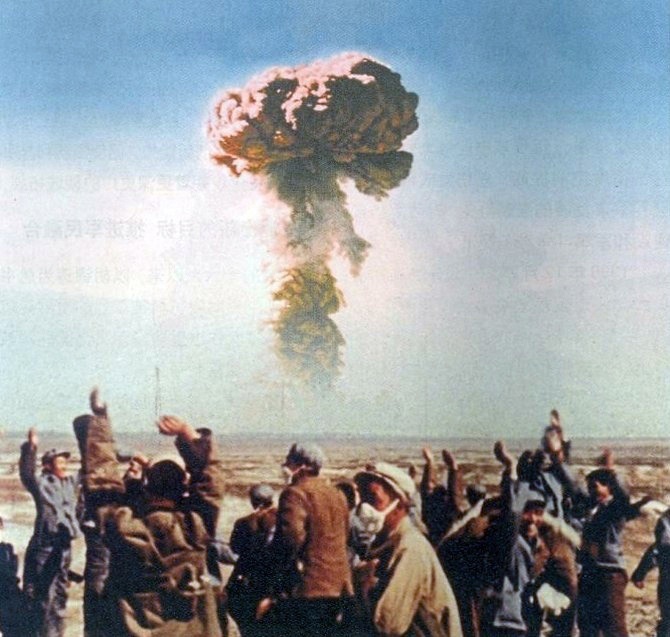
[Ed: I think this is highly retouched — I doubt these people were standing here during the blast. On the other hand, it’s not like Mao cared much about the proles.]
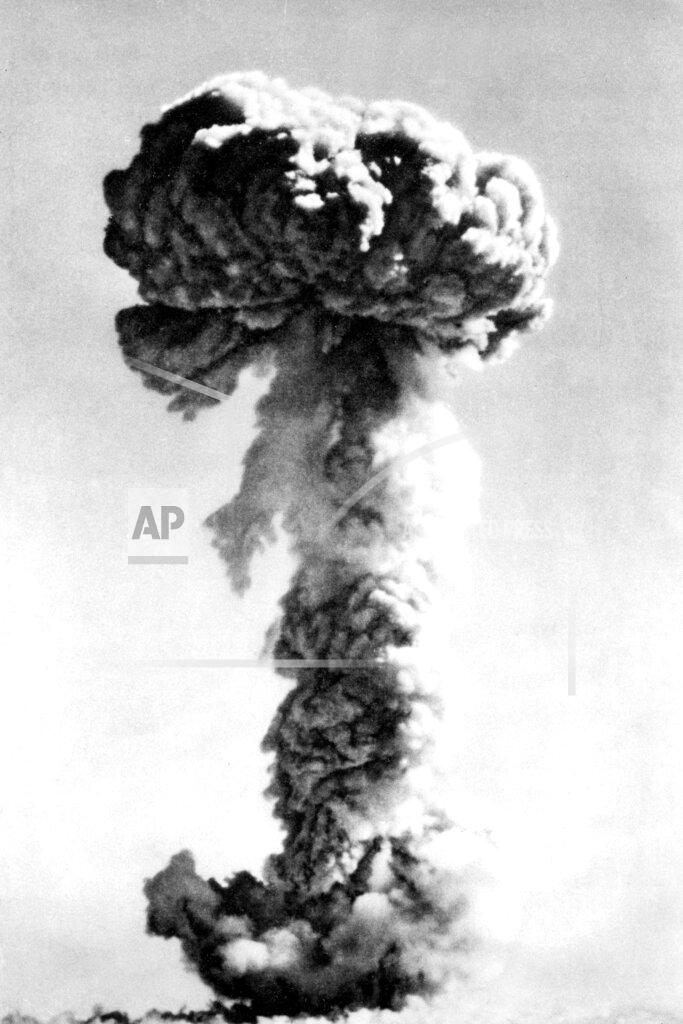
The People’s Republic of China became the fifth nation in the world (after the United States, the Soviet Union, the United Kingdom and France) to acquire nuclear weapons, after successfully exploding an atomic bomb at the Lop Nor test site in a desert in the Xinjiang region. The 25-kiloton bomb, code named “596”, was detonated at 3:00 in the afternoon China Standard Time (0700 UTC).
Communist China announced tonight that it had exploded its first atom bomb. Peking pledged that it would never be the first to use nuclear weapons in the future. A communiqué stated that a nuclear test was successfully conducted at 3 PM Peking time (3 AM, Eastern daylight time) in the western region of China. No details were disclosed.
“The success of China’s nuclear test is a major achievement of the Chinese people in the strengthening of their national defense and the safeguarding of their motherland as well as a major contribution by the Chinese people to the cause of the defense of world peace,“ the communiqué asserted. An accompanying government statement declared that the purpose of developing nuclear weapons was to protect the Chinese people “from the danger of the United States launching a nuclear war.”
“On the question of nuclear weapons, China will commit neither the error of adventurism nor the error of capitulation,” the statement said. “The Chinese people can be trusted.” The Peking statement formally proposed to the governments of the world that a universal summit conference be convened to discuss the question of a complete prohibition on and the thorough destruction of nuclear weapons.
President Johnson said today that Communist China’s first nuclear test was more a “tragedy for the Chinese people” because of their poverty than a threat to world peace. While the test is a reflection of policies that do not serve “the cause of peace,” the President said, “there is no reason to fear that it will lead to immediate dangers of war.” The President gave his views at the White House in confirming that Peking had exploded what he described as a crude nuclear device. While the President’s announcement said only that the explosion took place in “western China,” it was learned that the test site was in Sinkiang Province, which borders on the Soviet Union. The explosion was above ground and thus was the first test in the atmosphere since the signing a year ago of the treaty forbidding all but underground nuclear tests. Communist China did not sign the treaty. State Department officials dismissed as a “grandstand play” a Chinese proposal for a meeting of world leaders to discuss the prohibition of nuclear weapons.
There were four major engagements with the Communist Việt Cộng yesterday and today, with government forces mauling the foe in two battles and suffering reverses in two. Up to nightfall a total of 84 Việt Cộng guerrillas and 37 government dead had been reported. Fighting was reported still raging at dusk in the southern delta region, where Vietnamese airborne units caught a major Việt Cộng force, killing at least 44 guerrillas, American sources reported. These sources said Vietnamese soldiers carried in by helicopter jumped the Communist force near Bạc Liêu, 120 miles southwest of Saigon. When the size of the guerrilla force was realized, reinforcements were sent. Radio reports from the scene said three government soldiers were wounded.
The Defense Ministry had reported reverses in two of three engagements yesterday. Two Communist battalions attacked an army unit about 40 miles northwest of Saigon and Việt Cộng units penetrated a village near Phước Vĩnh. In the first encounter, 26 soldiers were killed and 11 wounded and 11 were reported missing. In the second six soldiers were killed and six others are missing. No mention was made of Việt Cộng losses in either attacks. The government said the Việt Cộng suffered 40 dead in the third clash, 30 miles north of Saigon. Five soldiers were killed.
South Vietnamese Premier Nguyễn Khánh insisted today that the forthcoming civilian government reserve “a place of honor” in its ranks for the Vietnamese armed forces. General Khánh, who met yesterday with the High National Council, was reported displeased with the role assigned to the army under the draft constitution he was shown. He has said repeatedly that he would step aside as Premier for a civilian replacement. But it has been expected that he would continue in the government in a top military position.
In a prepared statement, General Khánh said: “The fighting men of the Vietnamese armed forces, with the past revolutionary achievement of toppling the dictatorial Ngô family regime and who are now sacrificing to safeguard, the homeland, must be properly encouraged to defeat the Communist aggressors. Therefore, the civilian government to which power will be returned by the armed forces should acknowledge the noble and vital role of the armed forces and reserve a place of honor for it in the future government.”
The pro‐Communist Pathet Lao radio asserted today that a United States helicopter was shot down September 30 over Laos. The broadcast said the helicopter had been downed “by Laotian patriotic forces” over Muongsay, in Luang Prabang Province. The United States has supplied some military equipment to the Laotian forces fighting the Pathet Lao.
Without naming the deposed Soviet leader, Nikita S. Khrushchev, the new regime accused him today of “harebrained scheming,” “bragging and phrase‐mongering” and “armchair methods.” In its first declaration of a program the Soviet leadership at the same time pledged to continue its policy of peaceful coexistence with the West. The new leadership, headed by Leonid I. Brezhnev and Aleksei N. Kosygin, said that it would press for a conference of world Communist parties next year to deal with the ideological challenge of the Chinese Communists. In the ouster of Mr. Khrushchev, announced yesterday, Mr. Brezhnev took over the post of party First Secretary and Mr. Kosygin became Premier. The program was defined in an editorial in Pravda, the party newspaper. A. text of the editorial was made public by Tass, the Soviet press agency. The Pravda editorial was clearly a devastating attack on Mr. Khrushchev by his former associates.
Western observers felt that it did away with any pretense that Mr. Khrushchev’s departure might have been voluntary on the grounds of old age and health, as yesterday’s official announcement said. The charges against Mr. Khrushchev seemed to center on his domestic economic policies. This was contrary to the expectations of Western diplomats who had been convinced that the Soviet‐Chinese conflict was the pivotal issue in his downfall. They still did not rule out the possibility that Mr. Khrushchev would be castigated on this issue later.
The editorial said: “The Leninist party is an enemy of subjectivism and drifting in Communist construction. Harebrained scheming, immature conclusions and hasty decisions and actions divorced from reality, bragging and phrase mongering, commandism, unwillingness to take into account the achievements of science and practical experience are alien to it. The construction of Communism is a live, creative undertaking that does not tolerate armchair methods, personal decisions and disregard for the practical experience of the masses.”
When Leonid I. Brezhnev was in East Berlin 10 days ago, he underlined the Soviet Union’s wish to overcome the split with Communist China and to maintain a state of “peaceful coexistence” with the West. Experts at the United States mission here considered it likely that the leadership change in Moscow had been prepared well in advance of Mr. Brezhnev’s trip to East Germany since only three days elapsed between his return home and his take‐over of the top Communist party post from Nikita S. Khrushchev yesterday. There were no hints in what Mr. Brezhnev said in public in East Germany that changes were imminent. In his East Berlin speech he quoted Mr. Khrushchev as having professed the belief that “unity will eventually triumph among Communist brother parties.”
Without naming the Chinese Communists, Mr. Brezhnev denounced the “splitting policies” of those “who are seeking to undermine unity and to drive a wedge between the Socialist countries in order to further their own chauvinist aims.” He said the “international forum of Communists” tentatively scheduled by Moscow for next summer was to serve “an important step toward achieving consolidation within the Communist movement.” There was no mention by Mr. Brezhnev of the preparatory meeting of 26 Communist parties that Mr. Khrushchev had scheduled for this December and that has met with considerable resistance from many of these parties. Western officials said they felt Mr. Brezhnev’s statements indicated on the whole a less belligerent line toward China without a retreat from Moscow’s declared stand of living more or less peacefully with capitalism.
President Johnson and the new leaders of the Soviet Government exchanged messages today pledging further efforts to promote world peace. This first contact after the ouster of Premier Khrushchev was made at Moscow’s initiative. Anatoly F. Dobrynin, the Soviet Ambassador here, called on President Johnson to deliver assurances that his Government would continue, as he put it, to work for better relations with the West. Mr. Johnson welcomed that message and sent word to Moscow that the United States wanted only peace and international understanding.
Officials in Washington felt that the meeting had more symbolic than practical significance. It, yielded no clues to the reasons for yesterday’s shake‐up in Moscow. It demonstrated, however, that Mr. Khrushchev’s, successors were willing to reassert at once — and in Washington — the goals of coexistence and negotiation with the West that have outraged the Chinese Communists. President Johnson received Mr. Dobrynin with great cordiality after an Administration policy conference to review the Soviet shake‐up, China’s detonation of a nuclear device and the Labor party’s narrow election victory in Britain.
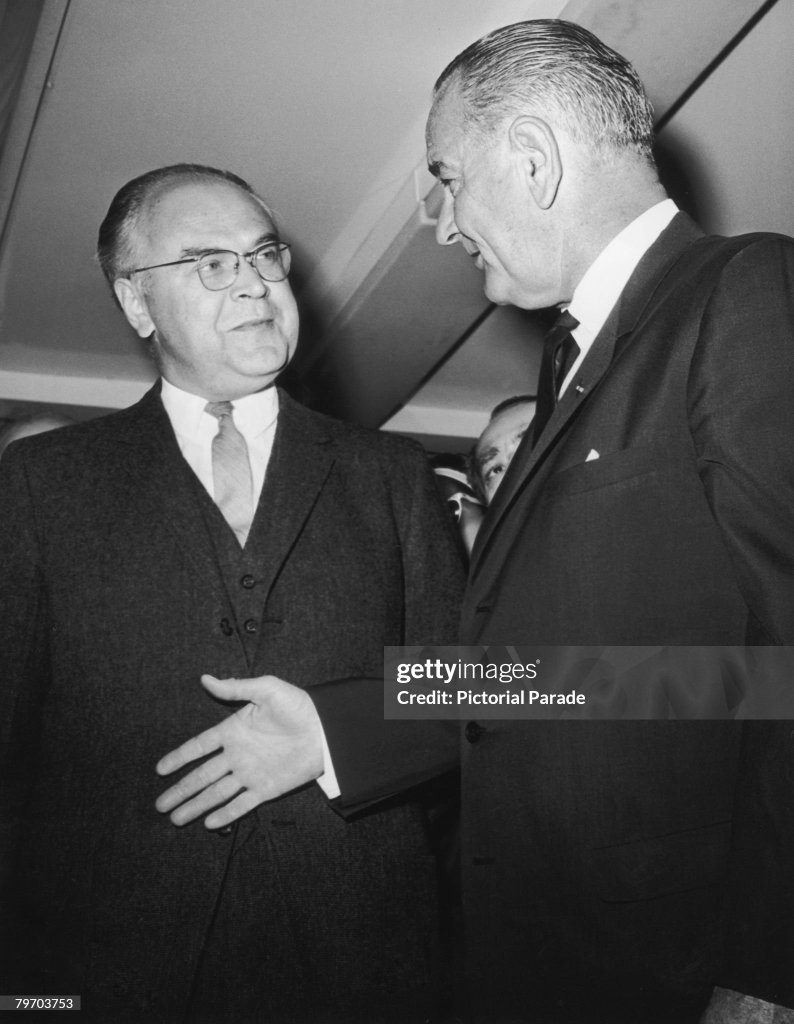
The Soviet Ambassador outlined future Soviet policy to Chancellor Ludwig Erhard today and assured him that Moscow would continue to seek peaceful coexistence. The Ambassador, Andrei A. Smirnov, officially conveyed the news of Premier Khrushchev’s ouster. The Chancellor, confronted on his first anniversary in office with a world scene that had changed overnight, directed his Government to keep flexible and wait for the dust to settle. An hour after the interview with Mr. Smirnov, Dr. Erhard’s press officer issued a statement that Bonn would also pursue its established international policy “independent of this change of government.”
President Tito cut short a visit to Cyprus and flew home tonight for urgent talks on foreign policy in the wake of the changes in the Kremlin. He was expected to meet with 13 other members of the Yugoslav Communist party’s Politburo, of which he is the head. The Soviet Ambassador, Alexander Pusanov, was expected to visit President Tito soon to give him assurances that former Premier Khrushchev’s policy of peaceful coexistence would continue. There was no official comment on the replacement of Mr. Khrushchev or immediate reaction to the explosion of Communist China’s first nuclear device.
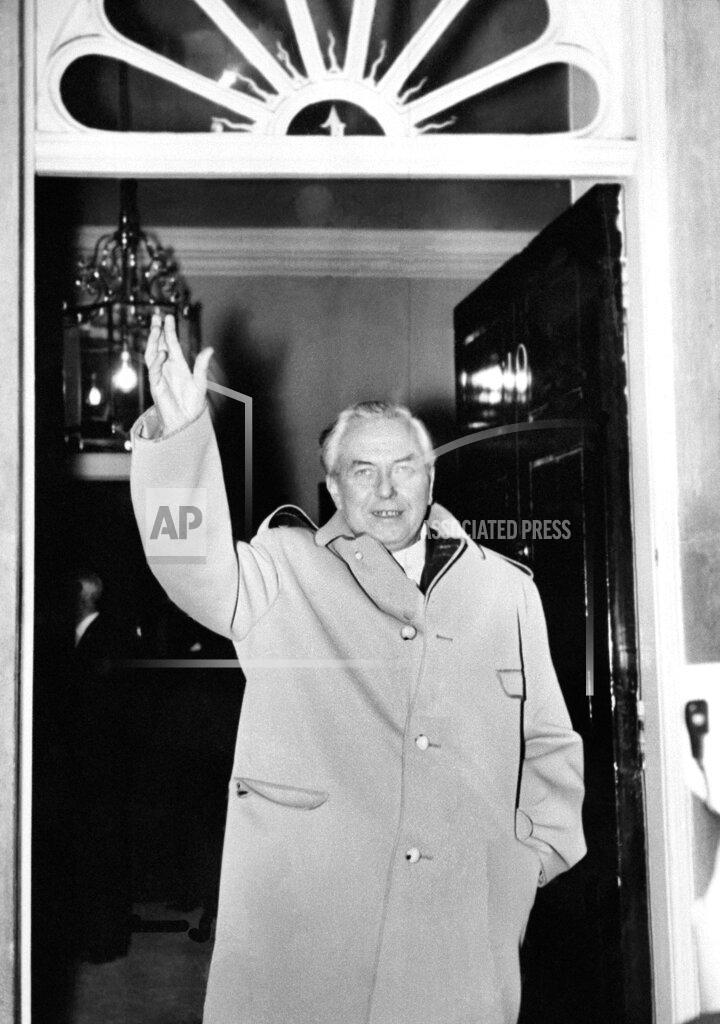
Harold Wilson was asked by Queen Elizabeth II to form a new government as Prime Minister of the United Kingdom, following the triumph of his Labour Party. Immediate appointments to the First Wilson ministry included Gerald Gardiner, Baron Gardiner as Lord Chancellor, James Callaghan as Chancellor of the Exchequer, and Patrick Gordon Walker as Foreign Secretary. He would continue as Prime Minister until June 20, 1970, then serve again from 1974 to 1976.
Baron Gardiner, was appointed by Prime Minister Wilson to be the new Lord High Chancellor of Great Britain, who functioned as the presiding officer of the House of Lords and the highest ranking judiciary officer for England and Wales, as well as a member of the Queen’s Privy Council and of the Prime Minister’s Cabinet.
The creation of a mixed‐manned allied nuclear fleet, which is strongly advocated by the United States, appeared to diplomats here to be in jeopardy after the Labor party’s victory in Britain. Another reaction to the election returns was a growing belief that Europe must now plan political unity “without the British for the time being,” as one diplomat put it. The consensus among diplomats accredited to the French Government, the North Atlantic Treaty Organization and other international organizations was that the narrow Labor majority would force Britain to “mark time” in foreign affairs. No positive initiatives are expected from London.
About 6,000 of Aden’s 8,000 voters went to the polls today to elect 16 members of the Legislature. The men elected and seven to be appointed by the British High Commissioner will in the next few days select a chief minister and may soon negotiate the independence of this British Crown Colony. The relatively large turnout was a victory for the Moderates who will cooperate with the British and a setback for the People’s Socialist party, who tend to favor President Gamel Abdel Nasser of the United Arab Republic.
Beginning March 7, Catholics throughout the world will see the priest’s face, instead of his back, when he celebrates the mass—the central sacramental mystery of the church. This change was one of many authorized today by an instruction distributed in St. Peter’s Basilica to the more than 2,000 bishops and higher prelates at today’s session of Ecumenical Council Vatican II. It represented the first major change applicable to the entire church resulting from the labors of the Fathers of the Council in the 1962 and 1963 sessions on liturgical revision.
The Secret Service knew in 1961 that Walter W. Jenkins had been arrested in 1959 but did not report it to anyone, the agency informed the White House today. President Johnson immediately directed Secretary of the Treasury Douglas Dillon to investigate the agency’s procedures to learn if they needed strengthening or changing. Mr. Jenkins was arrested in 1959 and again last week on morals charges. After the facts became known, he resigned Wednesday night from his post as special assistant to the President, touching off a political storm that has shaken the Democratic Presidential campaign.
Republicans have charged — and Mr. Johnson has denied — that the President covered up Mr. Jenkins’s 1959 arrest. Secret Service officials reported to the White House today that they did not inform anyone of the arrest when they learned of it in 1961 because it was not considered important and because Mr. Jenkins already had a “Q” clearance, dating from 1958, for access to top‐secret information.
The Secret Service did not know, because of the wording of the report, that the arrest involved a morals charge. Mr. Dillon will conduct the investigation of these procedures separately from a study of the Secret Service and other agencies already undertaken by a special committee he heads. That committee was named by the President to follow up on the recommendations of the Warren commission’s report on the assassination of President Kennedy. The report of the commission, headed by Chief Justice Earl Warren, severely criticized the Secret Service and also questioned some of the procedures of the Federal Bureau of Investigation and other agencies.
But Mr. Johnson decided that the Dillon committee should be exclusively concerned with its study of the safety of the President and the procedures of the agencies charged with that responsibility. Thus, his order to Mr. Dillon today for a separate study of the Secret Service’s procedures in the 1961 case amounted to a new blow at the prestige of that agency. Mr. Jenkins attended a party shortly before his arrest. The party was given by Newsweek magazine to celebrate the opening of a new suite of offices in a building on Pennsylvania Avenue. The building is about three blocks from the Young Men’s Christian Association where he was arrested. There were conflicting reports from those who attended the party as to whether Mr. Jenkins had had too much to drink.
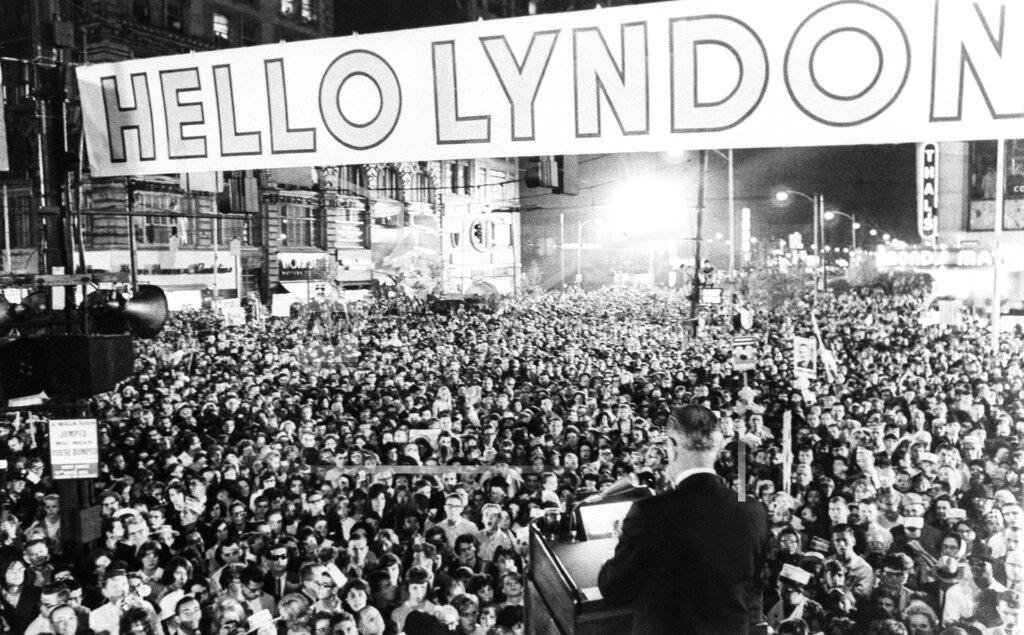
President Johnson, his voice edged, struck back from the speaker’s platform tonight at political use of the Walter W. Jenkins case. The President, addressing a huge crowd under floodlights in downtown Dayton, was confronted by several crudely lettered signs that alluded to the White House aide who resigned Wednesday after his arrest on a morals charge had been made public. Mr. Johnson took note of the signs, and said he was not on hand to indulge in “muckraking or mudslinging,” since “those are always weapons of desperation and of fearful, frightened men.” He added: “You can always tell them by their words, if not by their, signs.”
He went on to say: “I propose to use this campaign for the broad purposes that a campaign is meant for, a campaign to educate — educate the American people and the candidates themselves. “A campaign can tear open new wounds and it can pour salt on fresh wounds. It can divide America instead of uniting it.” The signs in the crowd were printed in black on white cards. One said: “What About Walter Jenkins.” Another read: “Corruption Patrol,” and linked the names of Robert G. Baker, Billie Sol Estes, and Mr. Jenkins.
A. high official of the Johnson Administration said today that some of this year’s union wage contract settlements had “probably been too big.” Robert V. Roosa, Under Secretary of the Treasury, told the Business Council that the wage settlements threatened the continuation of the recent improvement in the United States balance of international payments. “It has me worried,” he said. He said he believed that the only real solution to the balance of payments deficit was an increase in American export sales, and that this required American products to be competitively priced. The balance of payments measures the difference between American income and outgo in all transactions with foreigners.
Mr. Roosa said that he intended his remarks about large wage settlements specifically to cover the recent labor agreement signed by the major automobile companies and the United Automobile Workers. He thus became the first Administration official publicly to. label the auto settlement as too high, although an official White House comment described the new auto contract as “generous.”
The American Motors Corporation and the United Automobile Workers negotiated tonight to settle a strike that has shut down the nation’s fourth largest automobile maker. Edward L. Cushman, American Motors vice president, and Douglas Fraser, director of the union’s American Motors Department, said at a news conference today that the strike centered on three national issues and a number of local disputes. Bargaining tonight was concentrated on the local issues, which meant that a settlement was unlikely on the national contract before tomorrow. Toplevel bargaining recessed until tomorrow morning, as negotiators awaited the outcome of the local discussions.
The two negotiators said the parties were close to a national economic agreement, which would retain some form of the profit‐sharing plan pioneered in their 1961 contract. But they indicated that so much time had been spent haggling over profit sharing in the final hours before the midnight strike deadline yesterday that time ran out before they could resolve the other issues. Mr. Fraser said the three unresolved national issues dealt with a national economic agreement for the Kelvinator appliance division, alleged wage inequities, and seniority for transferred workers. Mr. Cushman said a larger number of local disputes would have to be settled before a national accord could be achieved. These center mainly on American Motors demands for concessions where the company believed its workers have superior conditions to those the union has obtained from competing companies. Mr. Fraser said he hoped a settlement could be achieved by tomorrow, indicating that in any event he did not expect the strike to last beyond the weekend. But Mr. Cushman appeared somewhat less optimistic, emphasizing that “some very real problems” remained.
A Federal grand jury has indicted six Georgia men, including four Ku Klux Klansmen accused or murdering a Washington Black educator, on charges of intimidation and violence against Blacks, the Federal Bureau of Investigation said today. Three of the men were later arrested in Athens. The agency said that the men arrested were Denver Willis Phillips, 24 years old, an Athens garage mechanic; George Hampton Turner, 32, a loom fixer in Athens who lives in Hull, Ga.; and Herbert Guest, 37, who operates the garage where Phillips is employed. The agency said that they were arrested on two indictments returned by a Federal grand jury in Athens. The first indictment charges that Phillips, Turner, Guest and three other men — Cecil William Myers, Joseph Howard Sims and James S. Lackey — conspired to injure, oppress, threaten and intimidate Blacks.
President Johnson has signed a bill that guarantees some increases tor every veteran or veteran’s widow now receiving a pension under the Federal veterans’ pension program. The White House, disclosing this today, said the President signed the measure Tuesday. A list of bills signed that day, issued by the White House, did not include the pension bill and the White House said then, in response to specific inquiries, that Mr. Johnson had not signed the bill. It has been estimated that the new law will add $80 million to $85 million a year to the cost of the program.
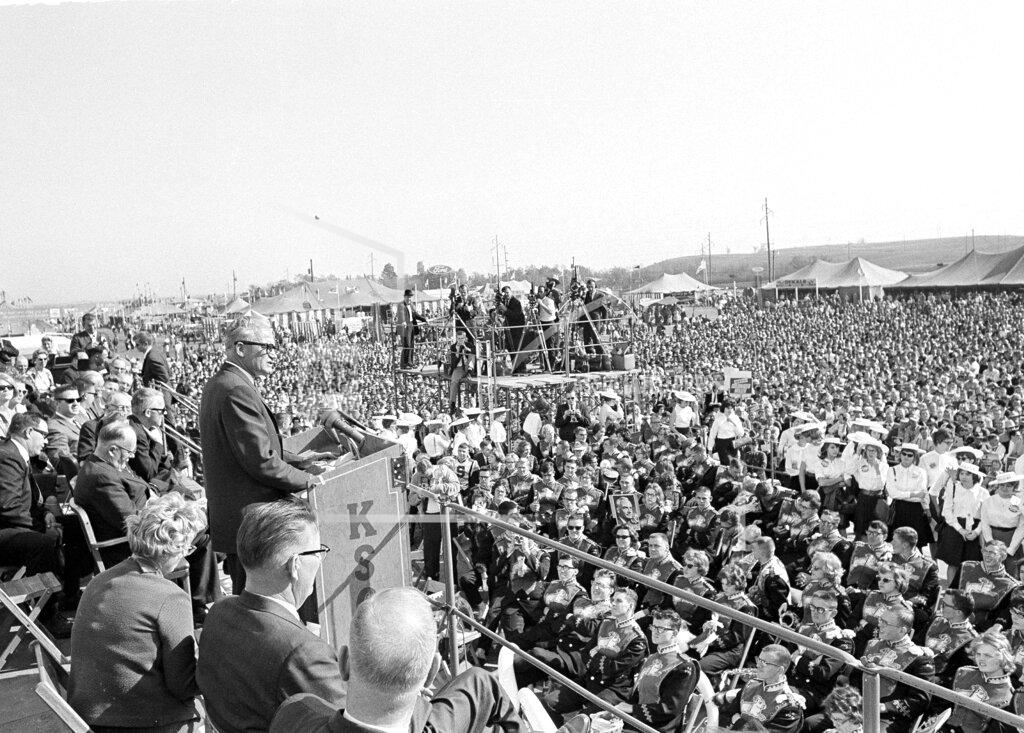
Senator Barry Goldwater of Arizona took his Presidential campaign to the upper Middle West today, and in his first major campaign speech on civil rights said that “forced integration is just as wrong as forced segregation.” He called the busing of schoolchildren and other measures to end de facto segregation “morally wrong,” and said that busing was an example of “doctrinaire and misguided equalitarianism.” In a speech tonight to a $100‐a‐plate fund‐raising dinner for 2,500 persons, he advanced the general argument that laws should protect citizens from discrimination on the part of government but that laws should not infringe the right of “free association” in discrimination between citizens.
Earlier in the day, at the national corn‐picking contest near Sioux Falls, South Dakota, Mr. Goldwater, the Republican Presidential candidate, said he would go slowly in overturning the liberal programs he has been denouncing, and added: “Above all, we must not scrap existing programs until we are sure we have something better to substitute for them.”
The Board of Directors of the Cleveland Indians votes to keep the club in Cleveland.
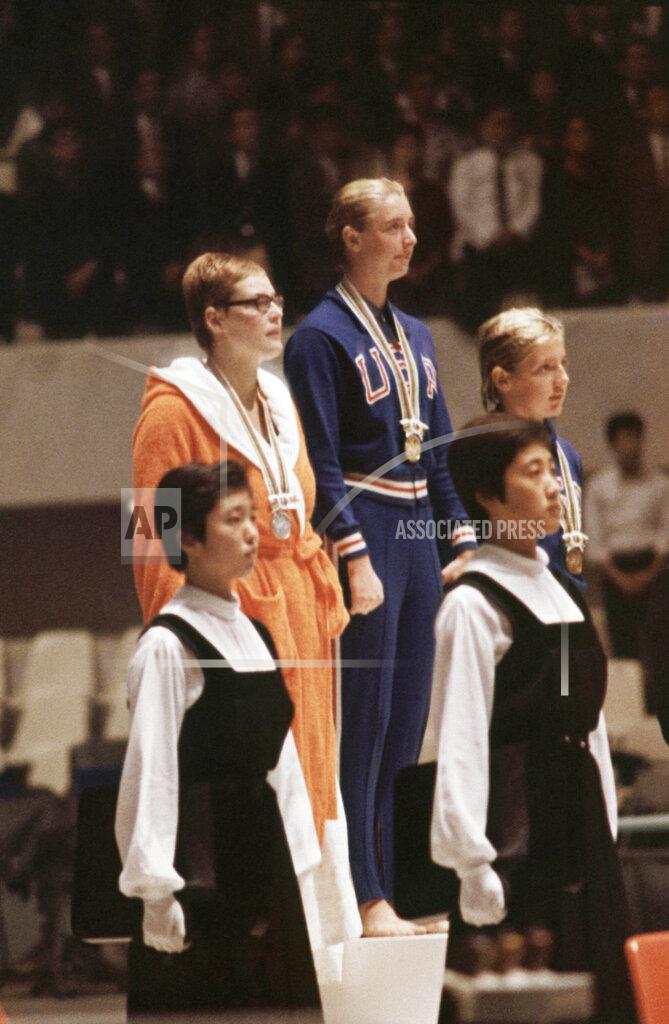
American swimmer Sharon Strouder sets world record 1:04.7 to beat Ada Kok of the Netherlands by 0.9s and win the women’s 100m butterfly at the Tokyo Olympics.
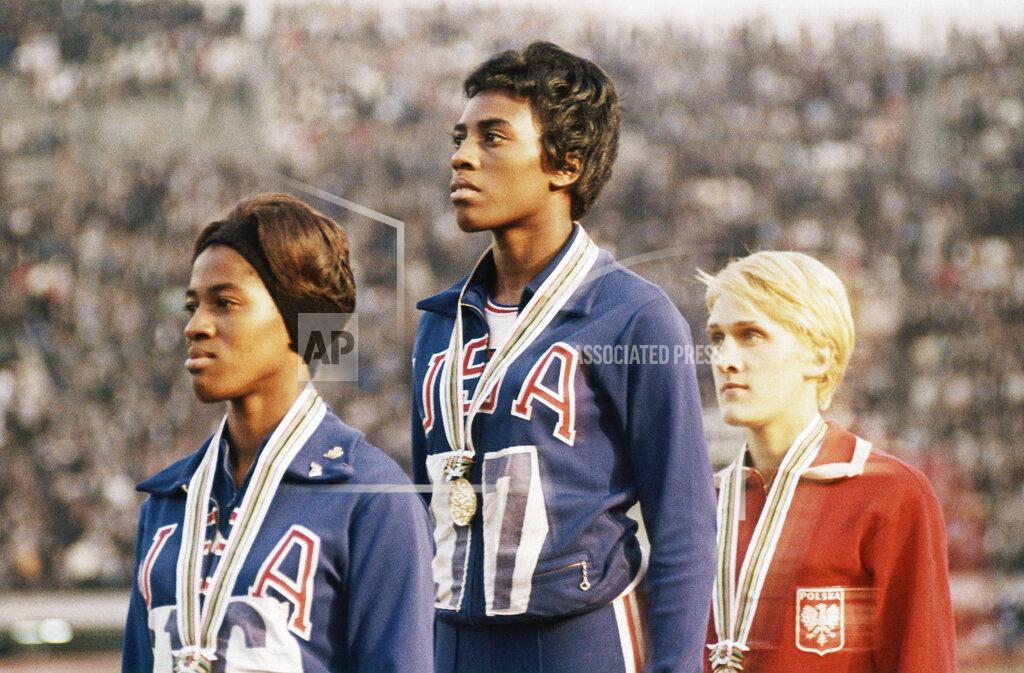
In an incredibly close women’s 100m final at the Tokyo Olympics American sprinter Wyomia Tyus runs 11.4s to beat teammate Edith McGuire by 0.2s; Ewa Kłobukowska of Poland takes bronze with the same time as McGuire.
US men’s 4 × 100m medley relay team of Thompson Mann, Bill Craig, Fred Schmidt & Steve Clark swim world record 3:58.4 to beat Germany by 3.2s and win gold medal at the Tokyo Olympics.
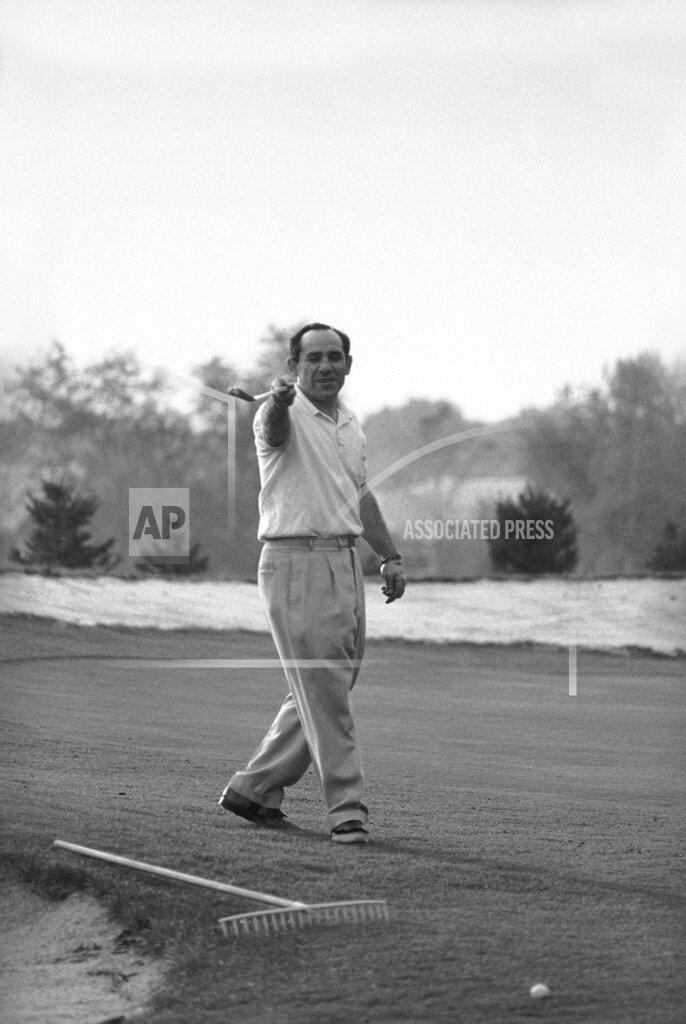
The New York Yankees fire manager Yogi Berra, one day after losing the World Series. It wil be 12 years before they get back to the Fall Classic.
AFL Football:
Oakland Raiders 43, Boston Patriots 43
Mike Mercer’s 38‐yard field goal with five seconds remaining tonight earned the Oakland Raiders a 43–43 American Football League tie with the Boston Patriots. The Raiders had to fight back twice in the game, the first time after they lost a 20‐point third quarter lead. The Raider quarterback, Cotton Davidson, hurled four touchdown passes, as did Babe Parilli of Boston. Mercer’s field goal, his third of the game, ruined a Boston victory bid in which Parilli fired an 11‐yard scoring pass to Larry Garron with 48 seconds remaining. A 2‐point conversion pass gave the Patriots the 3‐point lead that Mercer wiped out. A Fenway Park crowd of 23,279 saw Davidson fire touchdown passes of 38 and 9 yards to Art Powell, 49 yards to Bo Roberson and 26 yards to Clem Daniels. Billy Cannon ran 34 yards for the other Raider score. Mercer kicked the conversion after four of the scores and had field goals of 42 and 37 yards in addition to his last‐second equalizer.
Dow Jones Industrial Average: 873.54 (+5.1)
Born:
Bob Perryman, NFL fullback (New England Patriots, Denver Broncos), in Raleigh, North Carolina (d. 2023, after a rapid decline with dementia).
Joe Felton, NFL guard (Detroit Lions), in Saginaw, Michigan.
Stephen Paul “Steve” Lamacq [Lammo], British disc jockey (BBC Radio 6), in Islington, London, England, United Kingdom.
 History Diaries