Konstantin U. Chernenko, the Soviet leader, today offered several ways for improving Soviet-American relations and for opening talks on arms control but said that so far he had seen “no practical shift” toward peace by the White House. Speaking in detail on Soviet-American relations for the first time since President Reagan’s meeting with Foreign Minister Andrei A. Gromyko last month, Mr. Chernenko said there were widespread sentiments “in favor of a shift for the better.” “Unfortunately,” he said, “so far there has been no ground to speak of such a shift in Soviet-U.S. relations as a fact of life.” As before, he suggested that it was up to President Reagan to take up some Soviet proposals, but added that “there has been no practical shift in the direction of peace by the White House.”
In an interview in his Kremlin office with The Washington Post, he set out four issues in which improvement could be made and suggested that a resolution of “at least some of them would mean a real shift” in Soviet- American relations and international relations as a whole. The White House and State Department had no immediate reaction, but officials said privately that they were favorably impressed with the conciliatory tone of Mr. Chernenko’s remarks. The American officials added, however, that they did not detect any substantive change in position.
Four areas listed by the 73-year-old Soviet leader as offering prospects for progress were talks to prevent the militarization of outer space, a mutual freeze on nuclear weapon systems, ratification by the United States of treaties banning underground nuclear testing, and an American pledge not to be the first to use nuclear weapons. President Reagan has so far rejected the freeze and the proposal for a pledge against first use, and he has imposed conditions for talks on space-based weapons and on ratifying the nuclear testing agreements that were negotiated in 1974 and 1976. Mr. Mondale has rejected the first-use pledge but endorsed all three of the other steps.
Viscount Whitelaw, the Deputy Prime Minister, said today that “some of the general conclusions” of an investigation of the bomb attack last Friday on the British Cabinet would be made public. Most such security investigations in Britain remain secret. Speaking in the House of Lords, which began its fall session this afternoon, he disclosed that security at the Palace of Westminster, where Parliament meets, had been greatly augmented. Meanwhile, Sir Geoffrey Howe, the Foreign Secretary, who emerged unscathed from the attack although the sitting room of his suite was destroyed, warned United States businessmen against supporting the Irish Republican Army, which, like the Beirut bombers, he said, “challenges the values that are seen as fundamental in Britain and the United States alike.”
“I take this opportunity,” he told an American Chamber of Commerce meeting in London, “to say again, with all the force at my command, that those who provide funds to the I.R.A. through any of their front organizations in the United States, in the profoundly mistaken belief that they are romantic nationalists fighting in an honorable cause, should rid themselves of such delusions. Let them make no mistake – they are supporting and promoting terrorism.” In his speech, Lord Whitelaw said, “Total, impregnable security is not compatible with the free society we enjoy.” He added, “We must continue to search for improvements in security arrangements – but without calling into question the basis on which public life in this country is conducted.”
Foremen at British coal mines said they will join the seven-month-old miners’ strike, an action that could close the mines and force electricity cuts. Leaders of the foremen, who carry out mandatory safety inspections at Britain’s 175 pits, made the decision a day after the collapse of talks between the miners and the state-run Coal Board. The strike began over Coal Board plans to shut 20 money-losing mines and eliminate 20,000 jobs. Jimmie O’Connor, Scottish area mine supervisors’ secretary, confirmed the board’s decision to join the stoppage. The union’s 17,000 members last month voted 82.5 percent in favor of a strike.
Chancellor Helmut Kohl today used the visit by Nicolae Ceaușescu of Rumania to rebut Soviet accusations that West Germany claimed former German territories in Easern Europe. At a lunch in honor of Mr. Ceaușescu and his wife, Elena, who is a First Deputy Prime Minister, Mr. Kohl called the Soviet contention “nonsensical, unjustified and unfounded.” “The Federal Republic of Germany has no territorial claim against anyone, and will not raise any in the future,” Mr. Kohl said, endorsing the treaties that normalized West Germany’s relations with the Soviet Union, Poland and East Germany.
A Soviet official volunteered to a group of visiting Danish legislators that dissident physicist Andrei D. Sakharov “can leave the Soviet Union whenever he wishes, but he does not want to go.” Ivan Polyakov, vice chairman of the Supreme Soviet Presidium and member of the Central Committee, said, “Sakharov has… been afforded an exit visa from the Soviet Union but will not go.” In Washington, a State Department spokeswoman said, “Statements like this can’t be trusted.” Sakharov, 63, has been in internal exile in the city of Gorky for four years.
A time bomb filled with nails exploded near a bus carrying 38 Israeli schoolchildren on a nature tour in the occupied West Bank of the Jordan River, wounding seven children near the Arab town of Nablus, Israeli officials said. All but one of the wounded were later released from a hospital after being treated for minor injuries.
A Syrian-backed Shia Muslim political leader was elected Speaker of the Lebanese Parliament, replacing another Shia who had supported the now-abrogated 1983 Lebanese-Israeli troop-withdrawal accord. Hussein Husseini was chosen by a 41-28 vote to replace Kamal Assad, Speaker for 12 years. Husseini immediately pledged to “make the liberation of south Lebanon from Israeli occupation” the main goal of his one-year term. Lebanese political commentators said the move had been dictated by Syria and showed that Syria had tightened its control over this country’s political structure. The new Speaker is Hussein Husseini, a member of Parliament from the Bekaa region and a former leader of the Amal movement. He will replace Kamal al-Assad, a scion of one of the semifeudal families that have long dominated Lebanese political life.
The Soviet leader, Konstantin U. Chernenko, and President Hafez al-Assad of Syria, who is visiting the Soviet Union, accused the United States and Israel today of aggravating tensions in the Middle East and blocking peace in the region, the Tass press agency said. Mr. Chernenko and Mr. Assad, who arrived in Moscow on Monday, also accused the United States of carrying out a policy that “pushes mankind to the brink of nuclear disaster.” Tass said Mr. Chernenko told Mr. Assad that the Soviet Union would continue to supply assistance to Damascus “and other Arab peoples in their struggle for a just and stable peace in the Middle East.”
Soviet Deputy Foreign Minister Leonid F. Ilyichev arrived in Peking for a fifth round of the two-year-old normalization talks with the Chinese. He told reporters that the Soviets “never lose hope” that relations between the Communist neighbors will improve.
China denied reports that Israel has provided new guns and fire-control systems for Chinese battle tanks. A Foreign Ministry spokesman said “stories such as this are sheer fabrications, concocted… in an attempt to undermine the friendly relations between China and the Arab countries.” The Sunday Times of London had quoted intelligence experts as saying that Peking and Israel had made a secret arms deal to modernize China’s force of 9,000 Soviet-design tanks. China has no diplomatic relations with Israel.
General Motors’ contract offer to its 36,000 Canadian workers was rejected, and union leader Bob White said it will take a miracle to avert a strike today. Officials said a strike in Canada would force layoffs at some U.S. plants within a few days. The offer, rejected unanimously by the union bargaining committee, was described as similar to the one recently accepted by GM’s U.S. workers.
The trial of 19 Grenadians accused of murdering former Prime Minister Maurice Bishop opened with the defendants refusing to enter pleas and one of them, Phyllis Coard, the only female defendant, appearing to faint. Chief Justice Archibald Nedd adjourned the trial until November 1 and ordered that Mrs. Coard be examined by three doctors, including one of her choice.
Salvadoran negotiators said that despite the lack of agreement on a cease-fire, they were cautiously optimistic about the results of the meeting Monday between Government and rebel officials. However, they said they were divided on major issues.
Nicaraguan leaders rejected strongly opposition suggestions that they follow the example set in El Salvador and agree to talk with anti-Government rebels. Sandinista junta leader Daniel Ortega said Nicaragua will not follow El Salvador’s lead and open peace talks with rebels. Ortega said Salvadoran guerrillas are fighting against “social injustice” with popular support, while the rightist Nicaraguan rebels are fighting with “artificial support” that would crumble without U.S. backing. Ortega accused the CIA of sending Soviet-made AK-47 rifles and other military supplies captured during the 1983 U.S. invasion of Grenada to Costa Rican-based Nicaraguan rebels.
A CIA booklet that became public this week tells Nicaraguan insurgents how to win popular support and gives advice on political assassination, blackmail and mob violence. The 44-page booklet is a step-by-step primer on insurgency.
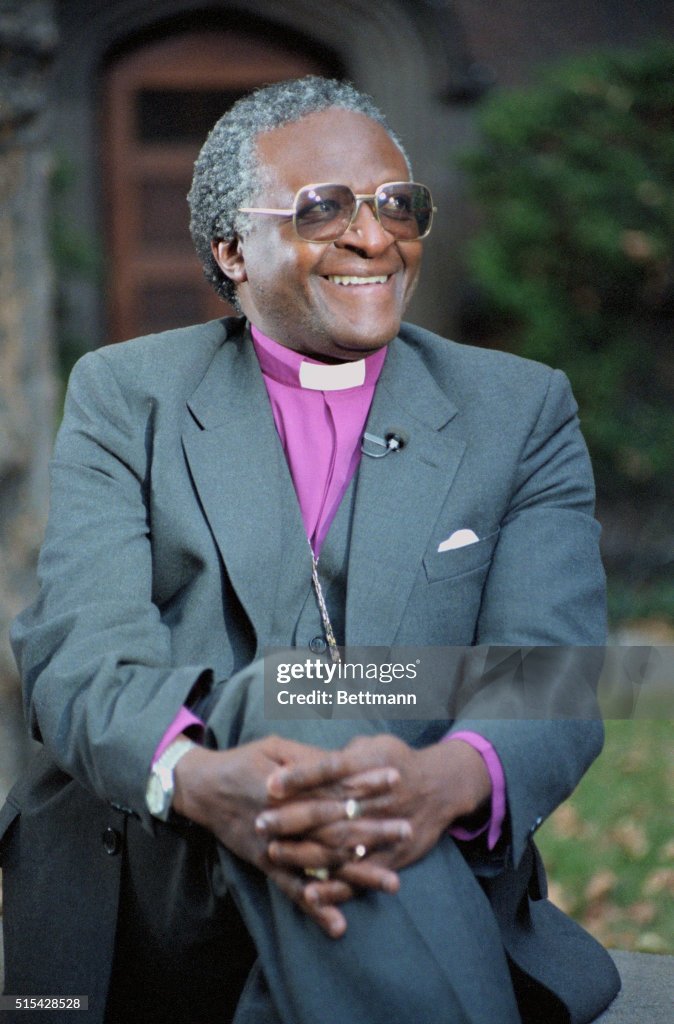
The 1984 Nobel Peace Prize was awarded to Bishop Desmond Tutu, a leading voice in South Africa for nonviolent efforts to end that country’s policy of apartheid. The Bishop is the general secretary of the South African Council of Churches.
Bishop Tutu learned of his award of the Nobel Peace Prize at the General Theological Seminary in Manhattan, where he is a visiting professor in Anglican studies. The bishop remarked to an interviewer, “I slept badly last night. It was almost like waiting for exam results.”
Industrial production fell last month for the first time since the recession ended in November 1982, the Federal Reserve Board reported. The announcement of a moderate six-tenths of 1 percent decline from the August peak brought quick assurances by the Reagan Administration that the report was essentially good news in that the economy is settling down to slower growth.
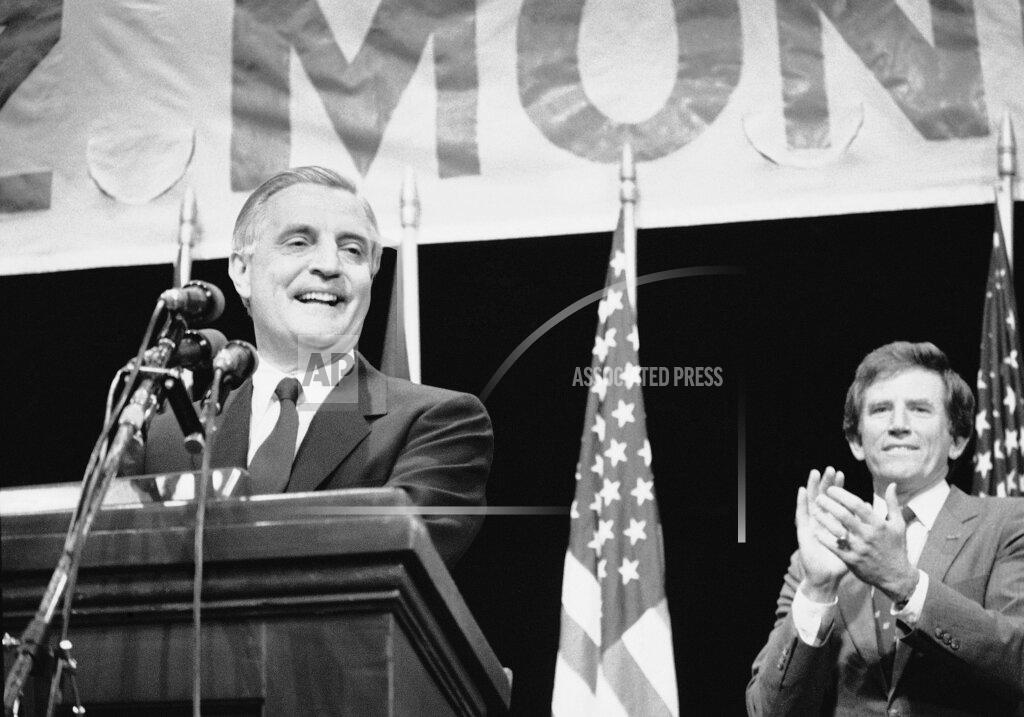
Walter F. Mondale’s decision to skip the Alfred E. Smith Memorial Dinner of the Roman Catholic Archdiocese, a highlight of New York City’s political season, created a stir, with many politicians saying they thought the Democratic Presidential nominee had made a mistake but predicting it would probably not do him much damage in the end. The Mondale camp sought to focus attention on the decision of the dinner committee to refuse to accept Geraldine A. Ferraro as a stand-in.
A political shift among unionists is occurring in the industrial Middle West. A gloomy sense of inevitable defeat for labor’s Presidential candidate, Walter F. Mondale, has given way, especially since his first debate with President Reagan, to a lively, underdog enthusiasm. But so far this feeling has been slow to penetrate beyond the union officials and shop stewards and reach the rank and file.
President Reagan’s strategists expect him to attack Walter Mondale in Sunday’s debate much more aggressively than he did in their first debate on October 7. In interviews, White House and campaign officials said Mr. Reagan would likely take the offensive, attacking Mr. Mondale’s policies as a threat to American security and placing less emphasis than before on facts and figures.
Walter Mondale’s strategists said their debate plans called for him to make a broad assault on President Reagan’s foreign policy and his personal competence. But several strategists said Mr. Mondale planned to pursue high road tactics.
President Reagan signs controversial legislation giving lumber companies in the western states the ability to buy timber at post-Carter inflation prices.
President Reagan receives an Honorary Doctor of Humanities Degree by Brother David Delahanty, President of Lewis University, Romeoville, Illinois.
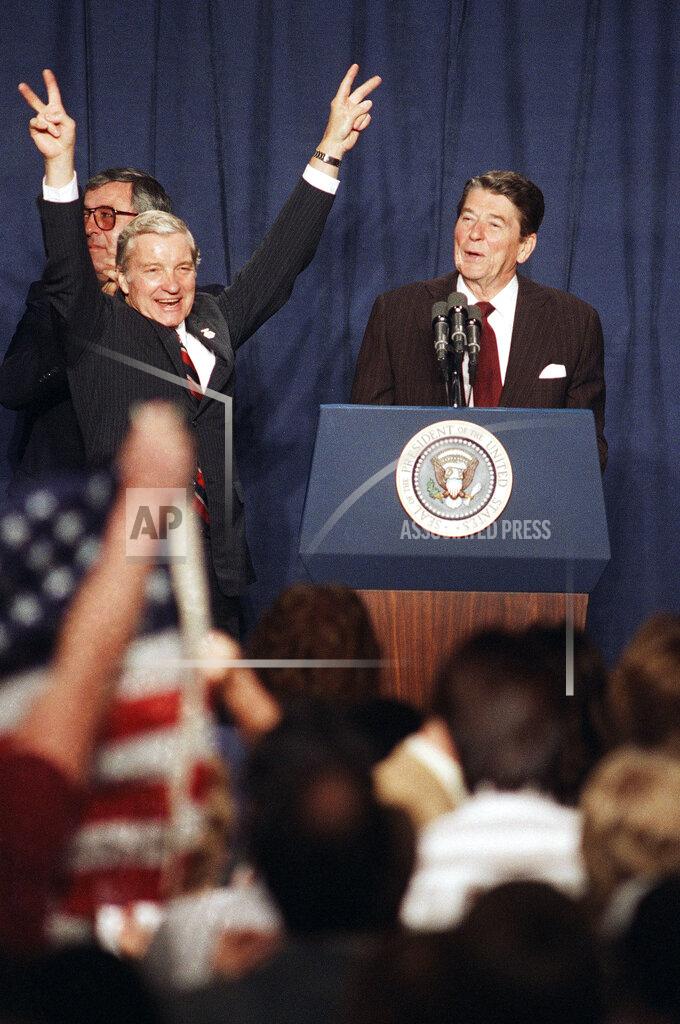
President Reagan campaigned against Walter Mondale by telling high school students in the Chicago area that he had inherited a nation that “over the years had unilaterally disarmed.” Mr. Reagan used the description in criticizing Mr. Mondale’s foreign policy record as he fielded a few questions from students without follow-up queries. He accused the Carter Administration, in which Mr. Mondale was Vice President, of scrapping the B-1 bomber program without achieving a comparable arms concession from the Soviet Union. The students, in the Chicago suburb of Bolingbrook, cheered and applauded Mr. Reagan, particularly when he emphasized that in facing the Russians he had been shoring up the military to make this nation “as strong as they are.”
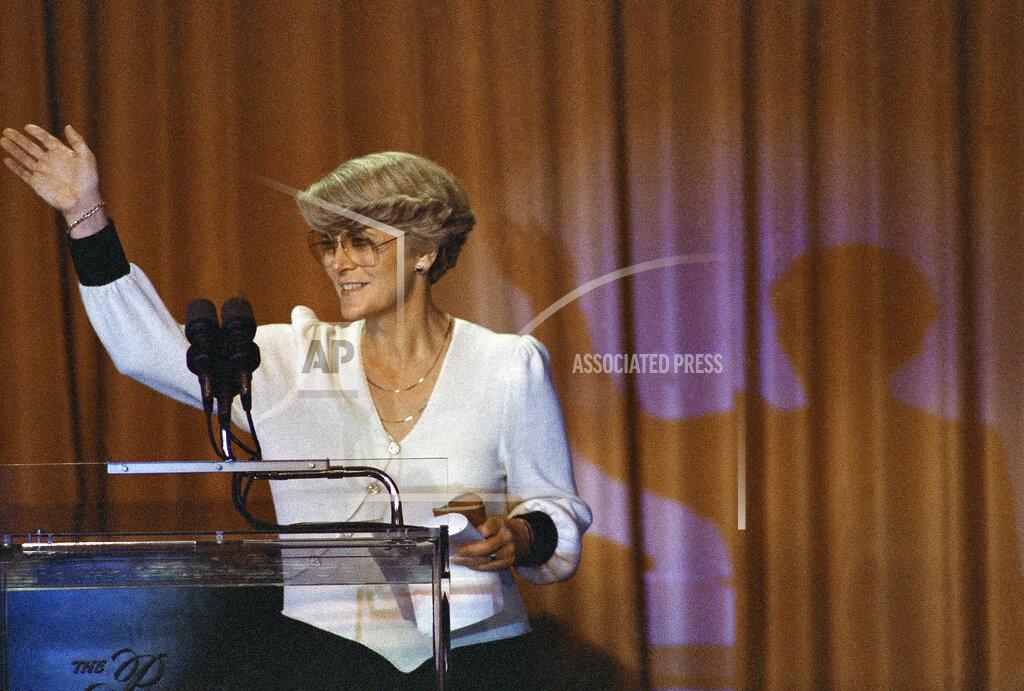
Geraldine A. Ferraro criticized President Reagan before a cheering crowd of Democrats in Springfield, Illinois, as a captive of special interests, who are “the rich, the powerful and the greedy.” Later she also assailed Vice President Bush for declining to apologize for saying in last Thursday’s debate that the Democratic ticket of Walter F. Mondale and Mrs. Ferraro had said that the marines who died in the bombing of the United States Embassy in Beirut had died “in shame.” Mrs. Ferraro said that Mr. Bush should apologize as well to the parents of the marines who were killed. “It is not the first time that Mr. Bush or Mr. Reagan or somebody else in the Administration has distorted what Fritz Mondale and I have said or our views or policies,” the Queens Representative said. “It is also an indication of how this Administration has operated over the last four years. They make a mistake and they don’t admit to the mistake and then they don’t learn from the mistake.”
A Nuclear Regulatory Commission panel reversed its denial of a license to the Commonwealth Edison Co.’s Byron atomic power plant and cleared the way for the northern Illinois station to begin generating electricity. A spokesman said the utility is ready to begin loading fuel into one of the plant’s two reactors and hopes to have the station, located near Rockford about 90 miles west of Chicago, in operation by February. The second reactor is not expected to go on-line until April, 1986.
Georgia’s Supreme Court ruled that parents or guardians can end life-sustaining medical care for incompetent and terminally ill patients who are in a vegetative state with no hope of recovery. The ruling means parents or guardians no longer need a court order to remove life support systems once three physicians have determined a patient is vegetative and has no hope of recovery. “While the state has an interest in the prolongation of life, the state has no interest in the prolongation of dying,” the justices wrote.
A man killed himself on a freeway just before the police found a woman’s body in his van, and officers who searched his apartment say they turned up evidence that indicated he may have killed as many as six women. Investigators who searched the apartment of the dead man, Fernando Velazco Cota, turned up bogus identifications, a false badge and other evidence that detectives think may link him with several unsolved homicide cases, according to Lieutenant Don Trujillo. “Crime scene technicians discovered a closet that was apparently used to hold kidnap victims,” Lieutenant Trujillo said in a prepared statement. “There were metal brackets secured to the floor that were used with chains and manacles.” Mr. Cota, 38 years old, shot himself after telling state highway patrolmen, “I’m a very sick man, kill me. If you don’t kill me, I’ll kill myself.” The police said they were investigating the possibility that Mr. Cota could be involved in the slayings of five San Jose area women over the past seven weeks in addition to the death of Kim Marie Dunham, 21, whose body was found in his van.
Reports that up to six children were murdered after appearing in pornographic photos were being investigated by police, following a prosecutor’s claim that child sex abuse charges against 22 adults were dropped to protect an investigation “of great magnitude. The information was given by some of the children involved to police investigators and in turn we’re reviewing it,” said Dean Johnson, deputy chief of police in Jordan, Minnesota. A story in the Minneapolis Star & Tribune, quoting unidentified sources, said the murder investigation was based on what children of former defendants in the Jordan sex ring cases said they saw or heard.
The Washington headquarters building of the U.S. Postal Service and the Public Broadcasting Service, was hit by a $100 million four-alarm fire that gutted a third of the ninth floor. It took firefighters 90 minutes to knock down the blaze that led to the 10-story building suffering heavy smoke and water damage as water cascaded into the ornate marble lobby through light fixtures and fire escapes. The fire sent 21 firemen to hospitals for treatment of smoke inhalation.
A nurse was found innocent in Newburyport, Massachusetts, of charges that she tried to kill her terminally ill patient. Victoria Knowlton, 36, was acquitted of assault with intent to murder William Cronin, 59, of Lynnfield. Cronin, who suffers from amyotrophic lateral sclerosis, which has left him confined to a wheelchair and unable to speak, accused Knowlton of turning off his respirator on February 17 and telling him he was going to die. Mr. Cronin, 59, who cannot speak and is mostly paralyzed by the progressive and incurable nerve disorder amyotrophic lateral sclerosis, was revived after the nurse called his son for help.
A man who set his estranged wife on fire after seeing the television movie “The Burning Bed” was charged with second degree murder today by the Milwaukee County District Attorney’s office. The suspect, Joseph G. Brandt, 39 years old, is accused of dousing his wife with gasoline and setting her on fire October 8. The police said that was the same night he watched a television movie about a woman who killed her abusive husband by igniting his bed. Sharon Brandt, 37, died Monday after suffering third-degree burns over 95 percent of her body. Mr. Brandt was being held in $35,000 bail.
FBI agents have made the largest recovery of rare postage stamps in U.S. history, seizing stamps worth $500,000 stolen from the New York Public Library, the agency announced in Cleveland. The 82 stamps, appraised by the American Philatelic Society, were among 153 from a single collection that were taken in a 1977 burglary, said Special Agent Joseph Griffin. Griffin said the stamps began surfacing in 1982, but the recovery was just announced because of grand jury restrictions in New York. The stamps were traced to the now-deceased stamp dealer Lambert W. Gerber of Tamaqua, Pennsylvania.
Researchers at Dartmouth Medical School injected a drug — bethanechol chloride — directly into the brain of victims of Alzheimer’s disease in what may be the first effective treatment of the mind-crippling ailment, it was announced in Hanover, New Hampshire. The drug is believed to mimic the action of a natural brain chemical called acetylcholine, which Alzheimer’s victims lack. The findings were reported in the October issue of the medical journal Neurosurgery.
Shrimp harvesters are mostly idle in the Southeast, mainly because of a freeze that killed much of this fall’s crop and competition from imports. Some believe the shrimp industry, a mainstay of many coastal economies since World War II, will never be the same again.
Up to three feet of snow fell in central Colorado, paralyzing Denver and other large cities and stranding many motorists for several hours.
Gene Mauch, who resigned as the California Angels’ manager after the 1982 season, is hired again.
Dow Jones Industrial Average: 1197.77 (-5.19)
Born:
Brandon London, NFL wide receiver (Miami Dolphins), in Richmond, Virginia.
Mkristo Bruce, NFL defensive end (Jacksonville Jaguars), in Seattle, Washington.
Shayne Ward, British singer (UK X Factor – “That’s My Goal”), and actor (“Coronation Street”), in Tameside, Greater Manchester, England, United Kingdom.
Died:
Peggy Ann Garner, 53, American actress (“Little Women”, “Daisy Kenyon”), of cancer.
Ken Carpenter, 84, TV announcer (“Lux Video Theater”).





 History Diaries