Fighting in the west is impeded by mud; motorized vehicles are having trouble. The German blitzkrieg is slow in starting. Hitler’s warning of a war of destruction is not immediately followed up by attack.
General Gamelin, French Commander-in-Chief, issues an Order of the Day predicting a massive German offensive “at any moment.”
The escaped Polish Intelligence team resumes code-breaking operations in France with their highly secret replicas of the German “Enigma” machine. Having brought over two copies of the Enigma machine, Polish cryptanalysts resume their efforts to break the German ciphers in France.
A new Italian ambassador is sent to London, Signor Bastianini.
The Berlin-Moscow tie looks unstable. Germans foresee the day when interests will clash.
Danzig Nazis demand the ousting of all Jews.
The first group of ethnic German Latvian citizens leaves for the Third Reich by sea.
Soviet and Finnish representatives concluded the unsuccessful talks discussing border revisions. Finland’s counterproposals for a land exchange on their mutual border were refused by the Soviet negotiators. Finnish negotiators requested for more time and returned to Finland. Official Soviet demands were for garrisons and exchange of territories. The Soviets claimed to be mainly concerned with securing the safety of Leningrad and becoming satisfied that Finland would maintain firm, friendly relations with the Soviet Union. “Both points are essential for the purpose of preserving against external hostile aggression the integrity of the Soviet Union coast of the Gulf of Finland and also of the coast of Estonia, whose independence the Soviet Union has undertaken to defend.”
The Finns have 340,000 men in ten divisions and accompanying units, a formidable force that is expert in winter weather.
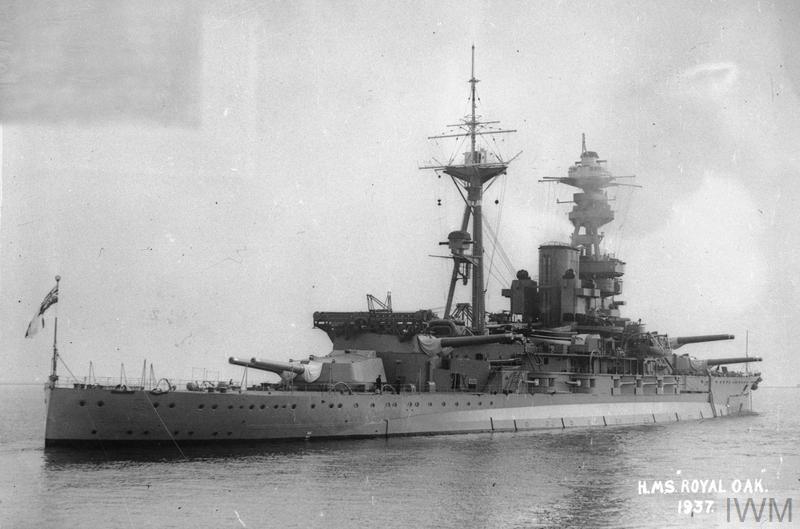
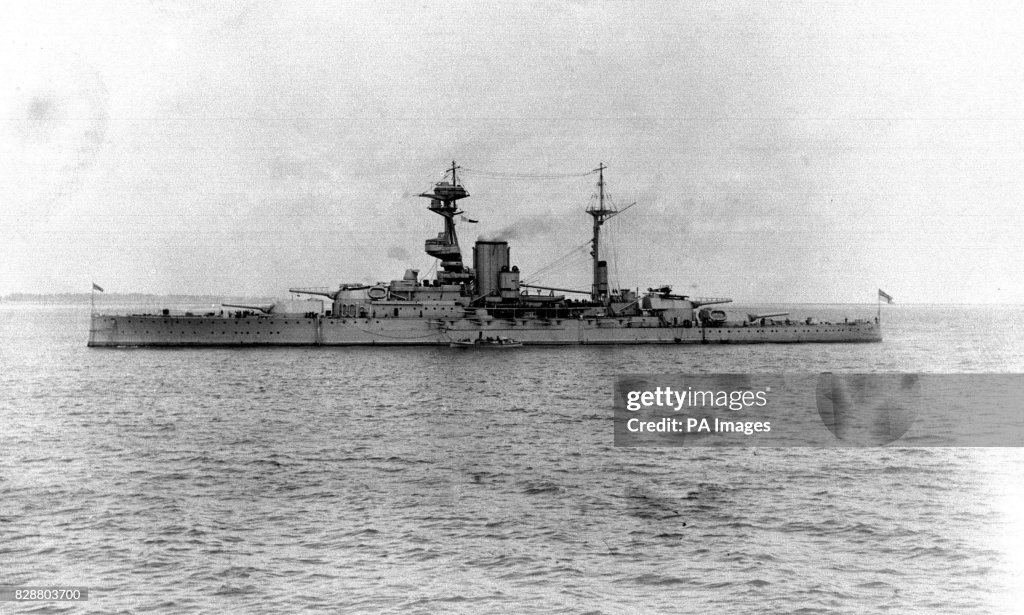
U-47 (Kplt. Günther Prien) sinks the battleship HMS Royal Oak (08) at Scapa Flow (at 58°55′N 2°59′W). The second torpedo salvo fired by U-47 soon after midnight, and about an hour after the first, sank HMS Pegasus as well as the Royal Oak, which sinks in just 13 minutes resulting in 835 crew lost, including Rear Admiral Henry Blagrove. This penetration of the RN Home Fleet base gave Germany a major propaganda victory, and the Home Fleet was temporarily relocated to Loch Ewe on the West Coast of Scotland until Scapa’s defenses were improved. On his return to base, Commander Günther Prien and his entire crew were taken to Berlin, and fêted after Hitler personally presented Prien with the award of the Knight’s Cross. At Scapa Flow, HMS Royal Oak and her 835 dead remain a war grave and a memorial of this incident.
After an investigation, it is revealed that there is a 50-foot gap in the net over Kirk Sound. The Royal Fleet changes its location to Loch Ewe.
Sailing with the unescorted Convoy KJF.3, the French steam merchant Bretagne was torpedoed and sunk by the U-45 approximately 230 miles southwest of Fastnet, Ireland (50°20′N 12°45′W). Of the ship’s complement, 7 died, five crew and two passengers. The 10,108-ton Bretagne was carrying general cargo and was bound for Le Havre, France.
Sailing with the unescorted Convoy KJF.3, the British motor merchant Lochavon was torpedoed and sunk by the U-45 approximately 230 miles southwest of Fastnet. All of the ship’s complement were picked up by the destroyer HMS Ilex (D 61). The 9,205-ton Lochavon was carrying passengers and general cargo, including dried fruit and was bound for Southampton , England.
The U-45, commanded by Kapitänleutnant Alexander Gelhaar, was sunk by depth charges from the destroyers HMS Inglefield (D 02), HMS Ivanhoe (D 16), and HMS Intrepid (D 10) southwest of Ireland, in position 50.58N, 12.57W. All of the ship’s complement of 38 died.
The British steam merchant Sneaton was stopped by gunfire and after the crew abandoned ship was torpedoed and sunk by the U-48, commanded by Kapitänleutnant Herbert Schultze, about 150 miles southwest of Cape Clear, England in the eastern Atlantic Ocean (49°05′N 13°05′W). Of the ship’s complement, 1 died and the survivors were picked up by the Belgian tanker Alexandria André. The 3,677-ton Sneaton was carrying coal and was bound for Rio de Janeiro, Brazil.
German armored ship Deutschland shelled and sank Norwegian freighter Lorentz W. Hansen 420 miles east of Newfoundland, 49°05’N, 43°44’W.
The German cargo ship Marion Traber ran aground in the Baltic Sea off Nyköping, Södermanland, Sweden and was wrecked.
U-23 was attacked in the North Sea by the British submarine HMS Sturgeon with three torpedoes, but all three missed.
The Polish submarine ORP Orzel has been at sea for almost a month after escaping from Estonian detention. It now completes its journey to the British Isles.
U.S. freighter Nashaba is detained at Le Havre by French authorities.
U.S. freighter Scanstates is detained at Kirkwall, Orkneys, by British authorities.
U.S. freighter Exporter is detained at Gibraltar by the British.
The War at Sea, Saturday, 14 October 1939 (naval-history.net)
U-47 sank battleship ROYAL OAK (Flagship Rear Admiral H E C Blagrove, Captain W G Benn) at 0058 at anchor in Scapa Flow and escaped unharmed. Rear Admiral Blagrove, Lt Cdr S D Roper, Lt J E Moore, Captain H E Balls RM, Instructor Lt H Stewart, Lt (E) R L W Clark, Lt (E) C H Cock, Lt (E) M P Roupell, Surgeon Lt (D) W A Dickie, Surgeon Lt H J Cornelius RNVR, Sub Lt J L T Graham Brown, Chaplain Reverend J D B Cree, Midshipmen P W C Graham, E J Martin, N M Patterson, PG Piddington, S R M Wilson, Paymaster Midshipman W J R Bowhay, Commissioned Gunner A Powell Rtd, Commissioned Telegrapher R Hughes Rowlands, Warrant Engineer W H G Cheesley, Warrant Ordnance Officer R D Ward, Naval Cadets V G U Jay, A D McDermott, and eight hundred and nine ratings were lost.
Anti-submarine operations were conducted in the harbour by destroyers SOMALI, MASHONA, ASHANTI until the 22nd, but without result as U-47 had escaped the area shortly after sinking ROYAL OAK. The first attack made was by destroyer ASHANTI at 1030/13th, long after the submarine had departed. Fortunately, most of the Fleet was at Loch Ewe. However, old seaplane tender PEGASUS was in the berth next to ROYAL OAK and, although identified by U-47 as battlecruiser REPULSE, was not damaged.
Light cruisers AURORA at 0829 and BELFAST at 0730 and most of the fleet auxiliaries in the Orkneys left for Loch Ewe, arriving on the 14th. Anti-aircraft ship CURLEW was able to proceed there on the 16th.
The cruisers on Northern Patrol were transferred to Sullom Voe which was only protected by an anti-submarine net. Light cruisers CALEDON, CARDIFF, DELHI and COLOMBO at 0730 and armed merchant cruisers CALIFORNIA, MONTCLARE, SCOTSTOUN, SALOPIAN and CHITRAL departed Scapa Flow on the 14th, and armed merchant cruisers AURANIA, RAWALPINDI and TRANSYLVANIA on the 15th.
Remaining at Scapa Flow were: base ship IRON DUKE, accommodation ship VOLTAIRE, destroyers SOMALI, MASHONA, ESKIMO, ASHANTI which were standing by for convoy duty, destroyer TARTAR with serious defects and minesweepers HAZARD, HEBE, SEAGULL, SHARPSHOOTER, SPEEDY.
Light cruiser CALEDON arrived at Kirkwall on the 18th, and COLOMBO at Sullom Voe on the 18th.
Destroyers COSSACK, MAORI, ZULU which had departed Gibraltar on the 11th, arrived at Portland. Sister ship NUBIAN, left with the other three, and reached Portsmouth on the 14th. Because of turbine defects, she was towed to Southampton on the 20th and was under repair until 23 November, but did not leave Portsmouth until the 30th for duty with the Home Fleet. The final unit of the 4th Destroyer Flotilla, destroyer SIKH, remained in the Mediterranean with turbine defects until 20 December and did not arrive at Dover until the 23rd.
Submarine STURGEON fired three torpedoes at U-23, 20 miles E of the Skaw in 57-50N, 9-59E at 1452.
Polish submarine ORP ORZEL, which escaped internment at Tallinn on 18 September, was met in the North Sea 30 miles east of May Island by fast escort ship/destroyer VALOROUS and escorted into Rosyth.
Convoy FS.21 departed Methil, escorted by destroyers VIVIEN, WHITLEY, WITCH and sloop STORK, and arrived at Southend on the 16th. There was no convoy FN.21.
French destroyers BRESTOIS and BOULONNAIS departed Brest for Cherbourg, where BRESTOIS began refitting. The third destroyer of the 5th Division, FOUDROYANT, was on escort duty in the Atlantic and joined the other two on 2 November.
U-48 sank steamer SNEATON (3678grt) in 49 05N, 13 05W, 150 miles SW of Fastnet, with the loss of one crewman. The survivors were picked up by Belgian tanker ALEXANDRE ANDRE (5261grt).
A group of merchant ships from convoy KJF.3, en route to France and escorted by French submarine SURCOUF, were attacked by U-37, U-45, U-46, U-48, south of Ireland early on the 14th, after SURCOUF lost touch in a storm. U-45, on her second war patrol, sank two ships from the group. French liner BRETAGNE (10,108grt) went down 130 miles SW of Fastnet in 50 20N, 12 45W, and her survivors were picked up by destroyers IMOGEN and ILEX, arriving Plymouth on the 15th. British steamer LOCHAVON (9205grt) was torpedoed 230 miles SW of Fastnet in 50 25N, 13 10W early on the 14th, sinking at 1800/16th, 150 miles SW of Fastnet. She lost seven crew with her survivors rescued by destroyer ISIS, which had left Plymouth on the 8th for escort duty with sister ship IMPERIAL. Steamer KARAMEA (8457grt) was also attacked by U-45, 100 miles SW of Fastnet in 50 30N, 12 14W, but escaped unharmed. U-45 was then sunk south of Ireland in 50 58N, 12 56W by destroyers INGLEFIELD, IVANHOE, INTREPID and ICARUS, which departed Plymouth on the 13th for anti-submarine patrol in support of KJF.3. All 38 crew were lost.
German pocket battleship DEUTSCHLAND sank Norwegian steamer LORENTZ W HANSEN (1918grt) east of Newfoundland in 49 05N, 43 44W, with the loss of three crew. The survivors were put aboard Norwegian tanker KONGSDAL (9959grt) stopped later the same day.
Aircraft carrier HERMES and French battlecruiser STRASBOURG arrived at Dakar having departed Plymouth and Brest, respectively, on the 7th.
Light cruiser DAUNTLESS departed Malta and reached Port Said on the 16th.
Destroyers GRAFTON and GALLANT reached Gibraltar to escort battleship RAMILLIES, and DUCHESS to escort convoy Green 5.
Destroyers HAVOCK and HOTSPUR arrived off Montevideo for refueling and left again that evening.
Heavy cruisers SUSSEX and SHROPSHIRE of British Force H, departed Simonstown and swept the southern half of the Capetown to Freetown route. On the 22nd, they returned to refuel – SUSSEX at Simonstown and SHROPSHIRE at Capetown.
Australian light cruiser HMAS HOBART departed Sydney late on the 13th, with Australian destroyers HMAS STUART, HMAS VENDETTA and HMAS WATERHEN leaving at 0900/14th (local time) and all four proceeded in company. HOBART reached Darwin on the 21st, left the same day and proceeding via Lombok Strait, arrived at Singapore on the 26th. Meanwhile, the three destroyers reached Brisbane on the 15th to refuel and shelter from heavy weather, departed on the 16th, refueled at Townsville on the 18th, arrived Darwin on the 22nd, departed on the 23rd and reached Singapore on the 29th.
Australian destroyers HMAS VOYAGER and HMAS VAMPIRE also left on the 14th, from Fremantle, and proceeded to Singapore via the Sunda Strait, arriving on the 21st. All six ships were initially assigned to convoy duty from Singapore. On 13 November, the destroyers left Singapore for Colombo.
German steamer MARION TRUBER (2334grt) was lost by grounding near Oxelosund.
By mid-October, the British and French Admiralties had organized the following Hunter Groups which were formed on the 5th in response to sinkings by German battleships:
Force F – heavy cruisers BERWICK and YORK stationed in the West Indies and North America. YORK was detached from the America and West Indies Station, but did not serve in Force F. She was maintained for Halifax convoy cover)
Force G – heavy cruisers CUMBERLAND and EXETER stationed off South America with New Zealand light cruiser ACHILLES detailed on the 5th to join them.
Force H – heavy cruisers SUSSEX and SHROPSHIRE near the Cape of Good Hope.
Force I – aircraft carrier EAGLE, heavy cruisers CORNWALL and DORSETSHIRE off Ceylon.
Force J – aircraft carrier GLORIOUS and battleship MALAYA off Aden in the approaches to the Red Sea.
Force K – aircraft carrier ARK ROYAL and battlecruiser RENOWN near Pernambuco.
Force L – French battlecruiser DUNKERQUE, aircraft carrier BÉARN, light cruisers GLOIRE, MONTCALM, GEORGES LEYGUES at Brest.
Force M – French heavy cruisers DUPLEIX and FOCH at Dakar.
Force N – French battlecruiser STRASBOURG, aircraft carrier HERMES, French heavy cruiser ALGÉRIE and light cruiser NEPTUNE to be based at Jamaica, but reassigned to Dakar.
STRASBOURG, DUPLEIX and ALGÉRIE travelled in company to Dakar.
Force N was never formed. FOCH did not arrive at Dakar until mid-November, then as Force X with DUPLEIX.
Senator Key Pittman of Nevada, chairman of the Senate foreign relations committee, and the New York Herald Tribune, as well as many Canadians, protest the comments made by Charles Lindbergh in a radio broadcast last night. Colonel Charles Lindbergh has caused deep anger both in Canada and in many circles in the United States by his radio broadcast last night in which he questioned the right of Canada to “draw this hemisphere into a European war because they prefer the Crown of England to American Independence.” Senator Key Pittman of Nevada, the chairman of the Senate foreign relations committee, attacked Colonel Lindbergh’s speech. The New York Herald Tribune called it “as fantastic in logic as it is bad in taste”. Many Canadian leaders have already wired their fury to Washington, and Canadian ex-servicemen’s groups have protested. Lindbergh appeared to try to meet the charge that he is pro-German by calling for both Nazi and Communist influence in America to be “stamped out”. He also said that British and French colonies in the Caribbean should be handed to the U.S. to pay war debts.
Senate debate on the Neutrality Bill today turned into a free-for-all discussion of Colonel Lindbergh’s radio speech last night, in the course of which three Administration leaders charged him with inconsistency and, in one case, with substantive approval of “the brutal conquest of democratic countries.” Senator Pittman, chairman of the Foreign Relations Committee, said in a speech prepared as an analysis of Colonel Lindbergh’s speech: “The most unfortunate part of Colonel Lindbergh’s statement is that it encourages the ideology of the totalitarian governments and is subject to the construction that he approves of their brutal conquest of democratic countries through war or threat of destruction through war.” Senator Barkley, the majority leader, and Senator Connally, co-author of the pending bill, coupled Colonel Lindbergh with former President Hoover, pointing out a parallel between statements in the colonel’s speech and a previous statement by Mr. Hoover.
All three speakers emphasized, as well, the flier’s advocacy of exports of arms for “defensive” purposes; pointed out that this action in itself would require repeal of the current embargo on exports of munitions, and then attacked the colonel’s idea that there is a difference between arms for offense and arms for defense with argument and scorn. In the course of the debate Senator Clark of Missouri, who put Colonel Lindbergh’s speech in the Record, warmly applauded it. Earlier in the day Senator Vandenberg had made a public statement praising the speech, but he refrained from participating in the debate on the floor.
Discussion of the Lindbergh speech precipitated probably the most exciting episode of the week, but it occurred in the presence of only about a score of Senators and before galleries which held only scattered groups of listeners. The day had been expected to be more or less routine, with Senators Frazier and Lundeen scheduled to deliver more or less routine speeches in opposition to repeal of the embargo on arms exports and Senator Connally a rebuttal of arguments advanced by anti-repealers in other debates this week. These speeches were made, but amid unexpected explosions.
Senator Lundeen, Farmer Laborite, of Minnesota, proposed that the United States seize with its armed forces the British possessions in the Caribbean as payment for the war debts. We need them for air and naval bases, he said. “There wouldn’t be a shot fired,” he declared. “They (the British) are pretty busy on the Western Front.” The session immediately became stormy. “He’s opposed to war,” Senator Connally exclaimed, “but he wants us to send our army and navy down to take the Bahamas by armed force. This man of peace! Now that England has a knife at her throat, now is a lofty time for a great nation like ours to take them.”
“It reminds me,” Senator Schwellenbach interjected, “of what Molotov of Russia told Latvia and Finland and the other Baltic nations — ‘we need them; therefore, no matter what happens, we’re justified in taking them.’ ” At adjournment tonight, ending the second week of debate, there was no agreement or evidence of an early conclusion, although leaders remained optimistic.
The distinction drawn by Colonel Charles A. Lindbergh between “offensive” and “defensive” weapons and munitions in connection with the discussed repeal of the arms embargo was disputed yesterday by Major General John F. O’Ryan, wartime commander of the Twenty-seventh Division.
As the Senate neared the end of its general debate on revision of the Neutrality Act today Administration leaders appeared confident that President Roosevelt’s objectives, chief among which is repeal of the automatic arms embargo imposed by the present statute, would be accomplished within a short time.
A majority of American voters of all national origins save those of German origin are in favor of repealing the arms embargo, according to an analysis of the voting in a survey by the American Institute of Public Opinion, of which Dr. George Gallup is director. The national figure is about 60% in support of repeal; German-Americans are 55% opposed.
Robert Pitcoff, a former official of Amtorg, the Soviet trading corporation in the United States, told the House committee investigating un-American activities today that some Americans were members of the OGPU, Russian secret police.
The army has completed plans under which a minimum of 1,000,000 men, fully supplied with modern equipment, could be quickly mobilized in case of defense need.
The U.S. Naval Aircraft Factory authorized to develop radio-control equipment for use in remote-controlled flight testing of aircraft without risking the life of a test pilot.
BMI (Broadcast Music Incorporated) is formed.
In Baltimore, the Negro League all stars complete four-game series of games against a big-league all-star team (as noted by historian John Holway) by losing 3–1. The winning pitcher is Pete Appleton, while the losing pitcher is Marion “Sugar” Cain. Webster McDonald pitched hitless and runless ball for 8 relief innings for the Negro Leaguers. The doubleheader on October 8 was won by the Major Leaguers, 3–1 and 2–0.
Selected college football scores:
Alabama 20, Mercer 0
Amherst 26, Tufts 7
Army 6, Columbia 6
Auburn 7, Miss. State 0
Baylor 19, Arkansas 7
Bowdoin 19, Wesleyan 7
Carnegie Tech 21, Case 0
Colgate 10, Brown 0
Cornell 20, Princeton 7
Duquesne 7, Manhattan 0
Harvard 61, Chicago 0
Holy Cross 13, Georgia 0
Indiana 14, Wisconsin 0
Louisiana State 7, Rice 0
Marquette 17, Michigan State 14
Michigan 27, Iowa 7
Minnesota 13, Purdue 13
Muhlenberg 7, Lafayette 6
Navy 0, Dartmouth 0
Notre Dame 20, Southern Methodist 19
Nebraska 10, Iowa State 7
No. Carolina 14, N. Y. U. 7
Ohio State 13, Northwestern 0
Oklahoma 24, Texas 12
Oregon 6, California 0
Penn 6, Yale 0
Penn State 49, Lehigh 7
Pittsburgh 14, Duke 13
R. I. State 40, Brooklyn 0
Rutgers 6, Richmond 6
Scranton 31, C. C. N. Y 0
Southern California 26, Illinois 0
Stanford 14, U. C. L. A 14
Syracuse 13, Georgetown 13
Temple 13, Texas Christian 11
Tennessee 28, Chattanooga 0
Texas A&M 33, Villanova 7
Tulane 7, Fordham 0
Virginia 12, Maryland 7
V. M. I. 20, Vanderbilt 13
Washington State 6, Washington 0
Williams 20, Hamilton 6
At Changsha, Japanese forces of the 11th Army withdraw to their starting points on both the eastern flank (101st and 106th divisions) and the center of the line (33rd Division).
Three groups of Chinese bombing planes swept over Hankow today, loosing explosives that caused extensive damage to the Japanese air base and to military establishments, according to official reports in Chungking.
Chuichi Nagumo was placed on a committee studying capital ship bridge design.
Dow Jones Industrial Average: 150.38 (-0.47)
Born:
Ralph Lauren, fashion designer, in the Bronx, New York, New York.
Mickey Walker, NFL guard, linebacker, and center (New York Giants), in Petoskey, Michigan.
Jim Norris, AFL defensive tackle (Oakland Raiders), in Houston, Texas.
Died:
Henry Blagrove, 52, British Royal Navy officer (killed in the sinking of the Royal Oak).

 History Diaries