The war in Vietnam claimed 1,268 casualties in the last week, with unusually heavy losses for Americans, South Vietnamese Government troops and the Communists alike, United States figures showed today. During the week seven Americans were killed, five when a helicopter was shot down in flames, and 11 were wounded. Saigon’s losses were given at 260 dead, 440 wounded and 225 missing. Việt Cộng figures were given at 275 dead and 50 captured. The Việt Cộng, whenever possible, carry their wounded and dead from the field and casualties are calculated by a “body count.” The losses were the highest since mid‐September, when 1,280 casualties were reported during a peak casualty period. Government troops lost 545 weapons, including 30 heavy pieces, during the period ending October 10. This was a rich haul for the Việt Cộng, who depend primarily on captured equipment for arms. American sources said both sides had been digging in with more determination.
On the political front, reliable forces reported that, through a deal worked out with the 17-man High National Council, the military triumvirate that was supposed to step down October 27 would continue to hold executive power until next year. The High Council, organized by the triumvirate last month to guide the country back to civilian rule, will serve as a sort of legislature. Under revised arrangements, it is reported, Major General Nguyễn Khánh, who has said he wanted to return to duty in the armed forces, will resign the premiership but will join Major General Dương Văn Minh, the titular chief of state, in some unspecified job of the executive branch.
After considerable pressure from both sides, the United States authorizes its Yankee Team jets to fly cover missions with the Laotian Air Force T-28s that are bombing the trails and installations used by the Việt Cộng and North Vietnamese Army making their way through Laos. The U.S. jets are to protect the Laotian planes from attacks from North Vietnamese MiGs.
After ten years in power, Nikita Khrushchev has been ousted as both premier and chief of the Communist Party. The new Russian leaders will increase military aid to the North Vietnamese without trying to persuade them to attempt a negotiated end to hostilities.
The trial of leaders of the coup d’état that failed September 13 opens in Saigon tomorrow. Thirteen military officers and seven civilians will go on trial before the III Army Corps military field court. American officials said they were not aware of any move to involve the United States Government. Concern about the United States role had been expressed earlier when a civilian, Trần Quốc Bửu , was accused simply of having brought Brigadier General Lâm Văn Phát, chief leader of the coup attempt, to the United States Embassy on the night of September 13. Mr. Bửu, who heads the South Vietnamese labor federation, said he had volunteered the introduction in the hope that the Deputy Ambassador. Alexis U. Johnson, could assist General Phát in ending the rebellion, which had already begun to disintegrate.
General Khánh, who himself seized power last January 30, was back at the head of the government after about 24 hours. The young officers who stood by him in the September crisis were understood to nave demanded punishment of the revolt’s leaders.
The warring factions in Yemen’s two‐year‐old civil war are scheduled to hold their first formal peace conference later this month, authoritative sources said tonight. Unless some snag develops, sources in contact with both sides said, the parley will probably be held in secret starting next. Tuesday. Most likely sites are Asmara in the Ethiopian highlands or Port Sudan, in Sudan, across the Red Sea from Yemen. These sources said Beirut was once considered as a site, but had been ruled out because it did not offer the requested privacy. Well‐placed sources said representatives of both President Gamal Abdel Nasser of the United Arab Republic and Prince Faisal of Saudi Arabia would participate in the conference. Cairo has supported the Republican regime with arms and troops. Saudi Arabia has supported the forces of the ousted Iman.
The disclosures of plans for the meeting followed several private talks here between President Nasser’s right‐hand man, Field Marshal Abdul Hakim Amer, and Prince Sultan, the Saudi Defense Minister and one of Prince Faisal’s brothers. The talks took place during the conference of nonaligned nations that ended Saturday. President Nasser, apparently to bolster his hand in the negotiations, is reported to have increased the number of Egyptian forces in Yemen during the last few weeks. Qualified saurces now estimate that President Nasser now has 46,000 troops in Yemen, more than ever before. Diplomatic circles say President Nasser may have increased. the troop strength so that he could announce reductions in the force at the appropriate time and still leave a sizable garrison in Yemen to prop up the shaky Republican regime. The civil war in Yemen, a remote, barren and backward country in the southwestern part of the Arabian peninsula, has caused international concern because of the threat of a direct clash between the Saudis and the Egyptians.
Galo Plaza Lasso, the United Nations mediator for Cyprus, said today that he expected to devise a “new and lasting” solution before the end of this year. Mr. Plazo, here for talks with Premier George Papandreou and Foreign Minister Stavros Costopoulos, said on his arrival, “You can safely say we are moving in the right direction.” He was commenting on his talks with the Turkish and Cypriote Governments last week in his bid to end the hostility between the island’s Greek Cypriote majority and its Turkish Cypriote minority. At times, since violence erupted last December, the matter has threatened to draw Greece and Turkey into direct conflict. “Both in Ankara and in Nicosia,” Mr. Plaza said, “I found that positions are no longer frozen. There is a genuine desire in both capitals to seek a solution.” He added: “I have no specific plan in mind yet, but by the time I submit my report to the United Nations Security Council at the end of this month or the beginning of next month, I’ll have specific recommendations to make.”
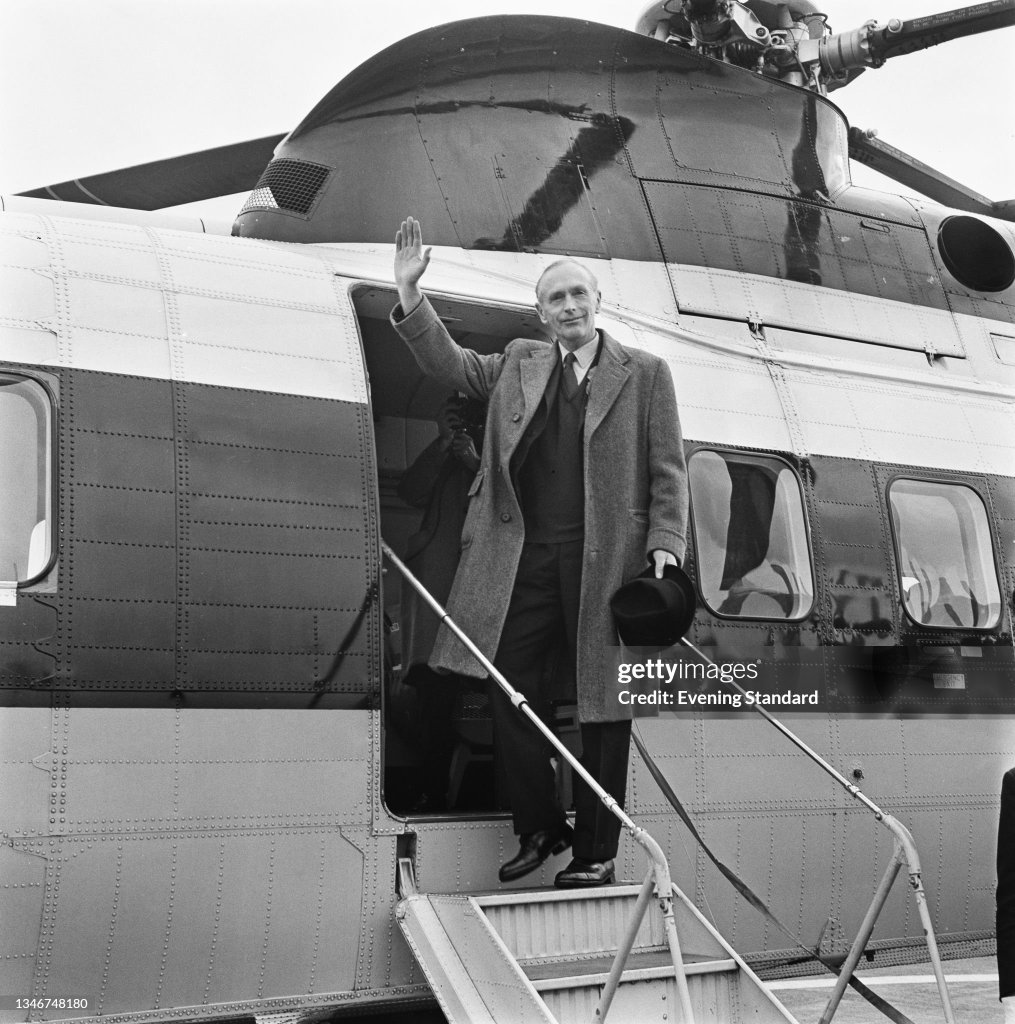
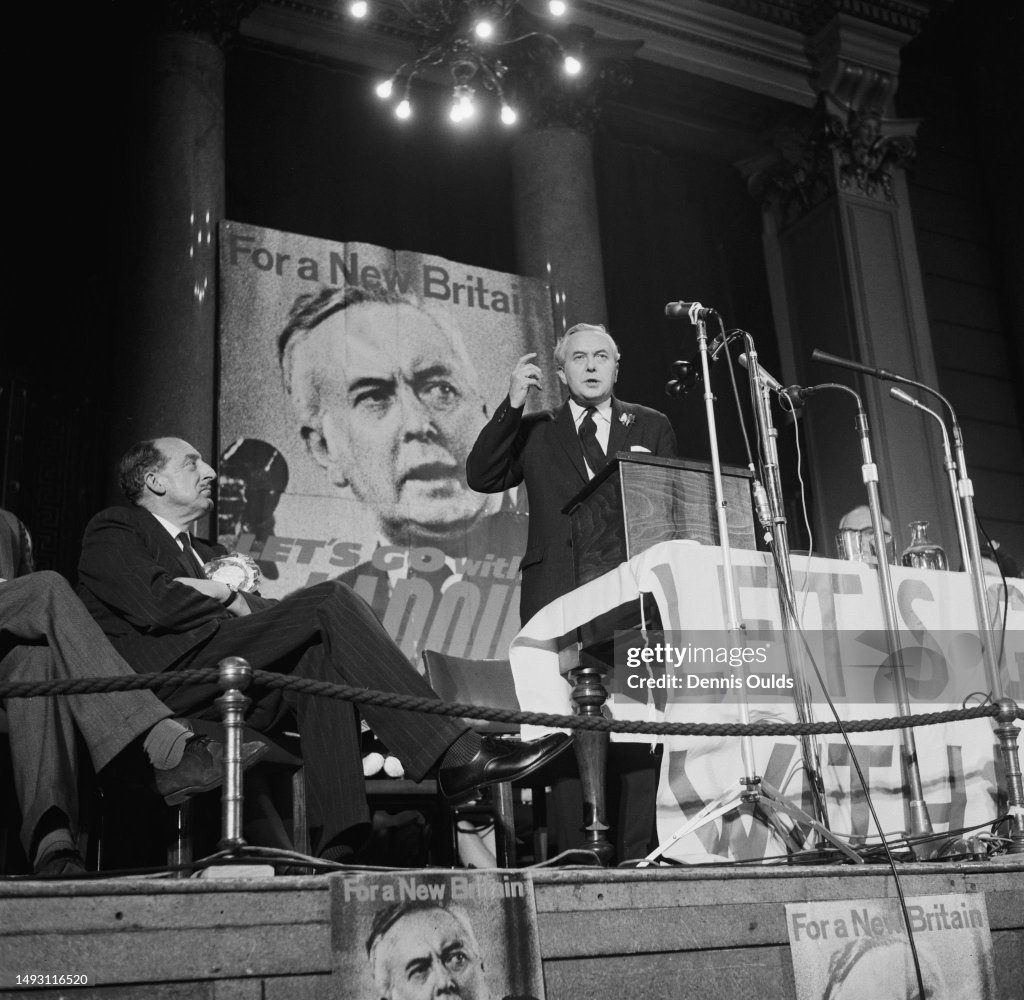
The final public‐opinion polls have judged the British general election tomorrow a toss‐up. Two of the national surveys to be published in the morning give the Labor party an inconclusive lead. The third, the poll of The Daily Express, shows the Conservative party ahead by eight‐tenths of a percentage point. If the polls are borne out in the voting, the outcome could be a standoff between the major parties with a handful of Liberal party Members of Parliament holding the balance of power. Before the poll results became available, the Prime Minister, Sir Alec Douglas‐Home, predicted that the Conservatives would make modern history by winning their fourth general election in a row. The Labor party leader, Harold Wilson, contented himself with the declaration that “we will do well.” In an election‐eve message to the 27 million or more Britons who are expected to cast ballots, he focused on the long Conservative rule and said: “Weigh deeply all the issues. Think over the whole of the past five years or, if you can bear it, the whole 13 years. Don’t be distracted by shortrun considerations, and above all, make sure of voting.”
The French Communist party asserted today its independence and that of all parties in the world Communist movement. A resolution of the Central Committee also condemned interference, by one party in the affairs of another. The French party, the resolution indicated, will henceforth frame its policies in accordance with the needs of the party and the situation in France. The resolution was adopted by the Central Committee at a meeting in Ivry last Friday and Saturday. It was published today in L’Humanité, the party newspaper. The French Central Committee voiced strong support of the Soviet party in its conflict with the Chinese. It noted that this had now progressed beyond an ideological schism to an open demand for Soviet territory and an “arbitrary demand“ to annex Mongolia, which is between the Soviet Union and China.
[Ed: LOL. The French Communists will continue to slavishly toe the Moscow line right up to the fall of the Soviet Union. Independence, My Ass.]
Communist China called today on all “peace‐loving” peoples to “struggle for complete, thorough, total and resolute prohibition and destruction of nuclear weapons.” In a long editorial on the nonaligned conference in Cairo, the Communist party organ Jenmin Jih Pao described as “justifiable aspirations” the conference’s demand for the abolition of foreign military bases, removal of the nuclear threat and an end to the arms race. The Chinese have been working for years to develop nuclear weapons. There have been reports that they will test their first nuclear device before the end of the year.
An armed attempt by political exiles to overthrow the Government of Niger’s President Hamani Diori has been crushed with the capture of a. large number of rebels, it was announced today. Four alleged rebels were executed yesterday in this capital city of Niger in north‐central Africa and two were sentenced to long prison terms. It was announced that other rebels were killed during attacks. Those captured will go before the state security courts. The announcement said rebel bands have been making unsuccessful attacks on posts in the east where Niger is bordered by Chad. It said the latest attack was made two days ago.
Rescue officials in Hong Kong said today that the death toll from Typhoon Dot was likely to reach 51. Most of the dead and missing are refugees from Communist China.
The Soviet Union announced the launching today of another unmanned instrument-carrying satellite to explore space. Kosmos 48 was sent up less than a day after conclusion of the 24‐hour 16‐orbit flight of Voskhod, the world’s first spacecraft carrying more than one man.
[Ed: Kosmos 48 was actually a Soviet first generation, low resolution, optical film-return reconnaissance satellite.]
Dr. Martin Luther King, Jr. became the youngest recipient of the Nobel Peace Prize, awarded to him for leading non-violent resistance to end racial prejudice in the United States. The 35‐year‐old civil rights leader is the youngest winner of the prize that Dr. Alfred Nobel instituted since the first was awarded in 1901. The prize honors acts “for the furtherance of brotherhood among men and to the abolishment or reduction of standing armies and for the extension of these purposes.” The Norwegian state radio changed its program schedule tonight to broadcast a 30-minute program in honor of Dr. King. In a broadcast from Atlanta, Georgia, Dr. King said that he was deeply moved by the honor. Dr. King said that “every penny” of the prize money. which amounts to about $54,000, would be given to the civil rights movement.
The nation’s total output of goods and services, as measured by the gross national product, rose another $8.9 billion in its annual rate in the third quarter of this year, the Department of Commerce estimated today. The growth of the economy in the third quarter, based on these partly estimated figures, was slightly less than the $9.8 billion gain registered in each of the first two quarters of the year. However, the economy, as the final quarter of the year began, was less than the $9.8 billion gain registered in each of the first two quarters of the year. President Johnson is likely to use today’s figures — the last to be issued before the election on this most comprehensive measure of the economy’s performance — to bolster his campaign theme that the economy is doing exceptionally well. This year has seen the record broken for duration of a peacetime period of expansion, and the growth rate has been high by historical standards.
President Johnson pledged last night to take important new steps toward lessening world tensions if he is elected. He used the forum of the Alfred E. Smith memorial dinner to hail an improvement in Soviet‐American relations. He said relations between the two powers had “come a long way since shoes were banged on desks here in New York and a summit meeting collapsed in Paris.” The President was clearly tired after a strenuous day of campaigning. He said at the outset that he would delete portions of his prepared speech because of the late hour — he did not start speaking until 11:14 PM Among the portions he deleted was a reference to impending moves to strengthen peace, and a hint of possible new arms agreements with the Soviet Union. But he said he stood by everything in his prepared text. His aides in Washington had regarded it as a major foreign policy speech.
The President was heard by 2,000 persons who paid $100 each to attend the dinner in the Waldorf‐Astoria. The receipts go to the Smith Memorial Foundation for charitable purposes. In his reference to peace moves, the President’s prepared text said: “I believe we may be nearing a time for further and more lasting steps toward decreasing tensions and a diminishing arms race. I will try to take these steps—always in consultation with our friends. I will expect respect for our courage and our convictions. I will offer understanding for the concerns and interests of others. I will work for the growth of freedom and the survival of man.”
Richard M. Nixon attacked today the Administration’s foreign policy and the handling of the Robert G. Baker case, saying that President Johnson was trying to be “all things to all men.” In a speech at Jackson Junior High School, his second stop in Ohio today the former Vice President said: “If the present Administration continues as it is in Vietnam we’ll have the big war in Southeast Asia.” Declaring his support for Senator Barry Goldwater’s Presidential race, Mr. Nixon said: “One of the most important thing in electing a President is character. The President as the Chief Executive must set an example above reproach. But there’s a cloud hanging over the White House today because Johnson has covered up the Bobby Baker case for political reasons. Goldwater, meanwhile, tells what he believes and does not try to be all things to all men as Mr. Johnson does.”
Walter W. Jenkins resigned tonight as a special assistant to President Johnson after it became known that he had been arrested here last week on a charge of disorderly conduct involving “indecent gestures.” The White House press secretary, George E. Reedy, announced the resignation in New York, where President Johnson was spending the night. The arrest of Mr. Jenkins, as well as a record of his arrest in January, 1959, under similar circumstances, is in the records of the Morals Division of the Washington Metropolitan Police Department. The charge against him in the 1959 arrest read “disorderly conduct (pervert).”
Mr. Jenkins, who has served Mr. Johnson for 25 years, has been a confidant and close associate of the President in the White House. He is thought to have had free access to much if not most of the information available at the White House but it could not be determined this evening what degree of clearance he held for the handling of materials affecting the national security. Mr. Jenkins’ arrest last Wednesday became known here this evening in a manner that is not entirely clear. Local reporters were somehow advised of the police record after Dean Burch, chairman of the Republican National Committee, had called attention to “a report sweeping Washington that the White House is desperately trying to suppress a major news, story affecting the national security.” Within an hour, the White House staff in New York disclosed that Mr. Jenkins had been hospitalized here to be treated for “extreme fatigue.”
The Republican party’s statement was distributed at about 6 PM and led to questioning all major government departments, including the White House staff in New York. Mr. Jenkins’ hospitalization was disclosed at about 7 PM. By 8:30, reporters here had examined the record of arrests for last week and addressed new questions to the White House. Mr. Reedy announced the resignation at 10:30 PM at a hurriedly called news conference in the Waldorf‐Astoria Hotel. A White House source said President Johnson had known nothing about Mr. Jenkins’ hospitalization or arrest until his staff received questions from newsmen. Mr. Jenkins, 46 years old, has been a personal aide to Mr. Johnson since 1939. In recent years, the relationship between the two men appears to have involved close professional, political, business and personal associations. One of Mr. Jenkins’ six children is named Lyndon.
Senator Barry Goldwater of Arizona declared tonight that he did not know “what the hell” the case of Walter Jenkins was about, but said in a speech here that Americans wanted to see in their Government “clear and constant evidence of the highest morality.” The resignation of Mr. Jenkins, a special assistant to President Johnson, after his arrest on a “disorderly” charge left an air of tense political expectancy, but virtual official silence, in the Goldwater camp. Mr. Goldwater, stopped on a sidewalk late tonight, said: “I don’t know what the hell this is all about, but I am going to try to find out tonight.”
[Johnson’s Republican opponent in the 1964 presidential election, Barry Goldwater, knew Jenkins from the Senate and from serving as commanding officer of his Air Force Reserve unit, but initially denied knowing him. He did not comment on the incident while campaigning. Although it fit well with the charges he had been making about the lack of morality in Johnson’s administration, those referred to Bobby Baker and Billie Sol Estes. Instead, since FBI agents had just questioned him about Jenkins, he publicly asked Hoover to explain why Jenkins had not undergone a rigorous security check before joining the White House staff. Goldwater later said he chose not to make the incident a campaign issue. “It was a sad time for Jenkins’ wife and children, and I was not about to add to their private sorrow,” he wrote in his autobiography. “Winning isn’t everything. Some things, like loyalty to friends or lasting principle, are more important.”]
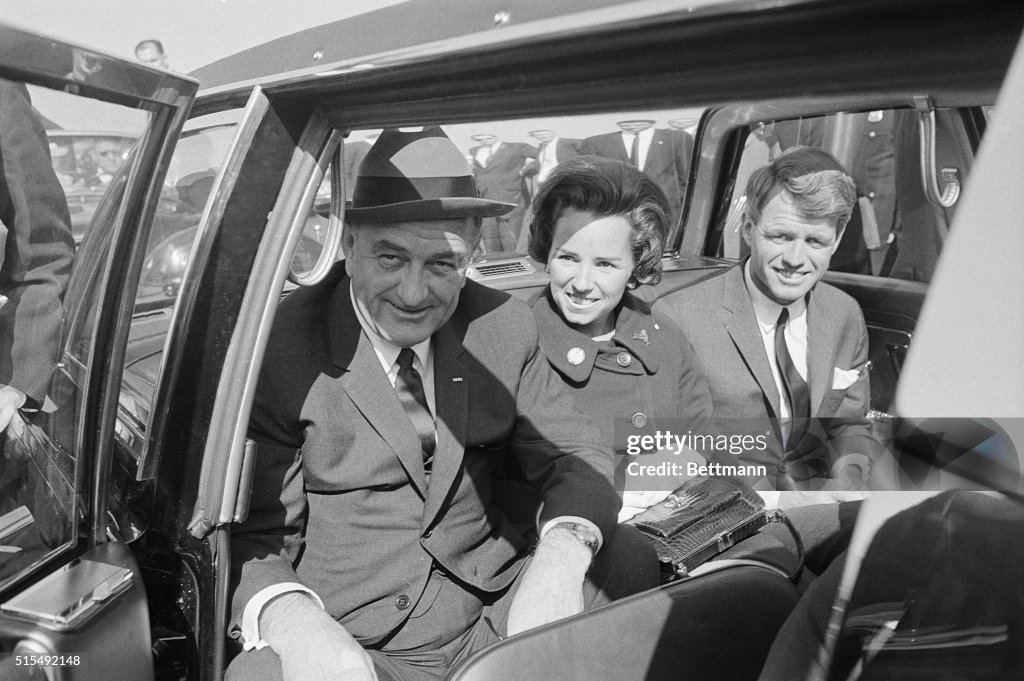
President Johnson today threw his arm, literally and figuratively, around the Democratic candidate for the Senate, Robert F. Kennedy. All through the day the President showed his support for the former Attorney General. He spoke privately with Mr. Kennedy for an hour in the President’s suite at the Waldorf-Astoria Hotel in New York. He talked animatedly with the Democratic Senate candidate on a ride in a motorcade. Mr. Johnson and Mr. Kennedy paid a call on Mrs. John F. Kennedy, widow of President Kennedy, at her new apartment. The trip to Mrs. Kennedy’s apartment was made without fanfare or official escort in a six‐car motorcade. There were no sirens or flashing lights. The party stopped at all red lights, and the President was largely unrecognized by the public.
Former President Dwight D. Eisenhower complained today that both President Johnson and Senator Barry Goldwater of Arizona were devoting too much time to criticizing each other and not enough to a discussion of the issues underlying the Presidential campaign. “This campaign is more personal than any I have ever known,” General Eisenhower said at an impromptu news conference outside his office on the campus of Gettysburg College. “The candidates are just not debating the issues.” He suggested that one of the issues that was not being discussed to his satisfaction was the future of the Social Security program. “I believe in a strong Social Security program,” he said, “but I think it would be bad to put medicare under it. It would break it down because of the heavier financial load. But if we could have catastrophic illness added, it would be a better program.”
The police sought a former Texas mental patient today for questioning about a possibly “serious” threat to assassinate President Johnson. Two former convicts, one of whom had a store of weapons in his home, were charged with violation of the Federal Firearms Act and held under $5,000 bond. Mr. Johnson will make a campaign swing through his home state this weekend. He is scheduled to speak in Corpus Christi at 6 PM Sunday.
A Boeing B-50D-80-BO Superfortress, 48-065, converted to KB-50J, of the 421st Air Refueling Squadron, Takhli RTAFB, crashed in Thailand shortly after takeoff on a training mission while supporting Yankee missions over Laos. Corrosion found in the wreckage would lead to early retirement of the KB-50 fleet and its replacement with Boeing KC-135s.
The first prototype Sikorsky YCH-53A Sea Stallion, Bu. No. 151613, made its first flight at the Sikorsky plant at Stratford, Connecticut, several months behind schedule. (Sikorsky Model S-65, serial number 65001.)
Philips begins experimenting with color TV.
English “Rolling Stones” drummer Charlie Watts (23) weds English sculptor Shirley Shepherd (26) in Bradford, England, until his death in 2021.
Italian soccer football legend Giorgio Chinaglia played his first professional game, appearing at the age of 17 for Swansea Town in a 2-2 tie with Rotherham United in the English League’s Third Division.
The Braves say they have a firm lease offer from Atlanta.
American swimmer Cathy Ferguson sets world record 1:07.7 to beat Kiki Caron of France by 0.2s and win the women’s 100m backstroke gold medal at the Tokyo Olympics.
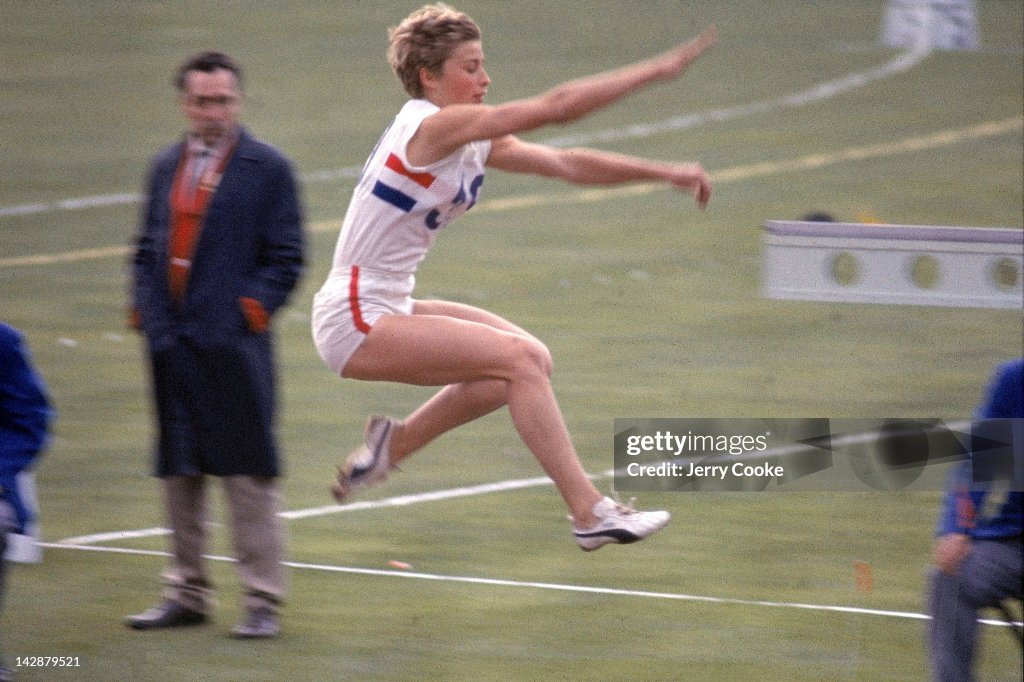
Mary Rand of Great Britain leaps a world record 6.76m to win the women’s long jump gold medal at the Tokyo Olympics.
American swimmer Dick Roth sets world record 4:45.4 to beat teammate Roy Saari and win the men’s 400m individual medley gold medal at the Tokyo Olympics.
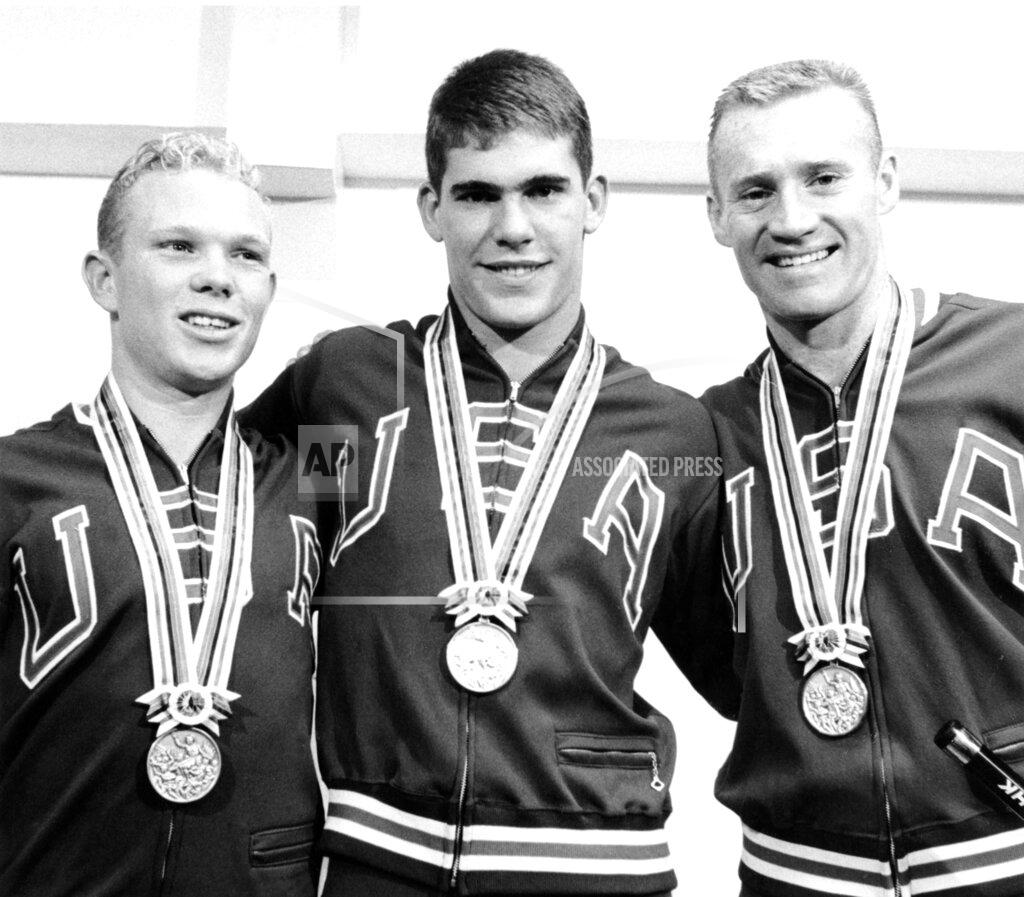
US 4 x 100m freestyle relay team of Steve Clark, Mike Austin, Gary Ilman & Don Schollander swim world record 3:33.2 to beat Germany by 4.0s and win the gold medal at the Tokyo Olympics.
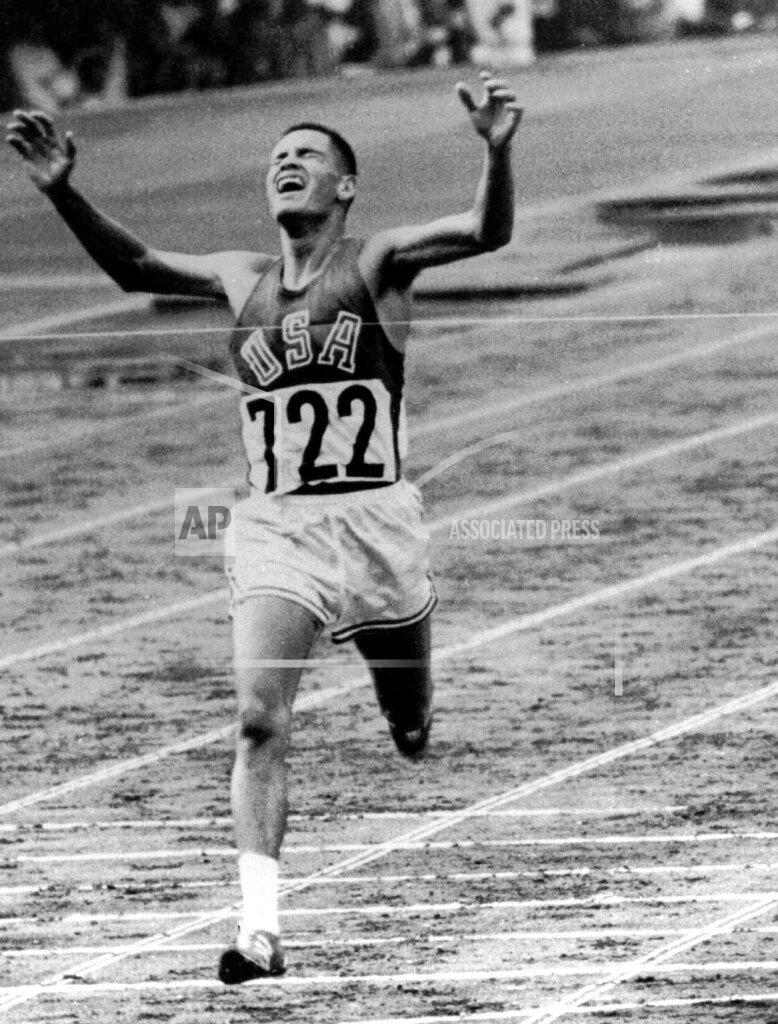
Little known American distance runner Billy Mills scores major upset by winning the 10,000m at the Tokyo Olympics; beats Mohammed Gammoudi of Tunisia by 0.4s; only American to ever win the event.
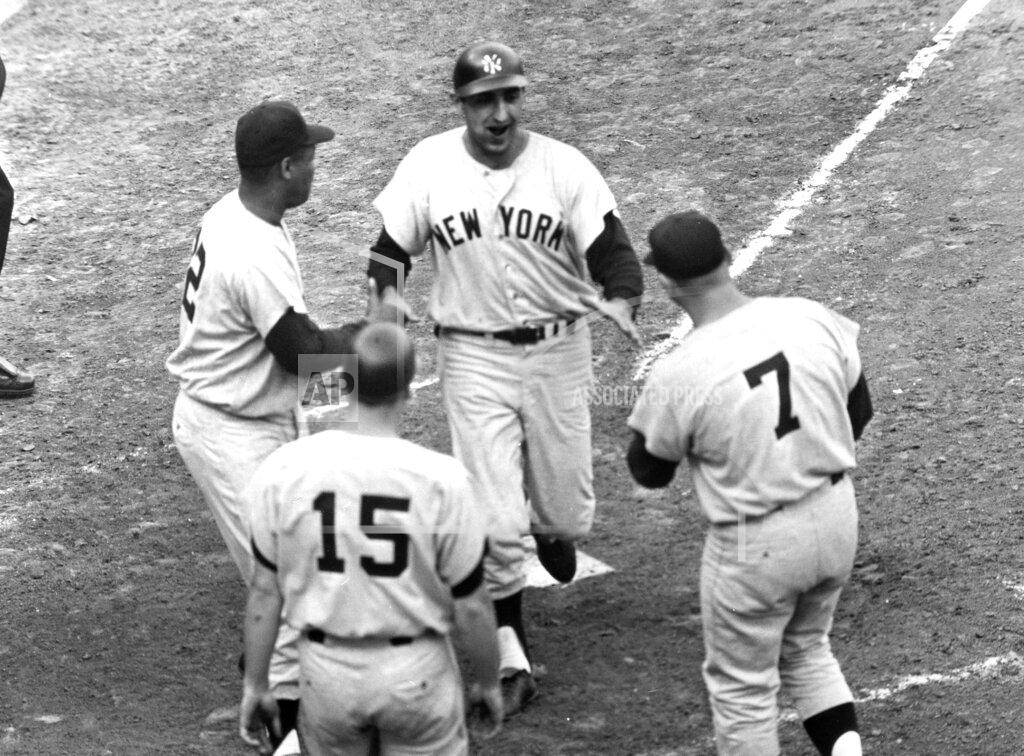
The New York Yankees won Game 6 of the 1964 World Series, 8–3, at St. Louis, evening the World Series, and forcing a deciding seventh game. Roger Maris and Mickey Mantle hit home runs on back-to-back pitches from Curt Simmons, and Joe Pepitone belts Gordie Richardson for a grand slam. The Cardinals struck first in Game 6 on Bill White’s double play with runners on first and third in the first off Jim Bouton, but the Yankees tied the score in the fifth when Tom Tresh hit a leadoff double and scored on Bouton’s two-out single off Curt Simmons. Back-to-back home runs by Roger Maris and Mickey Mantle put the Yankees up 3–1 in the sixth before they blew the game open in the eighth. With two on and two outs off Barney Schultz, Elston Howard’s RBI single made it 4–1 Yankees. After a walk loaded the bases, Gordie Richardson relieved Schultz and allowed a grand slam to Joe Pepitone to put the Yankees up 8–1. The Cardinals scored a run in the bottom of the inning on Bill White’s RBI groundout with runners on second and third and no out, then in the ninth, Bob Skinner hit an RBI single with two on off Steve Hamilton (the run charged to Bouton) before Curt Flood hit into the game-ending double play. The Yankees’ 8–3 win forced a deciding Game 7.
Dow Jones Industrial Average: 875.18 (-1.03)
Born:
Joe Girardi, MLB catcher (World Series Champions-Yankees, 1996, 1998, 1999; All-Star, 2000; Chicago Cubs, Colorado Rockies, New York Yankees, St. Louis Cardinals), and manager (Yankees, 2006-17), in Peoria, Illinois. Girardi was born on the day of the Yankees and Cardinals World Series game, Girardi was a catcher for both teams during his career, and managed the New York Yankees in winning the 2009 World Series.
Paul Palmer, NFL running back and kick returner (Kansas City Chiefs, Detroit Lions, Dallas Cowboys), in Bethesda, Maryland.
Jim Rome, American sports radio host (“The Jim Rome Show”), in Los Angeles, California.



 History Diaries