Summoned by the Communist Party’s Central Committee, First Secretary Nikita Khrushchev cut short his vacation. Before departing from Pitsunda to Moscow, he met, as scheduled, France’s Energy Minister, Gaston Palewski, in what would be his last conduct of foreign affairs, then boarded a plane and flew to Moscow. He was infuriated when nobody met him at the airport on his arrival, and went to the Kremlin to confront the Presidium, which was discussing his removal from office. According to one source, he ordered his defense minister, Marshal Rodion Malinovsky, to arrest Second Secretary Mikhail Suslov and any other conspirators; Malinovsky replied that he would only respond to the party’s Central Committee, and KGB Chairman Vladimir Semichastny gave the same reply. Khrushchev was advised that he was to appear before the entire 170-member Committee for a hearing on his removal from office.
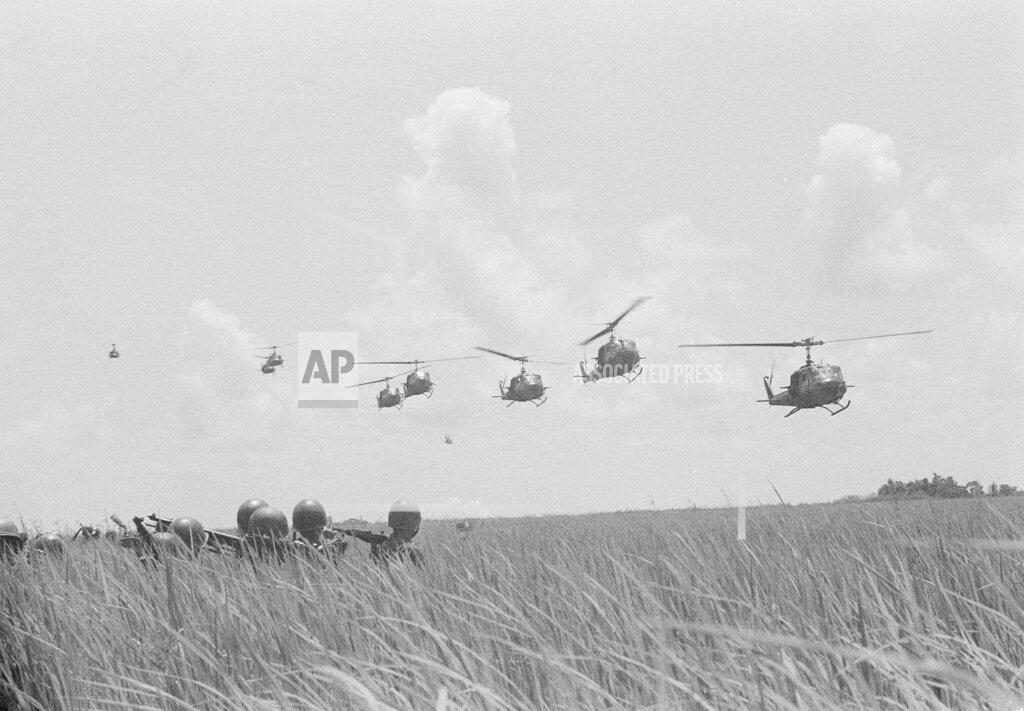
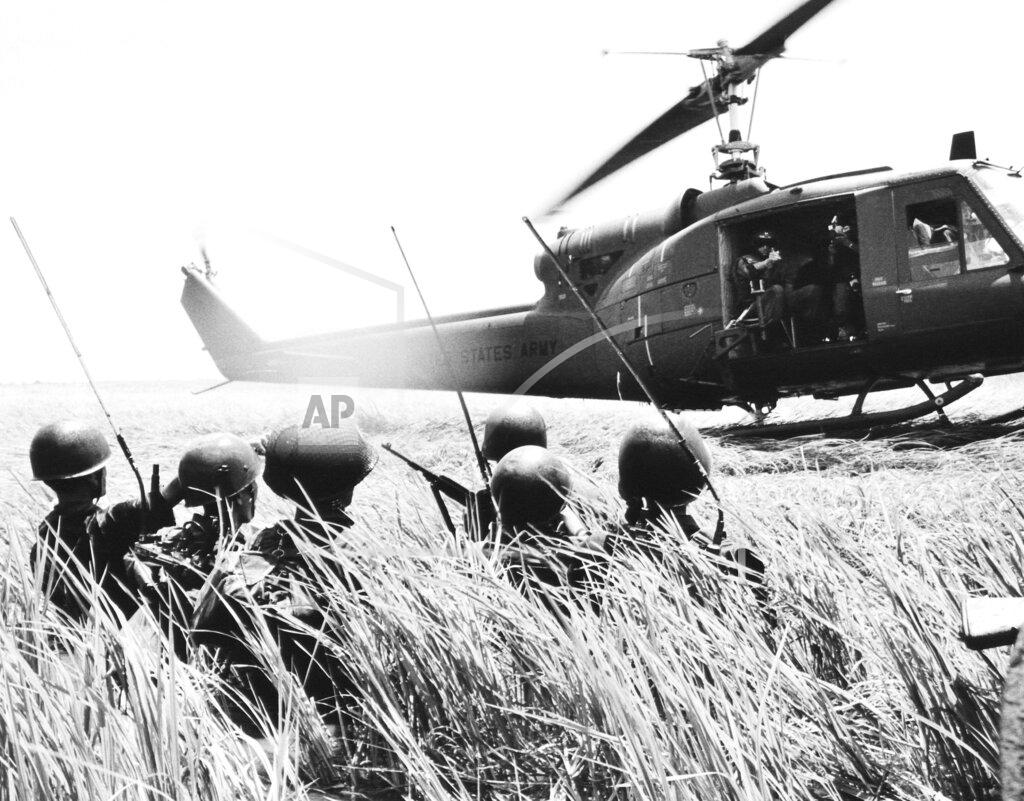
The United States announces it has set up a third helicopter company in the Mekong Delta area controlled by the Việt Cộng; it is designed to cut down on the ambushes against ARVN troops. However, a recent operation showed that it might take more than added helicopters to gain the initiative. Units from the new company and an older unit took part in flight to lift 60 South Vietnamese Government troops into a watery area 80 miles southwest of Saigon, near Cao Lãnh.
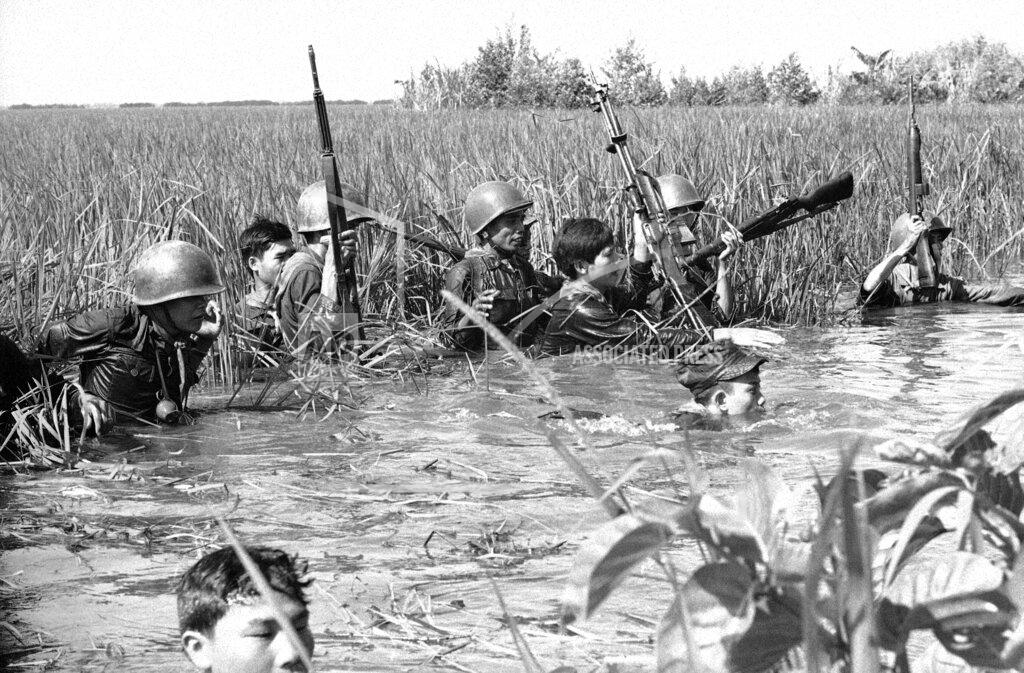
Government forces hit ground only 30 minutes after 300 Việt Cộng members were spotted in the area. While helicopters provided air support, troops jumped out to find themselves in ncar‐neck‐deep water. Reeds were well over their heads. Although there was sporadic shooting, neither force saw the other. The helicopters were unable to pinpoint enemy units, which escaped. The delta region is only dry about four months out of a year. Helicopter companies normally consist of 35 armed and troop‐carrying helicopters and 250 men.
The United States plans to urge this week that the nations in the Southeast Asia Treaty Organization increase their assistance to South Vietnam. Informed sources said today that United States representatives would press for the increase when SEATO’s standing military group meets this week in Bangkok, Thailand. Young South Vietnamese officers have been calling on Premier Nguyễn Khánh to seek an outright commitment to South Vietnam from the eight-nation alliance itself. Besides the United States, its members include Britain, France, Pakistan, Thailand, the Philippines, Australia and New Zealand.
Although not a member, South Vietnam is under SEATO’s “protective umbrella” as one of the nations the organization has volunteered to defend against external aggression. Americans here believe that formal action by the full organization is unlikely. They point to the opposition by France to United States policy in Southeast Asia and to the preoccupation of Britain with defending Malaysia from Indonesian harassment. But the United States hopes that the Philippines, Thailand, Australia and New Zealand will agree at the coming meeting to increase their individual contributions of manpower and material. Little assistance is expected from Pakistan the eighth member of the alliance. United States officials are understood to believe that no conbat troops from SEATO nations are required at this time. However, they define the term “combat troops” to exclude the American and Australian advisers here who join in military actions against the Communist guerrillas.
George Meany, president of the American Federation ofi Labor‐Congress of Industrial Organizations, said today that the labor organization was shocked by charges of treason placed against Trần Quốc Bửu, a labor leader in South Vietnam. “To us it is incomprehensible that one who has devoted his life to the advancement of human freedom and social justice. and who has suffered years of imprisonment and untold hardships for his devotion to the national independence of his country, democracy and free trade unionism, could be guilty of treason,” Mr. Meany said. The treason charges were made against the union official and 19 other military and civilian leaders in conncection with an attempt September 13 to overthrow the Government of Premier Nguyễn Khánh.
Voskhod 1 landed at 0747 UTC (2:47 p.m. local time) in the Kazakh SSR, northeast of Kustanai, after making 16 orbits of the Earth. The three Soviet astronauts manning the world’s first multiseater spaceship, Voskhod, returned to earth this morning after orbiting 16 times in 24 hours and 17 minutes. The landing took place at 10:47 AM Moscow time (3:47 AM New York time) near Kustanai, a farm town 350 miles north of Baikonur in Kazakhstan, the launching site. The ship had begun its 17th orbit some 15 minutes earlier. It traveled 437,000 miles. Reports made it evident that the three men remained in their ship as it came down on the ground. They were Colonel Vladimir M. Komarov, the craft’s commander; Konstantin P. Feoktistov, a spaceship designer, and Lieutenant Boris B. Yegorov, a physician. Although the exact method of landing was not described in today’s Soviet accounts, there were strong indications that it was achieved with the help of powerful braking, or retro rockets and a parachute.
Voskhod (Sunrise) flew across the Aral Sea just before it landed, according to Tass, the Soviet press agency. Voskhod landed in a field on a state farm whose workers rushed to greet the three astronauts, Tass reported. They were taken to Kustanai in a plane. Late tonight, Moscow television showed the reception they were given by local officials in the small town. They were welcomed with speeches, flowers, handshakes and a medal for local achievement. The three men were clad in athletes’ sweat suits. In flight, the men wore ordinary clothes. They were smiling broadly and happily but they were visibly exhausted. Izvestia, the Communist newspaper, quoting the spacecraft’s unnamed designer, reported tonight that Voskhod, in contrast to previous Soviet spaceships, had no mechanism for ejecting its passengers. The newspaper’s correspondent, writing before the landing took place, said that the three men would remain in their ship until after the touchdown. He said that the landing would be “soft” and that the speed of the capsule would be close to zero at impact.
The Soviet Union voiced today its “regret” that liquid mustard gas had been squirted at a West German Embassy official in a Russian church. In a note delivered to the Foreign Ministry here today, it promised to look into the incident, which occurred September 6. The note was in reply to a second, sternly phrased West German protest against the mysterious attack on the embassy official, Horst Sehwirkmann, at Zagorsk Monastery outside Moscow. West Germany has asked for an apology and the apprehension and punishment of the assailants. Bonn officials had hinted that an unsatisfactory answer might adversely affect the visit of Premier Khrushchev to West Germany early next year. Today’s note from Moscow appeared to be calculated to concede the Bonn Government the necessary minimum of satisfaction.
After expressing “regret in principle” at the assault, the Russians promised an investigation on clues on the possible attackers provided in the second West German protest. Although the note did not eliminate all West German misgivings, diplomatic observers were agreed tonight that its conciliatory tone would pave the way for Premier Khrushchev’s visit despite the Schwirkmann affair. As in its reply to a first West German protest of September 14, the Soviet Union said today that the attack on the German official looked like an attempt to worsen Soviet‐West German relations. However, today’s note did not again contain the implied charge, expressed in the answer to Bonn’s first protest, that the assault might have been the work of West German agents.
Robert F. Kennedy said today that President Kennedy rejected a proposal to bomb Cuba during the missile crisis of October, 1962, because his military intelligence advisers told him that 25,000 Cuban civilians would be killed.
Moïse Tshombe returned from diplomatic defeat abroad to a political triumph at home today. Scores of thousands of wildly cheering Congolese welcomed him. Observers said that it was the most massive demonstration ever seen here, topping the welcomes received by King Baudouin of Belgium, which formerly ruled the Congo, and the late Patrice Lumumba, the Congo’s first Premier, on Independence Day in 1960. Mr. Tshombe flew to Cairo last week to attend the meeting of the nonaligned nations, only to find himself barred from the conference hall. He spent the next three days held hostage by President Gamal Abdel Nasser in retaliation for police cordons around the Egyptian and Algerian Embassies in Leopoldville. The feelings of the Congolese in the demonstration were reflected by the independent newspaper Courier d’Afrique in a front‐page editorial headlined: “Thank you, Nasser.”
The newspaper declared: “If Nasser thought he was taking Tshombe down a peg in the Congo, he went about it in the worst possible way.” Hundreds waved homemade signs declaring: “Nasser to the gallows!” and “Down with the Arabs!” Other signs denounced President Kwame Nkrumah of Ghana and President Ahmed Ben Bella of Algeria, both of whom have opposed Mr. Tshombe and given tacit support to the rebel Congolese Peoples’ Republic in Stanleyville. As Mr. Tshombe rode the 15 miles from the airport to the center of the city, thousands took up the chant: “Long live Tshombe! Arabs go home!”
A group of unpaid former Congo mercenaries are looking for the men who up to the last minute promised them they would get their money. They arrived here last night aboard an Air Congo plane from Kamina in the Congo, where they had been fighting the rebels for the Leopoldville Government. Their first call today was at their bank to check on their accounts. They said not a penny had been paid in by the Congolese authorities.
Cypriot leader Archbishop Makarios said today upon his return from the conference of the nonaligned nations in Cairo that he was “even more optimistic” about a solution to the Cyprus problem. The President of this island republic commended the conference for having taken the position that the crisis “should be solved in accordance with the will of the people of Cyprus, on the basis of the principle of self‐determination and without any outside threats or intervention.” The stand of the nonaligned, which he termed the “only corbasis and the key” to a solution, is of particular significance in view of the United Nations General aseembly session opening November 10, the President said.
The Archbishop did not allude to the conference’s recommendation for the elimination of foreign bases in Cyprus. Mounting agitation against the two British bases here led to a mass protest march Sunday through one of the installations, near Limassol on Cyprus’s southern coast. The President said he was “particularly pleased” that Cyprus had, from the time of her independence from Britain in 1960, “followed a policy of nonalignment.” This statement, coupled with his observation last Friday in Cairo that Cyprus would “steadfastly remain in the nonaligned camp,” tended to reinforce a growing impression among diplomatic observers here. This is that the government is primarily interested in achieving full independence without foreign military bases rather than enosis, or union with Greece.
Striking railwaymen began returning to work on London’s disrupted subway system tonight after Labor party leaders had criticized their wildcat walkout. Harold Wilson, fearful of the strike’s possible effect on the Labor party’s chances in Thursday’s general election, called for an end to the “intolerable” inconvenience to tens of thousands of Londoners. Mr. Wilson, the party’s leader, linked his criticism of the strikers with an attack on Conservative wage policies. These, he asserted, are at the root of the labor trouble on the subways and in other municipal services.
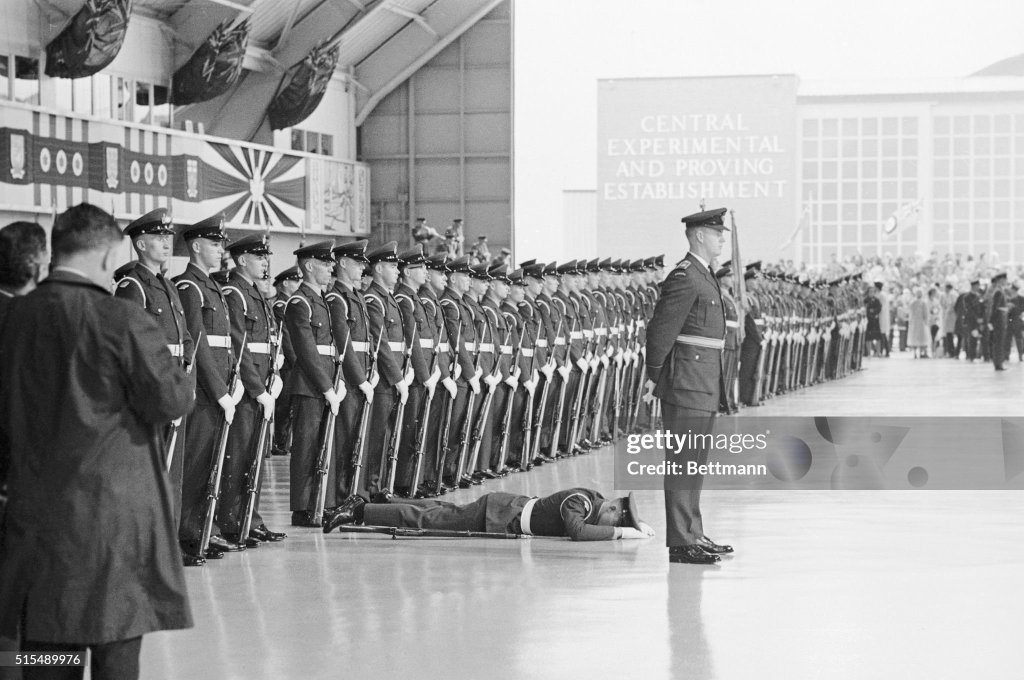
Queen Elizabeth II of the United Kingdom concluded her official tour of Canada, departing from Ottawa to London on the first flight of an airplane carrying the name and logos of Air Canada. On her nine‐day stay in Canada, the Queen received a friendly welcome in Charlottetown, Prince Edward Island, and a large, enthusiastic greeting in Ottawa. But her reception was cool in Quebec, where there is much agitation for a more autonomous rule for French Canada. Some British newspapers have described the lack of welcome as insulting.
Iran’s parliament, the Majlis, narrowly approved the “Bill of Capitulation” (Layihiyi Capitulasion) introduced by the government of Prime Minister Hassan Ali Mansur, giving diplomatic immunity to American military servicemen stationed there, voting 74 to 61 in favor of it. The reaction by the Ayatollah Ruhollah Khomeini 13 days later would lead to Khomeini’s expulsion from the country for the next 14 years.
Pope Paul VI was reported today to have assured a group of cardinals that there would be no drastic changes in the Roman Catholic Church’s proposed declarations on the Jews and religious liberty. The report of his assurance followed four days of maneuvers by supporters and opponents of the two declarations that have produced a tense atmosphere in Ecumenical Council Vatican II.
Mississippi’s bad image can be blamed at least in part on “active members of the Communist party” who pass out literature “openly advocating overthrow of the Government,” Governor Paul B. Johnson Jr. charged today. Mr. Johnson, one of 16 Governors attending the Southern Governors conference, said the literature being passed out “is printed in Cuba and Red China.” He invited the Governors to meet next year in Mississippi to dispel the state’s bad image. “We would not only grant you safe passage in our state,” Mr. Johnson said, “but we would welcome you with hospitality.”
Governor George C. Wallace of Alabama seconded Mr. Johnson’s defense of Mississippi. “It’s safer on any street in Mississippi or Alabama than on any subway anywhere in this country,” Mr. Wallace said. Discussions of politics and such noncontroversial issues as education and highway safety had dominated the conference until Governors Johnson and Wallace spoke on “case histories of Governors’ problems.” They have refused to support President Johnson and had remained in the background of the Governors conference until the discussion.
Governors John B. Connally Jr. of Texas, Farris Bryant of Florida, and Terry Sanford of North Carolina today added their names to the list of Southern Governors who think President Johnson will carry most of the South.
Sheriff’s officers raided the Corpus Christi, Texas, home of a former convict tonight and seized a cache of arms an informant said were to be used in an attempt on President Johnson’s life next weekend. Nueces County Sheriff John Mitchell said the raid was carried out at the home of Julius Schmidt, 29 years old, an ex‐convict living in a middle-class suburb outside the city. The sheriff said that Schmidt, who had served a prison term for murder with malice, was known as a gun trader. He said an informant had told him that “the supposed assassin would get the weapons from Schmidt.” Sheriff Mitchell declined to say whether he believed that there was a possible ring in volved. But he said he expected to make additional arrests.
The President is to visit this city next Sunday on a swing through his home state. The sheriff said he had notified Federal authorities and that agents of the Federal Bureau of Investigation, the Secret Service and the Treasury Department were on their way here. Schmidt was charged with violation of the Federal Firearms Act after the raiders seized an assortment that included a machine gun, a loaded pistol, a rocket launcher, a field mortar, several high‐powered rifles, one with a telescopic sight, as well as a number of live hand grenades and 20,000 rounds of ammunition. Schmidt was said to have a weapons permit. This, however, reportedly did not cover the machine gun, hand grenades and high‐powered rifles found in his home as well as his mother’s house and garage. The sheriff said that several Nazi flags, war helmets, and uniforms from World War II were found in Schmidt’s house on Kirkwood Street, a middle-class section. Sheriff Mitchell emphasized that he did not consider Schmidt as the intended “trigger man” but he allegedly would furnish the gun to the assassin. In Washington, the FBI and the Secret Service said they had no comment.
President Johnson extended today the deadline for an emergency board to seek an agreement in a dispute between the nation’s railroads and employes represented by the Brotherhood of Locomotive Firemen and Enginemen. Mr. Johnson created the board September 24 to investigate the dispute and seek to head off a strike. The original deadline for the board to report was October 24, but both sides agreed to an extension and Mr. Johnson fixed November 5 as the new deadline.
President Johnson will arrive in New York tomorrow to open his drive for the state’s 43 electoral votes and to help the campaign of the Democratic Senatorial candidate, Robert F. Kennedy. Several thousand uniformed policemen and many detectives will provide maximum security during the President’s visit. He is scheduled to arrive at 1:15 PM, after campaign visits to Paramus, New Jersey, and Wilkes Barre, Pennsylvania. He will attend the 20th annual Alfred E. Smith dinner at the Waldorf‐Astoria and will stay overnight at the hotel.
Republican Vice-Presidential candidate Representative William E. Miller categorized President Johnson tonight among “people who are making reckless appeals for civil disobedience.” In a talk prepared for delivery before the Union League Club here, Miller quoted Mr. Johnson as. having exhorted members of rural electric cooperatives to fight with beer bottles “in the fields, on the beaches, in the corridors of the capital asking no quarter and giving none.” The New York Representative linked this statement with attitudes underlying recent riots in Philadelphia. Mr. Miller did not specify when the purported remark was made. The candidate’s staff said it was made in 1959, when Mr. Johnson was a Senator.
Senator Barry Goldwater tonight called the Democratic party a “fascist organization.” The remark, made extemporaneously at the end of a prepared speech, was repeated by the Senator when he said the Democrats represented “absolutism and monarchy” and were a “fascist group.” Mr. Goldwater was highly emotional as he spoke and so was a crowd of about 10,000 persons who roared their approval at the Milwaukee Arena.
The Republican Presidential candidate’s remarks were triggered by a report that a Milwaukee alderman, Robert Dwyer of the Fourth Ward, had been expelled from the Democratic party for announcing that he would vote for Mr. Goldwater. Earlier in the day, Mr. Goldwater had accused Lyndon B. Johnson of being a “part‐time” President but a full‐time politician who was campaigning too much. The Senator said during the New Hampshire primary campaign last winter that there was a “fascism of the left”in the United States. Tonight, he told his audience that Alderman Dwyer had been forced to “turn in his Democratic suit.”
Mr. Goldwater said: “Now, ladies and gentlemen, I tell you when you build a fascist organization like that in a free country that will not even allow a member to speak his mind in favor of a member of the other party, then I say the need for a strong Republican party, a stronger Republican party, should be more and more evident, because we must make sure that this kind of absolutism, this kind of monarchy, this kind of fascist group never is allowed to gain a foothold in this country.” This afternoon, at Topeka, Kansas, the Senator attacked Mr. Johnson for “frantic campaign travel and too much campaigning.” He said the President gave “handshakes and handouts” instead of leadership. Mr. Goldwater called the President’s stop on Sunday in Phoenix, Arizona, the Senator’s hometown, a “political travesty of the Lord’s Day.” He said the President was neglecting his duties to campaign.
Senator Hubert H. Humphrey swung into New England today with oratory as fiery as the autumn foliage. In speech after speech, the Democratic Vice-Presidential candidate struck at Senator Barry Goldwater with some of the toughest language of the campaign. Mr. Humphrey, who likes to be called “the happy warrior,” seemed more like an angry warrior. He linked the Republican Presidential nominee indirectly to racist and hate groups, scornfully denounced him for absenteeism in the Senate and said that the “Goldwater faction” of the Republican party lived “in the conspiratorial police state of their own twisted imaginations.”
Mrs. Lyndon B. Johnson, just back from a train whistle‐stop campaign in the South, plans a tour by chartered plane through Texas, Arkansas and Oklahoma October 26 and 27. The White House said today that three Cabinet wives would accompany her on the visits to seven cities. They are Mrs. Robert S. McNamara, wife of the Secretary of Defense; Mrs. W. Willard Wirtz, wife of the Secretary of Labor, and Mrs. Orville L. Freeman, wife of the Secretary of Agriculture. The tour will take the women to Beaumont, Tyler and San Angelo in Texas; McAlester and Tulsa in Oklahoma; Fort Smith and Little Rock in Arkansas.
Former President Dwight D. Eisenhower said today he planned to spend his 74th birthday tomorrow working in his office on the campus of Gettysburg College. “I’ll have a full day here in the office,” General Eisenhower said, adding that there were no plans for family parties this year.
Former President Harry S. Truman slipped and fell at his home in Independence, Missouri today, breaking two ribs and cutting himself over the eye. His condition was reported as satisfactory. The 80‐year‐old former President was taken by ambulance from his home to Research Hospital and Medical Center, 11 miles away. He was in the emergency room for about an hour, under the care of his personal physician, Dr. Wallace H. Graham.
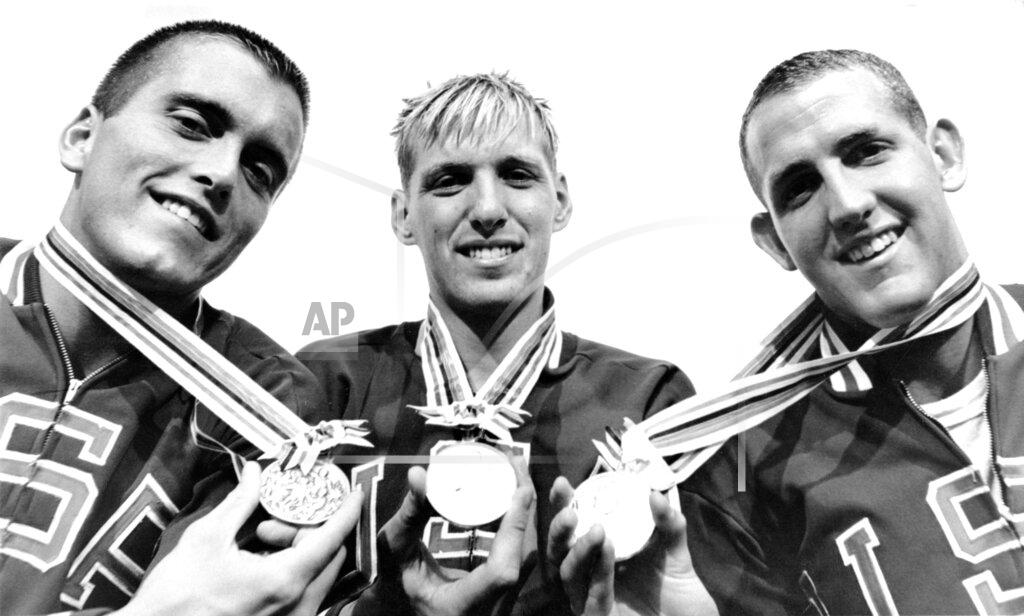
The U.S. sweeps medals in the men’s 200m backstroke at the Tokyo Olympics; Jed Graef swims a world record time of 2:10.3 to win gold ahead of teammates Gary Dilley and Bob Bennett.
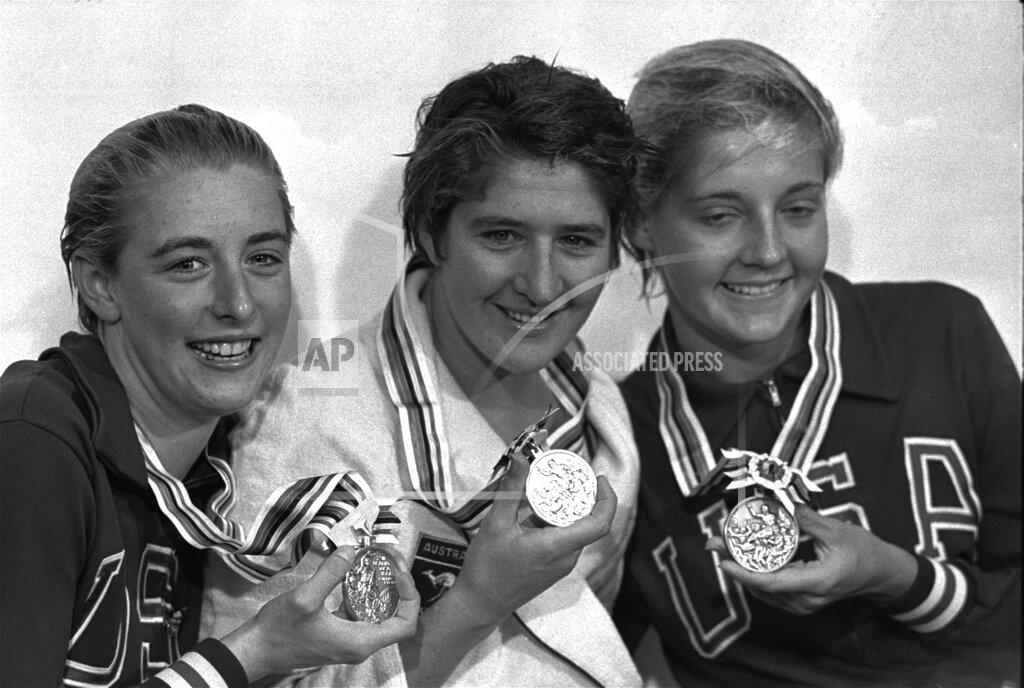
Australian swimmer Dawn Fraser wins her third consecutive Olympic 100m freestyle gold medal at the Tokyo Games in an Olympic record 59.05 seconds.
The United, States got off to a rousing start in track and field in the Olympic Games today when Bob Hayes of Jacksonville, Florida, led two other Americans in qualifying in the 100‐meter dash despite a persistent rain.
Americans also dominated other sports as 15‐year‐old Sharon Stouder and two other American girls smashed the 100‐meter Olympic butterfly swim record and the United States basketball team scored a 83–28 rout of Uruguay.
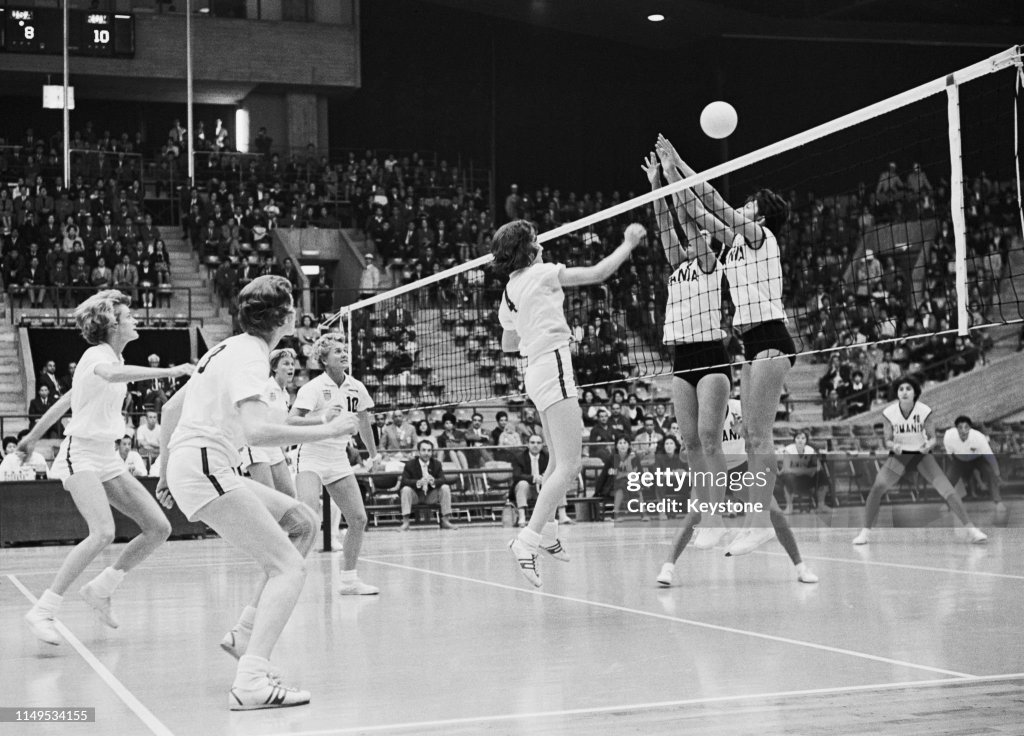
The United States, already leading the race for the unofficial team championship with a total of 10 medals, went into today’s fourth day of competition with high hopes for a one, two, three sweep in men’s diving and for other medals.
A surprisingly strong team from the Netherlands won the gold medal in the 100‐kilometer road cycling team trial race, the first of the six cycling events. The strongly favored Italians were second, taking the silver medal, and Sweden rallied to take the bronze medal for third.
Dow Jones Industrial Average: 876.21 (-1.36)
Born:
Christopher Judge, American-Canadian actor (“Stargate SG-1”), in Los Angeles, California.
Doug Emhoff, American lawyer, husband of Vice-President Kamala Harris, in Brooklyn, New York, New York.
Niè Hǎishèng, Chinese military pilot and CNSA astronaut, in Zaoyang, Hubei, China.
Chris Gwynn, MLB pinch hitter and outfielder, brother of Tony Gwynn (Los Angeles Dodgers, Kansas City Royals, San Diego Padres), in Los Angeles, California.
 History Diaries