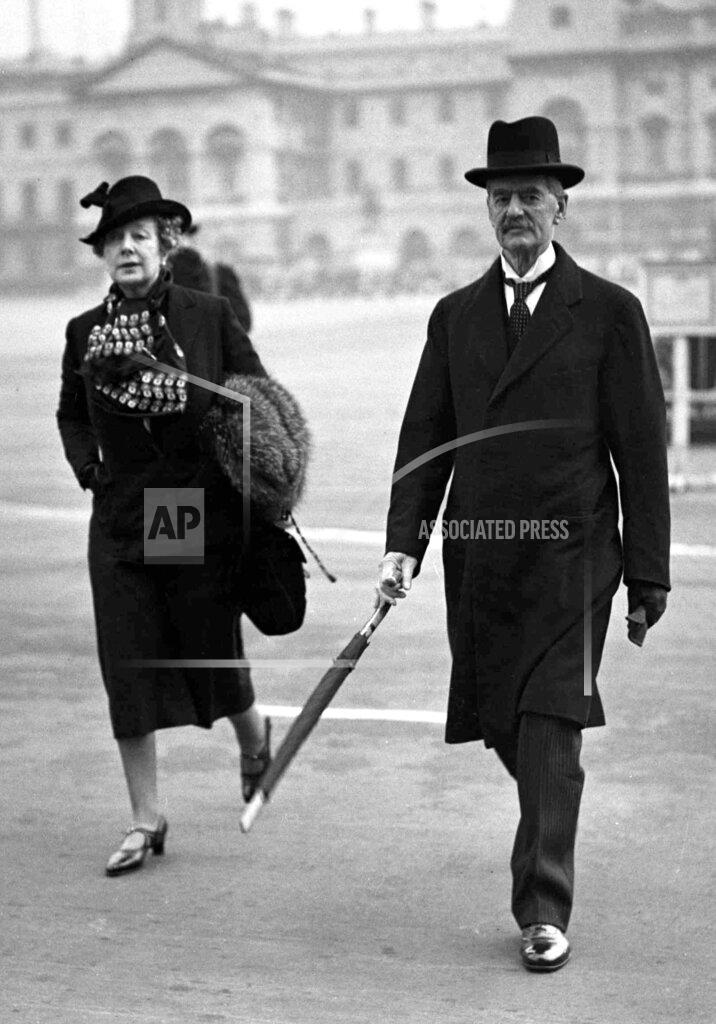
British Prime Minister Neville Chamberlain officially rejected the call for a European conference, to meet and resolve differences with Germany, made by Hitler on October 6, 1939. He said that to consider such terms would be to forgive Germany for all aggressions and he warned that German must choose between permanent security arrangements in Europe and “war to the utmost of our strength.” In the British House of Commons, Prime Minister Neville Chamberlain formally replied to Hitler’s peace offer by saying that a settlement “must be a real and settled peace, not an uneasy truce interrupted by constant alarms and repeated threats.” Chamberlain further explained, “Herr Hitler rejected all suggestions for peace until he had overwhelmed Poland, as he had previously overthrown Czechoslovakia. Peace conditions cannot be acceptable which begin by condoning aggression. The proposals in the German Chancellor’s speech are vague and uncertain and contain no suggestion for righting the wrongs done to Czechoslovakia and to Poland. Even if Herr Hitler’s proposals were more closely defined and contained suggestions to right these wrongs, it would still be necessary to ask by what practical means the German Government intend to convince the world that aggression will cease and that pledges will be kept. Past experience has shown that no reliance can be placed upon the promises of the present German Government.”
A bill to restrain war profiteering in the UK is introduced.
The French act to bar the crossing of the Rhine. A surprise attack is feared; a rise in the river level fails to endanger fortifications on the opposite shore.
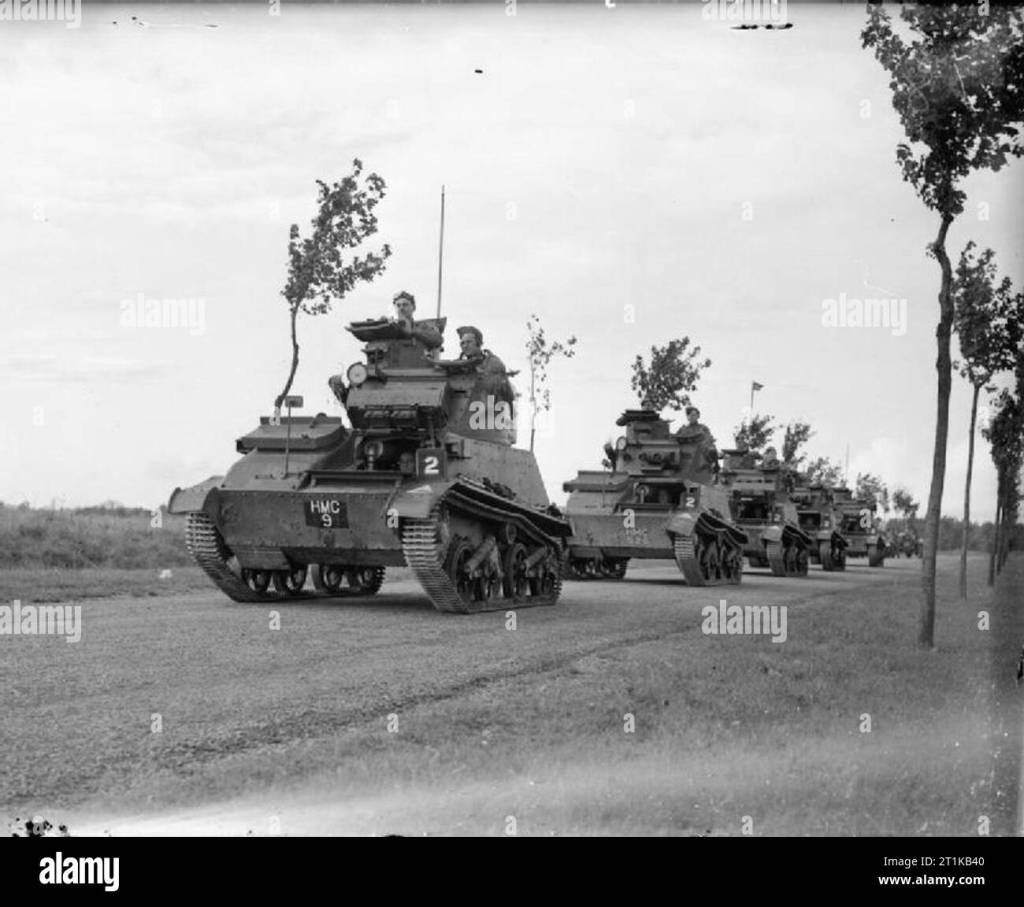
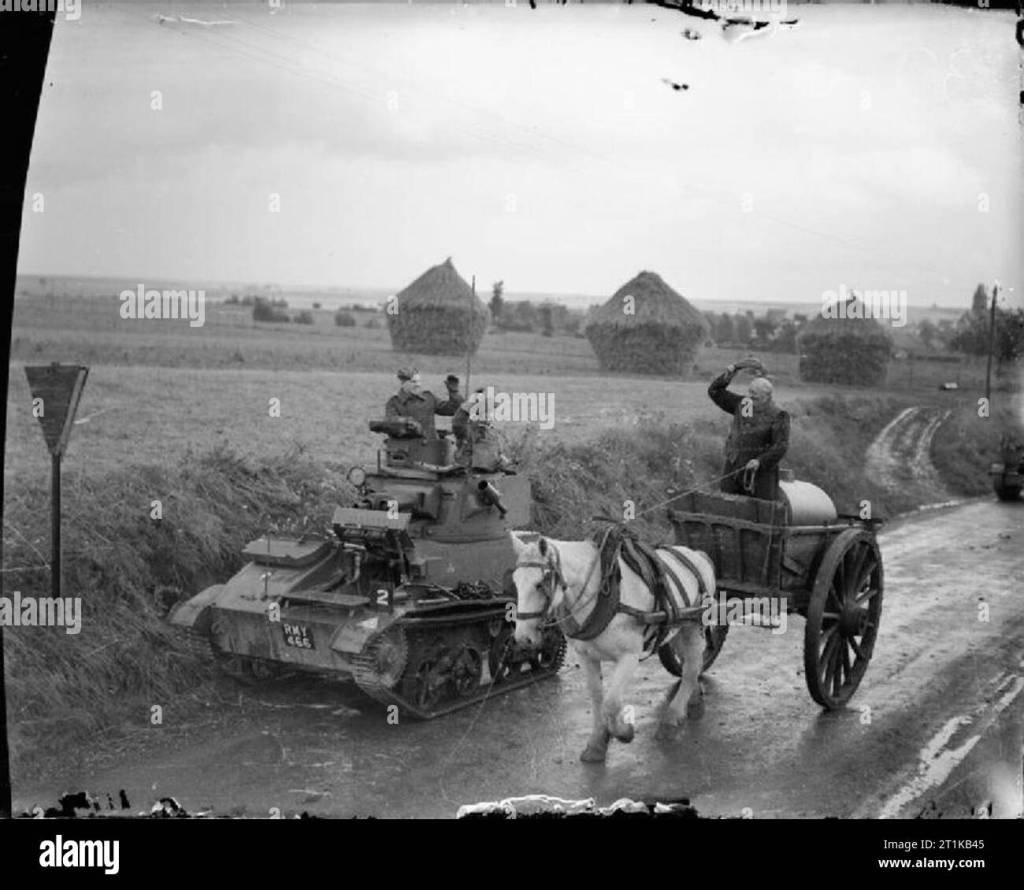
The British Expeditionary Force under General Alan Brooke, 2nd Corps, is now fully deployed along the Franco-Belgian border, between Maulde and Halluin.
Hitler ends his peace initiative for the time being. He also seeks to ramp up munitions production.
The regions of Nazi-occupied Poland not annexed by the Reich were incorporated into a new administrative unit called the General Government. Wawel Castle in Kraków was made the seat of government. Hans Frank, who chairs the Academy of German Law, is appointed Governor-General (Gauleiter) of Poland. Frank will report to Heinrich Himmler. He has authority over rump Poland, the part not outright annexed to the Reich such as Danzig and the Polish corridor (and obviously not the part under Soviet control). This includes Warsaw, Lublin, Radom, and Krakow.
The deportation of Jews from occupied Austria and Czechoslovakia to occupied Poland began under the direction of an SS administration headed by Adolf Eichmann. Hans Frank, newly appointed Governor-General of Poland, must prepare to receive these deported people.
Fedor von Bock was appointed the commanding officer of the German Army Group B (Heeresgruppe B).
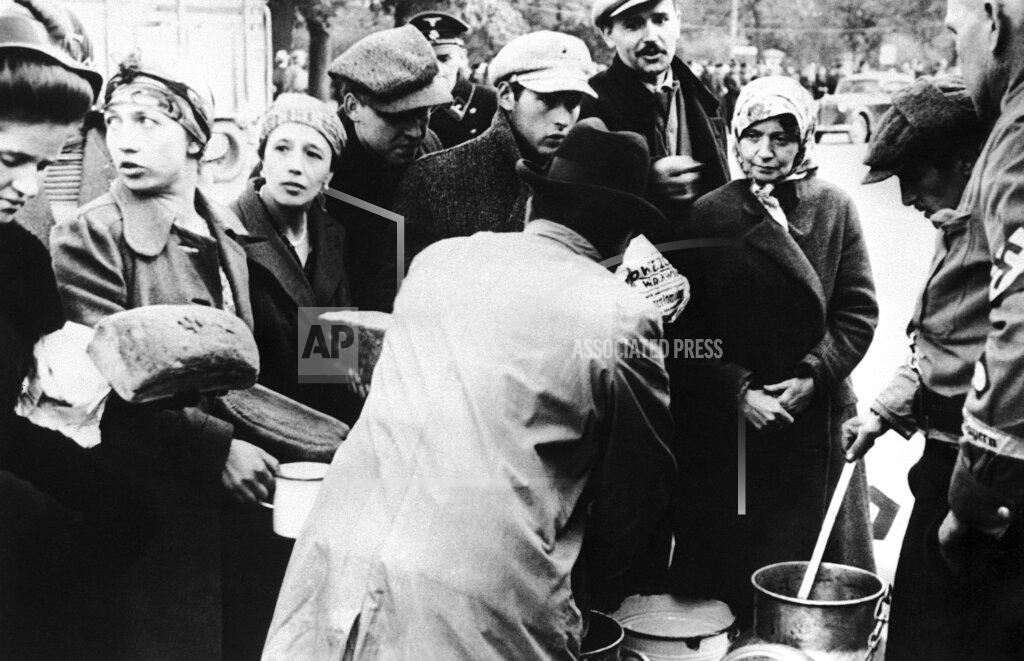
Polish prisoners and civilians work Reich farms and factories; most men are only lightly guarded in camps. With most of her able-bodied men absent on military duty, Germany is alleviating her increased lack of workers by bringing Poles, including large numbers of prisoners of war, into the Reich and setting them to work in the fields, roads; railroads and even light and heavy industries.
A papal paper sees Soviet demands increasing. Its policy toward Finland is called an attempt by Russia to dominate Scandinavia. The Soviet Union is said to ask for Finnish bases.
Soviet and Finnish representatives met in Moscow to discuss border revisions. Soviet demands included Finnish territory in the Karelian Isthmus, moving the border away from Leningrad to safeguard the city from attack by land. In addition, Finland was asked to cede several small islands in the Gulf of Finland and lease the Hanko peninsula to the Soviet Union for 30 years. In return the Soviets offered some land in the Suomussalmi area and a “mutual assistance pact.”. The Finns only feel able to offer a much smaller range of concessions. Negotiations prove unfruitful and remain deadlocked.
There was great hope in Finland tonight that the visit of the Finnish and Swedish Ministers to the United States State Department and the White House might cause Joseph Stalin to stay his hand.
The American Ambassador to Moscow, Steinhardt, conveys President Roosevelt’s wish to Molotov that the Soviets allow a full airing out of the Finnish position on boundaries.
Soviet forces begin arriving in Tallinn, Estonia by rail, bound primarily for Saaremaa and Hiiumaa island, and around Haapsalu and Paldiski.
It is reported in diplomatic circles In Berlin today that Turkey has agreed to close the Dardanelles to belligerents. The action follows prolonged negotiations in Moscow between the Soviets and the Turkish Foreign Minister, Shukru Saracoglu, and also constitutes the fulfillment of Turkey’s wishes, to restore her pre-war neutrality status, especially as it concerned the Dardanelles. If the Turkish decision represents a diplomatic victory for Russia it is also viewed as a significant asset of German political prestige in the East and, moreover, it is seen as a step in bringing Rumania more definitely into the German orbit.
A ship from Convoy KJ.2, the French motor tanker Emile Miguet was stopped by gunfire and after the crew abandoned ship was torpedoed and sunk by the U-48, commanded by Kapitänleutnant Herbert Schultze, 190 miles southwest of Fastnet, Ireland at 50°15’N, 14°50’W, in the eastern Atlantic Ocean. Of the ship’s complement, 2 died and the survivors were picked up by the American steam merchant Black Hawk. The 14,115-ton Emile Miguet was carrying gasoline and crude oil and was bound for Le Havre, France.
The unescorted and neutral Greek steam merchant Aris was torpedoed and sunk by the U-37, commanded by Korvettenkapitän Werner Hartmann, west of Ireland (53°28′N 14°30′W) with the loss of two crew of her 29 crew. were rescued by the Danish MS Sicilien. The 4,810-ton Aris was carrying ballast and was bound for Hampton Roads, England.
British seizure of U.S. mail continues: authorities at the contraband control station at Weymouth remove 94 sacks addressed to Rotterdam, 81 to Antwerp and 184 to Germany, from U.S. freighter Black Tern, which had been detained the day before; authorities at the Downs remove 77 sacks of parcel post, 33 sacks of registered mail, and 156 sacks of regular mail addressed to the Netherlands, in addition to 65 sacks of mail addressed to Belgium, 4 to Luxembourg, 3 to Danzig, and 259 to Germany, from Dutch motorship Zaandam.
The War at Sea, Thursday, 12 October 1939 (naval-history.net)
Battlecruiser REPULSE, after degaussing at Kirkwall, departed Scapa Flow with destroyers FAME and FORESIGHT at 1734 for boiler cleaning at Rosyth.
Light cruisers GLASGOW and NEWCASTLE were detached from the Home Fleet to cover convoys in the Western Approaches. They left Scapa Flow on the 12th at 1737 and 1915 respectively.
Light cruiser DUNEDIN departed Scapa Flow for Northern Patrol at 1810.
Light cruiser EDINBURGH departed Rosyth.
Four light cruisers were on Northern Patrol, with light cruiser SHEFFIELD still on patrol in the Denmark Strait.
Destroyers AMAZON and WAKEFUL were submarine hunting off Dover.
Destroyers ARROW, ACHATES, ACHERON, WREN and sloop FLEETWOOD were submarine hunting off Newhaven.
Destroyers FURY, BEDOUIN, PUNJABI were submarine hunting off the Hebrides.
Destroyer WOLVERINE attacked a submarine contact 51 31N, 5 41W.
Destroyer ECHO ran aground as she entered Plymouth in a heavy fog, damaged her stern and repaired at Plymouth, completing on 17 November.
Minesweeper/escort ship JASON ran aground on Row Point and sustained minor damage which was soon repaired.
Convoy BC.9S of six steamers, including CERVANTES and GUELMA (Commodore) departed the Loire, escorted by destroyers EXMOUTH and ECLIPSE, and arrived safely in the Bristol Channel on the 14th.
Convoy FN.20 departed Southend and arrived at Methil on the 14th. There was no convoy FN.21.
Convoy FS.20 departed Methil and arrived at Southend on the 14th.
U-37 sank Greek steamer ARIS (4810grt) in 53 28N, 14 30W; two crew were lost and 27 survivors rescued by Danish steamer SICILIEN (1654grt).
U-48 sank French tanker EMILE MIGUET (14,115grt), a straggler from convoy KJ.2, 190 miles SW of Fastnet in 50 15N, 14 50W. She caught fire and was abandoned with one crewman killed and one missing. Survivors were rescued by American steamer BLACK HAWK (4988grt) and she was scuttled by gunfire from destroyer IMOGEN.
U-48 sank steamer HERONSPOOL (5202grt), a straggler from convoy OB.17, 260 miles SW of Fastnet in 50 13N, 14 48W. American steamer PRESIDENT HARDING (13,869grt) picked up the SOS of EMILE MIGUET (above) and sailing to rescue her survivors in 50 08N, 14 00W, came upon HERONSPOOL’s entire crew and rescued them. PRESIDENT HARDING continued her rescue mission, but by that time BLACK HAWK had picked up EMILE MIGUET’s crew.
Convoy SLF.4 departed Freetown unescorted and arrived at Liverpool on the 20th.
Today in Washington, President Roosevelt issued an appeal for cooperation between the Red Cross and other groups carrying on relief tasks so as to avoid confusion and waste. He conferred with A. A. Berle Jr., Assistant Secretary of State: Norman H. Davis, chairman of the Red Cross, and Juan T. Trippe, head of Pan American Airways.
The Senate heard Senators La Follette, Chavez and Bulow discuss the neutrality resolution, and recessed at 5 PM until noon tomorrow.
The House heard Representative Luther A. Johnson urge repeal of the arms embargo and Representative Schafer demand the deportation of W. G. Krivitsky; received the Hoffman bill to prohibit persons from interfering with production or transportation of goods in interstate commerce and the Shanley resolution providing for a committee to arrange for celebration of Columbus Day in 1942, and adjourned at 2:34 PM until noon tomorrow
Administration leaders in the Senate intensified their efforts tonight to bring about the earliest possible vote on the Pittman neutrality resolution after a day in which the measure’s opponents picked up a recruit and subjected the embargo repeal provisions to five hours of raking fire. Senator Barkley, the majority leader, expressed to the Senate at the close of the day the hope that general debate might end this weekend. He announced that a session would be held on Saturday. Although the Kentucky Senator did not reveal it on the floor, another known intention of the leaders is to hold longer daily sessions to bring about earlier action.
Notwithstanding the day’s developments, which went against their cause, the Administration spokesmen still counted a two-to-one margin for embargo repeal in the Senate. Their intensified efforts were directed toward getting the question to a vote before any new event abroad might alter the situation here relative to President Roosevelt’s wartime policies. They were also spurred to renewed activity by reports that the margin for repeal in the House, counted as small even at the beginning of the special session, was in danger of narrowing still more.
The recruit for the isolationists was Senator Chavez of New Mexico, whom the Administration checkers had put down as an apparently sure vote. Mr. Chavez made his position known in an hour’s speech, which shared the spotlight in the day’s debate with a few earthy remarks in opposition to embargo repeal by Senator Bulow of South Dakota and an address by Senator La Follette of Wisconsin, which for drama and silence-provoking interest has not been surpassed during the neutrality discussions. Mr. Chavez’s statement was obviously as much of a surprise to Senators on the floor as to the press gallery, which had been informed earlier that he was to support the Administration. Not a great deal of interest was manifest in his remarks as he insisted that this country stay out of the war. In fact, in the manuscript of his speech which was sent to the press gallery the Senator ended by leaving the question open. On the basis of the manuscript, one press association had telegraphed that the New Mexico Senator “in his first public utterance on the neutrality issue failed to clarify his position” on the President’s request for embargo repeal.
But just before he took his seat Mr. Chavez said: “As for me, Mr. President, solemnly and with reverence, I shall cast my vote for what I think will keep us out of war and against repeal of the embargo.” Administration leaders turned in obvious amazement to the Senator, who had been speaking from the back row. Later several of them joined the equally astonished isolationist Senators in congratulating him on his address.
The House appropriations head asks President Roosevelt to specify his defense fund aims. Committee members believe Congress would promptly grant money.
U.S. President Franklin D. Roosevelt established the Advisory Committee on Uranium with Lyman J. Briggs, director of the U.S. National Bureau of Standards, as the committee head. This action was in response to a letter Roosevelt received the previous day from physicist Albert Einstein warning of the importance of research on chain reactions and the possibility that this type of research might lead to developing powerful bombs.
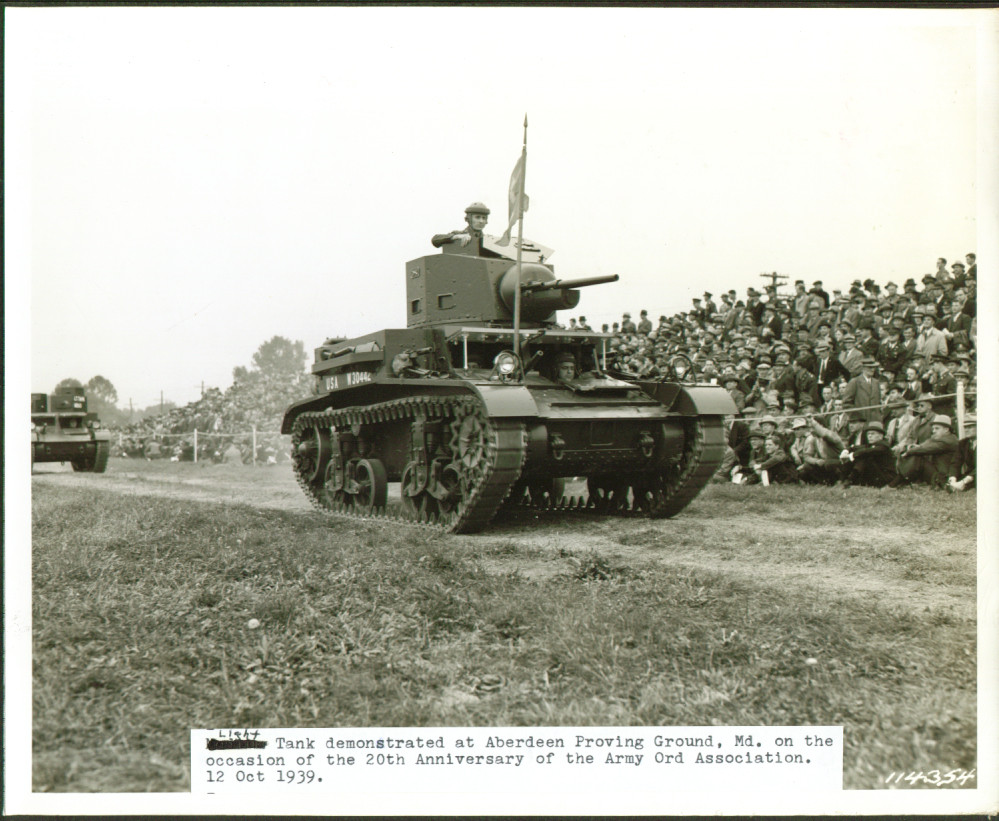
The roar of gunfire and of bursting bombs echoed across the upper reaches of the Chesapeake today as the army gave 3,000 members and guests of the Army Ordnance Asosciation a demonstration of the terrific power of modern arms at the Aberdeen Proving Grounds.
President Roosevelt appealed today to all voluntary relief groups aiding European war sufferers to coordinate their activities with those of the American Red Cross “in order to prevent duplication and confusion, avoid waste and promote the utmost efficiency.”
“We are getting practically no production from any of our Detroit plants,” K.T. Keller, president of the Chrysler Corporation, said tonight in a letter to dealers and distributors. A labor slowdown is blamed.
AP war coverage receives praise. Laudatory messages arrive from 150 newspapers around the nation.
A House of Representatives Committee invites Leon Trotsky to testify about Josef Stalin. He accepts.
James Roosevelt drops his Marine rank. He demotes himself to captain as the post is more suited to his experience.
During a voyage from Haines to Sitka, Territory of Alaska, with three passengers, a crew of three, and a cargo of four tons of potatoes, the American motor vessel Princeton was wrecked without loss of life during a gale on Little Island (58°32′25″N 135°02′35″W) in Lynn Canal in Southeast Alaska. On 13 October, the Alaska Game Commission motor vessel Bear rescued all six people who had been aboard Princeton.
With no one aboard, the American fishing vessel Crane was wrecked at Valdez, Territory of Alaska.
The Communist Eighth Route Army in Shansi Province has repulsed attacks by 40,000 Japanese troops split into nine mechanized columns and has killed 2,000 of the invaders, it was asserted in an official statement today. The Japanese, in armored cars supported by artillery, attacked Chinese positions throughout Eastern and Central Shansi, but were repulsed everywhere, the Chinese statement said.
A hospital, a boys’ school, a dispensary and three residences of the United Church of Canada were severely damaged when Japanese planes raided Tseliuching Tuesday, a message to the local headquarters of the Canadian mission reports. The Japanese scored several hits on the Canadian properties, it was reported. Eight Canadians at Tseliuching escaped possible injury by running to the countryside before the Japanese bombers arrived. Tseliuching’s famous salt wells were not damaged in the raid. Reports today from Sian revealed. that the Japanese marked China’s national holiday on Tuesday by one of the biggest air raids that has yet Jarred the Shensi capital. Seventy-five planes in five groups bombed the city from morning till late afternoon. The following day — yesterday — seventy-two planes in two groups subjected the city to another terrific attack. Two hundred and forty bombs were dropped, 1,000 buildings were destroyed and 120 were killed and injured in the two days.
Reports from the Hunan front say that Chinese forces have thrown a cordon of troops around the Japanese base at Yochow. The left flank of the Chinese is said to be in position to strike to the rear of the city and Japanese communications. Chinese press reports from Changsha say that many Japanese troops, retreating recently in the face of the Chinese counter-offensive north of Changsha, disrobed Chinese peasants and, disguised, fled singly and in groups to the mountains.
Japanese dispatches reported that a “council of war” had opened at Nanking today, presumably for study of Japan’s plan of campaign in China in the light of recent military developments. Chinese assert the Japanese have met a major reverse in their latest offensive. General Juzo Nishio, commander in chief of all Japanese armies in China, presided at the conference today. The Japanese struck, meanwhile, in a new zone, their communiqué reporting the capture of Wusueh, port on the north bank of the Yangtze River from which the Chinese have been harassing Japanese shipping. The communiqué said bluejackets had landed while warships shelled and airplanes bombed the Chinese positions.
Colonel William G. Hawthorne, commander of the United States Marine detachment in Tientsin, said today that Private Marcell Szymanski, from Lorain, Ohio, had been released by Japanese-controlled Chinese policemen who detained him after a shooting incident yesterday. Private Szymanski and Corporal John Armonia of Philadelphia were accompanying goods in transit here from Peiping, where they are stationed, and had an argument with a railway guard of undetermined nationality. Corporal Armonia shot the guard in the thigh and went to the Marine barracks. Private Szymanski stayed and guarded the goods until policemen came. Colonel Hawthorne said Private Szymanski “had an interesting experience, however, he was not ill treated.” Policemen escorted him to the barracks last night. A Marine board of inquiry is investigating the shooting.
Born:
Jerry Hill, NFL running back (NFL Champions-Colts, 1968, 1970; Super Bowl V Champions-Colts, 1970; Baltimore Colts), in Torrington, Wyoming.
John Frongillo, AFL center, guard, and tackle (Houston Oilers), in Mansfield, Massachusetts.
Carolee Schneemann, American avant-garde performance artist, in Fox Chase, Philadelphia, Pennsylvania (d. 2019).
Naval Construction:
The Royal Fleet Auxiliary Ranger-class fleet support tanker RFA Black Ranger is laid down by Harland and Wolff (Govan, Scotland).
The Regia Marina (Royal Italian Navy) Capitani Romani-class light cruiser Paolo Emilio is laid down by Ansaldo, Genoa, Italy. She is never completed; Construction cancelled in June 1940, scrapped between October 1941 and February 1942.
The Koninklijke Marine (Royal Netherlands Navy) Gerard Callenburgh-class destroyers HrMs (HNMS) Gerard Callenburgh and HrMs (HNMS) Tjerk Hiddes are launched by Rotterdamsche Droogdok Maatschappij, (Rotterdam , Holland)
The Royal Canadian Navy examination vessel HMCS Murray Stewart (Z 19) is commissioned.
The Royal Navy Lake-class ASW whaler HMS Ellesmere (FY 204) is commissioned. Her first commander is Skr. Robert Trueman, RNR.
The Royal Indian Navy auxiliary patrol vessel HMIS Sandoway is commissioned.
The Royal Indian Navy auxiliary patrol vessel HMIS Dipavati (4.109) is commissioned. Her first commanding officer is T/Lieutenant John Thomas Flockhart, RINR.
The Royal Indian Navy auxiliary patrol vessel HMIS Selama is commissioned. Her first commanding officer is Lieutenant Geoffrey Phillips Ranson, RIN.

 History Diaries