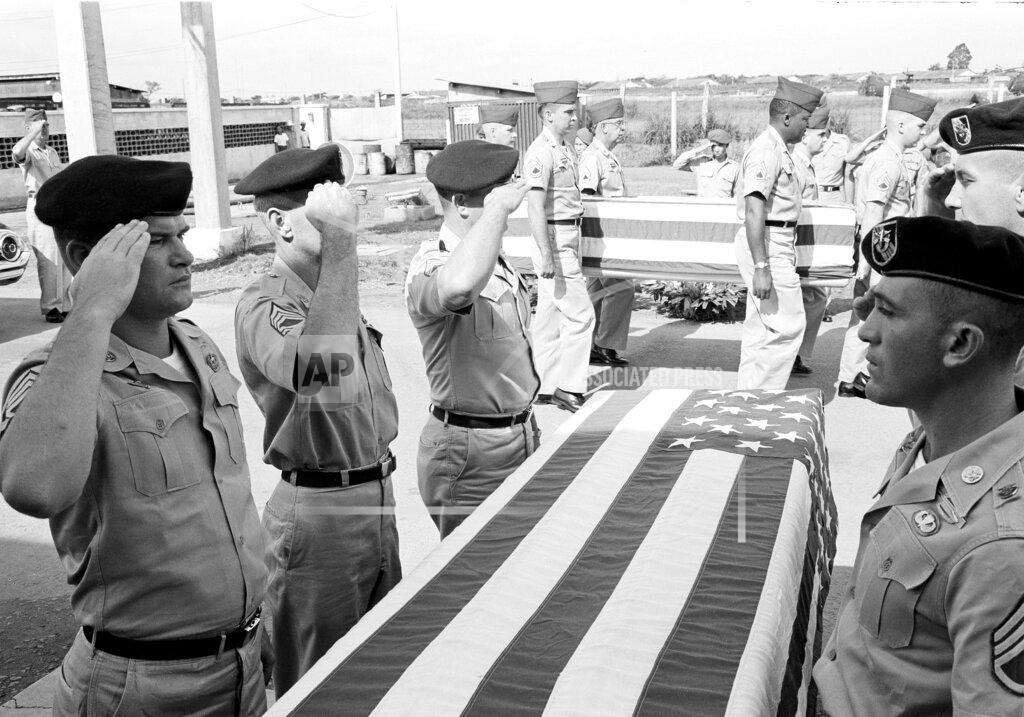
A United States Army helicopter pilot was killed by Việt Cộng fire today minutes after stepping from his disabled craft 370 miles northeast of Saigon. U.S. Army Chief Warrant Officer Manford Lloyd Kleiv from Whitefish, Montana was a Helicopter Pilot (Utility and Light Cargo Single Rotor) assigned to 7th Aviation Platoon, 56th Transportation Company, 45th Transportation Battalion, US Army Support Command Vietnam, MACV. According to his posthumously awarded Silver Star citation, on October 9, 1964, CW3 Kleiv was performing his duties as an instructor pilot of a UH-1B helicopter in connection with a support mission in the Republic of Vietnam when his aircraft was struck by ground fire and lost engine oil pressure. After successfully performing an autorotation landing, CW3 Kleiv evacuated the crew and established defensive positions around the downed aircraft while exposing himself to the advancing enemy troops. Despite the hail of heavy small arms fire, he returned to the aircraft, made an emergency distress call, and then covered the crew members as they maneuvered to defilade positions. Assured that the crew members were well covered, he again returned to the aircraft, repeated the distress call, and while attempting to rejoin the crew, was mortally wounded. His death brought to 201 the number of United States servicemen killed in combat in South Vietnam since 1961.
South Vietnamese Premier Major General Nguyễn Khánh says that South Vietnam now has the capability of bombing North Vietnam or China without U.S.
aid, but he says no such action is imminent. “We have the means to transport one‐ton, two‐ton or three-ton bombs into North Vietnam or southern China,” Premier Khánh said at a news conference. “Vietnamese armed forces by themselves have the capacity to bomb military and industrial installations.” The Premier said direct American military support would not be necessary to carry the war beyond South Vietnam’s frontiers. At the same time, he did not suggest that such an expansion of the war was imminent or that it would be attempted without consulting the United States.
“Our purpose is to win,” he said, “and we will use properly all the means at our disposal. But internal and international implications are involved — we must move in the right place at the right time.” Premier Khánh had conferred with Ambassador Maxwell D. Taylor in a regular weekly meeting, but qualified sources said the subject of expanding the war was not discussed nor had it been brought up between the two men since their disagreement on the policy last July. At that time Premier Khánh publicly advocated the policy of attacking the Communist North against Ambassador Taylor’s admonitions that this was contrary to American policy.
At the start of the 90‐minute news conference, Premier Khánh announced that the perpetrators of the abortive coup d’état of September 30 would be tried by a military court and that the maximum penalty would be death. A list of 13 military officers and seven civilians to be tried included the names of several persons whose alleged involvement had not been generally known. Foremost of these is Trần Quốc Bửu, head of the Vietnamese Workers Confederation, a labor union closely allied with the American labor movement. Mr. Bửu, who visited the United States earlier this year and conferred with President Johnson, is considered a controversial person in Saigon. Most of the public criticism against him has concerned his presumed influential role in the regime of the late Premier Ngô Đình Diệm.
Referring to the political agitation for the punishment of everyone who served in important positions under President Diệm, who was slain in a coup last November, Premier Khánh took what seemed to observers to be courageous stand against popular outcries condemning the Diệmist secret political party, Cần Lao. “Let’s not jump to conclusions,” he said. “People are being accused right and left of being Communists or Cần Lao. Everyone has a past.” He added: “We may accept even those who are Cần Lao if they are sincerely working for their country against Communism rather than accept so‐called patriots using and abusing those words for their own benefit.”
The ARVN forces, with U.S. support, announce they are to begin using the ‘Hoptac’ operation that, based on tactics used by the British in fighting the Communists in Malaya, will operate on several levels and proceed in a series of concentric circles around Saigon to eliminate the Việt Cộng. Quietly, behind the blare of the political upheavals of recent weeks, the United States and Vietnamese military commands have embarked on an intricate and intensive pacification effort in the provinces surrounding Saigon. Many months in the planning, the operation is an attempt to apply to South Vietnam the lessons of the 12‐year Malayan struggle against Communist terrorists. The operation holds priority in the American military effort though few important results can be expected for some time. Its purpose is to defeat the Việt Cộng insurgents militarily and politically in specified areas rather than in scattershot fashion.
The program is combining theories and tactics long talked about here but never applied in more than a half‐hearted and poorly organized manner. Involved are military clearing operations, to be followed by a police and administrative apparatus to hold the area cleared of guerrillas. Senior officials directing the program are aware that their effort may go the way of the poorly implemented 1962 program of fortifying so‐called strategic hamlets and building militia among the inhabitants, or of the hastily conceived country‐wide participation effort launched last March. Furthermore, the upheavals in the cities during the last six weeks have given a clear warning that it may be too late for victory through a pacification program. The example of Algeria in 1962 reminds officials that political developments can lose a war even if the ground has been won. International and internal pressures on the French Government to negotiate a settlement with the Muslim nationalists had become so overwhelming that the military situation was ignored.
President Johnson has said several times in recent weeks that he does not now favor a “big ofiensive” against North Vietnam. Presumably the President referred to an offensive by either American or South Vietnamese forces or by both. In continuing policy discussions here, however, increasing attention has been paid to possible efforts to cut off Việt Cộng supply lines. Effective strikes against these supply lines would also require an extension of the war beyond the borders of South Vietnam, and for that reason most such measures have not appealed to the Administration. When asked yesterday whether that attitude might change, Secretary of State Dean Rusk said he refused to predict the future because that would depend on the conduct of North Vietnam and Communist China.
Premier Moise Tshombe accused President Gamal Abdel Nasser today of trying to weaken and then dominate the Congo. “The United Arab Republic wants a weak and chaotic Congo,” the Congolese Premier said on his arrival here. “It does not want a strong Congo which might diminish Nasser’s chances for leadership.” President Nasser, he said, is “motivated only by a feeling of domination vis‐à‐vis the Congo and Black Africa.”
Premier Tshombe left Cairo this morning after having spent three days of what amounted to house arrest in a palace guesthouse. He had gone to the capital of the United Arab Republic to attend the conference of nonaligned nations there but was forbidden admission and incarcerated by Egyptian policemen and paratroopers. At a stop in Athens en route to Paris Mr. Tshombe characterized President Nasser’s treatment of him as “inhuman.”
The deputy chief of the United States Air Force mission here was kidnapped at gunpoint today by terrorists. The officer, Lieutenant Colonel Michael Smolen, was accosted by two men, one armed with a submachine gun, as he was enterting an automobile that was to take him to work. They forced the colonel to enter another car and immediately drove it away. Several newspapers received anonymous telephone calls warning that Colonel Smolen would be killed if South Vietnam carried out a plan to execute a 24‐year‐old prisoner accused of pro‐Communist terrorism. The telephone callers identified themselves as the kidnappers of the colonel. They alluded to the case of Nguyễn Văn Trỗi, who was arrested last May while installing a bomb under a bridge that was to be crossed by the United States Secretary of Defense, Robert S. McNamara, who was visiting Vietnam. Trỗi has been sentenced to public execution, and United States officials in Saigon are reported to have urged that the execution be carried out privately instead.
The Soviet Union said today that the United States was intent upon destruction of the United Nations through insistence upon payment of arrears owed by Moscow and others. Nikolai T. Fedorenko, the Soviet spokesman, who was recently in Moscow for consultations, spoke at a meeting of the Security Council called to consider the application of Malawi for membership in the United Nations. Malawi, formerly the British protectorate of Nyasaland, became independent on July 6. The Council unanimously recommended to the General Assembly that Malawi be approved for membership. This will bring the number of member states to 113. Malta, which became independent September 21, also has applied for membership.
Mr. Fedorenko, to support his allegations, cited a memorandum submitted by the United States yesterday, calling for enforcement of Article 19 of the United Nations Charter. This provides that members two years in arrears on their obligations shall lose their, vote in the General Assembly. The United States, asked that the question be acted upon on the first day of the Assembly’s session, November 10. Mr. Fedorenko reiterated emphatically that the Soviet Union would not change its position on the issue. He sald it “is not prepared to pay one single kopeck, one single cent” toward the costs of the peace‐keeping operations in the Congo and the Middle East, which he called illegal.
When the Royal Yacht Britannia noses into Wolfe’s Cove in Quebec tomorrow, Queen Elizabeth will be revisiting a scene associated with the British defeat of the French in, North America in 1759. Now, more than 200 years later, French Canadian resentment against English Canadian dominance of this country has reached such a pitch that the British monarch faces an uncertain welcome. Intensive security precautions have been prompted by the threat of demonstrations or possible violence against the Queen by small extremist ground demanding the separation of French-speaking Quebec from the rest of Canada. Most citizens of Quebec are not separatists, but all are “nationalists,” who advocate more provincial control over Quebec’s economic and social fortunes. Such an arrangement envisions a more autonomous role for Quebec. This is the position of the Quebec provincial government, which plans a friendly greeting for Elizabeth. Premier Jean Lesage said this week that he believed the Queen would “be very welcome.” However, one of his Cabinet ministers, René Levesque, said the visit was “not opportune.”
Security measures tightened as the Queen’s yacht, escorted by four Canadian destroyers, steamed up the St. Lawrence River toward this old fortress city. Cars coming into the city are being stopped by the Quebec Provincial Police. Occupants have been asked where they are going and why. Car trunks have been searched, and checks are being made at air and rail terminals. Plainclothes men with dogs are patrolling the Plains of Abraham, across which the Queen will drive several times. Frogmen are on hand to inspect the hull of the Britannia. Yellow police barriers line the narrow, winding streets of the city. Buildings along the routes the Queen will travel here, on the last leg of her eightday visit to Canada, has been checked. Public access to the Queen is severely limited. She will make no appearances among the general citizenry except for arrivals and departures.
French authorities reported today the sighting of two Russian cargo vessels in the Tuamoto Island group where France is developing a nuclear weapon test site. They reported that Russians from the ships went ashore yesterday at Kaukura Island in the Tuamotos, about 200 miles northeast of Tahiti. The French navy ship Bayonnaise went to the area to investigate and reported that the Soviet ships sailed away this morning.
Troops with fixed bayonets surrounded men’s hostels today in the black African township of Harare. An undisclosed number among 6,000 men scrutinized were held. They moved in before dawn to back up the police in a houseto‐house check for what were termed “undesirables” in the township just outside Salisbury. The Government reported that more than a hundred Africans had been detained without trial since the township was declared an emergency area Wednesday. The authorities also reported that 328 black Africans had been held for screening in other checks in the township in the last 48 hours.
At the Hôpital Necker in Paris, France, Dr. Jean Hamburger performed the first kidney transplantation from a deceased donor, after having pioneered kidney transplants in 1952. The donor was an anonymous 43-year old person who had “died of a sudden cerebral catastrophe” and the recipient was a 19-year old
President Johnson came to the Deep South today and asked Southerners to accord equal rights and opportunities to Blacks. In a speech tonight to a $100-a-plate dinner, broadcast by television stations throughout Louisiana and by many in Mississippi, the President declared: “If we are to heal our history and make this nation whole, posterity must know no MasonDixon Line and opportunity must know no color line.” When the Democrats win this election, the President said, ”our first work must be to bind our wounds and heal our history — and make this nation whole.”
He told his listeners that their great hero of the Civil War, Robert E. Lee, “counseled us well when he told us to cast off our animosities and raise our sons to be Americans.” Mrs. Johnson, on the first day of her political tour of the South, recalled the same quotation from Lee in a talk Tuesday in Alexandria, Virginia. She ended her tour and joined Mr. Johnson here tonight. A large crowd turned out to see the President meet his wife when her train pulled into Union Terminal after a four‐day whistle‐stop tour through eight Southern states.
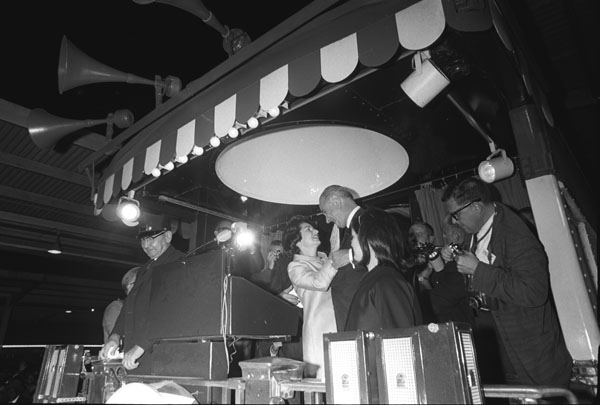
As the train backed in, Mrs. Johnson spotted the President and threw him a kiss. He held both his arms aloft, then bounded up the steps as the train came to a stop, gathered up first his daughter Lucy Baines and then his wife in a big embrace. After brief speeches from the train platform, the Johnson’s went to a stand outside the station. Senator Russell B. Long of Louisiana, who had accompanied Mrs. Johnson on her trip, said to the President as he introduced Mrs. Johnson to the crowd: “I observed that girl in Mississippi, Mr. President, and I’m telling you it took guts for that little girl to go into Mississippi and carry on that fight for you.” Everywhere, as the President went deeper into the South today, he received the same tumultuous reception he received in two previous days of campaigning in the Middle West. According to police estimates, 40,000 persons turned out to cheer him in Louisville and 200,000 in Nashville, where 85,000 were jammed into the courthouse square.
Mrs. Lyndon B. Johnson reached the last depot on her 1,700‐mile, eight‐state whistle‐stop swing around the South tonight, with the President at the station to welcome her. In her 47th speech of the last four days, the First Lady said that what she had seen and heard had strengthened her belief that the “majority of the South” wanted no part of “old bitterness.” Mrs. Johnson’s 19‐car train moved today along the edges of Florida, Alabama and Mississippi, three states in which her husband conceded last week he was lagging behind Senator Barry Goldwater. The turnouts were again large, with the same enthusiasm for Mr. Johnson and the same zealous, raucous knots of Goldwater backers yelling “n***er-lover Johnson” and “What about Vietnam?” In Mobile, Alabama, where 10,000 persons gathered to greet Mrs. Johnson, a woman standing in the midst of some Goldwater chanters burst out: “She’s the President’s wife — doesn’t that mean anything to you?”
Senator Barry Goldwater said tonight that President Johnson was letting “the Communists make fools of us” in the cold war. He described as nonsense the idea of a bipartisan foreign policy, and said the question was one that belonged in the race for the White House. Sharing a half‐hour recorded television appearance with the Republican Presidential nomines was former Vice President Richard M. Nixon, who said former President Dwight D. Eisenhower had set up an emergency procedure delegating authority over battlefield nuclear weapons to the supreme commander of the North Atlantic Treaty Organization.
Mr. Nixon demanded that Mr. Johnson apologize for calling Mr. Goldwater “reckless and a warmonger” after the Senator said tactical nuclear authority should be put in the hands of the supreme commander of NATO. Mr. Goldwater and Mr. Nixon joined forces in the second of seven nationwide campaign television appearances scheduled for the Arizona Senator this month.
Senator Barry Goldwater attacked today what he called the “silly, sick, weak attitude” about world Communism “that permeates Washington.” The Republican Presidential candidate said that as leaders of the Administration look around the world, they “shudder and shake” and “want to yield and give in.” Mr. Goldwater was speaking to employes of the Hughes Aircraft Company plant at Culver City and other citizens. The crowd was estimated by a plant official at 10,000. The Senator noted that his extended campaign travels had begun six weeks before when he arrived in San Diego on his first Western swing. He said it sometimes seemed like “six years.” In returning to California, he was also returning again to the scene of his major election triumph of the year. It was his victory over Governor Rockefeller of New York in the Presidential primary last June 2 that helped to clinch his nomination. However, although Mr. Goldwater unquestionably has a loyal and fervent following in Southern California, there were few signs that he was substantially cutting the lead President Johnson enjoys in local polls.
As has been the case in most of the cities he has visited so far, Mr. Goldwater attracts only small street crowds and there seems to he a lack of public curiosity to see him. California, with its 40 electoral votes, is one of the states that the Senator has listed as vital to his election chances. Besides the plant appearance, he spoke today at a lunch of the nonpartisan World Affairs Council in Los Angeles, and he was scheduled to speak here from a stage on famed Fisherman’s wharf. He is to arrive at the wharf from nearby St. Francis Yacht Harbor on the yacht Adventuress, owned by Dan London, a hotel operator. The heart of Mr. Goldwater’s speech at Culver City is also the heart of his personal thinking on foreign affairs. He summed it up by saying, “Communism is not mellowing.” He asserted that the Democrats believed that “if we can just be patient and just resist the opportunity to comment on Communist wrongdoing, we are going to be able to live with these people.”
The Republican Vice‐Presidential candidate, Representative William E. Miller, said today he believed great progress had been made in correcting what he said was a distorted impression of Senator Barry Goldwater systematically projected by his opponents.
Richard M. Nixon said today that “a State Department clique” was responsible for a “debacle” of the Johnson Administration’s foreign policy. He said the “clique” had also prevented President Kennedy from sending air support to Cuba during the Bay of Pigs invasion after he had made “the right decision to send in troops.” Mr. Nixon, speaking off the cuff before a breakfast gathering of 300 Essex County Republicans, took exception to a statement made by Secretary of State Dean Rusk at a news conference yesterday. Mr. Rusk had suggested that the Republicans were more to blame for Communism in Cuba than the Democrats. “Yes,” Mr. Nixon said “Castro did come to power during the Eisenhower Administration.”
But those responsible for the success of Premier Fidel Castro, he went on, were “a State Department clique who thought Castro was a ‘liberal’, a clique more interested in what world public opinion will be than in the security of their country, a clique that tried to sabotage [John] Foster Dulles.” The same group, he said, was responsible for “one of the great series of foreign policy defeats in our history.” “Put a map of the world on the wall,” the former Vice President said, his right hand jabbing at the audience. “Stand back 20 feet and throw darts and try to hit one part of the world where the United States hasn’t been humiliated in the past four years.” He said that the Administration’s foreign policy was “a disaster” because it “retreated in the face of aggression.” With a Republican Administration, he said, “we can have peace without surrender” and “remove that group that has been responsible for the defeat in foreign policy.”
The Defense Department took exception today to a Congressional subcommittee’s criticism and asserted that Pentagon policies would lead to a better communications satellite system at a lower cost. A critical report was issued yesterday by the Military Operations Subcommittee of the House Government Operations Committee. The report charged that Defense Secretary Robert S. McNamara had been “too timid and uncertain” in developing communications satellites, which both he and the Joint Chiefs of Staff had declared important to the national security. It also criticized as unduly risky the Pentagon’s plans for launching a communications satellite system.
Explorer 22 was launched into a “near perfect orbit” from Vandenberg Air Force Base in California as part of the first laser tests in outer space.
Charlie Finley says he lost $834,356 in Kansas City this year, a prelude to renewed efforts to move the A’s somewhere else.
AFL Football:
San Diego Chargers 26, Boston Patriots 17
A reserve quarterback, John Hadl, threw three touchdown passes tonight and the San Diego Chargers went on to score a 26–17 victory over the Boston Patriots. A crowd of 35,096, a record for Boston, saw the Chargers smash a four‐game Patriot winning streak. San Diego intercepted four passes by Babe Parilli and converted three into scores. Hadl completed nine of his first 10 passes, including eight straight after he had replaced Tobin Rote midway in the first quarter. His scoring throws were for 2 and 13 yards to Lance Alworth and 15 yards to Don Norton.
Dow Jones Industrial Average: 878.08 (+3.18)
Born:
Guillermo del Toro, Mexican-born film producer and director (“Pan’s Labyrinth”, “The Hobbit”; the “Hellboy” series; the “Pacific Rim” series; and two of the “Kung Fu Panda” films), in Guadalajara, Mexico.
Solomon Wilcots, NFL safety (Cincinnati Bengals, Minnesota Vikings, Pittsburgh Steelers), in Los Angeles, California.
Martín Jaite, Argentine tennis star, in Buenos Aires, Argentina.


 History Diaries