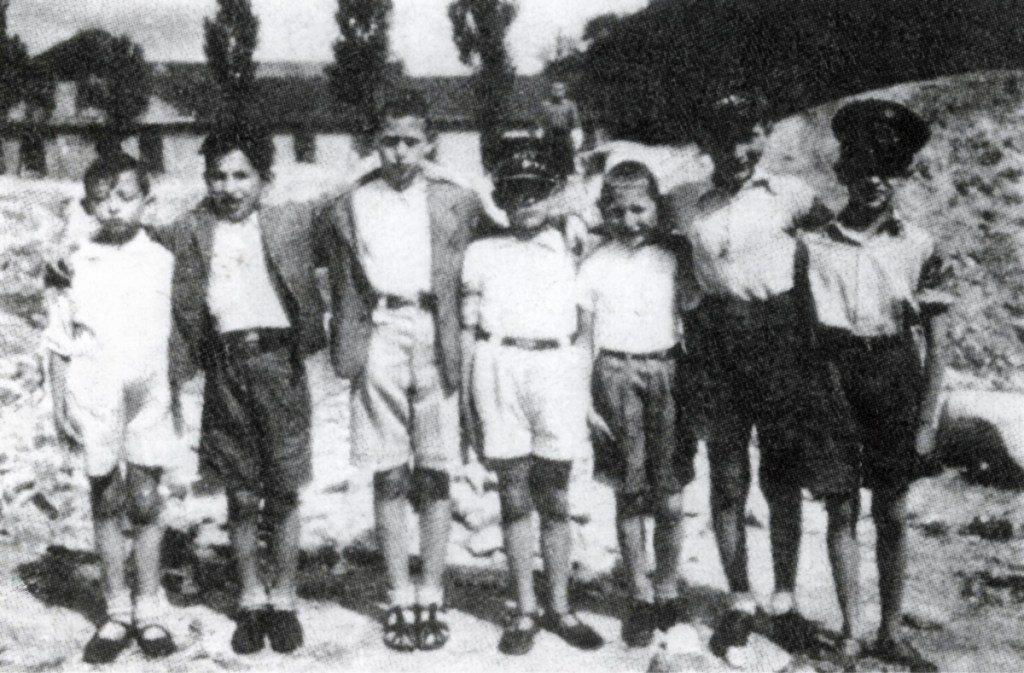
The first Jewish ghetto established in Piotrkow, Poland. The Piotrków Trybunalski Ghetto was founded in Nazi-occupied Poland. By January 1940 all the Jews of the city had moved into the ghetto area. It may be that the reason for establishing a ghetto at such an early date was that the city had been heavily damaged by bombing, and the Germans wanted to make room for Polish refugees in the city, as well as for Jews who had been expelled from of former Polish territories that had been annexed by the Reich. In addition, it is clear that local German residents of the city (“Volksdeutsche”) wanted to take over whatever Jewish assets were available — apartments, factories and possessions.
The Germans set a number of dates on which Jews were to move into the ghetto confines. When the Jews failed to comply with these dates despite announcements published by the Judenrat, the Germans began forcibly throwing Jews out of their apartments, ordering them to take up residence within the ghetto. Newly vacated Jewish apartments were handed over to non-Jews; at the same time, non-Jews were ordered to leave their apartments in the area designated for the ghetto, and to take up residence on the non-Jewish side of the city. Despite this, until the spring of 1942 the ghetto still housed many Polish residents.
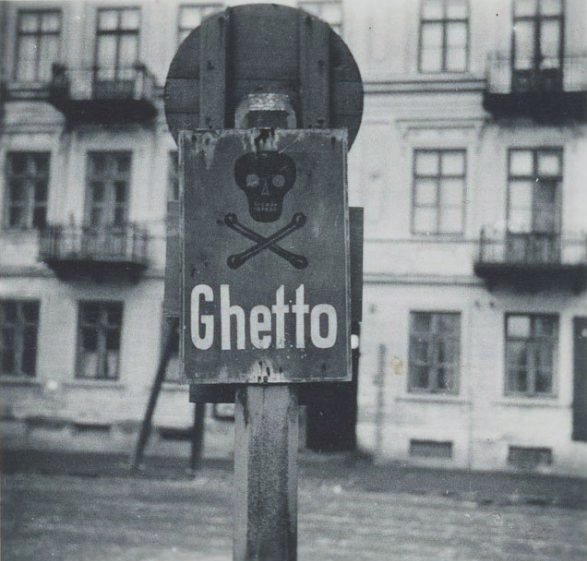
Until April 1942 the Piotrków Trybunalski ghetto remained ‘open’: it was not fenced in, nor was it guarded. The ghetto’s perimeters were marked by signs bearing the word “ghetto”, along with a human skull, but Jews were allowed to leave the ghetto without a license, albeit only during specific hours, and only to a certain part of the city. Many Jews, however, removed their armbands and roamed freely around the city. Several were even granted licenses to travel beyond the city limits. A number of Jewish artisans worked for Poles and Germans, and were paid. Jewish traders and merchants also succeeded in maintaining trade relations with residents – including non-Jews – of other cities, such as Warsaw and Częstochowa.
Many Jews smuggled food and heating materials into the ghetto. Illicit food production also flourished in the ghetto. Trade within the ghetto was brisk, and many Jews plied their trade as merchants, bribing the Polish and German authorities to allow them to continue their underground activities. At times the ghetto was searched, merchandise confiscated, and Jews executed for smuggling, yet these actions did not stop the illegal activities in the ghetto.
Most of the officially-sanctioned work places for Jews lay outside the ghetto. Thousands of Jews, among them many Jewish youths, worked in factories producing glass, wood and alcohol in the railway workshops and in other workplaces. The Judenrat established workshops that employed hundreds of skilled workers in the garment industry; their merchandise was supplied to the German market.
Until October 1940 the Judenrat succeeded in helping a number of Jewish families in the ghetto to emigrate from Poland. At the same time, the number of residents in the ghetto continued to rise steadily, due to an influx of Jewish refugees. While at the beginning of the war the city had held some 10,000 Jews, by April 1942 the number had risen to 18,500. All the Jews now lived within the ghetto, and almost 8,000 of them were refugees. The refugees came primarily from areas in western Poland – Pomerania, Poznan and Lodz – which had been annexed to the German Reich. Additional refugees came from Polish territories that had been annexed to the Soviet Union; these were refugees who had fled when the Soviet Union began deporting Jews to Siberia.
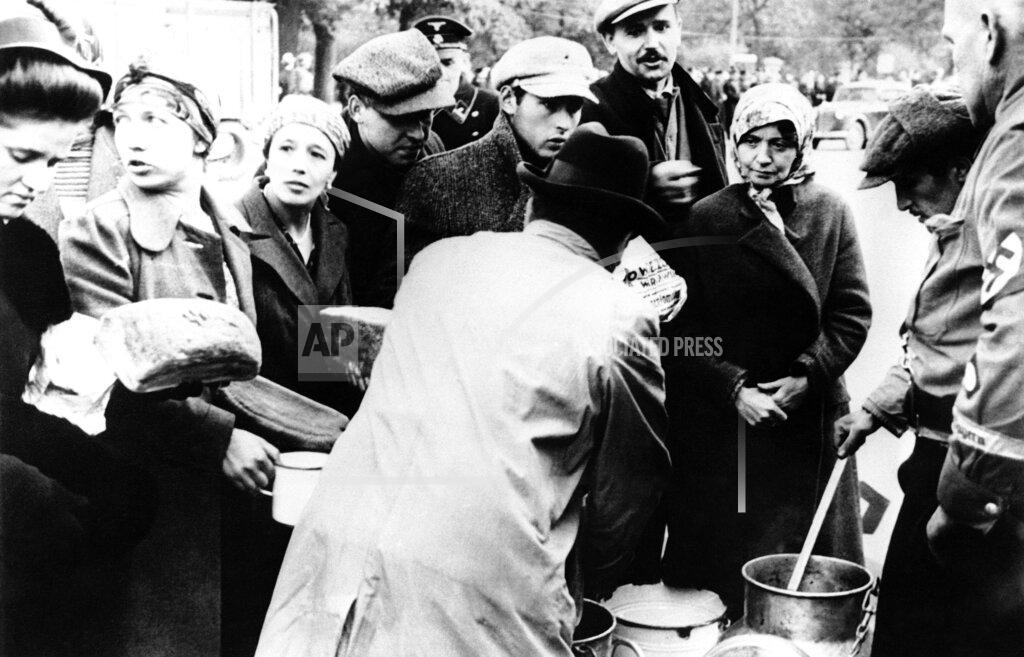
Most of the refugees were utterly destitute; despite the difficult conditions, the Judenrat’s Welfare Department attempted to provide them with aid. They were housed in religious and cultural institutions and also in butcher shops in the market. They received support from the Judenrat in the form of food, clothing and medication. The ghetto had two clinics, a family health center, a pharmacy and a dentist. Some of these institutions operated with the support of the Judenrat, which also distributed small sums of money to the needy. Rabbi Lau and a group of women founded the first soup kitchen, and two more were subsequently established. Later, the ghetto kitchen was supported by the Warsaw branch of the Juedische Soziale Selbsthilfe (the Jewish Social Self-Help foundation, or Żydowska Samopomoc Społeczna in Polish, a Jewish mutual help organization for monetary aid, medical supplies, clothing and food; the organization operated in the Generalgouvernement, its headquarters were based in Krakow). The Welfare Department in the Judenrat established an orphanage and a children’s club supervised by teachers, in which the children were provided with warm meals. A number of orphans were taken into foster care.
Despite these attempts to alleviate the situation, the intense crowding, insanitary conditions and hunger led to outbreaks of epidemics within the ghetto, resulting in a number of deaths. In the winter of 1940-1941, an outbreak of spotted typhus led to the establishment of several temporary hospitals and isolation rooms within the ghetto area. Sixty members of the “Sanitary Police” set aside buildings for isolating patients, disinfected apartments, and even forcibly washed, sterilized and isolated patients so as to forestall the spread of the disease. By spring, the epidemic had been eradicated, but the next winter it broke out again, albeit in a lighter form. The same methods were used to suppress the second outbreak of the epidemic.
Despite the conditions in the ghetto, the various political parties and Jewish youth organizations active in Piotrków Trybunalski before the war continued to function, first and foremost the Bund, but also Hashomer Hatzair (that organized a kibbutz for practical Zionist training in Żarki) as well as Beitar. A number of heders (religious primary schools), schools and yeshivot (Talmudic colleges) also continued to function. In addition the ghetto was home to a number of private teaching groups and small libraries, as well as a drama group. Several “bazaars” were held, and the revenue generated was donated to the orphanage. Jews in the ghetto continued to celebrate the holidays, and did their best to fulfill the various mitzvot (religious commandments); they persisted in these efforts right up to their deportation, at the end of 1942.
The ghetto liquidation action began on the night of October 13, 1942, commanded by SS-Hauptsturmführer Willy Blum. About 1,000 Jews unable to move were shot in their homes for “insubordination”. By the next morning, some 22,000 Jews were herded onto the square by the Synagogue in order to undergo a “selection”. In the course of the next few days, Jews were marched in columns to the railway station and loaded onto the awaiting freight trains without food or water, 150 to one car.
Following the 1942 deportations to Majdanek and Treblinka death camps, some 3,500 Jewish factory workers still remained in the small Ghetto. However, mass executions became more frequent in 1943, even inside the depleted Synagogue, in the Jewish cemetery, and at an execution site near Raków. By 1944 only 1,000 Jews were still alive. As the Soviet front began to approach, they were loaded onto freight trains and sent to Buchenwald and Ravensbrück, never to return.
Hitler issued a decree proclaiming the annexation of Pomerania, Wielkopolska and Silesia into the Reich. The annexed Polish territories became Reichsgau Danzig-West Prussia.
Germany tightens its internal economy. The government is resolved to keep people on minimum rations during wartime.
Germany and Russia have agreed to realize their program of economic collaboration ‘at a rapid pace and on a large scale,” a Soviet communiqué said tonight.
Cut off from many of her foreign oil sources by the war and the increasing need for fuel for her military machine, Germany faces uncertain prospects of getting much help from the oil resources of Soviet Russia, the U.S. Commerce Department indicated today in a study of the Reich’s foreign sources of crude and refined petroleum.
German and Latvian representatives sign an agreement for the patriation, to the Third Reich, of German-speaking citizens of Latvia. An estimated 50,000 ethnic Germans are involved.
Nazi leaders contemptuously dismissed tonight the first negative replies to Adolf Hitler’s peace proposals with the allegation that the London and Paris Governments were misrepresenting the “real desires for peace” among the British and French people.
British Prime Minister Chamberlain announced a committee of ministers to coordinate the war time economy.
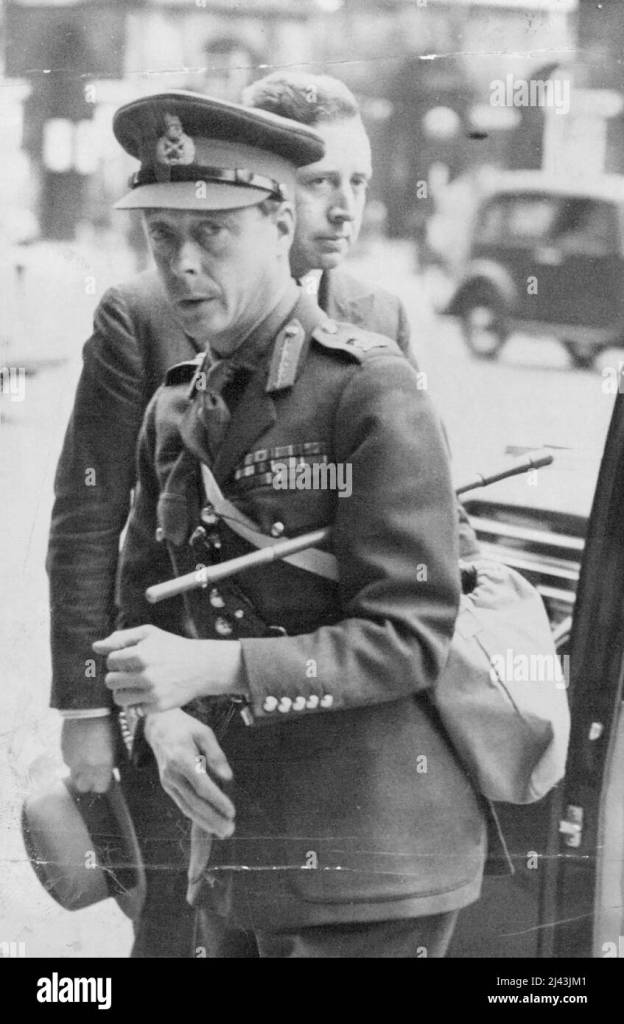
His Majesty the King returned from a two-day visit to the Home Fleet.
London’s now famous blackout was considerably lightened tonight by a big fire in a furniture warehouse in fashionable Belgravia.
A German flying boat was brought down after being engaged in combat with the British Royal Air Force (RAF) over the North sea. A Lockheed Hudson reconnaissance aircraft, patrolling the area near Jutland, shot down a Dornier Do 18 flying boat. It was the first air victory in the World War II achieved by an aeroplane operating from an air base located in the British Isles.
Paris reported that French artillery were engaged in repulsing German attacks, chiefly to the southeast of Zweibrücken.
Possibly as initial preparation for their eventual large-scale offensive, German scouting parties were numerous in no man’s land today, especially east of the Moselle. This is the sector where many persons believe that the strongest thrust may occur.
The police in Paris and agents of the National Surety service in the provinces today began a round-up of former Communist Deputies and late tonight announced the arrest of thirty-five of them. Almost all of the former party’s chief leaders, however, have evaded capture and are believed to be in hiding somewhere within the country.
The Finnish government accepts a Soviet invitation to send a delegation to Moscow to discuss border disputes. Finland also declares its determination to maintain its independence and its neutrality in the war.
The Finnish military begins to mobilize in response to Soviet threats.
Finns are said to seek Nazi aid with the Soviets. Reliable reports tonight said Finland was seeking diplomatic aid from Sweden and Germany to forestall what she feared might be “excessive” demands from Soviet Russia.
Should Britain and France reject Chancellor Hitler’s peace proposals, Italy will continue with renewed vigor her efforts to build and maintain a “neutral bloc,” according to circles close to the government.
General Henri Guisan, head of the Swiss Army, today ordered that the European war issue be kept out of the impending political campaign. The election for the National Council is scheduled for October 28 and 29, and will be decided almost entirely by 500,000 men under arms.
Battlecruiser Gneisenau and other ships of the German Navy sortie off Norway to draw the Home Fleet within U-boat and aircraft range. Capital ships Hood, Nelson, Repulse, Rodney and Royal Oak, together with the carrier Furious, cruisers and destroyers sail for various positions, but there is no contact.
German armored ship Admiral Graf Spee takes on board crews of British freighters Ashlea and Newton Beech in the South Atlantic and sinks the latter with demolition charges.
A RAF reconnaissance plane shot down a German flying boat conducting reconnaissance over the North Sea.
In the Atlantic, the USCG cutter USCGC Campbell joins the U.S. passenger liner SS Iroquois because of the warnings received about an attack on her. Later, the USN destroyers USS Davis and USS Benham also join. The four ships proceed in company to New York.
The neutral Swedish steam merchant Vistula was stopped and after the crew abandoned ship was sunk by gunfire by the U-37, commanded by Korvettenkapitän Werner Hartmann, approximately 45 miles north of Muckle Flugga, Shetlands in the northern Atlantic Ocean. Of the ship’s complement, 9 died and 9 survived. The 1,018-ton Vistula was carrying general cargo, including steel and paper pulp and was bound for Hull, England.
The Kriegsmarine Type VIIB U-boat U-47, under the command of Günther Prien, set out from Kiel on the soon to be famous attack on the British Fleet at Scapa Flow.
The Kriegsmarine Type IIB U-boat U-12 is sunk in the English Channel near Dover by a mine of the British anti-U-boat mine barrage in the Strait of Dover. 27 are killed (all hands lost). Her exact position is not known but it is at approximately 51°10′N 01°30′E. The body of the commanding officer, Kapitänleutnant Dietrich von der Ropp, was washed ashore on the French coast near Dunkirk on 29 October 1939.
The prototype of the Percival Proctor, designed to British Air Ministry Specification 20/38 for a communications and radio training aircraft, made its maiden flight.
The War at Sea, Sunday, 8 October 1939 (naval-history.net)
Sortie by German battlecruiser GNEISENAU, light cruiser KÖLN, and destroyers PAUL JACOBI, MAX SCHULTZ, BERND VON ARNIM, WILHELM HEIDKAMP, FRIEDRICH IHN, DIETHER VON ROEDER, ERICH STEINBRINCK, FRIEDRICH ECKHOLDT and KARL GALSTER from Kiel to operate off the south coast of Norway. They were to sink Allied shipping and entice the British Home Fleet into the range of Luftwaffe bombers. Destroyers HANS LODY and ERICH GIESE were to have sailed but suffered equipment defects. In addition, U-10, U-18, U-20, U-23 were deployed in a patrol line to attack the Home Fleet.
Admiral Forbes, informed of these movements by a RAF Coastal Command Hudson sighting, went to sea from Scapa Flow with the Home Fleet. Battleships NELSON, RODNEY, battlecruisers HOOD, REPULSE, aircraft carrier FURIOUS, light cruisers AURORA, SHEFFIELD, NEWCASTLE and destroyers SOMALI, MASHONA, ASHANTI, ESKIMO, BEDOUIN, PUNJABI, FAULKNOR, FURY, FORESTER, FAME, FORESIGHT, FORTUNE and FIREDRAKE. Heavy weather damaged FORTUNE at the start and she detached to the Clyde arriving on the 9th, and repairing until 2 November.
HOOD, REPULSE, AURORA and SHEFFIELD with SOMALI, MASHONA, ESKIMO, ASHANTI sailed for a position 50 miles NW of Stadlandet in 63 00N, 04 00E. At the same time, NELSON, RODNEY, FURIOUS and NEWCASTLE with FAULKNOR, FURY, FORESTER, FAME, FORESIGHT, FIREDRAKE, PUNJABI and BEDOUIN sailed for a position north of Muckle Flugga in 61 00N, 00 00E. Both forces were to reach their positions by dawn on the 9th, then steam towards each other in a pincer movement.
Light cruisers SOUTHAMPTON, EDINBURGH, GLASGOW with destroyers JERVIS, JUPITER, JAGUAR departed Rosyth, while destroyers JACKAL and JANUS departed Grimsby and joined at sea to operate off the mouth of the Skagerrak in 57 45N, 05 00E, before sweeping north. At 0605/9th, JAGUAR was detached to Rosyth for refueling and en route, was attacked by German bombers, but not damaged. JERVIS and JUPITER were ordered to search for Danish steamer TEDDY (557grt) which had picked up the crew of a German Dornier flying boat shot down on the 8th. They too were attacked by German bombers at 1518, but again without damage. However, JUPITER broke down at sea at 1650 and was taken in tow by JERVIS.
JAGUAR, refueling completed and JERSEY, which just finished repairs after her 22 September collision, were ordered to join the Humber Force off the Pentland Skerries to screen the withdrawal of JERVIS and JUPITER. Departing Rosyth, JAGUAR struck a small islet above the Forth bridge and damaged her starboard propeller shaft, arriving at Leith on the 11th for repairs. Just as unfortunate was JERSEY. Leaving at the same time she struck the Rosyth boom, and her repairs at Leith were not completed until the 16th.
SOUTHAMPTON, GLASGOW, EDINBURGH and JACKAL and JANUS of the Humber Force were heavily bombed by the Luftwaffe between 1120 and 1645/9th off the mouth of the Skagerrak. SOUTHAMPTON and GLASGOW were near missed, but neither was damaged. Shortly before arriving at Scapa Flow on the 10th, JUPITER was able to proceed on her own, screened by SOUTHAMPTON, GLASGOW, JACKAL and JANUS.
Battleship ROYAL OAK with destroyers MATABELE and STURDY sortied from Scapa Flow on the 9th to patrol to the west of the Shetlands in Fair Island Channel, but in heavy seas, ROYAL OAK’s destroyers lost touch and she returned to Scapa Flow, arriving on the 10th.
Home Fleet destroyers FOXHOUND and FEARLESS undergoing minor repairs at Scapa Flow were absent from this operation. Destroyer TARTAR with major machinery defects was repairing at Scapa Flow until the 23rd.
After a possible periscope was sighted six miles 180° from St Catherines, destroyer SALADIN was sent to investigate.
Convoy BC.8S of steamers BARON MACLAY, CLAN MONROE and TRELAWNY departed the Loire escorted by destroyers WESSEX, VISCOUNT and VENETIA, and arrived safely in the Bristol Channel on the 10th.
Convoy OG.2 was formed from the merging of OA.16G and OB.16G. The 30 ships proceeded to Gibraltar without an ocean escort, but were met by destroyers WATCHMAN and VELOX and escorted into Gibraltar on the 17th.
Convoy FN.18 departed Southend and arrived at Methil on the 10th. There was no convoy FN.19.
Convoy FS.18 departed Methil and arrived at Southend on the 10th. There was no convoy FS.19.
U-15 completed a survey of the English east coast and Straits of Dover lightships and buoys.
Finnish steamer INDRA (2026grt) was badly damaged by a mine near Terschelling; six crew were injured and they, together with 14 other crew were taken to Ymuiden, where INDRA was towed for repairs.
U-37 sank Swedish steamer VISTULA (1018grt) 45 miles north of Muckle Flugga, NNE of Unst, with the loss of nine crew men.
U-12 was mined and sunk off Dover with the loss of her 27 crew. The body of commanding officer, Kptlt von der Ropp was found near Bleriot Plage near Calais on the 29th.
Convoy HX.4 departed Halifax at 0900, escorted by heavy cruiser YORK and Canadian destroyers HMCS FRASER and HMCS ST LAURENT, the latter detaching on the 8th. YORK and FRASER detached on the 10th with YORK arriving back on the 13th. The bulk of the dispersed ships of the convoy reached Liverpool on the 22nd and one ship on the 24th.
Convoy KJ.4, the last of the KJ series which only began on 15 September, departed Kingston. Because of German raiders in the Atlantic, ships from the Caribbean now went north along the American coast and joined the HX convoys from Halifax before beginning the Atlantic crossing.
Convoy Green 4 departed Gibraltar with 39 ships, including 14 from OG.1, escorted by French destroyers CASSARD, KERSAINT and British sloop ABERDEEN. The French ships were relieved on the 13th by British destroyer GRENADE, and the convoy reached Port Said on the 17th escorted by GRENADE and ABERDEEN.
The second week of debate on the Neutrality Bill will open in the Senate tomorrow with every prospect of victory (possibly a quick one) for the Administration. Leaders of the revision group say they have the support of sixty-five votes. Some feel that a final vote may be reached this week, but members generally indicated a belief that this might be overly optimistic. At least twelve Senators, principally those opposing the bill with its cash-and-carry trade provisions which would be substituted for the embargo on munitions shipments to belligerents contained in the present law, have indicated their desire to speak on the bill.
However, the Administration leaders, eager to force the issue, believe they are being helped in that effort by evidence of diminishing public interest in the bill, manifested both in a falling off of letters and telegrams received in Senatorial offices and small crowds of spectators in the galleries during sessions in the latter part of the past week.
The first ballot in connection with the bill probably will come tomorrow when Senator Tobey, an opponent of the measure as written, calls up his motion to recommit the bill and order the Foreign Relations Committee to separate the section to repeal the arms embargo from another designed to safeguard American ships.
A vote on this motion was postponed last week until tomorrow by agreement with Senator Barkley, the majority leader, since the latter had to go to Kentucky to attend funeral services for the late Senator Logan. The postponement agreement indicated a vote would come tomorrow, although no pledge was given. In the meantime, Senator Tobey has striven to keep the vote on his motion from being considered a test vote on the whole bill.
Nevertheless, the leaders of the embargo repeal group persist in calling it a test, and have notified their followers that the motion must be defeated. They will assist Senator Tobey in getting an early vote. In In those circumstances, it appeared tonight that the vote on the Tobey motion would give a fair indication of the final roll-call on the Neutrality Bill. Senator Tobey, in a radio speech over a National Broadcasting network tonight, appealed to the public to send telegrams to their Senators, urging support of his motion. Others who took the air tonight to discuss neutrality legislation were Senators Schwellenbach and Overton, who debated the pending bill on the American Forum of the Air, over the Mutual Broadcasting System.
Two other prospective tests face the Neutrality Bill prior to a final vote. The first will come in the form of an amendment to strike from the bill a section empowering the President to authorize ninety-day credits on sales to belligerents. Senator Pittman, chairman of the Foreign Relations Committee and floor sponsor of the bill, says this amendment will be defeated. An effort also is in prospect to amend the bill to retain the embargo on arms shipments while applying cash-and-carry requirements to all permitted sales to belligerents. If the bill’s proponents have sufficient votes to assure its passage in the Senate they will be able to stop this effort.
There was no indication in Washington tonight that Chancellor Hitler’s peace hints had affected the neutrality debate one way or the other. Members of Congress indicated a feeling that even if an armistice were reached in Europe the bill still would be necessary to define American policy in the midst of international uncertainties. The Senate program will be further clarified tomorrow when Senator Barkley returns to his seat. In the meantime the House, moribund since it assembled under a do-nothing agreement pending Senate action on the Neutrality Bill, meets tomorrow to discuss this subject.
Apparently determined to make no move toward ending European hostilities until assured in advance of the support for his purpose of all the belligerent powers, President Roosevelt refused today to break his silence on officially prompted Berlin suggestions that he offer to mediate. Before he had left the family home here late in the day for Washington, the President added. nothing to the comment made on his authorization yesterday that he had nothing to say at this time regarding semi-official suggestions from Germany that his intervention in the role of peace-maker would meet with immediate acceptance by Chancellor Hitler.
The President talked by telephone with Secretary of State Cordell Hull and other Washington officials during the day, presumably regarding their opinion as to a move in the interest of European peace at this time, but no word came from the temporary White House offices on the discussion. It was assumed, in the absence of official information, that Mr. Roosevelt would canvas the situation with State Department officials again tomorrow.
Two reasons have been assigned in White House circles for the President’s refusal to comment on the supposed invitation from Germany that he intervene to bring the war to a close. One is that he would make no such move unless and until assured of the support of France and Great Britain. The other grows out of an obvious reluctance to add new issues to the Senate debate over repeal of the arms embargo.
Back at the White House tomorrow, Mr. Roosevelt is expected to take a hand in the scheduled attempt of members of the Senate isolationist bloc to bring about a separate consideration of the arms embargo provision, as distinct from other stipulations of the Neutrality Act, including the “cash and carry” clause, a move he is likely to oppose.
American manufacturers of aircraft are speeding the construction of $80,000,000 worth of war planes and flying equipment for England and France. Despite the embargo on shipment of arms to beliggerent nations, which has halted delivery of such material, the manufacturers are continuing to fabricate it as rapidly as possible.
Five days after the National Association of Broadcasters imposed restrictions on “spokesmen of controversial issues,” the Rev. Charles E. Coughlin today continued his radio speeches in defense of the arms embargo, declaring that its repeal would be a blow to “representative government.”
Aides of the Dies Committee on Un-American Activities revealed today that the committee’s file room at the House Office Building had been broken into this morning. They expressed fears that important evidence concerning Fascist, Communist and espionage activities had been tampered with.
Leaders of the C.I.O., assembling for their national convention, indicated today that they held little hope that any new appeal from President Roosevelt for peace between the two great factions of American labor would bear fruit in the near future.
Charges that a slow-down strike has been ordered in the main Dodge plant by the United Automobile Workers was made today in a statement issued by Herman L. Weckler, vice president in charge of operations of the Chrysler Corporation.
A professor challenges the distance to stars. He claims the 5,000 nearest are considered less than half as far away as was previously calculated.
Output of steel ingots in the United States last week continued its upward trend and reached 87 per cent of capacity, up 3 points from the previous week.
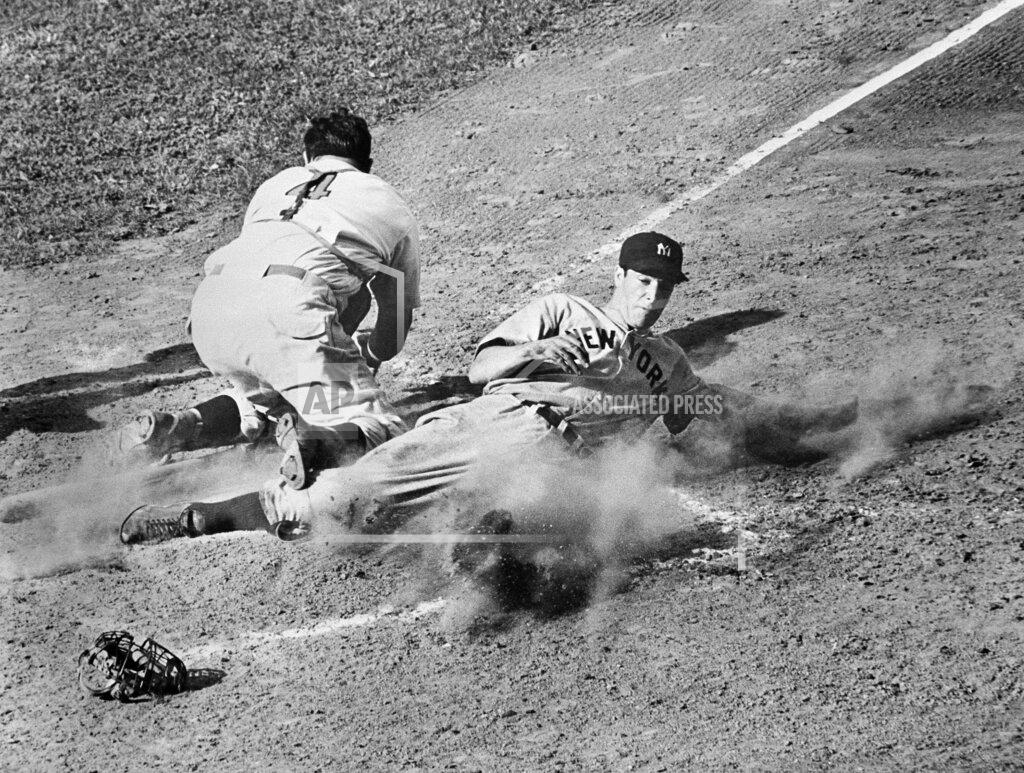
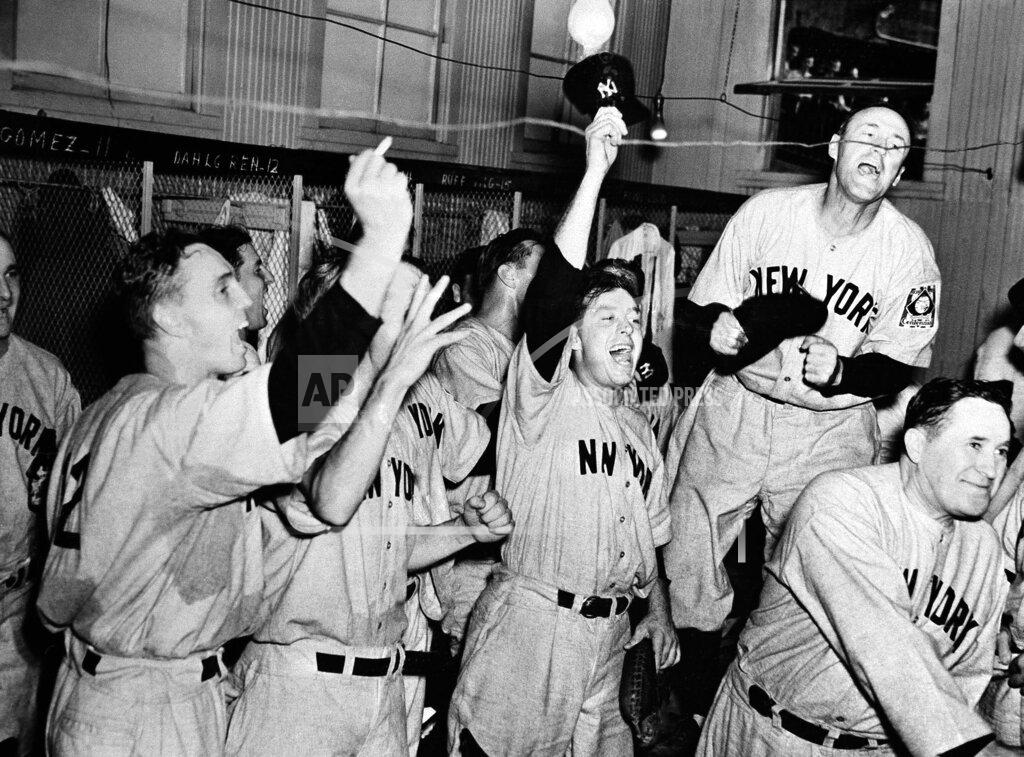
The New York Yankees win another Major League baseball championship. In the 10th inning of game 4, the Reds make 3 errors and watch in shock as the Yankees run wild, scoring three runs. The inning is climaxed by Joe DiMaggio’s slide across the plate left unguarded by Ernie Lombardi, who was stunned by a kick in the groin by the preceding runner, Charlie Keller. The Yankees win 7–4, beating Walters for the second time, and sweep the Reds to win their 4th straight World Championship. Starter Paul Derringer guns down the first 14 Yankees to tie a World Series mark set exactly two years ago. It will not be tied or topped this century. Neither side scored until the seventh. Home runs by Charlie Keller and Bill Dickey off of starter Paul Derringer put the Yankees on the board, but the Reds struck back in their half of the inning. With runners on second and third via an error and double off of reliever Steve Sundra, Wally Berger’s RBI groundout put the Reds on the board, then after a walk, back-to-back RBI singles by Willard Hershberger and Billy Werber put the Reds up 3–2. They added another run next inning when Ival Goodman hit a leadoff double off of Johnny Murphy and scored on Ernie Lombardi’s single, but in the ninth after two leadoff singles off of Bucky Walters, Dickey’s fielder’s choice aided by an error scored a run, then one out later, Joe Gordon’s RBI single tied the game. Next inning, with two on via a walk and error, Joe DiMaggio drove them both in with a single and another error allowed DiMaggio himself to score to put the Yankees up 7–4. In the bottom half, Murphy allowed two leadoff singles, but retired the next three batters to end the game and series.
The Yankees swept the Series in four games for the second straight year, winning their record fourth consecutive title (they would later win five straight from 1949 to 1953). Yankee manager Joe McCarthy won his fifth title, tying the record held by Philadelphia Athletics manager Connie Mack. The Yankees matched the Reds in hits with 27, but out-homered them 7–0 and out-scored them 20–8. Keller led the Yanks with seven hits, three home runs, six RBI, eight runs scored, a .438 average and a 1.188 slugging percentage. Both teams played sterling defense for most of the series until the ninth inning of Game 4. Up until then the Reds matched the Yankees with committing just one error for the series. But Cincinnati committed a total of three errors in the ninth and 10th innings of Game 4 which led to five unearned runs, sealing the New York sweep. Despite the loss, the Reds were an organization on the rise, having improved from eighth and last in the National League in 1937 (56–98, .364) to fourth in ’38 (82–68, .547) and first as NL champions in ’39. Ironically, despite being dominated by the Bronx Bombers in the 1939 Series, the Reds would return in 1940 to win the World Series while the Yankees finished behind Detroit and Cleveland in the AL pennant race, snapping their consecutive World Series streak at four.
The Canadian government announces that a division of 20,000 troops will leave for overseas early next year.
The Chinese report they have regained more than sixty miles of territory In five days along the North Hunan front in repulsing Japanese forces, who three weeks ago launched an offensive against Changsha. Dispatches from Changsha tonight reported the Chinese were continuing to clean up the area south of the Sinchiang River, decimating small Japanese units at various points and besieging others in towns. The Japanese force in the city of Sinchiang faces annihilation. It is surrounded by Chinese.
The Chinese 195th Division pursued the retreating Japanese troops in the Miluo River and Sinchiang River region in Hunan Province, China.
Japanese forces have occupied the strategic city of Shekki in the Canton River delta and have completed conquest of the historic Chungshan district of Kwangtung Province, it was announced tonight. The Chungshan area, homeland of the late Dr. Sun Yat-sen, founder of the present Chinese Nationalist regime, has withstood repeated attacks for months. Many Chinese in the United States came from this district. Shekki was bombed to ruins by a dozen Japanese planes before it surrendered, according to British reports. Thousands of fresh Japanese troops, who recently arrived in the Hong Kong area, participated in the offensive. The Japanese Domei news agency said the Japanese drive was led by partly mechanized units headed by Colonels Akimoto, Onishi, and Shigehisa. The occupation of Shekki was completed at 1:45 PM yesterday after a series of battles which began shortly before dawn. Japanese battalions were pursuing the Chinese remnants into the hills, the news agency reported.
In addition to the three Japanese columns that converged on Shekki another unit headed by Colonel Matsubara captured Fangchiya, about three miles west of Shekki, at 3 PM after removing Chinese barricades across the Chungshan River, one of the waterways of the Canton river delta. A Japanese naval detachment, which landed at Hengmen, assisted in the operations, capturing Chinesa pill boxes and a fortified hill a mile west of Hengmen. This action cut off one of the main lines. of the Chinese retreat. General Wu Fei, Chinese commander in the Chungshan area, was said to have escaped into the hills with about 5,000 men.
The reported seizure of Shekki came after repeated Japanese drives in the last six months had been beaten off by the Chungshan militia directed by District Magistrate Chang Huichang, one-time Chinese Air Force chief and later Minister to Cuba. Dispatches said the Japanese landed under the guns of warships. Their forces included several units of Chinese mercenaries from North China. The troops quickly overpowered the lightly armed Shekki militiamen, the reports said. Military observers pointed out that permanent Japanese occupation of the district might reduce the food supply of Hong Kong and the Portuguese colony of Macao, twenty-five miles south of Shekki. Foodstuffs and manufactured goods for the interior pass through Macao and the Chungshan Peninsula.
After more than a year’s Chinese resistance the Japanese are gaining in the Shekki district. Two thousand naval sailors, assisted by a dozen airplanes, are dispersing the Chinese, who are short of ammunition. Shekki, which is adjacent to Portuguese Macao, has been heavily. bombed for many months. A foreign mission cared for refugees at near-by Choihang, Sun Yat-sen’s. birthplace, which the Japanese avoided.
Efforts to settle the Foreign Office dispute over the plan to transfer the economic section to the Trade Ministry failed at 2 o’clock this morning when Foreign Minister Kichisaburo Nomura rejected a compromise plan prepared by the 150 striking employes of the section.
Australian opinion on Chancellor Hitler’s speech was reflected by Prime Minister Robert Gordon Menzies’ observation that it was not a peace offer, but a blustery attempt to justify war.
Born:
Paul Hogan, Australian actor (“Crocodile Dundee”, “Lightning Jack”), comedian and television presenter, in Lightning Ridge, New South Wales, Australia.
Boris Dubrovsky, Russian rower (Olympic gold medal, double sculls [Oleg Tyurin] 1964), in Moscow, Russian SFSR, Soviet Union (d. 2023).
Elvīra Ozoliņa, Soviet women’s javelin thrower (Olympic gold medal, 1960), in Leningrad, Russian SFSR, Soviet Union.
Andrew William Thomas, American composer (Three Transformations), in Ithaca, New York.
Lynne Stewart, American defense attorney (known for representing controversial, poor, and often unpopular defendants), in Brooklyn, New York, New York (d. 2017).
Naval Construction:
The Вое́нно-морско́й флот СССР (ВМФ) (Soviet Navy) Project 68 (Chapayev class) light cruiser Chapayev (Чапаев) is laid down by Sergo Ordzhonikidze Zavod (Leningrad, U.S.S.R.) / Yard 189.
The Kriegsmarine (German Navy) Type 35 torpedo boat T8 is completed.
 History Diaries