The chairman of the Joint Chiefs of Staff warned that American military capability would suffer and confrontations with other countries could occur if the United States extended its present 12-mile claim on coastal waters to 200 miles. The chairman, Air Force General George S. Brown, urged the Senate Armed Services Committee to vote against legislation proposing such an extension, in the interest of national security.
Senator Barry Goldwater (R-Arizona) said he would favor a constitutional amendment to limit the powers of the President in the area of war. “Let’s say that the President did want to destroy the world,” Goldwater said. “We haven’t taken away the power for him to reach in and punch that red button. If we want to change things — and I wouldn’t be opposed to this — let’s make punching that red button something that is going to be decided not by one man but maybe by a group of men.”
The national unity cabinet of Premier Konstantine Karamanlis resigned to make way for a caretaker government to conduct parliamentary elections November 17, Greece’s first in almost 11 years. Karamanlis will head an interim regime scheduled to be sworn in today. He asked Foreign Minister George Mavros and Defense Minister Evanghelos Averoff-Tositsas to remain in office to protect the continuity of their missions — the former as negotiator in the Cyprus dispute, the latter as a link between the government and the former military junta.
President Ford threatened again today to veto pending legislation that would cut off military aid to Turkey, calling the measure that the House of Representatives adopted yesterday “misguided and extremely harmful.” The measure is expected to be voted by the Senate tomorrow. The Presidential statement threatening a veto was issued today by the White House Press secretary Ron Nessen. The new language voted by the House is tougher than the language previously adopted by either body. It would require the President to certify both that Turkey was in compliance with American foreign aid laws and that “substantial progress” toward a settlement of the Cyprus problem had been made. The President’s statement was also viewed as tougher than his previous veto threat. He charged that the amendment, if passed, “will mean the indefinite postponement of meaningful negotiations,” will imperil relations with Turkey, and hurt the Greek Cypriots most of all.
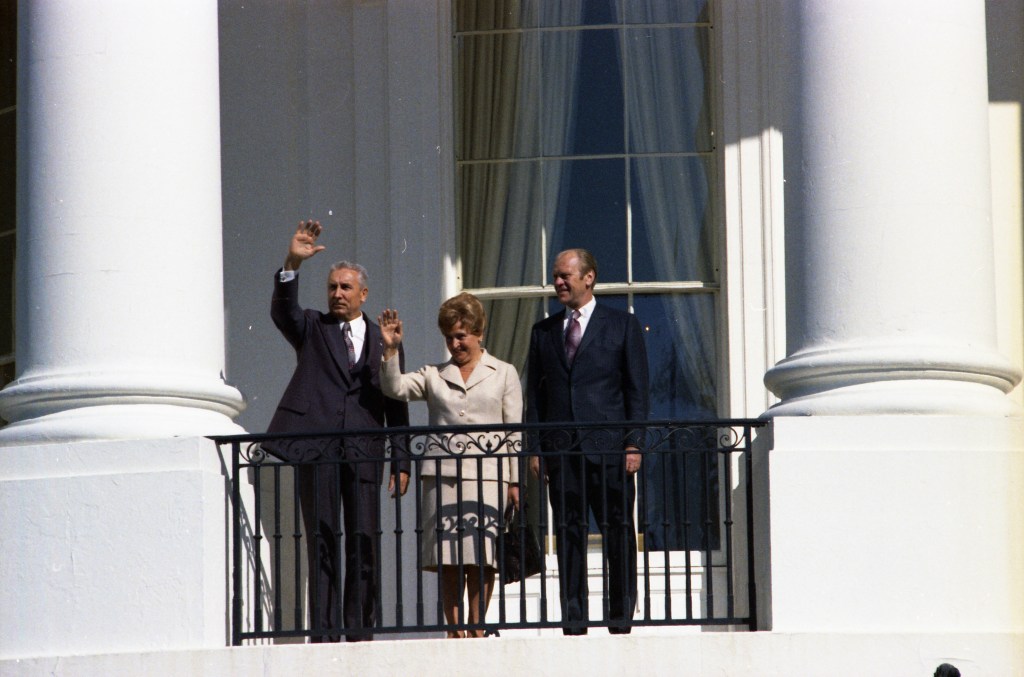
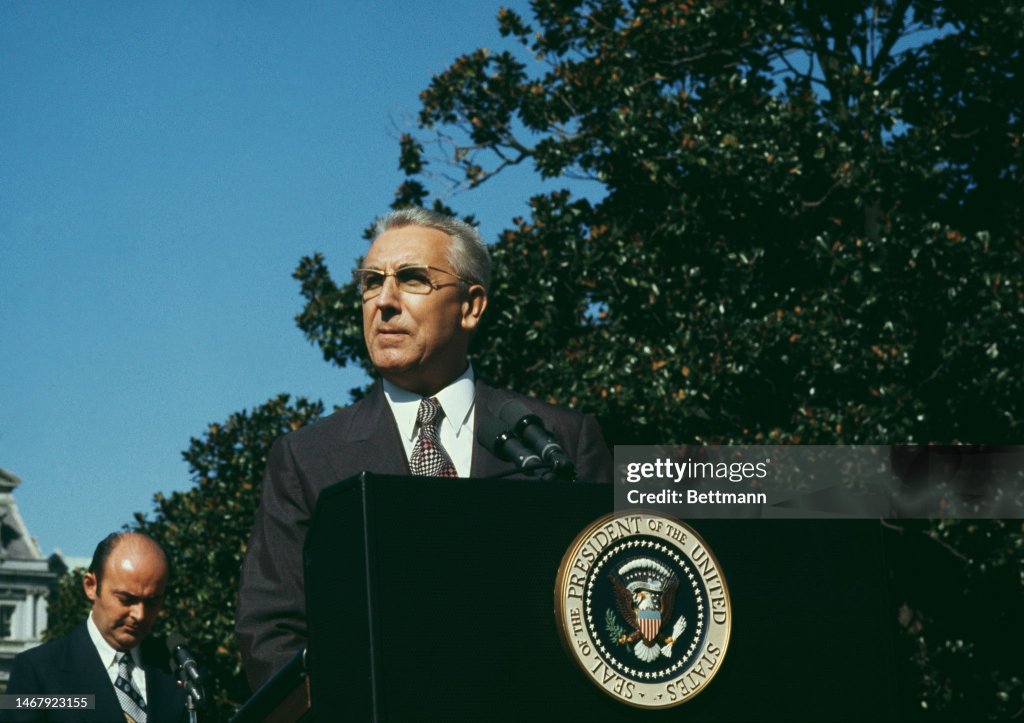
President Ford and the Polish Communist party leader, Edward Gierek, stressed “friendship” and “friendly ties” between the United States and Poland in their first meeting today. The “friendship” is to be documented tomorrow by Mr. Ford and Mr. Gierek in a joint declaration of principles. Mr. Gierek, who became chief of the governing Communist party of Poland in 1970, arrived in the United States Sunday for a week’s visit. He is the top-ranking Polish leader to come to the capital since World War II and he was welcomed as a head of state, with a 21‐gun salute in ceremonies on the White House lawn. Both Mr. Ford and Mr. Gierek spoke of the links between the two nations created by the emigration of millions of Poles to America. The President noted that seven Polish settlers had arrived in Jamesown in 1608, and Mr. Gierek spoke of “the friendly ties that have linked our two nations since the times of George Washington and Tadeusz Kosciusko.” General Kosciusko served in Washington’s Revolutionary army.
Key senators and Secretary of State Henry A. Kissinger worked to resolve a dispute which threatened tentative agreement with the Soviet Union over Jewish emigration. “We are back on track,” Sen. Abraham Ribicoff (D-Connecticut) said of prospects of the Administration’s trade bill. Sen. Henry M. Jackson (D-Washington), coauthor of an amendment blocking trade concessions to Russia unless it eases Jewish emigration barriers, said after the meeting, “We have made very substantial progress.”
Dissident Yugoslav writer Mihajlo Mihajlov has been arrested on suspicion of hostile activity against Yugoslavia and spreading hostile propaganda, legal sources said in Belgrade. They said the writer was being questioned about five articles that appeared earlier this year in two Russian emigrant publications.
Former Japanese Premier Eisaku Sato and Sean MacBride of Ireland, the United Nations commissioner for South-West Africa, were jointly awarded the Nobel Peace Prize. Mr. Sato was cited for stabilizing conditions in the Pacific area by his signing of the treaty to prevent the spread of nuclear weapons. Mr. McBride, who was Ireland’s Foreign Minister from 1948 to 1951, was honored for his work in human rights.
Secretary of State Henry A. Kissinger left for Cairo and a tour of the Mideast, warning that no dramatic results should be expected from the trip. “The primary purpose is to give concreteness to the negotiating process and perhaps to agree on some timing,” he told a news conference on the eve of his departure. Egyptian Foreign Minister Ismail Fahmy, meanwhile, on his return to Cairo from the United States, told newsmen, “I did not feel any pessimism during my meetings with Dr. Kissinger. There is no need for pessimism even though the Middle East crisis is a complicated one.”
On landing in Cairo tomorrow, Secretary of State Kissinger is not likely to find any of the exuberance that greeted him in June, when he arrived with Richard M. Nixon on what turned out to be Mr. Nixon’s final foreign tour as President. Egypt’s attitude toward the United States has become more sober; many Western diplomats say it is “more realistic.” Egyptian officials say they believe that President Ford will work for a Middle East settlement acceptable to the Arabs, as they felt Mr. Nixon was doing. But the Egyptians note that Mr. Kissinger’s mediation effort has lost momentum. In addition, it is stressed here, the Nixon visit raised expectations for American aid and private investment that have not been fulfilled. Arab diplomats express the view that if Mr. Kissinger’s visit is to be regarded as at least a minimal success by moderate Arab governments, it must set a new process of negotiation into motion or, better, produce an approximate timetable for the next stages of a settlement with Israel.
The ruling provisional military council of Ethiopia announced that five officers were killed and six others wounded in Monday’s outbreak of fighting at an engineering corps depot in Addis Ababa. It was the first time military factions had come to blows and Western diplomats feared more bloodshed was possible. Both the military council and the imperial bodyguard, the most important opposition group, have been sending reinforcements to the capital.
Shah Mohammed Reza Pahlevi, on his recently concluded 17‐day trip to five Asian countries placed new emphasis on two of Iran’s major foreign policy objectives. One objective, the maintenance of oil prices at a level acceptable to the Shah, was stated more clearly and firmly than ever in his response to declarations by President Ford and Secretary of State Kissinger that high oil prices were threatening world stability. The other objective, the Shah’s intent to increase Iran’s influence in Asia, was also elaborated in his remarks in the countries he visited — Singapore, Australia, New Zealand, Indonesia and India.
India’s Food Minister said today that the Indian Government had taken adequate steps to cope with the shortages caused by drought in the northern, western and eastern parts of the country. The minister, Chidambaram Subramaniam, told foreign newsmen that shortages caused by the drought would be met through imports and through the raising of emergency short-term crops in the areas not affected. In Washington, Administration sources said India had asked for food assistance from the United States. The Indian Food Minister declined to give any details about imports, but said the Indian Government had been inquiring about commercial purchases from all countries with surpluses. “As far as I know, no request has been made to Moscow for a new shipment of wheat,” the minister said. He said that 1.7 million tons of wheat was arriving from the Soviet Union from last year’s commitment of two million tons.
The six terrorists holding seven hostages in the Venezuelan Consulate in Santo Domingo accepted an offer of safe conduct out of the country, the American Ambassador, Robert Hurwitch, announced. The offer assures the six safe conduct to any country of their choosing under guarantees from the American, Spanish and Venezuelan embassies in Santo Domingo.
The United Mexican States added Baja California Sur as its 30th state and Quintana Roo as its 31st state, after ratification by the Congress of Mexico and by a majority of the legislatures of the other states of Mexico. President Luis Echeverría Álvarez signed the decree to confer statehood on both former territories.
The Foreign Minister of Venezuela, the western hemisphere’s leading oil‐exporting nation, told the United Nations General Assembly today that “the welfare of one–third of the world is being achieved at the expense of the other two–thirds.” Without naming the United States expressly, Foreign Minister Efrain Schacht Aristeguleta noted that “a single industrialized country, with only 6 percent of the world population, uses for its benefit more than half of the mineral resources of the world.” He charged that, the developed nations obtained their positions of great power “through the purchase of raw materials and sources of energy at unfairly low prices.”
In La Paz, Bolivia, a bomb destroyed a statue of former U.S. President John F. Kennedy on the Avenue of the Americas. There were no injuries.
U.S. President Gerald Ford launched his “Whip Inflation Now” (WIN) campaign in conjunction with a speech to Congress to reduce the federal deficit by reducing federal spending and raising the income tax for corporations and wealthy individuals by five percent. The “WIN” campaign was intended to encourage Americans to save money by reducing personal spending. The next day in major newspapers, a button that said “WIN” on it was offered to anyone who signed and mailed back a pledge that said, “Dear President Ford: I enlist as an inflation fighter and Energy Saver for the duration. I will do the very best I can for America.” Urging a “new mobilization against inflation,” President Ford proposed a broad program that included a call for a reduction of oil imports and a one-year tax increase for corporations and many individuals. In an address to a joint session of Congress,. Mr. Ford called on all Americans to enlist in the fight to “whip inflation now.” The President’s proposals would provide tax incentives for business, help unemployed workers, stimulate home construction and expand agricultural production.
Congressional reaction to the President’s economic proposals was restrained, with key members of both houses hailing the spirit of the program while many Democrats and Republicans alike voiced sharp disagreement with its substance — particularly Mr. Ford’s call for a 5 percent surcharge on middle-income and high-income taxpayers, The Senate Republican leader, Hugh Scott of Pennsylvania called the Ford program “courageous,” but added that there was a “reluctance to share the President’s enthusiasm for sacrifice.”
Under the President’s many-faceted tax proposals, the working poor would get a small reduction, corporations and many individuals would get a one-year increase and businesses would get two permanent programs of tax relief. Mr. Ford also endorsed a complex tax-revision bill before a House committee, apparently enhancing the possibility that some sort of tax legislation would be passed by Congress this year.
In his address to Congress, Mr. Ford called on the American people to adopt a variety of energy-saving measures from driving less to using cold water for laundry. He also called for increased domestic oil production, and named Secretary of the Interior Rogers C, B. Morton to head a new national energy board. Ruling out an increase in the federal gasoline tax, he urged motorists to form car pools, use public transportation or walk.
Vice President-designate Nelson Rockefeller has been requested to turn over to the Senate Rules Committee “detailed background information” of financial gifts he has given to his aides and associates. The request for the information came following the disclosure that Mr. Rockefeller had given $550,000 to William Ronan, now chairman of the New York-New Jersey Port Authority. The gift was in the form of canceling a number of loans to Dr. Ronan.
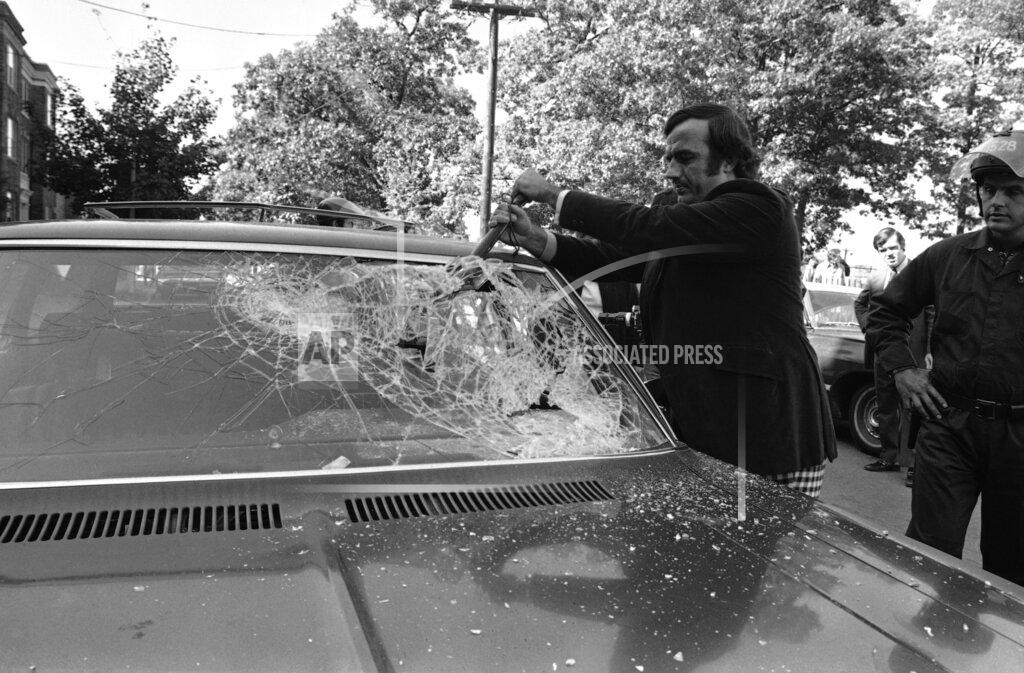
The presence of United States marshals was requested by Boston Mayor Kevin White to maintain order in the city’s schools while a program of court-ordered school busing for integration is carried out. Despite the request, at the same time, widespread stoning of cars by black youths developed in a previously peaceful black neighborhood. A white taxi driver was seriously injured when he was beaten by black youths.
In the largest bank failure in U.S. history, Franklin National Bank on Long Island, adjacent to New York City, collapsed after becoming insolvent and having insufficient assets to pay the interest on a one-billion-dollar loan from the U.S. Federal Reserve Bank. Franklin National Bank of New York was declared insolvent and promptly taken over by a local bank owned by six of the largest financial institutions in Europe. Under an agreement designed to protect them from loss, all Franklin depositors will become depositors of the European-American Bank and Trust Company, which will operate all of branch offices.
Congress, attacking a Supreme Court position in a secrecy case, has sent President Ford a compromise bill that backers claim will give the public greater access to government documents. The package of amendments makes the first changes in the Freedom of Information Act since it took effect on July 4, 1967. Rep. Frank Horton (R-New York) said that he expected Mr. Ford would sign it. The bill would give right-to-know cases precedence on appeal court dockets and prescribes a 30-day limit for government replies. A major feature would overturn the 1973 Supreme Court decision which ruled that the President could classify documents basically free of judicial review if the contents covered national defense or foreign policy data.
The House voted 359 to 7 for a limited reform of its committee procedures, after substituting it for a more sweeping reorganization of operation and jurisdiction. The measure leaves the structure and area of the existing committees virtually intact but creates a new study committee on aging. The rejected measure, product of more than a year of work by a special bipartisan committee, would have made extensive shifts in jurisdiction, notably reducing that of the Ways and Means Committee, and would have abolished two committees. The new measure bars proxy voting and restricts changes of views in conferences.
The Senate voted to require that broadcast licenses be issued and renewable for a five-year term instead of the current three-year period. The increased term was added to the broadcast license renewal bill, which would direct the Federal Communications Commission to establish new rules and procedures requiring the nation’s more than 8,400 broadcasters to determine the problems, needs and interests of their audience and to reflect those needs and interests in their programming.
Fearful of more racial outbursts of the sort that left a white student fatally shot yesterday, the authorities, closed all schools today in the Mississippi River town of Destrehan, Louisiana, about 20 miles north of New Orleans. Meanwhile, a 16-year-old black student was arrested and charged in the slaying. His name was not released because of his age. The shooting victim was Timothy Weber, 13, a freshman at Destrehan High School, the scene of the racial outburst. Witnesses told the police that he had been hit by a pistol bullet fired from a bus loaded with black students. At the time of the shooting, the witnesses said, white students were pelting the bus with rocks. The police, who arrived at the 1,200‐pupil school within minutes of the shooting, escorted the bus to a nearby sheriff’s office, unloaded the students, then found a 45‐caliber automatic hidden in a seat lining. An empty shell casing was also recovered.
The end is in sight for mob-controlled crime in the United States, said Alfred King, an attorney with the Organized Crime and Racketeering Section of the Justice Department. “If we keep up at the present rate, the mob will be destroyed in another 3½ years,” he told a seminar on organized crime in Richmond, Virginia. “We have made inroads so deep,” he said, that in some sections of the country, “nobody wants to be a mob leader anymore.”
Hoping to forestall second guessing, Betty Ford’s personal physician plans to assemble a team of medical specialists to chart the First Lady’s breast cancer treatment. “The management of a breast cancer patient is so controversial now that we want the very best experts we can find,” said Dr. William Lukash, the Fords’ family physician. “Before any decisions are made we will have a meeting with the medical staff — the doctors at Bethesda Naval Hospital and some eminent specialists to discuss thoroughly Mrs. Ford’s case,” Lukash said as his patient continued her recovery from the September 28 operation.
The nude bodies of three young women and two small children were found in a blood-splattered apartment in Fort Worth. Authorities said the women had been raped although the children were not sexually molested. They all were bound, gagged and apparently killed with a butcher knife. The bodies were discovered by a relative, who identified them as Laura McClendon, 22, and her son, Steve, 2; Martha McClendon, 24, and her daughter, Natoshi, 2, and Linda McClendon, 18. Laura and Martha were identified as sisters and Linda as their cousin. Authorities said all three women lived at the rambling apartment complex in a middle-class section of the city.
Plans to establish an Office of Hispanic Affairs in Newark — regarded as a major concession to the city’s Spanish-speaking community after last month’s racial disturbances — appear to be languishing in a morass of bureaucratic red tape and opposition. In addition, several Hispanic leaders have begun to question the commitment of Mayor Kenneth Gibson and his administration to redress grievances.
Sal Bando homers again and Vida Blue hurls a 2-hitter to give the Oakland A’s a 1–0 win and a 2-1 lead over Baltimore in the American League Championship Series. Blue fans seven and walks none. In a great complete-game pitching battle between Blue and Jim Palmer, Blue hurled a two-hitter and Palmer a four-hitter. But one of the four hits yielded by the Oriole right-hander was a home run by Sal Bando in the fourth inning, the only run of the game.
The Pittsburgh Pirates, facing elimination, stay alive with a 7–0 win over the Los Angeles Dodgers in the National League Championship Series game as Bruce Kison gets the win. Richie Hebner and Willie Stargell drive in 6 runs between them. A record crowd for Dodger Stadium (55,953) showed up for Game 3 with the home team one win away from the World Series, but the Pirates hammered starter Doug Rau in the top of the first. After a leadoff single and one-out walk, Willie Stargell’s three-run home run put the Pirates up 3–0. One out later, an error, the first of five the Dodgers committed in the game, allowed Bob Robertson to reach base before Richie Hebner’s two-run home run extended the lead to 5–0. In the fourth, back-to-back two-out RBI singles by Hebner and Mario Mendoza with two on off of Charlie Hough made it 7–0 Pirates. Bruce Kison gave up only two hits in the 6+2⁄3 innings he worked and his reliever Ramón Hernández, slammed the door on the Dodgers the rest of the way.
Dow Jones Industrial Average: 602.63 (-4.93, -0.81%).
Born:
Fredrik Modin, Swedish National Team and NHL left wing (Olympics, 2006 (gold medal), 2010 (5th); NHL: NHL Champions, Stanley Cup-Lightning, 2004; NHL All-Star, 2001; Toronto Maple Leafs, Tampa Bay Lightning, Columbus Blue Jackets, Los Angeles Kings, Calgary Flames, Atlanta Thrashers), in Sundsvall, Sweden.
Kevyn Adams, NHL centre (NHL Champions, Stanley Cup-Hurricanes, 2006; Toronto Maple Leafs, Columbus Blue Jackets, Florida Panthers, Caronlina Hurricanes, Phoenix Coyotes, Chicago Blackhawks), in Washington, District of Columbia.
Rashaan Salaam, American College Football Hall of Fame and NFL running back (Heisman Trophy 1994, U of Colorado; NFL: Chicago Bears, Cleveland Browns), in San Diego, California (d. 2016, suicide).
Rod Manuel, American defensive end (Pittsburgh Steelers), in Fort Worth, Texas.
Mitchell Galloway, NFL wide receiver and kick returner (Buffalo Bills), in Chesterfield County, South Carolina.
Koji Murofushi, Japanese athlete in the hammer throw, 2004 Olympic gold medalist and 2011 World Champion; in Numazu, Shizuoka Prefecture, Japan.
Martin Henderson, New Zealand actor (“Grey’s Anatomy”), in Auckland, New Zealand.
DJ Q-Ball [Harry Dean, Jr.], American musician and actor (“Bloodhound Gang”), in Limerick, Pennsylvania.
Zoran Zaev, Prime Minister of North Macedonia from 2020 to 2022; in Strumica, SR Macedonia, SFR Yugoslavia.
Died:
Harry Carney, 64, American tenor and baritone jazz saxophonist (Duke Ellington Orchestra, 1927-1974).
Paul G. Hoffman, 83, American businessman and statesman, administrator of the Marshall Plan and recipient of the Presidential Medal of Freedom.

 History Diaries