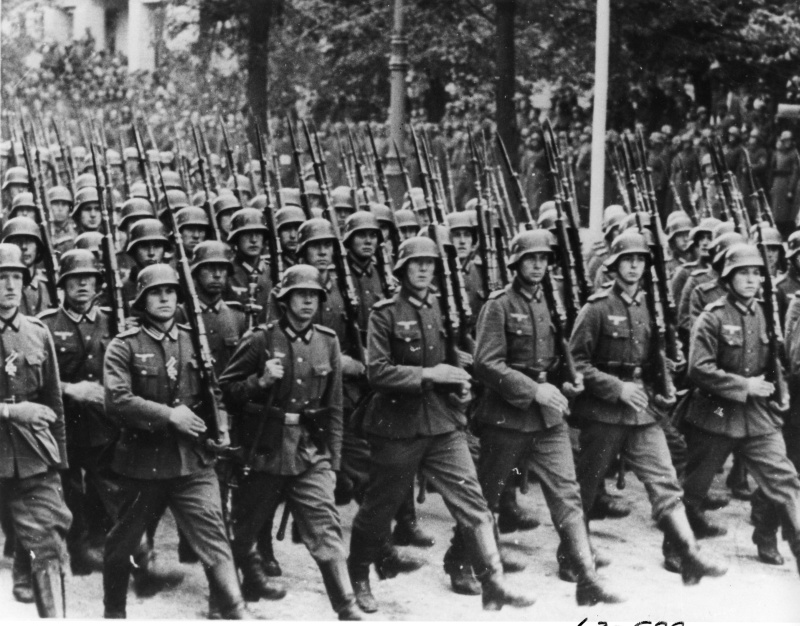
The Battle of Kock, the final battle in the invasion of Poland, ended in a Polish tactical victory but a German strategic victory. German General von Wietersheim decided that he would use two of his divisions. They would attempt to encircle and destroy the Polish forces. The 13th Motorized Infantry Division advanced on Bystrzyca and Adamów then Nowa Wróblina and Stanin; the 29th Motorized Division advanced on Radoryż Kościelny and Nowa Wróblina where they met troops from the 13th Motorized Infantry Division. General Kleeberg decided to destroy the 13th Motorized Infantry Division by using forces from the 50th and 60th infantry divisions and the ‘Zaza’ cavalry division. The Podlaska Cavalry Brigade defended the position under Radoryż Kościelny and Nowa Wróblina.
The 13th Motorized Infantry Division’s artillery began to fire on the 180th Infantry Regiment battalion’s positions in Adamów and the ‘Olek’ Battalion in Gułów grange at 05:30. Two and a half hours later, the 66th Motorized Infantry Regiment’s advance began. After a short fight at 10:00, the Germans captured Adamów, they then attacked the Polish position on hill 170 and Gułów, which they captured after heavy fighting. The 66th Motorized Infantry Regiment took many losses. The division occupied positions on the eastern edge of Adamów forest. General Podhorski sent the ‘Pils’ cavalry brigade to support them. After contact with the enemy brigade, they began an attack on the German positions in the forest. They captured the forest and, there, they established defensive positions.
After the capture of Adamów and Gułów grange by the 66th Motorized Infantry Regiment, the 33rd Motorized Infantry Regiment began to advance, capturing Wojcieszków and Glinne. The Polish 178th Infantry Regiment withdrew. The commander ordered his force to re-take Wojcieszków and Glinne, which they did, but they withdrew after taking heavy losses. The advance of the 180th Infantry Regiment on Adamów failed. Colonel Brzoza-Brzezina sent the 178th infantry regiment who soon met the German advance. The 1st battalion included a part company of sappers. The 2nd and 3rd battalions took heavy losses and withdrew to Burzec.
Meanwhile, an attack by the Polish 184th infantry regiment, with the support of a battalion of the 179th infantry regiment, recaptured the church and cemetery in Wola Gułowska. An advance by the 182nd Infantry Regiment with the help of three 100mm howitzers broke the German defense in Helenów. At 16:00, the last German advance from Adamów began on positions of the 10th Uhlan Regiment in Krzywda forest by the 182nd regiment in Helenów and the 184th regiment in Wola Gułowska. The 10th Uhlan Regiment, after a hard fight, withdrew into the forest. Most forces of the ‘Brzoza’ division successfully defended their positions in Burzec. The 182nd Infantry Regiment held their position. The 184th regiment had to withdraw due to a lack of artillery ammunition. During this time two key Polish advances began. The 2nd battalion of the 183rd Infantry Regiment, with artillery support, began an assault with the bayonet on the Germans who had attacked the southern wing of the ‘Pils’ cavalry brigade.
The assault succeeded and the Germans began to retreat, being chased by infantry and cavalry. The rear of the southern wing of the 13th Motorized Infantry Division was attacked by the ‘Edward’ cavalry brigade, they captured the village of Poznań, including a German artillery battery (which had to be destroyed when the cavalry were forced to withdraw due to them coming under fire from another German artillery battery). Elements of the 13th Motorized Infantry Division began to withdraw. One of the last attacks was by the 29th Motorized Division on the ‘Podlaska’ Cavalry Brigade positions and the rear of the ‘Brzoza’ Division. After that both Polish formations withdrew to the south of Krzywda.
At 16:30, General Kleeburg gave his last order in Hordzieżka, and then, as the Hordzieżka forest was being shelled, returned to his headquarters in Krzywda. At 20:40, Lieutenant Colonels Kazimierz Gorzkowski and Tadeusz Śmigielski left to establish contact with the command staff of the 13th Motorized Infantry Division. They made contact with the Germans near Adamów, and both sides agreed to a ceasefire lasting until 6 October (the next day) at 06:00, before which time a surrender was to be concluded.
Independent Operational Group Polesie surrendered on 6 October at 10:00. In his last order, General Kleeberg wrote that the reason for his decision to capitulate was that they were surrounded and ammunition and food were depleted. General Kleeberg’s ceremonial surrender took place on 6 October at the Jabłonowskich Palace in Kock.
The War in Poland is over.
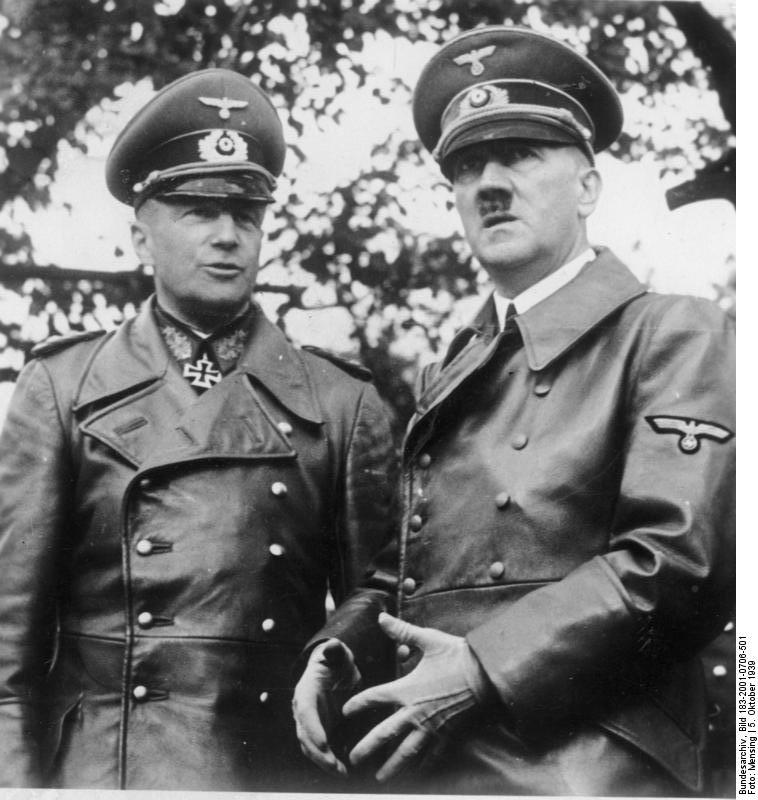
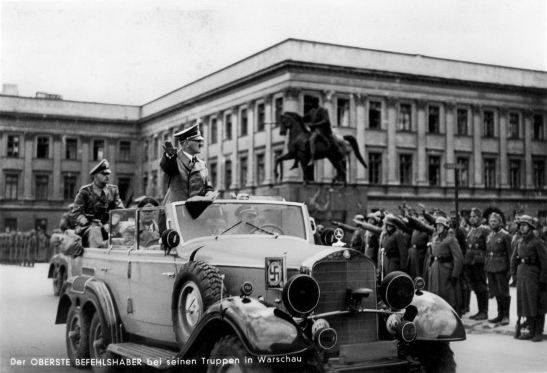
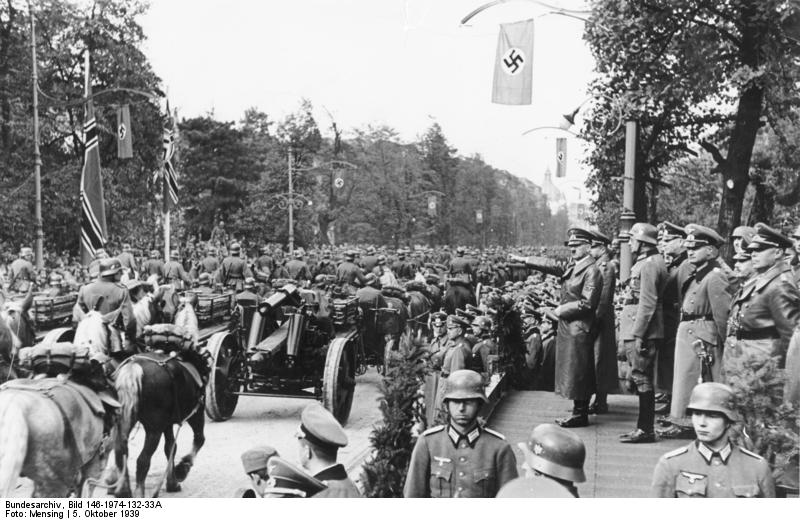
Adolf Hitler flew to Warsaw and reviewed a victory parade in the fallen Polish capital. Chancellor Hitler, supreme commander of the German armed forces that ravaged Poland in a four-week lightning war and virtually destroyed her capital in a twenty-day siege and two-day merciless bombardment, paid a flying visit to wrecked Warsaw today and for two hours reviewed his victorious troops. He reviews a victory parade before departing for Berlin. Hitler cites Warsaw as a warning. The city’s fate is termed a lesson to certain statesmen.
German forces continue mopping up operations against Polish troops still at large between the Vistula and Bug rivers.
It was reported today without confirmation that Mayor Stefan Starzynski of Warsaw committed suicide the day after the Polish capital surrendered to the German Armies.
The Nazi anti-Semitic weekly, Der Sturmer, publishes a “Hymm of Hate” calling England the “curse of the world.”
With rain squalls continuing all along the West Front, operations again marked time today. Air forces in particular were inactive, while the infantry restricted itself to scouting parties and consolidating its positions.
With Communist Deputies deprived of their legal immunity by this morning’s decree ordering a recess of Parliament, the French Government lost no time in instituting a purge of Communist groups throughout the country, including the all Communist-dominated Municipal Councils.
Belgians looked to their nation’s defenses today after a Belga News agency dispatch from Berlin (denied by the German Propaganda Ministry] reported that circumstances might cause Germany to consider herself released from neutrality pledges to Belgium.
The Soviet–Latvian Mutual Assistance Treaty was signed, providing the Russians with naval and air bases in Latvian territory. Latvian-U.S.S.R. 10-year mutual-assistance pact signed at Moscow. The Soviet government concluded an agreement with the Latvian government which provided the Russians with naval and air bases in Latvian territory. This is the result of Stalin’s free hand in the Baltic States granted by the German-Soviet Boundary and Friendship Treaty. Stalin has also signed a Treaty of Mutual Assistance with Estonia giving the Soviets the right to occupy the naval bases of Narva, Baltiski, Haapsalu and Parnu. Talks have started with Lithuania on the last “Treaty of Mutual Assistance.”
Rumania resumes Iron Guard arrests. The arrest of a woman employe in the army technical bureau and discovery of a manifesto by the pro-Nazi Iron Guard, attacking King Carol and the Jews, precipitated a new campaign against that outlawed organization today.
Concern was expressed in the House of Commons today over whether Brittain might be forced to give more than temporary shelter to thousands of Jewish and other refugees admitted here pending permission to enter the United States and other neutral countries.
British Admiralty and French Ministry of Marine form eight “hunting groups” in the Atlantic and Indian Oceans to counter the threat posed by German armored ship Admiral Graf Spee. At this stage the British and the French can afford to divert considerable forces to such a task.
The British cargo ship Newton Beach was captured in the Atlantic Ocean south of Freetown, Sierra Leone (9°35′S 6°30′W) by the Kriegsmarine ‘pocket battleship’ raider Admiral Graf Spee. Her 34 crew were captured. She was scuttled three days later off the coast of Angola.
The German pocket battleship SMS Deutschland stopped the 5,044-ton British transport ship Stonegate 400 miles east-southeast of Bermuda (31°10′N 54°00′W). After the Stonegate’s crew was taken off the ship was sunk by gunfire. The Stonegate was bound for Alexandria, Egypt with a cargo of nitrate. Later on October 9, when the American steamer City of Flint was captured, Stonegate´s crew was transferred to her.
The British steam merchant Marwarri was damaged by a mine in the Bristol Channel (51°24′N 3°57′W)). Of the ship’s complement, 2 died and 29 survived. The 8,063-ton Marwarri was carrying government stores and was bound for Newport, England.
U.S. freighter Exeter is detained by French authorities at Marseilles, France; freighter City of Joliet, detained by the French since 14 September, is released.
The War at Sea, Thursday, 5 October (naval-history.net)
Battleships NELSON, RODNEY, battlecruisers HOOD, REPULSE, and aircraft carrier FURIOUS and escorting destroyers departed Loch Ewe and arrived at Scapa Flow.
Light cruiser SHEFFIELD departed Scapa Flow for Invergordon, arriving on the 6th. She was back at Scapa the same day.
Light cruisers CALYPSO and CALEDON departed Scapa Flow for Northern Patrol. CALYPSO arrived back on the 11th and CALEDON on the 13th.
Destroyer ECHO departed Plymouth and arrived at Dover on the 6th.
Submarine SEAWOLF fired two torpedoes at German torpedo boat FALKE in 57-39N, 9-28E, but missed. The target was reported as a light cruiser of the NÜRNBERG class.
Convoy OA.15 of six ships departed Southend escorted by destroyer ANTELOPE from the 5th to 8th, when the convoy dispersed.
Convoy OB.15 departed Liverpool escorted by destroyers WALPOLE and WINCHELSEA until the 8th.
Convoy BC.7S of 17 steamers including NEW TEXAS (Commodore), departed Quiberon Bay escorted by destroyers EXPRESS, ESK, ESCAPADE and ECLIPSE, and arrived safely in Barry Roads on the 8th.
After survey ship FRANKLIN sighted a submarine 9 miles 310° from Calais High Light, destroyer BRAZEN carried out an unsuccessful search.
Steamer MARWARRI (8063grt) was damaged in the Bristol Channel, 3½ miles 190° from Scarweather Light Vessel, on a mine laid by U.32 on 17 September. She was run aground in Mumbles Bay to prevent her sinking and salved the following month.
French destroyers CASSARD and KERSAINT arrived at Gibraltar to exchange convoy escort duty with British destroyers GREYHOUND and GLOWWORM.
Steamers ALCANTARA (22,209grt) and FRANCONIA (20,75grt) of convoy Red 2 collided between Gibraltar and Malta. The convoy proceeded to Malta where FRANCONIA was repaired completing on 14 November, while ALCANTARA after temporary repairs and escorted by destroyer GRIFFIN, was able to proceed on the 13th for Alexandria, arriving on the 16th. Destroyer GRENVILLE continued with steamer EMPRESS OF AUSTRALIA, and destroyer GIPSY, no longer needed to escort ALCANTARA, headed for Alexandria.
Convoy HGF.2 departed Gibraltar with liners CIRCASSIA (11,136grt) and DERBYSHIRE (11,660grt), and arrived at Liverpool on the 9th. Both liners were taken in hand for conversion to armed merchant cruisers.
Convoy HG.2 of 13 ships departed Gibraltar escorted by destroyers DOUGLAS and VELOX. Ocean escort was provided by armed merchant cruiser ALAUNIA which sailed with the convoy from the 5th to 13th, when it arrived at Liverpool.
German pocket battleship ADMIRAL GRAF SPEE captured steamer NEWTON BEECH (4651grt) in the South Atlantic in 09 35S, 06 30W. After her cargo and crew were transferred, she was scuttled late on the 8th.
German pocket battleship DEUTSCHLAND sank steamer STONEGATE (5044grt) east of Bermuda in 31 10N, 54 00W after the crew had been taken off. Later, when American steamer CITY OF FLINT was captured, STONEGATE’s crew was transferred to her.
As a result of the sinkings by German pocket battleships, the British Admiralty ordered the organization of further Hunter Groups along the lines of the ARK ROYAL-RENOWN force.
Battleship RAMILLIES in the Mediterranean was ordered to join the North Atlantic Escort Force, departed Gibraltar at 1215, escorted by destroyers WISHART and VORTIGERN, but was recalled at 2233/6th to replace battleship MALAYA, due to leave the Mediterranean. RAMILLIES, WISHART and VORTIGERN arrived back at Gibraltar on the 8th. RAMILLES stayed in the Mediterranean until November when she was transferred to the East Indies, serving with the 3rd Battle Squadron at Aden from November until May 1940.
Heavy cruisers NORFOLK, SUFFOLK and light cruiser EFFINGHAM were detached from the Home Fleet to operate in the Denmark Strait against any raider threat to the convoy routes in the South Atlantic (at that time only GRAF SPEE had been identified. They were there to keep other raiders from going into the South Atlantic or returning to Germany). EFFINGHAM proceeded to Plymouth to repair defects, and left again on the 9th.
Light cruisers COLOMBO and CERES of the 11th Cruiser Squadron, previously attached to the Northern Atlantic Command at Gibraltar and the Channel Force based at Portland respectively, replaced EFFINGHAM in the Northern Patrol. The 12th Cruiser Squadron, Northern Patrol was redesignated the 11th Cruiser Squadron, and COLOMBO became Flagship of Captain R J R Scott AM, Commodore, 2nd Class at Plymouth on the 9th. She arrived on station on the 13th and CERES on the 31st after refitting at Plymouth.
NORFOLK and SUFFOLK proceeded to the Mediterranean, where they served in the 1st Cruiser Squadron until arriving back in England on 11 November. They left Portsmouth on 16 and 18 November respectively, called at the Clyde, and were both on Northern Patrol on the 22nd.
The third day of U.S. Senate debate on the Neutrality Bill saw that contest drop sharply from the dramatic tone with which it opened to a general reading of speeches which failed to hold the interest of a sizable group of Senators or the spectators who on previous days have crowded the galleries.
A promise that opportunity will be given to the House for full discussion of the neutrality question was given to members today by Representative Rayburn of Texas, majority leader, when signs of unrest over the current “blackout” of political discussion came from the Republican side during the session.
Franklin Roosevelt spoke to Winston Churchill for the first time over the telephone. Roosevelt, who initiated the call, engaged Churchill in a discussion on the German attempt to attack American shipping as an attempt to sabotage British-American relations; such an effort would later found to be a mere rumor.
Grand Admiral Erich Raeder, head of the German Navy, sent word yesterday to the United States Government through the American naval attaché in Berlin that he had information that an American ship, the Iroquois, now at sea bringing home 566 passengers, virtually all Americans, was to be sunk when it neared the American coast, it was announced at the White House late today. The “circumstances,” Admiral Raeder was quoted as saying. would be similar to those surrounding the sinking of the Athenia, British liner sent to the bottom on September 3, the first day of the war. Germans have charged that the British sunk the Athenia.
Incredulity was expressed at the White House that Britain or France would do such a thing as Admiral Raeder’s “information” appeared to imply, but as a precaution against harm to the Iroquois from any source a United States flotilla was dispatched to accompany the ship. The Iroquois left Cobh, Ireland, on Tuesday and is expected in New York next Wednesday. It has a crew of 210.
Eighteen Congressmen are in the Army reserves, subject to call up for war duty.
The Army’s recruiting rate rises to 750 men per day.
95% of Americans polled by George Gallup’s American Institute of Public Opinion oppose any sort of American Expeditionary Force to be sent to fight in Europe, or any declaration of war on Germany.
Sixteen more inspectors in last month’s primary elections in four more election districts of the Eighteenth Assembly District, North, in Harlem, New York City, were arrested yesterday in District Attorney Thomas E. Dewey’s inquiry into alleged primary corruption.
Grover Cleveland Bergdoll, the Philadelphia draft evader, was convicted of escape and desertion in time of war by a general courtmartial yesterday afternoon. He was sentenced to serve three years in prison at hard labor, in addition to the five years he already is working out.
Harvard University and the Massachusetts Institute of Technology stress the importance of cooperation between scientific researchers and the press, stating that publicity helps the general public understand science.
Secretary of State Cordell Hull requests Chargé d’Affaires ad interim in Germany Alexander C. Kirk, to ascertain why German authorities have detained Swedish motorship Korsholm (at Swinemünde), Estonian steamship Minna (at Kiel), and Norwegian steamship Brott (at Sivinemünde). All of the neutral merchantmen carry cargoes of wood pulp or wood pulp products consigned to various American firms. These are the first instances of cargoes bound for the United States held up for investigation by German authorities. While no U.S. ships are detained, cargoes bound for American concerns in neutral (Finnish, Estonian, Latvian, and Norwegian) merchant ships come under scrutiny by the Germans.
President Roosevelt and his Cabinet discuss an official message from German Admiral Raeder to the American military attache in Berlin, warning him that the British are planning to sink the Iroquois, an American ship. Harold Ickes writes in his secret diary, “Of course no one in this country believes that the British would do a thing of this sort, but Hitler and his government have not ceased to insist that it was Churchill who personally gave the orders to sink the Athenia (September 3) for the purpose of having it blamed on the German government in the hope of embroiling us with Germany.”
Hawaiian Detachment of United States Fleet is formed under Commander Scouting Force (Vice Adm. A. Andrews). The carrier Enterprise (CV-6) (flagship), two heavy cruiser divisions, two destroyer squadrons and a light cruiser flagship, a destroyer tender and a proportionate number of small auxiliaries make up the force.
The bulk of the scouting force of the United States fleet set out today for Hawaii. This will centralize at Pearl Harbor the strongest naval force ever stationed in the Hawaiian Islands, other than during annual war games.
Navy Department informs U.S. passenger liner Iroquois of word received late the previous day concerning the plot to sink the ship as she nears the east coast. “As a purely precautionary measure,” President Roosevelt announces this day, “a Coast Guard vessel and several navy ships from the [neutrality] patrol will meet the Iroquois at sea and will accompany her to an American port”.
In Game Two of the World Series, Yankees pitcher Monte Pearson does not allow a base hit until one out in the 8th when Ernie Lombardi singles. The Reds are shut out 4–0. Babe Dahlgren hits a home run and double to pace the Bombers off losing pitcher Bucky Walters. Lasting just 87 minutes, both pitchers threw complete games, Pearson winning it with a two-hitter. In the bottom of the third inning Babe Dahlgren hit a leadoff double and scored on two groundouts. Red Rolfe then singled and scored on Charlie Keller’s double. After another single, Bill Dickey’s RBI single made it 3–0 Yankees. They added another run in the fourth inning on Dalgren’s home run and took a 2–0 series lead heading to Cincinnati.
Japanese troops called off the attack on Changsha, Hunan Province, China after suffering heavy casualties.
In a downed aircraft, Chinese troops discovered General Yasuji Okamura’s order calling off the offensive on Changsha, Hunan Province, China. Nearby, Chinese 23rd Division attacked a Japanese Navy anchorage at Yingtian (now Miluo), damaging several vessels.
In a determined counteroffensive on the Changsha front, the Chinese claim to have smashed the Japanese attack on the Hunan capital. Changsha dispatches say that the Japanese have been driven out from almost all the positions recently occupied south of the Mi River and at many points have been pushed back twenty-five or thirty miles. The Mi River is sixty miles north of Changsha.
Badly battered Japanese forces are said to be holding on desperately at Milo, Yingtien, and Hsingshi, points on the south bank of the river. A bitter battle is said to be raging along the river. Heavy Japanese casualties are said to have marked the Chinese successes.
Meanwhile, on the north bank of the Yangtze a minor Chinese counter-offensive is reported to be making progress near Chunghsiang and Huihsien, northeast of Hankow. The Chinese accept the Japanese statement in Shanghai that they never intended to take Changsha, “a city strategically unimportant,” as a concession of defeat in their drive.
The Chinese forces in Northern Hunan Province continued today to recover ground lost to the Japanese troops who were engaged in the offensive against Changsha last week. According to semi-official dispatches from Changsha the reoccupation of Siangyin and Paishui, fifty miles north of Changsha, has been completed and Pingkiang, on the Mi River, to the northeast, is being besieged. The Chinese said they had inflicted 10,000 casualties on the Japanese in the last week’s fighting.
Japanese airplanes last night carried out their seventh night bombing raid on Szechwan Province cities in seven days. Five squadrons raided the outskirts of Chungking, keeping the capital in a state of alarm for nearly five hours. Six hours after the first night alarm, another warning this morning heralded the coming of more Japanese planes. Rain and low clouds, however, prevented the attackers from reaching Chungking. Seasonal heavy mists have returned to the capital, so bombings are believed to have virtually ended until next Spring.
A definite Japanese setback with heavy losses appeared today to be the result of Japan’s first major military offensive against China in nearly a year. Chinese reported that the campaign aimed at Changsha had been repulsed and that the Japanese were falling back across the Mi River. The Japanese offensive was launched a few days after Japan and Russia reached a truce September 16 in hostilities along the frontier between Manchukuo and Outer Mongolia. Designed to strike a severe blow at Generalissimo Chiang Kai-shek’s forces, the drive was the first important military action in China since Hankow was taken on October 25, 1938. Estimates of the number of men involved ran as high as 500,000.
The Japanese drive had started from the Tungting Lake region, southwest of Hankow, and headed down the Canton-Hankow railway line. Chinese expressed the belief that the Mi River would form the temporary boundary between Chinese and Japanese forces. A year ago, the Japanese pushed so close to Changsha that much of it was burned by the Chinese in accordance with their “scorched earth” policy preventing valuable buildings or equipment from falling into enemy hands. That Japanese attack also was blocked.
The extent of Japanese victories over huge Chinese armies assembled by Generalissimo Chiang Kai-shek in North Hunan Province to defend the approaches to his southwest defense area is much greater than reported in earlier dispatches, the Japanese Domei news agency said today. Domei claimed that, on the basis of information assembled at Japanese headquarters in Hankow, it was established that Japanese forces driving southward on both sides of the Hankow-Canton railway during the past fortnight had engaged forty-two Chinese divisions comprising all the troops in General Chiang’s ninth war zone. Fourteen of these divisions were crushed, Domei claimed, and the total number of Chinese dead was believed to have reached 25,000.
[Ed: It’s Always a “great victory” in Tokyo, no matter how badly they get their ass kicked.]
Dow Jones Industrial Average: 150.48 (+0.23)
Born:
Consuelo Ynares-Santiago, Associate Justice of the Supreme Court of the Philippines, in Binangonan, Rizal, Philippines.
Dennis Bennett, MLB pitcher (Philadelphia Phillies, Boston Red Sox, New York Mets, California Angels), in Oakland, California (d. 2012).
Marie Laforêt, French singer and actress, in Soulac-sur-Mer, Gironde, France.
Marie-Claire Blais, French Canadian author and playwright, in Quebec, Canada.
Walter Wolf, Slovenian-Canadian industrialist, in Graz, Austria.
Naval Construction:
The Kriegsmarine (German Navy) Type VIIB U-boat U-83 is laid down by Flender Werke AG, Lübeck (werk 291).
The Вое́нно-морско́й флот СССР (ВМФ) (Soviet Navy) “M” (Malyutka)-class (3rd group, Type XII) submarines M-30, M-62, and M-63 are launched by Krasnoye Sormovo (Gorkiy, U.S.S.R) / Yard 112.
The Royal Australian Navy auxiliary minesweeper HMAS Mary Cam is commissioned.
The Royal Navy armed merchant cruiser HMS Transylvania (F 56) is commissioned. Her first commanding officer is Captain (retired) Francis Nigel Miles, RN.

 History Diaries