
A House-Senate conference committee has voted to remove bans on military aid to Turkey and Chile from a stopgap resolution to continue foreign aid spending. The vote, which supports the administration, was expected. Almost all members of the joint committee had previously indicated their opposition to the restrictive amendments. Senator Thomas Eagleton said today he would continue his fight to cut off military aid to Turkey when the Senate considers the recommendations of the committee.
Premier Vasco Goncalves took over Portugal’s Defense ministry and made the Information Ministry directly responsible to his office while the army, meanwhile, relaxed its six-day alert after an abortive right-wing coup. A government communique said Goncalves did not replace Defense Minister Mario Firmino Miguel, who quit Monday in sympathy with the resignation of President Antonio de Spinola, but instead took over the post himself.
Italy’s 36th postwar government resigned tonight. The Government’s collapse came after a 10‐minute Cabinet session. Premier Mariano Rumor went directly to the Quidinale palace and presented his Government’s resignation to President Giovanni Leone. President Leone put off a decision and asked Premier Rumor and his colleagues to remain in office “to look after current business.” So that members of Parliament have time to meet and discuss the turn of events, the President will not begin formal consultations on a resolution of the crisis until Monday morning. For two weeks, political leaders have been exchanging recriminations, attempting to attribute the country’s continuing crises to each other and to rival parties. The country is struggling with the severest inflation in Western Europe‐12 percent last year and more than 20 percent this year. The balance of payments is in severe deficit, largely because of high prices for oil and the other raw materials that Italy must import.
Communist Party leader Edward Gierek of Poland said he is ready to discuss with President Ford next week enormous purchases of capital goods from the United States. He said he is hopeful that Polish-American trade soon will top $1 billion a year. In an interview with The Associated Press, Gierek said the EastWest detente has made the meeting with Mr. Ford possible and predicted that the talks would bring about a quick and substantial growth in the two nations’ trade.
Chess players Anatoly Karpov and Viktor Korchnoi agreed to draw their eighth game of the world challengers final in Moscow after playing 10 moves in the adjourned match. Karpov retains his 2–0 lead in the series with six draws. The eighth game was adjourned after 41 moves. The first player to win five games in the series qualifies as the challenger to world champion Bobby Fischer next year.
Two Swedish writers, regarded as literary giants in their own country but virtually unknown abroad, have been named co-winners of the 1974 Nobel Prize in Literature. Eyvind Johnson and Harry Martinson, both members of the Swedish Academy, are the first Swedish winners since 1951. Besides gold medals, the two will share about $124,000 in cash. Of the scores of novels, short stories and poems the two winners have written, only a half dozen have been published in English, and none are in print in the United States.
Secretary of State Kissinger hopes to convince Israeli and Arab feeders to agree to an early resumption of negotiations during his trip to the Middle East next week, a senior American Official said today. But the official said that the exact timing and framework for such talks remained uncertain. A belief here early in the summer that such talks could begin by early falls seems to have faded considerably in recent weeks. The Israelis, who assert they are flexible on negotiations, say a tougher Arab stance is responsible for the situation. The Arabs accuse the Israelis Of stalling on further troop withdrawals from occupied, Arab territory. In a cautious appraisal for newsmen of the diplomatic situation, the officials said that despite nearly two months of intensive discussions in Washington and in New York, no firm decision on the next stage in the Arab‐Israeli dialogue had been made. And the newsmen Were told that Mr. Kissinger did not know whether he could work out such an agreement during his five days in Egypt, Syria, Jordan and Israel.
One well‐informed diplomat said that Mr. Kissinger was less optimistic now about the situation than he was a month ago. There has been a general hardening in the positions of both the Arabs and Israelis in recent weeks. President Anwar el‐Sadat of Egypt, in particular, has come out very strongly in public statements in support of the Palestine Liberation Organization, the main guerrilla organization and has spoken of a need to resume arms imports from the Soviet Union. This has raised a question in Washington whether the Egyptians are as willing to begin separate talks with the Israelis, toward further Israeli concessions in the Sinai Peninsula, as they were two months ago. Moreover, the Israelis have stressed that they would not agree to make further troop withdrawals without some kind of easing of tensions, such as a statement of nonbelligerency by the Egyptians.
Israeli Foreign Minister Yigal Allon, speaking against a background of heightened tension between Israel and Syria, warned the U.N. General Assembly that détente must be global and apply to the Middle East “or there will be no détente at all.” Allon spoke in Hebrew for the first time in the General Assembly, apparently as a response to the adoption of Arabic as an official language this year. Foreign Minister Allon expressed measured optimism today that negotiations could solve his country’s disputes with the Arab states and also satisfy the “needs of the Palestinians.” However, he used his first address to the General Assembly to warn against recognizing the Palestine Liberation Organization as representing the Palestinians. He denounced it as a terrorist group bent on destroying Israel. “Acceptance of P.L.O. demands may well condemn the prospects of the negotiating process to failure—just when the first ray of light has been glimpsed on the horizon,” Mr. Allon said. He spoke in Hebrew. In advance of the scheduled Middle East visit by Secretary of State Kissinger, the Israeli Foreign Minister reiterated Israel’s readiness to make significant territorial compromises, but not at the expense of her own security.
Syrian army and air force units wound up large-scale joint exercises with modern equipment, using tactics learned in last October’s war. Israel kept its forces on special alert along the Golan Heights cease-fire line during the maneuvers, whose duration, location and weaponry were not revealed by the Damascus government. Syria did, however, give unusual publicity to the war games.
Sheik Ahmed Zaki Yamani of Saudi Arabia, whom Americans tend to regard as the “good guy” among Arab oil officials, was in Washington today talking, in his soft, persuasive voice, about cutting oil prices. Such talk is music to the ears of Ford Administration policy‐makers, who are busily searching for a plan to bring down prices, which have quadrupled in the last year. However, Sheik Yamani did not arrive with a price cut in his pocket, and some of the conditions he seemed to be attaching to a reduction were calculated to cause qualms here. Last night, the Sheik, who is the Saudi Minister of Petroleum, assured a group of Washington correspondents that a solution to the ArabIsraeli conflict would bring prices down. At the same time, he said that if the Israelis did not withdraw from the Arab territories they occupy, “this will produce war.” Such a war, he declared, would “have a very disastrous effect on prices, as well as the supply of oil.”
The United States Navy will be permitted to retain its port facilities on the Persian Gulf island of Bahrain as a result of a Shift in the emirate’s policy, Pentagon sources said today. A year ago, at the height of the Arab‐Israeli war, Bahrain in a gesture of solidarity with the Arab cause notified the United States that it would have to withdraw its small naval force within a year. Steadily increasing Soviet sea and air activity in and around the Persian Gulf and resulting Arab concern over the oil‐rich area’s security, plus some discreet American and Iranian pressure, apparently combined to make the Bahraini Government change its mind. United States military sources emphasized that the naval force stationed at Jufair, the harbor of Manama, Bahrain’s capital, consists of only one converted amphibious landing craft, the La Salle, and two destroyers. The ground installations, taken over when the British left the area, include important electronic installations that monitor military traffic throughout the area.
Drawing warm applause from the fourth Synod of Bishops, Joseph Trịnh Văn Căn, auxiliary to the archbishop of Hanoi, told of a flourishing Roman Catholic Church in North Vietnam. The first prelate from North Vietnam to attend an official meeting at the Vatican in decades, the bishop spoke of huge and joyful congregations in his country despite a ratio of 300 priests for a Catholic population of 1 million.
Terrorists holding U.S. diplomat Barbara Hutchison and six others hostage inside the Venezuelan consulate in Santo Domingo dropped their demands for a $1 million ransom. They asked instead to take political asylum in Mexico or Peru, and offered to trim the list of 37 political prisoners they wanted exchanged. There was no immediate response from the Dominican Republic government, which already has offered to fly the gunmen out of the country, but which insists it will not meet any other demands.
An 8.1 magnitude earthquake in Peru killed 78 people and injured 2,414 others. The epicenter was located 50 miles (80 km) west-southwest of Lima. The intensity around Lima was generally about MM V to VII, but the maximum reached IX. Two buildings of reinforced concrete collapsed in La Molina, where the intensity was MM VIII to IX. A four-story reinforced concrete building in Callao collapsed.
Administration sources said there was little chance that President Ford’s economic policy message next week would include measures capable of causing an early, significant reduction in energy consumption and oil imports. The administration’s highest councils were depicted by participants as torn between the sense that the time for dramatic action had come and the reluctance of politicians, including the President, to go to the public with unpleasant measures before congressional elections.
Serious differences of opinion have emerged among the top policymakers of the Ford administration who are trying to work out a program that would both fight inflation and, at the same time, reduce the nation’s consumption of energy. Only one aspect of the argument is the battle for and against a large tax on gasoline. Those opposing the increase in the gasoline tax appeared to be winning when a statement from a White House spokesman declared that President Ford “does not favor this kind of tax on gasoline.”
As expected, former President Nixon has asked Federal District Judge John Sirica to quash two subpoenas commanding his appearance as a witness at the Watergate cover-up trial. The request was contained in two motions filed by Mr. Nixon’s attorneys at the federal courthouse in Washington as the selection of a jury went into its third day. Judge Sirica said the motions would remain under seal until he decides “what action I’ll take, if any.”
Senate-House conferees agreed on a bill providing $11.8 billion for a six-year program of aid to mass transit systems. The bill is tailored to White House requirements, said Sen. Harrison A. Williams Jr. (D-New Jersey). Williams said the measure included an amendment which would permit using capital funds for operating subsidies if the capital funds were repaid with state money. He said the major difference between this bill and the legislation sought by the White House was $800 million, but Williams said he did not think that difference would lead to a veto. Funds would be distributed on a basis of 50% population and 50% population density.
A bill providing for public financing of presidential campaigns and making other sweeping changes in election laws was agreed on by Senate-House conferees. Campaign contributions and expenditures would be limited and an independent enforcement commission would be established. The measure, a compromise of separate bills passed by the two chambers, is an outgrowth of the Watergate scandals and other abuses in the 1972 elections. One provision would limit members of Congress to $15,000 in fees for speeches or writings, with a $1,000 top for each one.
Congress and the Administration broke a year-long standoff on welfare legislation with a compromise bill broadening eligibility rules without raising the overall budget. Proposals introduced in both Senate and House would continue a $2.5 billion ceiling on funds for social services, but eligibility would be based on income, rather than limiting it to those already on, or likely to go on, welfare. The legislation applies to a broad range of services from providing day care centers to treatment for drug addiction and alcoholism, supplying hot meals for the aged and setting up services for the handicapped.
A $200-million financial-aid package from a group of American banks and a state-owned Iranian bank yesterday resolved the deep financial troubles that have been threatening the Grumman Corporation’s production of F-14A fighter planes.
The second ranking official in the U.S. Interior Department has ordered a controversial plan that would open up to 13 million acres of Pacific and Atlantic Ocean bottom to exploration by oil and gas companies. A confidential memo by Interior Undersecretary John C. Whitaker said that up to 13 million acres of ocean bottom could be made available to the oil companies next year in order to achieve a goal of leasing 10 million acres for offshore drilling.
Ted Bundy victim Nancy Wilcox, 16, disappears in Holladay, Utah. She was a student at Olympus High School there. According to the Utah Department of Public Safety, she was last seen near her home in a yellow Volkswagen Beetle driven by an unidentified man. Bundy confessed to killing her shortly before his execution in 1989, but told police he could not remember the exact location where he had buried her body. Because Wilcox’s body has not been recovered, her case has never officially been solved.
A pregnant bank employee, seized by a robber who made off with an estimated $14,000 from the People’s Bank of Sandy Hook, Kentucky, escaped unharmed after being left tied up in a motel room in Columbus, Ohio. Mrs. Dan Ison, 21, who is nearly eight months pregnant, freed herself and telephoned police. Kentucky police said the holdup man and an accomplice who drove the getaway car were still at large.
Clouds formed over much of the nation and dropped some rain and snow. A storm dumped 6 inches of snow in New York’s Finger Lakes area and southeast of Rochester. Showers prevailed over the central plateau and the northern Rockies and a few heavy thunderstorms brought flash flood warnings in. southwestern Utah. The snowstorm in upstate New York left thousands of residents without power, forced school closings and disrupted travel. Elsewhere, skies were clear, especially over most of the southern half of the nation.
Six years of exile in Canada as an American military deserter have ended for Gary Della Bitta. Upon accepting President Ford’s amnesty program, he has returned to his parents’ home in Gilroy, California, only to find his first hours at home filled with tension he had carried with him from Vancouver, B.C.
The deep financial troubles that have been threatening the Grumman Corporation’s production of F-14A fighter planes was resolved when a group of American banks and a state-owned Iranian bank agreed to put together a $200 million package. A revolving credit of up to $125 million will be provided by nine banks in this country. The other $75 million will come as a subordinated loan by Bank Melli Iran, the national bank of Iran, which has ordered 80 of the F-14’s.
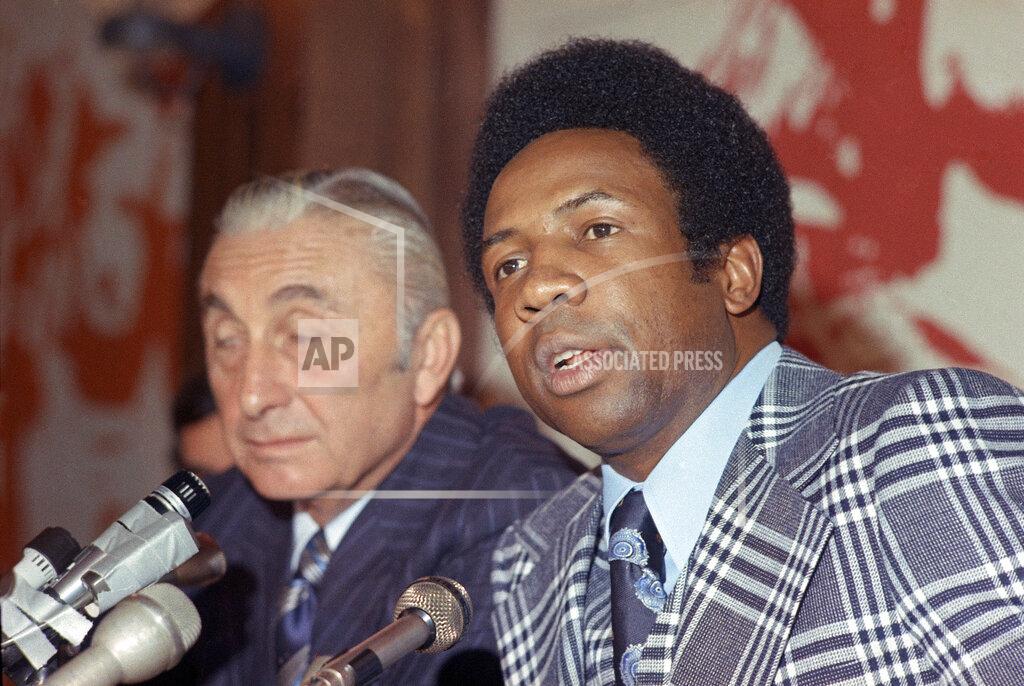
Frank Robinson becomes the first black manager in the major leagues, as the Indians name him to replace Ken Aspromonte for the 1975 season. Robinson, 39, becomes MLB’s first African-American manager when he signs as player-manager for Cleveland Indians; agrees to 1-year contract estimated at $180,000 and becomes the 28th manager in the history of the Cleveland Indians.
Future Basketball Hall of Fame guard Jerry West (“Mr. Clutch”) retires after 14 NBA seasons with the LA Lakers; West has 25,192 career points; averages 29.1 ppg in 153 playoff games.
Dow Jones Industrial Average: 587.61 (-13.92, -2.31%).
Born:
Marianne Timmer, Dutch speed skater who won three Olympic gold medals and three world championships, primarily for the 1000m, between 1997 and 2006; in Sappemeer, Groningen, Netherlands.
Mike Johnson, Canadian NHL right wing (Toronto Maple Leafs, Tampa Bay Lightning, Phoenix Coyotes, Montreal Canadiens, St. Louis Blues), and broadcaster (NHL Network, TSN), born in Scarborough, Ontario, Canada.
Álex Ramírez, Venezuelan MLB outfielder (Cleveland Indians, Pittsburgh Pirates), in Caracas, Venezuela.
Woody Aragón (stage name for Emilio de Paz Aragón), Spanish magician and illusionist; in Madrid, Spain.
Adel Ferdosipour, Iranian TV producer and journalist known for the Iranian programs Navad and Football 120; in Rafsanjan, Iran.
Died:
Bessie Louise Pierce, 86, American historian, author of “A History of Chicago.”



[Ed: Heartbreaking.]

 History Diaries