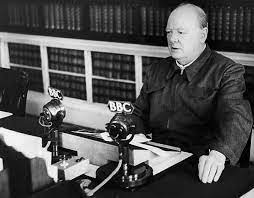
IT IS NOT FOR HITLER TO SAY WHEN THE WAR WILL END
By WINSTON CHURCHILL, First Lord of the Admiralty
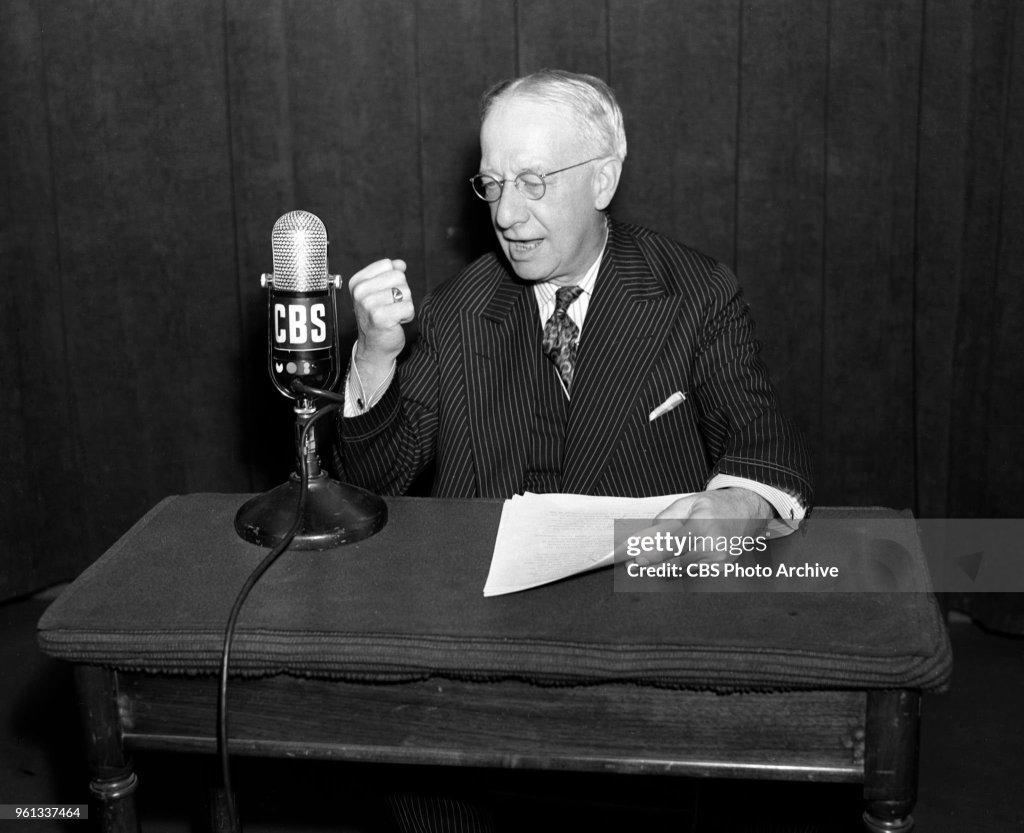
Radio address from London, October 1, 1939
THE British Empire and the French Republic have been at war with Nazi Germany for a month tonight. We have not yet come at all to the severity of fighting which is to be expected; but three important things have happened.
First, Poland has been again overrun by two of the great powers which held her in bondage for 150 years but were unable to quench the spirit of the Polish nation. The heroic defense of Warsaw shows that the soul of Poland is indestructible, and that she will rise again like a rock which may for a spell be submerged by a tidal wave but which remains a rock.
What is the second event of this first month? It is, of course, the assertion of the power of Russia. Russia has pursued a cold policy of self-interest. We could have wished that the Russian Armies should be standing on their present line as the friends and allies of Poland, instead of as invaders. But that the Russian Armies should stand on this line was clearly necessary for the safety of Russia against the Nazi menace.
At any rate the line is there, and an Eastern Front has been created which Nazi Germany does not dare assail. When Herr von Ribbentrop [German Foreign Minister] was summoned to Moscow last week, it was to learn the fact, and to accept the fact, that the Nazi designs upon the Baltic states and upon the Ukraine must come to a dead stop.
I cannot forecast to you the action of Russia. It is a middle wrapped in mystery inside an enigma; but perhaps there is a key. That key is Russian national interest. It cannot be in accordance with the interest or safety of Russia that Germany should plant itself upon the shores of the Black Sea, or that it should overrun the Balkan states and subjugate the Slavonic peoples of Southeastern Europe. That would be contrary to the historic life interests of Russia.
But here these interests of Russia fall into the same channel as the interests of Britain and France. None of these three powers can afford to see Rumania, Yugoslavia, Bulgaria, and above all Turkey, put under the German heel.
Through the fog of confusion and uncertainty we may discern quite plainly the community of interests which exists between England, France and Russia to prevent the Nazis from carrying the flames of war into the Balkans and Turkey. Thus, at some risk of being proved wrong by events, I will proclaim tonight my conviction that the second great fact of the first month of the war is that Hitler, and all that Hitler stands for, have been and are being warned off the East and Southeast of Europe.
What is the third event? Here I speak as First Lord of the Admiralty and with special caution. It would seem that the U-boat attack upon the life of the British Isles has not so far proved successful.
It is true that when they sprang out upon us and we were going about our ordinary business, with 2,000 ships in constant movement every day upon the seas, they managed to do some serious damage.
But the Royal Navy has immediately attacked the U-boats, and is hunting them night and day, I will not say without mercy—because God forbid we should ever part company with that—but at any rate with zeal and not altogether without relish. And it looks tonight very much as if it is the U-boats who are feeling the weather, and not the Royal Navy or the world-wide commerce of Britain.
A week has passed since a British ship, alone or in convoy, has been sunk or even molested by a U-boat on the high seas, and during the first month of the war we have captured by our efficient contraband control 150,000 tons more German merchandise—food, oil, minerals and other commodities —for our own benefit than we have lost by all the U-boat sinkings put together.
In fact, up to date—please observe I make no promises, we must deal in performances, not in promises—we have actually got 150,000 tons of very desirable supplies into this island more than we should have got if war had not been declared and if no U-boat had ever cast sailormen to their fate upon the stormy seas. This seems to be a very solid, tangible fact which has emerged from the first month of the war against Nazidom.
We are told that all the U-boats have gone home to tell their master about their exploits and their experiences. But that is not true, because every day, even on Sundays, we are attacking them upon the approaches to the British Isles. Some undoubtedly have preferred to go off and sink the unprotected neutral ships of Norway and Sweden. I hope the day will come when the Admiralty will be able to invite ships of all nations to join the British convoys and insure them on their voyages at a reasonable rate.
We must of course expect that the U-boat attack upon the sea-borne commerce of the world will be renewed presently on a greater scale. We hope, however, that by the end of October we shall have three times as many hunting craft at work as we had at the beginning of the war; and by the measures we have taken we hope that our means of putting down this pest will grow continually. We are taking great care about that.
Therefore, to sum up the results of the first month, let us say that Poland has been overrun, but will rise again; that Russia has warned Hitler off his Eastern dreams; and that the U-boats may be safely left to the care and constant attention of the British Navy.
Now I wish to speak about what is happening in our own island. When a peaceful democracy is suddenly made to fight for its life there must be a lot of trouble and hardship in turning over from peace to war. I feel very keenly the reproaches of those who wish to throw themselves into the fight but for whom we cannot find full scope at the present time. All this will clear as we get into our stride.
His Majesty’s Government is unitedly resolved to make the maximum effort of which the British nation is capable, and to persevere, whatever may happen, until decisive victory is gained. Meanwhile patriotic men and women, especially those who understand the high causes in human fortunes which are at stake, must not only rise above fear, they must also rise above inconvenience and, perhaps most difficult of all, boredom.
Parliament will be kept in session and all grievances or muddles or scandals can be freely ventilated there. In past times the House of Commons has proved itself an instrument of national will power capable of waging stern wars.
Parliament is the shield and expression of democracy, and Ministers of the Crown base themselves upon the parliamentary system. You have seen the power of Parliament manifested in the last week, when a budget, gigantic in its burdens, a budget which would have infuriated everybody a year ago, has been accepted with prompt and stolid resolve.
In other fields our work goes forward. A large army has already gone to France. British armies upon the scale of the effort of the Great War are in preparation. The British people are determined to stand in the line with the splendid army of the French Republic, and share with them, as fast and as early as we can, whatever may be coming toward us both.
It may be that great ordeals may be coming to us in this island from the air. We shall do our best to give a good account of ourselves, and we must always remember that the command of the seas will enable us to bring the immense resources of Canada and the New World into play as a decisive ultimate air factor beyond the reach of what we have to give and take over here.
Directions have been given by the government to prepare for a war of at least three years. That does not mean that victory may not be gained in a shorter time. How soon it will be gained depends upon how long Herr Hitler and his group of wicked men, whose hands are soiled with blood and corruption, can keep their grip upon the docile, unhappy German people.
It was for Hitler to say when the war would begin, but it is not for him nor his successors to say when it will end. It began when he wanted it, and it will end only when we are convinced that he has had enough.
The Prime Minister has stated our war aims in terms which cannot be bettered, and which cannot too often be repeated: “To redeem Europe from the perpetual and recurring fear of German aggression and enable the peoples of Europe to preserve their independence and their liberties.” That is what the British and French nations are fighting for.
How often have we been told we are the effete democracies whose day is done, and who must now be replaced by various forms of virile dictatorship and totalitarian despotism. No doubt at the beginning we shall have to suffer, because of having too long wished to lead a peaceful life. Our reluctance to fight was mocked at as cowardice. Our desire tosee an unarmed world was proclaimed as the proof of our decay.
Now we have begun: now we are going on; now with the help of God, and with the conviction that we are the defenders of civilization and freedom, we are going to persevere to the end.
After all, Great Britain and France together are eighty-five millions, even in their homelands alone. They are united in their cause and convinced of their duty. Nazidom, with all its tyrannical power, controls no more. They, too, have eighty-five millions, but of these at least sixteen millions, new conquered Czechs, Slovakians and Austrians, are writhing under their cruel yoke and have to be held down by main force.
We have the oceans, and the assurance that we can bring the vast latent power of the British and French Empires to bear upon the decisive points. We have the freely given, ardent support of the twenty millions of British citizens in the self-governing dominions of Canada, Australia, New Zealand and South Africa. We have the heart and moral convictions of India on our side.
We believe we are entitled to the respect and good-will of the world, and particularly of the United States.
Here I am in the same post as I was twenty-five years ago. Rough times lie ahead; but how different is the scene from that of October, 1914! Then the French front, with its small British army fighting in the line seemed to be about to break under the terrible impact of German imperialism. Then Russia had been laid low at Tannenberg. Then the whole might of the Austro-Hungarian Empire was in battle against us. Then the brave, war-like Turks were about to join our enemies.
Then we had to be ready night and day to fight a decisive sea battle with a formidable German fleet.
We faced those adverse conditions then. We have nothing worse to face tonight. In those days of 1914 also Italy was neutral but we did not know the reason for her neutrality.
It was only later on that we learned that by a secret clause in the original treaty of the Triple Alliance Italy had expressly reserved to herself the right to stand aside from any war which brought her into conflict with Great Britain.
Much has happened since then; misunderstandings and disputes have arisen but all the more do we appreciate in England the reasons why this great and friendly nation of Italy, with whom we have never been at war, has not seen fit to enter the struggle.
I do not underrate what lies before us; but I must say this: I cannot doubt we have the strength to carry a good cause forward and to break down the barriers which stand between the wage-earning masses of every land and a free and more abundant daily life.
Of all the wars that men have fought in their hard pilgrimage none was more noble than the great Civil War in America nearly eighty years ago. Both sides fought with the high conviction, and the war was long and hard. All the heroism of the South could not redeem their cause from the stain of slavery, just as all the courage and skill which the Germans always show in war will not free them from the reproach of Nazism with its intolerance and brutality.
We may take good heart from what happened in America in those famous days of the nineteenth century. We may be sure that the world will roll forward into broader destinies. We may remember the words of old John Bright, after the American Civil War was over, when he said to an audience of English working folk:
“At last after the smoke of the battlefield had cleared away, the horrid shape which had cast its shadow over the whole continent had vanished and was gone forever.”
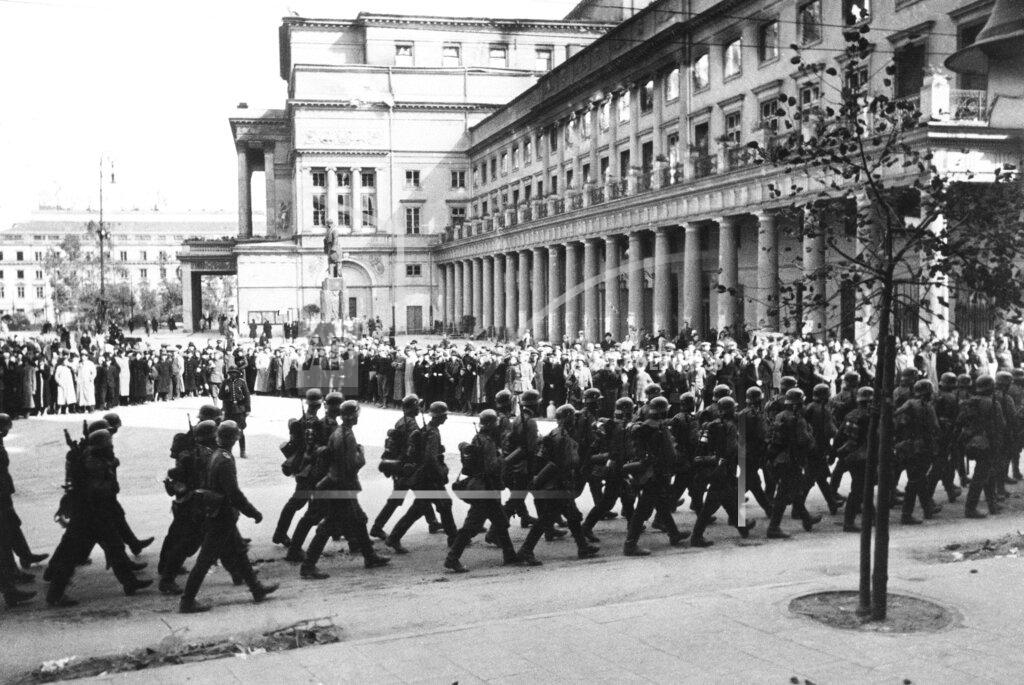
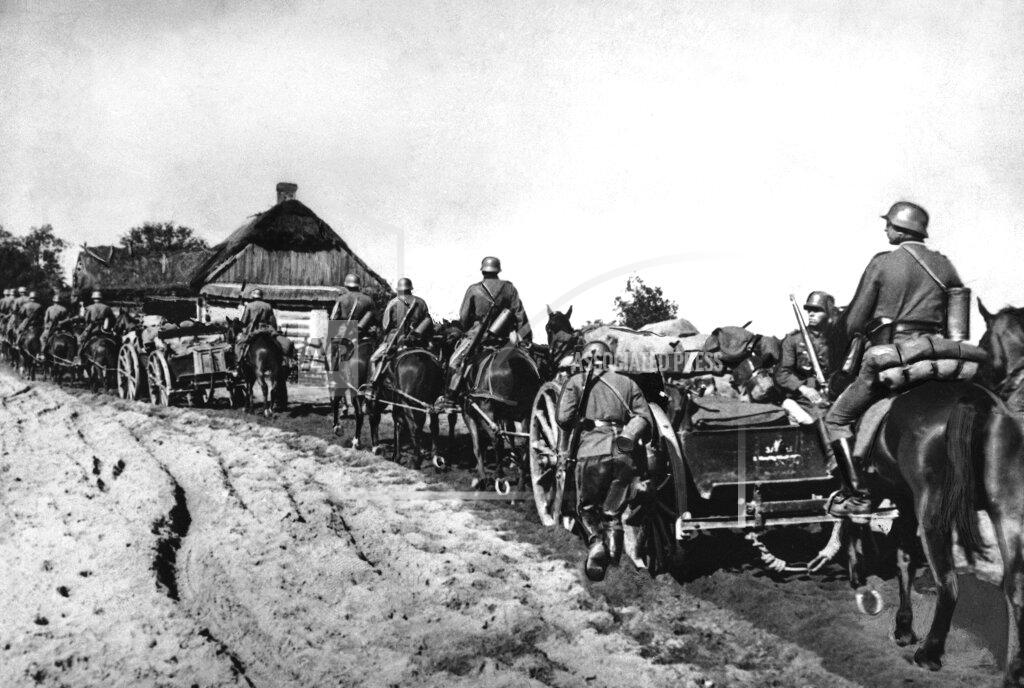
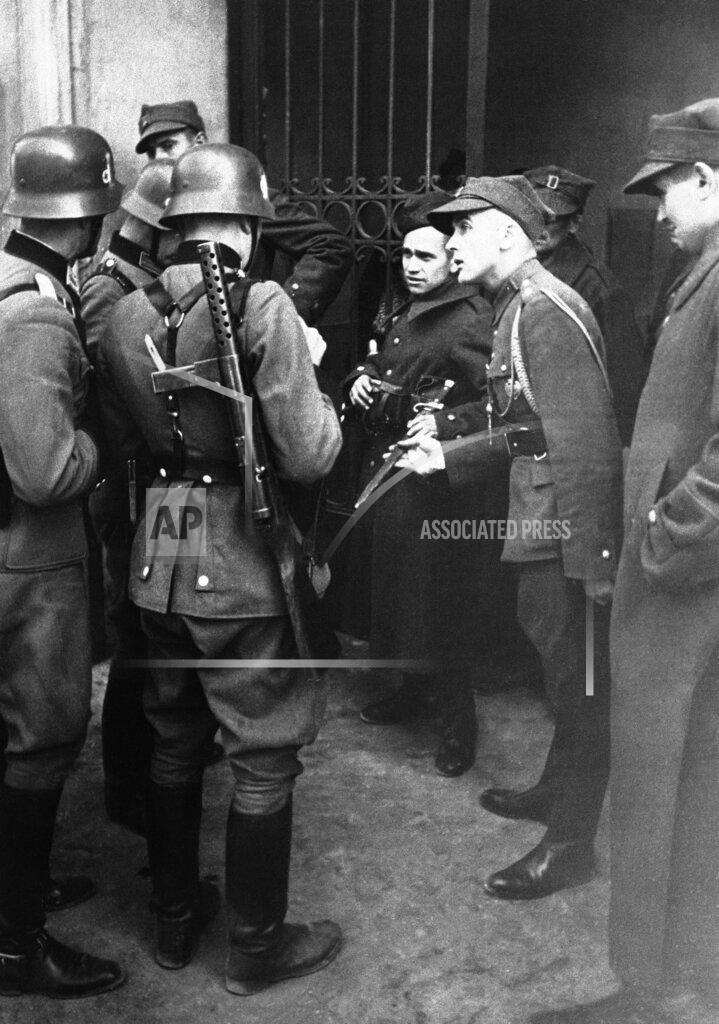
German troops enter Warsaw and begin disarming the Polish garrison (estimated to number 100,000 officers and men).
The Polish garrison on the Hel Peninsula in Gdansk Bay surrenders. The 3,000 Polish soldiers and sailors under command of Polish Rear Admiral Józef Unrug had resisted the Germans since September 20, 1939 and inflicted damage on the battleship SMS Schleswig-Holstein and claimed to have shot down approximately 50 German planes.
Following Hitler’s speedy victory in Poland, a period known as the Phony War follows in Western Europe. Hitler proposes several peace conferences, all are quickly rejected. The British and French use this 6-month lull for strategic planning. This period will end abruptly with the German invasions of Norway and France.
The Battle of Wytyczno was fought, resulting in Soviet victory.
During the next two months, 214 Polish priests are executed, among them the entire cathedral chapter of the bishopric of Peplin.
In Paris, Polish cryptologists arrive with two Enigma machines.
The Kriegsmarine (German Navy) Type 1916 minesweeper M-85 struck a mine laid by submarine ORP Żbik in the Baltic Sea north of Jastarnia, Poland (54°45′N 18°45′E) and sank with the loss of 24 of her 71 crew. The survivors were rescued by M-122 and a number of R boats (all Kriegsmarine).
The German euthanasia program begins on the ill and feeble. The first “euthanasia” questionnaires are distributed to mental hospitals. They are completed, in their capacity as “experts,” by Professors Heyde, Mauz, Nitsche, Panse, Pohlisch, Reisch, C. Schneider, Villinger, and Zucker, all of whom are professors of psychiatry, and thirty-nine other doctors of medicine. Their payment is 5 pfennigs per questionnaire when more than 3,500 are processed per month, and up to 10 pfennigs when there are less than 500. A cross signifies death. There are 283,000 questionnaires to be processed. These experts mark at least 75,000 with a cross.
Adolf Galland is awarded the Iron Cross 2nd Class medal and is promoted to the rank of Hauptmann.
Germany this month successfully fires and recovers A-5 development rockets with gyroscopic controls and parachutes, attaining an altitude of 7½ miles and a range of 11 miles.
Galeazzo Ciano meets with Adolf Hitler in Berlin, Germany. While the German peace offensive continued on all fronts, with increasing warnings about an impending German military offensive that would include intensified submarine and air warfare, Count Ciano, the Italian Foreign Minister, arrived in Berlin late this afternoon and immediately went into a long conference with Chancellor Hitler and Foreign Minister Joachim von Ribbentrop at the Chancellery.
Compared with previous visits of the Italian Foreign Minister, the reception accorded him today was considerably quieter, a fact that was officially explained as being in keeping with the seriousness of wartime. But Count Ciano was nevertheless received with all the etiquette due a valued friend. He had been greeted at Brenner Pass by the Chief of Protocol, he drove with Herr von Ribbentrop in an open car through Berlin streets to the cheers of crowds that were numbered by the thousands and he was lodged in Bellevue Palace, the official residence for State visitors.
Word of the German pocket battleship SMS Admiral Graf Spee’s sinking of the British freighter Clement reaches the British Admiralty, which begins the disposition of ships to meet the threat posed by the surface raider in the South Atlantic.
In an address to the House of Commons and broadcast on the radio, First Lord of the Admiralty Winston Churchill says that the Soviet Union has “pursued a policy of cold self-interest” in Poland. He adds that “we could have wished that the Russian armies should be standing on their present line as the friends and allies of Poland instead of invaders. But that the Russian armies should stand on this line was clearly necessary for the safety of Russia against the Nazi menace.” He finishes by referring to Soviet policy as “a riddle wrapped in a mystery inside an enigma.”
A royal proclamation ordered all British men between the ages of 20 and 22 to report for army registration on October 21.
Cardinal Bertram informs all bishops that they should comply with Kerrl’s suggestion of September 30, and the church bells in all dioceses in Germany ring out to celebrate Hitler’s first military victory.
The Turks fear that Nazis are inciting “Reds,” suspecting an attempt to embroil Russia with the Allies by menacing the Balkans.
Fate has hit Latvia faster than had been expected. Tonight a Stockholm report from Riga declares that the Estonian Foreign Minister, Karl Selter, on his return from Moscow, brought an alarming message to the Latvian Government. It was an “invitation” from the Soviet Union to send a delegation to Moscow.
U-16 encountered an enemy submarine in the North Sea, but neither sub attacked.
The neutral and unarmed Belgian steam merchant Suzon was stopped by gunfire and after the crew abandoned ship was torpedoed and sunk by the U-35, commanded by Kapitänleutnant Werner Lott, southwest of the English Channel in the eastern Atlantic Ocean (48°08′N 7°36′W). Of the ship’s complement, all 20 survived and were picked up by the destroyer HMS Acheron. The 2,239-ton Suzon was carrying pit props and was bound for Cardiff, Wales.
The Swedish cargo ship Gun was stopped in the evening of 30 September 30 miles (48 km) northwest of Hanstholm, Denmark by U-3 (Kriegsmarine). The papers of the ship showed that she was carrying contraband. A German scuttling party went aboard while the crew left, but then a British submarine came. The ship was finally sunk by a torpedo from U-3 in the morning of 1 October. The crew were rescued by Dagmar (Denmark).
The Koninklijke Marine (Royal Netherlands Navy) Jan van Amstel-class minesweeper HrMs (HNMS) Jan van Gelder was damaged by her own naval mines off Terschelling on 1 October 1939. At least five men were killed. After initial repairs at Willemsoord, Den Helder, she received a new stern at Gusto, Schiedam, and was recommissioned on 17 April 1940.
The War at Sea, Sunday, 1 October (naval-history.net)
Battleships HMS Resolution and HMS Revenge of the Channel Force at Portland were ordered to join the South Atlantic Command at Freetown. The orders were cancelled on the 5th before sailing. On the 7th, both battleships sailed for Halifax and duty in the North Atlantic Escort Force.
Heavy cruiser HMS Suffolk departed Portsmouth on 29 September escorted by destroyer HMS Express. The cruiser arrived at Scapa Flow on the 1st to relieve light cruiser HMS Edinburgh in Cruiser Squadron 18. Edinburgh was then attached to Cruiser Squadron 2 of the Humber Force. Heavy cruiser HMS Norfolk arrived at Rosyth on the 3rd. After completing the replacement of a gun at Rosyth, both heavy cruisers proceeded to the Mediterranean. Norfolk departed Rosyth on the 7th and Suffolk departed Scapa Flow on the 8th. En route in heavy weather on the 11th, Norfolk’s Walrus was washed off the catapult and lost and her catapult trolley badly damaged. Both cruisers arrived at Gibraltar on the 12th and departed on the 14th. They arrived at Alexandria on the 18th.
Battleships HMS Nelson and HMS Rodney, battlecruisers HMS Hood and HMS Repulse, aircraft carrier HMS Ark Royal, light cruiser HMS Newcastle and destroyers HMS Ashanti, HMS Mashona, HMS Matabele, HMS Somali, HMS Fame, HMS Foresight, HMS Fortune and HMS Firedrake departed Scapa Flow for Loch Ewe where they arrived at 0700/2nd.
Light cruisers HMS Diomede and HMS Dunedin, which departed Scapa Flow on 30 September, were on Northern Patrol between the Orkneys and the Faroes. Light cruisers HMS Cardiff and HMS Dragon, which departed Scapa Flow on 28 September, were also on Northern Patrol.
Convoy OA.13 departed Southend escorted by destroyers HMS Jackal and HMS Janus, and dispersed in 48-50N, 13-40W on the 4th.
Convoy OB.13 departed Liverpool escorted by destroyers HMS Versatile and HMS Warwick to 4 October.
Convoy DB.10 departed Southampton with two personnel ships, escorted by destroyers HMS Arrow and HMS Intrepid, and arrived at Brest on the 2nd.
Convoy MB.10 departed Southampton with six cargo ships, escorted by destroyers HMS Acheron and HMS Achates, and also arrived at Brest on the 2nd.
Light cruiser HMS Curlew departed Portland for a work up at Scapa Flow, which was completed on the 21st.
Destroyer HMS Eclipse attacked a submarine contact in 51 12N, 4 22W.
Convoy BC.6F of steamers Fenella, St Julien, Tynwald and Ulster Prince departed the Loire without escort, and safely arrived in the Bristol Channel.
U-35 stopped Belgian steamer Suzon (2239grt, Lejeune, Master) 42 miles 330° from Ushant Island. She was abandoned, sunk by U-35, and the entire crew picked up by destroyer HMS Acheron. Early on the 2nd, 15 miles 296° from Ushant, Acheron was attacked unsuccessfully by U-35.
Heavy cruiser HMS Kent departed Hong Kong, and arrived back on the 21st. She was docked on the 24th and was in dock until the end of the month.
Light cruiser HMS Orion departed Kingston for patrol in the Curacao area.
Light cruiser HMS Galatea and destroyers HMS Afridi, HMS Gurkha, HMS Mohawk and HMS Sikh departed Alexandria on patrol duties. Afridi refueled at Malta arriving on the 4th and departing on the 5th to return to patrol. Sikh arrived at Malta on the 5th, was found to have stripped a turbine and began long repairs there. Mohawk refueled at Malta, arriving on the 6th and departing on the 7th for Gibraltar. Galatea refueled at Malta arriving on the 7th and departing the same day to return to patrol. Afridi and Gurkha refueled at Malta arriving on the 7th and departing on the 10th for Gibraltar.
Destroyers HMS Nubian and HMS Zulu attacked a submarine contact in 32-00N, 30-08E.
Orders to return to the Home Fleet were suspended for destroyers HMS Havock and HMS Hotspur of the South America Station and HMS Hyperion and HMS Hunter of the Freetown Force. Due to the threat of raiders operating in the South Atlantic, they were ordered to remain on station and the remaining units of the 2nd Destroyer Flotilla in the Mediterranean were ordered to join them in the South Atlantic.
At the beginning of October, French Mediterranean destroyer escort groups were as follows:
1st Large Destroyer Division – Vauban, Lion, Aigle
7th Large Destroyer Division – Vautour, Gerfaut, Albatros
9th Large Destroyer Division – Maillé Brézé, Kersaint, Cassard
11th Large Destroyer Division – Épervier, Milan
Group G.1 – La Palme, Le Mars, British HMS Greyhound
Group G.2 – Tramontane, Tornade, British HMS Glowworm
Group G.3 – Tigre, Tempête, Typhon
In mid-October, the destroyers departed the escort group, but were relieved by destroyers Le Fortune, Simoun, La Railleuse of the 3rd Destroyer Division. At the beginning of November, the forces were redistributed.
The German Navy sustained its only loss of the Polish campaign when minesweeper M-85 of the 7th Minesweeping Flotilla struck a mine at 1440 northeast of Heisternest in 54-45N, 18-45E and sank. This mine was laid by Polish submarine ORP Zbik on 9 September. Twenty-four men on M-85 were lost. German minesweeper M-122 and some R boats rescued 47 survivors.
At noon tomorrow Vice President Garner will call the Senate to order and what is expected to be one of the greatest oratorical battles in the history of the country will get under way. The issue will be the Neutrality Bill, drafted by a group of Democratic members of the Senate Foreign Relations Committee. The crux of the bill is the proposal to repeal the provision of the existing Neutrality Act which imposes a mandatory embargo upon shipments to belligerents of arms, munitions, and implements of war, and to substitute therefor a “cash-and-carry” plan for handling commerce in arms between this country and nations which are at war with each other.
Senator Key Pittman, chairman of the Foreign Relations Committee, is scheduled to begin the debate with a speech explaining the bill his committee has reported. Senator William E. Borah, the veteran Isolationist from Idaho, is to speak first for those who oppose the bill, regarded as an Administration measure. Senator Tom Connally of Texas, who helped draft the bill, will be one of its early defenders. Senator Arthur Vandenberg of Michigan is slated to speak against the bill early In the debate. Only the most optimistic supporters of the measure predict that the debate would end in less than three weeks. To most observers it would occasion no surprise if a full month elapsed before the issue came to a vote.
A foretaste of what the impending discussion in the Senate may be like was afforded by radio addresses broadcast tonight. Senator Pittman championed his committee’s bill in an address over a Mutual Broadcasting network and Senator Nye assailed it in a speech on the same program. Over the National Broadcasting Company’s network Senator Clyde M. Reed of Kansas explained the Issues involved and stated his views concerning them. Administration forces say that they have a majority of the Senators’ pledges to support their measure. Senator James F. Byrnes of South Carolina, who has been directing the behind-the-scenes fight for the Administration, said that fifty-seven Senators were lined up on this side. He predicted that this number would increase to sixty-five by the time a roll-call was reached and that the maximum strength of the isolationists would not exceed thirty-one votes.
This appraisal of the situation was challenged by Senator Nye in his radio address. He said that the country would very soon learn that the Administration did not have a majority on its side. The prevalent opinion, however, was that very few votes would be blown off their course by the oratorical winds that will roar through the Senate chamber during the coming weeks. Instead, the belief prevails that whatever votes may be changed between now and the first Senate roll-call on the bill will be switched because of public reaction to the situation as it is revealed by the Senate debate.
The isolationist forces particularly will be “talking to the country” when they state their case on the Senate floor. They believe that their arguments that the Administration’s bill is the “road to war” Instead of the “road to peace” that President Roosevelt called it will so impress the people of the country that the flood of letters and telegrams with which all members of the Senate and House have been deluged will continue and will be preponderantly in their favor. Thus, they believe, enough votes will be changed to bring them victory.
Former New York Governor Alfred E. Smith, bitter opponent of the New Deal, called upon the nation last night to “stand solidly” behind President Roosevelt in his fight to amend the Neutrality Law. He spoke over a nationwide hook-up of the Columbia Broadcasting System. The only way to prevent American entry into the present war, he told the radio audience, is to bar American ships and American passengers from belligerent waters.
Mr. Smith urged all supporters of the President’s program for lifting the arms embargo to permit cash-and-carry sales of munitions and war supplies and to bar American shipping from the war zones to inform their Representatives and Senators in Congress of their stand. By such action, he said, they would undo the effect of the “deluge” of messages sent to Congress by opponents of the President’s plan.
“It is because I firmly believe in my heart and soul that the amendments suggested by the President are best calculated to save us from the scenes we witnessed in 1917 when our American boys were starting for France that I am at this microphone tonight, appealing to the American people to stand solidly behind the President because he is so obviously right, so obviously on the side of common sense and sound judgment and of patriotism, that only those who lack an understanding of the issue will oppose him,” said Mr. Smith. “I urge this with all the sincerity I possess and with the profound conviction that I speak for the good of the nation which we all love so much.”
The National Committee to Uphold Constitutional Government finds that Roosevelt holds too much power, calling it “shocking” and they urge Congress to repeal any powers that might allow the President to pull the United States into the war.
The AFL intends to recommend that the United States act as mediator for warring countries in the world. Delegates to the fifty-ninth annual convention of the American Federation of Labor will be told tomorrow that the Executive Council believes that the United States should offer to mediate among the warring nations in Europe in an effort to bring about peace. The proposal, coupled with a strong plea for United States neutrality and an attack on Nazism, fascism and communism, appears in the Executive Council’s report, made public today. The delegates will receive copies when the convention opens here tomorrow.
“We favor our nation offering our mediation services for peace and hope that warring countries may be prevailed upon to accept them,” the council report states. “But with that we refuse to go farther. As for our own country, we demand that it stay out of the European conflict, maintaining neutrality in spirit and in act.” Members of the council who were asked to comment on the peace pronouncement indicated that this part of the report had not been submitted to them for approval at their last quarterly session in Atlantic City in August. This section, inserted at the direction of William Green, the AFL’s president, was prepared between the time of Great Britain’s declaration of war and President Roosevelt’s calling of the special session of Congress.
The government studies new ocean flying aids. The European war may hasten governmental establishment of new safety and rescue facilities for transatlantic air travel. This process is speeded because the war is interfering with the reporting of weather conditions.
Women in the U.S. spent approximately $200,000,000 in beauty shops in 1939, with the overwhelming majority of the money paid for hair care.
A New York consumer protection group sets up a public meeting to fight increases in milk prices.
New York’s welfare bureau asks for testing of the food stamp program in rural areas.
The War Department sends sealed orders to more than 10,000 manufacturing plants with instructions in case of war.
The rate of U.S. Army recruitment is at a peacetime high. The largest peace-time recruiting campaign in the history of the United States Army is now under way and making excellent progress, Secretary Woodring announced today.
As of this date, the U.S. Navy consists of 396 commissioned ships divided amongst the major U.S. Fleet commands afloat: Battle Force (Battleships, Cruisers, Destroyers, and Aircraft), Submarine Force, and Base Force; the Scouting Force (Cruisers and Aircraft); the Atlantic Squadron; the Asiatic Fleet; the Special Service Squadron and Squadron 40-T. There are 175 district craft in service in the following naval districts: First (headquarters in Boston, Massachusetts), Third (New York), Fourth (Philadelphia, Pennsylvania), Fifth (Norfolk, Virginia), Sixth, Seventh and Eighth (Charleston, South Carolina), Ninth (Great Lakes, Illinois), Eleventh (San Diego, California), Twelfth (San Francisco, California), Thirteenth (Seattle, Washington), Fourteenth (Pearl Harbor, Territory of Hawaii), Fifteenth (Balboa, Canal Zone) and Sixteenth (Cavite, Philippine Islands); vessels not in commission (but includes those ordered recommissioned incident to the expansion of the fleet) number 151; 5 district craft are carried as not in service. Vessels listed as “in service” include some used for USNR or Naval Militia training. Vessels not in commission include those loaned to the states of Pennsylvania, California, New York and Massachusetts for use as maritime school ships, the Maritime Commission and the Sea Scouts; as well as “relics” like the Civil War vintage Hartford, the Spanish-American War prize Reina Mercedes, and Spanish-American War veterans Olympia and Oregon. Interestingly, the list contains the gunboat Panay (PR-5), bombed and sunk by Japanese naval aircraft in the Yangtze River on 12 December 1937.
To achieve an immediate expansion of pilot training, the U.S. Naval Air training syllabus was revised to set up a program of concentrated instruction which reduced the length of the training period from 12 to 6 months. The new program provided a primary course in landplanes and a basic phase in service landplanes and instrument flying for all students, and restricted each student in the advanced program to specialization in patrol and utility aircraft, observation planes, or carrier aircraft. Ground school was similarly concentrated and shortened from 33 to 18 weeks.
The Detroit Tigers and Cleveland Indians split a doubleheader on the last day of the season. Cleveland won the opener, 8–3, behind Bob Feller’s 24th win. The Tigers take the nitecap, 1–0, behind Bobo Newsom’s 20th win of the year, as the game is called after five innings due to darkness. Bobo won 3 with St. Louis before being traded to Detroit.
The eighth-place St. Louis Browns ended their most disastrous season today with a tenth-inning 4–3 triumph in ten innings over the fourth-place Chicago White Sox. Trailing, 3–0, and apparently headed for their 112th trimming of the year, the Brownies scored two runs in the eighth. Joe Grace lifted a ball over the wall to tie the count in the ninth and then gave the 707 loyal spectators something to remember him by during the Winter by driving in the winning run with one out in the tenth.
Doubleheaders scheduled between the Yankees and Red Sox, and Senators and A’s, are rained out.
The Pittsburgh Pirates closed their poorest season since 1917 today by dropping the first game of a double-header, 9–1, to Cincinnati’s National League champions, then winning the nightcap, 8–0, from the Reds’ second team.
The Brooklyn Dodgers edged the last-place Philadelphia Phillies, 3–2, as Hugh Casey won his 15th of the season. The second game of a scheduled doubleheader was rained out.
The Chicago Cubs ended the season today with a 2–1 victory over the St. Louis Cardinals, but remained in fourth place, a half-game behind the Dodgers.
Harry Gumbert contributed a 5–0 shutout as his eighteenth victory of the season today when the New York Giants romped away easily in the only game the weatherman allowed them to play against Casey Stengel’s Boston Bees to close the league season.
Several senior officers of the Kwantung army, the Japanese army stationed in nominally independent state of Manchukuo (formerly Manchuria), have been dismissed in the wake of the agreement signed in Moscow, settling the border war with the USSR.
The Japanese in Shanghai belittled the Chinese attacks in Kwangtung Province, chiefly in the areas next to Hong Kong. The attacks started at 11 PM Saturday, the British border guard reported, and were carried out by regulars of the Chinese Fourth Route Army, who apparently hoped to pin the Japanese against the British border. About 5,000 Japanese troops in scattered garrisons, supported by large numbers of planes and heavy artillery, were on the defensive. Chinese reaching the Hong Kong border said their forces had occupied Shataukok and that a Chinese column of 5,000 men was besieging Shumchun, which was defended by about 1,500 Japanese. Another Chinese column of 3,000 is attacking Namtau. The Chinese are attacking on a line about thirty miles long. Observers here believe the Chinese attacks in Kwangtung are designed to relieve Japanese pressure on Changsha, in Hunan Province, and forestall a northward drive by Japanese forces based on Canton along the southern part of the Canton-Hankow Railway.
According to Japanese reports, Japanese planes flew over Changsha yesterday and reported that the city, which is on the Canton-Hankow Railway, had been abandoned by the Chinese under General Pai Chung-hsi, who had established his headquarters at Hengyang, to the south, and that he was preparing a new stand. The Japanese Domei News Agency reported that nine army groups were converging on Changsha and were expected to make a formal entry into the burned city today. These groups carried out a series of pincer movements during the weekend that brought them into the Changsha suburbs. Six of the groups stormed Chinese positions on the south bank of the Mi River and then moved southeast toward Changsha. The other three crushed three divisions of Szechwan Province troops under General Yang Sen in the Wang Yang Mountains, and then occupied a Chinese stronghold on the motor highway south of the mountains. The Japanese reported heavy Chinese troop movements between Kukong, Kwangtung Province, and Hengyang. They believe the Chinese are establishing a secondary defense area around Yuanling in West Hunan Province.
[Ed: The truth is not quite so positive for the Japanese…]
The Japanese 6th Division begins to fall back from Changsha, Hunan Province, China across the Laodao River. The Japanese 11th Corps begins withdrawing from northern Hunan province, ending an abortive attempt to capture Changsha and the Tungting Lake area. The fighting is known as the first battle of Changsha and it is a major victory for the Chinese Nationalists led by Chiang Kai-shek.
Hong Kong sees attacks by the Chinese. The Japanese infantry is fighting to hold the line 300 yards from the British colony’s border. Chinese Army headquarters reported tonight the capture of the eastern section of Japanese positions along Hong Kong’s mainland border in a surprise attack that broke a five-week period of inactivity. The announcement said 5,000 Kwangtung troops had participated in the attack, which, according to witnesses, centered on Shumchun, a Japanese headquarters village. The Japanese have maintained posts along the Chinese side of the boundary since their troops mopped up the area in mid-August. After occupying a twenty-two-mile strip paralleling British territory, the Japanese forces were reduced, leaving only Chinese mercenary troops under Japanese officers. Chinese forces advanced in the face of bombing and machine-gunning by Japanese planes which appeared to reinforce the threatened land forces, the report said.
The Japanese are angry over U.S. naval activity. Moves in the Pacific are criticized by a retired admiral. “The question narrows down to this: Does America mean to go to war with Japan over China,” says Rear Admiral Gumpei Sekine in Bungei Shunju, a leading monthly. Admiral Sekine is now retired, but until a few years ago he was connected with the information section of the Navy Office.
Official utterances are entirely different. Rear Admiral Kanazawa, present director of the information section, told the press that Japan was not disturbed by American naval movements in the Pacific and added that in time of war it was perfectly natural for the United States Fleet to conduct maneuvers at Hawali and take other precautions.
Admiral Sekine’s article reveals that his bitterness is partly due to the fact that he was an admirer of the United States during his active days. The Japanese, he says, too easily accepted the suggestion that America is a country wedded to the principles of justice and humanity. Now it is realized that the United States simply paid lip service to those principles while pursuing a policy of self-interest, he declares.
Ever since the Russo-Japanese War, Japan’s experience has been to be cheated by Great Britain and oppressed by America, he asserts. He gets to the hub of his indictment when, after upbraiding the United States for exploiting China, he declares: “The Japanese are most anxious to know whether the United States intends to use armed force to make its will prevail regarding China.” Personally Admiral Sekine does not believe the United States will fight for China because the American people believe such a war would bring no advantage. He proposes that the United States sell Guam to Japan as the best means of restoring friendship.
Born:
George Archer, American golfer (U.S. Masters 1969), in San Francisco, California (d. 2005)
Sonny Bishop, AFL guard and tackle (AFL Champions-Texans, 1962; AFL All-Star, 1968; Dallas Texans, Oakland Raiders, Houston Oilers), in Winner, South Dakota.
Naval Construction:
The Kriegsmarine (German Navy) vorpostenboot V 102 Cressida is commissioned.
The Kriegsmarine (German Navy) vorpostenboot V 103 Sylvia is commissioned.
The Kriegsmarine (German Navy) vorpostenboot V 104 Falke is commissioned.
The Kriegsmarine (German Navy) vorpostenboot V 107 Botilla Russ is commissioned.
The Kriegsmarine (German Navy) vorpostenboot V 108 Porjus is commissioned.
The Kriegsmarine (German Navy) vorpostenboot V 202 Franz Westermann (later V 205 Franz Westermann) is commissioned.
The Royal Navy armed merchant cruiser HMS Aurania (F 28) is commissioned. Her first commander is Captain Ivan W. Whitehorn.
The Royal Navy “T”-class submarine (First Group) HMS Trident (N 52) is commissioned. Her first commander is Commander James Gordon Gould, RN.

[Ed: LOL. If you think she is vaguely familiar, you’re right — You’re just 25 years too early. That’s “Granny” from “The Beverly Hillbillies.”]
 History Diaries