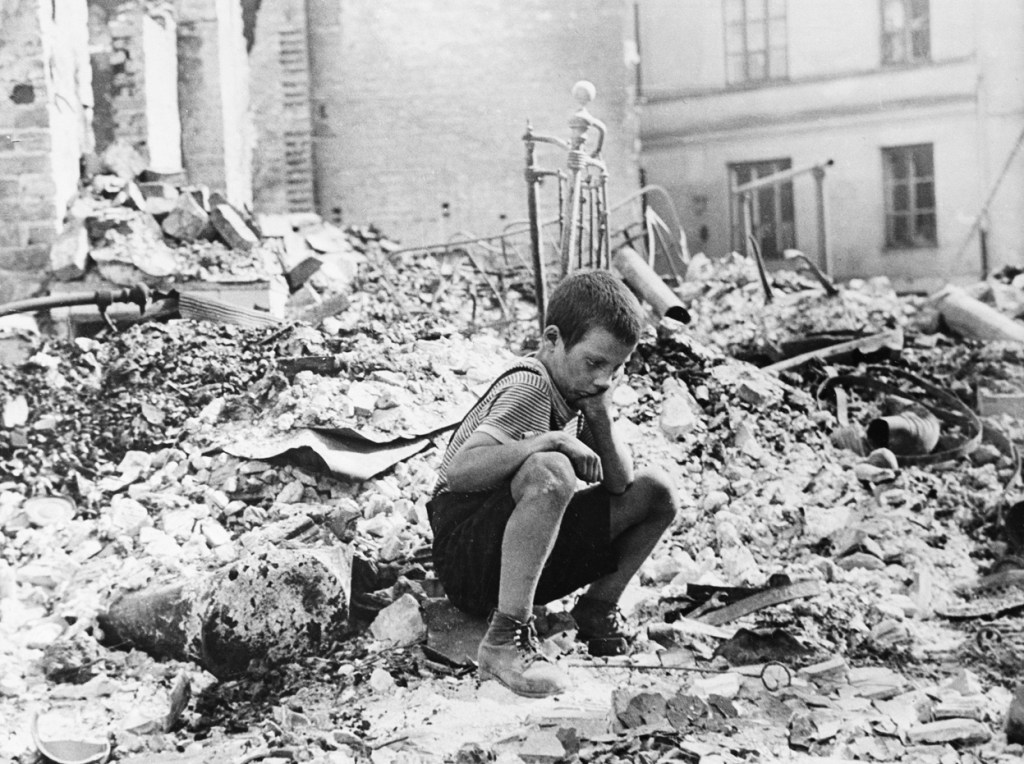
Bryan wrote in 1958: “Ryszard Pajewski was a study in dejection when I saw him sitting on a pile of rubble. Only nine, he had suddenly been made the family breadwinner – and there was no bread to be had. Now a truck driver, he remembers that when he saw me last, I was carrying two “boxes”-my cameras.” In September 1959 Julien Bryan wrote more about it in Look magazine: “The spot where nine-year-old Ryszard Pajewski sat atop a pile of rubble in 1939 is now a smooth lawn. But a friend saw my picture of this scene and told Pajewski. He came to see me. The rubble pile had been near his home, and he had taken time out from a search for food, for his mother and brother, to rest. His father was later taken away by the Nazis, and he never returned. Pajewski, who is divorced, now lives alone outside Warsaw.”
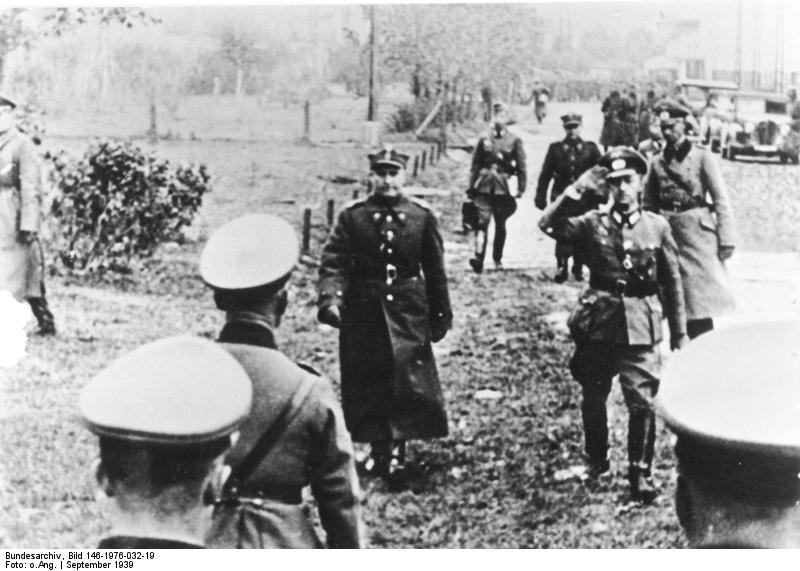
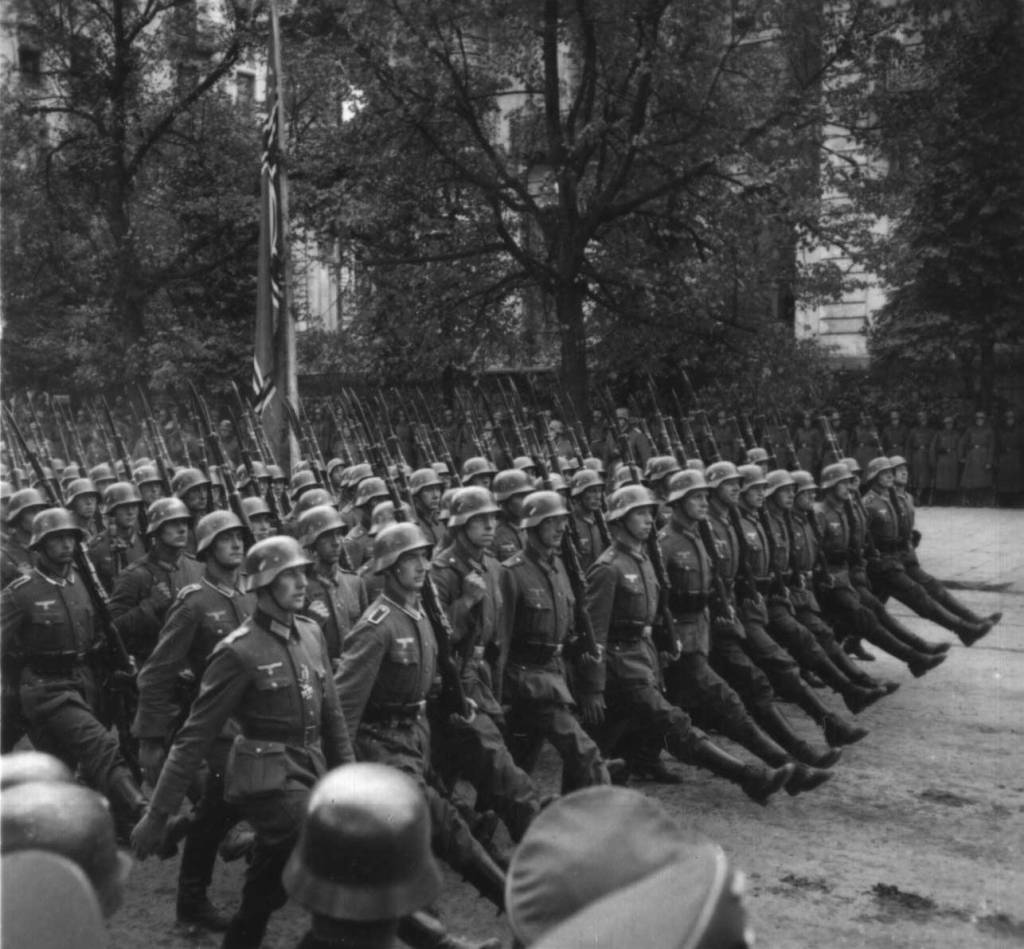
The Siege of Warsaw ended after twenty days when the Polish garrison capitulated to the Germans.
The New York Times reports:
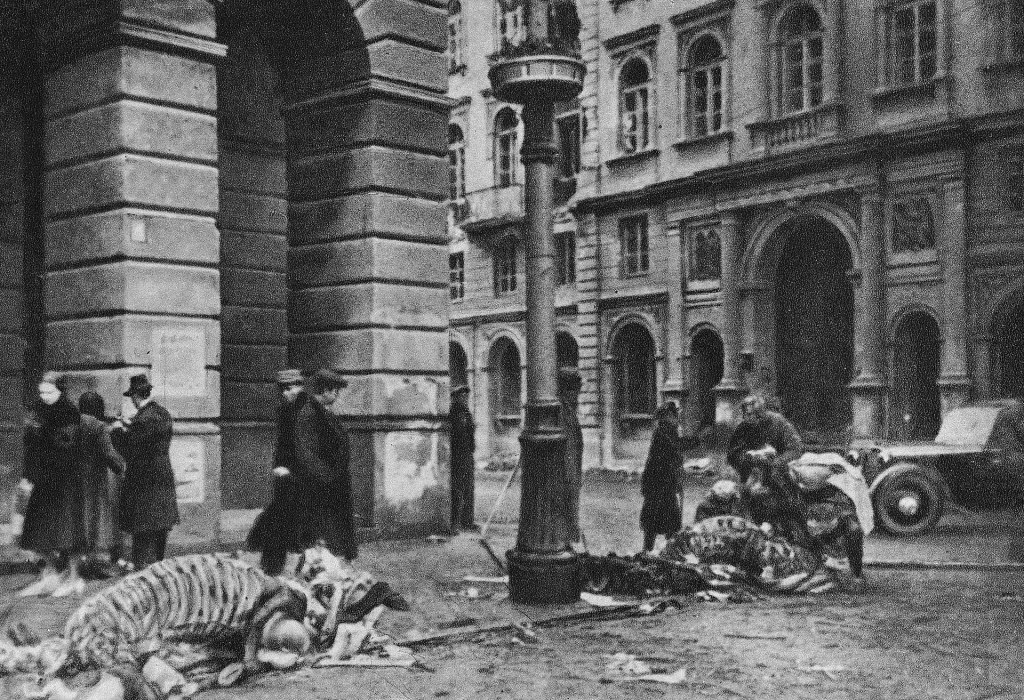
“The city of Warsaw surrendered unconditionally tonight, the German High Command announced, after twenty days of siege that saw the Polish capital bombed and burned “into an unspeakable inferno” with thousands of civilian dead.
“Complete destruction of at least half of the once magnificent city on the Vistula, exhaustion of its defenders’ ammunition, starvation and pestilence brought capitulation long after Polish resistance had been virtually wiped out in the rest of the nation. For days the city had stood alone in defiance of the German conquest from the West and the Soviet Russian invasion from the East, fighting off German troops and tanks in the outskirts in hand-to-hand fighting while German long-range guns and bombing planes systematically wrecked the capital.
“In the last twenty-four hours of Warsaw’s defense more than 3,000 persons, mostly women and children, were reported to have been killed. The Polish Transcontinental Press said 500 fires were sweeping what had been magnificent buildings, parks and homes. The announcement of Warsaw’s unconditional surrender was made by the German High Command in Berlin, but Polish radio dispatches. confirmed the capitulation. The Berlin radio announced the surrender at 8:10 PM [2:10 PM Eastern time), then struck up “Deutschland über Alles” and the “Horst Wessel Lied.”
“The German High Command said actual surrender of the city to the German forces encircling it on all sides — in some places they have been within four miles of the center of the city for four days — probably would occur Friday. The Germans estimated that 100,000 ragged and weary Polish troops of the Warsaw garrison would surrender and hand over their arms, along with the civil administration headed by Mayor Stefan Starzynski, who has come to be known as “Stefan the Stubborn” because of his rejection of every German ultimatum during the twenty days of siege.”
The Battle of Szack was fought, resulting in a tactical Polish victory over the Soviets. During the invasion of Poland, the Polish Border Defence Corps (KOP) was severely stripped of all the reserves and heavy armament. All the available Polish forces were sent to the west to reinforce the units resisting the German invasion. When the Red Army invaded Poland on 17 September, there were barely any Polish forces to oppose them. The garrisons of the KOP were overstretched and after initial clashes and skirmishes for the border forts, the Polish units had to fall back.
The deputy commander of the KOP, general Wilhelm Orlik-Rueckemann decided to unite as many troops under his command as possible and join with the rest of the Polish forces in the west. He ordered all the KOP forces in Polesie area to withdraw. In several days he managed to gather approximately 9,000 men under his command, coming from various units spread along a 300-kilometer long strip of the Polish-Soviet border. On 19 September he ordered all his units to march towards Kowel, where his forces were to be joined by the Independent Operational Group Polesie under general Franciszek Kleeberg. However, the difficult situation and the outcome of the battles of Brześć and Kobryń forced Rueckemann’s group to change its plans. The Polish units changed the direction and started to march through the forests towards Włodawa and Kamień Koszyrski.
The group found itself in a no-man’s-land between the Soviet forces and the Wehrmacht and could operate freely but the morale of the troops was low. On 27 September General Orlik-Rueckemann decided to engage the Soviet forces to achieve a victory and raise morale. The Polish forces were marching in two columns. In the early morning of 28 September the northern column reached the forests near the village of Mielniki while the southern column reached the forests east of Szack (now Shatsk). Polish reconnaissance reported that the town of Shatsk was occupied by Soviet infantry and tanks. Orlik-Rueckemann ordered both columns to form a defensive line along the border of the forest and provoked the Red Army to attack.
At 8 o’clock in the morning, the Soviet tank unit (composed mostly of the T-26 tanks) started a direct assault on Polish positions. The Polish forces did not open fire until the tanks came close. When the tanks were only some 500 meters from the Polish lines the Polish Bofors wz. 36 anti-tank guns opened fire. Soon they were joined by the infantry and the 75 mm artillery. All Soviet tanks were destroyed and the battalion of Major Balcerzak was ordered to attack the town of Shatsk. The Soviet units were taken by surprise and after a short hand-to-hand fight, the Soviet forces were routed. Only a small part of the motorized infantry managed to retreat but had to leave behind all their lorries, artillery and 9 T-26 tanks. The Poles also captured the staff headquarters.
According to the orders of the Soviet 52nd Rifle Division found in the headquarters, the Soviet units operating from the Kobryń area were to “clean up the area east of Bug River from the bands of Polish officers.” At 2 o’clock in the afternoon, Soviet reserve units appeared in the area and Orlik-Rueckemann decided to withdraw his troops to the forests. The Polish forces withdrew unopposed and started their march towards the Bug River. The only Polish unit destroyed by the Red Army was the tabor of KOP “Polesie” Brigade, caught by surprise near the village of Mielnik by the armoured troops of the Soviet 4th Army under general Vassili Chuikov. After a brief fight, the Polish unit surrendered. Upon the surrender all the Polish officers and NCOs were shot (about 500).
The remaining Polish forces evaded capture and crossed the Bug River, where they took part in the Battle of Wytyczno.
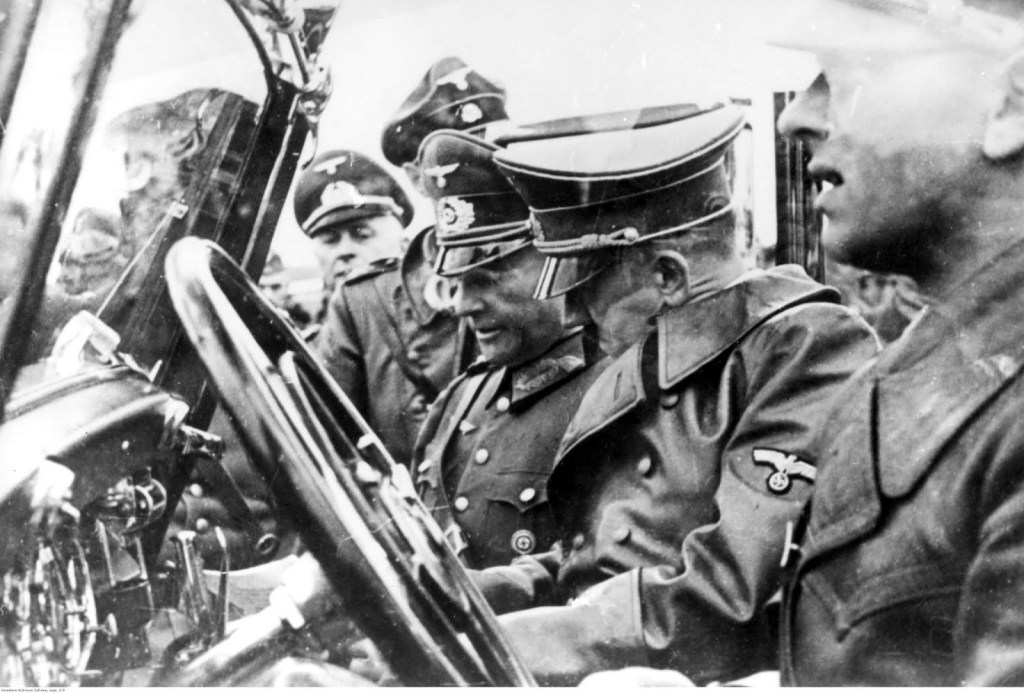
The Massacre in Zakroczym, Poland, took place on 28 September 1939 when, in spite of a cease-fire, soldiers of Panzerdivision Kempf stormed Polish positions at Zakroczym, where soldiers from the Polish 2nd Infantry Division were getting ready to surrender. Hundreds of Polish soldiers were murdered. The rest were beaten and abused. Many civilians were killed or wounded. German troops broke into houses, robbed them, set them on fire, and tossed hand grenades into the basements filled with scared civilians. Kazimierz Szczerbatko estimated, based on the testimony of the eyewitnesses, that the Germans killed around 500 soldiers and 100 civilians. The massacre may have been revenge for the Battle of Mława, in which the Germans suffered 1,800 killed, 3,000 wounded and 1,000 missing. Additionally, Panzer Division Kempf lost 72 tanks despite using Polish civilians as human shields, forcing them to be chased in front of their tanks.
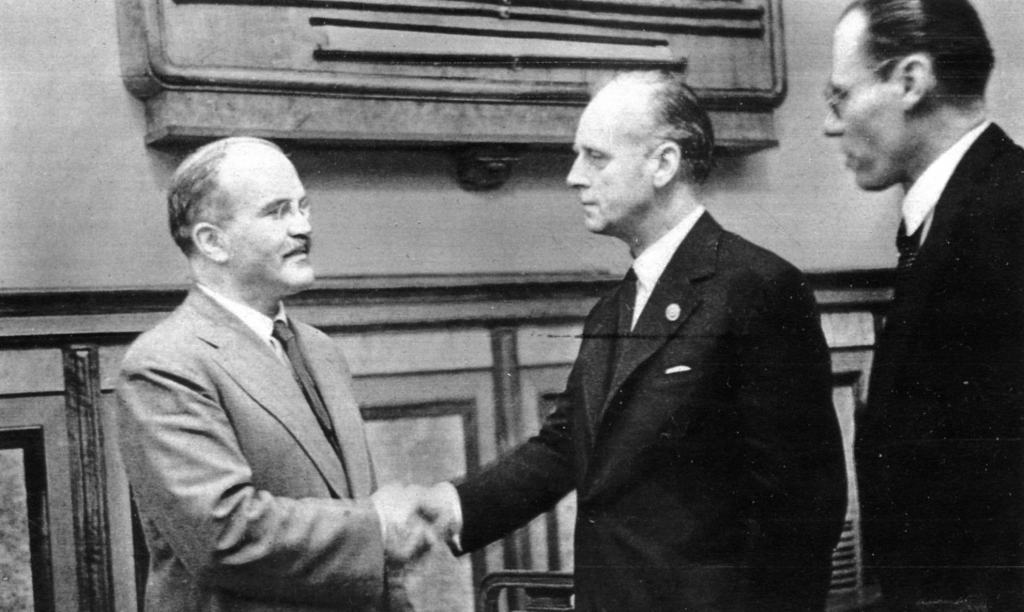
Germany and the Soviet Union signed the German-Soviet Frontier Treaty, amending a secret clause in the Molotov–Ribbentrop Pact. At Brest-Litovsk, Germans and Soviets sign the agreement denoting their common border in Poland. Poland is partitioned between Germany and the Soviet Union. During the fighting about 60,000 Polish soldiers have been killed; some 6,000 were Jews. Soviet Commissar for Foreign Affairs Vyacheslav Molotov and German Foreign Minister Joachim von Ribbentrop meet in Moscow to conclude the Treaty of Frontier Regulation and Friendship. At Soviet insistence, Lithuania is transferred from the German zone to the Soviet Union in exchange for land east of Warsaw to the Narew, Bug and San Rivers.
Vsevolod Merkulov sends his superiors in Moscow, Russia a report, noting that his NKVD Operational Group No. 1 has arrested 923 Polish officers, policemen, land owners, Ukrainian nationalists, etc. in eastern Poland. Many of them will die in the Katyn Massacre at the hands of the Soviet NKVD during the Spring of 1940.
The Soviet–Estonian Mutual Assistance Treaty was signed in Moscow. The Soviet Union and Estonia sign a 10-year “mutual assistance” pact giving the Soviet Union material, air bases, and military rights in Estonia. The Estonians have been given little choice in the matter. The Soviet Union gives an empty promise that it will not interfere with the Estonian internal affairs. Without necessitating any immediate change in the uncertain map of Europe the Estonian Republic virtually ceased to exist in the early hours of today. By the signature of two treaties, labeled “mutual assistance” and “trade agreement,” the little Baltic republic passed under the full domination of the Soviet Union and yielded to Russia naval bases and airdromes and the right to maintain military forces in Estonian territory.
She fully accepted the implications of Soviet assertions about the operations of mysterious, unidentified submarines in Estonian waters and handed to Moscow the keys to her security and national existence, which she had held since the collapse of Russian Czarism and the formation of the Soviet Union. The “mutual assistance” pact is to come into force upon the exchange of ratifications at Tallinn, the capital of Estonia, within six days. The pact is concluded for ten years. Unless it is denounced by either party within a year from the date of expiration, it is to continue for another five years.
It was signed by Premier and Foreign Commissar Vyacheslav M. Molotov of Russia and Foreign Minister Karl Selter of Estonia. The final form of Estonia’s political eclipse was “negotiated” within the walls of the Kremlin with the hapless Estonian Foreign Minister. While Germany’s Foreign Minister. Joachim von Ribbentrop, after a banquet at the Kremlin, sat watching the Russian Ballet in the Moscow Theatre, the little anticommunist state, which until now had been the playground of the Nazi forces, was handed over to the Russian colossus within a few months after her rejection of proposals to guarantee her frontiers against German aggression in the attempted Anglo-Franco-Russian peace front. It was rumored that Estonia had made a vain appeal to Germany at the eleventh hour.
General Wladislas Sikorski, former chief of the Polish General Staff and a former Premier of Poland, was appointed today Chief Commander of the Polish legions to be formed in France.
The British Admiralty, responding to the German propaganda of recent successes against British warships in the North Sea, declared that “no British ship has been damaged nor any casualties incurred from German aircraft.”
The Swedish steam merchant Nyland was stopped by gunfire and after the crew abandoned ship was torpedoed and sunk by the U-16, commanded by Hannes Weingärtner, about 45 miles northwest of Stavanger, Norway in the North Sea. Of the ship’s complement, all survived and were picked up by the Norwegian minelayer Olav Tryggvason. The 3,378-ton Nyland was carrying iron ore and was bound for Ramsgate, England.
The Norwegian steam merchant Jern was stopped by gunfire and after the crew abandoned ship was torpedoed and sunk by the U-32, commanded by Kapitänleutnant Paul Büchel, 65 miles west of Norway. Of the ship’s complement, all 14 survived and were picked up by the Swedish steam merchant Caledonia. The 875-ton Jern was carrying wood pulp and was bound for Northfleet, England.
U-22 spotted a British submarine at 2130hrs (Starship class). U-22 fired three torpedoes, but they all missed.
The British Admiralty declares that “no British ship has been damaged nor any casualties incurred from German aircraft.” The statement is in response to German radio reports of recent successes against British warships in the North Sea.
The War at Sea, Thursday, 28 September (naval-history.net)
Northern Patrol – light cruisers HMS Cardiff and HMS Dragon departed Scapa Flow on Northern Patrol duties, and arrived back 5 October.
British northern waters – U-18 and U-22 were ordered into the approaches to Scapa Flow.
British east coast – after a submarine was reported by British aircraft, destroyers HMS Fury, HMS Forester, HMS Foresight, and HMS Ashanti searched 55 miles ENE of Rattray Head.
Convoy FS.12 departed Methil and arrived at Southend on the 30th. There was no FS.13.
Light cruiser HMS Southampton and destroyers HMS Jervis and HMS Jupiter attacked a submarine contact outside May Island.
Convoy FN.12 departed Southend and arrived at Methil on the 30th. There was no FN.13.
Norwegian waters – U-32 sank Norwegian steamer Jern (875grt) 65 miles west of Skudesnes in 58-30N, 2-50E. No crew were lost and her 14 survivors rescued by the Swedish Caledonia.
U-16 sank Swedish steamer Nyland (3378grt) off Kvitsoey, 45 miles SW of Stavanger. Her survivors were rescued by Norwegian minelayer HNoMS Olav Tryggvason.
U-7 sank Norwegian steamer Solaas (1368grt) 25 miles SW of Lister Light. (DB – The German “Seekrieg” states that Solass was sunk next day on the 29th by Luftwaffe I/ZG26 in the North Sea. Editor: According to “Axis Submaríne Successes” by Rohwer, U-36 stopped Solass on the 28th, released her, but she sank next day, possibly mined)
English Channel – destroyer HMS Kempenfelt, escorting convoy OA.11, collided with steamer Hester (1199grt) off Newhaven. She was taken to Devonport for repairs which completed 7 November.
Destroyer HMS Impulsive on patrol in the English Channel was damaged by heavy seas, and taken to Devonport for repairs completed 23 October.
UK-France convoys – BC.6F of steamers Fenella, St Julien, Tynwald, and Ulster Prince departed Barry Roads escorted by destroyers HMS Keith and HMS Montrose and arrived safely at Quiberon Bay on the 29th.
Mediterranean – destroyers HMS Grenville, HMS Grenade, HMS Gipsy, and HMS Griffin departed Gibraltar on escort duties with convoy Green 3, consisting of 15 ships. Destroyers HMS Greyhound and HMS Glowworm were also at Gibraltar on this date, but not employed. The four escorting destroyers were relieved on 3 October by destroyers HMS Grafton and HMS Gallant and sloop HMS Deptford which continued with the convoy to Alexandria, arriving on the 7th.
Central and South Atlantic – French submarine Poncelet sighted German merchant ship Chemnitz (5522grt) at 0830, shortly after she departed Las Palmas, Canary Islands to return to Germany. She was stopped in 38-05N, 30-40W at 1305 and escorted to Casablanca, arriving 3 October. Chemnitz was renamed Saint Bertrand in French service and served in the French Merchant Marine until the fall of France when she returned to German hands. Between the 25th and 1 October, light cruiser Duguay Trouin had been searching for Chemnitz as well as steamer Amasis, both of which had been reported departing Las Palmas early on the 24th
Convoy SL.3 departed Freetown on the 28th September, escorted by light cruiser HMS Dauntless, both arriving at Gibraltar on 9 October. The convoy arrived at Liverpool on the15th.
Destroyers of the 4th Destroyer Division were ordered home from the South Atlantic. However, the order was cancelled on 1 October because of German raider activity in the South Atlantic.
Light cruiser HMS Danae departed Simonstown on escort duties and arrived back on 2 October.
Indian Ocean – light cruiser HMS Birmingham arrived at Singapore.
Pacific – New Zealand light cruiser HMNZS Achilles arrived at Buenaventura, Colombia and departed on the 30th, escorting steamer Orduna (15,507grt) to Callao, where they both arrived safely on 4 October.
In Washington, the Foreign Relations Committee decides to submit the Neutrality Bill to the U.S. Senate. Administration forces won an opening skirmish today in the neutrality fight when the Foreign Relations Committee, by a vote of 16 to 7, approved and sent to the Senate, the Pittman resolution repealing the arms embargo and substituting cash-and-carry a strict system for all American commerce with warring nations. The committee adopted only two substantial changes in the resolution as drafted last week-end. One was designed to give some relief to American ships and airlines serving British and French possessions in the Western Hemisphere and to trans-Pacific airlines flying between American ports and similar possessions in the Orient. The other, aimed to tighten the provision for ninety-day short-term commercial credits to belligerent purchasers of goods in this country.
The committee’s action, taken one week almost to the hour after President Roosevelt convened Congress in special session to buttress America’s neutrality in the new European war, made it certain that the prospectively historic debate on foreign policy would begin next Monday. Despite the favorable committee report, the measure faces a “hell-to-breakfast” fight from the Senate isolationists who are intent upon retaining the arms embargo against all countries at war.
Senator Barkley of Kentucky, majority leader, obtained the Senate’s consent at a brief session this noon for Senator Pittman, chairman, to file the committee’s official report during the weekend recess. The committee has been called to meet again tomorrow to polish up the language of the resolution, which will go before the Senate as a substitute for the Bloom bill passed by the House at the last session. Four of the committee majority which gave the favorable report reserved the right to seek amendment or vote against the resolution on the floor. Even with these exceptions the Administration gained a distinct advantage in avoiding further delay or an adverse recommendation in committee.
The isolationists did not make a stand in the committee room. They made no motions and offered no amendments. They hardly raised a voice in protest, preferring simply to record their votes and then wait for the open battle on the Senate floor where they propose to make a last-ditch fight against repeal of the mandatory embargo. Except for the proposed embargo repeal, the isolationists look upon the Pittman resolution with great favor, particularly because of the mandates it puts upon the President and Executive departments to maintain this country’s neutrality.
Opponents of the repeal of the arms embargo as proposed in the Neutrality Bill reported by the Foreign Relations Committee sharpened their weapons today and pressed forward their plans for a fight to retain the embargo as a basic national policy.
The tentative Republican platform made public tonight by the resolutions committee of the party’s State convention declares that the United States must remain neutral in the present war in Europe “whether neutrality is maintained under existing law or some proper and reasonable modification of that law.”
U.S. unemployment dropped 4.3 percent in August, the lowest rate since December 1937.
A survey finds the United States fears a Nazi attack; 63 percent in a Gallup study believe Hitler will extend the war if he defeats the Allies.
The prosecution at the court-martial of Grover Cleveland Bergdoll produced immigration records yesterday in an attempt to refute his testimony that he interrupted his exile in Germany and returned here to live seven years undetected while he was wanted as a World War draft-dodger.
Final broadcast of “The Fleischmann Hour” / “The Royal Gelatin Hour” was heard on NBC radio. First airing on October 29, 1929, the show quickly became a top-rated program, being one of the five most popular shows for every year between the 1929–30 and 1934–35 seasons (it was second only to Amos ‘n’ Andy during the 1930–31 season).
On this program, the American listening audience heard many future stars for the first time, as it introduced such talents as Milton Berle, Burns and Allen, Alice Faye, the Mills Brothers, Joe Penner, Kate Smith and Red Skelton. Gloria Swanson and Vincent Price made their radio debuts on the show. Other guests included Ray Bolger, James Cagney, Fanny Brice, Ilka Chase, Helen Hayes, Leslie Howard, Bert Lahr, Ethel Merman, Margaret Sullavan, Fay Wray and A. A. Milne. Edgar Bergen became the first ventriloquist to successfully perform on national radio when he and Charlie McCarthy initially appeared on Rudy’s show on December 17, 1936. Subsequent appearances led to their inclusion on The Chase and Sanborn Hour in May 1937. In 1937, at Vallée’s insistence, Louis Armstrong hosted the show during Vallée’s summer vacation. This made Armstrong the first African American to host a national network program.
Hawaiian Detachment, U.S. Fleet, is established in response to Japan’s continuing undeclared war against China that has been underway since 7 July 1937. The establishment of the Hawaiian Detachment, to be based at Pearl Harbor, necessitates changing the schedules of the supply ships and oilers needed to provide logistics support.
Dutch Leonard, portly knuckleballer, gained his twentieth victory of the year today for the sixth-place Senators, downing the Red Sox, 6–1, with six hits in the second contest of a double-header. Lefty Grove scored his fifteenth triumph of the season when he beat the Senators, 4–2, in the first game.
The New York Yankees and the Phialdelphia A’s also split their doubleheader today. The Yankees won the opener, 8–4, lifted by Joe Gordon’s two hoome runs, and one by George selkirk. The Athletics came back to take the nightcap, 5–4, winning on Sam Chapman’s line-drive homer in the top opf the ninth.
Pie Traynor resigned as manager of the Pittsburgh Pirates.
The Cincinnati Reds clinched the National League pennant with a 5–3 win over the St. Louis Cardinals. Starting the day with a 2½ game lead, host Cincinnati clinches the pennant with the Reds’ Paul Derringer defeating the 2nd-place St. Louis Cardinals, despite allowing 14 hits. It is Derringer’s 25th win. He also drives in the go-ahead run in the 6th with a single. Harry Craft adds an 9th-inning home run. It’s the first pennant for the Reds in twenty years.
The Brooklyn Dodgers and Boston Bees split a pair. An effort by the Dodgers to escape from fourth place was foiled today by Richard Merriwell Errickson when he hurled the Bees to a 3–1 triumph in the first game of a double-header. But Toto Tamulis hurled a three-hitter and the Dodgers won the nightcap, 3–0.
The New York Giants and Philadelphia Phillies combine for a record setting 13 double plays in their doubleheader. The mark will be tied on September 6, 1948. New York sweeps winning 4–3 and 8–3. Billy Jurgess has five RBIs on two doubles and a single in game two.
Gandhi asks Britain to state its war aims, and to make Indian independence one of them.
The Russo-Japanese armistice has allowed Japan to reduce her forces in Manchukuo by withdrawing troops moved north from China during the worst of the border fighting. Both armies are delighted to be able to return to normal barracks. The Mongolian border is one of the coldest places on earth, and neither Japanese nor Russians enjoyed the prospect of a Winter on these windswept plains at thirty degrees below zero. When the necessary formalities have been completed and stores removed, both armies will leave the border. Japanese and Russian officers are carrying out the armistice arrangements in a friendly spirit that reflects their relief at escaping the frigid Mongolian solitudes. Since the “ceasefire” order was sounded the entire frontier has been quiet. With Japan busy in China and Russia marching in Europe, its peace looks secure for several years.
No reduction is being made in Japan’s regular forces in Manchukuo. The Kwantung army has a definite role, not only in the defense of Manchukuo, but in Japan’s general defensive scheme against Russia. Numerically it is too small to cope with a serious Russian invasion, but it is strong enough to hold a pass while the main armies are preparing. Its strength has been fixed for that definite task, and its numbers cannot be materially reduced unless Russo-Japan relations change remarkably. If the Soviet reduces the Far Eastern Red Army to any appreciable degree, the Japanese will follow suit. Meanwhile Japanese Army chiefs regard such a change as merely a theoretical possibility.
It is difficult to explain five months of fighting as a frontier. dispute, yet neutral experts surveying the history of the affair do not believe it originated as a form of intervention in China. Undoubtedly, it developed into a military diversion that sometimes threatened to embarrass Japan’s freedom of action, but this was incidental.
Russia’s purposes, according to those experts, were limited and were dictated by her relations with Outer Mongolia and the latter’s place in Russia’s Far Eastern strategy. Outer Mongolia is a defense against flank movements from the south against the Siberian Railway. The Russian answer to the establishment of Manchukuo was a mutual assistance treaty with Mongolia. Refusing to accept the frontier claimed by Japan, Russia was defending her own interests more than Mongolia’s. How far the Soviet determination not to accept an indefensible frontier was influenced by the Mongols’ needs in the matter of access to grazing lands is not known, but the Russians were determined not to accept an unfavorable frontier and countered every Japanese move.
Japanese troops reached the outskirts of Changsha, Hunan Province, China; the Japanese had thus far suffered 40,000 casualties on this assault. Japanese forces advancing on Changsha are reported to have been halted by a stiffening of Chinese resistance about fifty miles north of the Hainan capital. The Chinese declared two Japanese columns advancing along the Hankow-Canton railway line were checked at Paishui, and forces pushing along the Siang River were stopped just north of Hsiangyin. The Japanese are said to be rushing up reinforcements in an effort to continue their advance.
Chinese dispatches say the Kiangsi-Hunan border column, attempting a wide flanking movement northeast of Tungcheng, was repulsed before it cut the highway from Hsiushui through Pingkiang to Changsha. The Chinese rebut Japanese Shanghai claims that a Chinese army of half a million men has been trapped in Northern Hunan. They say a glance at the Japanese and Chinese positions will show the Chinese have the greatest freedom of movement and are not in the least danger of being surrounded.
Despite low-hanging clouds, Japanese planes raided Chungking twice last night.
Neither the Japanese nor the Americans show much interest n Chinese Foreign Minister Wang Chung-hui’s proposal to put the conflict in China to U.S. mediation. The Japanese find the idea unacceptable; Cordell Hull finds it impractical.
Dow Jones Industrial Average: 151.12 (-1.96).
Born:
Rudolph Walker, Trinidadian-born British actor (“Love Thy Neighbour”), in San Juan, Trinidad, West Indies.
Chon Gallegos, AFL quarterback (Oakland Raiders), in Gallup, New Mexico.
Died:
Martha Root, 67, American Bahá’í teacher.
Felicjan Szopski, 74, Polish composer.
Naval Construction:
The Royal Navy Bar-class boom defense vessel HMS Barcote (Z 52) is laid down by the Blyth Shipbuilding & Drydock Co. Ltd. (Blyth, U.K.).
The U.S. Navy (163-foot steel hull) submarine chaser USS PC-451 is laid down by the Defoe Shipbuilding Co. (Bay City, Michigan, U.S.A.).
The Regia Marina (Royal Italian Navy) Capitani Romani–class light cruisers Attilio Regolo, Scipione Africano, Caio Mario, and Claudio Tiberio are laid down by O.T.O., Livorno, Italy. Only the first two are commissioned. Caio Mario is launched incomplete and used by the Germans as an oil bunker after the Italian surrender. Claudio Tiberio is cancelled and scrapped on her slip in 1941.
The Regia Marina (Royal Italian Navy) Capitani Romani–class light cruiser Ulpio Traiano is laid down by CNR, Palermo, Italy. Sunk before commissioning 3 January 1943 by British human torpedo attack while fitting out in Palermo.
The Royal Navy Dragonfly-class river gunboat HMS Locust (T 28) is launched by Yarrow Shipbuilders Ltd. (Scotstoun, Scotland).
The Kriegsmarine (German Navy) auxiliary minesweeper M 1507 Teutonia is commissioned.
The Kriegsmarine (German Navy) vorpostenboot V 209 Carl Röver (later V 203 Carl Röver) is commissioned.
The Kriegsmarine (German Navy) vorpostenboot V 210 R. Walther Darré (later V 208 R. Walther Darré) is commissioned.
 History Diaries