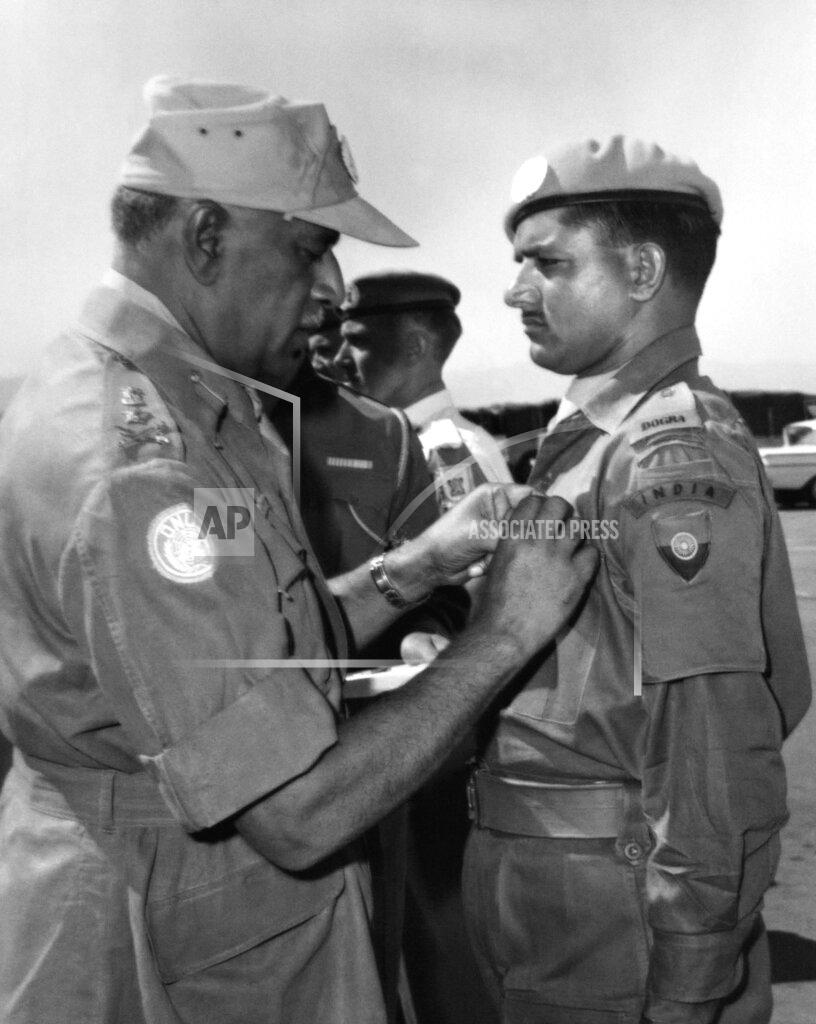
President Johnson said tonight that he does not want to get American soldiers “into a war with 700 million Chinese.” In answer to suggestions by Senator Barry Goldwater and others that the United States carry the war in South Vietnam to the North, Mr. Johnson said: “Before I start dropping bombs around the country, I would want to think about the consequences of getting American boys into a war with 700 million Chinese.” The President said the loss of 190 American lives in Vietnam was bad.
“But it’s not like the 190,000 we might lose the first month if we escalated that war,” he declared. “We’re not going north and drop bombs at this stage of the game, and we’re not going south and run out and let the Communists take over either.” Mr. Johnson, speaking to New Hampshire weekly newspaper editors, said the suggestion to carry the war in Vietnam to the North had been advanced by Senator Goldwater, Governor Rockefeller, Governor William W. Scranton of Pennsylvania and others. It was the first time the President had mentioned the name of Senator Goldwater, his Republican opponent in the Presidential race, since the campaign opened.
The situation in South Vietnam appears to have reached the most critical stage since the United States began its massive military support there three years ago. Adjectives such as “bleak” and “pessimistic” have been used frequently by officials to characterize the picture as South Vietnam slides slowly into a chaotic factionalism. The concern centers not so much on the military situation in the war against the Communist guerrillas as on the apparently increasing weakness of the government in facing a rise in religious, labor, tribal and army dissidence. Observers note that these splits have long been an integral part of Vietnam’s structure, but the rifts have been growing wider under the strain of constant warfare. Communist agitators have taken advantage of the ferment and have, at the least, participated in some of the demonstrations. But the main problem is a weak political structure and war‐weariness.
Major General Nguyễn Khánh succeeded today in quelling a week‐long rebellion by mountain tribesmen in South Vietnam’s Central Plateau. A Government spokesman said Premier Khánh had flown into an outpost of the rebellious Rhade tribesmen at Bon Sar Pa for a flag‐raising ceremony planned to reassert the Government’s authority. A few hours earlier two companies of paratroopers and rangers entered the camp where the warrior‐tribesmen had held out since September 20 as an expression of their grievances. The tribesmen, who are an ethnic minority, contend that they are suppressed by the Vietnamese majority. Many of the tribesmen have been trained by American Special Forces are irregular mountain fighters for the war against the Communists.
Fearful that a clash might develop between the tribesmen and the arriving Vietnamese troops, the United States command decided to evacuate 13 Americans at the Bon Sar Pa camp. Seven of them had remained in the camp throughout the revolt to mediate and provide an avenue of communication. According to reliable sources, Premier Khánh was unable to meet the main leaders of the revolt, who had apparently disappeared from Bonsarpa camp. However, through government officers of Rhade extraction, negotiations to raise the tribesmen’s status are going on at five border‐control camps where the rebels had raised the own flags a week ago.
Crosscurrents of political unrest in the area from Huế to Nha Trang have threatened the Government’s local authority since street fighting erupted a month ago. Youths have demonstrated almost weekly, and Saturday night, according to reliable reports, the tension turned once more into violence in Quy Nhơn, in the Central Region.
After day‐long demonstrations in outlying villages, a militiaman in Tuy Phước village reportedly fired a rifle grenade info a menacing crowd of 100. One person was killed and seven were injured. Early yesterday, 43 small buses of Tuy Phước residents drpve into Quy Nhơn to demand the arrest of the lieutenant commanding the militia detachment. They seized the government radio station to broadcast their grievances against local officials who had served Ngô Đình Diệm when he was President. Order was restored by nightfail after two battalions of government infantrymen were flown into Quy Nhơn. There were no official statements from the Vietnamese Government on the Quy Nhơn incidents. Premier Khánh flew back to the capital from Bon Sar Pa tonight.
Pope Paul VI, in a letter to the Roman Catholic Archbishop of Saigon, has made “an urgent appeal” for an end to fratricidal violence in South Vietnam. The Pope’s letter to the Archbishop, the Most Rev. Paul Nguyễn Văn Bình, was apparently evoked by recent bloodshed between Roman Catholics and Buddhists, although it spoke only generally of “Fratricidal violence.” The letter, dated September 4, was released by Catholic officials today.
Unexpected confidence and cheer have prevailed in the Laotian capital of Vientiane since Prince Souvanna Phouma’s return last week from Paris where the neutralist leader conferred with spokesmen for the right‐wing and leftist factions of Laos. The breakdown of the Paris talks has borne out predictions by the right‐wing military leaders and United States observers who had been skeptical of the meetings. A typical reaction was voiced today by Phoui Sananikone, president of Laos’s National Assembly. Asked whether the Palis negotiations might yet produce results, he answered happily, “Never!” He added, “The Pathet Lao are too far under the control of the Communists.”
Among the Laotian neutralists whose thinking approaches, though it does not parallel, that of the rightists, satisfaction also has been expressed. The neutralists believe that Prince Souvanna Phouma, the Premier, acquitted himself well in Paris, insisting on his preconditions for another Geneva conference and resisting the suggestions of the French. The leftists want a reconvening of the 14‐nation Geneva conference of 1962, which arranged for the organization of a coalition regime of leftists, rightists and neutralists in Laos. That coalition came apart when the pro‐Communists later withdrew and sporadic fighting has been going on ever since.
The Premier’s candor about the Paris sessions has occasioned some amusement at the expense of the French. On his return, for example, Prince Souvanna Phouma said that he had agreed for only one reason to meet with his half‐brother, Prince Souphanouvorig, the head of the pro‐Communist Pathet Lao. Since the French had gone to all the trouble and expense of providing a site for the meetings, he said, he had felt it would he impolite not to meet together at least once. Prince Souvanna Phouma flew today to Luang Prabang, the royal capital, to report to King Savang Vatthana on his trip. In the last few days the neutralist Premier who will celebrate his 63d birthday next month, has attended a variety of diplomatic receptions, always in unusually high spirits.
Soviet leaders celebrated today the centenary of the First International with appeals for unity in the Communist world. In an anniversary meeting at the Bolshoi Theater, Premier Khrushchev called on “all fraternal parties, all revolutionary forces to close up their ranks even more.” In a major speech that followed Mr. Khrushchev’s introductory remarks, Boris N. Ponomarev, one of the Soviet party’s secretaries, said the present trend toward disunity in the Communist world was not in the nature of the Communist system.
He said “certain centrifugal tendencies” resulted in part from the Stalin period and in part from the “novelty of the transition to socialism” in countries having different social, economic and cultural levels.” Mr. Ponomarev did not give specific examples of the centrifical tendencies to which he referred, but one obviously involved the ideological dispute now raging between the Soviet and Chinese Communists over interpretation of Marxist doctrine.
The Communist party newspaper Pravda said today the Chinese Communist leaders had assumed the role of the main adversaries of proletarian internationalism and of the unity of the world’s revolutionary movement.
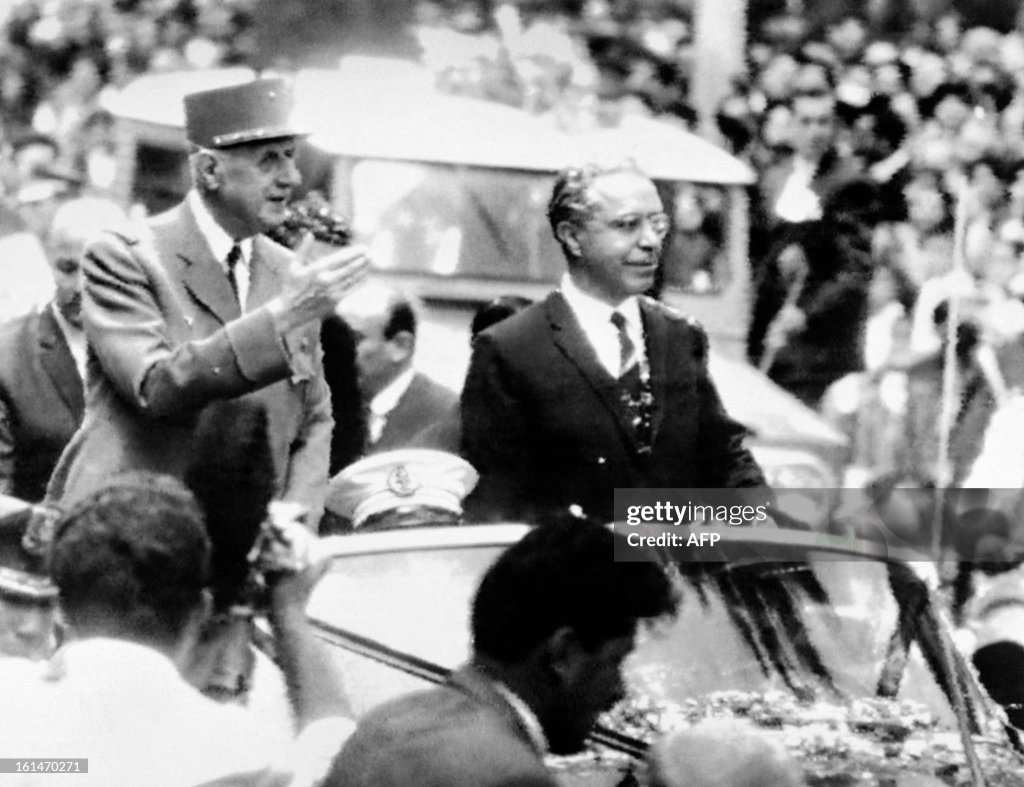
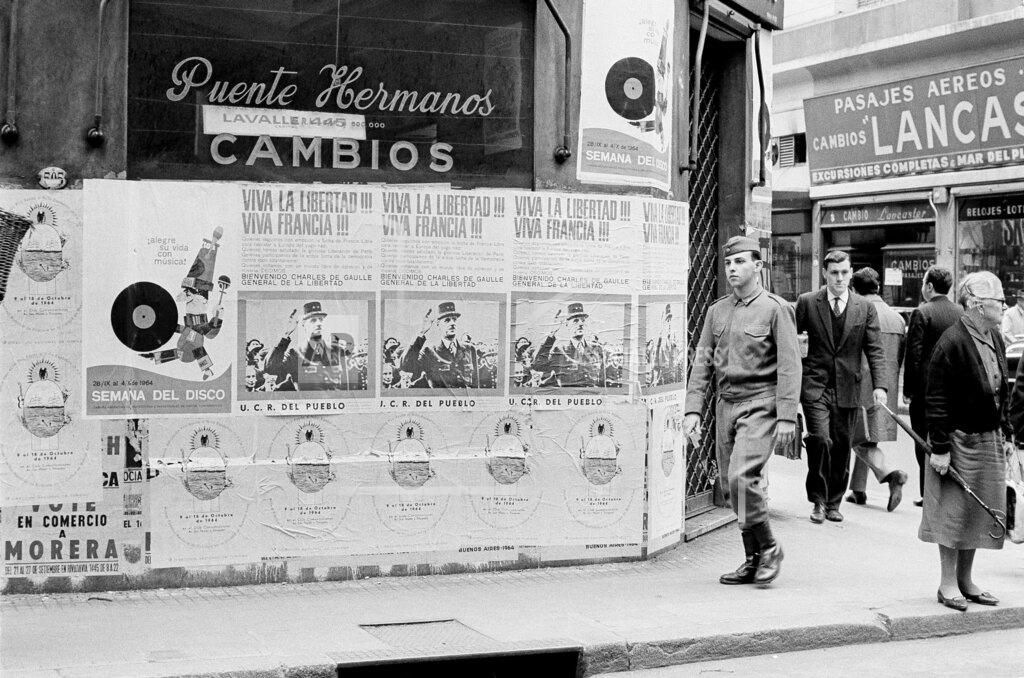
French President Charles de Gaulle was welcomed to Bolivia today by cheering crowds and an embrace from President Victor Paz Estenssoro.
Brigadier General Adib Shisekly, a former President of Syria, was shot to death today on a street in Ceres, a farmer center in the state of Goias, in the interior of Brazil. The killing was thought to be political.
Suriname governor A. Currie resigns.
Republican presidential nominee Barry Goldwater announced that his leading choice for his Secretary of State would be Richard M. Nixon. Sources close to the campaign told reporters that other picks by a President Goldwater would be former General Electric chairman Ralph J. Cordiner for Secretary of the Treasury; retired U.S. Army General Lucius D. Clay for Secretary of Defense; campaign aide F. Clifton White for Attorney General; Idaho Governor Robert E. Smylie for Secretary of the Interior; Nebraska U.S. Senator Carl Curtis for Secretary of Agriculture; Motorola CEO Robert Galvin for Secretary of Commerce; and Clare Boothe Luce for Secretary of Health, Education and Welfare. No names were under consideration at the time for Secretary of Labor.
The Senate approved a plan today for the replacement of an ailing President and for keeping the office of Vice President filled. With fewer than a dozen members present, a voice vote approved a proposed constitutional amendment, which usually calls for a formally recorded two‐thirds Congressional vote, backed up by ratification by three‐fourths of all the states. Today’s vote in the midst of heavy absenteeism fanned by the adjournment drive, however, was not expected to be challenged. It sounded unanimous, but apparently can result in little more than a Senate expression. The House, which has similar legislation, has not even held hearings on a sheaf of largely conflicting proposals. No one would admit seeing a chance of final action there during this Congress. Leaders were still pressing for a sine die adjournment by next Saturday, but hope appeared to be slipping. Speaker John W. McCormack said he was “not optimistic.” There was still much work to be done by both chambers for completion of Administration programs now in advance positions. The proposed constitutional amendment would apply under conditions such as the following:
– If a President were removed from office by death or resignation, the Vice President, as under the present constitutional formula, would become President.
– Whenever there was a vacancy in the office of the Vice President, the President would nominate a Vice President who would take office upon confirmation by a majority vote of both houses of Congress.
– If the President declared in writing that he was unable to discharge the powers and duties of his office, such powers and duties would be discharged by the Vice President as Acting President.
– If the President did not so declare, and the Vice President, with the written concurrence of a majority of the heads of the executive departments (the Cabinet) or such other body as Congress might provide by law, transmitted to Congress his written declaration of Presidential inability, the Vice President would immediately take the post as Acting President.
– Whenever the President transmitted a written declaration to Congress that no inability exists, he could reassume his powers and duties unless the Vice President, with the written concurrence of a majority of the heads of the departments, declared to Congress within two days that the President was in fact disabled.
– Thereupon Congress would immediately decide the issue. If Congress determined by a two-thirds vote of both houses that the President was not able to resume his duties, the Vice President would continue to discharge them as Acting President. Otherwise the President would resume the powers and duties of his office.
The complete complement of Senators who were here was not represented by far in the final voting on the proposed amendment. Earlier, 51 members responded to a quorum call, although some time was required to muster them. The House did not try to see whether a quorum was in town. It adjourned until tomorrow after a 17‐minute session made up of one‐minute speeches and reports from the Senate. Senator Jacob K. Javits, Republican of New York, noted that the Senate amendment action was coming within 24 hours after the publication of the Warren Commission report on the assassination of President Kennedy. “I hope,” he said, “that this will focus the attention of the American people on the importance of the Vice‐Presidency.”
The special committee appointed by President Johnson to go over the Warren Commission’s recommendations will probably hold its first meeting tomorrow. Officials said today that the committee wanted to get to work as quickly as possible. It was unable to meet today because one of the four members, John A. McCone, director of the Central Intelligence Agency, was out of the country. The other members are Douglas Dillon, Secretary of the Treasury; Nicholas deB. Katzenbach, Acting Attorney General, and McGeorge Bundy, special assistant to the President for national security affairs. Whether there will be any special staff remains to be decided. For the present, Mr. Dillon’s office is handling all arrangements.
The Secret Service, which has the main responsibility for protecting the President, is in the Treasury Department. It was the Secret Service that received the heaviest criticism yesterday in the report of the President’s Commission on the Assassination of President Kennedy, headed by Chief Justice Earl Warren. The commission called for more agents and much more complete preventive systems in the Secret Service, Among other things, it said manual files should be replaced by an electronic data‐processing system.
The Presidential committee, appointed yesterday, will study the needs of the Secret Service. It may also go into the broader question — raised but not answered by the Chief Justice and his fellow commissioners — of whether the service’s whole role in protecting the President should be transferred to another agency. One Warren Commission proposal that could get a quick response in Congress is for legislation making attempts on the life of the President or the Vice President a Federal crime.
President Johnson flew to Boston early this morning for a 35‐minute visit with Senator Edward M. Kennedy, who suffered a broken back in a plane crash. “The Senator was very cheerful,” Mr. Johnson said. “He was in wonderful spirits.” The President was accompanied by Mrs. Joan Kennedy, the Senator’s wife. Mrs. Johnson stayed at the airport. Mr. Johnson said he and Senator Kennedy discussed a wide range of topics including the election, the record of Congress and Vietnam.
The investigation into the financial affairs of Robert G. Baker reopens Thursday, with a public hearing on charges of a $35,000 contract kickback. The chairman of the Senate Rules Committee, B. Everett Jordan, Democrat of North Carolina, said he did not have a list of witnesses for the hearing as yet, but indicated there was a possibility it could go into a second day. Senator John J. Williams, Republican of Delaware, recently asserted that a Philadelphia contractor, Matthew H. McCloskey, overpaid a performance bond on building the D. C. Stadium in Washington, $25,000 of which was scheduled to go to the 1960 Democratic campaign fund through Mr. Baker. Mr. Baker, former secretary to the Senate Democratic majority, resigned after the initial inquiry started.
The first nuclear deterrence patrol by a James Madison-class submarine with the longer range Polaris A-3 missiles began as the USS Daniel Webster left the Polaris Missile Facility Atlantic (PomFlant) at Charleston, South Carolina.
Australia (represented by Roy Emerson and Fred Stolle) won the 1964 Davis Cup international tennis tournament, taking back the Cup from the United States team (Chuck McKinley and Dennis Ralston) in the fifth match of five. With the meeting in Cleveland tied at two matches apiece, Emerson lost the first set, 3-6, then beat McKinley 6–2, 6–4 and 6–4.
Sadaharu Oh hits his 55th home run of Yomiuri’s 130-game season. It is his highest total and a Japanese record.
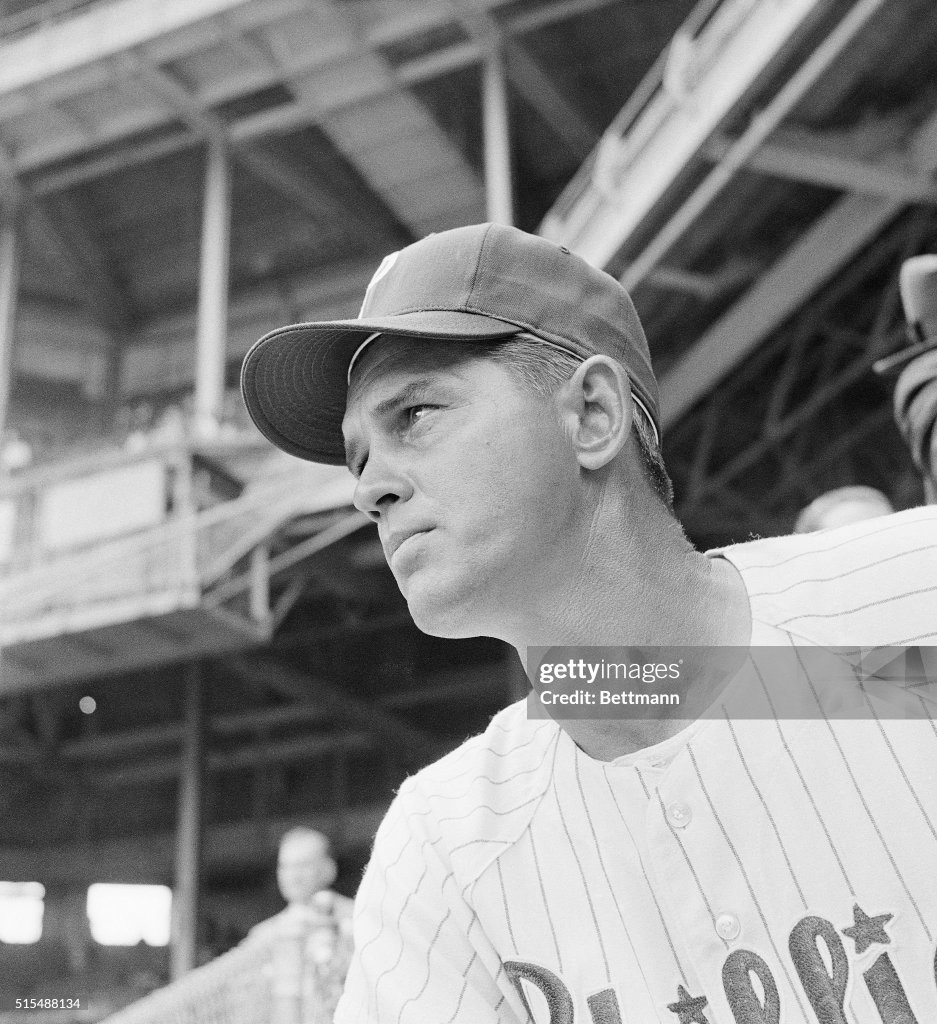
The Philadelphia Phillies drop to third place when they lose in St. Louis, 5–1. The Cardinals’ Bob Gibson is the winner over a tired Chris Short. It is the Phillies’ eighth-straight loss, and the Cardinals’ sixth consecutive win. The Cardinals have move into second place, one game behind the Cincinnati Reds. Gibson had permitted the Phillies only four singles and a double to gain his 18th victory of the season and his eighth in his last nine starts. He got relief help from Barney Schultz to close out the ninth.
Dick Tracewski, a pinch‐hitter, looped a single to right in the eighth inning tonight to score Bart Shirley with the deciding run in a 2–1 Los Angeles Dodger victory over the Chicago Cubs. The game was witnessed by the smallest Dodger crowd in the history of the Chavez Ravine Stadium — 11,808. The Cubs rallied in the ninth, with men on first and third and only one out. But Ron Perranoski worked out of trouble with the help of fine defensive plays by Wes Parker and Tracewski.
NFL Football:
Green Bay Packers 14, Detroit Lions 10
The Detroit Lions could not get untracked tonight and were beaten, 14–10, by the Green Bay Packers before the largest professional football crowd in Detroit history, 59,203. The Packers’ powerful defensive unit held the Lions to a field goal for the first 56 minutes. Then the Lions marched 80 yards to score their lone touchdown on a 15-yard pass to Pat Studstill and get back into the game. After forcing the Packers on to punt, the Lions gained control with less than 2 minutes left on their own 32‐yard line. But Studstill fumbled a pass and Willie Wood recovered for the Packers to wrap up the victory. All the Packers’ scoring occurred in the second quarter. Bart Starr, before he suffered a shoulder injury that forced him out early in the second half solved the Detroit defense with accurate passing and shifty running. Green Bay took a 14–3 halftime lead by marching 47 and 58 yards to score, first on a 2-yard run by Paul Hornung, then on a five-yard run by Starr. Wayne Walker kicked a 45-yard field goal for Detroit.
Dow Jones Industrial Average: 875.46 (+0.75).
Born:
Janeane Garofalo, American comedienne and film actress (“Saturday Night Live”, “Truth about Cats & Dogs”); in Newton, New Jersey.
Susan Walters, American actress (‘Lorna’- “Loving”, ‘Mary Beth’- “Dear John”), in Atlanta, Georgia.
David Fulcher, NFL safety (Pro Bowl, 1988-1990; Cincinnati Bengals, Los Angeles Raiders), in Los Angeles, California.
Greg Lasker, NFL defensive back (NFL Champions, Super Bowl 21-Giants, 1986; New York Giants, Chicago Bears, Phoenix Cardinals), in St. Louis, Missouri.
Died:
Harpo Marx, 75, American comedian and the second oldest of the Marx Brothers team. Born as Arthur Marx, Harpo was the one member of the group who did not speak during his performances.
Adib Shishakli, 55, former President of Syria who had been forced to flee into exile after eight months of brutal rule, was shot to death by a man had been orphaned by Shishakli’s bombing of Druze Muslim settlements. Nawaf Ghazaleh traced Shishakli to Brazil, located him in the small city of Ceres, and had lunch with him at a downtown restaurant. As they walked out, Ghazaleh drew a pistol and shot the former president twice, then jumped into his car and drove out of town.
George Dyson, 81, British composer.
Nacio Herb Brown, 68, American composer best known for the melody of “Singin’ in the Rain” in the film of the same name.
 History Diaries