The Battle of Władypol was fought, resulting in Soviet victory. The Battle of Władypol was an armed engagement near the town of Sambor. It was among the last cavalry battles of 1939 and one of the last large-scale battles in Central Poland. After the Battle of Tomaszów Lubelski General Władysław Anders’ Cavalry Operational Group (Polish: Grupa Operacyjna Kawalerii) consisting of his own Nowogródzka Cavalry Brigade as well as two regiments (1st KOP Cavalry and 22nd Cavalry) of Kresowa Cavalry Brigade and other units was one of the very few Polish units to escape encirclement. General Anders decided to break through towards Hungary.
On 25 September General Anders’ force reached the village of Wólka Horyniecka, already manned by a German garrison. Anders dispatched envoys to the German commander and the Germans allowed the Polish force to pass through unopposed towards Hungary in exchange for setting free German prisoners of war taken during the battle of Krasnobród, among them General Rudolf Koch-Erpach.
On 26 September 1939 Anders gathered his forces around Krakowiec, and ordered his cavalry to advance southwards, through Lubienie, Borów, Siedliska, Lipniki and Radenice. The unit moved unopposed as the German forces have already started their withdrawal towards the so-called “border of peace”, or a Soviet-German demarcation line established in the Molotov–Ribbentrop Pact, thus leaving a narrow strip of unoccupied land. However, although the Polish unit was still a coherent force of some 2,500 men, most of the soldiers have been on the front line for almost four weeks without rest. The Polish column moved all night; the commanders feared that if they allowed their men to dismount, they would fall asleep and it would be impossible to wake them back up. Overnight the column captured two Soviet lorries travelling towards Mościska, but their drivers did not disclose the location of the nearest Soviet units.
The following morning the Polish unit reached the Hill 292 right outside the village of Władypol, some 15 kilometers (9.3 mi) north of the city of Sambor and 120 kilometers (75 miles) from Hungarian border. The village has already been taken by advanced Soviet forces of Gen. Ivan Tyulenev’s 12th Army. As there was officially no state of war between Poland and the Soviet Union, and the advancing Soviet troops often informed local populace that they entered Poland to help the Polish Army against the German invaders, Anders dispatched Capt.ain Kuczyński as an envoy to the Soviet commander, but the envoy was robbed of all his belongings by Soviet soldiers and barely escaped with his life. Soon after his return the Soviets attacked.
A meeting engagement ensued in which the Polish 26th Cavalry Regiment repelled the Soviet cavalry and tank units. Simultaneously a larger Soviet force appeared in the vicinity of Chliple (modern Khlipli), some 5.5 kilometers (3.4 miles) to the northeast. It was stopped by a combined force of 25th Cavalry and the 9th Mounter Artillery Regiment passing through the village of Wola Sudkowska, halfway between Chliple and Władypol. The Polish force captured Chliple and held out against the Soviets long enough for the rest of the column to pass further south, but Polish artillery exhausted all its ammunition and the guns had to be destroyed by their crews to prevent their use by the enemy.
The Polish force withdrew further south, towards the Błażenka Nowa stream, but the Soviets attacked once again between Władypol and the village of Rajtarowice, some 6 kilometers (3.7 miles) west. A combined cavalry and tank force composed of the entire 34th Cavalry Division and elements of 32nd Cavalry Division. The Poles withdrew westwards, to a large forest to the north of Rajtarowice.
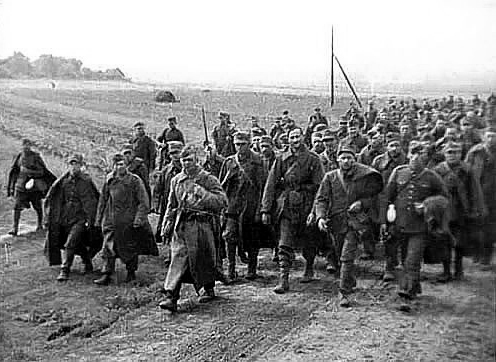
Seeing no chances to defeat yet another Soviet unit, General Anders called up a war council in a forester’s hut Jordanówka near Władypol and ordered his units disperse and try to break through the Soviet units on their own. The 26th Cavalry Regiment with Anders himself in charge was to man the forest for as long as possible to cover the withdrawal. However, in the chaotic withdrawal most Polish forces, roughly 1,500 men, were taken prisoner of war by the Soviets.
Anders, by then wounded twice, withdrew together with a group of roughly 250 men. They broke through to the assembly point, but failed to recover contact with the remaining regiments. Surrounded by the Soviet forces once more on September 29, he dispersed his group onto groups of 10 and ordered his men to either return home or try to break through towards Hungary on their own. He was wounded for the third time soon afterwards and was captured by the Soviets. He was among the very few high-ranking Polish officers to survive the Katyn Massacre of the following year.
In Warsaw, General Walerian Czuma had managed to gather enough forces and war material to successfully defend the city for several weeks longer. However, the situation of the civilian inhabitants of Warsaw became increasingly tragic. Constant bombardment of civilian facilities, lack of food and medical supplies resulted in heavy casualties among the city’s population. The water works were destroyed by German bombers and all boroughs of Warsaw experienced a lack of both potable water and water with which to extinguish the fires caused by the constant bombardment. Also, the strategic situation became very difficult. The Soviet Union’s entry into the war and lack of support from the Western Allies made the defence of the city pointless and heavily demotivated the volunteers in participating in any further military actions.
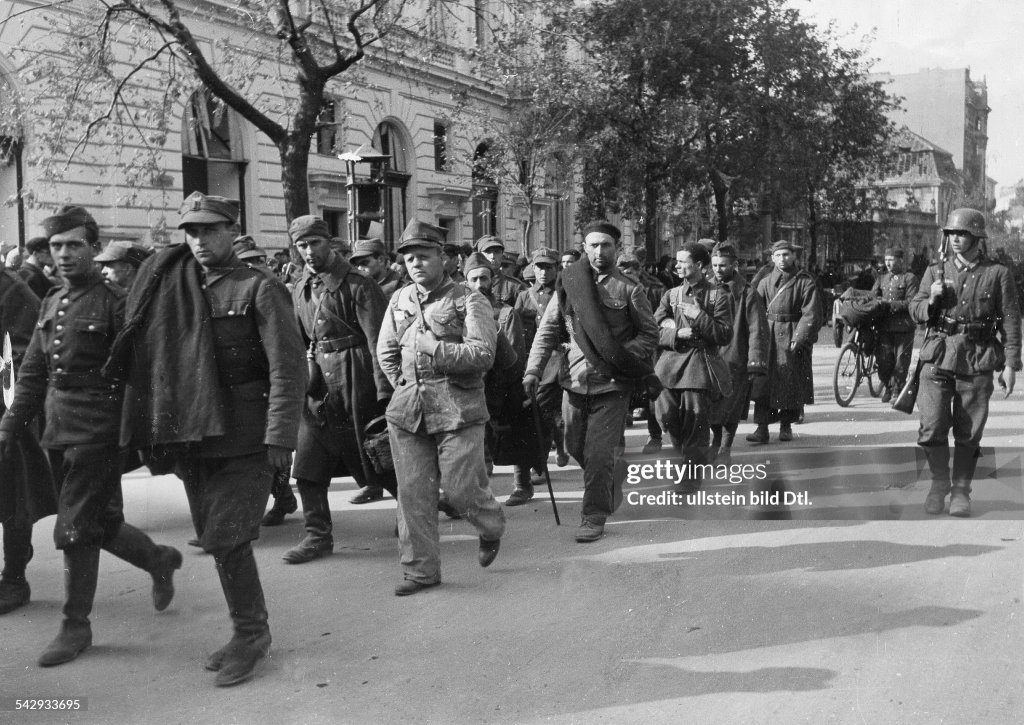
Warsaw capitulates after 26 days of bombardment and 11 days of siege. At 12 p.m. General Johannes Blaskowitz accepts the surrender of the Polish garrison and a cease fire agreement is signed in a railway car on the edge of Warsaw. 160,000 men, soldiers and civilians, are taken prisoner. After a grueling defense and destructive bombardment, the Polish forces in Warsaw surrender and significant Polish opposition comes to an end, although Polish forces east of the Vistula will not surrender until October 5th. Some surviving Polish forces cross the frontier into Romania. The German armed forces ‘combined arms’ tactics proved remarkably successful and determined the outcome of the campaign within the first ten days of the fighting.
Several units declined to put down their weapons and cease fire, and their commanding officers had to be visited by Generals Czuma and Juliusz Rómmel personally. On September 29, the garrison of Warsaw started to hide or destroy their heavy armament. Some of the hidden war material was later used during the Warsaw Uprising. On September 30, the evacuation of Polish forces to German prisoner of war camps started and, the following day, German units entered the capital. The city was occupied until January 17, 1945.
The siege has resulted in the deaths of some 2000 Polish soldiers and 10,000 civilians. A total of 40,000 people are believed to have been killed or injured. About one eighth of the buildings in the city have been destroyed. German forces take about 150,000 prisoners. General von Blaskowitz, who received the Polish surrender, allows the Polish officers to keep their swords and promises that the troops will only go into captivity for as long as it takes to “dispose of the necessary formalities.” The terms of the capitulation provide for the immediate relief of the civilian population and the wounded.
The first Polish resistance movement, the Służba Zwycięstwu Polski (“Service for Poland’s Victory”), was created. It was created by the order of general Juliusz Rómmel on 27 September 1939, when the siege of Warsaw, capital of Poland, where Rómmel commanded Polish defence, was nearing its end (Warsaw would capitulate on 28 September). The commander of SZP was General Michał Karaszewicz-Tokarzewski. This secret organisation was tasked with the continuing of armed struggle to liberate Poland in the pre-war borders of the Second Polish Republic, recreation and reorganization of the Polish army and establishment of the secret government (Polish Underground State). In November 1939 SZP was renamed Union of Armed Struggle (ZWZ).
In late September in the village of Urycz ca. 100 Polish POWs were imprisoned and then burnt alive in a burn. 25 Jews were forced to bury them and after that they were murdered as well. This happened in revenge for the fact that one Polish Lt. (POW) during investigation pulled out a pistol from the holster of Hauptwachtmeister (and Kompaniechef) Paul Golla who was investigating him and killed him, commiting suicide after that.
Near Grabowiec, Poland, the Soviets execute 150 Polish wounded prisoners of war and policemen.
Representatives of the German Gestapo organization and the Soviet NKVD organization meet at Bugiem, Poland (now Brest, Belarus) to coordinate the suppression of Polish resistance efforts.
Lithuania annexes the Vilna region of Poland.
The Polish government in exile under Wladyslaw Raczkiewicz is formally established in Paris, France.
The Reichssicherheitshauptamt (“Reich Security Main Office”) was created under the command of Heinrich Himmler. His assumption of control over all security and police forces in Germany was a significant factor in the growth in power of the Nazi state. With the formation of the RSHA, Himmler combined under one roof the Nazi Party’s Sicherheitsdienst (SD; SS intelligence service) and the Sicherheitspolizei (SiPo; “Security Police”), which was nominally under the Interior Ministry. The SiPo was composed of two sub-departments, the Geheime Staatspolizei (Gestapo; “Secret State Police”) and the Kriminalpolizei (Kripo; “Criminal Police”). In correspondence, the RSHA was often abbreviated to RSi-H to avoid confusion with the SS-Rasse- und Siedlungshauptamt (RuSHA; “SS Race and Settlement Office”).
The creation of the RSHA represented the formalization, at the highest level, of the relationship under which the SD served as the intelligence agency for the security police. A similar coordination existed in the local offices, where the Gestapo, criminal police, and SD were formally separate offices. This coordination was carried out by inspectors on the staff of the local higher SS and police leaders. One of the principal functions of the local SD units was to serve as the intelligence agency for the local Gestapo units. In the occupied territories, the formal relationship between local units of the Gestapo, criminal police, and SD was slightly closer.
The RSHA continued to grow at an enormous rate during World War II in Europe. Routine reorganization of the RSHA did not change the tendency for centralization within Nazi Germany, nor did it change the general trend for organizations like the RSHA to develop direct relationships to Adolf Hitler, adhering to Nazi Germany’s typical pattern of the leader-follower construct. For the RSHA, centrality within Nazi Germany was pronounced since the organization completed the integration of government and Nazi Party offices as to intelligence gathering and security. Departments like the SD and Gestapo (within the RSHA) were controlled directly by Himmler and his immediate subordinate SS-Obergruppenführer and General of Police Reinhard Heydrich; the two held the power of life and death for nearly every German and were essentially above the law.
Reinhard Heydrich remained the RSHA chief until his assassination in 1942. In January 1943 Himmler delegated the office to SS-Obergruppenführer and General of Police Ernst Kaltenbrunner, who headed the RSHA until the end of the war in Europe. The head of the RSHA was also known as the CSSD or Chef der Sicherheitspolizei und des SD (Chief of the Security Police and of the Security Service).
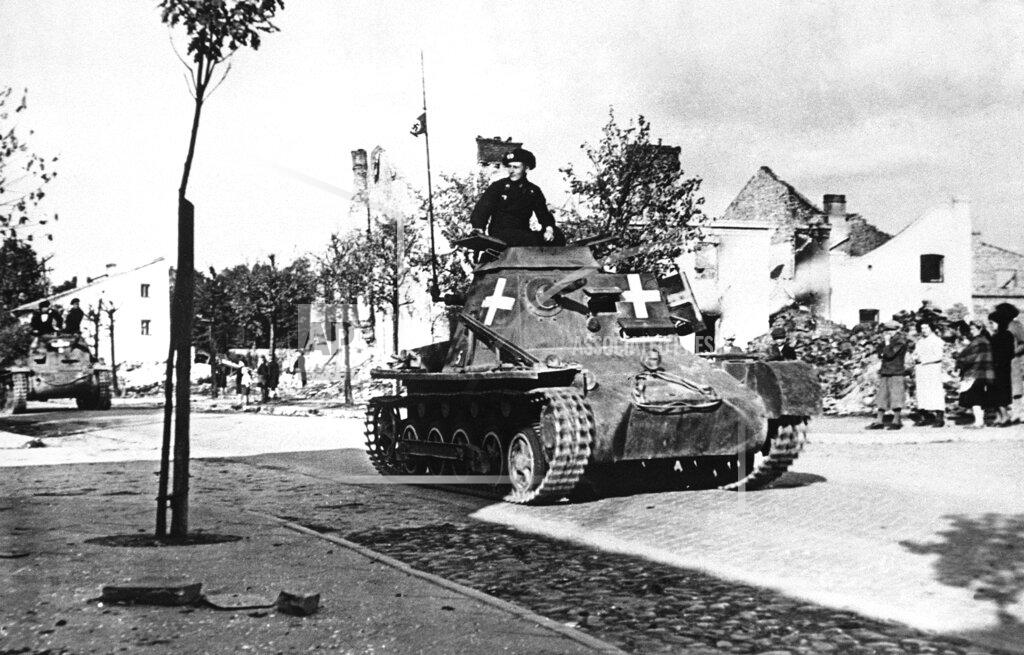
After the fall of Poland, the war on the western front degenerates into a stalemate, sometimes derisively called the “Phony War” or “sitzkrieg” (“sitting war”) in mockery of the blitzkrieg that had crushed Polish resistance in a month.
Adolf Hitler orders to his top military leaders to begin planning for a war in the west, with a target launch date of 12 November 1939. The generals complain that the date is too soon.
German shelling of areas in France behind the Maginot Line continues and increases in volume.
Trains are moving across Germany in a steady stream, reinforcing Germany’s western borders. Any window of opportunity the French had for a rapid offensive into Germany is now closed.
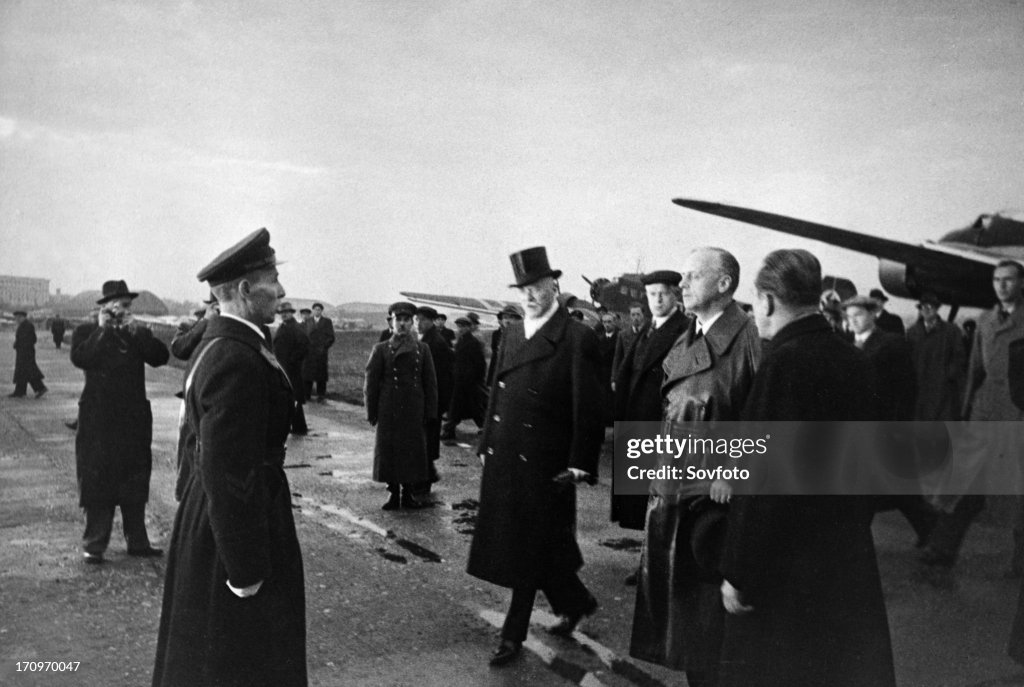
Coincident with the arrival of Foreign Minister Joachim von Ribbentrop in Moscow, the press in Berlin has intensified its inspired campaign of warning to Great Britain and France to “halt the war while there still is time.”
Dachau Concentration Camp in Germany is temporarily closed until 18 February 1940 for use of training SS units; prisoners of Dachau are sent to Mauthausen Concentration Camp.
Germany today expressed formal regret for an attack by a German seaplane yesterday upon a Netherland airliner, in which one passenger was killed.
Chancellor of the Exchequer Sir John Simon introduced an emergency war budget raising income taxes, inheritance taxes, profits taxes and duties on alcohol, sugar and tobacco. Even with the new tax revenue Britain still faced a deficit of £938 million.
Polish Cardinal August Hlond is allowed to broadcast a message to the Poles of the world over the Vatican Radio. The Pope, unhappy with the cardinal’s presence in Rome, wants him to return to Poland, but the Germans will not allow it.
The Swedish steam merchant Algeria was stopped by by the U-36, commanded by Kapitänleutnant Wilhelm Fröhlich, 20 miles west of Skudesnaes and was sent to Kiel as a prize, arriving on October 4. Three days later the ship and its cargo were released by the Germans.
Soviet Union announces the sinking of the freighter Metallist by ‘an unknown submarine’ off Narva, Estonia. According to Estonian intelligence, the ship was still afloat hours after the claimed sinking. This incident is a Soviet provocation to put pressure on the Estonians to succumb to all the Soviet demands in the ongoing negotiations at Moscow.
Pope Pius has been working diplomatically through neutral States to get Britain and France to agree to a peace conference that would end with the creation of a Polish buffer State on ethnic lines, it is reported in Rome.
U.S. freighter Executive is detained by French authorities at Casablanca, French Morocco.
The War at Sea, Wednesday, 27 September (naval-history.net)
British northern waters – destroyers HMS Fury and HMS Forester on Fair Isle Channel Patrol were informed of a possible submarine in the south side of Fair Isle Channel.
Destroyer HMS Foxhound screened the attempted salvage of Norwegian steamer Sardinia (1975grt) which had run aground off the Burness Peninsula, north of Kirkwall, Orkneys.
U-10 on patrol in the North Sea was ordered to carry out a reconnaissance of the Orkneys area.
British east coast – destroyer HMS Valorous and sloop HMS Hastings were attacked by German bombers in the Firth of Forth, but neither were damaged.
Light cruiser HMS Glasgow and destroyer HMS Jervis departed Rosyth to investigate an enemy vessel report 220 miles ENE of Rosyth. They arrived back that evening without contact.
German waters – U-36 sank Swedish steamer Algeria (1617grt) at 58.27N, 04.08W.
English Channel – aircraft carrier HMS Hermes was taken in hand at Devonport for repairs prior to transfer overseas.
UK-France convoys – convoy BC.6 of steamers Adjutant, Baharistan, Baron Minto, Bellerophon (Cdre), Biela, Cairngorm, Custodian, Dalemoor, Diplomat, Ena de Larringa, Goldfinch, Harmattan, Jacinth, Sandhill, Trelawny, and Treverbyn departed Bristol Channel escorted by destroyers HMS Exmouth, HMS Escapade, HMS Encounter, HMS Eclipse, and HMS Wessex. The convoy arrived in the Loire on the 29th. Escort was also provided by French large destroyers Indomptable, Triomphant, and Malin on the 28th.
DB.8 of two personnel ships, escorted by destroyers HMS Vansittart and HMS Venomous, departed Southampton, and arrived at Brest on the 28th.
Convoy MB.7 departed Southampton with seven cargo ships, escorted by destroyers HMS Arrow and HMS Intrepid and also arrived at Brest on the 28th.
UK-out convoys – OA.11 of 11 ships departed Southend. Destroyers HMS Kempenfelt and HMS Echo departed Devonport to provide escort OA.11, with Echo arriving back on 2 October.
OB.11 departed Liverpool escorted by destroyers HMS Mackay and HMS Vimy until the 30th.
Gibraltar area – British cableship HMS Retriever, escorted by destroyer HMS Velox departed Gibraltar to carry out repairs at 36-58N, 08-26W and 36-06N, 07-30W.
Mediterranean – destroyers HMS Cossack, HMS Maori, HMS Zulu, and HMS Nubian departed Malta for escort duties with convoy Green 2.
Polish gold, Mediterranean – The gold being carried from Poland to prevent it falling into German hands had arrived at Beirut. French light cruiser Émile Bertin and destroyers Vauban and Épervier departed Toulon and at Beirut, Bertin embarked 57 tons of gold and the destroyers 18 tons. The ships left on the 24th, and arrived at Toulon on this date, the 27th. The gold was sent on to Paris, arriving 24 October.
Indian Ocean – heavy cruiser HMS Cornwall arrived at Colombo, then departed on the 28th, arriving Calcutta on 1 October.
Light cruiser HMS Liverpool arrived at Bombay.
A plea to the country to study closely the new neutrality resolution, to see if it is not in fact a stronger guarantee that America will not be involved in the European war than the present arms embargo, was broadcast tonight by Senator Pittman on the eve of the Foreign Relations Committee’s formal consideration of the measure. The Senator, who is chairman of the committee, coupled with his plea a prediction that the new resolution, repealing the embargo on arms and munitions and substituting a mandatory “cash-and-carry” system for all commerce between the United States and warring nations, would become law. He spoke over a network of the National Broadcasting Company.
Mr. Pittman’s forecast as to the outcome was being adopted by more and more observers in Washington with each new addition to the “paper” majority which the Administration has claimed for embargo repeal from the start. The prediction was made on all sides tonight, even among opponents of repeal, that the resolution would be reported favorably by the Foreign Relations Committee tomorrow or Friday and that debate would start in the Senate early next week.
In the face of appeals and predictions of the Administration forces, opponents of the resolution continued to insist that they would win in their efforts to retain the arms embargo, maintaining that the issue was at bottom one of peace or intervention by the United States. Arrangements were completed tonight for a mass meeting of pro-embargo forces to be held Friday night at the Belasco Theatre, under the auspices of various peace and religious societies. Speakers scheduled for the meeting, described as “America’s Town Meeting Against War,” are Senators Capper of Kansas, Clark of Missouri and Nye of North Dakota; the Rev. Ernest Fremont Tittle of Chicago; Norman Thomas, former Socialist candidate for President; John T. Flynn, economist, and Roland Hayes, African-American concert singer. Among the sponsors of the meeting are the Women’s International League for Peace and Freedom, the National Council for Prevention of War, the Fellowship of Reconciliation, the War Resisters League, the Keep America Out of War Congress, the Youth Committee Against War, World Peace Ways, the World Peace Commission of the Methodist Church and the Church of the Brethren.
A 4.3 percent decline during August brought national unemployment to the lowest point since December, 1937, according to statistics made public yesterday by the National Industrial Conference Board. The number of jobless persons dropped from 9,852,000 in July to 9,424,000 last month, a reduction of 428,000. Total employment in the United States rose from a July figure of 44,782,000 to 45,263,000 in August. Agriculture and manufacturing showed the greatest advances, with more than 200,000 additional employees recorded in each field. The government’s emergency labor force declined to 2,169,000 workers, a drop of 16.6 percent from July This was the sixth consecutive monthly cut in the emergency workforce, and brought the total to the lowest point in twenty months.
First Lady Eleanor Roosevelt urges the repeal of the arms embargo. She holds that neutrality and a third term for President Roosevelt are unrelated.
CIO officers warn that the war may affect government jobs. Curtailment of services may be the result.
A World War I draft dodger, Grover Cleveland Bergdoll, swears he hid in the United States for seven years. He returned twice while the nation thought he was in the Reich, he claims, and hid in his Philadelphia mansion..
Commandant of the Coast Guard informs Commander of the Boston Division that upon withdrawal of destroyers from the Grand Banks Patrol, the patrol will be maintained by two Campbell-class 327-foot cutters.
While under tow from Cordova to Seward, Territory of Alaska, with a cargo of 60 tons of assorted machinery, the American scow PSB&D Co. #11 sank 10 nautical miles (19 km; 12 mi) southwest by south of Johnston Point (60°28′N 146°37′W) on the south-central coast of the Territory of Alaska, probably after hitting a snag. No one was on board.
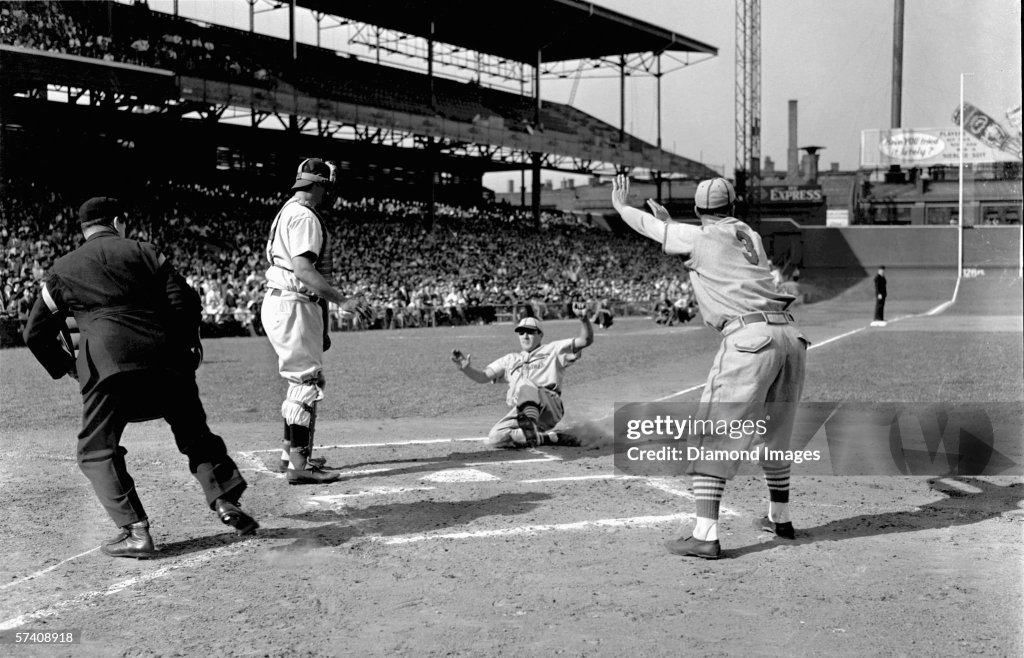
The hometown Chicago White Sox play the first “day-night” doubleheader against Cleveland, but lose both games to the Indians, 5–2 and 7–5. The nightcap is Bob Feller’s 23rd win of the season. Fans are charged a single admission for the two games. For just the second time this century, visitors sweep more doubleheaders than the home team; 58 sweeps for the visitors, 47 for the home team. Retrosheet stats by Dave Smith will show that the first season this occurred was 1923; 1962 will be the last.
The St. Louis Browns took their ninth straight on the chin today as the Detroit Tigers mopped up a three-game series with a 7–4 victory for Buck Newsom. A homer by Pete Fox in the fifth and another by Charlie Gehringer with one on in the eighth lifted Newsom to his 19th win of the season.
The St. Louis Cardinals’ Fiddler Bill McGee stopped the Cincinnati Reds cold today, beating the leaders by 4–0. He allowed four scattered hits. As a result, the scrapping Cardinals retained their slim chance of winning the National League pennant. They trail by 2½ games with four to play. The Cardinals cannot afford to lsoe even one game.
The Chicago Cubs climbed back into third place. in the National League today by beating the Pirates twice in a wildhitting double-header, 9–8 and 9–5, each time with a tenth-inning. drive. The double triumph lifted the Cubs a half game and two percentage points ahead of the idle Dodgers. The two teams made 53 hits, including 14 doubles, 8 triples and 4 home runs. Hank Leiber’s double. and singles by Glen Russell and Bobby Mattick gave Chicago two runs and victory in the first contest. Pitcher Bill Swift collapsed in the tenth of the second game, yielding five hits and four runs. It was the seventh straight loss for Pittsburgh.
China suggests U.S. mediation. The basis for peace would be a return to a nine-nation treaty, says the foreign minister.
Thus far the Russian-Japanese armistice is not affecting the siege. status of the Japanese Army in Manchukuo, although it is expected that after the border is delimited substantial numbers of troops which were transferred from China will be returned to areas south of the Great Wall. These dispositions will not be decided until after General Juzo Nishio, newly named to the supreme command of all Japanese forces in China, personally surveys the situation. General Nishio will arrive in Shanghai tomorrow and go to Nanking, which will be made the general headquarters of the entire expeditionary forces in China south of the Great Wall.
It was reported today that a new group of Russian volunteers had arrived in China recently by way of Sinkiang to fight the Japanese and had been distributed among various war zones. Their arrival was said to have set at rest Chinese fears that the Soviet attitude toward China had changed since the signing of the RussianJapanese armistice on fighting on the Outer Mongolian-Manchurian frontier. The first group of Soviet volunteers joined China’s army last Autumn during the fighting for Hankow.
Britain and Japan resume talks. The Japanese are bitter at Germany. Japanese advocates of the Axis fear they are backing the wrong horse. Early resumption of the Anglo-Japanese negotia tions in Tokyo is foreshadowed in the return of Sir Robert Leslie Craigie, the British Ambassador, to Tokyo tonight, while Sotomatsu Kato, his opposite number in the conversations on the Tientsin situation, is on his way from China.
Dow Jones Industrial Average: 153.08 (-0.46).
Born:
Kathy Whitworth, American golfer (7 x LPGA Player of Year, 6 x major titles, record 88 LPGA Tour wins), in Monahans, Texas.
Jim Ross Lightfoot, American politician (Rep-R-Iowa, 1985-1997), in Sioux City, Iowa.
Carol Lynn Pearson, American poet and writer (“Goodbye I Love You”), in Rexburg, Idaho.
Naval Construction:
The Kriegsmarine (German Navy) Type VIIC U-boats U-97 and U-98 are laid down by F. Krupp Germaniawerft AG, Kiel (werk 602 and 603).
The Royal Navy Flower-class corvette HMS Snapdragon (K 10) is laid down by Smiths Dock Co., Ltd. (South Bank-on-Tees, U.K.).
The Regia Marina (Royal Italian Navy) Capitani Romani–class light cruiser Claudio Druso is laid down by Cantiere del Tirreno, Riva Trigoso. She is never completed; scrapped on the slip in 1941.
The Вое́нно-морско́й флот СССР (ВМФ) (Soviet Navy) Project 7-class (Gnevny-class) destroyer Retivy (Ретивый, “Ardent”) is launched by Zavod imeni Leninskogo Komsomola (Komsomolsk-na-Amur, U.S.S.R.) / Yard 199.
 History Diaries