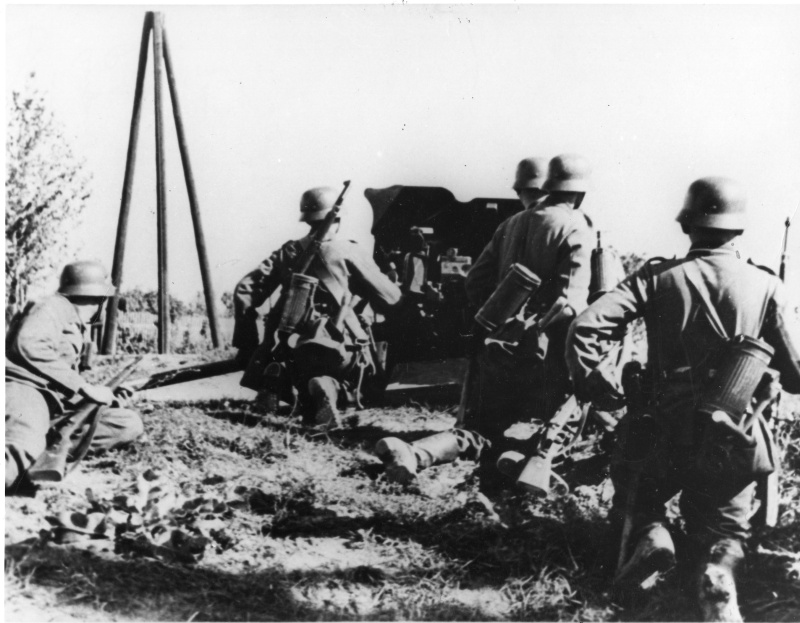
The siege of Warsaw continues. After a massive artillery bombardment of Warsaw, the Germans conduct a major infantry assault on the center of the city. Talks begin on the surrender of the city. The German 8th Army, under the command of the German Army Commander in Chief, von Brauchitsch, joins the attack on Warsaw. There is a massive artillery bombardment of Warsaw, followed by a major German infantry assault, leaving the city center in flames. Poles recapture Mokotow Airport and 6 hastily rebuilt aircraft fly out during the night (September 26-27).
The Battle of Tomaszów Lubelski ended with the capitulation of most of the Polish forces in the region.
The victorious German Army, which early this month broke through the supposedly impregnable Polish Narew fortifications within forty-eight hours, today evacuated all the territory east of the Pisia and Narew Rivers, which form the German-Russian demarcation line in the north, leaving that territory to the Soviets.
The Soviet tanker Metallist was sunk in Narva Bay by Tucha (Soviet Navy). The Soviets blamed the loss on a Polish submarine as a pretext to take action against Estonia.
Werner von Fritsch was given a funeral with full military honors in Berlin. Hermann Göring and Walther von Brauchitsch were among those present but Hitler was not, sending a large wreath instead.
French artillery fires on the forward defenses of the German Siegfried Line. Gunners and aviators were most active on the Western Front today. In the Saarbruecken and Zweibrücken sectors the French heavy artillery continued to pound the first zone of the Westwall while the German artillery persisted in replying southeast of Zweibrücken.
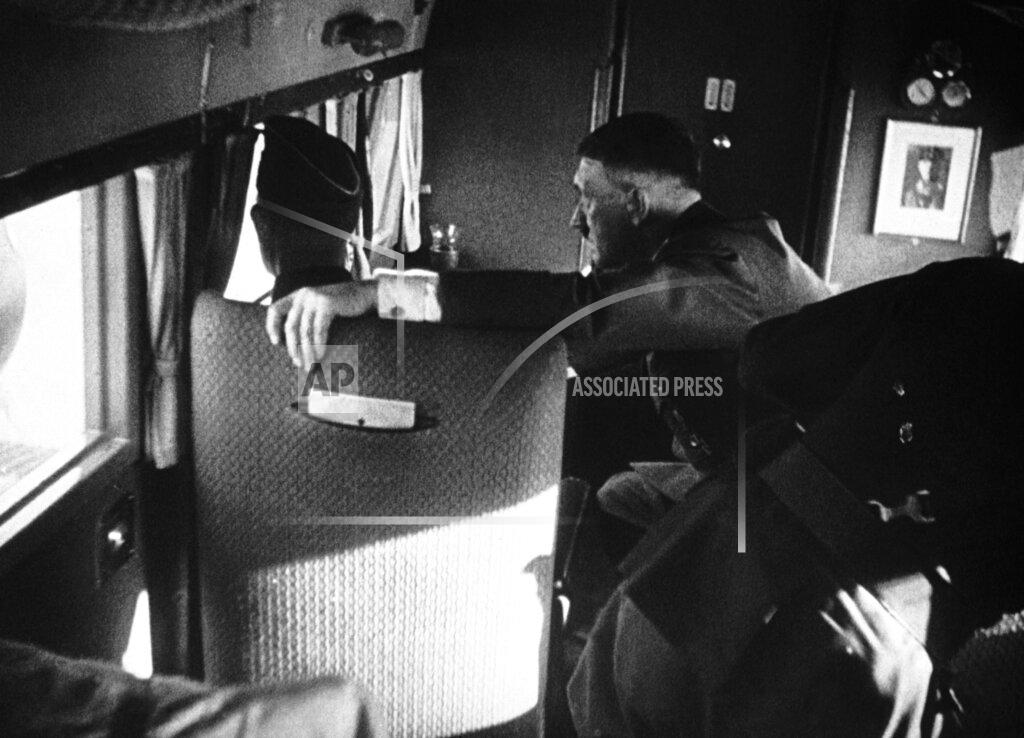
Chancellor Hitler returned to Berlin tonight to concentrate his energies on the war on the Western Front.
A Luftwaffe aircraft was shot down by the British for the first time. A Dornier Do 18 flying boat was downed by a Blackburn Skua of 803 Naval Air Squadron north of the Fisher Bank.
The French Communist Party and all of its affiliates were banned. The French government took the action in response to the Soviet Union’s invasion of Poland and pact with Germany. The Communist Party is dissolved by a presidential decree. It is now also illegal to propagandize themes of the Third International. (French communists at this time are leaders of the antiwar movement.) Some of the communist leaders are interned.
[Ed: Ironically, the French communists will later become some of the most ardent fighters against German occupation — but only after Stalin’s USSR is betrayed by Germany in 1941. The French communists will only remember they hate Hitler and join the fight against him when he invades the USSR. These vermin have no loyalty to Paris; only to Moscow.]
In the House of Commons, First Lord of the Admiralty, Winston Churchill, claims that Britain is winning the U-boat war. He says that one tenth of the German submarine fleet was destroyed in the first two weeks of the war and that the losses are probably a quarter and perhaps a third by now.
[Ed: Churchill is far too optimistic.]
Former German Army Commander-in-Chief Werner von Fritsch is buried in Berlin, Germany. Neither Adolf Hitler, nor Joachim von Ribbertrop, nor Heinrich Himmler attends the ceremonial state funeral. The Nazis had removed von Fritsch as CINC in 1938 due to his ‘political unreliability’.
The sensational announcement was made this evening that Foreign Minister Joachim von Ribbentrop of Germany was about to pay another visit to Moscow, arriving by plane tomorrow. Herr von Ribbentrop’s visit, the second in little more than a month, is certainly connected, for опе thing, with the presence here of Foreign Minister Shukru Saracoglu of Turkey. Mr. Saracoglu visited the Kremlin today and saw Premier-Foreign Commissar Vyacheslav M. Molotov and President Mikhail Kalinin. Later Mr. Molotoff was host at lunch to Mr. Saracoglu, who was accompanied by the Turkish Ambassador to Moscow, the counselor of the embassy and the military attaché. Among the Russians present were Vladimir P. Potemkin, Vice Commissar for Foreign Affairs, and V. G. Dekanasoff, the Second Vice Commissar.
This evening Mr. Saracoglu and his party attended the opera. Tomorrow a luncheon is being given at the Turkish Embassy; various Soviet dignitaries will attend and probably also diplomats of the Balkan States, who welcomed Mr. Saracoglu on his arrival last night. But for the third day of the visit no program has been officially announced. The reason probably is the pending arrival of Herr von Ribbentrop.
Many things point to the conclusion that one object of Herr von Ribbentrop’s visit will be to present an agreement whereby Germany would guarantee not to invade the Balkan countries and Russia would also guarantee no occupation in return for a Turkish pledge to close the Straits to all belligerents. From the Balkans a promise doubtless would be extracted, in return for Germany not invading them, that they would place their entire economic resources at Germany’s disposal.
This would be a “bloodless” but important victory for Germany extracted under threat of bloodshed. Such an agreement would be worthwhile for Turkey, which would thus escape being drawn into war, but, far more important, would receive a promise-whatever this might be worth-that neither Germany nor Russia would send troops to the Balkans. Turkey’s fears of seeing Rumania and Greece in military occupation of a great power are based largely on the difficulty of defending Istanbul, owing to Turkey’s post-war losses to Greece. But Turkey probably would retain freedom of action in the event of Italy entering the war.
For Russia such an agreement not only would bring security on the Black Sea in the event of war with France and Britain, but would secure her sea communications there for the transit of goods. The things that Russia might be able to supply to Germany — cotton, manganese, some wheat and a limited quantity of oil — are all products of Southern Russia. With the port of Leningrad due shortly to freeze over and with congestion on the northern railways since mobilization, the simplest method would be to ship these supplies to Odessa, thence to Lwow and then across German Poland to Germany.
German armored ships Admiral Graf Spee and Deutschland, poised in the South and North Atlantic, respectively, receive their orders to begin commerce raiding operations.
The Luftwaffe mounts a strike on HMS Ark Royal, which is claimed to be sunk. They only score near misses. The German claim to have sunk the ‘Ark Royal’ is not denied by the Admiralty. Three Fleet Air Arm Skua aircraft of 803 Naval Air Squadron of HMS Ark Royal were collectively credited with the first confirmed British kill (a Do 18 flying boat) against Germany.
A second meeting of the second Uranverein (Uranium Club) was held. This conference was attended by Werner Heisenberg and Paul Harteck. Harteck had experience with heavy water, and argued that the chain reaction pile test be conducted with heavy water as the moderator. Heisenberg argued the atomic pile needed layering of the uranium and the moderator, in order to avoid the neutron capture resonance of U238. The second conference left Heisenberg in charge of the team responsible for theoretical investigation, with Diebner and Bagge responsible for the experimental program. The fission program would be headquartered in the new Kaiser Wilhelm Institute of Physics in Berlin-Dahlem. Fission research was made a secret of the state and publication of scientific results was suppressed.
The War at Sea, Tuesday, 26 September (naval-history.net)
British northern waters – German submarines were deployed off the Orkneys to intercept British naval units – U-10 from 26 September to 15 October, U-22 from 28 September to 16 October, U-23 from 2nd to 16th October, U-20 from the 1st to 17th, and U-18 from the 3rd to 16th. On 29 September, U-22 fired at a submarine east of Dogger Head, but the attack failed due to torpedo defect.
British east coast – convoy FS.11 departed Methil, and arrived at Southend on the 28th.
Convoy FN.11 departed Southend, and arrived at Methil on the 28th.
Anti-aircraft cruiser HMS Cairo departed Dover and arrived at Grimsby later the same day.
Kattegat/Skagerrak/Baltic – German destroyers Hans Lody, Friedrich Ihn, and Erich Steinbrinck and four torpedo boats of the 6th Torpedo Boat Flotilla inspected 45 merchant ships in the Kattegat from the 26th to 28th.
Destroyers Wilhelm Heidkamp, Bernd Von Arnim, Erich Giese, Diether Von Roeder, Hans Lüdemann, Hermann Künne, and Karl Galster stopped 58 merchant ships in the Skagerrak from the 28th to 30th. Nine were sent to Kiel as prizes and Arnim captured two Danish steamers with cargo bound for England. On the 30th, Roeder, Lüdemann, Künne, and Galster proceeded to Swinemünde and Heidkamp, Arnim, and Giese to Kiel.
Beginning on the 30th and continuing through 6 October, German destroyers and torpedo boats stopped and inspected 72 merchant ships for contraband in the Skagerrak and Kattegat. They seized Swedish steamer Aspen (1304grt) on the 30th, and Finnish steamer Orient (4160grt) and Latvian steamer Imanta (1233grt) on 1 October for contraband violations. German destroyers Max Schultz, Bruno Heinemann, and Paul Jacobi were detached from exercises in the Baltic to escort the prizes into port
German waters – U-30 arrived at Wilhelmshaven escorted by minesweeper M-7. U-29 also arrived on the 26th.
UK-France convoys – BC.4 departed Quiberon Bay and arrived in Bristol Channel on the 28th.
BC.5F of steamer Ben My Chree departed Quiberon Bay with destroyers HMS Eclipse, HMS Encounter, HMS Escapade, and HMS Exmouth and arrived safely in the Bristol Channel on the 27th.
Gibraltar-UK (HG) convoys – The first of the series, HG.1, departed Gibraltar with 27 ships and local escort provided by destroyers HMS Grenville, HMS Gipsy, HMS Griffin, and HMS Grenade. Polish destroyer ORP Błyskawica joined the escort from the 26th to 28th and light cruiser HMS Colombo from the 26th to 5 October.
After leaving convoy OG.1, destroyers HMS Imogen and HMS Ilex were escorts from 3 October until the 4th, and HMS Isis and HMS Imperial, from the 3rd to 5th. Destroyers HMS Intrepid and HMS Echo joined on the 5th until the 6th when the convoy and tankers Abbeydale and Serbol arrived at Liverpool.
HMS Colombo and HMS Imperial arrived at Devonport on the 5th and HMS Echo on the 6th.
Convoy HGF.1 departed Gibraltar with steamers Scythia (19,761grt), Orford (20,043grt), Memnon (7506grt), and Orcades (23,456grt) and no escort. They arrived at Liverpool on 1 October.
Mediterranean – Sloop HMS Fowey arrived at Alexandria from the East Indies.
Caribbean/ Atlantic – convoy KJ.2 departed Kingston escorted by light cruiser HMS Orion from the 26th to 29th and French submarine Surcouf from the 26th to 17 October. Destroyers HMS Malcolm, HMS Vanoc, HMS Warwick, and HMS Vanessa joined the escort on the 15th. HMS Vanoc, HMS Warwick, and HMS Vanessa detached on the 17th, and HMS Malcolm on the 18th, when the convoy arrived.
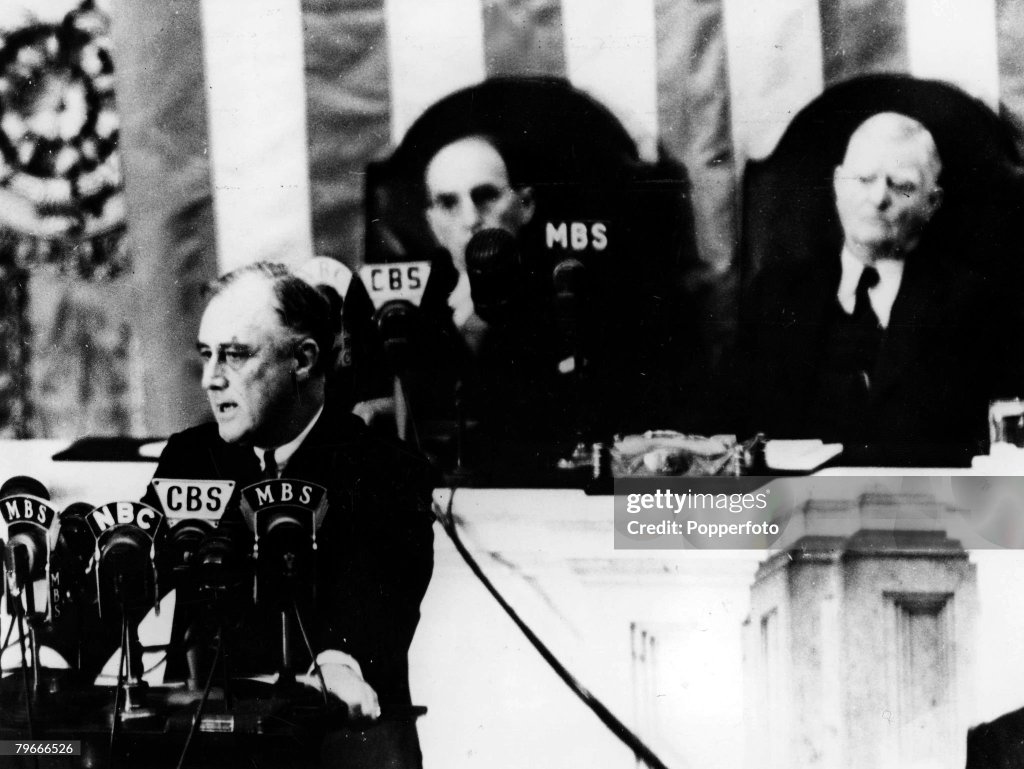
The Senate isolation group opened fire today on the proposal of administration adherents to substitute a mandatory “cash-and-carry” plan for the arms embargo against belligerents, condemning it as “window dressing” to “befuddle the issue” involved in prospective shipping arms and munitions to wartorn Europe, and limiting the issue to the fight over repeal. Meanwhile the administration forces, from President Roosevelt down, kept their counsel pending Thursday’s meeting of the Foreign Relations Committee, hoping that the particular provisions of the new neutrality resolution would appeal to a majority of the Senate and the country as the best means of keeping the United States away from the perils of war.
The President and Secretary Hull passed up repeated opportunities at their press conferences to publicly discuss the neutrality question. Mr. Roosevelt engaged in a series. of conferences with legislative and administrative officials, however, on the proposed revision of this. government’s wartime policies. He disclosed the government’s apprehension over attempts of foreign powers to acquire essential war materials from a reserve stock which the United States is attempting to build up against possible future emergencies, and intimated his purpose to see that these stores were not depleted or that the program to add to them was not hampered.
Fifteen members of the group pledged to vote against change in the current Neutrality Law and any substitute program for “cash-and-carry” sales of munitions and all kinds of merchandise met in a long session in the office of Senator Johnson of California. After that meeting Senators Nye and Vandenberg were especially critical of the bill, basing their views on studies made of it since. yesterday morning, when a draft was given to each of the Republican members of the Foreign Relations Committee, and also Senator Clark of Missouri, dissident Democrat, who was left out of the majority group which wrote the measure.
The opponents of repeal displayed little patience with the long and detailed bill written by Senator Pittman, chairman of the Foreign Relations Committee, with the assistance of Senators Connally and Thomas of Utah and the advice of eleven other Democratic members counted upon to vote to report the bill out of committee. Senator Vandenberg touched on the details of the bill in a general way, saying that “these gentlemen have gone a long, long way toward cushioning the effect of repeal.” The Senator asserted that “the entire effort fails at the outset when we depart from the internationally acknowledged trademark of our neutrality,” and added: “So long as the arms embargo is repealed, this bill has upon its face the trademark of unneutrality and malice. Most of us believe that the purpose of this bill was to befuddle the issue, befuddle the debate.”
Former Governor Alfred E. Smith will go on the air on Sunday to speak over a nation-wide hook-up in favor of President Roosevelt’s program for American neutrality.
The American Legion, through a committee, stated its attitude on neutrality today to be that the United States should stay out of war, that Congress should be left to decide whether the present embargo on arms should be continued or changed and “demanded” that the lawmakers stay in session “during the present grave crisis.”
The National Republican Club went on record last night in support of President Roosevelt’s stand for revision of the Neutrality Act to permit the export of arms and munitions on a cash-and-carry basis.
Clerks in the House and Senate postoffices sighed with relief today as the flood of letters and postcards on neutrality legislation subsided.
President Roosevelt made it clear today that the United States Government was aware of efforts of foreigners to acquire supplies of vital materials which this country is trying to accumulate against the possibility of emergencies.
Representative Dies of Texas, chairman of the Committee on Un-American Activities, said today that the Roosevelt Administration had asked the Justice Department to begin “purging” about 2,850 “known Communists” who hold key government positions. He based his statement, he said, “on information which comes from a very authoritative Administration source.” In addition, he said he had received word that one of the country’s most prominent labor leaders had decided to conduct a similar purge in his organization’s “high command.” Communists will be asked to renounce communism or step down from their positions, Mr. Dies asserted.
Amplifying his remarks about the government “purge,” he said that the Justice Department would proceed quietly to eliminate from Federal employment a list of persons it has been checking for many months. “The investigation will come to a head now that Germany and Russia have gotten together and the Communists are considered as known enemies,” Mr. Dies said. As a result of the European conflict and of testimony before his committee, it probably would ask. Congress to “outlaw” the GermanAmerican Bund and the Communist party of the United States, the chairman added. “The political activities of these organizations are merely a masquerade for a spy system and possible sabotage,” he declared.
The Dies Congressional Committee on Un-American Activities was ridiculed as a “kindergarten” yesterday by Fritz Kuhn, national leader of the German-American Bund. Reacting to a committee decision to seek his indictment for perjury and perhaps contempt, Kuhn said the committee should relinquish its inquiry to the Federal Bureau of Investigation and a United States Attorney. The leader of the Nazi movement fingered the first growth of a mustache, a wide mustache, as he answered the committee’s threat. He was in the office of the Bund in New York, the walls of which were hung with several signs urging neutrality and that the United States keep out of the war.
In showing his scorn, Kuhn rattled off the names of a number of committee members. He put special emphasis on his feelings for Gerhart H. Seger, former Social Democrat member of the German Reichstag, now publisher of the German-American weekly, Neue Volkszeitung, who made serious charges against Kuhn before the committee on Monday.
The navy has decided to shift a “pretty fair-sized” force of vessels to Hawaii, in a move which appears to be linked with the European war and international tension in the Far East.
Elliot Roosevelt says his father has not given the 1940 presidential election a thought.
An AFL group urges an arms ban revision. A metal trade unit asks Congress to permit the sale of goods to all nations. A report says the ban discriminates against democracies and aids dictatorships.
No lasting good is seen in the war boom. A policy group holds that the effect on trade will be unfavorable.
The World Fair cuts admission to a flat 50-cent rate for all of October.
The St. Louis Browns set a new all-time record for club defeats today when they dropped their 108th and 109th games of the season to the Detroit Tigers, 5–4 and 7–5. The major league record for defeats, 117, was set by the Athletics In 1917. The Tigers came from behind to win both games, although Joe Gallagher, Brown outfielder, was the star with three home runs. Two of them were in the short nightcap, called at the end of seven innings because of darkness. Rudy York, Joe Grace and Hank Greenberg also hit for the circuit in the second game.
The Philadelphia Athletics defeated the Washington Senators, 15–4, today in a game featured by twenty-six hits and seven errors. The Senators committed four of the misplays. Huskie Bill Beckman scattered ten Washington hits, while Philadelphia made sixteen off four Senator rookies — Early Wynn, Bucky Jacobs, Bill Holland, and Lou Thuman. Wally Moses, Philadelphia outfielder, hit safely four times.
Little Billy Myers’s big bat kept the league-leading Cincinnati Reds three and one-half games in front today, his home run with two aboard defeating the St. Louis Cardinals, 3–1, in the first game of their crucial double-header and making it relatively unimportant that the Cardinals came back to take the second, 6–0.
At the Polo Grounds, the New York Giants and Brooklyn Dodgers split a pair, with New York taking the opener, 9–5, and Brooklyn winning game 2, 3–2 in 7 innings. Cookie Lavagetto has a grand slam for Brooklyn in the opener, and Hot Potato Hamlin is the winner in the nitecap.
Steady hurling by Kirby Higbe gave the last-place Phillies a 5–3 victory over Boston today and ended a six-game losing streak. The game, played before 200 fans, was the Phils’ forty-fifth victory of the season, the same number of triumphs recorded by the National Leaguers in 1938. Higbe not only bore down in the pinches and scattered the Bees’ ten hits, but his hit in the fifth drove Morrie Arnovich home to break a 1–1 tie. Jim Turner held the Phillies to eight hits, but home run drives by Joe Marty and Charlie Letchas aided in his defeat.
The Dominion Government of Canada in Ottawa assumed complete control tonight over the exportation of all metals from Canada. Special permits will be required for exporting any nickel, bauxite, aluminum, copper, lead, zinc, asbestos, cobalt, ferro-silicon, cadmium or ferro-manganese, or scrap metals of any kind. It was understood that special arrangements had been made to see that United States markets would continue to get aluminum, Canadian production of which has been financed largely by capital from across the border. Great Britain and France, however, will have first call on all aluminum supplies.
The Marquess of Linlithgow, the Viceroy, today met Mohandas K. Gandhi in pursuance of his policy of maintaining contacts with Indian political leaders. The meeting was at the invitation of the Viceroy and lasted three and one-half hours. No official indication was given about the meeting; but it was expected the talk concerned the war.
Japanese forces near Changsha. One column is said to be only 20 miles from the capital of the Hunan province. “The Chinese defenses of Changsha are crumbling,” Domei reported, quoting reports from front line Japanese units. Five Chinese divisions, which the Japanese have been attacking for a fortnight on a line north of Changsha, were said to be “in full retreat.” Chinese casualties during the past fortnight were estimated at 8,200 dead and thousands of wounded.
Three Japanese columns are closing in on Changsha, which was partly destroyed last year by the Chinese when the Japanese began advancing southward along the Canton-Hankow Railway after their capture of Hankow. The first is astride the railway, the second is moving southward along the Wuchang-Changsha highway and the third is east of the railway. It is anticipated that the Chinese will fall back to prepared positions in Hengyang, southwest of Changsha, and attempt to make a stand there in defense of Generalissimo Chiang Kai-shek’s “southwest defense area.”
Dow Jones Industrial Average: 153.54 (+0.90).
Born:
Ricky Tomlinson, actor and activist, in Bispham, Blackpool, England, United Kingdom.
Judith Appelbaum, American magazine & newspaper editor and educator, in New York, New York (d. 2018).
Naval Construction:
The Royal Navy Flower-class corvette HMS Salvia (K 97) is laid down by William Simons & Co. Ltd. (Renfrew, Scotland).
The Sjøforsvaret (Royal Norwegian Navy) Otra-class minesweeper HNoMS Rauma is launched by Nylands Verksted (Oslo, Norway).


 History Diaries