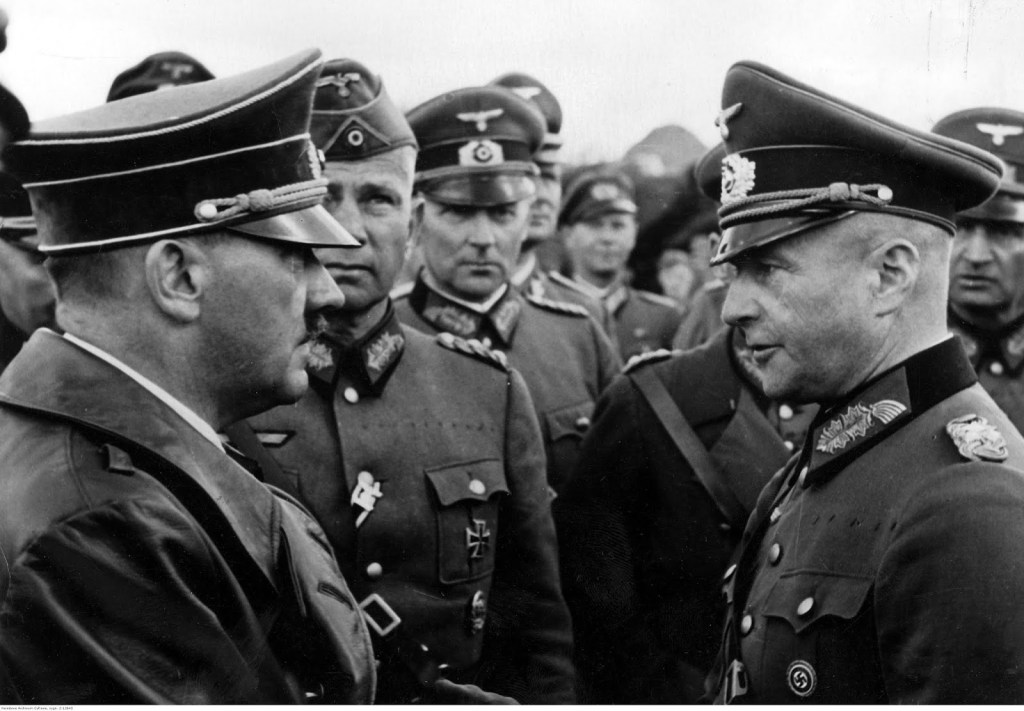
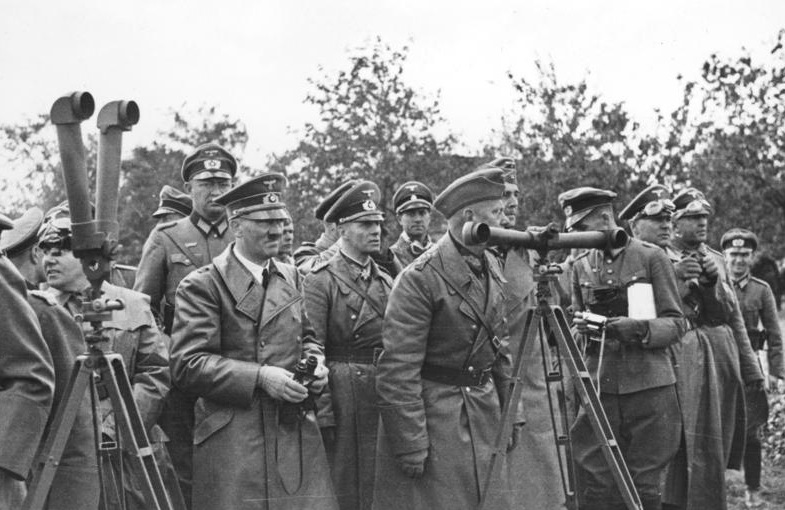
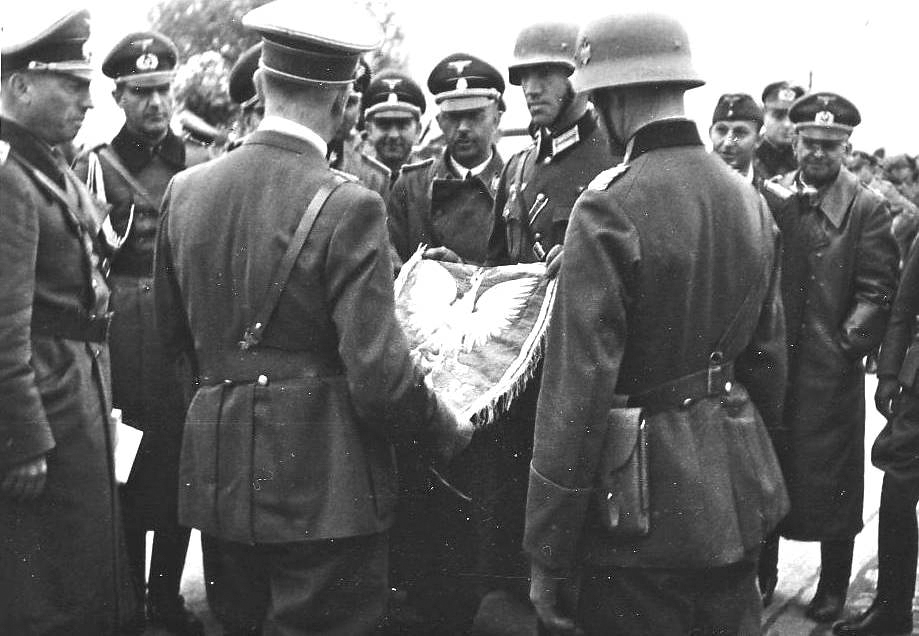
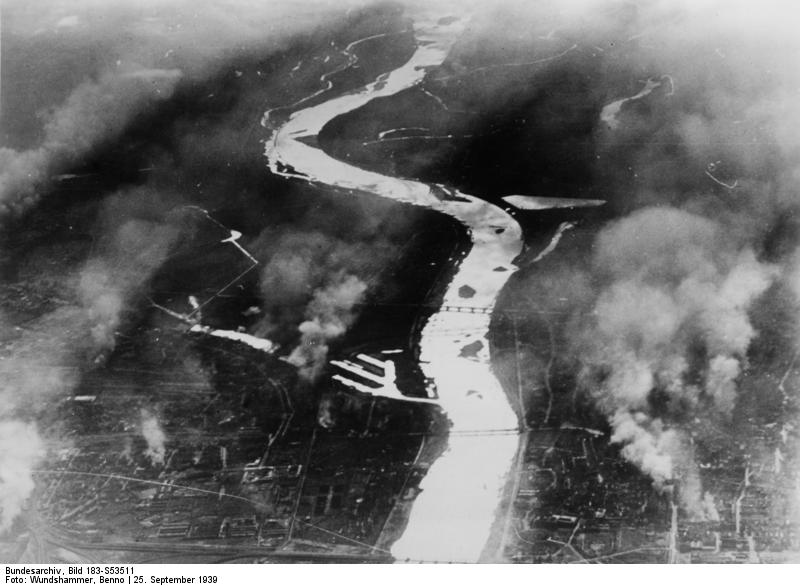
The siege of Warsaw continued. Half the city is reportedly in flames. The entire central section of Warsaw, a city of magnificent buildings and parks four weeks ago, was reported in flames tonight while its defenders fought hand-to-hand with bayonets against the German invaders in the suburbs. The Germans issued a second ultimatum to the garrison defending the city. Warsaw suffered heavy Luftwaffe bombing and artillery bombardment as Adolf Hitler arrived to observe the attack. To the east, Soviet troops captured Bialystok, Poland. Meanwhile, Joseph Stalin proposed to the Germans that the Soviet Union would take Lithuania which was previously within the German sphere of influence; in exchange, the Soviets would give the portions of Poland near Warsaw which were previously within the Soviet sphere of influence but had already been overrun by German troops.
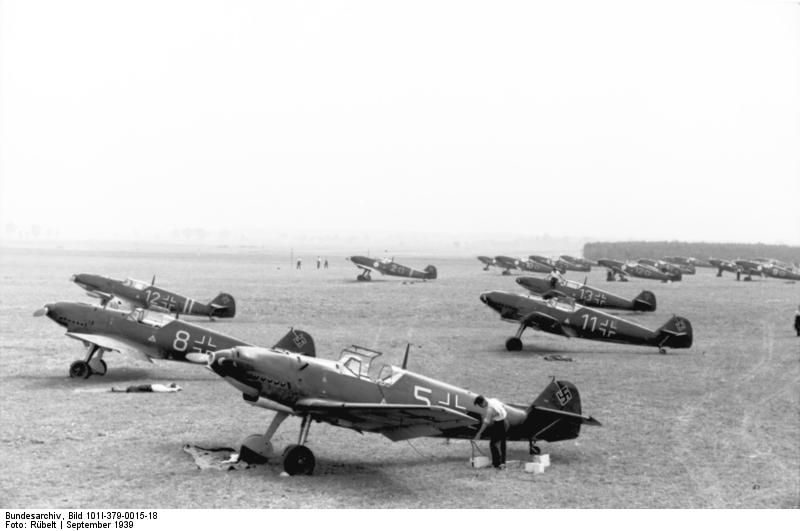
German forces step up their bombardment of Warsaw and add heavy air attacks to it. Some 400 Luftwaffe bombers and Stuka dive bombers make repeated sorties, starting significant fires. Hitler wishes to complete the conquest as soon as possible and since the garrison is fairly strong, it is necessary to force them to submit by terrorizing the civilian population. The bombing continues until the surrender.
Hitler issued Directive No. 4, Finishing the War in Poland. German Chancellor Adolf Hitler issued his fourth war directive, ordering increased attacks on Allied shipping and a swift conclusion to the war in Poland:
The Supreme Commander Of The Armed Forces.
The Leader’s Headquarters. 25th September, 1939. 7 copies
Directive No. 4 For The Conduct Of The War
- The final form of Government of the former Polish territory in the area between the demarcation line and the German frontier has not yet been decided. After the conclusion of hostilities around Warsaw and Modlin the demarcation line is to be adequately secured by formations of lower fighting power. The forces of the Army and Air Force which are required for the quick destruction of the continuing Polish resistance behind the demarcation line (area San-Vistula-Narew-Pisia) will be retained in the east. I request a report on the strength of the forces which it is proposed to employ for both these purposes.
- I shall myself decide whether Modlin and the part of Warsaw west of the Vistula are to be reduced by a general attack before 3rd October. This will depend upon the success of local attacks and the process of wearing down the enemy. Preparations will, however, be made for such an attack.
- The flow of refugees westwards across the demarcation line will be halted at once, with the exception of refugees of German racial origin, and Ukrainian activists.
- Decisions for the further strategy of the war will be made in the immediate future. In the meanwhile no measures shall be taken by the Armed Forces, either in the matter of organization or of equipment, such as may limit freedom of decision. The possibility of going over to the offensive in the west at any moment must be kept open. Sufficient forces must be retained in East Prussia to occupy Lithuania with all speed, even if there should be armed resistance.
- (a) On land the Directives given for the conduct of the war in the west remain in force for the present. (b) At sea, trade war according to International Prize Law is to be waged against both France and England, free from previous restrictions. In addition, the following are now permitted: Attacks on French naval and air forces, French merchantmen in convoy, and all troopships; mining operations off the north French coast (embarkation points). War on merchant shipping according to Prize Law by naval aircraft. Attacks on passenger steamers, or large vessels which obviously carry passengers in considerable numbers in addition to cargo, will still be forbidden. (c) For air warfare in the west the existing limitations remain in force. Aircraft will cross the German frontier only for purposes of local reconnaissance or to attack hostile aircraft and observation balloons. The Air Force may also operate in the German Bight and in the western declared mined areas, and in direct support of naval operations against English and French ships. A separate order will cover long range reconnaissance.
- With reference to submarine warfare, from now on only the following terms will be used: For submarine warfare in accordance with Prize Law: trade warfare . For unrestricted submarine warfare: the sea siege of England .
- English merchantmen which are definitely known to be armed may be attacked by submarines without previous warning.
(Signed) Adolf Hitler.
Bread and flour rationing is introduced in Germany. The distribution of food ration cards is completed.
Artillery duels took place on the Western Front of the European War. The French shell Reich forts on the Rhine as Nazis mass troops near Basel.
Andorra and Germany sign a treaty ending World War I, as Versailles Peace Treaty forgot to include Andorra
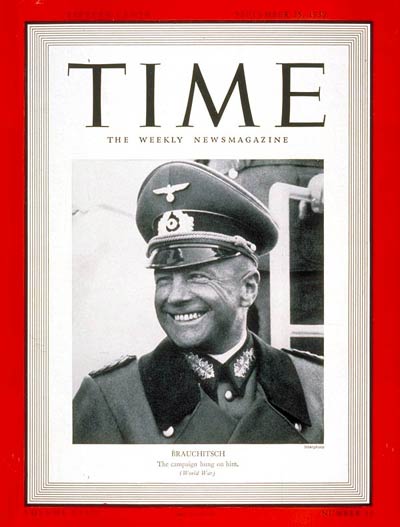
Franz Halder noted in his diary that he believed Adolf Hitler was ready to plan a war with France and Britain.
Hundreds of Jews trudged through the streets of Prague to their synagogues today bearing their radios. The Gestapo had ordered all radios in Jewish hands turned in and this afternoon they were picked up by trucks and hauled off to an unrevealed destination.
After a near miss in an air attack, German propaganda claims that the British aircraft carrier Ark Royal has been sunk. This is the first of several such false claims during the coming months. The attack also marks the debut of the German Ju88 bomber.
The maiden flight of the Handley-Page Halifax heavy bomber took place from the RAF Bicester airfield in Oxfordshire. In conjunction with the Lancaster heavy bombers, the Halifax formed the mainstay of the RAF Bomber Command offensive in later years.
The British began laying anti-submarine mines in the Strait of Dover.
Automobiles are vanishing from British roads. The effect of war-time gasoline rationing, imposed Saturday, became apparent today as tanks of cars that had been filled by foresighted drivers began to run dry. The streets around Piccadilly are almost empty now.
Britain stages a new leaflet raid; messages tell the Reich that all hope for a quick war is gone.
In the House of Commons, First Lord of the Admiralty Winston Churchill claims that Great Britain is winning the U-boat war.
The Swedish steam merchant Silesia was stopped by gunfire and after the crew abandoned ship was torpedoed and sunk by the U-36, commanded by Kapitänleutnant Wilhelm Fröhlich, 45 miles west-northwest of Egerö Lighthouse, Norway. Of the ship’s complement, all 19 survived and were picked up by the Swedish motor merchant Suecia. The 1,839-ton Silesia was carrying wood and general cargo, including steel and iron pipes and was bound for Hull, England.
The Dutch coaster Tegri departed from Göteborg, Sweden for a Dutch port, but never arrived and was lost without a trace with all 7 hands. She probably struck a mine in the North Sea.
The Italian Government, through its press, went on hammering away today at the idea of peace suggested by Premier Mussolini in his speech on Saturday.
The Soviet Union has offered to guarantee Turkey against German expansion to the Black Sea if Turkey will agree to remain neutral in the European war and close the Black Sea to ships of belligerent nations, according to information reaching diplomatic quarters in Washington today from Europe.
The War at Sea, Monday, 25 September (naval-history.net)
Western Atlantic – convoy HXF.2 departed Halifax at 0700 escorted by Canadian destroyers HMCS Saguenay and HMCS Fraser, before they detached on the 26th. The convoy reached Liverpool on 4 October, but there were no HXF.3, HXF.4, or HXF.5.
Northern Patrol – Anti-aircraft cruiser HMS Calcutta was temporarily attached to the 7th Cruiser Squadron, operating on Northern Patrol.
British northern waters – light cruisers HMS Diomede and HMS Dragon arrived at Scapa Flow.
Irish Sea – patrol sloop HMS Kingfisher attacked a submarine contact 10 miles NE of St John’s Point, Ireland.
British east coast – destroyers HMS Brazen and HMS Boreas attacked a submarine contact 10 miles east of Sunderland.
Sloop HMS Bittern attacked a submarine contact off Flamborough Head.
Sloop HMS Enchantress attacked a submarine contact 20 miles SE of the Humber.
Norwegian waters – U-36 sank Swedish merchant ship Silesia (1839grt) 45 miles WNW of Egersund.
Baltic – Polish submarine ORP Zbik arrived at Sandhamn, Sweden, for internment.
Anti-submarine minefields, Dover Straits – the British started laying a deep minefield between Folkestone and Cap Griz Nez to close the Straits to German submarine traffic. Minelayers HMS Adventure and HMS Plover and auxiliary minelayers HMS Shepperton and HMS Hampton laid 3,636 mines and completed the field on 23 October.
Only U-31 was able to pass successfully through the Dover Strait during the war, on the 11th/12th September. U-35 attempted to pass through at approximately the same time, but was forced to abandon the attempt and instead proceeded to her patrol area by the north-about route.
U-12 was lost in the field on 8 October, U-40 on the 13th, and U-16 badly damaged and ultimately lost on the 24th.
English Channel – after working up at Portland, destroyer HMS Jaguar sailed and arrived at Grimsby on the 26th. She left there on the 28th and arrived at Rosyth the same day to join Humber Force.
Light cruiser HMS Caradoc began repairing defects at Devonport, which were completed on 6 October.
UK-out convoys – OA.10 departed Southend with 42 ships, escorted by destroyers HMS Acasta and HMS Ardent from the 23rd to 28th, when the convoy dispersed.
OB.10 departed Liverpool escorted by destroyers HMS Winchelsea and HMS Walpole until the 28th.
Central and South Atlantic – convoy SLF.2 departed Freetown without an escort on the 25th and arrived at Southend on 6 October.
Destroyers HMS Hyperion and HMS Hunter of the 4th Division sailed from Freetown on the 25th to an area SW of Ascension Island to intercept suspected German raiders. On the 28th, they joined heavy cruiser HMS Cumberland, which departed Rio de Janiero on the 25th, and light cruiser HMS Neptune from Freetown on the 26th, but no enemy shipping was found. Cumberland and Neptune headed for Freetown and arrived on 2 October. Following refuelling, Cumberland departed on the 3rd to return to South America Station, arriving on the 9th.
New Zealand waters – New Zealand light cruiser HMNZS Leander departed Auckland and headed into the seas south of New Zealand for Auckland and Campbell Islands. She reached the area on the 28th and after carrying out an inspection, sailed for Wellington, arriving on 1 October. A second inspection of the area was conducted in November 1939.
A resolution providing for outright repeal of the present arms embargo against belligerents and enactment in its stead of a mandatory “cash-and-carry” system for all commerce between the United States and warring nations was presented to the Senate Foreign Relations Committee today as the basis on which the Administration will seek to rewrite its wartime policy to meet the realIties of the conflict in Europe. Broader, more definite and more detailed than the cash-and-carry provisions which expired last May, the new plan was presented by an Informal subcommittee of ten Democratic Senators as the product of their labors over the week-end. It was recommended by its authors as more neutral than the arms embargo, more definite in its mandates than the proposals outlined by President Roosevelt in his message last Thursday and more likely to protect the commerce and nationals of the United States than any plan offered from any source.
The “carry” requirements in the measure are absolute. They would prohibit under penalty of heavy fine or imprisonment the transportation of all goods and passengers to belligerent ports by American vessels. The “cash” prescriptions are modified only by permission of short-term nonrenewable credits — not to exceed ninety days — in aid of legal transactions and of character customarily used in normal peacetime commercial transactions.” The resolution makes it mandatory, however, that all title to and interest in goods sold to belligerent nations or their agents be transferred before they leave the shores of the United States.
Furthermore, American nationals would be prohibited from traveling on ships of belligerent nations, except under such rules and regulations as the President might prescribe. The exception was understood to have been recommended at last week’s “unity conference” by Colonel Frank Knox, who cited the case of war correspondents and other Americans on legitimate missions who might find it necessary to travel on vessels of belligerents. Various other prohibitions and restrictions relating to such matters as collection of war funds in this country and the use of American ports as possible supply bases for submarines or havens for armed merchantmen, are included in the resolution — all with the intent of preserving the neutrality, peace, security and commerce of the United States and its citizens.
After formally receiving the new plan, the Foreign Relations Committee recessed until Thursday to allow the “isolationist” Senators time to study its provisions. Administration leaders were confident that the program would strengthen the cause of embargo repeal. The isolationists, however, refused to be deterred from their purpose to maintain the arms ban and declared they would fight to the last ditch to retain it.
Both the Senate and House adjourned after short meetings. They will reconvene on Thursday but adjourn again if a measure is not then reported. The House, in fact, adopted a plan to adjourn periodically until October 9, leaving the whole play to the Senate. There is little likelihood that serious debate will begin in the upper body before next week. Meanwhile, the debate through the press and over the radio is expected to continue apace. Washington is particularly watching the American Legion convention in Chicago, where men who fought in the last World War are expected to take some action relative to the embargo dispute now before Congress.
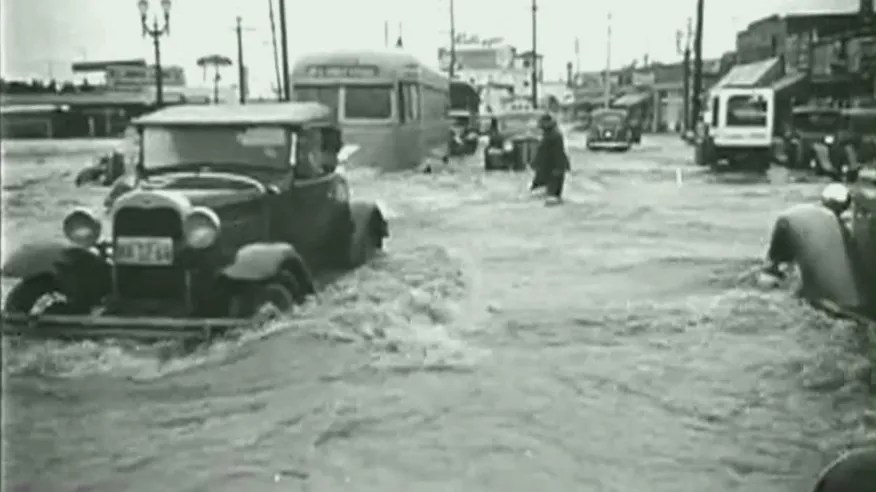
A tropical storm made landfall near San Pedro, California, the only tropical storm to do so in the twentieth century. At least forty-three persons apparently perished in a violent wind and rain storm which struck Southern California late yesterday and caused damage which officials said today might exceed $1,000,000. Dozens of other persons were on fourteen pleasure boats that were reported missing along the coast. The wreckage of what apparently had been an eighty-foot yacht was found in the surf near Huntington Beach. No craft of that size, however, was listed as missing.
The storm wrecked, sank, or beached more than a score of boats, created flood conditions in many localities, including mountain resort areas, put 35,900 telephones out of commission in Los Angeles and nearby towns, seriously disrupted rail and highway traffic and cut off power service. A thirty-mile-an-hour gale swept the Los Angeles harbor area tonight. More rain was forecast. Thirty homes were damaged and eight destroyed on Alamitos Peninsula near Long Beach, causing damage estimated at $100,000. Portions of Whittier, Artesia, Downey, Montebello, Burbank, Pasadena and San Fernando Valley were without lights or telephones. Several persons were marooned at a resort in San Antonio Canyon but were not in immediate danger. Damage of $100,000 resulted from pounding waves at the Los Angeles Yacht Club’s cove at Fish Harbor. Five racing sloops sank and others were battered. About 200 persons were rescued last night and today from wrecked and disabled pleasure boats and fishing craft.
On board the boats reported missing were parties ranging from two or three to eight persons. Most of these craft last were known to be between Los Angeles Harbor and Catalina Island, twenty-six miles off shore, and it was thought that some may have reached safety at those places without having given official notice. The casualty list included eight persons drowned off boats and in rip tides and whose bodies were recovered. In addition, the unidentified bodies of a man and woman were washed ashore in the Los Angeles-Long Beach harbor area, and these brought the known death list to ten.
The storm created near-flood conditions in some parts of Los Angeles, with 5.41 inches of rain in less than twenty-four hours preceding noon today. It was the heaviest September rain in the city’s weather history, and it broke up the worst heat wave here in Weather Bureau records, as measured by intensity and duration, eight days. Most of the storm victims were on board the sport fishing boat Spray, which sank off Point Mugu near Oxnard, seventy miles northwest of here. Twenty-three persons apparently drowned when the Spray capsized last night within 500 feet of the pier. Two persons fought their way safely ashore. The body of one of the Spray victims, that of Mrs. Charlotte King of Los Angeles, was recovered today.
Today in Washington, President Roosevelt returned after a weekend at Hyde Park and received callers, including Senators and Representatives, with whom he discussed the neutrality situation.
The Senate met for three minutes. The Foreign Relations Committee received the draft of the new neutrality bill. The Joint Monopoly Committee opened a study of the oil industry.
The House passed a bill appropriating $222,000 for traveling expenses of members of Congress; passed a resolution providing for three-day adjournments for the next two weeks, and adopted a resolution naming as Speaker Pro-Tempore Sam Rayburn, the majority leader. It also received bills from Representative Voorhis of California designed to strengthen United States neutrality, a resolution from Representative Fish asking for a report on credits extended by the Export-Import Bank to warring nations, and adjourned at 1:23 PM until noon Thursday.
A unanimous decision to seek perjury and possibly contempt indictments against Fritz Kuhn, head of the German-American Bund, was reached by the House Committee Investigating Un-American Activities today after it had received documented evidence held to contradict that given to it by the former German machine-gunner several weeks ago. The contradictory evidence was offered by Gerhart H. Seger, former Social Democrat member of the German Reichstag and now publisher in New York of the German-American weekly Neue Volkszeitung. Its general effect was to rebut Kuhn’s statements that the Bund is not an agency of the Nazi government operating in this country.
No definite action toward the indictment of Kuhn is expected, however, until after the committee has heard other testimony and has recalled Kuhn for further questioning. On the motion of Representative Thomas, the committee also directed submission to both the State and Justice Departments of evidence it has received which, Mr. Thomas said, showed “no doubt” that officers and members of both the Bund and the American Communist Party not only were violating the law requiring agents of foreign governments to register but the Espionage Act also.
Three hundred members of the German-American Bund, meeting as the Patriotic Dinner Club tonight in New York, heard speakers denounce President Roosevelt’s neutrality policy as favoring England and ask for funds for the defense of Fritz Kuhn, national Bund leader, who is under indictment.
The U.S. Agriculture Department issues a revised list of farm surpluses that can be purchased through the food stamp program
1940 Studebaker prices start at $660 for the Custom Coupe.
The board of the World Fair is expected to approve the continuation of the fair on its present site for 1940.
The Chicago White Sox increased their third-place margin to a game and a half today with a 4–3 victory over the St. Louis Browns. Ted Lyons scattered nine St. Louis hits for his fourteenth triumph, while Chicago was touching Roxie Lawson for thirteen, including four singles by little Ollie Bejma.
The Bees’ Johnny Cooney hits his second homer in two days, a third-inning blast off New York Giants pitcher Bill Lohrman. For Cooney, it is the second and last homer in what will be a 20-year career. But the Giants prevail over Boston, 6–5. The Bees score three in the top of the ninth to take a 5–3 lead but the Giants answer with three to win it with one out.
The prevailing opinion today among Foreign Ministers of the American nations meeting in Panama was that an appeal would be made to all belligerents to refrain from warlike actions, including search and seizure of vessels, in American waters south of the Canadian border.
The Japanese are engaged in a major drive in China. Tokyo says its forces are making steady gains, but the Chinese say defenses are sturdy. Taking advantage of the war in Europe, Japan hurled the might of her army against almost 1,000,000 Chinese troops today in an effort to strike a death blow in the twenty-six-month-old conflict in China. An army communiqué announced that a “large force” of Japanese assaulted sixty divisions of Chinese having an estimated strength of 950,000 men in Kiangsi and Hunan Provinces.
The front is seventy miles long, with the heaviest fighting around Tungting Lake, south of the Yangtze River, according to Japanese reports. The battle is the first major military operation in several months. Succeeding communiqués reported that the Japanese were making steady progress, but details were not disclosed. Observers believed that Japan was attempting to take a quick advantage of British, French and Russian preoccupation in Europe and crush Chinese resistance. Great optimism was apparent in official circles in Tokyo, where the view prevails that all three European powers will be forced to abandon China because of the more urgent crisis at home.
Engaging in the most extensive military operations in China in ten months, the Japanese Army reported today that its forces had reached a point within fifty miles of Changsha after an advance down the Canton-Hankow Railway. Changsha, in Hunan Province in South Central China, is the objective of a Japanese drive that began shortly after Tokyo agreed to a truce with Russia on the Manchukuo frontier.
Apparently convinced that world. conditions were favorable for a major military effort in the planned conquest of China, the Japanese were reported to have launched a sudden two-pronged drive from the southern end of Lake Tungting and from Tsungyang, in Southeastern Hupeh Province. At the same time the westward attack on Changsha from Nanchang, in Kiangsi Province, continued with heavy fighting and widespread aerial activity reported on fronts extending 200 miles from east to west and 100 miles from north to south.
Twenty thousand die in the Japanese drive towards Changsha. Each side loses 10,000 in battle as Chinese cities are being bombed anew.
U.S. Navy patrol squadron VP 21 arrives at Manila, P.I.; it will be tended by Langley (AV-3), which arrived the previous day.
Dow Jones Industrial Average: 152.64 (-0.35).
Born:
“Sweet Joe” Russell, American a cappella singer (The Persuasions – “Slip Sliding Away”), in Henderson, North Carolina (d. 2012).
David S. Mann, American Democratic politician (Rep-D-Ohio, Mayor of Cincinnati), in Cincinnati, Ohio.
Feroz Khan, Indian actor, producer and director (known as Clint Eastwood of Bollywood), in Bangalore, Kingdom of Mysore, British India (d. 2009).
Leon Brittan, British politician, Home Secretary and member of the European Commission, in London, Engalnd, United Kingdom (d. 2015).
Naval Construction:
The Kriegsmarine (German Navy) Type IID U-boats U-137, U-138, U-139, U-140, U-141, U-142, U-143, U-144, U-145, U-146, U-147, U-148, U-149, U-150, U-151, and U-152 are ordered from Deutsche Werke AG, Kiel (werk 266-281).
The Kriegsmarine (German Navy) Type IXC U-boats U-153, U-154, U-155, U-156, U-157, and U-158 are ordered from AG Weser, Bremen (werk 995-1000).
The Kriegsmarine (German Navy) Type IXC U-boats U-161, U-162, U-163, U-164, U-165, and U-166 are ordered from Deutsche Schiff und Maschinenbau AG, Bremen (werk 700-705).
The Kriegsmarine (German Navy) Type IXC U-boats U-501, U-502, U-503, U-504, U-505, and U-506 are ordered from Deutsche Werft AG, Hamburg (werk 291-296).
The Kriegsmarine (German Navy) Type VIIC U-boats U-551, U-552, U-553, U-554, U-555, U-556, U-557 and U-558 are ordered from Blohm & Voss, Hamburg (werk 527-534).
The Nihon Kaigun (Imperial Japanese Navy) Type B cruiser submarine I-28 is laid down by Mitsubishi (Kobe, Japan).
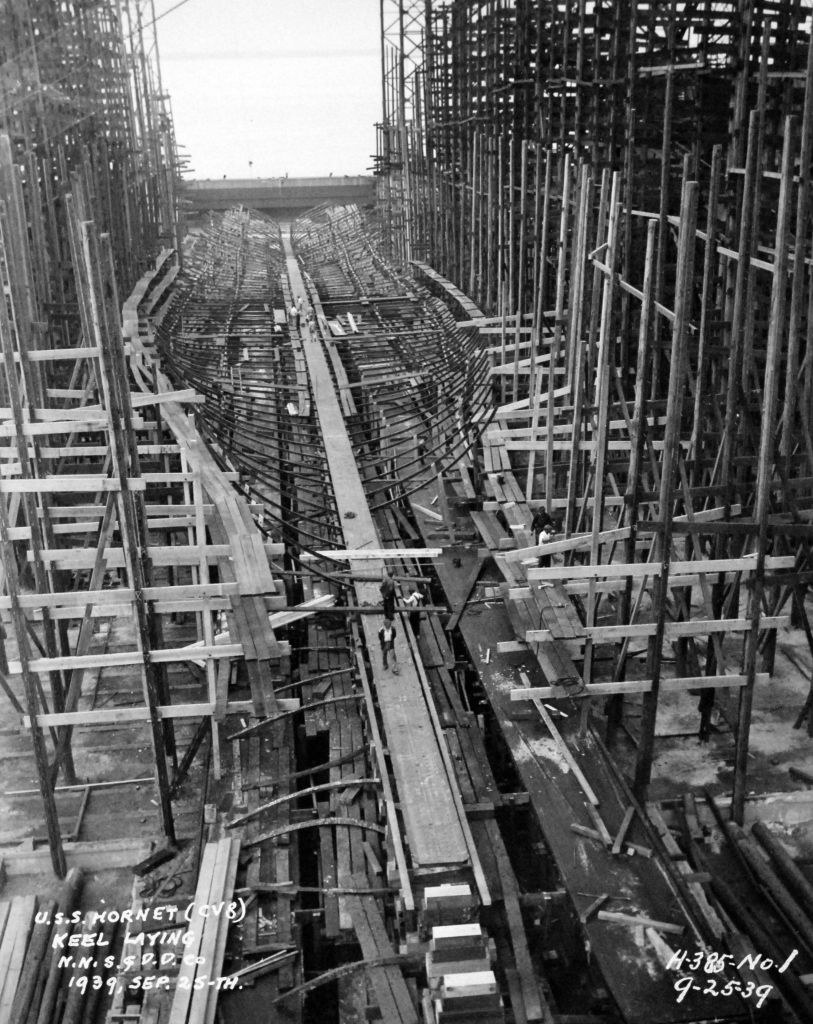
The U.S. Navy Yorktown-class aircraft carrier USS Hornet (CV-8) is laid down by the Newport News Shipbuilding and Dry Dock Co. (Newport News, Virginia, U.S.A.).
The Nihon Kaigun (Imperial Japanese Navy) Katori-class light cruiser HIJMS Kashima (鹿島 練習巡洋艦) is launched by Mitsubishi (Yokohama, Japan).
The Kriegsmarine (German Navy) vorpostenboot V 409 August Bösch is commissioned.
The Kriegsmarine (German Navy) vorpostenboot V 407 Saarland (later V 411 Saarland) is commissioned.
The Royal Australian Navy auxiliary minehunter HMAS Doomba (N 01, later J 01), formerly the Royal Navy Hunt-class minesweeper HMS Wexford, is commissioned.
 History Diaries