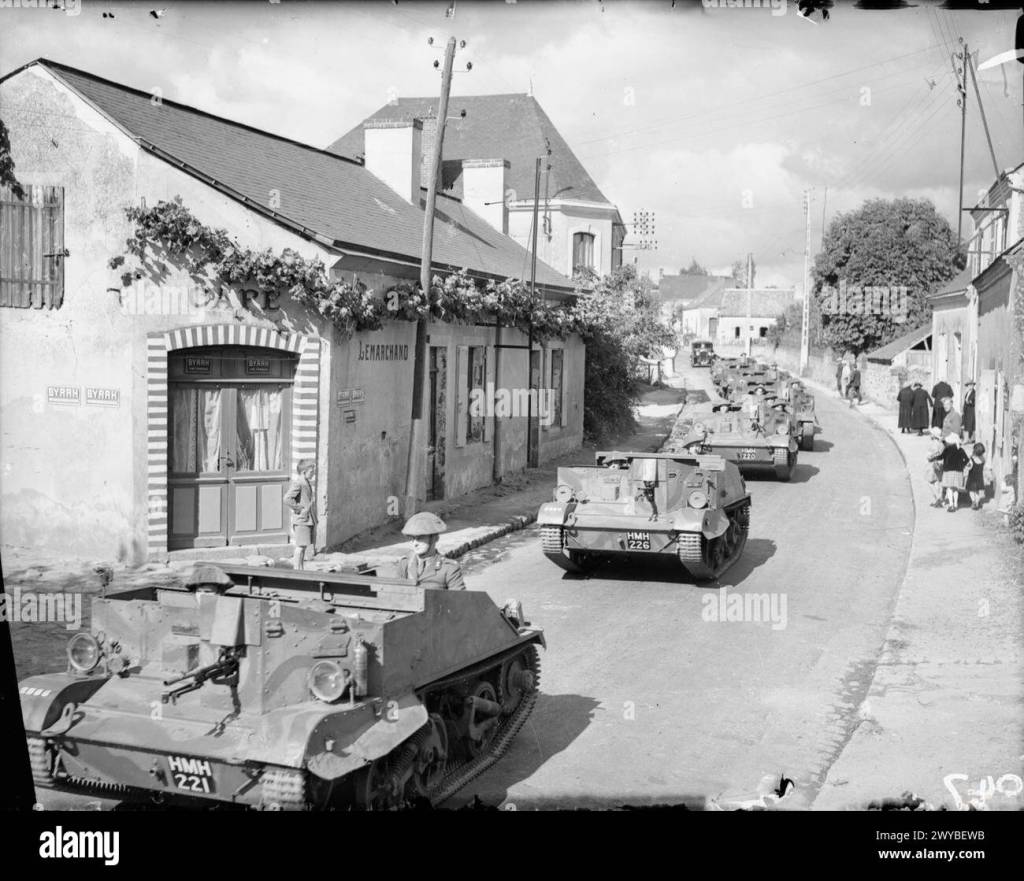
In the Battle of Husynne, the Polish Army beat back a Soviet infantry corps but were surrounded and forced to surrender by a counterattack of Soviet tanks. The battle took place in the vicinity of Husynne manor, some 7 kilometers (4.3 mi) to the north east of the town of Hrubieszów. In the effect of a swift cavalry charge, a Polish improvised cavalry unit broke through Soviet infantry lines, but were then defeated by Red Army tanks.
On 24 September the 8th Rifle Corps of the Red Army crossed the Bug River near Hrubieszów. The unit, consisting of 44th and 81st Rifle Divisions, captured the town and headed westwards. It was met by an improvised Polish cavalry unit operating in the area. The Polish force, commanded by Major Witold Radziulewicz (retired), was composed of a march squadron of the 14th Regiment of Jazlowiec Uhlans, reinforced by a squadron of mobilised mounted police from Warsaw and an understrength battalion of chemical defence troops, some 1,500 men strong and armed with 36 81 mm wz. 31 mortars commanded by Captain Józef Cwynar. The Polish commander was heading southwards, towards the border with Hungary and Romania. Radziulewicz decided to break through the ranks of Soviet infantry and continue his march. The Soviet infantry started an assault of the Polish formation in an open field, but were met by a counter-charge of 400 Polish policemen, supported by the sudden bombardment of the mortar battery. The sudden counterattack caused panic in the Soviet lines and the Soviet infantry started a hasty retreat. Soon afterwards a Soviet tank detachment appeared from the Bug River valley. After a brief fight, the Poles were overwhelmed, surrounded and forced to surrender after the mortars had expended their ammunition.
The Red Army suffered several hundred casualties and the Poles lost 18 killed and 139 wounded. After the battle at least 25 Polish prisoners of war were murdered and are buried in a small war cemetery in Rogalin and in Husynne.
The Battle of Kodziowce ended with the escape of many of the Polish troops from the Battle of Grodno into Lithuania. The Battle of Kodziowce was a battle that took place at Kodziowce (now in modern Belarus) that occurred on 23-24 September 1939 during the Soviet invasion of Poland. It was fought between the Polish Wołkowysk Cavalry Brigade commanded by Wacław Przeździecki and Edmund Heldut-Tarnasiewicz who were retreating from the Battle of Grodno (1939) and the Soviet 2nd Light Armoured Brigade under Colonel Alexey Kurkin. The 2nd Light Tank Brigade was mainly composed of BT-7 light fast tanks and a small amount of BA-I armoured cars.
Most of the Polish troops fighting the Battle of Grodno including the Wołkowysk Cavalry Brigade were able to retreat north and so avoid capture by the victorious Soviet forces to Grandzicze and Hoża. The forces from Grodno occupied the area around Sopoćkiń. It was planned to reorganized the retreated forces by uniting them under the structure of an Infantry Division after moving them to the area around Sejny. Wacław Przeździecki planned on 22 September that all of his troops would breakthrough to Lithuania through areas currently lightly held by Soviet forces.
The 2nd Light Tank Brigade under Colonel Alexey Kurkin received orders from Ivan Boldin, commander of the force it was part of, the Dzerzhinsky Cavalry-Mechanized Group, on September 21 at 11:00 am to form a new group with tanks, armored cars and motorized troops, as well as with anti-tank and anti-aircraft weapons to be commanded by Major Chuvakin. This group was to neutralize Polish units in the Augustów Primeval Forest and capture Augustów and Suwałki. This group set off to accomplish their objectives at 3 pm on September 21. The group of Major Chuvakin separated likely after resting at a village called Bieliczany. One of the separated groups from the original group unit went to Sylwanowce and then Kodziowce. Another separated group went to Kownia and Sopoćkina. On 23 September at Sylwanowce Soviet troops heard gunfire and then Soviet armoured cars were attacked by Polish troops.
After a clash between Soviet and Polish forces the Soviets withdrew with Polish forces in pursuit. Early in the afternoon when Polish forces were exhausted, 7 Soviet tanks surprised the defending Poles around Kodziowce and broke through Polish lines. Also at this time Polish Lancers, probably of 4th Squadron from 101st Uhlan Regiment, spotted resting Soviet troops to the east. Major Żukowski, commander of the 101st Uhlan Regiment, who was commanding from Kodziowce, decided to defeat the resting Soviet forces with a surprise assault at 4 am next morning.
Meanwhile Soviet armour under Major Czuwakina attacked from the east of Sopoćkiń after arriving in the vicinity on 3 am the previous day. This meant that the rear of a company from KOP Sejny Battalion under Lieutenant Józef Smereczyński on the edge of Sopoćkiń was vulnerable forcing the company to retreat. After this the Soviet armor continued to advance into Sopoćkiń itself, being opposed by the reserve units of the KOP Sejny battalion, who after an hour withdrew from Sopoćkiń. In the morning of the next day the KOP Sejny Battalion withdrew to the Augustów Canal after halting the Soviet advance.
While the KOP Sejny Battalion was fighting Soviet armor, the Polish forces around Kodziowce, including the 101st Uhlan Regiment, were forced to retreat after realizing they would not be able to successfully defend against a new incoming group of Soviet armor. The retreat was rapid with dead and wounded being left behind. Major Żukowski having been gravely wounded in the fighting was evacuated so he could be reunited with other Polish forces around Kodziowce. Retreating Polish forces stood firm, being able to repel the last Soviet attack on 8 am on 24 September. After this most of the Polish force used the respite to gradually retire to Lithuania unit by unit under Soviet harassment, at which point they were safe from Soviet forces in the neutral country. Some Polish units chose to stay in Poland to keep fighting the invaders, instead of seeking sanctuary in Lithuania.
Despite heavy casualties received in the fighting in Poland including commander of 3rd squadron Lieutenant Stanisław Dobrzański, Kpr. General Józef Olszyna-Wilczyński, and Major Żukowski who died of his wounds on the way to hospital in Lithuania, the 101st Uhlan Regiment did not break up when it reached the safety of Lithuania. Major Żukowski was later awarded the Virtuti Militari Cross V Class the Virtuti Militari Cross, the highest military award of Poland, for his role in the fighting. Polish forces in the battle took casualties of roughly three companies of infantry and official Soviet figures say they suffered casualties of 4 tanks, 3 armored cars, and 11 killed and 14 wounded. However Polish sources place Soviet casualties significantly higher at 22 armored fighting vehicles.
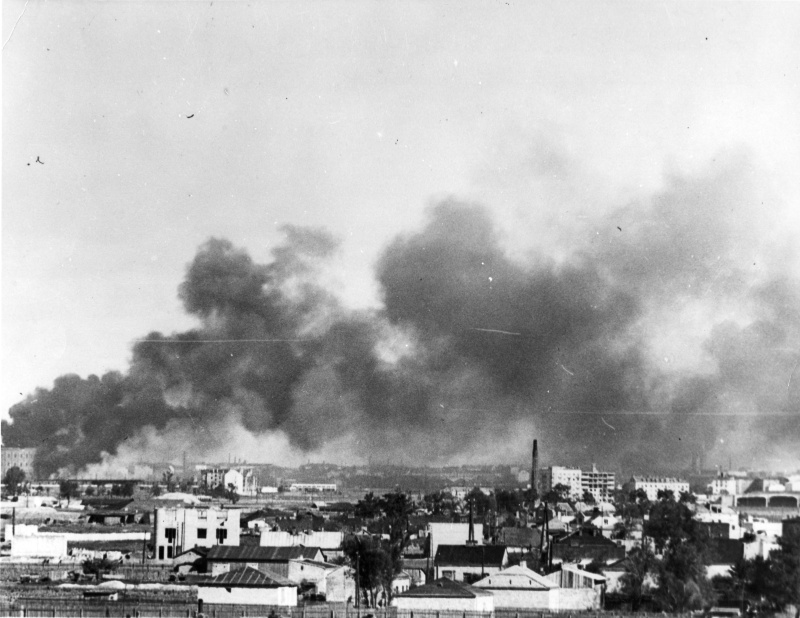
The siege of Warsaw continues. German forces isolate Modlin Fortress, north of Warsaw; reports from Warsaw suggest heavy casualties among those in the city including wounded in hospitals. German planes and guns were reported in Polish dispatches today to be subjecting Warsaw to its “most dreadful bombardment,” with more than 1,000 civilians killed in twenty-four hours and the city “practically in ruins.”
Terrorizing raids by thousands of German airplanes on the Polish civil population were described by Anthony J. Drexel Biddle Jr., United States Ambassador to Poland, on his arrival in Paris today. He was accompanied by members of his family and his staff.
Meanwhile, Soviet forces enter the Galician oilfields.
The Soviet Union gives an ultimatum to the Estonian Foreign Minister in Moscow, Russia, demanding land to build a Soviet military base in Estonia. Warships of the Soviet Navy appear off Estonian ports and Soviet bombers begin a threatening patrol over Tallinn. In Moscow Soviet Commissar for Foreign Affairs Vyacheslav Molotov demands that Estonia allow the Soviet Union to establish military bases and station 25,000 troops on Estonian soil for the duration of the European war or the Soviet Union will use “more radical actions.”
On this Jewish Day of Atonement, Jews across Poland are publicly humiliated by SS troops: forced labor, coerced shavings of beards, destruction of property, beatings, and forced dancing. At Piotrków, Poland, Jews are compelled to relieve themselves in the local synagogue school, then use prayer shawls and holy books to clean up the mess.
Jewish prisoners of war are forced by the Germans to clean the latrines with their bare hands and are treated with particular brutality. Joseph Berger was one of the thousands of soldiers who were taken captive on September 19 in the area between Sochaczew and Zyrardow, after the defeat at the Bzura River. He reports that immediately after the surrender the Germans began to group the prisoners according to nationality. A German officer addressed the 1,500 Jews there, accusing the Jewish people of wanting to conquer Berlin. Brutal treatment began forthwith. A large number of prisoners, both Jews and non-Jews, were driven to the concentration-point at Zyrardow, which had been set up in the open at the local stadium. They were kept there for ten days without food and managed to stay alive solely because the local inhabitants threw food over the fence. On September 24, the Day of Atonement, the Germans treated the Jews with particular brutality, forcing them to clean latrines with their bare hands. From Zyrardow the prisoners were taken to a permanent camp. They were packed together in sealed cattletrucks and for the ten-day journey were not allowed to leave the cars even to relieve themselves.
German Einsatzgruppen murder 800 members of Polish intelligentsia at Bydgoszcz, Poland. During the first four months of the occupation, the Germans murdered up to 5,000 residents of Bydgoszcz and the Bydgoszcz County in secret or public executions, of which probably between 1,500 and 1,900 victims were from Bydgoszcz itself. On September 18, Einsatzgruppe IV officers had directed the first transport consisting of 62 people from Bydgoszcz to the Dachau concentration camp. At the same time, a secret order was issued to the Dachau commander to shoot all prisoners upon the arrival of the transport – except for Canon Józef Schulz.
Friends of the Rev. Martin Niemöller said today that the imprisoned pastor had volunteered from a concentration camp cell to resume his World War service as a submarine commander, but had been turned down by Nazi authorities.
There was a growing belief in London today that some new peace offer may be forthcoming from Chancellor Hitler soon. This belief was heightened somewhat over the weekend by Premier Mussolini’s speech declaring that now is the time to end the war.
What form it will take or who will be its sponsor is not known, but it is as certain as ever that Great Britain and France will not be tempted to halt the hostilities until their minimum war aims — ending Hitlerism and threats of aggression — are achieved.
Since their attitude is believed to be understood not only in Berlin but in neutral capitals as well, the British suspect that the new move, if made, will have as a major purpose an attempt by Chancellor Hitler to shift responsibility for prolonging the war. With Poland all but crushed under the Nazi military machine, the German fighting units are being moved to the Western Front, and it was reported here today that large fleets of bombing and fighting planes are being concentrated behind the Westwall and at the border of Belgium, which has called up 750,000 troops to defend her neutrality.
The British Expeditionary Force was described officially today as preparing to go into action on the Western Front.
Pope Pius XII is deeply anxious about the Polish situation and worries about Catholics there.
French bombers strike the German Zeppelin base at Friedrichshafen.
French artillery fires on the German border.
Belgium is prepared, but its army is small. The force is organized for quick action.
Rumanian King Carol disregards government wishes, attending the funeral of Premier Calinescu.
Christian X, King of Denmark suffers a mild heart attack.
French observers reject Premier Mussolini’s proposal to base peace on the conquest of Poland.
Russia shuts the Neva River as Finns dig trenches. The Soviet Government was reported today to have handed to the Finnish Government a note announcing that passage through Leningrad via the Neva River would be closed henceforth to Finnish vessels.
Refugees from Poland and other Central European countries are arriving in Palestine at the rate of 1,200 or more a week and more than 5,000 have sought to enter the Jewish homeland since the war began, Baruch Zuckerman, vice president of the World Zionist Organization, told representatives of 150 leading Jewish organizations of Greater Boston today. These are “illegal immigrants” from the viewpoint of the British Government, being outside the quota limits, he said, but the government has modified that attitude, refugees being taken to concentration camps, but almost immediately freed.
The unescorted British steam merchant Hazelside was torpedoed and sunk by the U-31, commanded by Kapitänleutnant Johannes Habekost, southeast of Fastnet, Ireland in the eastern Atlantic Ocean (51°17′N 9°22′W). Of the ship’s complement, 12 died and 22 survivors reached land by lifeboat. The 4,646-ton Hazelside was carrying timber, pulp, and wheat and was bound for Liverpool, England.
The neutral Swedish steam merchant Gertrud Bratt was stopped by gunfire and after the crew abandoned ship was torpedoed and sunk by the U-4, commanded by Oberleutnant zur See Harro von Klot-Heydenfeldt, in the Skagerrak, 12 miles southeast of Jomfruland, Norway (58°40′N 9°52′E). Of the ship’s complement, all 20 survived. The 1,510-ton Gertrud Bratt was carrying wood pulp, paper, piece goods, and cellulose and was bound for Bristol, England.
The 287-ton British steam fishing trawler Caldew was stopped and after the crew abandoned ship was sunk by gunfire by the U-33, commanded by Kapitänleutnant Hans-Wilhelm von Dresky, north of Scotland in the North Sea (60°47′N 6°20′W). Of the ship’s complement, all 11 survived and were picked up by the Swedish motor merchant Kronprinsessan Margareta, which was captured a few days later by the German destroyer Friedrich Ihn and the torpedo boat Iltis. The British sailors were taken prisoner and interned in the German POW Camp Stalag XB.
The German cargo ship Minden was intercepted in the Atlantic Ocean south of Iceland by HMS Calypso ( Royal Navy) and was scuttled by her crew, who were rescued by HMS Dunedin ( Royal Navy).
The Estonian steam merchant Hanonia was stopped by the U-34, commanded by Kapitänleutnant Wilhelm Rollmann, off Norway in the North Sea and brought to Kiel-Friedrichsort and later to Hamburg by a prize crew, because the cargo of the ship had been bound for an English port. The 1,781-ton Hanonia was carrying timber and was bound for Grimsby, England.
The French cargo ship (2,660 GRT, 1939) Phryne struck a mine laid down by U-13 on 4 September 1939 and sank in the North Sea 3.5 nautical miles (6.5 km) off the Aldeburgh Lightship (Trinity House) (52°09′N 1°43′E). Her crew were rescued by HMS Boreas and HMS Brazen (both Royal Navy).
U.S. freighter Black Condor, detained by British authorities since 17 September, is released.
The War at Sea, Sunday, 24 September (naval-history.net)
German policy – Admiral Raeder lifted the order protecting French shipping from U-boat attacks.
Northern Patrol – light cruiser HMS Delhi departed Scapa Flow on this date with HMS Dunedin for Northern Patrol duties, and arrived back on 1 October.
Northwestern approaches – German steamer Minden (4318grt) which had departed Rio de Janiero on the 6th and was now 330 miles NW of Cape Wrath in 62 00N, 15 34W, scuttled herself when intercepted by light cruiser HMS Calypso, which had left Scapa Flow on the 22nd. Light cruiser HMS Dunedin, which left on the 24th, arrived on the scene alerted by Calypso’s contact report, but Minden had already scuttled. The crew was taken aboard Dunedin which arrived at Scapa Flow on the 28th.
U-33 sank British trawler Caldew (287grt) north of the Hebrides in 60 47N, 06 20W. The survivors were picked up by Swedish steamer Kronprincessan Margareta (3789grt), but she was stopped by German destroyer Friedrich Ihn and torpedo boat Iltis in the Skagerrak and the 11 British seamen taken off. They spent the war in Stalag XB.
North Channel – British aircraft attacked a submarine contact two miles NE of Fairhead, NE Ireland. Patrol sloops HMS Sheldrake, HMS Shearwater, HMS Kingfisher, and HMS Widgeon departed Belfast on the 24th to join the hunt.
Rescue of submarine Spearfish, North Sea – HMS Spearfish (LT J H Eaden) on patrol off Horns Reef was badly damaged by German anti-submarine forces and unable to submerge. Creeping along the neutral Danish coast, she was able to radio for help at 0510/25th.
Light cruisers HMS Southampton and HMS Glasgow of the Humber Force departed Rosyth at 0723 and joined destroyers HMS Jervis and HMS Jupiter off May Island at 0910. They were to operate off the Norwegian coast at 60N with destroyers HMS Somali, HMS Matabele, HMS Mashona, and HMS Eskimo, already off the Norwegian coast in order to cover Spearfish’s return.
Destroyers HMS Foresight and HMS Fame with one other destroyer were on Fair Isle Patrol. Light cruisers HMS Aurora and HMS Sheffield, also at sea, proceeded well into the approaches of the Skagerrak and met the Spearfish to provide cover.
The rescue force was supported by battlecruisers HMS Renown and HMS Hood, cruisers HMS Norfolk, HMS Newcastle, and HMS Edinburgh, and destroyers HMS Faulknor, HMS Foxhound, HMS Forester, HMS Fearless, HMS Fortune, and HMS Firedrake which departed Scapa Flow on the 25th.
Battleships HMS Nelson and HMS Rodney, aircraft carrier HMS Ark Royal, and destroyers HMS Bedouin, HMS Punjabi, HMS Tartar, and HMS Fury departed Scapa Flow on the 25th to cover the Humber Force returning with Spearfish. HMS Fame and HMS Foresight which had been at sea since 24 September joined the Nelson force at sea. HMS Mashona and HMS Matabele also later joined at sea. Foresight attacked a submarine contact north of the Orkneys.
Only destroyer HMS Ashanti which was having turbine repairs was absent from the operation.
At 1724, HMS Matabele was detached to investigate Danish steamer Ove Toft (2135grt) and did not rejoin the Fleet until after dark. At 1925, HMS Somali and HMS Eskimo were detached to join Spearfish, reaching her in 57 04N, 06 40E at 0100/26th and escorting her towards Rosyth screened by the Humber Force.
In German air attacks on the British forces, the screening HMS Glasgow was able to drive off an attack on Spearfish. HMS Ark Royal was near missed and HMS Hood was struck by a glancing bomb that did not explode. Lieutenant B S. McEwen, flying a Skua of Ark Royal’s 803 Squadron, shot down a Do.18 aircraft whose aircrew was picked up by Somali. Finally HMS Sheffield was bombed, but sustained no damage.
The Humber Force, HMS Spearfish and destroyers HMS Eskimo and HMS Matabele, covered by HMS Aurora, HMS Sheffield, HMS Somali and HMS Bedouin, arrived safely at Rosyth late on the 26th. Spearfish docked at Newcastle for repairs lasting until 4 March 1940.
Home Fleet and Humber Force – After refuelling, Humber Force and the Home Fleet units sailed again on patrol on the 27th. Heavy cruiser HMS Norfolk was detached for Northern Patrol.
At 2103/26th, destroyer HMS Fortune attacked a submarine contact 45 miles ESE of Duncansby Head.
Home Fleet destroyers HMS Fame, HMS Punjabi, HMS Foresight, HMS Faulknor, HMS Fearless, HMS Forester, HMS Mashona, and HMS Fury, detached from the Main Force, arrived at Scapa for refuelling on the 27th.
Shortly before arriving at Scapa Flow and after a submarine attack on battlecruiser HMS Hood was reported, destroyers HMS Foxhound, HMS Firedrake, HMS Eskimo, HMS Tartar, and HMS Bedouin detached to search for the submarine. Firedrake, in company with HMS Punjabi and HMS Fortune had been hunting since midnight for a submarine reported by FAA aircraft at 1812/26th. Then at 0255/27th, 20 miles east of Scapa, Fortune attacked a contact
The Main Fleet arrived at Scapa later that day. HMS Fortune immediately started boiler cleaning which was completed on the 29th.
After a submarine was reported by aircraft 55 miles ENE of Rattray Head, HMS Fury, HMS Forester, HMS Foresight, and HMS Ashanti left Scapa Flow to search.
Destroyers HMS Tartar and HMS Bedouin arrived early on the 28th. Later that day, Tartar, Bedouin, HMS Punjabi, HMS Somali, HMS Mashona, HMS Matabele, HMS Fearless, HMS Fortune, HMS Fame, and HMS Foresight departed Scapa Flow on an anti-submarine sweep. All arrived back on the 30th.
British east coast – convoy FS.10 departed Methil, and arrived at Southend on the 26th.
Destroyers HMS Jupiter and HMS Whitley attacked a submarine contact six miles north of St Abbs Head. Whitley, which was escorting an east coast convoy, again attacked a submarine contacts 45 miles NE of Blyth and then five miles SE of the Farne Islands.
French merchant ship Phryne (2660grt) was sunk 3½ miles east of Aldeburgh Light Vessel on a mine laid by U-13 on the 4th. Survivors were rescued by destroyers HMS Brazen and HMS Boreas and reached the Tyne that evening.
Convoy FN.10 departed Southend, and arrived at Methil on the 26th.
Norwegian waters – U-34 took in prize Estonian steamer Hanonia (2534grt) off the Norwegian coast. She was taken to Hamburg, later commissioned as Schiff 11 by the German Navy and used in minelaying off the English coast.
U-4 sank Swedish steamer Gertrud Bratt (1510grt) ten miles off Jomfruland, SE Norway off Lillesand in 58 40N, 09 52E.
UK-France convoys – BC.5F of steamer Ben My Chree departed Bristol Channel escorted by destroyer HMS Escort and HMS Electra, and arrived in the Loire on the 25th. The convoy was also escorted by French large destroyers Mogador and Volta from 0600 to 2000 on the 25th.
BC.5 of 12 steamers, including Beaverdale (Cdre), City Of Derby, Delius, Lowick, Trehata, and Volo departed Bristol Channel escorted by destroyers HMS Vivacious, HMS Viscount, HMS Venetia, and HMS Vanessa, arriving in the Loire on the 26th.
DB.7 departed Southampton of two personnel ships, escorted by destroyers HMS Vansittart and HMS Venomous, and arrived at Brest on the 25th.
Southwestern approaches – U-31 sank steamer Hazelside (4646grt) 10 miles SE of Fastnet in 51 17N, 09 22W. Twelve crewmen were lost and 22 injured and rescued. Destroyers HMS Vimy and HMS Versatile were sent to search for the submarine, and at 1352/25th, a Sunderland flying boat dropped seven bombs on U.31, ten miles SE of Fastnet. Three were reported as direct hits, but no damage was done.
South Atlantic – Light cruiser HMS Ajax sailed north from the Falklands to Rio de Janiero to relieve heavy cruiser HMS Cumberland which was heading towards Ascension Island on a sweep for German supply ships.
A new draft of the Neutrality Act would end the ban on arms. Final draft of a new Neutrality Bill, described by its authors as “more definitely neutral” than the present law, was completed in a five-hour conference today of ten Democratic Senators, who agree with President Roosevelt that the existing arms embargo against belligerents should be repealed.
The new plan will be presented to the Foreign Relations Committee tomorrow morning, according to Senator Pittman, chairman of both the formal committee and the informal group, which drafted the proposed new act. Senator Pittman and Senator Barkley, majority leader of the Senate, expressed confidence that the new measure would be reported by the committee and sent to the Senate for debate before the end of the week. In substance the new plan calls for immediate repeal of the automatic arms embargo and substitution of a comprehensive program following closely that proposed by the President in his specific suggestions last Thursday.
Senator Pittman intimated that the proposed new law went even further than the President advocated. He made it clear that the new bill embodied repeal of the arms embargo, but he emphasized just as strongly that it carried definite language for the conduct of the country’s neutrality program. The latter was in reply to questions as to whether the law would prescribe certain measures, as insisted upon by many in Congress, or whether much of the neutrality program would be left to Executive discretion, as suggested repeatedly by the President in Thursday’s mesSage. “The new bill is just as definite as it possibly can be made,” Senator Pittman said.
Mr. Pittman said the new plan seemed to meet the requirements of all those present today. Other Senators attending the meeting, besides himself and Senator Barkley, were Connally of Texas, Green of Rhode Island, Pepper of Florida, Murray of Montana, Thomas of Utah, George of Georgia, and Van Nuys of Indiana. The chairman’s remarks as to the unanimity of opinion on the new bill was considered the more significant because of the presence of Senators George, Van Nuys, and Murray, each of whom has expressed some misgivings relative to the Administration’s neutrality proposals.
After a day in the open air motoring about the family estate in New York, President Roosevelt left on his special train tonight for Washington, where he planned to confer tomorrow with administrative strategists on plans for bringing about a quick vote to repeal the mandatory arms embargo provided in the Neutrality Act. The President left Hyde Park House at an unannounced hour. The secrecy with which the secret service has surrounded his movements recently has been equaled only by the extraordinary precautions taken to guard his person on his travels to and from the temporary White House. However, he was expected to be back in the capital before noon tomorrow.
News from Washington was given. as the reason for the President’s decision not to extend his visit with his mother beyond today. Although Mr. Roosevelt said before leaving the capital that he probably would return on Monday, White House aides indicated he might stay away longer if the weather was inviting. The President has been told by his legislative spokesmen that success of his plan to end the mandatory arms embargo to permit shipments of arms and munitions to belligerent nations may depend on the speed with which it is brought to a vote. This factor was understood to have had a bearing on his decision to leave for Washington today.
Senator Pat McCarran, Nevada Democrat, a bitter opponent of President Roosevelt’s plea for revision of the Neutrality Act, warned here last night that changing the act to permit cash-and-carry sales of war supplies would be the first step toward the nation’s entry into the European war. The Senator was the principal speaker at an anti-war rally in the Manhattan Opera House last night under the auspices of the New York Committee to Keep America Out of War. The 1,500 persons present approved the contentions of the speakers that the Neutrality Act should not be changed. They cheered the name of the Rev. Charles E. Coughlin and booed the mention of Senators Robert F. Wagner and James M. Mead because of the failure of the Senators to take a stand against Neutrality Act revision.
Twenty-two persons were missing and at least seven were dead tonight as the Southern California coast from San Diego to Santa Barbara was lashed by a tropical storm which broke an eight-day heat wave. Only two persons were known to have escaped from the wreck of the fishing boat Spray, which capsized in a heavy ground swell off Point Mugu with twenty-six persons on board. The survivors, a man and a woman, said the craft was struck by a violent gale as it neared the shore. Point Mugu is several miles south of Ventura. Two bodies were found in the surf at Point Mugu.
At Cabrillo Beach, near Los Angeles harbor, two more perished when the cabin cruiser Rarotonga was battered against the harbor breakwater. One woman lost her life when the pleasure craft Jolly Tom was crushed to pieces at the jetty entrance at Newport Harbor, fifty miles south of Los Angeles. Wind velocity at some coastal points reached an intensity of sixty miles an hour. Most of the 111 navy vessels concentrated at Los Angeles harbor for maneuvers rode out the storm in a fifty-mile-an-hour gale. One destroyer’s electrical steering apparatus was disabled but auxiliary backup equipment kept her from harm.
Proctor and Gamble agree to modify their advertising based on objections by the Federal Trade Commission. They will stop claiming that their soap contains a special ingredient that allows it to be the only brand that can remove “deep down” dirt.
The American Farmer arrives in New York harbor with 29 survivors of the crew of the British steamer Kafristan, sunk by a German U-boat. Passengers and the master of the American Farmer said that while the survivors were still in their boats a British airplane swooped down on the German submarine, spraying its deck with machine gun fire and dropping bombs, one of which fell on the conning tower.
The Washington Senators have the bases loaded in the seventh, with nobody out, leading 2–0. The New York Yankees turn a triple play on a line drive to Babe Dahlgren, who throws to Frankie Crosetti for the second out, and the return toss to Dahlgren at first makes thre. The Yankees mount a comeback, aided by Joe DiMaggio’s nineth inning homer (30th of the year), to stun the Senators, 3–2.
The Boston Red Sox score five in the eighth inning today to down the Philadelphia Athletics, 9–4.
The Detroit Tigers pushed the Cleveland Indians out of third place today by sweeping a doubleheader, 2–1 and 9–1, in the Tribe’s last home appearance of the season. Cleveland dropped a full game behind the White Sox for third place.
The Chicago White Sox climbed back into third place again in the American League race by beating the St. Louis Browns in both games of a doubleheader today, 11–9 and 4–3.
The Cincinnati Reds beat the Pittsburgh Pirates, 11–2 to hold their 3½ game lead in the National League race. The Pirates walk 11 Reds batters to make it east for Paul Derringer to win his 24th game of the season.
Brilliant pitching by Max Lanier, rookie lefthander, backed by a sixteen-hit attack, gave the St. Louis Cardinals a 9-to-1 victory over the Chicago Cubs today and kept them in the running for the National League pennant, three and a half games behind the Reds.
Outfielder Johnny Cooney of the Boston Bees, playing at the Polo Grounds, hits his first home run after 15 years as pitcher and outfielder in the majors. The dinger is a two-run shot off Randy Gumbert in game one of a Sunday twinbill, but the New York Giants win 5–4. Tomorrow Cooney will repeat the feat. Boston wins game two, 5–3, behind George Barnicle’s second Major League win in 5 days.
The Brooklyn Dodgers sweep a doubleheader with the last-place Philadelphia Phillies, 3–1 and 6–1. Ira Hutchinson and Bill Crouch get the wins.
A proposal to create a 300-mile-wide “area of primary defense” band around the Western Hemisphere and forcibly prohibit belligerent activity by non-American nations within that area was discussed unofficially tonight by delegates to the inter-American conference in Panama. It was learned that such a proposal had been suggested by several delegations to the conference. The underlying principle was the same in all cases, the only difference of opinion being in the width of the “primary defense band.” Reliable sources said that the opinion of most of the delegations was crystallizing on the 300-mile suggestion.
Some delegates thought fifty miles would be a sufficient breadth to assure the safety of the various American nations, while others wanted to extend the figure to 1,000 miles. The proposal has not been registered formally. A capable informant said that the proposal did not comprise a formal extension of territorial jurisdiction of customs and other ordinary peacetime purposes. Rather it suggested the creation of a new area under international law in which belligerent activities would be banned.
The Central News Agency [Chinese] reported today that Japanese planes had bombed the entire coast of Fukien Province, south of Foochow. Many towns, including Fuching, Pingten, Putien, and Changlo, were raided.
The seaplane tender USS Langley arrived at Manila, Philippine Islands, to serve as the flagship for the Commander Aircraft Asiatic Fleet (Commander Arthur C. Davis).
Born:
Sonny Turner, American singer (The Platters, 1959-70 – “With This Ring”, The Metrotones), in Fairmont, West Virginia (d. 2022).
Dick Nen, MLB first baseman and pinch hitter (Los Angeles Dodgers, Washington Senators, Chicago Cubs), in South Gate, California.
Harold Hays, NFL linebacker (Dallas Cowboys, San Francisco 49ers), in Gulfport, Mississippi.
Moti Kirschenbaum, media personality and documentarian, in Kfar Saba, Mandatory Palestine (d. 2015).
Died:
Carl Laemmle, 72, German-born American filmmaker and producer (Universal Pictures), of cardiovascular disease.
Naval Construction:
The Kriegsmarine (German Navy) vorpostenboot V 212 Hinrich Hey (later V 210 Hinrich Hey) is commissioned.
The Kriegsmarine (German Navy) Type 1936 destroyer Z22 Anton Schmitt is commissioned.
 History Diaries