Rebellious mountain tribesmen (Montagnards) were reported today to have barricaded themselves inside a United States‐operated Special Forces camp 25 miles from Buôn Ma Thuột, and to be holding six Americans hostages. Premier Nguyễn Khánh flew to this village in the central highlands in a personal attempt to quell the rebellion. United States Army advisers with the South Vietnamese Army’s 23d Division here said the mountain tribesmen had been holding Colonel John Freund since the rebellion began Sunday. He is a deputy senior adviser to the Vietnamese Army’s III Corps.
A United States spokesman said five American Special Forces soldiers — a captain and four enlisted men — were also held hostage inside the camp. The United States personnel are assigned to the camp to train the tribesmen in anti‐guerrilla tactics. The spokesman said the tribesmen had refused to let anyone in or out of the camp. They were reported to be holding 40 Vietnamese Special Forces troops, including the camp commander. He was last seen tied to the camp flagpole. The camp is just off Highway 14 — the main transport route in the Central Highlands. The rebels are members of the Rhade tribe, who receive arms, pay and training at the camp without having to join the Vietnamese Army.
Premier Nguyễn Khánh’s Government asserted today that it had met all the “righteous aspirations” of the rebellious mountain tribesmen in central South Vietnam. General Khánh returned to Saigon last night after a hurried flight to Buôn Ma Thuột, center of the rebellion that a handful of United States Army Special Forces troops had been trying to mediate. Yesterday he termed the situation “very serious.” The statement was vaguely worded and did‐not say what measures would be taken by the Government. The several hundred rebels, trained and armed by the Americans to fight the Việt Cộng, the Communist guerrillas, had demanded autonomy and freedom from the control of the lowland Vietnamese. About 4,000 government soldiers and 12 field guns guarded Buôn Ma Thuột against the heavily armed mountain people, who slew perhaps 50 lowland Vietnamese officers and soldiers at their camps last weekend and seized 50 other Vietnamese as hostages.
The Montagnards, members of the Rhade tribe, did not appear to be in a mood for bargaining. Wearing camouflaged uniforms, they maintained barricades around four of their camps in the area and kept control of a bridge on Route 14, the only direct highway to Saigon. They were still angry about a Vietnamese Army ambush of a truck convoy of tribesmen who had started through a no man’s land toward the Vietnamese lines Tuesday with an assurance of safe conduct. Three of the tribesmen were killed and eight wounded. The rebel leader, Y Bham, was arrested by the late President Ngô Đình Diệm in 1958 for organizing a resistance movement and preaching regional autonomy for the tribesmen, whose language and welfare differ from those of the Vietnamese. New rebel demands include representation of tribesmen in the Saigon Government, the departure of all lowland Vietnamese officers from their camps and their replacement by Americans, and the teaching of the tribal language in local schools.
The Defense Department, confronted with what it feels are contradictory reports from the Navy, is trying to reconstruct what happened in the naval incident in the Gulf of Tonkin last Friday. A special Navy team has been dispatched to the Far East to make a detailed study. The two destroyers involved have been instructed to replot their movements and actions during the night‐time encounter in which they opened fire on four unidentified craft.
On the basis of initial reports from the Seventh Fleet, the Defense Department announced last Saturday that the two destroyers had opened fire after they had been “menaced” by the four vessels, whose course, position and speed seemed to indicate “hostile intent.” The craft, presumed to be North Vietnamese patrol boats, were reported to have “disappeared” after the destroyers opened fire, and the presumption was that as many as three had been sunk. As the days have passed and more reports have come in about the incident, however, the Defense Department has become more uncertain about what actually happened.
The detailed reports from the destroyers were said to have differed in some important respects from the original reports, made during and immediately after the encounter. Furthermore, according to defense sources, the reports were said to contain contradictory detail that has contributed to. the confusion and uncertainty. For example, some of the radar‐range reports from the destroyers show the “hostile targets” closing at speeds far in excess of the capability of 40‐knot patrol boats. As a result of these changing and contradictory reports, some doubt was reported to have arisen in some Pentagon circles whether radar actually had detected hostile craft.
The National Council, South Vietnam’s present hope for a return to civilian rule, met for the first time today after some last‐minute changes in its make‐up. The council plans to begin active work Saturday. The 17‐member civilian group, appointed after some major behind‐the‐scenes political bickering, met informally with the titular chief of state, Major General Dương Văn Minh. Premier Nguyễn Khánh promised to form the council after mobs forced him last month to resign as president and to scrap a constitution that gave full powers to the military. The council is to draw up a provisional constitution and appoint a legislative body to draft a permanent constitution for submission to the people.
Prince Souphanouvong, spokesman for the pro‐Communist Pathet Lao, warned today that the leftists would resume their offensive in Laos unless ‐ the country’s neutralists and right wing accepted their terms for a ceasefire. The leftist leader accused Premier Souvanna Phouma, the neutralist leader, of complicity with “American imperialists” and of sabotaging negotiations here among the country’s three factions, the left, the neutralists and the right wing. Prince Souphanouvong’s warning at a news conference was attributed by qualified sources to his chagrin over Prince Souvanna Phouma’s refusal during talks to accept left‐wing conditions for a cease‐fire. The Premier was described as “completely disillusioned” with past Pathet Lao promises and determined never to be as “gullible” as he was last spring.
During his visits to Peking and Hanoi early this year, the neutralist leader was told that the presence of a single neutralist battalion in the Plaine des Jarres in Laos was delaying establishment of stability. If that battalion were withdrawn, the Chinese and North Vietnamese Governments indicated, all would be well.
Shortly after the battalion was withdrawn, the Pathet Lao launched a number of attacks that improved the Leftist position in the plain. These attacks led to the political coup d’état of April that strengthened the right wing’s position in Prince Souvanna Phouma’s Government. The Premier, it is understood, was under considerable pressure from the highest echelon of the French Government to accept the Pathet Lao’s position in the talks. The French fear that the present situation in the Plaine des Jarres, which is neither war nor peace, may lead to a resumption of fighting.
The Soviet Union accepted today a take-it-or-leave- it invitation from Peking to send a delegation to take part in the 15th anniversary celebration of the founding of Communist China. Viktor V. Grishin, Soviet trade‐union leader and an alternate member of the party’s Presidium, was named to head the delegation at the October 1 festivities. The Soviet announcement said the Chinese invitation was sent a week ago “through diplomatic channels” with the explanation that the Soviet Union could send “a party‐Government delegation, or a Government delegation, or a public [nongovernmental] delegation” or “not send a delegation at all.” Explaining the Soviet acceptance, the announcement said: “Our party, the Soviet Government and all the Soviet people have sentiments of sincere fraternal friendship for the great Chinese people and highly appreciate their struggle for the victory and development of the Chinese revolution.”
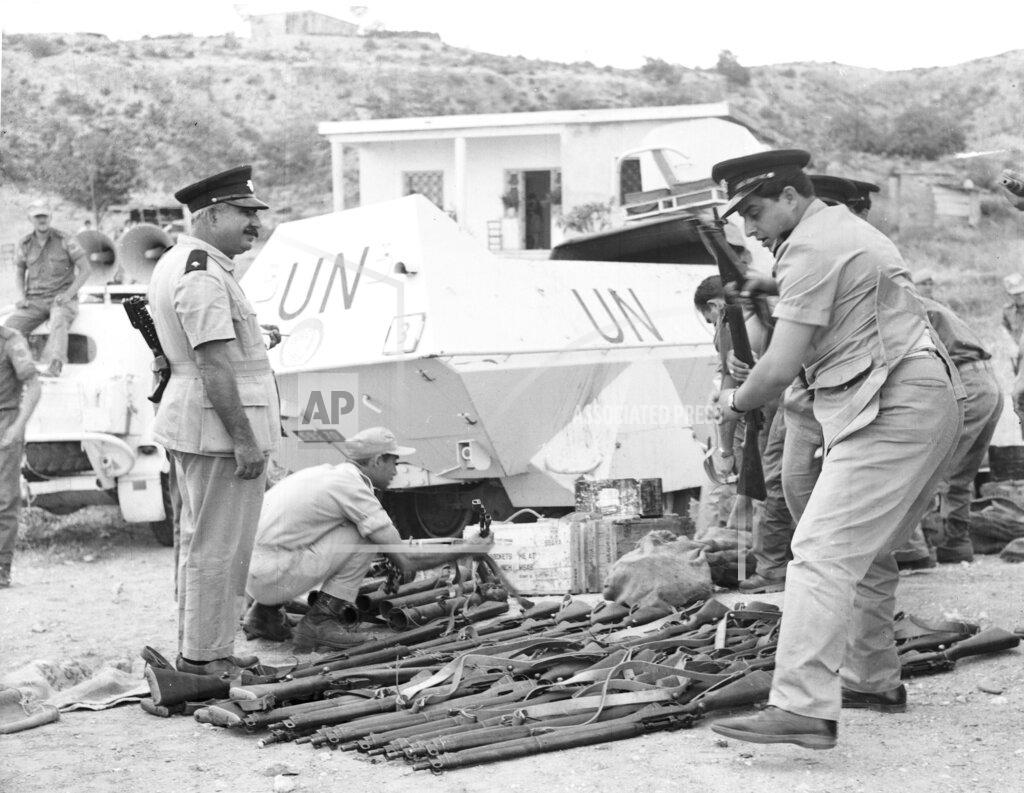
Five Swedish soldiers of the United Nations peace‐keeping force were arrested today on suspicion of illegally transporting arms for the Turkish Cypriots. The arrests were announced by the United Nations shortly after Greek Cypriot policemen and national guardsmen discovered a load of weapons and ammunition from the Turkish Cypriot village of Kokkina in two Swedish armored vehicles. It was the first major arms smuggling incident involving the peace force. Observers believed it would eliminate any remaining chance that the government, dominated by Greek Cypriots, would go along with efforts in the Security Council to achieve freedom of movement for the force. The Swedish suspects — two officers and three enlisted men — were placed under arrest by the United Nations command. They will be turned over to the Swedish contingent for transfer to Sweden and for trial by court‐martial, according to a United Nations source.
A Cypriot Government source said the Swedish soldiers had admitted that they were carrying the arms from Kokkina to Lefka, another Turkish Cypriot stronghold, south of Xeros. General Kodendera S, Thimayya, commander of the peace force, flew by helicopter to Xeros as soon as he was informed of the incident. The general ordered the provost marshal of the peace force to search the vehicles in his presence. The search disclosed, according to the United Nations announcement, that “the vehicles were carrying a number of arms and an amount of ammunition.” According to the Greek Cypriots, the load consisted of 75 rifles. 64,360 rounds of rifle ammunition, 72 bayonets, 10 Bren guns with 40 magazines, 2 mortars with 16 shells, 10 rocket launchers with 48 projectiles, 250 hand grenades and a pistol
General Grivas took responsibility for having ordered the halting and searching of the Swedish vehicles although he conceded, “We had no right to search United Nations vehicles.” The general said he had ordered the searches “after certain United Nations officers had been followed and their activi ties noted.” He added that He had protested to General Thimayya over the suspected gunrunning. The Swedish soldiers, he went on, refused to allow the armored cars to be searched. He said the soldiers in one vehicle had threatened to shoot their way through a Greek Cypriot roadblock until they were informed that a bazooka was aimed at them.
[Ed: Got a problem? No matter how Bad it is, the U.N. can make it Worse!!! :/]
At the United Nations, the six elected members of the Security Council agreed on the text of a resolution to keep the force in Cyprus until Dec. 26, three months beyond its present expiration date. Passage on Friday was likely.
In East Berlin, representatives of West Germany and East Germany signed a one-year agreement that would permit residents of West Berlin to visit relatives in the Communist nation during four designated holiday periods, starting in November. While residents of East Germany were still not allowed to travel to the west, and the terms did not apply to Germans outside of West Berlin, westerners with permits could cross through a door in the wall at the Oberbaum Bridge during periods coinciding with November, the Christmas and New Year’s Day holiday, Easter, and the Whitsuntide period in the late spring. The friendship pact with the Soviet Union, concluded in Moscow in June, stipulates that the two Communist regimes agree “to consider West Berlin an independent political entity.”
Willi Stoph succeeds Otto Great as Prime Minister of German Democratic Republic (East Germany). Stoph was named Premier of East Germany today to succeed Otto Grotewohl, who died Monday. Mr. Stoph, 50 years old, had been Acting Premier since Mr. Grotewohl suffered a stroke in 1960. The Volkskammer, or Parliament, which named Mr. Stoph, also unanimously ratified the friendship treaty between East Germany and the Soviet Union. In the treaty the Russians state that the East German borders are “inviolable” and that they are pledged to defend the country from attack.
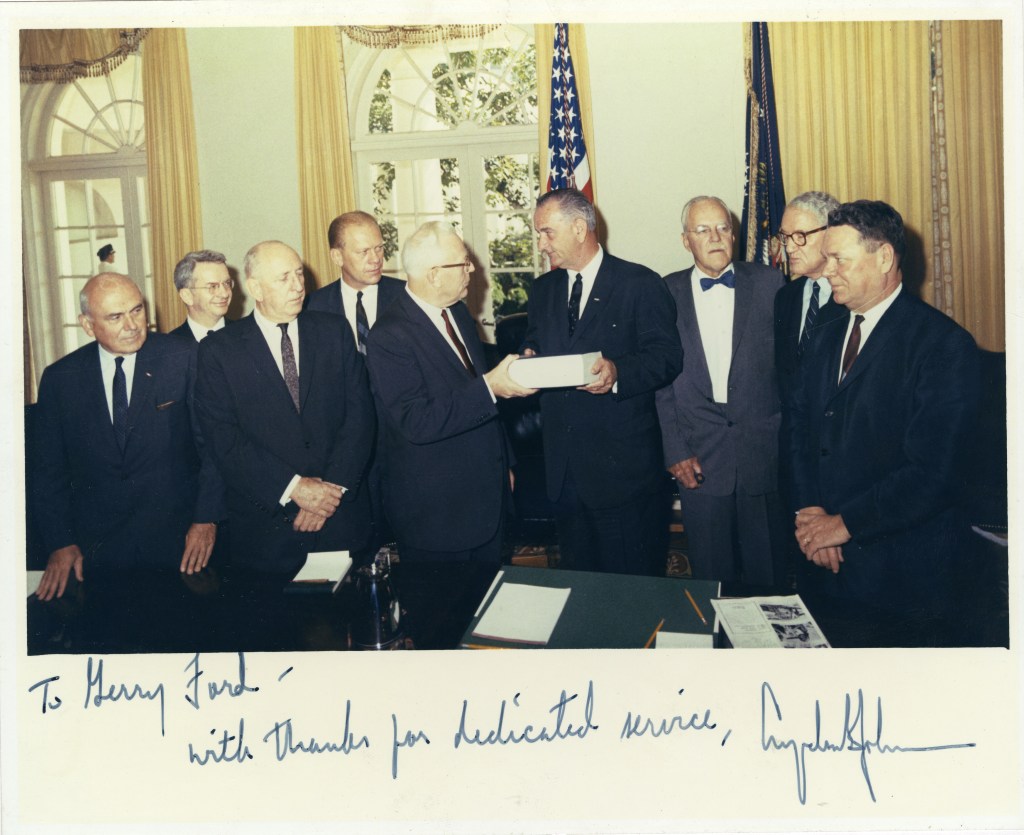
In Washington, the Warren Commission presented President Johnson with an 888-page summary of its investigation into the assassination of John F. Kennedy, with a pledge that the summary would be released to the public at 6:30 p.m. Eastern time on Sunday, September 27. The report was supplemented with “26 volumes of supporting documents, testimony, or depositions of 552 witnesses and more than 3,100 exhibits.” President Johnson received from the hands of Chief Justice Earl Warren today a presentation copy of the Warren Commission’s report on the assassination of Presdent John F. Kennedy. In a letter of thanks released later the President told the Chief Justice: “The commission, I know, has been guided throughout by a determination to find and tell the whole truth of these terrible events. This is our obligation to the good name of the United States of America and to all men everywhere who respect our nation — and above all to the memory of President Kennedy.” Those words reflected one major hope — that the Warren Commission report would minimize, if not end, the belief that is widespread in foreign countries that the full truth of the assassination has been withheld.
The report is expected to find that Lee Harvey Oswald was the lone assassin of Mr. Kennedy and that Jack Ruby was acting alone when he murdered Oswald. One victim of the assassin’s rifle was in the White House today as Mr. Johnson’s guest. He was Gov. John B. Connally Jr. of Texas, who arrived this week to talk politics with his old friend. This afternoon Governor Connally, who was wounded in the chest, wrist and leg by one of the assassin’s bullets last November 22, spoke to reporters in the White House lobby, and the subject of the report came up. Mr. Connally had not seen it, but said, “I don’t think there will be any surprises.” One question about the assassination is whether Governor Connally, who was riding with Mr. Kennedy, was hit by a second bullet or the first one that struck the President. “I have some pretty strong feelings on that subject and I testified about them to the Warren Commission,” the Governor said when asked about this. “I have always felt that there was a second shot that hit me.”
The Senate broke a deadlock over a vexing issue today by approving a resolution suggesting a slowdown in court‐ordered reapportionment of State Legislatures. The vote was 44 to 38. It came on a proposal by the Senate majority leader, Mike Mansfield of Montana, to express “the sense of Congress” on the issue rather than to attempt to require the Federal courts, through legislation, to allow the states more time to carry out redistricting orders. The action removed the main obstacle to early adjournment of Congress. There were indications that the session’s work might now be completed by the end of next week.
Approval of the Mansfield resolution brought victory to a group of Senate liberals who had immobilized the Senate for three weeks by a filibuster against an effort to force the courts to delay reapportionment. By their extended debate, the liberals blocked approval of a rider to the pending foreign aid bill that was offered last month by the Senate Republican leader, Everett McKinley Dirksen of Illinois. The Dirksen rider, unlike the nonbinding Mansfield proposal, was framed as mandatory legislation. It would have ordered the suspension until Jan. 1, 1966, of all Federal court proceedings arising from the Supreme Court’s “one man, one vote” decision of last June 15. The Court’s ruling was that the districts of both houses of bicameral state legislatures must be substantially equal in population. Since, then, lower Federal courts have ordered more than 30 states to redistrict their legislatures to conform with the decision.
Senator Mansfield had been a co‐sponsor of the Dirksen rider until yesterday, when he offered his nonbinding proposal as a substitute for it. He explained that the deadlock had reached the point where an ‘“adjustment of positions” was necessary to resolve what he called the “total stalemate” on the issue. Approval of the Mansfield substitute had the effect of killing the Dirksen rider. On the rollcall, 37 Democrats and seven Republicans voted for the substitute. The opposition consisted of 23 Republicans and 15 Democrats. With the notable exception of Senator Wayne Morse, Democrat of Oregon, the opponents favored the stronger Dirksen rider and wanted to keep it alive.
The Senate approved today a $3.3 billion program of economic and military aid to friendly governments overseas. The vote was 45 to 16. The measure, authorizing $216 million less than requested by President Johnson, moved through the Senate with little more than an hour’s debate and with only minor amendments. The log jam that had prevented action on the measure since Aug. 1 was broken earlier in the day with the disposition of the fight over the reapportionment of state legislatures. The Senate’s authorizing bill must be followed by a separate measure appropriating the money. The bill passed today merely sets the ceilings on the categories of aid to be provided in the appropriation measure.
Also helping toward final passage of the aid authorization was an immediately preceding vote of 54 to 11, adopting a Senate‐House conference report on the $4 billion Food‐forPeace program. Although strongly opposed by the Administration, this measure retained a provision forbidding sales of United States farm surpluses to Yugoslavia and Poland except in exchange for dollars.
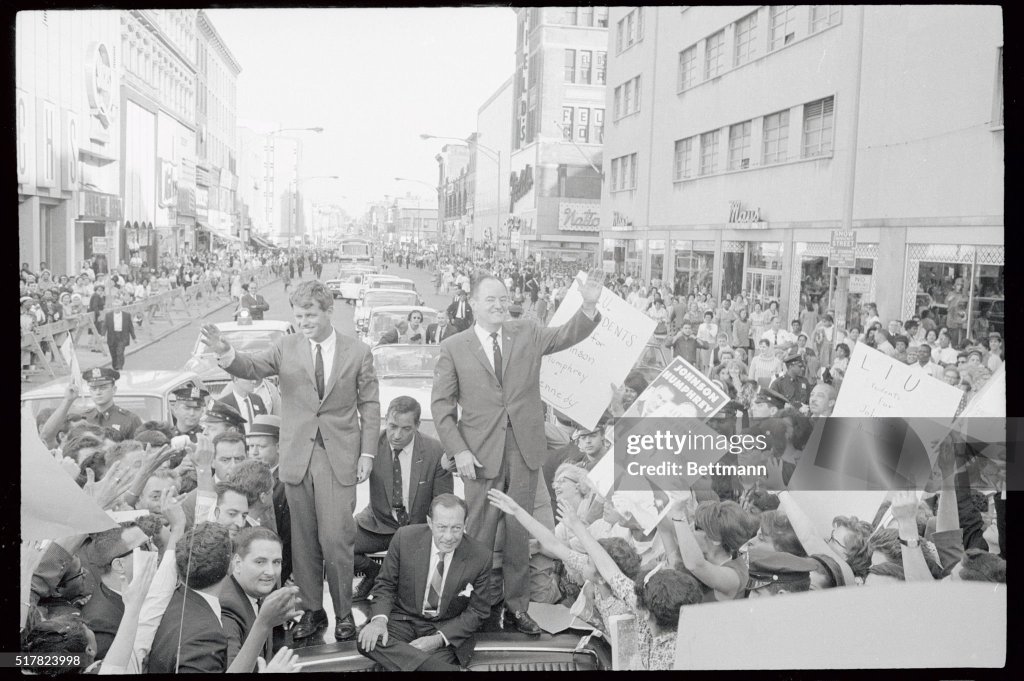
Robert F. Kennedy was promised the unqualified and unstinting support of the Johnson Administration yesterday in his campaign for the Senate. The promise came as an ebullient Hubert H. Humphrey quieted rumors of a rift by campaigning vigorously with Mr. Kennedy in Manhattan, Queens and Brooklyn. Both the Democratic Vice-Presidential nominee and Mr. Kennedy belittled reports of squabbles between the JohnsonHumphrey staff and the Kennedy organization. “There’s no friction that I know of,” said Senator Humphrey. “I’m for Kennedy and he’s for Johnson and Humphrey—you can’t get a better working arrangement than that.” The Administration’s blessing on the Kennedy campaign was publicly displayed as the two candidates rode side by side in a motorcade up Fifth Avenue, a double feature that lured crowds so vast that traffic in the area was frozen during the noon hour.
President Johnson met here today with three alleged victims of racist terrorism at McComb in southwestern Mississippi. He then directed the Justice Department to suggest possible federal action that might help alleviate strife in that area. Lee White, a Presidential aide, said that the Justice Department would probably increase its force of lawyers in the area as soon as Congress passes a pending supplementary appropriations bill. Mrs. Aylene Quin, one of the three Black women who met with the President, said Mr. Johnson had also promised to explore the possibility of establishing an office of the Federal Bureau of Investigation in McComb. Last night there were two more bombings in McComb, bringing the total since last April to 16.
After the meeting with the President the three women met for more than an hour in a closed briefing session with sympathetic Congressmen and Congressional aides. Representative William Fitts Ryan, Democrat of Manhattan, said after the meeting that he would ask the Justice Department to convene a grand jury in McComb to investigate what he called possible “collusion” between local police and white terrorists. The other women with Mrs. Quin were Mrs. Matti Lean Dillon and Mrs. Ora Bryant.
McComb, Mississippi authorities were holding about 20 Blacks today on charges of “criminal syndicalism” in connection with a racial disturbance here Sunday night. At the same time, authorities were attempting to show that civil rights workers — not local whites — were responsible for bombings of Black homes and churches. The Council of Federated Organizations, which has a staff of 14 civil rights workers here, termed the charge ridiculous. Two more bombings occurred last night, the 15th and 16th since April. Single sticks of dynamite were exploded outside the homes of two Blacks, one a former city policeman, causing minor damage. Sheriff R. R. Warren said he believed that the four explosions since Sunday had been “staged” in an effort to induce the Federal Government to declare martial law here. He said every effort was being made to determine who was responsible.
Pike County’s Prosecuting Attorney, Robert S. Reeves, said about 25 persons had been charged with criminal syndicalism, a felony, and that all but about five remained in jail in lieu of bonds ranging from $1,000 to $5,000. The others are free on bond. Mr. Reeves said all the defendants had been involved in a Sunday night melee set off by two bombings. Maximum punishment under the law is 10 years’ imprisonment and a $1,000 fine. The defendants have been bound to a grand jury that meets October 5. Dennis Sweeney, a 21‐year-old white field worker for the Student Nonviolent Coordinating Committee also was arrested this week. He was released today when a Black witness refused to testify against him in court. The police said that Mr. Sweeney, a Stanford University senior who has been working here for several months, had been charged as an accessory to the production of Molotov cocktails in the Black neighborhood.
A federal judge in Oxford, Mississippi has ruled that Chief United States Marshal James P. McShane is not answerable to Mississippi on an indictment returned following the 1962 rioting at the University of Mississippi. United States District Judge Claude F. Clayton referred to an 1833 statute, which laid down the principle “that the state has no jurisdiction over a person when he is acting under the authority of the United States.” Mr. McShane, a former New York City policeman, was indicted by a Lafayette County grand jury, which said his conduct the night of Sept. 30, 1982, had led to “a breach of the peace and to incite a riot.” The indictment referred to Mr. McShane’s orders to fire tear gas at students encircling ithe Lyceum Building the night before James H. Meredith became the first Black to enroll at the university. In the rioting that followed, two men were killed, hundreds injured and heavy property damage inflicted on university and town property.
A group of students at the all‐Negro Booker T. Washington School in Philadelphia, Mississippi were suspended today when they wore “freedom” buttons to classes after being warned such a practice was against school rules.
Chairman B. Everett Jordan of the Senate Rules Committee promised today that all principals in the reopened investigation into the private business affairs of Robert G. Baker would be called to testify. The North Carolina Democrat indicated a hope that hearings might begin next week. Other committee sources cast doubt on the prospect of such rapid action, however.
Ringo Starr forms Brikley Building Company Ltd.
American actress Jayne Mansfield (31) weds American film producer and director Matt Cimber (28) in Mulege, Baja California Sur, Mexico; they divorce in 1966.
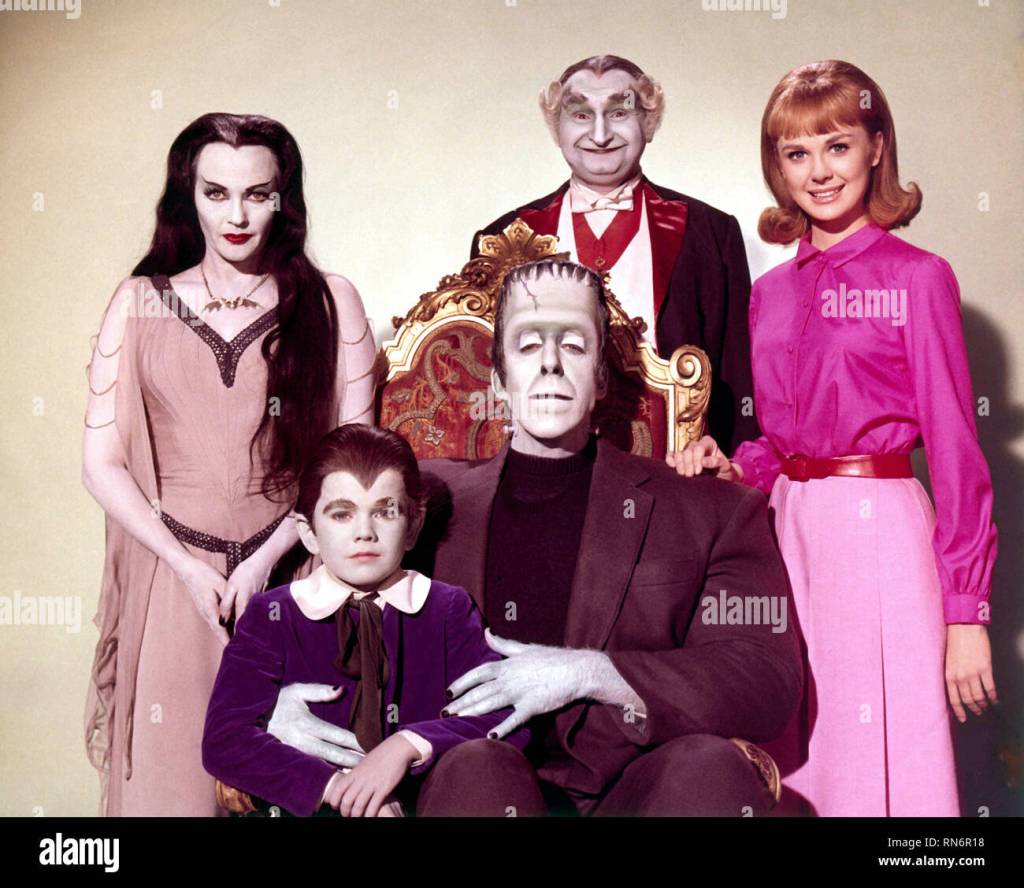
At 7:30 p.m. Eastern time, the CBS television network debuted “The Munsters,” a family comedy that, like ABC’s new show “The Addams Family,” was created in the wake of the popularity of monster movies. Both shows would appear for two seasons, and both would be popular in syndication. Acknowledging the similar themes of the two shows, UPI critic Rick Du Brow would note that “‘The Munsters, for instance, are almost lovable” and “perhaps wiser than the Addamses in playing their abnormality with more absolute normality” and another critic would comment that “to say the show won’t be a hit would take more courage than facing up to Frankenstein inside a graveyard fence.”
All American League teams were idle today.
The Milwaukee Braves sent the skidding Philadelphia Phillies to their fourth straight loss tonight as Joe Torre hit a pair of triples for three runs in a 5–3 victory. The Phils, who had hoped to clinch the pennant in their final home stand, lost the sixth of their last seven games and saw their lead over the second-place Cincinnati Reds cut to three games. The loser was Jim Bunning, who had won 10 of 11 games, including six in a row, at home before tonight. Torre drove in Eddie Mathews with a triple in the second inning when his line smash to center hopped over the shoulder of a rookie, Adolfo Phillips. Torre’s second triple came in the eighth off Jack Baldschun when Johnny Callison couldn’t quite make a shoestring catch of Torre’s soft‐dropping liner. The hit scored Hank Aaron, who had singled, and Mathews, who had walked. It brought Torre’s run‐battled‐in total for the season to 100. Aaron scored his 100th run for the 10th straight year, just short of the 11‐year records of Stan Musial and Willie Mays. Wade Blasingame, two months short of his 21st birthday, toyed with the Phillies’ right‐handed platoon, setting down the first 14 batters before Tony Taylor walked and Richie Allen singled in the fourth.
The surging St. Louis Cardinals defeated the Pittsburgh Pirates 4–2 and 4–0, behind the pitching of Bob Gibson (17–11) and Ray Sadecki (19–10) tonight. Gibson gained his 17th victory of the season and set a club strikeout record in the opener. Sadecki scored his 19th triumph of the year in the second game, aided by the homers of Lou Brock and Duke Shannon. Gibson set the strike‐out mark of 232 for one season as he fanned 11. The former club mark of 224 was set by Sam Jones in 1958. Gibson’s mark is the best in the league this season. Sadecki, who has lost 10, scattered five singles, struck out 10, and permitted only one Pirate runner past second base. The Cardinals collected five hits off Tom Butters but five walks helped keep Butters in trouble throughout the game. The Cardinals remain in third place, half a game behind second-place Cincinnati.
The Chicago Cubs official lineup showed Ernie Banks playing first base and batting fifth. John Boccabella started the game in his place and grounded out in the second and fourth innings. However, in the sixth Ron Santo tripled and so did Boccabella, scoring Santo. Los Angeles Dodgers’ manager Walter Alston then protested the batting order. Boccabella’s triple was nullified and Santo placed back at third. Ernie Banks was deemed to be the proper batter and was called out and given a time at bat. However, this was an incorrect ruling by crew chief Frank Secory. According to rule 3.08(a)(3), Boccabella became the first baseman and the proper fifth place batter when he took the field in the top of the first inning as an unannounced substitute. Therefore, it was incorrect to remove Boccabella’s triple and to charge Banks with a time at bat. Boccabella finished the game at first base, collecting a single in the eighth inning. The Cubs won with a two-run rally in the bottom of the ninth inning thanks to three walks, an error and Santo’s sacrifice fly. The final score was 4–3.
Dow Jones Industrial Average: 872.98 (+1.03).
Born:
Rafael Palmeiro, Cuban-American MLB first baseman and outfielder (All-Star, 1988, 1991, 1998, 1999; Chicago Cubs, Texas Rangers, Baltimore Orioles), in Havana, Cuba.
Jim Neidlinger, MLB pitcher (Los Angeles Dodgers), in Vallejo, California.
Terrence Flagler, NFL running back (NFL Champions, Super Bowl 23 and 24-49ers, 1988, 1989; San Francisco 49ers, Phoenix Cardinals), in New York, New York.
Tom Flaherty, NFL linebacker (Cincinnati Bengals), in Chicago, Illinois.
Dale Henry, Canadian NHL left wing (New York Islanders), in Prince Albert, Saskatchewan, Canada.

 History Diaries