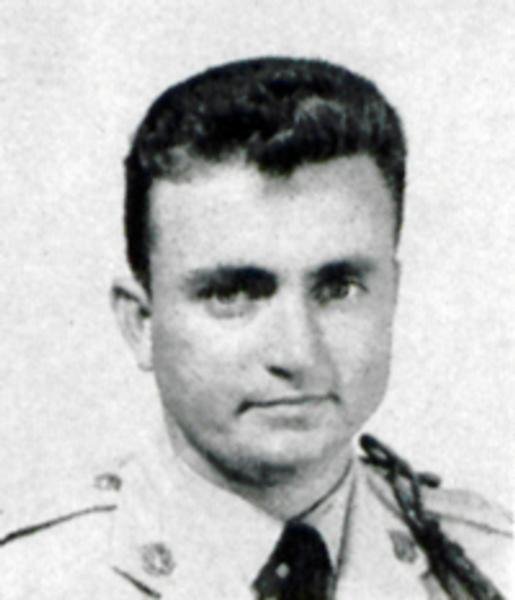
Captain Flynn was listed as missing in action and on June 5th, 1973 his remains were recovered and repatriated to the United States, with final identification coming on January 13th, 1976. He had served over four years in the Air Force and was 26 years old when he died. Captain George Edward Flynn III is buried in Section Q, Square 26, Plot 5 of the Garden of Memories Cemetery in Metarie, Louisiana. He is remembered on the Wall at Panel 1E, line 64.
Near Rạch Giá, Việt Cộng ground fire downs two U.S.-piloted planes; one pilot is safe but the other is missing. One American pilot was missing, and was feared killed or captured. His Vietnamese co‐pilot was also rescued. A United States military spokesman said the second United States pilot escaped death, as did his Vietnamese co‐pilot, when they rode their craft down to a “controlled crash landing.” In Washington, the Air Force identified the pilot missing in Vietnam as First Lieutenant George E. Flynn 3d, 26 years old, of New Orleans. The downed aircraft had been sent to the defense of the town of Đông Thành, which was under attack by 400 Communist guerrillas. As the planes flew in, the Việt Cộng guerrillas began shelling Đông Thành and nearby Hiếu Lê, in the Rạch Giá area.
There would be no happy ending for Captain Flynn. He was captured and soon executed.
Military action by the Việt Cộng, mainly terrorist attacks, rose close to a record pitch during the political troubles in Saigon last week, according to figures made public today by the United States Military Assistance Command. The step‐up in Communist pressure, both overt and covert, across the country was noted by military analysts here as an apparent response to the Government instability since last week’s abortive coup d’etat and continued agitation in the cities.
Political unrest has apparently not immobilized Vietnamese forces in the field. Paramilitary units manning an outpost in Kiến Hòa Province about 43 miles south of Saigon successfully repulsed an attack early today by a Việt Cộng force estimated to be in battalion strength. The clash pitted about 50 civil guardsmen against attackers numbering over 500. A military spokesman said regular army units arriving to reinforce the outpost found the Việt Cộng in flight, having abandoned 37 bodies and 26 weapons. Aerial spotters saw other dead or wounded being dragged away and moved out in small boats. There were no reports yet of the extent of government casualties.
Intelligence evaluations of a battle Sunday in Quảng Trị Province just south of the frontier with North Vietnam led the Military Assistance Command today to the conclusion that integral units of the North Vietnamese Army were not involved. Informed sources reported that numbers of armed persons were observed infiltrating South Vietnam from the north across the demilitarized zone separating the countries and by small boats. A resulting clash between about two companies of Communist troops and a coordinated air, sea, and ground government operation took place only a few miles from the South China Sea. Communist casualties were reported to have been heavy. Official American spokesmen have estimated that a third of the Việt Cộng units in South Vietnam consist of personnel infiltrated from North Vietnam, but they have been unwilling to state that any integral North Vietnamese units have come across. Only if such was the case would they be willing to call the infiltration outright invasion.
Counting all types of detected Việt Cộng incidents last week —terrorism, sabotage, intrusions by armed propaganda teams and attacks — Việt Cộng activity approached the high point reached last November, right after the coup overthrowing President Ngô Đình Diệm. Incidents totaled 975 last week, compared with 580 the week before. Terrorist incidents in the period were nearly double the level of the previous week. Personnel and weapons losses of the week ran heavily against the government in relative terms. The Việt Cộng lost more men — 270 listed killed against the Government’s reported toll of 235 — but the ratio would normally be far higher in favor of the government.
Spreading defiance of the central South Vietnamese Government’s authority among the powerful mountain tribes that inhabit the country’s central plateau has caused grave concern in Saigon. Some officials have spoken of an open rebellion in the making. Green, red and blue tribal flags have been hoisted over remote outposts in place of the red and gold Vietnamese Government flag. The outposts were built by United States Special Forces troops as training camps for mountain youths who were joining irregular civilian‐defense forces. Peace talks are being attempted in the far‐flung mountain villages to which defiance has been spreading, it was reported. The situation has stirred fears that longstanding demands for autonomy among the ethnic minority groups in the mountains will be pressed with renewed vigor during the present period of governmental weakness.
The Laotian Government has decided to protest to the North Vietnamese Government against the presence of Hanoi’s troops in Laos, it was announced today. The decision, made at a Cabinet meeting yesterday, followed‐what the Laotians said was proof of the presence of North Vietnamese troops. The proof was said to be “documents taken from corpses and statements from captured prisoners.”
The West German Cabinet approved a new agreement with East Germany today that will enable 800,000 West Berliners to visit relatives in East Berlin five times in the next 11 months. Having obtained unanimous backing from his Cabinet and the leaders of the major West German parties, Chancellor Ludwig Erhard authorized Mayor Willy Brandt of West Berlin to enter into the agreement. The Cabinet action came in an atmosphere of eagerness to close the long wrangle on the Berlin passes — an atmosphere presumably generated by the wish of Moscow and Bonn to create a favorable climate for Premier Khrushchev’s visit to West Germany, probably next year. Horst Korber, an official of the West Berlin government, will sign the agreement tomorrow “on instructions of the head of Chancery of the Senate [government] of West Berlin by the direction of Mayor Brandt.” Erich Wendt, Under Secretary of State of the Ministry of Culture, will sign for the East German Government.
The issue has been hotly debated in West Germany, with humanitarian considerations balanced against misgivings about any kind of negotiation with the East German Government. Chancellor Erhard declined to approve essentially the same agreement two weeks ago. Much of the difficulty has involved the styles for the title and signatures on the agreement — issues that were considered by some to imply recognition or acceptance of the political status quo. In the intervening time Mr. Korber effected minor changes and the Chancellor was able to line up solid support. Karl‐Günther Von Hase, the Federal press spokesman, said that the Cabinet’s refusal to approve the agreement September 9 had been justified by improvements obtained thereafter. Informed sources said the improvements were an agreement for almost automatic extension of the agreement so that it would cover the Christmas season of 1965 and a change in the application forms to indicate that the Western side does not recognize East Berlin as “the capital of the German Democratic Republic.”
A deadlock over the terms of a proposed resolution prevented Security Council action today on the extension of the mandate of the United Nations force in Cyprus. The Council met for only three minutes, long enough to fix another meeting for tomorrow. According to reliable sources, the deadlock resulted from a Cypriote demand that the proposal make a favorable reference to a recent decision by Archbishop Makarios, President of Cyprus, to grant a general amnesty and to remove restrictions on Turkey’s shipments of food to the Turkish Cypriotes. Turkey refused to agree to this provision. The six elected members of the Council will meet tomorrow in an attempt to agree upon a short proposal, which would merely extend the stay of the force for three more months without going into details. The current authorization expires Saturday. Orhan Eralp, the Turkish representative, gave the Secretary General, U Thant, a check for $100,000 against the current expenses for the Cyprus force, reducing its $2 million deficit.
The Government said tonight that it could not receive a five-nation African commission that was on its way here to try to halt United States aid to the Congo. The United States position was given to the five‐nation body, the African Reconciliation Commission of the Organization of African Unity, through Ambassador William Attwood at Nairobi, Kenya, the State Department reported. The five members of the Reconciliation Commission — Kenya, Ghana, Guinea, Nigeria and the United Arab Republic — are being informed that the United States Government would be willing to meet the commission “at a mutually agreed time and place” only if the Congolese Government of Premier Moise Tshombe would take part. The commission called last night for a withdrawal of all United States military supplies from the Congo and said a delegation would be sent tomorrow to present this view to President Johnson.
In Leopoldville President Joseph Kasavubu said the Congo would no longer abide by decisions of the Organization of African Unity.
Charles Helou, the former Education Minister and a former editor of a French-language newspaper, was inaugurated as President of Lebanon.
Peace negotiations between the government of India and the Naga National Council began in the village of Chedema.
In Saudi Arabia, the new College of Petroleum and Minerals held its first classes, with 67 young men enrolling at its campus in Dhahran. By 1975, it had become a public university and, in 1986, would be renamed for the reigning monarch as King Fahd University of Petroleum and Minerals. It now has an enrollment of 10,000 students.
At the autumnal equinox, the Order of Bards, Ovates and Druids (OBOD) was founded in the UK.
President Johnson said today that the United States faced a choice “between the center and the fringe.” He said voters should stand up and be counted to prevent the country from falling “into the hands of extremists of any stripe.” It was the second straight day that Mr. Johnson had made remarks generally interpreted to be aimed at his Republican opponent for the Presidency, Senator Barry Goldwater. But, as has been the President’s custom since the campaign began, he named no names. Mr. Johnson spoke to the annual convention of the International Union of Electrical Workers at the Statler Hotel in Washington.
By closed‐circuit television his words and image were also carried to meetings of the United Rubber Workers in Chicago, the United Textile Workers in New York, the Tobacco Workers in Miami Beach, the Minnesota unit of the American Federation of Labor and Congress of Industrial Organizations in St. Paul and the Missouri Labor Council in Kansas City. A New Year’s Eve spirit prevailed among the 1,500 Electrical Workers delegates just before the President arrived. Confetti and paper streamers filled the air, and most of the delegates wore red, white and blue paper caps with the legend “LBJ and HHH for the U.S.A.” But when Mr. Johnson began to speak, his manner was so solemn and his delivery so measured and slow that the audience was hushed. He was interrupted by applause only 14 times.
He asked “reasoning and responsible men” to stand up and be counted because, he asserted,’ “the heart of our American way of life is under attack — and those who love it must go forth and save it.” Mr. Johnson said the nation was “not presented with a choice of . parties” and “not presented with a choice of liberalism and convervatism.” “Americans are faced with a concerted bid for‐power by factions which oppose all that both parties have supported,” he said. “It is a choice between the center and the fringe, between the responsible mainstream of American experience and the reckless and rejected extremes of American life.” Before Mr. Goldwater was nominated for the Presidency, Governor Rockefeller and other Republicans who opposed him often charged that he was out‐ side “the mainstream” of Republican and American opinion.
Senator Barry Goldwater of Arizona said today that the responsible use of power through military force was the key to a “rational solution” that could end the cold war without nuclear destruction or a Communist take‐over. He gave this analysis here at the annual convention of the American Legion, which accorded him a reception somewhat cooler than he has had elsewhere in the Southwest. Mr. Goldwater, the Republican Presidential nominee, in a summary of his military and defense policies, told the legionnaires that “the great, harsh fact” of today was the war against Communism, and that it was not necessary to “look forward to a cold war which will last forever.” “There is a rational solution to the problem which confronts us,” he said. In his elaboration of this, he said that in order to halt Communist aggression, “we must be stronger than the enemy, not just a little bit, but by far.” If he had in mind a solution that would be a clear alterlative either to the present policy of deterrence or to nuclear war or Communist victory, he did not specify what it was.
But the policy of the present Administration, he said, is “based on false answers.” He charged that the Administration’s “let’s be friends” theory had not worked. The only reversals the Communist world has suffered, he added—their having been checked by the North Atlantic Treaty Organization in Europe and the fact that “they have been thrown back to the 38th parallel in Korea” — were brought about “by the use or the threatened use of military force.” Mr. Goldwater, on the third day of a busy week of campaigning, visited areas of strong support for his candidacy. The convention floor of the Memorial Auditorium was crowded, but the galleries, which were open to the public held at most one‐third of their capacity of 6,000 persons. He was applauded briefly 26 times during his speech. There were no campaign banners in the public galleries, and the crowd was notably more adult than at other stops.
President Johnson told Congress today the trade‐agreements program had led to record exports and reaffirmed the Administration’s commitment to its “full and vigorous implementation.” He said, “I hope that our friends in other countries will neither underestimate nor undervalue the strength of American support for trade liberalization. We are willing to offer the free nations access to our American markets—but we expect, and we must have, access to theirs as well. That applies to our agricultural as well as our industrial exports.” In submitting to Congress the annual report on the program and the Trade Expansion Act of 1962, the President reported that in 1963 United States exports reached a new high of $22.3 billion, $5.1 billion more than its imports.
Mrs. Clare Boothe Luce took a gloomy view today of the election possibilities of Senator Barry Goldwater, whom she strongly supports. “He cannot possibly get elected without Democratic votes,” Mrs. Luce said in a speech to the American Club of Paris. Mrs. Luce saw also a trend to one‐party rule and “national socialism” in the United States. Asked to define the latter, she charged that there had been a growth of “big, big business” that lived mainly on armament orders. Furthermore, she contended, 95 percent of the American people have, no access to capital‐forming wealth and live on their salaries alone. Only 5 percent, she continued, own 85 percent of that wealth. Discussing Mr. Goldwater’s chances, Mrs. Luce said the predominant voting pattern favored the Democrats and this ratio was rising as the population groups that traditionally voted Democratic were growing with the “population explosion.” “Such Republicans as are here,” she told her audience, “will just have to, digest it, because we are being greatly outbred by the Democrats.”
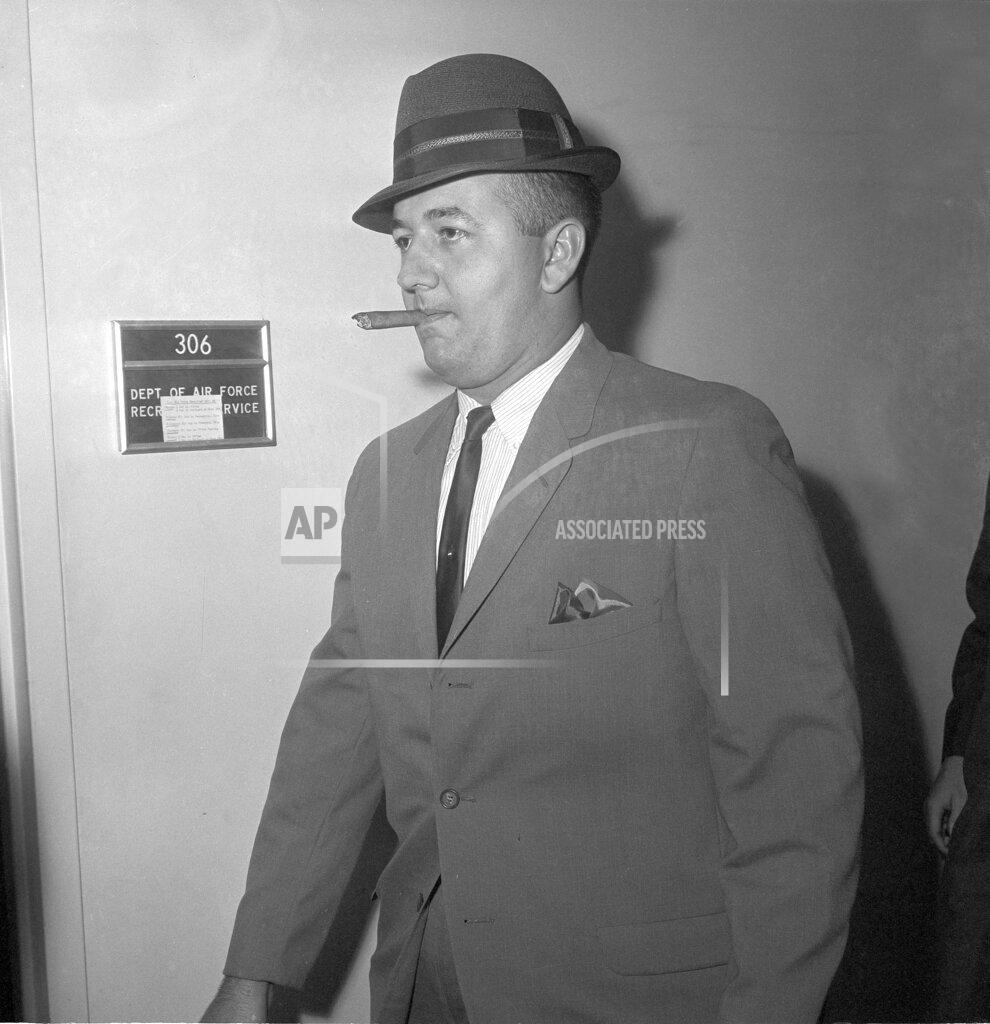
“Regardless of what you have heard or see about me, I’m innocent.” Cecil Price, the 26‐year‐old deputy sheriff of Neshoba County, wore these words on his chest today when he arrived for questioning by a federal grand jury investigating the slaying of three civil rights workers last June. Mr. Price, who arrested and detained the three young men shortly before their deaths, was among several persons called today who had been mentioned, in connection with anti‐Black activities in the Philadelphia, Mississippi, area.
The pudgy, dark‐eyed deputy arrived at the Federal Building under subpoena wearing a gray business suit, a silk handkerchief and dark glasses. He clenched a cigar in his teeth. He produced a printed card proclaiming his innocence and placed it in his breast pocket briefly for reporters. But he had nothing further to say about the case. Mr. Price waited in the witness room all day without being called and was asked to return tomorrow. “I have nothing to tell the jury,” he told reporters.
The House approved today establishment of an Ice Age National Scientific Reserve for preservation of a 10,000‐year-old glacial scene covering 32 500 acres in Wisconsin. The vote was 180 to 118. Backers said that the reserve, besides being valuable for scientific study and teaching, would provide a vast recreational area for swimming, fishing, hiking and picnicking. The total federal cost was estimated at §800,000.
In the United States, the new University of South Alabama held its first classes, becoming the first state-supported college institution in the 20th century in Alabama. Initial enrollment for the university, located in Mobile, was 750 students. Fifty years later, it would have almost 17,000 students.
The sizzling New York Yankees win their 9th in a row, defeating the Cleveland Indians twice, 4–3 in 11 innings and 6–4. Elston Howard’s homer off Louie Tiant snaps a tie in the opener. John Romano homers in each game for the Indians while recently acquired Pedro Ramos finishes up both games for New York. Ramos, however, will not be eligible for the World Series.
Bob Perry’s error enabled Gene Stephens to scare from second in the ninth inning tonight and gave the Chicago White Sox a 2–1 victory over the Los Angeles Angels and Dean Chance. Despite the victory, the White Sox fell four games behind the New York Yankees in the American League pennant race. The White Sox now are tied for second place with the Baltimore Orioles, who lost to Detroit. Chance, working in relief for the first time since May 17, was touched for singles by Stephens and a pitcher, Gary Peters, in the ninth. Stephens went all the way around when Perry let Peters’s hit get by him.
The Detroit Tigers thwarted Baltimore’s pennant hopes for the second straight day by whipping the Orioles, 10–3, today as a rookie southpaw, Johnny Seale, gained his first major league victory. The Orioles jumped on the Detroit starter, Phil Regan, for two runs in the first inning before a batter was retired. But Detroit evened the count in the last of the first against Steve Barber.
Dave Boswell, a 19-year‐old right‐hander, blanked Kansas City for eight innings, but needed ninth‐inning help to give the Minnesota Twins a 2‐1 victory over the Athletics tonight. The Twins scored off Lew Krausse, who yielded only three hits over the first six innings. A fielder’s choice in the third and Earl Battey’s sacrifice fly in the fourth game gave Boswell the runs he needed.
Washington’s Don Loun makes his first mound appearance for the Senators and shuts out the Boston Red Sox, 1–0 for his only Major League win. Loun, a 23‐year‐old southpaw, allowed only five hits. Loun will lose his next and last start.
The slumping Philadelphia Phillies (90–63) drop their 3rd in a row to the Cincinnati Reds, 6–4. Vada Pinson has two homers, good for 4 runs, to lead the Reds over the 1st-place Quakers. The Reds (86–66) trail by 3½ games, with the Cardinals and Giants 5 back.
The New York Mets surprise the Cardinals and Roger Craig, 2–1, scoring the winner on an error.The Cards only run is Bill White’s homer off Galen Cisco. Cards manager Johnny Keane is quoted as saying he has no idea whether he will be asked to return as Cards manager next year.
Juan Marichal of San Francisco became the first Giant pitcher in more than 25 years to win 20 or more games in consecutive seasons when he checked Houston on five hits tonight for a 4–1 victory. Marichal, with a record of 20–7, became the second pitcher in the National League to hit the 20‐victory mark this season. Larry Jackson of the Chicago Cubs has 22 triumphs. The last Giant to win 20 in consecutive seasons was Carl Hubbell, who won 20 games from 1933 to 1937. Marichal won 25 games last year.
Larry Jackson pitched his 22d victory — and eighth in a row — in a 9–6 Chicago Cub triumph today over the Los Angeles Dodgers. The big Cub righthander has lost 10 games. Jackson allowed only two hits in the first six innings and retired 15 straight batters before Willie Crawford’s pinch single with one out in the sixth.
Willie Stargell drove in three runs with an inside‐thepark home run to spark a six-run Pirate uprising in the second inning tonight and give Pittsburgh a 7‐4 victory over the Milwaukee Braves.
Dow Jones Industrial Average: 871.95 (-0.52).
Born:
Diane Dixon, American 4x400m runner (Olympic silver medal, 1988), in Brooklyn, New York, New York.
Larry Krystkowiak, NBA power forward (San Antonio Spurs, Milwaukee Bucks, Utah Jazz, Orlando Magic, Chicago Bulls, Los Angeles Lakers), in Missoula, Montana.
Jim Farmer, NBA shooting guard (Dallas Mavericks, Utah Jazz, Seattle SuperSonics, Philadelphia 76ers, Denver Nuggets), in Dothan, Alabama.
Kerry Porter, NFL running back (Buffalo Bills, Los Angeles Raiders, Denver Broncos), in Vicenza, Italy.
Tom Porell, NFL nose tackle (New England Patriots), in Cambridge, Massachusetts.
Koshi Inaba, Japanese rock singer-songwriter, and musician (The B’z) years), in Tsuyama, Japan.
Died:
Fred M. Wilcox, 56, American motion picture director best known for “Forbidden Planet” and for “Lassie Come Home.”

 History Diaries