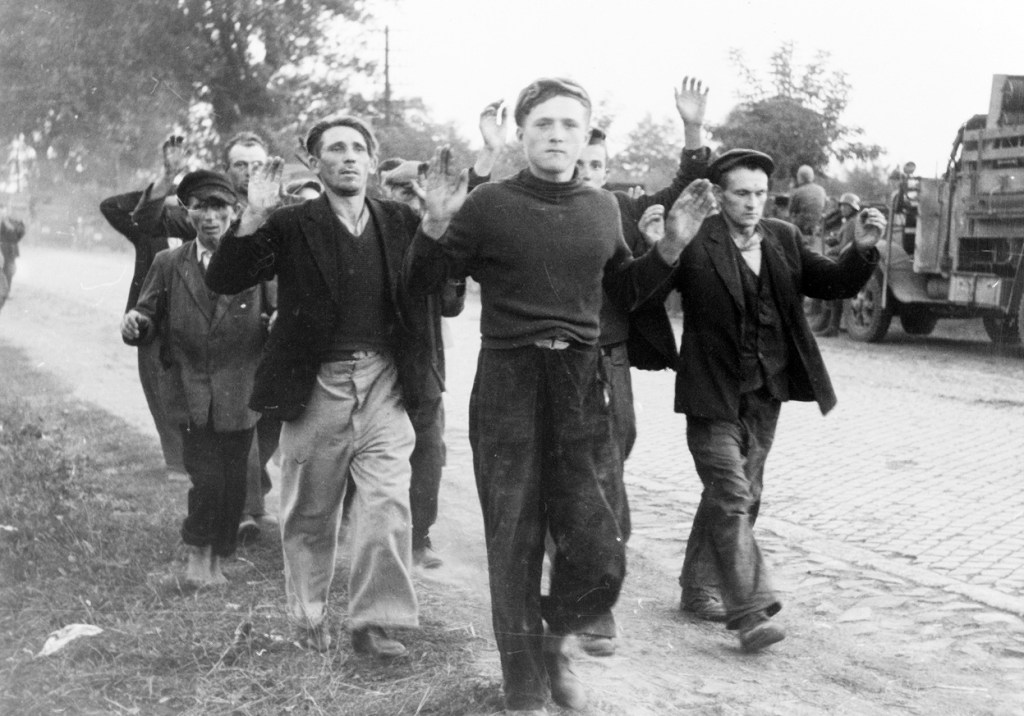
The Battle of Lwów ended when the Polish commander handed the city over to the Soviets. The Red Army captured Lvov, Poland after it surrendered when the Soviets accepted all conditions proposed by Polish General Władysław Langner. The conditions were that all privates and NCOs were to leave the city, register themselves with Soviet authorities and be allowed to go home. Officers were to be allowed to keep their belongings and leave Poland for whichever country accepted them. The conditions accepted in the morning were broken by the Soviets shortly after noon when the NKVD started arresting Polish officers. They were escorted to Tarnopol, where they were sent to various gulags in Russia, mostly to the infamous camp in Starobielsk. Most of them, including General Franciszek Sikorski himself, would be murdered in what became known as the Katyn Massacre in 1940.
The Battle of Cześniki ended indecisively. The Polish 39th Division successfully forced the Germans to retreat and broke through on their way from Zamość towards the Hungarian border. However, instead of breaking through towards Hungary, the division was ordered to attack towards the besieged city of Lwów. The 39th Division reached Tomaszów Lubelski but was destroyed in the Second Battle of Tomaszów several days later.
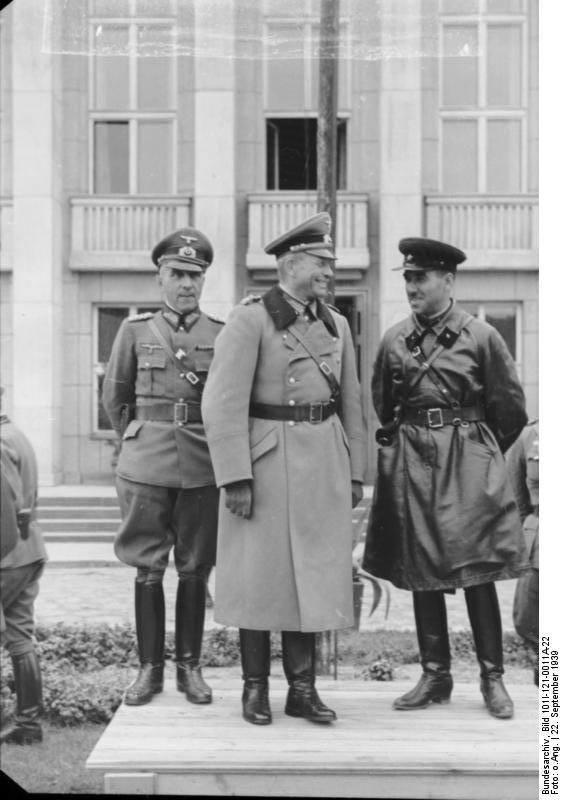
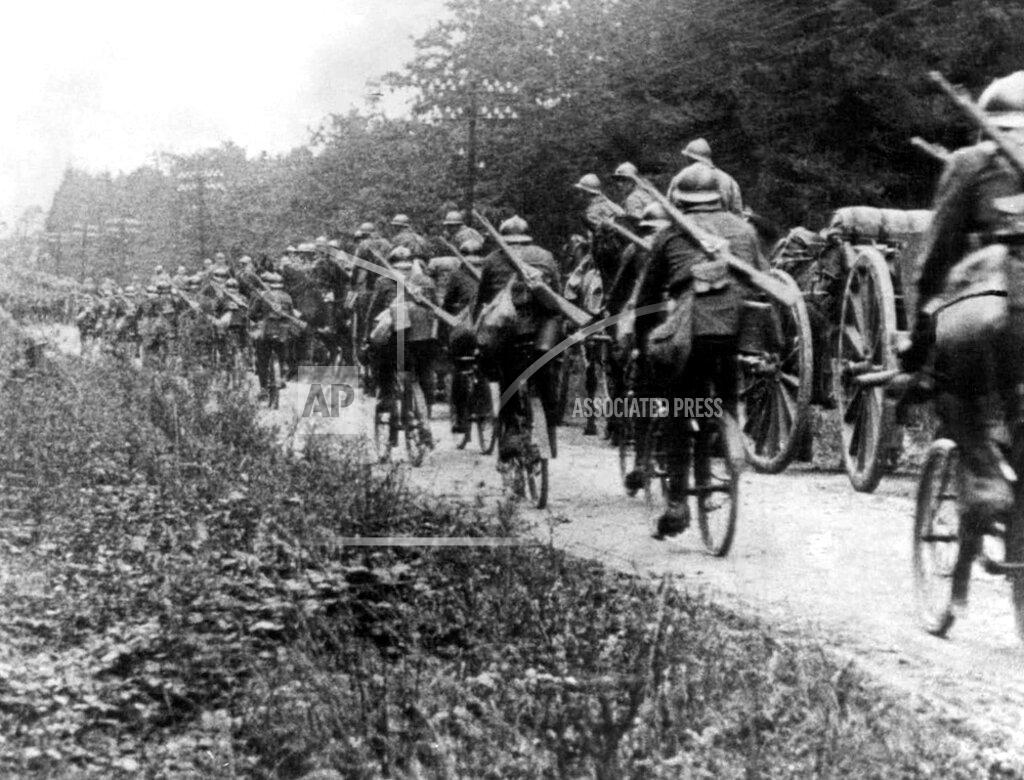
The German–Soviet military parade in Brest-Litovsk was held. It marked the withdrawal of German troops to the demarcation line secretly agreed to in the Molotov–Ribbentrop Pact, and the handover of the city and its fortress to the Soviet Red Army. According to the initial agreement, the procedure included German and Soviet troops marching before their commanding officers followed by changing the flag, accompanied by national anthems of Germany and the Soviet Union. However, the Soviet commanding officer, kombrig Semyon Krivoshein, wrote in his memoirs that he did not allow Soviet troops to pass alongside the German forces because he was afraid that Soviet troops, weary after a long march to Brest, would look inferior in comparison with the Germans, who had been in the city for several days. Instead, he suggested that the Soviet columns would enter the city separately and salute the leaving Germans whenever they meet.
The parade began at 16:00, and the “Victory Arches” were erected which the Soviet troops decorated with swastikas and red stars and through which German troops marched. The Soviets fielded the 4th Battalion of 29th Light Tank Brigade, which was the first unit of the Red Army to roll into the city. The Soviet and German generals paid homage to each other’s armies and their respective victories over Polish forces. After the parade, which Niall Ferguson described as amicable, the Germans withdrew to the western bank of the Bug, and the Soviets took control over the city, as well as the rest of Eastern Poland (Western Belarus and Western Ukraine).
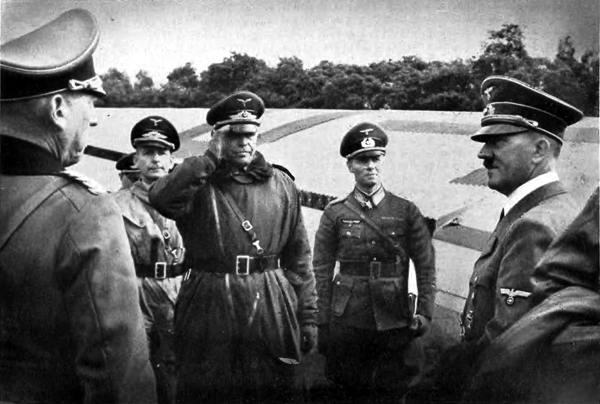
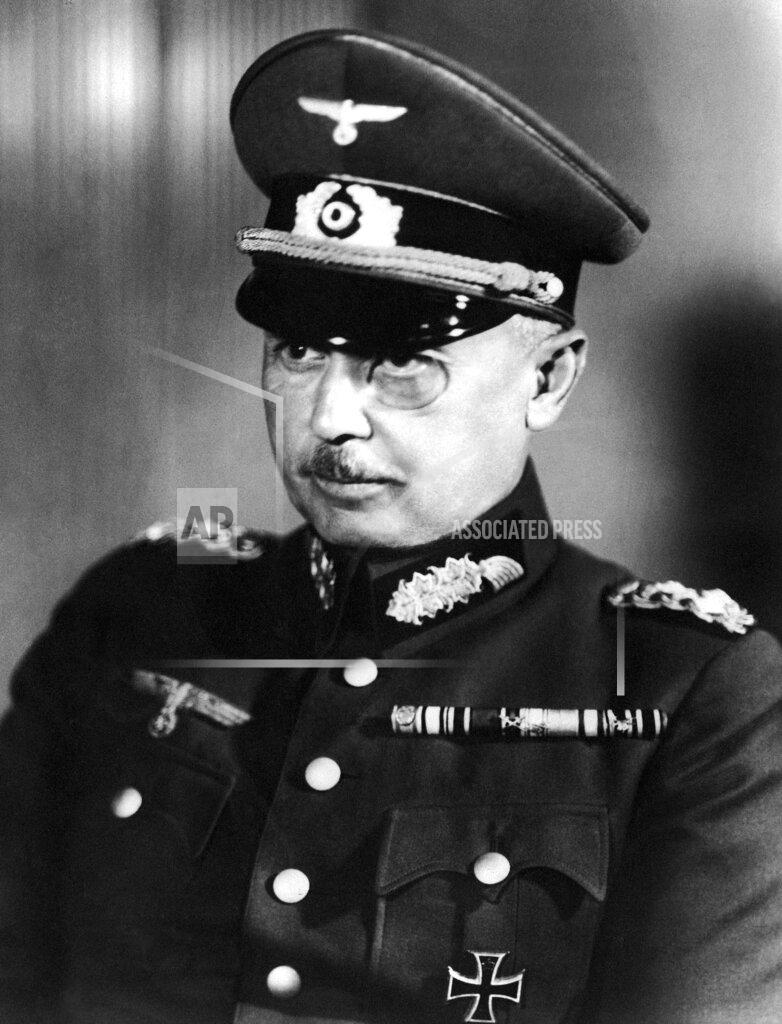
Former German Army Commander-in-Chief Werner von Fritsch was mortally wounded by a Polish bullet while on a tour of inspection at Praga, Warsaw, Poland. He was the second German general to perish in that conflict after Wilhelm Fritz von Roettig. Lieutenant Rosenhagen, adjutant to Fritsch and an eyewitness to his death, wrote in his original, official report: “[…] In this moment the Herr Generaloberst received a gunshot in his left thigh, a bullet tore an artery. Immediately he fell down. I took off his suspenders to bind the wound. The Herr Generaloberst said: “please leave it”, lost consciousness and died, with a foolish grin on his fading face. Only one minute passed between receiving gunshot and death.”
Fritsch received a ceremonial state funeral four days later in Berlin. William L. Shirer covered the event in his diary entry dated 26 September 1939: “They buried General von Fritsch here this morning. It rained, it was cold and dark — one of the dreariest days I can remember in Berlin. Hitler did not show up, nor Ribbentrop, nor Himmler, though they all returned to Berlin from the front this afternoon.”
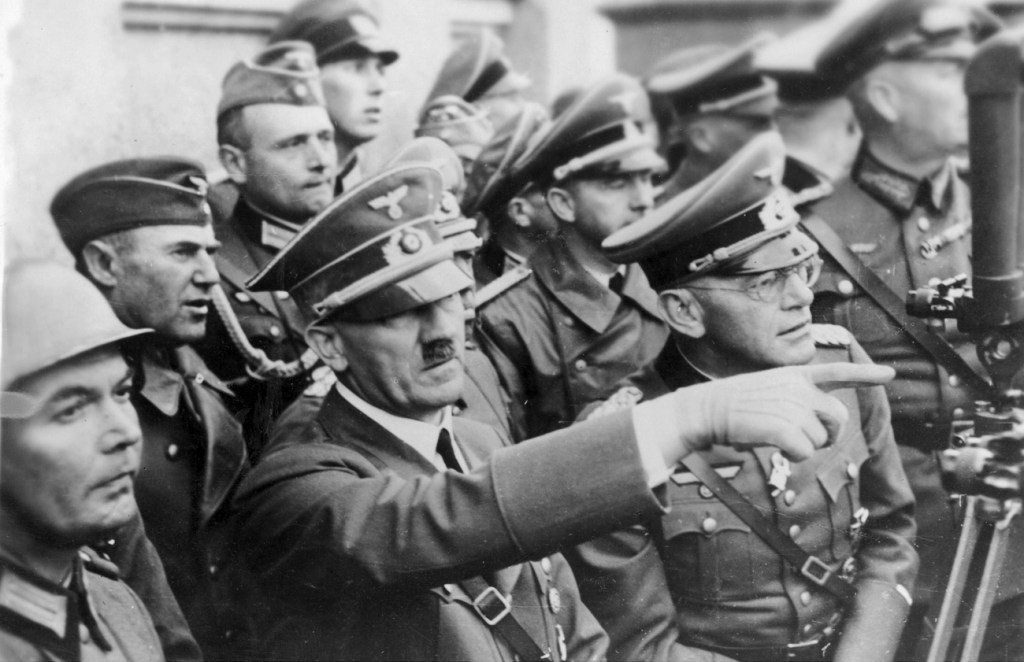
Adolf Hitler got a distant view of Warsaw today. He saw the Polish capital, surrounded by his troops, from a high point as he toured the operations zone of the Nazis’ North Army, in an advance southward from East Prussia over the Bug and Narew Rivers. The trip also enabled Herr Hitler to see the work of the German Air Force in crippling rail communications leading into Warsaw. To the east he was shown how German bombs wrecked a Polish armored train attempting to break through German lines.
Polish peasants organized into local battalions by the Soviet Red Army are hunting down and arresting landlords in the vast forests and marshes of Eastern Poland, it was announced by Radio Moscow tonight.
The Holy See has been completely cut off from the Catholics in Poland, but it was learned in Rome today that Mgr. Filippo Cortesi, Nuncio to Warsaw, is now in Bucharest, where he is organizing a work of religious, moral and spiritual assistance as well as material aid for Polish refugees.
The Anglo-French Supreme War Council met again in Hove. For the second time since hostilities broke out less than a month ago, the Supreme War Council met today, this time on British soil, to weigh events since its previous session on Sept. 12 and to plan future strategy in the war Great Britain and France are making against Germany. Discussion centered on Italy and whether it would be possible to deploy military force at Salonika or Istanbul without provoking Benito Mussolini. With their huge army mobilized but idle, the French feared an ebbing of military morale and were accordingly bellicose and impatient for action; Britain, on the other hand, shrank from such measures. At the Hove meeting there was also discussion about munitions production and reinforcements to the air and anti-aircraft defences in France. The British party at Hove consisted of Neville Chamberlain (prime minister), Lord Halifax (Foreign Secretary), Sir Alexander Cadogan (Permanent Under-Secretary at the Foreign Office) and Edward Bridges (Cabinet Secretary). France was represented by Édouard Daladier (prime minister), General Maurice Gamelin, Admiral François Darlan (C-in-C French Navy), Raoul Dautry (minister of munitions), and Jean Monnet (chairman of the Franco-British Economic Co-ordination Committee). Chamberlain stated that the Allies could not prevent a German intervention into Yugoslavia. At this and the two further meetings in 1939, on 17 November (in Paris) and 19 December, the French turned down a British scheme to bomb industrial targets in the Ruhr if the Germans were to invade Belgium. The French view was that such action would not stop the invasion of Belgium, but it would risk retaliation by the Luftwaffe against Britain and France.
The Finnish steam merchant Martti-Ragnar was stopped by gunfire and after the crew abandoned ship was scuttled by the U-4, commanded by Oberleutnant zur See Harro von Klot-Heydenfeldt, about 5 miles south of Arendal, Norway in the North Sea. Of the ship’s complement, all 24 survived and were picked up by two fishing boats. The 2,262-ton Martti-Ragnar was carrying cellulose, pulp and sulphur and was bound for Ellesmere Port, England.
The unescorted British steam merchant Akenside was stopped by gunfire and after the crew abandoned ship was torpedoed and sunk by the U-7, commanded by Werner Heidel, near Marsten Island off the coast of Norway in the North Sea. Of the ship’s complement, all 26 survived and were picked up by the Norwegian torpedo boat Storm and the Marsten pilot boat. The 2,694-ton Akenside was carrying coal and was bound for Bergen, Norway.
The U-30 arrived at Wilhelmshaven, Germany, where her commanding officer, Kapitanleutnant Fritz-Julius Lemp, informed the Commander U-boats Karl Donotz, in private, that he [Lemp] believed himself responsible for the sinking British passenger liner Athenia.
Josef František and his Polish Air Force squadron were evacuated to Rumania. František’s unit was ordered to withdraw with its remaining aircraft to Rumania. The unit flew first to Ispas in Bukovina, and then via various airfields eventually to Pipera near Bucharest, where it was interned by the Rumanian authorities. But many interned members of the Polish Air Force escaped. They included a group of four Czechoslovak airmen nicknamed the “Czech Cloverleaf”: František, Josef Balejka, Vilém Košař (one of the pilots who had landed to rescue František after his forced landing in Poland) and Matěj Pavlovič. The four went to Constanța, whence a Romanian cargo steamship, the Dacia, took them to Beirut in French-ruled Lebanon.
František would go on to fly for the French Air Force during the Battle of France, and be awarded the Croix de Guerre. After France surrendered, František fled to Britain and after training on 2 August was assigned to Polish No. 303 Squadron based at RAF Northolt, flying Hawker Hurricane fighters. Between 2 and 30 September 1940 he shot down 17 German aircraft and 1 probable, including nine Bf 109 fighters, six Heinkel He 111 bombers and one Junkers Ju 88 bomber. This made him one of the top scoring Allied fighter pilots of the Battle of Britain and on 20 September, King George VI decorated him with the Distinguished Flying Medal. A bar was later added to his DFM. His final confirmed victory was a Bf 109 near Brooklands in Surrey on 30 September 1940. On 8 October 1940, František’s Hurricane crashed in Ewell, Surrey, on return from a patrol. The cause is not known.
The British Press Association reported tonight that representatives of Great Britain’s principal political parties had agreed there would be no parliamentary or municipal elections during the war. Before the war began it had been expected a general election would be held in November.
The present British Government not only has the pledged support of all parties but, though largely Conservatives, includes Liberal and National Labor representation. During the World War the Parliament passed one act after another extending its own duration, which otherwise is limited to five years. The Parliament elected in December, 1910, was not dissolved for eight years. A party truce found expression in the establishment of a coalition government.
Petrol rationing was introduced in Britain. Cars were restricted to 20 gallons per month.
Four hundred Legionaries are murdered in Rumania by government death squads and their bodies left at the country’s crossroads as a warning to others. Those remnants of the Iron Guard who had survived until today in concentration camps were executed wholesale by the Rumanian Government after yesterday’s assassination of Premier Armand Calinescu by members of the outlawed fascist organization.
Hungarian troops yesterday crossed the Polish frontier and occupied Sianki, a small town on the border of Carpatho-Ukraine, according to a dispatch from Ungvar by the Italian newspaper Giornale d’Italia’s special correspondent. Budapest denied that any move across the border had taken place.
All German Jews are ordered to turn in their radios to the police.
New ration cards covering every category of food with the exception of skimmed milk, fruit, fresh vegetables and fish and further reducing the rations were issued in the Reich today, effective Monday.
The Dutch and Belgians open dikes, seeing a threat in German moves. The area around Utrecht is now flooded. Belgium is pouring water from the Albert Canal into the area between Lige and Antwerp.
While the Netherlands gave every indication today of a determination to preserve her neutrality, she was preparing on a big scale to defend herself if necessary. She has mobilized an army of 650,000 and is keeping them depoyed on her borders at some cost.
U.S. freighter Syros is detained by French authorities.
At Heston the Photographic Reconnaissance Unit (PRU) is set up. It is initially just called the Heston Flight.
Authoritative sources said today that a Turkish-Soviet Russian mutual assistance pact would be concluded by Foreign Minister Shukru Saracoglu, who now is en route to Moscow.
The War at Sea, Friday, 22 September (naval-history.net)
Western Atlantic – heavy cruiser HMS Berwick departed Halifax on escort duties.
Northern Patrol – light cruisers HMS Calypso and HMS Dunedin departed Scapa Flow on Northern Patrol duties. Calypso was missed by a torpedo at 2340 in 61-50N, 8-22W.
Light cruiser HMS Enterprise departed Scapa Flow on Northern Patrol duties, and arrived back on the 28th.
British northern waters – light cruiser HMS Delhi arrived at Scapa Flow.
Operation SK, North Sea – Rear Admiral, Destroyers on light cruiser HMS Aurora with destroyers HMS Tartar, HMS Bedouin, HMS Punjabi, and HMS Eskimo departed Scapa Flow and light cruisers HMS Southampton, HMS Glasgow, and HMS Sheffield with destroyers HMS Jervis, HMS Jersey, HMS Javelin, and HMS Jupiter of the 7th Flotilla departed Rosyth to attack German shipping off the Norwegian coast.
To cover the operation, battlecruisers HMS Hood and HMS Repulse left Scapa Flow with destroyers HMS Fame, HMS Foresight, HMS Firedrake, and HMS Fortune. Soon after sailing, Fortune got a submarine contact which was confirmed by destroyer Firedrake, but attacks did not produce any results. Battleships HMS Nelson and HMS Rodney, aircraft carrier HMS Ark Royal, and destroyers HMS Faulknor, HMS Foxhound, HMS Fearless, HMS Matabele, HMS Mashona, and HMS Somali also left Scapa Flow as cover.
Destroyers HMS Fury and HMS Forester departed Newcastle to join Forbes at sea, and 15 miles off the mouth of the Tyne, depth charged a submarine contact. Destroyers HMS Esk and HMS Express also departed Scapa Flow to join the operation.
However, when destroyers HMS Javelin and HMS Jersey collided later on the 22nd, 120 miles WSW of Lister Light in 57 09N, 03 08W, the raid was abandoned. Javelin could only steam at 10 knots and was escorted by HMS Jervis and HMS Jupiter to Newcastle. Meanwhile Jersey headed for Leith at slow speed escorted by HMS Mashona and HMS Eskimo, which arrived back at Scapa Flow on the 24th.
Destroyers HMS Fury and HMS Forester attacked a submarine contact 15 miles off the mouth of the Tyne, while destroyer HMS Express sighted a floating mine off the port side of battlecruiser HMS Hood, came up and exploded the mine with gunfire. On the 23rd, when an explosion was felt four miles from Hood, destroyers HMS Fortune, HMS Firedrake, HMS Mashona, and HMS Matabele were sent to investigate. They carried out attacks in 58 17N, 01 30W.
By 23 September, all forces involved had returned to their ports of departure. HMS Jersey repaired at Leith, returning to service on 9 October, and HMS Javelin at Newcastle. She left the Tyne on 21 October for further repairs at Hartlepool, but was damaged in another collision en route.
British east coast – convoy FS.9 departed Methil and arrived at Southend on the 24th.
British submarine HMS L 26 was damaged in collision with Blyth Pier.
Destroyer HMS Wren attacked a submarine contact six miles WSW of Owers Light Vessel.
Minesweeper HMS Hussar and minesweeping trawlers HMS Mastiff and HMS Cedar attempted to locate and examine a German mine after steamers Magdapur and City of Paris were mined off Orfordness.
Convoy FN.9 departed Southend and arrived at Methil on the 24th.
Norwegian waters – U-7 sank steamer Arkenside (2694grt) 25 miles SW of Bergen in 60 07N, 04 37E. Her entire crew was rescued.
U-4 captured Finnish steamer Martti Ragnar (2262grt) 50 miles off Arendal, Norway, took her in tow to a point five miles south of Arendal and scuttled her with explosive charges. No crew were lost.
Engish Channel – destroyer HMS Jaguar investigated a crossing-of-a-loop reading off Portland, which indicated a possible submarine in the area.
Destroyer HMS Jackal attacked a submarine contact 4½ miles S by E of Start Point, and was joined by destroyer HMS Eclipse.
Light cruisers HMS Ceres and HMS Caradoc departed Plymouth on escort duties and arrived back the next day.
UK-France convoys – DB.6 departed Southampton with two personnel ships, escorted by destroyers HMS Vansittart and HMS Venomous, and arrived at Brest on the 23rd.
Bay of Biscay – From the 22nd, French submarines Achilles, Casabianca, Pasteur, Sfax of the 2nd Division from Admiral West were stationed in turn near Cape Ortegal to keep watch on German merchant ships in northern Spanish ports. The last patrol ended on 3 November.
Mediterranean – Convoy Green 2 (AB.3) departed Gibraltar with 18 ships for Port Said, escorted by destroyers HMS Hardy, HMS Hero, HMS Hereward, HMS Hasty, and HMS Hostile from the 22nd to 27th. The destroyers then proceeded to Malta. Destroyers HMS Cossack, HMS Maori, HMS Nubian, and HMS Zulu provided escort from 27 September to 2 October when it arrived at Port Said.
Mediterranean Fleet – destroyer (and sloop) status on the 22nd was as follows:
HMS Afridi and HMS Gurkha were at sea with French convoy L.3 proceeding from Marseilles to Beirut. They joined the convoy southeast of Malta on the 23rd after the collisions between large destroyer Vautour and steamer El D’jezair, and steamers Chenonceaux and Mariette Pacha. HMS Mohawk and HMS Sikh were also at sea. Afridi and Gurkha arrived at Alexandria on the 26th, and Mohawk and Sikh on the 28th. HMS Cossack, HMS Maori, HMS Zulu, and HMS Nubian were at Alexandria due to leave on the 24th to take over Green 2 off Malta on the 27th. They arrived at Malta on the 26th and departed next morning.
HMS Gallant had been at Alexandria since the 21st after returning from the Dardanelles. She was to have met steamer Eocene (4216grt) carrying Polish gold, but the steamer did not arrive. HMS Garland was at Alexandria under repair. HMS Grafton was at Malta awaiting the arrival of steamer Clan Menzies (7336grt). HMS Grenville, HMS Gipsy, HMS Grenade, and HMS Griffin were at sea. They departed Alexandria on the 22nd for Gibraltar to take over Green 3 on the 28th. HMS Greyhound and HMS Glowworm were with Blue 2, due to arrive at Gibraltar on the 28th.
HMS Hardy, HMS Hero, HMS Hereward, HMS Hostile, and HMS Hasty were escorting Green 2 from Gibraltar, and due to arrive at Malta on the 27th to make good defects prior to leaving the Mediterranean station. They departed Malta on 2 October for Gibraltar.
Sloops HMS Aberdeen and HMS Fleetwood were with Blue 2 due to arrive at Gibraltar on the 28th. Sloops HMS Grimsby and HMS Deptford were at Alexandria since arriving from the Red Sea on the 19th.
Central Atlantic – on the 22nd, French submarines Agosta and Ouessant of the 8th Division, Admiral West left their patrol areas off the Azores for Martinique, arriving on the 29th, to guard the Antilles passages against German blockade runners. On 5 October, submarines Bévéziers and Sidi Ferruch of the 8th Division were ordered to join them and arrived on 27 October.
On 27 December, the relief of these submarines was ordered. The submarines passed Gibraltar on 16 January. On 22 February 1940, French submarines Venus, Iris, Ceres, and Pallas of the 15th Submarine Division from Bizerte arrived in the Caribbean. These submarines departed station on 1 May and arrived back at Toulon on 3 June 1940.
South Atlantic – destroyer HMS Havock departed Montevideo with the first outbound local convoy, consisting of steamers Sussex, Roxby, El Ciervo, and Falkland Island Company ship Lafonia (1961grt). They were covered by heavy cruiser HMS Exeter. At dusk, the convoy dispersed and Havock escorted steamer Lafonia, carrying troops for the defense of the Falkland Islands, to Port Stanley.
Indian Ocean – light cruiser HMS Liverpool departed Aden for Bombay, arriving on the 27th.
Far East – heavy cruiser HMS Dorsetshire departed Hong Kong on escort duties and arrived back on 13 October for docking prior to transferring to the East Indies Station.
Administration leaders in the U.S. Senate began the preparation today of an all-embracing cash-and-carry plan for commercial intercourse between the United States and warring nations, to be offered as a substitute for the rigid arms and airplane embargo, the repeal of which President Roosevelt requested of Congress yesterday. The Democratic high command moved simultaneously to restrict the special session to the issues. growing out of the new European war. A resolution calling for a limitation of this kind was voted unanimously by nineteen members of the Senate Democratic policy and steering committees, who hold varying views as to the methods by which the United States should be kept neutral.
The idea of restricting the session to war issues was agreed upon in substance even by the isolation. group, which convened again to consider the formation of a national committee to carry on an “educational campaign” in behalf of retention of the present arms embargo. Among those whom the committee hoped would serve on the committee were Herbert Hoover, Colonel Charles A. Lindbergh, former Governor Philip La Follette of Wisconsin, Charles A. Beard, the historian, and Henry Ford. The opposition also discussed the possibility of obtaining an endorsement by the American Legion convention in Chicago next week. They had been informed that Paul V. McNutt, Federal Security Administrator, and Louis Johnson, Assistant Secretary of War, both former Legion commanders, would go to Chicago to try to prevent the organization from going on record against repeal of the embargo.
Both sides were doing their utmost to affect the flow of mail and telegrams to Capitol Hill, most of it opposing embargo repeal. Even the President took cognizance of the adverse mail, saying he was aware of it despite the flow of messages approving his address of yesterday. Senators from States close to Washington reported that communications favoring the President’s position were noticeably greater since he delivered his message, but that the majority still ran heavily the other way. As the oppositionists met again Senator Barbour, of New Jersey, issued a statement warning against any conclusion as to his stand. Mr. Barbour met twice yesterday with the isolationists, but explained today that he was meeting with all groups and canvassing all opinion before making up his mind on the subject.
“Right now I am listening to every shade of argument, and dispassionately and without political prejudice studying the points involved,” Senator Barbour said. “Upon conclusion of this study I will make up my mind and no one will have to guess, but will know, what my views are.” The plans for a new cash-and-carry policy, similar to that which lapsed last May, with the notable exception that the arms embargo would be lifted, were disclosed by Senator Pittman, chairman of the Foreign Relations Committee, after a conference with President Roosevelt at the White House.
House leaders felt confident tonight that the chamber would agree unanimously on Monday to the “marktime program” under which the House would adjourn for three-day periods for about three weeks, or until the Senate acts upon the neutrality revision legislation.
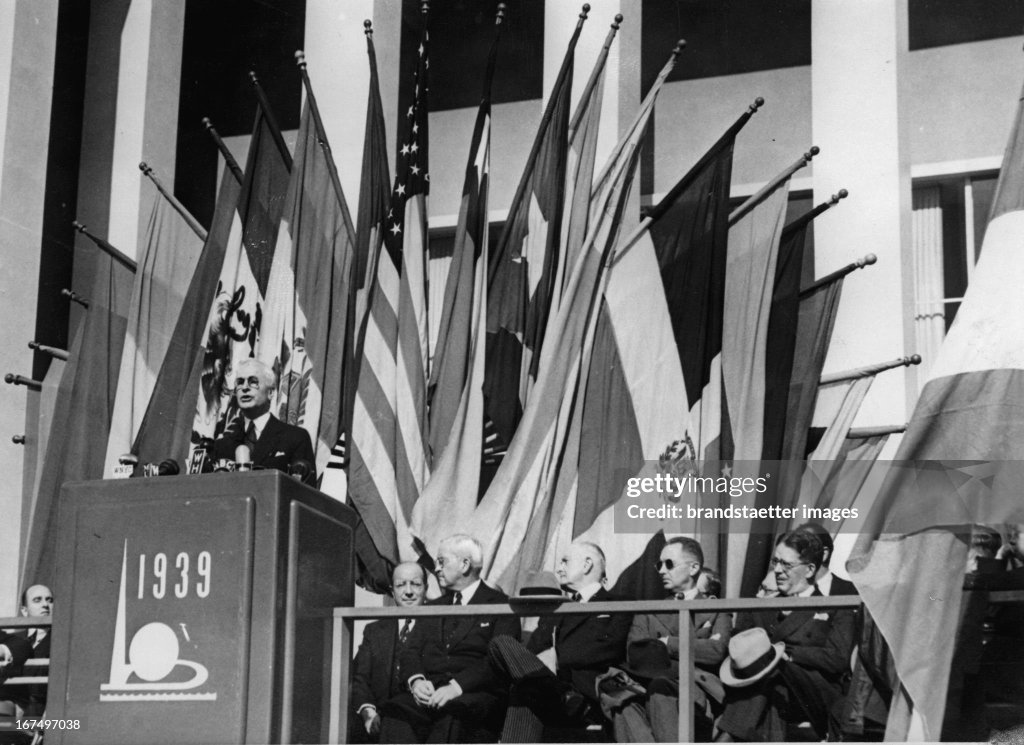
Living side by side in a neighborly peace that does not rest on fear, each of the twenty-one American republics, bound together by pacts of inter-American solidarity, “is ready to defend itself against any threat to its security that may come from any part of the world,” Secretary of State Cordell Hull declared yesterday in the principal speech of Pan-American Day at the World’s Fair.
Speaking over an extensive radio network that carried his words throughout the United States and to Canada, Europe, and South America, Secretary Hull asserted that although the Americas remain at peace, they already have felt the economic effect of “the disastrous deterioration of international morality in many parts of the earth” and now will suffer under the heavy hand of the hostilities in. Europe.
An audience of 7,300, assembled in the Court of Peace, applauded repeatedly as Mr. Hull outlined how “our nations” had sought to convince the world that the American system, whereby “small countries do not feel menaced by their powerful neighbors,” is far better than “a state of affairs in which callous disregard of law and morality, with resort to brute force and unbridled violence, are the methods deliberately chosen for the attainment of national aims.”
President Roosevelt made it known today that two submarines of unknown nationality had been seen in North American waters. He gave their approximate positions but then told correspondents at his press conference not to get too inquisitive about the nationality of the vessels nor to inquire as to the source of his information.
[Ed: This is, of course, baloney. There are NO submarines off our coast in September 1939, except perhaps a few American ones. Whether this is rumor-mongering based on error, or outright manipulation by the president, is impossible to say.]
California heat causes 65 deaths. After sweltering through the hottest night in its history, with a minimum temperature of 84 degrees, Southern California had another day of near-record heat which baked Los Angeles with a midday maximum of 103.2 degrees. The Northrop aircraft factory in Inglewood is closed for the day when the temperature inside reaches 112. Many schools through southern California remain closed.
Chief of Naval Operations Harold Stark ordered the U.S. Navy Scouting Force (under Adolphus Andrews) to move from California, United States to Pearl Harbor, U.S. Territory of Hawaii.
The War Department announced various new steps today in the aggressive program to strengthen the national defense. It moved to increase the enlisted strength of the National Guard to 235,000 as authorized in an executive order signed last week by the president, and ordered $64 million in new equipment, over 90% of that for aircraft.
World developments are forcing a rush to strengthen the Panama Canal defenses, but it will be several years before they can be considered invulnerable, Major General David L. Stone, commanding officer, said today.
Roy Weatherly’s ninth-inning single with two out scored Bob Feller and gave the Cleveland Indians a 5–4 victory over the Detroit Tigers in the series opener today.
The combination of Doc Cramer’s heavy hitting and the opposition’s poor fielding gave the Boston Red Sox a 7–5 triumph over the Philadelphia Athletics in today’s series opener.
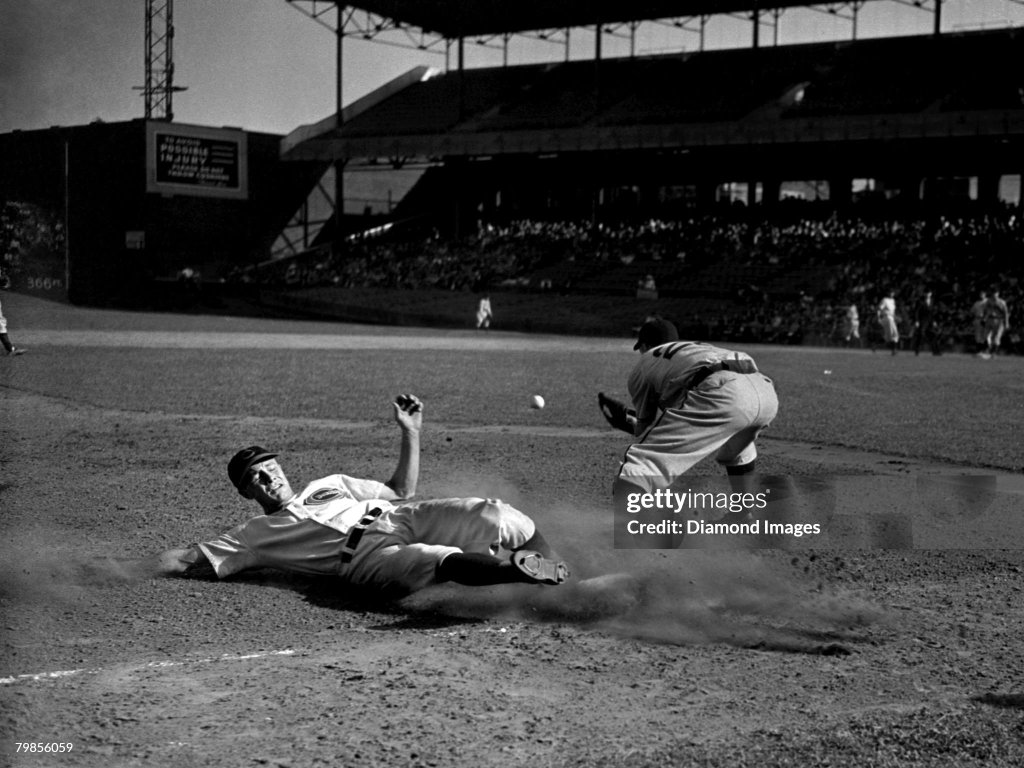
The first-place Reds sweep a pair from the Pirates, 6–0 and 10–9. Rookie Gene Thompson wins the opener for his 11th victory of the year. Wally Berger has a grand slam in the third inning of game 2. The Reds now lead the Cardinals by 3 games.
Two freshman pitchers, Morton Cooper and Bob Bowman, combined today to stop slugging Hank Leiber cold and give the fighting St. Louis Cardinals an important 3–2 victory over the Chicago Cubs.
Censorship regulations in effect under the War Measures Act were made public in Ottawa today. On Canada’s declaration that a state of war existed with Germany, general directions were issued to the press and radio stations by censorship authorities.
Canadians seek the purchase of 500,000 blankets from the United States. The order is too big for any single American business to meet.
Chileans endorse President Roosevelt’s views, believing the Neutrality Act is unsafe as is.
The Chinese ask for French aid, seeking the release of war shipments impounded in Indo-China.
Japan gives a Shanghai plan. The proposal is studied by the United States, Britain, and Italy. The Japanese are determined to have China completely in their sphere of influence in their “Greater East Asia Co-Prosperity Sphere”; the western powers are equally determined to resist this.
Dow Jones Industrial Average: 152.57 (-0.91).
Born:
Marlena Shaw [as Marlina Burgess], singer (“California Soul”), in New Rochelle, New York (d. 2024).
Mike Sullivan, American politician (Governor of Wyoming 1987-1995), in Omaha, Nebraska.
Timothy Wirth, American politician (Rep-D-Colorado, 1975-1987), President of United Nations Foundation, in Santa Fe, New Mexico.
Guy Reese, NFL defensive tackle (Dallas Cowboys, Baltimore Colts, Atlanta Falcons), in Dallas, Texas (d. 2010).
Lloyd Winston, NFL fullback (San Francisco 49ers), in Merced, California.
Stover McIlwain, MLB pitcher (Chicago White Sox), in Savannah, Georgia (d. 1966, from testicular cancer).
Gilbert E. Patterson, American minister and presiding bishop of the Church of God in Christ, in Humboldt, Tennessee (d. 2007).
Junko Tabei, Japanese mountain-climber, 1st woman to climb Mount Everest, in Miharu, Japan (d. 2016).
Died:
Werner von Fritsch, 59, German general (killed in action during the Siege of Warsaw).
Naval Construction:
The Royal Navy Flower-class corvette HMS Primrose (K 91) is laid down by William Simons & Co. Ltd. (Renfrew, Scotland).
The Kriegsmarine (German Navy) vorpostenboot V 405 J. Hinrich Wilhelms is commissioned.
The Kriegsmarine (German Navy) vorpostenboot V 705 Carsten (later V 603 Carsten) is commissioned.
The Kriegsmarine (German Navy) vorpostenboot V 706 Fritz Reiser (later V 604 Fritz Reiser) is commissioned.
The Kriegsmarine (German Navy) vorpostenboot V 707 Arthur Duncker (later V 605 Arthur Duncker) is commissioned.
The Kriegsmarine (German Navy) vorpostenboot V 708 Fladengrund (later V 606 Fladengrund) is commissioned.
The Royal Navy naval trawler HMT Warwick Deeping (H136) is commissioned.

[Ed: Anyone found with so much as a pocketknife was immediately shot.]
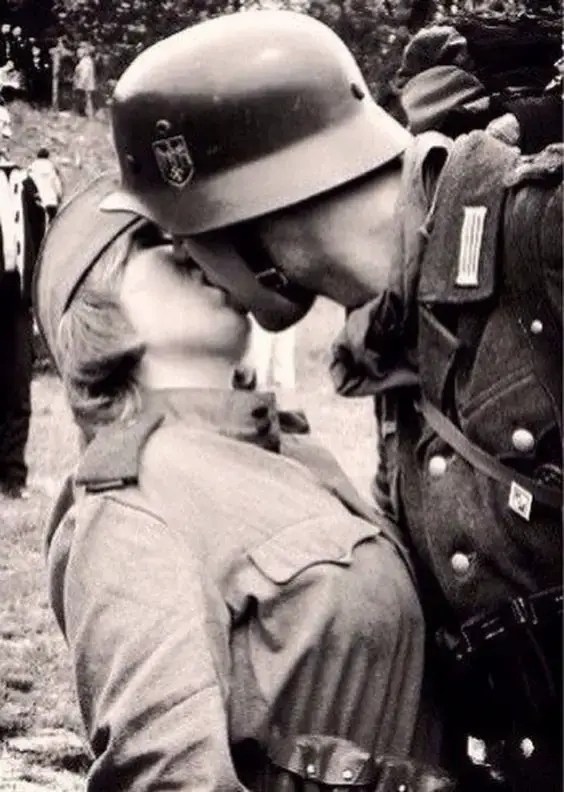
[Ed: Two years later he’ll be trying to kill Russians. I wonder if she was sent to GULAG for this. Stalin had people sent to the camps for less.]
 History Diaries