South Vietnam’s military forces suffered one of their worst weekends in the fight against the Việt Cộng, military sources said today. They reported 230 casualties inflicted on government troops. The most serious government setback took place Saturday in a battle near the Cambodian border, the informants said. The Việt Cộng killed 23, injured 41 and escaped with 150 weapons.
Meanwhile, claims are made that government forces have inflicted heavy casualties on Communist units that entered South Vietnam from North Vietnam two days ago, reliable military sources said today. Field intelligence reports said that about two companies, more than 200 men, were seen crossing the demilitarized zone that separates the two parts of Vietnam. Some units are also believed to have landed from small boats along the seacoast. The South Vietnamese First Infantry Division promptly moved into positions to prevent the new arrivals from penetrating deeply into the country, the sources said. A frontal engagement took place late yesterday afternoon about six miles northeast of Quảng Trị, near the South China Sea and 15 miles inside South Vietnam.
South Vietnam’s Premier Nguyễn Khánh blames the Montagnard uprising yesterday on ‘Communists and foreigners and it does appear that the National Liberation Front has begun to influence some of the Montagnards by taking advantage of their age-old resentment of the South Vietnamese government. The U.S. Special Forces work with the Montagnards to train them to fight against the Việt Cộng but will never really be able to gain the full support of these independent people who essentially want to be left alone.
A general strike began in Saigon this morning, paralyzing electricity. water, buses and communications. The strike was ordered by union leaders protesting the Government’s prohibition on strikes during the state of emergency. The strike was scheduled to last 48 hours. It involved about 60,000 workers who are members of the South Vietnamese Confederation of Labor. During the forenoon about 3,000 strikers marched through the city to the office of the Premier, Major General Nguyễn Khánh. General Khánh was absent, but high officials agreed to transmit the demands presented by a delegation of union leaders.
The demonstrating strikers remained outside the Premier’s office while armed troops were stationed inside the grounds of the office to prevent any disorders. The union leaders called the strike both to demand better wages and working conditions and to protest against restrictions on meetings imposed by General Khánh’s regime. About 80 member unions are involved, leaders of the Confederation of Labor said. The strikers are chiefly transport, textile and public utility workers, with some plantation workers from outside the city involved.
At a news conference, President Johnson says that although urged by some of his advisers to bomb North Vietnam for the recent incident in the Gulf of Tonkin, he chose to hold back. Without identifying the source of this advice, the President said at his news conference that he felt he should take no further action until daylight reconnaissance in the gulf could determine exactly what had happened. He added that no additional information was ever obtained and that this left him without proof of the identity of four hostile vessies sighted by radar. Mr. Johnson’s first public comment on the incident added little to the Administration’s weekend accounts. But the President showed some sensitivity about suggestions in the press and by Republican leaders that the government was withholding information. The terse official report by Defense Secretary Robert S. McNamara on Saturday “reflects exactly what, happened and is about all of the sure information they have,” Mr. Johnson said.
Leaders of the Laotian neutralists, right ists and leftists edged toward agreement tonight on an agenda for the opening session of their conference. The remoteness of an ultimate accord among the factions was demonstrated again when Prince Souphanouvong, leader of the pro‐Communist Pathet Lao, sharply accused the United States,of “intervention and aggression” in Laos. Under the chairmanship of the Premier and neutralist leader, Prince Souvanna Phouma, representatives of the three factions assembled this afternoon outside Paris, àt the Chateau de La Celle‐St. Cloud, which has been lent to them by the French Government.
The formal conference was scheduled to open August 24, but it began four weeks late after long and apparently fruitless conversations. At the moment diplomats consider the factions’ positions irreconcilable. Their impression was confirmed in a speech by Prince Boun Oum, head of the rightists, in Prince Souvanna Phouma’s opening remarks and in Prince Souphanouvong’s condemnation of American “imperialism.” After meeting for nearly four hours, the three leaders announced qualified agreement on a three‐point agenda, covering the following matters:
- A cease‐fire and a peaceful settlement of the military conflict, on the Plaine des Jarres, the area dominating Laos’s vital north‐south roads.
- Another 14-natlon conference on Laos, conditions for reconvening such a conference, the composition of a Laotian delegation and rules of procedure.
- The establishment of a coalition government in a capital acceptable to the three factions.
Prince Souphanouvong, who represents the Neo Lao Hak Xat, parent body of the Pathet Lao, objected to imposing any conditions for a 14-nation conference, which would be a follow‐up to the 1962 meeting that set up a neutral Laos under a coalition government. Calling such a conference is “an urgent matter for the peace of the area,” the leftist Prince said. None of the delegations expects early or meaningful negotiations on any of the agenda points. Premier Souvanna Phouma is to leave tomorrow for Vientian the Laotian administrative capital, turning over leadership of neutralist delegation to foreign minister Pheng Phohsavan. Prince Souphanouvong and Prince Boun Oum have yet to disclose their immediate plans.
Communist China asserted today that the Soviet Union was spending money everywhere to buy support for its policies. This accusation, made in an authoritative commentary in Jenmin Jih Pao, the party newspaper, was the latest in a series of exchanges that Hong Kong specialists on Soviet and Chinese affairs said had reduced some aspects of the ideological polemics to mudslinging. Peking’s charge that Moscow was paying out “filthy lucre” to gain adherents was part of a detailed rebuttal of the Soviet accusation that the Chinese Communists were financing anti‐Russian propaganda through illicit sale of opium. Hsinhua, the Chinese Communist press agency, in a denial last night compared Soviet propaganda to that of Joseph Goebbels, Hitler’s propaganda minister.
In recent articles Moscow had made other charges — slanderous by Communist standards — that Peking was engaged in economic dealings with South Africa and Portugal while saying it was supporting antiapartheid forces and African insurgents in Portuguese Angola. Chinese Communist propaganda has put its main emphasis on what was termed Premier Khrushchev’s support of United States imperialism. Western analysts examining these exchanges of charges have found strong elements of exaggeration in them with Moscow usually playing the game with a heavier hand.
Radio monitors here also reported that the broadcasting war between Peking and Moscow had been stepped up. Russian‐language broadcasts from Peking have been increased recently from nine hours a day to 13. The Chinese Communists thus have regained the advantage lost in April when Moscow radio increased its transmissions in Mandarin from six hours a day to nine and a half. The Peking radio has been shifting its broadcasting frequencies because of apparently deliberate Soviet radio interference with Russian‐language transmission.
France rejected today a United States suggestion that she donate part of the $7 million required to keep the United Nations force in Cyprus for three months after September 26, when its present mandate expires. Roger Seydoux, the French representative, told the Security Council that it was not practical to finance the force except under the method set forth last March in the resolution establishing the force. This provided for the costs to be met by Cyprus, by voluntary donations and by the nations supplying contingents. None of the money was to be taken from the United Nations treasury. The Secretary General, U Thant, has had difficulty in raising the money, and last week he notified the Council that he would pay for the three-month extension out of general revenues if donations were not sufficient.
The island nation of Malta became independent after 164 years of rule by the United Kingdom. The flag raising ceremony, with Britain’s Prince Philip appearing on behalf of his wife, Queen Elizabeth II, took place at Floriana, near the capital city, Valletta. Maurice Henry Dorman, who had been the colonial governor since 1962, became the first Governor-General of Malta and Giorgio Borġ Olivier continued as Prime Minister. The State of Malta would become a presidential republic on December 13, 1974.
The Bolivian Government announced tonight that an unsuccessful attempt was made last night to assassinate Vice-President René Barrientos Ortuno, apparently by plotters whose attempted coup d’état was put down yesterday. In a statement, the government said that an explosive device had gone off in the bedroom of General Barrientos’s residence in Cochabamba while he was sleeping, but that he was not injured.
Senator Barry Goldwater of Arizona accused President Johnson tonight of avoiding the issues of the campaign, and “dared” the President to face him in debate “before the world.” He accused the Administration of holding the belief that government is “master, not servant of the people,” and of operating through a centralized authority “that has even given you a number to replace your name.” “We want to give you your freedom and your names back again,” Mr. Goldwater, the Republican Presidential candidate, said in a speech before a capacity crowd of 17,000 at a campaign rally in the Charlotte Coliseum. He continued: “We want to give the Government of this nation back to the people of this nation. An administration that understands, rather than one that tries to wreck the balances of constitutional power, can do the job.”
The Senator’s plane from Washington, landing under a full moon, was greeted by a few hundred persons at the airport, and there was apparently no effort to turn out a crowd along the motor‐caravan route through the city to the splendid new glass‐and-concrete coliseum. But in the domed stadium, it was different. The place was packed with applauding, yelling Republicans. Strom Thurmond, the South Carolina Senator who recently shifted from the Democratic to the Republican party, received an ear‐splitting ovation when he was introduced and told the gathering: “I didn’t leave the Democratic party — it left me.” It was Mr. Goldwater’s third trip into North Carolina in six days.
The Senator began his speech with an attack on Mr. Johnson, saying that the President “will not face the issues, he will not face me, he will not face you.”
“Instead,” he said, “he sends forth his curious crew of camp followers to speak for him. Some are socialistic radicals like his running mate, Hubert Horatio. Some are bosses of big cities, big unions and big business. Some are bureaucratic lackeys. Some are even buildings. We keep hearing that the White House announces or that the Pentagon says such‐and-such. “The Pentagon talks so much that I’ve suggested it be given a name — like Peter Pentagon. It is an interesting thing, a building with five sides and a hole in the middle. It ought to be able to talk. Can my opponent talk? What does my opponent have to say? I challenge my opponent, the interim President Lyndon Baines Johnson, to face the issues. I dare him to face me before the world. I ask of him, debate. We do not want oppressive powers in the hand of the executive branch, or the Supreme Court,” he continued. “We don’t want oppressive powers in the hands of Congress or the states. But we do want proper powers restored to the Congress and to the states. We do want the proper balance between all branches and all levels.”
President Johnson said today that he did not believe in being overconfident about the election and indicated he planned to step up his campaign. He held a news conference, his 31st, in his oval office and then took reporters on a fourlap walk around the south driveway of the White House. Later in the afternoon, Mr. Johnson spoke to 261 leaders of fraternal organizations, saying that “compassion does not corrupt a nation.” “We must care about the rights of our fellow man as much as we care about rights of our own,” the President said.
Meanwhile, it was learned on high authority that the President felt his Republican opponent, Senator Barry Goldwater, had drawn good crowds during last week’s campaign swing in the deep South and that the President was aware of polls showing Mr. Goldwater substantially ahead in Alabama. Mr. Johnson has also seen polls, however, that show him leading Mr. Goldwater even among Republican voters in some big Northern states, the source indicated.
Legislation providing for a review of United States public land policies with a view to deciding whether some land should be sold was signed today by President Johnson. He approved three related bills that would create a bipartisan public land law review commission, direct the Secretary of the Interior to classify public lands, and provide temporary authority for the sale of public lands subject to some conditions. The sale authority expires June 30, 1969. The commission will consist of six members each of the House and Senate Interior Committees, six citizens appointed by the President and a chairman elected by a member. It is to report by June 30, 1968.
President Johnson has signed an appropriation of $7,089,707,000 to finance the Department of Labor and Health, Education and Welfare, the White House announced today. The total, worked out in a Senate‐House compromise, is $713,483,000 less than the President recommended in his budget. Labor Department activities account for $565,904,000 of the total.
The net assets of Senator Hubert H. Humphrey, the Democratic Vice-Presidential nominee, and his wife, Muriel, were reported today to total $171,396 as of September 10. The Minnesotan is thus shown to be the least wealthy of the four national candidates in the current Presidential campaign. On August 19 President Johnson and his family listed net assets of $3,484,098. Other estimates, all unofficial, had guessed at a total ranging from $9 million to $14 million. The net assets of Senator Barry Goldwater, the Republican Presidential nominee, and his wife, Margaret, were reported on August 10 at $1.7 million as of last June 30.
President Johnson will receive Thursday the report of the Warren Commission’s investigation of the assassination of President Kennedy. George E. Reedy, White House press secretary, said the report would be made public over the weekend. Mr. Johnson appointed the commission, under the chairmanship of Chief Justice Earl Warren, shortly after the slaying of Mr. Kennedy in Dallas, last November 22. It has held extensive hearings and prepared a report running heard more than a quarter million words, Mr; Reedy said.
Robert F. Kennedy’s camp cried “scurrilous” yesterday to a campaign charge by Senator Kenneth B. Keating that Mr. Kennedy had made a deal with a “huge Nazi cartel.” Senator Keating, meanwhile, softened the charge, but insisted, at a press conference in Syracuse, that Mr. Kennedy should have taken greater pains to see that none of the proceeds from the sale of the General Aniline and Film Corporation should fall into the hands of its former German owners. The multimillion‐dollar corporation, owned by the German chemical combine, I. G. Farben, was seized as enemy property during World War II.
A Black church and the home of a Black civil rights worker were bombed in McComb, Mississippi last night and angry Blacks pelted a police car when it arrived. The police said 2,000 or 3,000 Blacks attacked the patrol car with bricks and bottles when it drove up to the wrecked home of Mrs. Aylene Quin. Black leaders said there were about 150 in the crowd. Sheriff R R. Warren said, “In my opinion, the bombing [of the home] and the one at the Society Hill Church were plants.” Officers arrested about 20 persons and said many of them were carrying arms. One Molotov cocktail was reported found by officers in the Blacks’ possessions. Mrs. Quin, 42 years, old, the operator of a cafe and a civil rights leader, said her two children were injured by the blast, but not seriously. They were treated for minor lacerations.
Prominent business and professional men were among 12 persons arrested in the fashionable suburb of Darien, Connecticut today on charges of serving liquor to minors at house parties. Fourteen warrants were issued. Twelve persons appeared at the police station here and were booked on a charge of violating a Connecticut statute that prohibits the serving of liquor to minors by persons other than their parents. Two of the persons named in the warrants were out of the state today. Among the first of those arrested was Carlton Josselyn of Westport, a science teacher in the Fairfield public school. He had tended bar at one of two house parties at which teen‐agers were served liquor.
The statute was invoked by Circuit Court Judge Rodney S. Eielson, who is presiding at the trial here of Michael Smith, 18 years old, of 1059 Post Road, in the death of Nancy Hitchings, 17, of Half Mile Road, both Darien, in an automobile crash. The youth is charged with reckless driving and negligent homicide as a result of the accident, which occurred on June 23 after the two house parties here. The youth has pleaded not guilty. Judge Eielson, regarded by his colleagues as a stern upholder of the law, ordered warrants issued for all adults “who had anything to do with serving liquor to minors at the party. The guilt of needless loss of life is in every living room in this community,” Judge Eielson said sternly in court last Thursday in announcing the move, “and in the conscience of every parent who knew his or her child was going to be served liquor or who served liquor to a minor on that night.”
“I wish I had the power to get at every parent who is guilty,” he added.
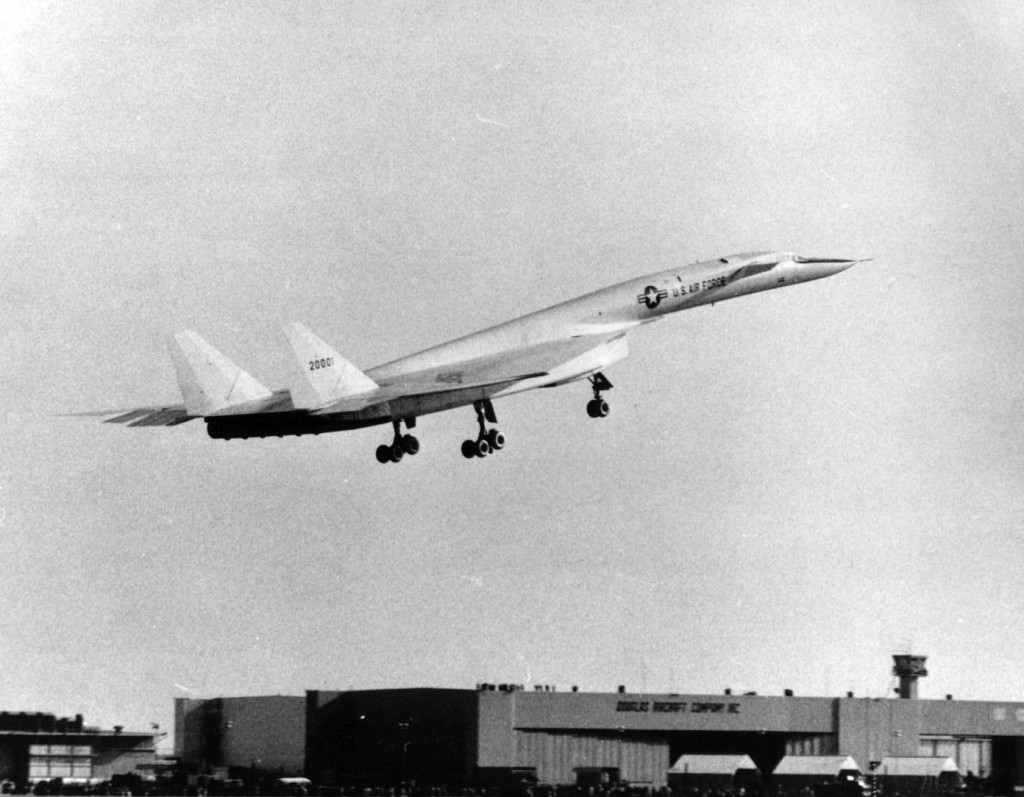
The North American XB-70 Valkyrie flew for the first time, piloted by North American Aviation’s Alvin White and U.S. Air Force Colonel Joseph Cotton. It departed the runway at North American’s Plant 42 test facility at Palmdale, California for the trip to Edwards Air Force Base at 8:38 in the morning and, though capable of flying more than 2,000 miles per hour at high altitudes, did not exceed 280 knots (about 322 mph or 519 kph). 5,000 employees and guests at Air Force Plant 42 in Palmdale, Calif., watched as NAA Chief Pilot Alvin White and U.S. Air Force copilot Joseph Cotton took the graceful six-engine giant up for its first flight. It was the culmination of an effort that began in 1954 when both Boeing and NAA submitted designs for the Air Force Weapon System 110A competition, and on December 23, 1957, NAA won the competition.
The United States kept yachting’s America’s Cup for the 20th consecutive time since the competition began in 1851, as the 12-meter Constellation, owned by the New York Yacht Club and skippered by Eric Ridder and Bob Bavier, won the fourth race in a sweep of the best-of-seven series against the Royal Thames Yacht Club and its boat, Sovereign, captained by Paul Anderson.
The Philadelphia Phillies baseball team, in first place in the National League and 6½ games ahead of its opponents with only 12 games left in the season, began a losing streak that would later be referred to in Phillies lore as “The Curse of Chico Ruiz”. Ruiz, a rookie for the Cincinnati Reds was on third base with two men out in the sixth inning, and “stole home” in what a reporter would refer to the next day as a “dumb, dumb baseball play”, and scoring the lone run in a 1-0 loss for Philadelphia. The loss was the first of ten in a row for the Phils, which would conclude with a loss to the eventual pennant-winner, the St. Louis Cardinals, on September 30. John Tsitouris (8–11) hurls a 1–0 shutout for the Cincinnati Reds today over Art Mahaffey and the first-place Philadelphia Phillies, launching the 10-game Phils’ losing streak. It is Tsitouris’ first career shutout. Rookie Chico Ruiz scores the only run when, with Frank Robinson at bat, he steals home with two out in the 6th inning. The Phillies now lead the Reds by 5½, and the Cardinals by 6. That is about to change in shocking fashion.
In the only other Major League game scheduled this day, Ken Johnson’s four‐hit pitching and clutch hitting by John Bateman and Rusty Staub enabled the Houston Colts to beat the San Francisco Giants, 3–1, tonight. It was the Colts’ fifth, straight victory. The Colt right‐hander, who lost a no‐hit game earlier this year, did not walk a man and fanned six in getting his 11th victory. Jim Hart’s 29th homer was the only damaging blow off Johnson.
Dow Jones Industrial Average: 871.58 (+6.46).
Born:
Bob Errey, Canadian NHL left wing (NHL Champions, Stanley Cup-Penguins, 1991, 1992; Pittsburgh Penguins, Buffalo Sabres, San Jose Sharks, Detroit Red Wings, Dallas Stars, New York Rangers), in Montreal, Quebec, Canada.
Danny Villa, NFL tackle, guard, center, and long snapper (New England Patriots, Phoenix Cardinals, Kansas City Chiefs, Carolina Panthers), in Nogales, Arizona.
Keith Smart, NBA point guard (San Antonio Spurs), in Baton Rouge, Louisiana.
Dr. Jorge Drexler, Urugayan ear, nose and throat specialist and Academy Award-winning songwriter; in Montevideo, Uruguay.
Died:
Otto Grotewohl, 70, East Germany’s Chairman of the Council of Ministers and head of government since the nation’s founding in 1949. Communist Party Secretary Walter Ulbricht appointed Willi Stoph to replace Grotewohl.
Raymond Brutinel, 82, French-born Canadian entrepreneur and pioneer in mechanized warfare

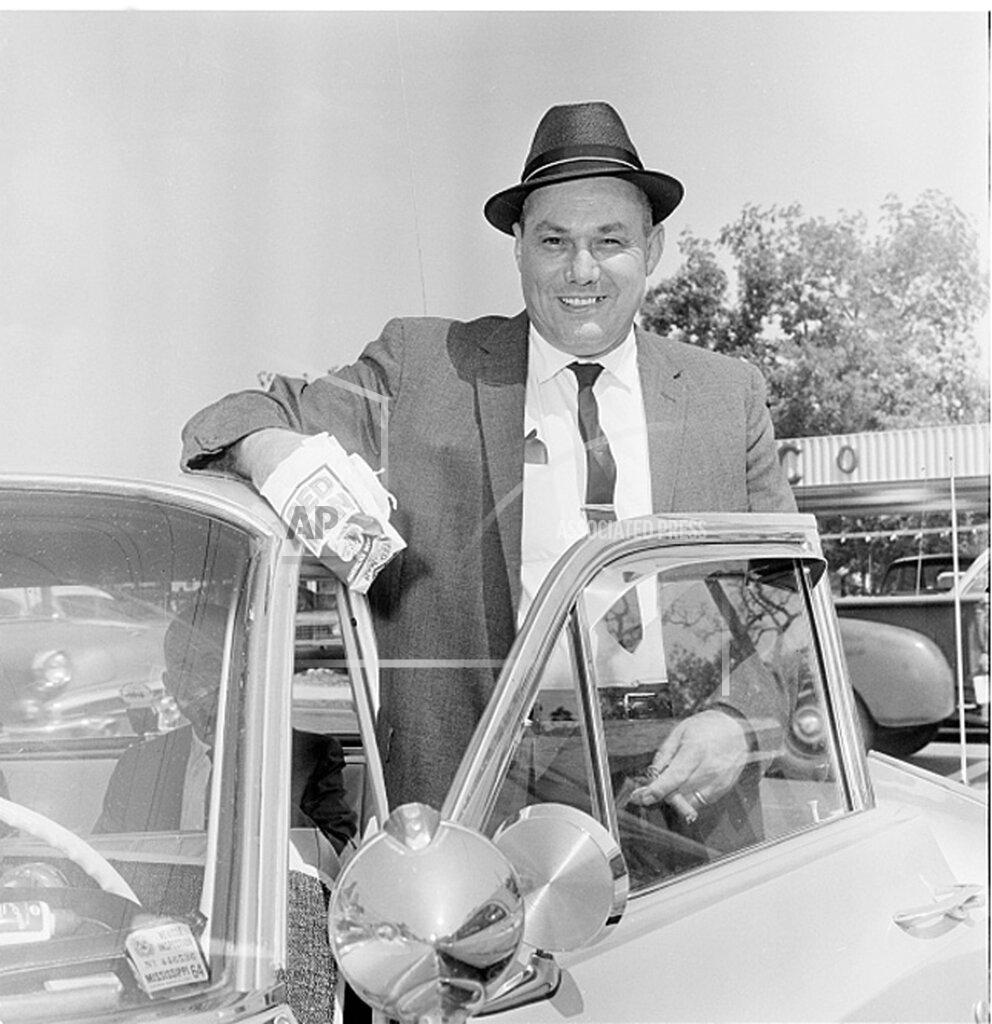
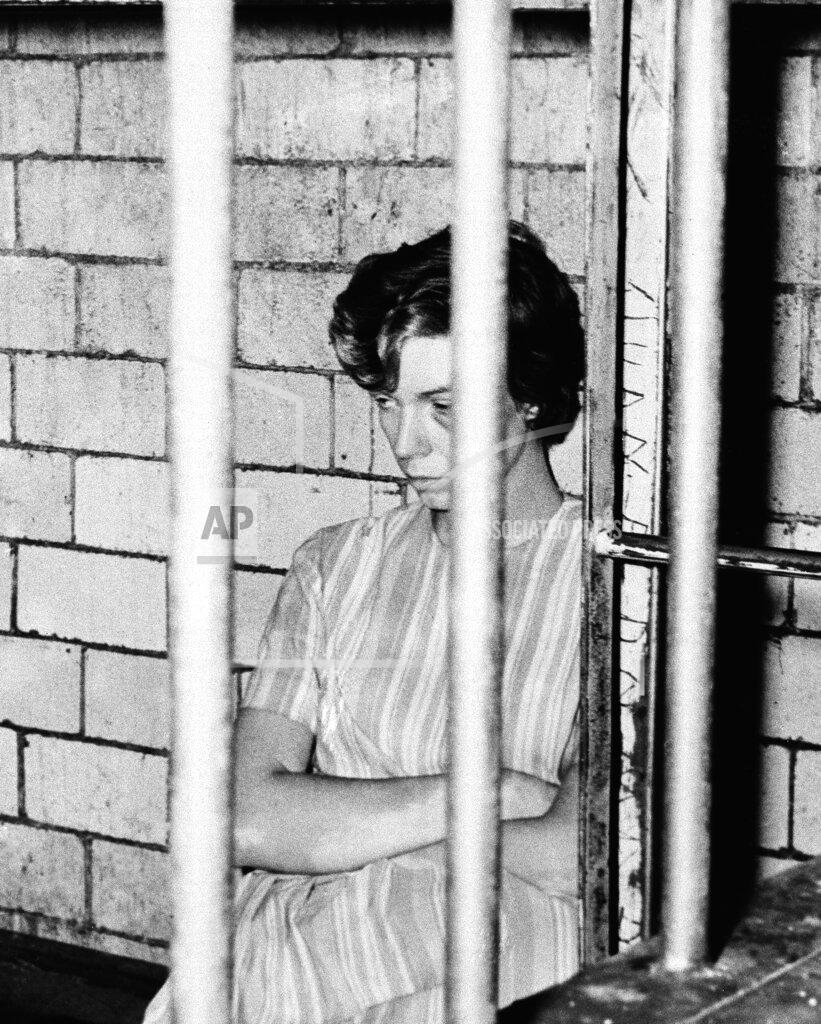
Sharon Kinne (born Sharon Elizabeth Hall, November 30, 1939), also known as Jeanette Pugliese and in Mexico as La Pistolera, is an American murderer and prison escapee who was convicted in Mexico for one murder and is suspected of two others in the United States, one for which she was acquitted at trial. As of 2024, Kinne is the subject of the longest currently outstanding arrest warrant for murder in the history of Kansas City, Missouri, and one of the longest outstanding felony warrants in U.S. history.
On March 19, 1960, Sharon’s husband, James Kinne, was found shot in the head. Sharon claimed that their two-year-old daughter, who had often been allowed to play with James’s guns, had accidentally shot him, and police were initially unable to disprove her story. Then, on May 27, the body of 23-year-old Patricia Jones, a local file clerk, was found by Sharon and a boyfriend in a secluded area. Investigators found that Jones had been the wife of another of Sharon’s boyfriends, and that Jones’s husband had tried to break off his affair with Sharon shortly before Jones went missing. When Sharon admitted to having been the last person to speak to Jones, she was charged with her murder and, upon further investigation of his death, that of James.
Sharon went to trial for Jones’s murder in June 1961 and was acquitted. A January 1962 trial on charges of murdering her husband ended in conviction and a sentence of life imprisonment, but the verdict was overturned because of procedural irregularities. The case went to a second trial, which ended within days in a mistrial. A third trial ended in a hung jury in July 1964. Sharon was released on bond following the third trial and subsequently traveled to Mexico before a scheduled fourth trial could be held in October 1964.
In Mexico, Sharon, claiming to have been acting in self-defense, killed a Mexican-born American citizen named Francisco Paredes Ordoñez, who was shot in the back. An employee of the hotel in which the shooting occurred, responding to the sound of gunshots, was also wounded but survived. Investigation into the shootings showed that Ordoñez was shot with the same weapon that killed Jones. Sharon was convicted in October 1965 of the Ordoñez killing and sentenced to ten years in prison, later lengthened to thirteen years after judicial review. She escaped from the prison during a blackout in December 1969. Despite extensive manhunts, Sharon Kinne’s whereabouts are unknown.

 History Diaries