
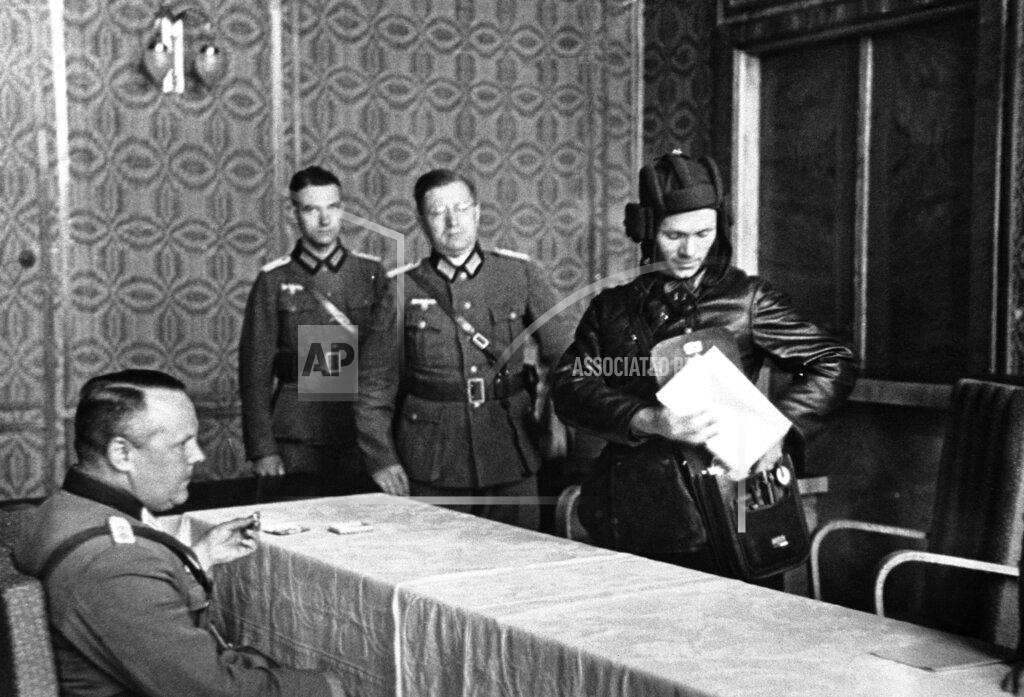
Army Kraków surrendered in the Battle of Tomaszów Lubelski. After a series of chaotic skirmishes, with number of killed and wounded growing, and ammunition shrinking, General Piskor decided to surrender. Some 11,000 Polish soldiers were captured, with small groups managing to hide in forests. Meanwhile, Operational Group “Boruta” (named after General Mieczysław Boruta-Spiechowicz), which was part of Army Kraków, separated from main Polish forces and marched towards Narol. Surrounded by Germans, Polish units were destroyed one by one. Some managed to reach the area of Rawa Ruska, where 3,000 soldiers surrendered on 20 September, ending this phase of the battle.
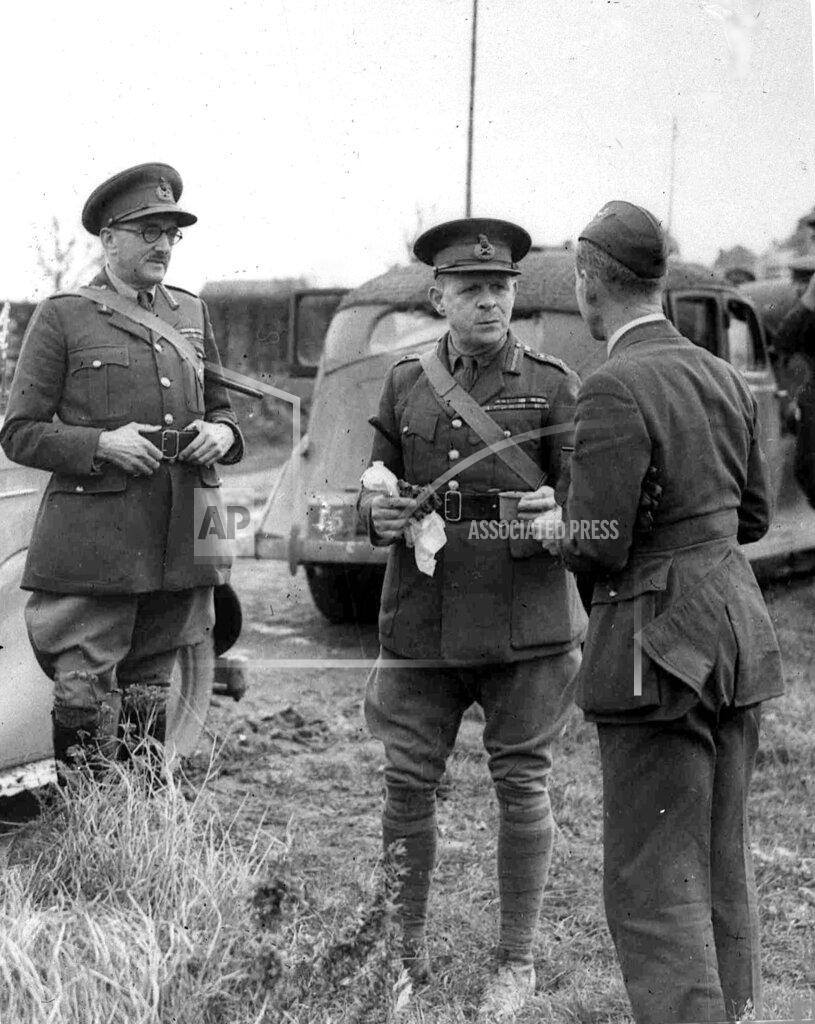
The second phase (also known as the Second Battle of Tomaszów Lubelski) involved Polish units from the so-called Northern Front — remaining elements of Army Lublin, Army Modlin and Operational Groups Wyszków, Narew and Nowogródzka Cavalry Brigade under generals Emil Krukowicz-Przedrzymirski and Stefan Dąb-Biernacki. On 20 September these forces were some 40 kilometers north of Tomaszów, in the area of Sitaniec. General Dąb-Biernacki, who commanded them, until the final hours had no idea about the ongoing battle and did not help fighting troops. At the same time, General Piskor did not know about Dąb-Biernacki’s units operating northeast of Tomaszów. Altogether, forces of Northern Front had 39,000 soldiers and 225 cannons. They were divided into three groups — Cavalry of General Władysław Anders, Operational Group of General Jan Kruszewski, and Operational Group of General Emil Krukowicz-Przedrzymirski. The Polish forces were no match for the German 10th Army and 14th Army, guarding the roads to the south, but General Dąb-Biernacki, at a meeting of his officers on 18 September in the village of Wereszcze Duże near Chełm, decided to go along with an attempt to break out to Hungary or Rumania. Dąb-Biernacki already knew that the Red Army had invaded Poland the day before, so time was of crucial importance.
The Northern Front forces marched southwards from the area of Chełm in two columns, towards Zamość, which Dąb-Biernacki decided to attack. On 18 September Poles attacked Krasnystaw, but failed to capture it. On next day, Dąb-Biernacki ordered the attack on Zamość to be carried out on 20 September but on the night of 19-20 September he found out about the ongoing battle of Tomaszów Lubelski and decided to help. Northern Front units headed towards Tomaszów, but on 20 September, in the evening, they were attacked by 4th Light Division and 27th Infantry Division near Cześniki. Meanwhile, units of Operational Group of General Emil Krukowicz-Przedrzymirski reached the area of Tomaszów, and on 21 September, a few hours the first phase of the battle had ended, attacked troops under command of General Ernst Busch (28th Jäger Division and 8th Jäger Division). Since Polish forces proved to be stronger than expected, Field Marshal Wilhelm List decided to send reinforcements to General Busch — 68th Infantry Division, 27th Infantry Division, and 2nd Panzer Division, which had just mopped Polish forces in the first phase of the battle of Tomaszów Lubelski.
In the evening of 22 September cavalry of General Władysław Anders attacked, capturing Krasnystaw, and then reaching Sambor. Other Polish units were not successful, and in several skirmishes were surrounded on 23 September. General Dąb-Biernacki ordered his officers to capitulate, escaped the encirclement, and left Poland, ending up in France. General Przedrzymirski refused to obey the order, and on 24 September attacked Krasnobród, but then was stopped by 8th Jager Division. Most of the remaining Polish forces capitulated around 26 September.
German General Johannes Blaskowitz notes in his order of the day that, at the Battle of the Bzura in Poland, also known as Battle of Kutno to the Germans, his troops were fighting “in one of the biggest and most destructive battles of all times.” Elsewhere, German troops withdrew to the agreed demarcation line in Poland, with Soviet forces moving in behind them. Finally, also on this day, the remaining Polish garrison in Grodno manages to kill 800 Soviet troops and destroy at least 10 tanks.
The Soviet Russian high command reported tonight that its troops, driving through Poland, had occupied Grodno, about sixty miles from the East Prussian border.
There was considerable diplomatic activity in Moscow today. The French Charge d’Affaires, Jean Payart, called this morning on Premier Vyacheslaff Molotoff to request on behalf of his government an explanation concerning the Soviet Union’s action in invading Poland.
The Rumanian Government announced today that Marshal Edward Smigly-Rydz, chief of Poland’s scattered military forces, would be interned in Rumania for the duration of the European war, despite appeals from Great Britain and France.
The Pope has given instructions to his Nuncio in Berlin to ask the Reich not to extend the anti-religious measures enforced in Germany to the conquered Polish regions, it was learned today.
Nazis execute a 71-year-old farmer for setting his grain on fire.
Britain rations fuel; consumers get 75 percent of last year’s supply.
Whole populations are being moved from war zones in France.
Critics of Prime Minister Neville Chamberlain decry inadequate support to Poland.
Refugees swarm to neutral land; thousands pour from Poland to Hungary and Romania for safety.
Britain and France vow to keep fighting in response to recent peace offerings by Hitler. They declare that the Allies “will not permit a Hitler victory to condemn the world to slavery and to ruin all moral values and destroy liberty.”
RAF and Luftwaffe aircraft engage in battle for the first time when a flight of German Me109 fighters attacks three Fairey Battle light bombers being used for reconnaissance over the Siegfried Line near Aachen, Germany. Two of the Fairey Battles are shot down. Sergeant F. Letchard claims the first RAF victory of the war after shooting down one of the Messerschmitt Me 109s.
Berlin announces the arrival of Colonel General Walther von Brauchitsch, Commander-in-Chief of the Wehrmacht, at the western front and the transfer of many divisions from Poland to the Westwall.
The Kriegsmarine (German Navy) Type VIIA U-boat U-27, commanded by Johannes Franz, is sunk west of Scotland (58°35′N 9°02′W) by depth charges from the destroyers HMS Fortune (H 70) and HMS Forester (H 74).
The destroyers HMS Fortune and HMS Faulknor (who sank U-39 six days earlier), had been part of a concerted effort to find and sink the U-Boat that had been attacking trawlers. On 20 September 1939, three torpedoes were fired at the warships, but failed to do any damage when they exploded prematurely. The British vessels replied with a series of depth charge attacks, one of which damaged the German submarine sufficiently to force it to the surface. Fortune’s ramming attack was curtailed when it became apparent that the U-Boat was surrendering.[7] All 38 crewmen survived and were taken prisoner.[2] U-27 became the second German submarine to be sunk in World War II after U-39 was sunk on 14 September 1939.
At 18.52 hours, the Kingfisher-class patrol vessel HMS Kittiwake (Cdr. E.R. Conder, RN) is damaged by a British mine in the defensive barrage between Goodwins and Ruytingen in the Strait of Dover, 2 nautical miles east of South Goodwin Light vessel. Five ratings (British sailors) are lost. The commander is blown off the bridge and is rescued by a trawler. 39 crewmen are taken off by HMS Harrier, which tows the vessel to Dover. On 7 October, she will be towed by the British steam tugs Gondia and Simla to Sheerness where the ship will remain under repair until January, 1941.
U.S. freighters Ethan Allen and Ipswich are detained by British authorities.
Squadron 40-T departs Villefranche, France; flagship, light cruiser Trenton (CL-11) (Rear Admiral Charles E. Courtney) and destroyer Jacob Jones (DD-130) head for Lisbon, Portugal; destroyer Badger (DD-126) for Marseilles, France.
The War at Sea, Wednesday, 20 September (naval-history.net)
Northern Patrol – light cruiser HMS Emerald departed Scapa Flow on Northern Patrol duties and arrived back on the 28th.
A/S operations, northern waters – after U-35 sank British trawlers off the Butt of Lewis on the 18th, a submarine hunt began on the 19th. Destroyers HMS Somali, HMS Matabele, HMS Punjabi, HMS Tartar, and HMS Eskimo of the 6th Flotilla and HMS Faulknor, HMS Fortune, HMS Fearless, HMS Firedrake, HMS Fury, and HMS Forester of the 8th Flotilla departed Loch Ewe on the 19th for the hunt. Two of these destroyers were employed on Fair Isle Channel patrol and the other two divisions of destroyers were off the Butt of Lewis.
Fame unsuccessfully attacked German Type VIIA U-boat U-27 at 0100/20th, 10 miles WNW of Fair Isle. HMS Fortune and HMS Forester then sank U-27 at 0342 off the Butt of Lewis in 58 35N, 09 02E. HMS Fortune, which was able to retrieve secret documents from the submarine before the submarine sank, HMS Faulknor, and HMS Fury rescued the entire crew of four officers and 34 ratings which were transferred to HMS Fearless.
HMS Faulknor attacked another contact at 1112/20th, 20 miles NW of the Butt of Lewis.
Home Fleet – battleships HMS Nelson and HMS Rodney, battlecruisers HMS Hood and HMS Repulse, aircraft carrier HMS Ark Royal, and destroyers HMS Firedrake, HMS Fortune, HMS Tartar, and HMS Punjabi departed Loch Ewe at 1915/20th. Destroyers HMS Faulknor, HMS Foxhound, HMS Fury, HMS Fearless, HMS Forester, and HMS Foresight departed Scapa Flow on the 20th and joined the arriving force.
HMS Foxhound had problems with her depth charge thrower during the U-27 hunt and arrived at Scapa Flow on the 20th. The defects were repaired alongside light cruiser HMS Aurora.
HMS Firedrake attacked a submarine contact at 0945/21st, 312° from Dunnet Head, assisted by destroyer HMS Fortune.
The fleet, joined at sea by destroyers HMS Matabele, HMS Mashona, HMS Eskimo, and HMS Bedouin, arrived at Scapa Flow for refueling on the 21st. Destroyers HMS Fame and HMS Somali also arrived at Scapa Flow on the 21st.
British northern waters – destroyers HMS Forester, HMS Fury, HMS Faulknor, and HMS Mashona departed Scapa Flow on patrol.
British west coast – two Anson bombers attacked a submarine off Lundy Island. Destroyers HMS Wolverine, HMS Witherington, HMS Volunteer, and HMS Verity departed Milford Haven at 0055/21st to hunt for the submarine.
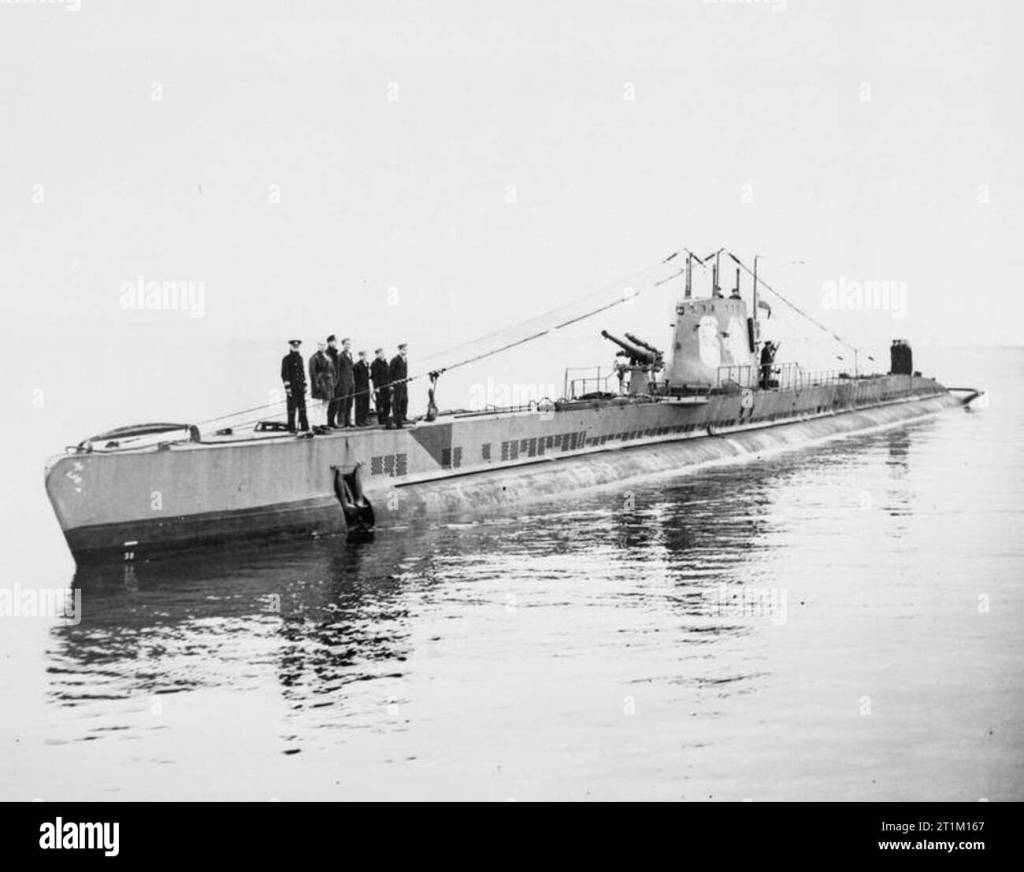
British east coast – Polish submarine ORP Wilk arrived at Rosyth from the Baltic, then departed for Scapa Flow on the 21st, escorted by destroyer HMS Sturdy.
Convoy FS.8 departed Methil, and arrived at Southend on the 22nd.
Convoy FN.8 departed Southend, arrived at Methil on the 22nd.
North Sea – submarines HMS Starfish and HMS Sturgeon were withdrawn from patrol areas off the Norwegian coast allocated at the outset of the war to RAF Coastal Command. Aircraft now took over the patrol, starting with Hudson bombers on the 18th. Submarines HMS Seahorse and HMS Triton remained on patrol off the Norwegian coast to intercept German merchant ships. The submarines were then deployed in the Heligoland Bight, off Jutland, and in the Skagerrak.
English Channel – aircraft carrier HMS Hermes departed Plymouth with destroyer HMS Kelly on aircraft flying exercises. After the exercises, Hermes returned to Plymouth and Kelly went on to Portland to join destroyer HMS Kingston which was working up.
Light cruiser HMS Caradoc departed Plymouth on escort duties and arrived back on the 21st.
UK-France convoys – BC.2 of steamers City of Pretoria and Harmattan departed the Loire escorted by destroyers HMS Montrose and HMS Wakeful, and safely arrived in Bristol Channel on the 22nd.
DB.5 departed Southampton with three personnel ships, escorted by destroyers HMS Vansittart and HMS Scimitar, and arrived at Brest on the 21st.
Southwestern approaches – British aircraft attacked a submarine contact 40 miles WSW of the Scillies. Destroyer HMS Ilex was sent to investigate, but did not regain the contact.
Mediterranean – light cruisers HMS Arethusa and HMS Penelope departed Alexandria for patrol south of the Otranto Straits. They refueled at Malta on the 25th/26th, sailed on the 27th and patrolled Kithera Channel. They arrived back at Alexandria on the 30th.
Convoy Blue 2 departed Port Said with 10 merchant ships. Destroyers HMS Greyhound and HMS Glowworm and sloops HMS Fleetwood and HMS Aberdeen escorted the convoy from the 20th to 30th, and were joined by French destroyer Trombe and torpedo boat Pomone from the 26th to 29th.The convoy arrived at Gibraltar on the 30th.
Central and South Atlantic – convoy SLF.1 was escorted by light cruiser HMS Neptune, departing Freetown on the 20th. The cruiser was detached on the 23rd and proceeded to Dakar. The convoy arrived at Liverpool on the 28th.
Heavy cruiser HMS Exeter departed Montevideo to patrol off Rio de Janiero.
Indian Ocean – aircraft carrier HMS Eagle departed Colombo for a week of raider hunting in the Indian Ocean.
President Roosevelt wall lay before Congress in special session tomorrow the important question of how to keep the United States clear of the new European war. In so doing he is expected to recommend repeal of the existing arms embargo as one of the means to that end. The President is scheduled to address a joint session in the House chamber at 2 PM (EST). That he would ask at least for repeal of the controversial embargo, which he was compelled under the law to apply against England, France, Poland and Germany at the outbreak of the war, was the consensus of the fourteen Democratic and Republican leaders who met with him and Secretary Hull in a “national unity conference” today.
These leaders discouraged the President, however, from going the whole way and asking for repeal of the entire Neutrality Act and a return to the processes of international law. They told him in effect that although in their opinion Congress would weather the flood of adverse mail and telegrams pouring today upon Capitol Hill, and consent to repeal of the arms embargo, it would insist upon substitution of cash-and-carry restrictions on sale, and transportation of goods to belligerents, or some other form of mandatory neutrality law.
It was tacitly agreed among the Congressional leaders present, therefore that the neutrality problem would be met on the issue of swapping a cash-and-carry plan for the present rigid arms prohibition. Senator Pittman, chairman of the Foreign Relations Committee, announced immediately that he would call the committee to meet Friday to consider the question. He said further that he would ask that the Bloom Neutrality Bill, already passed by the House, be made the vehicle for the new plan.
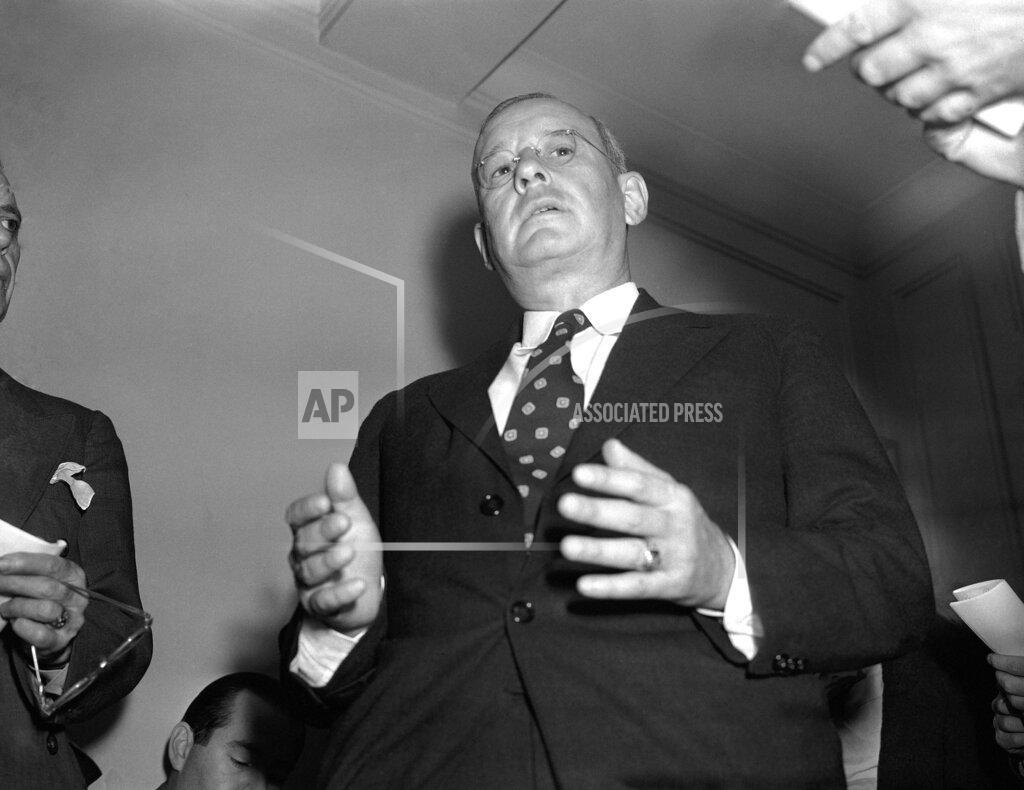
The White House conferees, including leaders of both major parties in the Senate and the House, and Alfred M. Landon and Colonel Frank Knox, Republican candidates. for President and Vice President in 1936, agreed with Mr. Roosevelt that, in dealing with the whole neutrality question, partisanship should be adjourned in “Congressional and Executive action.” Mr. Landon demanded, however, that Congress be kept in session for the duration of the “limited” emergency proclaimed by the President. “I feel that the judgment of two departments of the government is better than that of a single branch or a single individual,” Mr. Landon said.
Others attending the “unity conference” were Vice President Garner, Speaker Bankhead, Senators Barkley and McNary, the majority and minority leaders of the Senate; Chairman Pittman of the Senate Foreign Relations Committee; Representative Bloom, chairman of the House Foreign Affairs Committee; Senators Minton, Democrat of Indiana, and Austin, Republican of Vermont, the assistant leaders; Representatives Rayburn of Texas and Martin of Massachusetts, the majority and minority leaders of the House; Senator Byrnes, Democrat of South Carolina. and Representative Mapes of Michigan, ranking Republican member of the Rules Committee.
The problem of how to keep House pressure groups under control during the Administration’s attempt in the Senate to revise the Neutrality Act beset leaders tonight as they awaited the opening of the special session.
Henry Ford, avowed opponent of war, said today that he was opposed to “any tampering with the Neutrality Act” and that “only the makers of war munitions profit financially from the human misery entailed in warfare.”
A new poll finds that only 24.7% of Americans support a total and complete neutrality embargo.
The new Cunard White Star liner Mauretania slid unexpectedly into New York Harbor yesterday afternoon, bearing 698 passengers who, although they escaped the horrors of war in Europe, had a suggestion of it at sea when the liner’s gun crew practiced with the ship’s defensive equipment during the speedy crossing.
An economist for the Federal Reserve Bank finds banks healthier and attributes that to less competition and stress.
Job placements rise as 43 percent more youth were placed in private jobs in 1939 than in 1938.
The special House committee to investigate the National Labor Relations Board has mailed at least 60,000 questionnaires to employers and union organizations as its first definite move toward its objective.
The conflict between the A.F. of L. and the C.I.O. is causing a growing feeling of public hostility toward labor, Matthew Wolt, third vice president of the American Federation of Labor, said here today, adding that “unless there is an end of this conflict there may be an end of the labor movement.”
Tropical weather strikes southern California. Temperatures in California reach 100 for the fifth day in a row, while rain and lightning add to the discomfort of residents. In Castaic, the temperature reaaches 112.
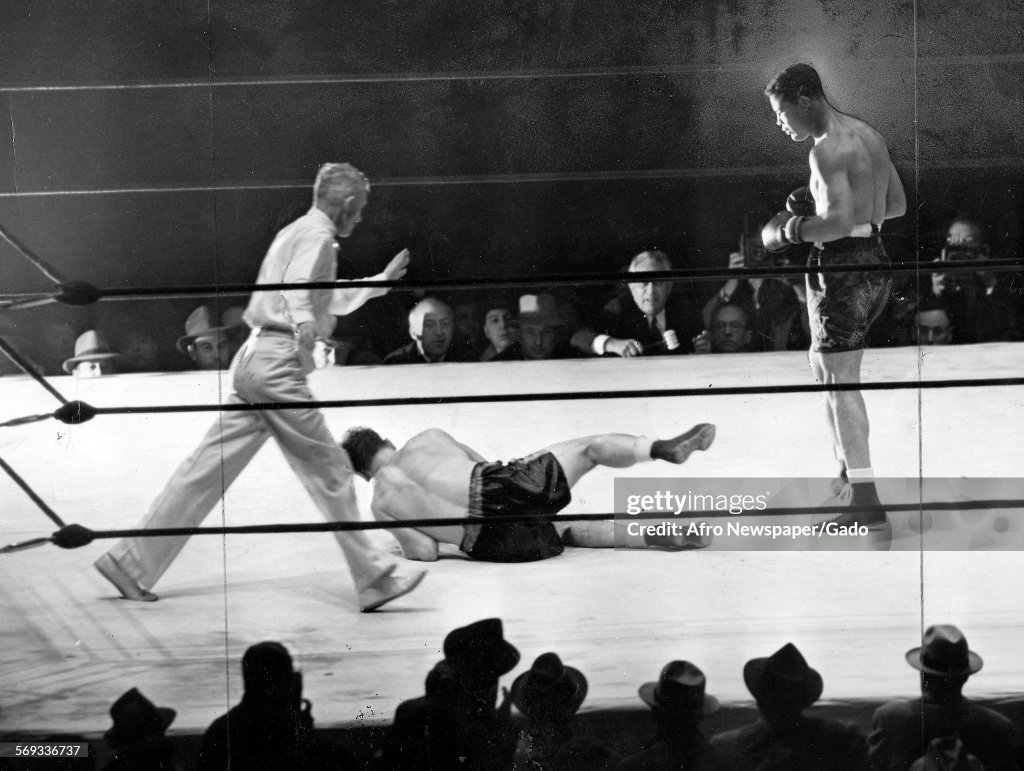
Joe Louis retained the world heavyweight boxing title with an 11th-round knockout of Bob Pastor at Briggs Stadium in Detroit. Joe Louis puts Bob Pastor down 5 times before an 11th round KO in his 8th heavyweight boxing title defense. The thundering fists of Joe Louis claimed Bob Pastor as a victim tonight in Briggs Stadium, ending a gallant but futile bid for the world heavyweight title that was witnessed by 33,868 thrilled boxing fans from all over the country.
At Boston, the Browns score 3 runs in the 16th off Fritz Oestermueller and outlast the Red Sox, 11–8. Fritz shuts out the Browns for 7 innings before allowing the winning runs. Bob Harris is the winner, pitching 9 innings of relief and allowing 2 runs. Ted Williams hits his 29th homer and is walked 4 times, while Lou Finney has 4 hits and 4 RBIs for Boston. Myril Hoag, George McQuinn and Joe Gallagher each have 4 hits for the Brownies.
Steve Sundra’s unheralded pitching exploits of 1939 gained another notch in magnitude yesterday as the strapping New York Yankee right-hander turned back the Chicago White Sox at Yankee Stadium, 8–4, to record his eleventh victory of the year against which there has yet to be charged a defeat.
The Philadelphia A’s came from behind today to defeat the Detroit Tigers in thirteen innings, 5–4. Detroit scored two in the top of the 12th, but the A’s managed to tie it and won it in the following frame.
The Cleveland Indians used the Senators as a stepping stone to undisputed possession of third place today, beating the Washington Senators, 7–2, behind the six-hit pitching of Mel Harder. Joe Krakauskas, who started for the Senators, failed to retire a batter, being blasted for five runs in the first inning before Manager Bucky Harris rushed Joe Haynes to the rescue. Haynes yielded two runs on as many hits in five innings.
Helped by a break when he was hit in the back by a pitched ball, Bucky Walters won his twenty-sixth hurling victory of the year and gave the Cincinnati Reds a ninth-inning 3–2 triumph over the Philadelphia Phillies today.
The Cards were stacked against the Brooklyn Dodgers again today, the Gas House experts of St. Louis dealing them a second straight defeat, 10–4. Bob Bowman won his thirteenth for the Cardnals. St. Loouis scored four int he sixth to reak a 1–1 tie, then added five more in the eighth to put it out of reach.
With only two full days of rest since he beat the Cardinals, Carl Hubbell hurled the New York Giants to a 4–2 victory over the Chicago Cubs today for his tenth triumph of the season. Both Cubs runs were unearned. The Giants got ten hits off Bil Lee, who took the loss, including Billy Jurges’ triple.
In a move designed to put an end to the recent acute differences between the Szechwan militarists Generalissimo Chiang Kai-shek himself has assumed the chairmanship of the Szechwan Provincial Government, replacing General Wang Chang-shu.
Japan’s truce with Soviet Russia on Mongolian-Manchukuoan frontier was entirely unconnected with European or American events, but stands alone, according to a statement issued today by Kensuke Horinouchi, the Japanese Ambassador to the United States. Japan’s policy, according to the statement, was to avoid entanglement in the European war and concentrate on a settlement of the “China affair.” The truce, it was added, was not preliminary to a non-aggression pact, or to a closer association of Russia and Japan, nor was it consummated by the good offices of Germany. The statement was read by the Ambassador at a press conference and obviously was intended to reassure American public opinion. It was issued, Mr. Horinouchi said, on his own initiative in view of reports that have been circulated concerning the truce. The statement was as follows:
“The Japanese Embassy wishes to make the following statement concerning the Soviet-Japanese agreement for the cessation of hostilities in the Nomonhan area along the Outer Mongolia-Manchukuo frontier, which was announced on September 16:
“With regard to the present war in Europe, the Japanese Government has already enunciated its policy, which is to avoid involvement in that conflict and to concentrate its efforts on the settlement of the China affair.
“Japan’s agreement to the cessation of hostilities and to the negotiations for delimitation of the Outer Mongolia-Manchukuo frontier was solely prompted by the above basic policy of the Japanese Government.
“It is grossly misleading to attach any deeper significance to this agreement for cessation of local fighting. There is no reason to regard it as preliminary to a non-aggression pact or to any move toward a close association of Soviet Russia and Japan. It is further to be stated that there is no foundation whatsoever for the rumor that the agreement was consummated by the good offices of Germany.”
Dow Jones Industrial Average: 152.25 (+0.11).
Born:
Bill Thornton, NFL fullback (St. Louis Cardinals), in Toledo, Ohio (d. 2008).
Died:
Paul Bruchési, 83, French Canadian Catholic archbishop of Montreal.
Naval Construction:
The Royal Navy Flower-class corvette HMS Gardenia (K 99) is laid down by William Simons & Co. Ltd. (Renfrew, Scotland).
The Kriegsmarine (German Navy) Type IXB U-boat U-64 is launched by AG Weser, Bremen (werk 952).
The Kriegsmarine (German Navy) vorpostenboot V 408 Haltenbank is commissioned.
The Kriegsmarine (German Navy) U-boat UA is commissioned. Her first commanding officer is Kapitänleutnant Hans Cohausz. Built at Kiel as one of four submarines of the Ay-class for Turkey, Batiray as she was to have been named, was not handed over to the Turkish Navy, being seized by Germany and commissioned into the Kriegsmarine.
The Kriegsmarine (German Navy) Admiral Hipper-class heavy cruiser Blücher is commissioned. Her first and only commanding officer is Captain Heinrich Woldag.
 History Diaries