This miserable little shitling has torn Europe apart, with Stalin’s eager help, and begun his war of extermination and slavery against the Jews, Poles, and Slavs.
The Battle of Wilno ended with the Soviet capture of the city. By the end of the previous day the Soviets had secured the airfield and made several thrusts into the city, taking the Rasos Cemetery. By the morning of 19 September, the advanced Soviet armoured units had been reinforced with infantry and cavalry. The Polish defenders delayed the Soviet advance, particularly by holding the bridges, but later that day the poorly coordinated Polish defense collapsed and the Soviets took control of the city. Polish units had either surrendered or withdrawn, disorganized, towards the Lithuanian border or deeper into Poland. The Soviets transferred the city to Lithuania according to the Soviet–Lithuanian Mutual Assistance Treaty. Lithuanian troops entered the city on 27–28 October.
The Battles of the Bzura and Kępa Oksywska ended in German victories. The Battle of the Bzura effectively ends with the surrender of the Polish Posnan and Pomorze Armies west of Warsaw, at the bend of the Vistula River, German troops imprison 170,000 Polish troops as they surrender. Yesterday morning, the Germans had started their drive towards the south along both banks of the Bzura and were supported by more than 300 aircraft and heavy artillery. German howitzers, taking advantage of their position on the high ground of the Vistula’s right bank, shelled Polish positions for the entire day. After two days of heavy fighting, with no ammunition or food rations remaining, further attempts at a breakout for the Poles became impossible.
Only a few Polish units managed to break out of the encirclement. The groups crossed the Kampinos Forest and fought German units in the area (such as at the Battle of Wólka Węglowa), then entered Warsaw and Modlin, mostly around 19 and 20 September. Among them were Generals Kutrzeba, Knoll-Kowacki and Tokarzewski, two cavalry brigades (Wielkopolska and Podolska) of General Abraham and the 15th and 25th Infantry Divisions. The remainder (4th, 14th, 17th, 26th and 27th Infantry Divisions), which did not manage to cross the river, surrendered with General Bortnowski between 18 and 22 September. Polish casualties were estimated at 20,000 dead, including three generals: Franciszek Wład, Stanisław Grzmot-Skotnicki and Mikołaj Bołtuć. German casualties are estimated at 8,000 dead.
The Battle of Kępa Oksywska took place in the Oksywie Heights outside the Polish city of Gdynia between 10 and 19 September 1939. The battle, fought by the Polish Army and the German Wehrmacht, was part of the Polish September Campaign during World War II. It was one of the bloodiest battles of the campaign, with Polish KIA losses reaching roughly 14% of all the forces engaged. In order to spare the city from destruction in the event likely urban combat, on 12 September, Pułkownik (Colonel) Stanisław Dąbek ordered all of his forces to withdraw to Oksywie Heights to the northeast of the town, thus abandoning Gdynia. Until 14 September all Polish forces, by then reduced to roughly 9,000 servicemen, gradually withdrew to the area, along with up to 140 HMGs, 14 mortars, 23 pieces of artillery and a large number of civilian refugees. Massed in an area no greater than 4 square kilometers, the Poles were able to inflict heavy losses on the numerically and technically superior enemy. Until 19 September there were no less than 110 skirmishes fought in an area of less than 4 square kilometres.
However, constant aerial bombardment and lack of supplies and reinforcements finally forced Colonel Dąbek to order a cease-fire on 19 September. By then the Polish casualties amounted to roughly 2,000 dead and 7,000 wounded, and there were hardly any unwounded soldiers. Colonel Dąbek then committed suicide.
The Red Army joined the Battle of Lwów. In the early morning of September 19, the first Soviet armoured units reached the eastern outskirts of the city and the suburb of Łyczaków. After a short fight, the Soviet units were pushed back. However, the Soviet forces completed the encirclement of the city overnight and linked with the German army besieging Lwów from the west.
The Polish defences were composed mainly of field fortifications and barricades constructed by the local residents under supervision of military engineers. Sikorski ordered organised defence of the outer city rim, with in-depth defences prepared. In the morning of September 19, the first Soviet envoys arrived and began negotiations with the Polish officers. Colonel Ivanov, the commander of a tank brigade, told Colonel Bronisław Rakowski that the Red Army entered Poland to help it fight the Germans and that the top priority for his units was to enter the city.
The same day, Schörner sent his envoy and demanded the city be surrendered to his troops. When the Polish envoy replied that he had no intention of signing such a document, he was informed that a general assault was ordered for September 21 and that the city would most surely be taken. Hitler’s evacuation order from September 20 instructed Gerd von Rundstedt to leave the capture of Lwow to the Soviets. The attack planned by XVIII Corps for 21 September was cancelled, and the German corps prepared to move to the west of the Vistula-San River line. The following day, Sikorski decided that the situation of his forces was hopeless. The reserves, human resources and materiel were plentiful, but further defence of the city would be fruitless and result only in more civilian casualties. He decided to start surrender talks with the Red Army.
The Battle of Wólka Węglowa was fought, resulting in Polish tactical victory. The battle of Wólka Węglowa was a cavalry battle, as Polish Uhlan cavalry (14th Regiment of Jazlowiec Uhlans of Podolska Cavalry Brigade and elements of the 9th Regiment of Lesser Poland Uhlans) retreating towards Warsaw encountered German units. The commanding officer of the 14th Regiment, Pułkownik (Colonel) Edward Godlewski ordered a cavalry charge. German infantry was taken by surprise, but machine guns and tanks hidden nearby opened fire on the cavalry. Eventually Polish units broke through towards Warsaw, as intended, but at the cost of heavy losses (105 killed, 100 wounded – about 20% of their initial strength).
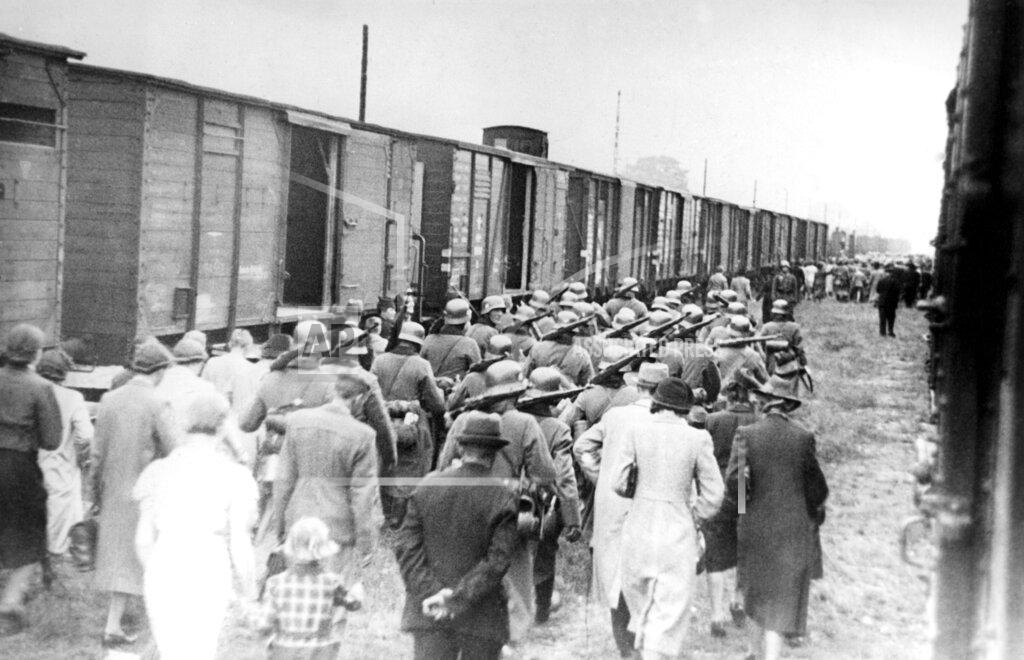
Heer (German regular army) troops murder 100 Jews in Lukov, Poland.
On entering Plonsk, the Germans plundered a number of Jewish stores – the pharmacy of Hirsch Nanas and two jewelry stores belonging to Szeprling and Grünbaum – and a few days later began to abuse and humiliate the city’s Jews. On 19 September 1939, the Germans brought all the Jewish men aged 16 and over to the prison courtyard and registered their names. The registration process was accompanied by brutal beatings, recorded by German photographers. Gestapo men came from Płock and took 17 Jews and some 40 Poles hostage, among them Mayor Pioterkowski, the regional doctor, teachers and priests. All but one were shot.
The Heer asks the SS organization to hold off the rounding up and mass murder of Polish Jews until December 1939 when the Army would be out of the area.
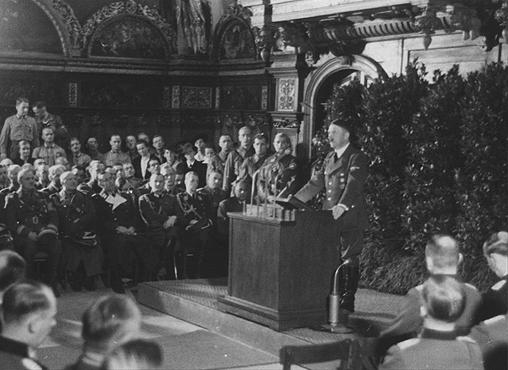
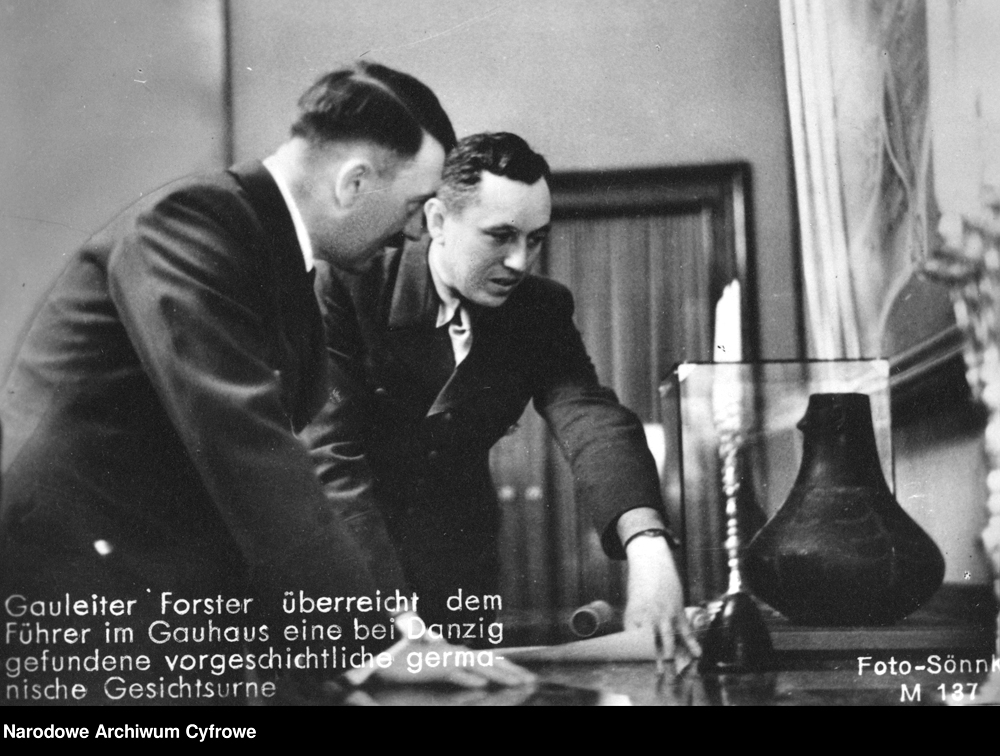
German Chancellor Adolf Hitler makes a triumphal entry into Danzig and gives a foreign policy speech that makes a general peace offer on the basis of Germany’s territorial gains, warning that otherwise the war would be fully prosecuted. He also refers to “weapons with which we ourselves cannot be attacked”, which leads to speculation that Germany is developing secret weapons. Hitler entered the former Free City of Danzig and gave a speech denouncing the Polish government and warning England that Germany would never capitulate even if the war lasted years.
Having crushed Poland and partitioned that country between National Socialist Germany and Bolshevist Russia, Chancellor Adolf Hitler today launched his long expected “peace offensive,” outlining his war aims. He spoke for an hour and a quarter in a festively decorated, brightly illuminated Danzig, which he entered today thunderously acclaimed as a “liberator.” Even the usual blackout has been waived for his visit, although the guns that Danzig’s “liberation” had loosed could still be heard in the region of Gdynia, where a few “death battalions” of Poles were making a last desperate stand.
It was a speech full of pride at Germany’s military achievements of the past nineteen days and full of menace for any who dared turn down his peace offer. But, although he asserted that “this Germany will not capitulate,” no matter how many years the war may last, and that he would retaliate for every attack with the same method, he made no claim that Germany was able or wanted to deal with France and Great Britain as she had with Poland. On the contrary, Herr Hitler reemphasized his attempt to win the friendship of both France and Britain. He then outlined the terms on which these efforts could be renewed. These terms, which he also laid down as his peace terms, are:
- The fate of Poland, “which will never rise again in a second Versailles,” is to be decided by Germany and Russia within whose spheres of influence it lies.
- Germany has accepted her western border, despite heavy sacrifices, and has no war aims against either France or Britain.
Any implication that Germany had any further war aims, he denounced as lies. Whether these terms, involving as they do, surrender of the proclaimed French and British war aims, are merely designed as a break for actual peace negotiations or a new mediation effort before the war in the West has become general or merely as a propagandistic device to weaken the Allies” will to fight is still not clear. But the political purpose of the speech in launching a peace offensive is also emphasized in German official quarters, and it is pointed out that, except for Poland, Herr Hitler did not make any new demands, not even for colonies. And he expressed how frightful and futile this war was.
As for the Allies’ charges that they could not have any confidence in the words of a German statesman, he replied that Germany in return had no confidence in the words of those who broke their promises at Versailles. Poland, Herr Hitler said, was a product of the stupidity of Versailles and was dominated by “a thin, tubercular class,” which suppressed both the Germans in Poland and its own people.
The bombardment of Warsaw by the Germans continues.
While flying a reconnaissance mission in a unarmed Polish aircraft, Josef Frantisek attacks advancing German columns by throwing hand grenades from the cockpit near Kamionka Strumilowa, Poland (now Kamianka-Buzka, Ukraine).
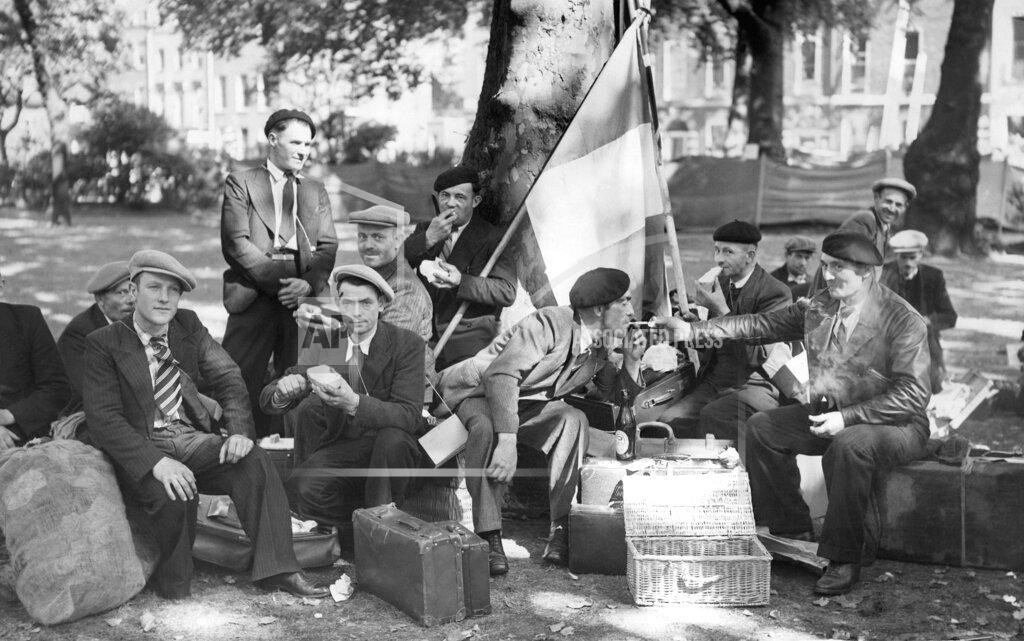
A second, bigger and more destitute wave of Polish refugees reached Cernauti, Rumania during the night and this morning.
The construction of the German aircraft carrier Graf Zeppelin is halted temporarily as Erich Raeder and Hermann Göring compete for resources.
A Baltic move by the Soviets is predicted. The Soviet wish for a port is thought to be behind the action of the Soviet fleet.
A Vatican City paper fears Soviet designs on Europe.
The Soviet Union blockades the harbor of Tallinn, the capital of Estonia. This action is supposedly taken in response to the escape of a Polish submarine from the harbor.
The Marynarka Wojenna (Polish Navy) Kraków-class river monitor ORP Wilno was scuttled near Osabowicze to avoid capture.
The Marynarka Wojenna (Polish Navy) Zaradna-class gunboat ORP Zaradna was scuttled on the Strumen River to avoid capture. She was raised, repaired and put into Soviet service as Beloruss.
The Marynarka Wojenna (Polish Navy) Zuchwała-class gunboat ORP Zawzięta was scuttled on the Strumen River to avoid capture. She was raised, repaired and put in Soviet service as Trudovoy.
U-30 puts a wounded man ashore in Reykjavik, Iceland.
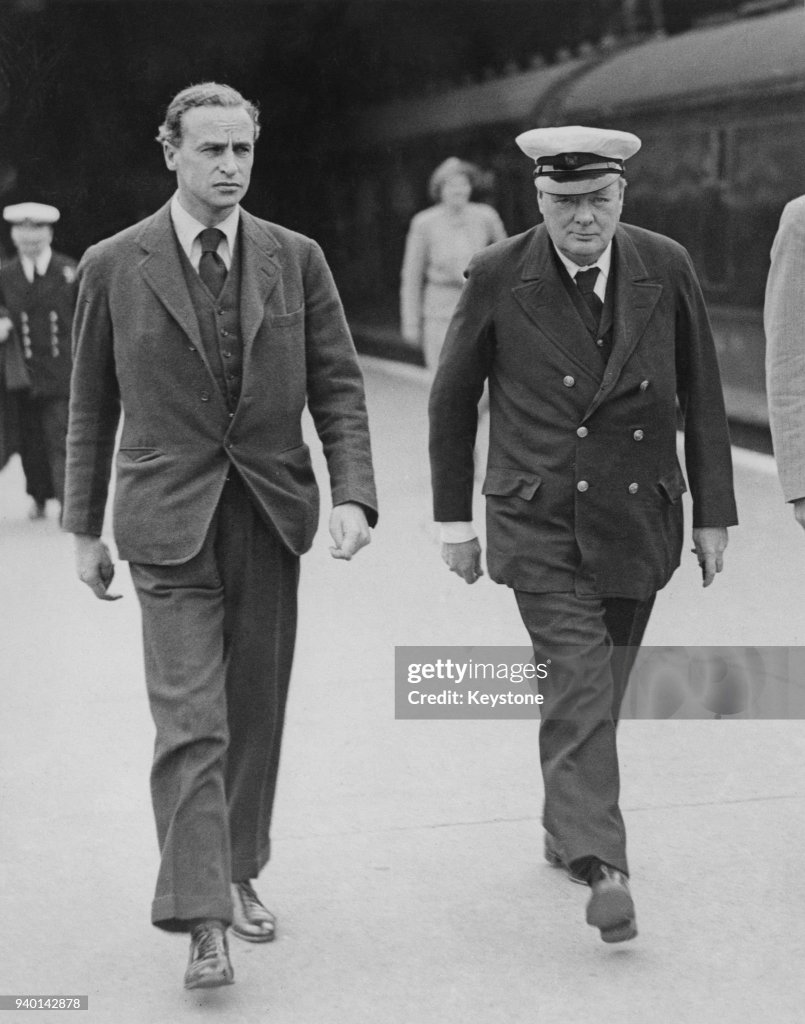
Commander of the British Expeditionary Force Lord Gort arrives in France.
Queen Wilhelmina said today in her Speech From the Throne opening the Dutch Parliament that the military mobilization had bean prompted only by this country’s desire to maintain the strictest neutrality.
Negotiations for the recognition of Soviet Russia by Yugoslavia and the conclusion of a non-aggression pact were reliably reported under way tonight.
The War at Sea, Tuesday, 19 September (naval-history.net)
Western Atlantic – in response to a submarine report in Neutrality Area l off Nova Scotia, American destroyer USS Leary (DD-158) (LCDR E Watts) departed Boston to search for the supposed German submarine. After several hours of unsuccessful search, Leary returned to Boston on the 20th.
Convoy HXF.1 departed Halifax at 1400 escorted by Canadian destroyers HMCS Fraser and HMCS Saguenay, with cover provided by heavy cruisers HMS Berwick and HMS York on the 19th and 20th. In the Western Approaches, the convoy was escorted on the 27th to 29th by destroyer HMS Amazon, which had escorted OA.9. Convoy HXF.1 arrived at Liverpool on the 29th.
Convoy KJ.1 departed HMS Kingston escorted by light cruiser HMS Orion from the 19th to 22nd. In Home Waters, the convoy was escorted by destroyer HMS Vivacious from 10th to 11th October, when the convoy arrived.
British northern waters – destroyers HMS Foresight and HMS Fame departed Scapa Flow on patrol.
Destroyers HMS Fortune, HMS Eskimo, HMS Tartar, and HMS Punjabi departed Loch Ewe on patrol.
British east coast – destroyer HMS Wanderer attacked a submarine contact off Flamborough.
Destroyer HMS Wallace attacked a submarine contact 10 miles east of Cromer Knoll.
English Channel – destroyer HMS Vanoc attacked a submarine contact 15 miles SW of Eddystone.
UK-out convoys – destroyers HMS Acasta and HMS Janus departed Plymouth on the 19th to escort OA.7, consisting of 28 ships, which had left Southend on the 19th. They were joined on the 20th by destroyer HMS Ardent, the convoy dispersed on the 22nd in 48N, 12-30W and the destroyers returned to Plymouth.
OB.7 departed Liverpool, escorted by destroyer HMS Whirlwind until the 20th. She was relieved by destroyer HMS Mackay as escort from the 20th to 22nd, and Mackay by Warwick escorted the convoy from 19 to 22 September.
UK-France convoys – MB.5 departed Southampton with six cargo ships, escorted by destroyers HMS Achates, HMS Sardonyx, and HMS Acheron. The convoy arrived at Brest on the 21st.
BC.3 F. of steamers Fenella, St Julien, and Ulster Prince departed Bristol Channel and arrived at Quiberon Bay on the 20th. The convoy with the same ships departed Quiberon Bay on the 21st and arrived in Bristol Channel on the 22nd.
Southwestern approaches – British aircraft dropped bombs on a submarine contact 30 miles N by W of Land’s End. Destroyer HMS Intrepid was sent to investigate.
Destroyers HMS Inglefield and HMS Kelly attacked a submarine contact 70 miles southeast of Fastnet. This was later determined to be the wreck of steamer Kensington Court (4863grt) sunk on the 18th.
Morocco-Biscay – a French unnumbered convoy of steamers Marrakech, Kerguelen, Kilissi, Katiola departed Casablanca escorted by destroyers Brestois and Foudroyant. The convoy arrived at Bordeaux on the 23rd.
Caribbean – Light cruiser HMS Orion and Australian light cruiser HMAS Perth departed Kingston on patrol. Orion arrived back on the 23rd.
President Roosevelt will appear before a joint session of the Senate and House on Thursday to deliver personally his plea for a revamping of the neutrality laws, according to tentative plans announced today by the President himself. With Senators and members of the House arriving in Washington for the special session, and on the eve of a meeting with titular leaders of both major parties tomorrow, the President guarded carefully the contents of his message. Asked at his press conference if he still planned to hold the session to consideration of neutrality only, the President replied that he would specify only that issue.
In pursuance of a policy of silence pending his meeting with the leaders, the President declined to give any inkling as to whether he would seek substitution of the cash-and-carry plan for the present mandatory arms embargo or whether he would request outright repeal of the Neutrality Act of 1937 and reliance entirely on the traditional principles of international law. The President as well as other officials withheld comment on the fast changing situation in Europe or Chancellor Hitler’s speech in Danzig. Mr. Roosevelt said he was not aware of any new plans for industrial mobilization or expansion of the armed forces beyond recently authorized increases, and said of any future necessary expansion in the army and navy that it was all in the lap of the gods.
Although the President refused to indicate what his recommendations would be on neutrality legislation, Secretary Hull at his press conference several hours earlier made clear that his fundamental views had not changed since May 27, when he outlined them in identical letters to Senator Key Pittman, chairman of the Committee on Foreign Relations, and Representative Sol Bloom, chairman of the Committee on Foreign Affairs. In his letters, the Secretary of State urged the elimination of the arms embargo provision, but retention of sections in the existing law prohibiting American ships from entering combat areas, restricting travel by Americans in combat! areas, providing for a cash-and-carry system for goods destined for belligerents, banning loans and credits to nations at war, regulating the solicitation and collection in this country of funds for belligerents and continuing the National Munitions Control Board and the system of arms export and import licenses. Asked today whether his views had changed in respect to any details, apart from fundamentals, Mr. Hull preferred to make no comment.
The President said he listened for two or three minutes to Herr Hitler’s speech, but Secretary Hull did not hear it, nor had he read it when he held his press conference at noon. For those reasons he was not prepared to comment on the address. In general, the attitude among officials here toward the speech was one of reserve. They wanted an opportunity to study the text and to await what Prime Minister Neville Chamberlain will say to the House of Commons tomorrow before attempting to estimate possibilities.
Even then, some observers felt that a peace proffer might be put forward by King Victor Emmanuel, Premier Mussolini, or from some other quarter after the two sides have stated their positions. No one claimed to know, however, that such a move was planned. The attitude was one of waiting to see and a feeling that neutrals in Europe have been considering possibilities of some effort for peace. ever since Germany invaded Poland. A report in this connection to the effect that Pope Pius had approached President Roosevelt for collaboration in a peace proposal was denied by Mr. Roosevelt at his press conference.
In all the circumstances, officials felt that Herr Hitler planned his Danzig speech as a curtain-raiser for a peace offensive, but no one seemed to know whether a peace proposal would be forthcoming. While the President referred to the State Department all inquiries concerning his views toward Russian participation in the conquest of Poland, Secretary Hull was not communicative. He was giving attention to all phases of the situation, he said, but had no comment to make on Russia’s action.
Arrangements for the President’s appearance before the joint session of Congress were made by telegraphic correspondence between the White House and Congressional leaders. Vice President Garner, Senator Barkley, majority leader of the Senate, and Speaker Bankhead gave assurances that the preJiminarles, including a resolution for the joint meeting in the House Chamber, could be completed in time for the President to deliver his message any time after 1 o’clock. The White House set 2 o’clock in order to allow time for luncheon.
The President told reporters at the press conference that his message would be comparatively short, and that he had begun work on it during the day. He intimated that it would avoid any detailed discussion of the national defense problem. He said specifically that he knew of no new plans for a resurvey of the needs for an increase in army personnel and additional equipment. Mr. Roosevelt declined to discuss details of his plan for the White House conference, which will be attended not only by the Congressional leaders of both parties, but. by Alf M. Landon and Frank Knox, titular heads of the Republican party.
San Antonio’s mayor describes Vice President Garner as a “fine, water drinking, Christian gentleman with a fine past,” adding that he is too old to run for president. Garner opposes FDR’s bid for a third term and plans on running for the Presidency in 1940. Battle lines are being drawn within the Democratic Party.
Three Republican and two Democratic members of Congress, returning from Europe yesterday on the United States liner President Harding, declared in a jointly prepared statement handed out on shipboard that they neared home shores deeply convinced that the United States must remain neutral.
The American Red Cross sets up a program to help Americans stranded in war zones.
The New York Yankees bowl over the Chicago White Sox, 6–2, for their 100th victory of the season. Oral Hildebrand gets the victory. Charlie Keller hit his ninth home run, and Joe DiMaggio, struggling in a minor slump, had two singles. DiMaggio’s batting average rose to .387, but it looks as if a .400 season might be slipping out of reach.
In a 6–2 Red Sox win over the St. Louis Browns at Fenway, the Sox bunch six consecutive singles for four runs in the seventh inning. Jack Wilson went the distance for Bston and scattered nine hits for the win.
In a barn burner at Griffith Stadium, the Indians take the lead with 3 runs in the 9th, only to see the Senators score 2 off reliever Willis Hudlin to win, 10–9. Nats rookie Early Wynn gives up 6 runs in 6+ innings and doesn’t help his cause when he’s called on to bunt with two runners on: he lines to Ken Keltner who starts a triple play. Ben Chapman scores 5 runs for Cleveland. September call-up Elmer Gedeon collects all three of his major league hits of his five-game career in the game. The Washington center fielder is the first of two major leaguers to be killed in World War II when his plane was shot down over France in 1944.
The Detroit Tigers piled on Nelson Potter is the last two innings today to defeat the Philadelphia Athletics, 8–4. The Tigers’ Hank Greenberg hit his 30th home run of the season in the ninth.
Max Lanier hurls a five-hitter and the St. Louis Cardinals defeated the Brooklyn Dodgers, 6–1. Jimmy Brown had four hits for the Cardinals. The Cards now trail the Reds in the National League pennant race by just 2½ games.
Their defense shattered, pitching gone haywire and attack missing, the top-flight Cincinnati Reds took a 13–1 drubbing today from the cellar-dwelling Philadelphia Phillies. Walter Higbe tossed a six-hitter for the Phillies.
The Chicago Cubs survive an eighth-inning rally and hold on to beat the New York Giants, 3–2. With the bases loaded, one run in, and one out, Charley Root came out of the bullpen to get a pop-up and a strike out to end the threat. Hank Leiber’s two-run homer for the Cubs was the big blow.
Rookie Bob Elliott’s home run with one on in the fifth inning gave the Pittsburgh Pirates a 5–3 victory over the Boston Bees before 702 fans at Forbes Field today.
The Canadian Government, apparently in answer to criticism that it had not taken a definite stand on the question of dispatching an expeditionary force to Great Britain, announced tonight that it would organize and train one division to be availabl for overseas duty when required.
Japanese claimed tonight that their troops had bottled up 60,000 Chinese soldiers near Kaoan and that their air force had killed 3,000 in the revived offensive in Kiangsi Province. The Chinese deny such heavy losses.
The Chinese are confident of Russia’s help. They do not believe that the invasion of Poland changes its favorable policy. Confidence is expressed that Russia’s aggression against Poland does not indicate a future change in Russian policy, adverse to China, in an editorial today in Ta Kung Pao, leading Chinese daily, which has close connections with the highest official quarters. The editorial is representative of the prevailing opinion in government circles, where a more optimistic and confident feeling is now evident.
Ta Kung Pao declares that the Soviet will not be so foolish as to help Japanese militarists conquer China, where later they could recruit an army of “slave troops” to eventually throw against Russia. The paper says that Poland deserved extinction because of double-dealing with Russia and other countries, her own aggressions, her actions against the League of Nations and her support of Japan against China. Meanwhile, Shanghai reports of Chinese-Japanese peace talks are causing perplexity here. There is no tendency in Chungking to consider a direct settlement with Japan a real possibility. In this connection it is officially denied that T. V. Soong is in Moscow.
A comprehensive review of the Chinese viewpoint on recent developments in the Japanese invasion of China was given in an interview tonight with Chu Chia-hua, Secretary General of China’s ruling Nationalist party. Mr. Chu said that the recent appointment of General Juzo Nishio as Commander-in-Chief of the Japanese armies in China, with former War Minister Lieutenant General Seishiro Itagaki as his Chief of Staff, was evidence of the acute need of more unity among the various factions in the Japanese Army in China so that intensified efforts could be directed toward an early conclusion of the campaign in China.
Japan has given official assurances to the British Government that she will not permit the arming of German merchantmen in her ports for use as commerce raiders.
VP 21 (PBYs), assigned to the Asiatic Fleet to provide aerial reconnaissance capability to safeguard the neutrality of the Philippines, departs Pearl Harbor for Manila, P.I. The squadron will fly via Midway, Wake, and Guam (see 25 September). Seaplane tender (destroyer) Childs (AVD-1) will provide support at Wake, the least developed place on the movement westward.
Dow Jones Industrial Average: 152.14 (+4.36).
Born:
Moshe Weinberg, Israeli Olympic wrestling coach (murdered in the Munich Olympic massacre), in Haifa, British Mandate of Palestine (d. 1972).
Naval Construction:
The Royal Navy Bangor-class minesweepers HMS Bangor (J 00) and HMS Blackpool (J 27) are laid down by Harland & Wolff Ltd. (Govan, Scotland).
The Royal Navy Flower-class corvette HMS Coreopsis (K 32) is laid down by A & J Inglis Ltd. (Glasgow, Scotland); completed by Kincaid. In 1943 she is transferred to the Vasilikón Naftikón (Royal Hellenic Navy) as RHS Kriezis (K 32).
The Вое́нно-морско́й флот СССР (ВМФ) (Soviet Navy) Project 7U-class (Storozhevoy-class) destroyer Slavny (Славный, “Glorious”) is launched by Sergo Ordzhonikidze Zavod (Leningrad, U.S.S.R.) / Yard 189.
The Royal Canadian Navy Fisherman’s Reserve patrol vessel HMCS Signal (FY 30) is commissioned.
The Royal Navy armed merchant cruiser HMS Rawalpindi is commissioned. Her first and only commanding officer is Captain (retired) Edward Coverly Kennedy, RN. The career of Rawalpindi will be short. But her end is the stuff of legends.
The U.S. Navy Benham-class destroyer USS Mayrant (DD-402) is commissioned. Her first commanding officer is Lieutenant Commander Edwin Ashby Taylor, USN.
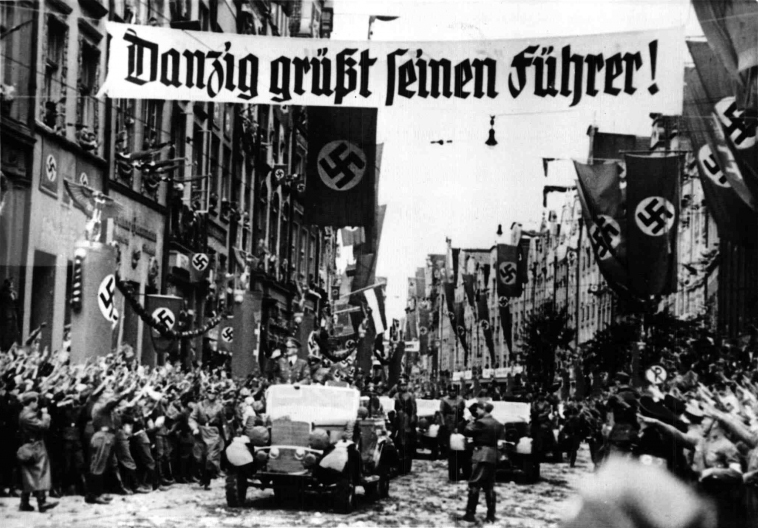
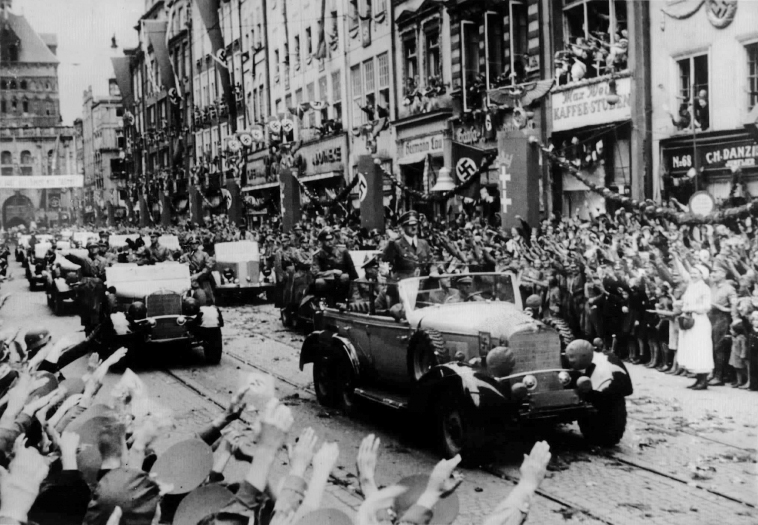
[Ed: You assholes won’t be heiling when Ivan comes in 1945.]
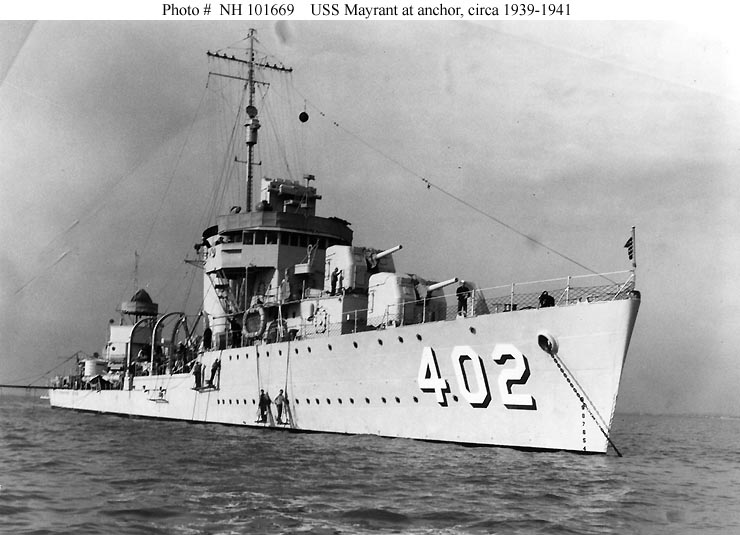
Launched 14 May 1938, Commissioned 19 September 1939.
Mayrant received three battle stars for World War Il service. Spent much of the war in the Mediterranean and Atlantic. Arrived in the Pacific in the closing months of the war.
Designated as test ship for operation “Crossroads,” the 1946 atomic bomb tests, she arrived Bikini Atoll, Marshall Islands, 31 May 1946. Damaged in the atomic bomb tests in July 1946. Decommissioned 28 August 1946. Scuttled off Kwajalein 4 April 1948. Stricken 30 April 1948.
https://www.history.navy.mil/research/histories/ship-histories/danfs/m/mayrant-ii.html
 History Diaries