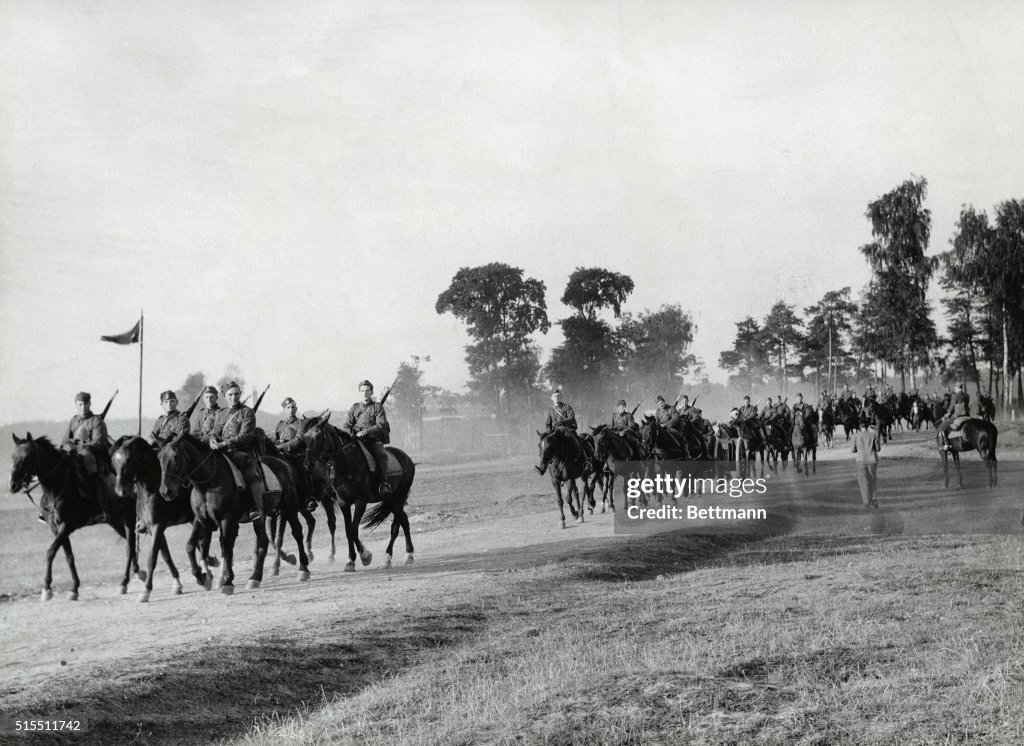
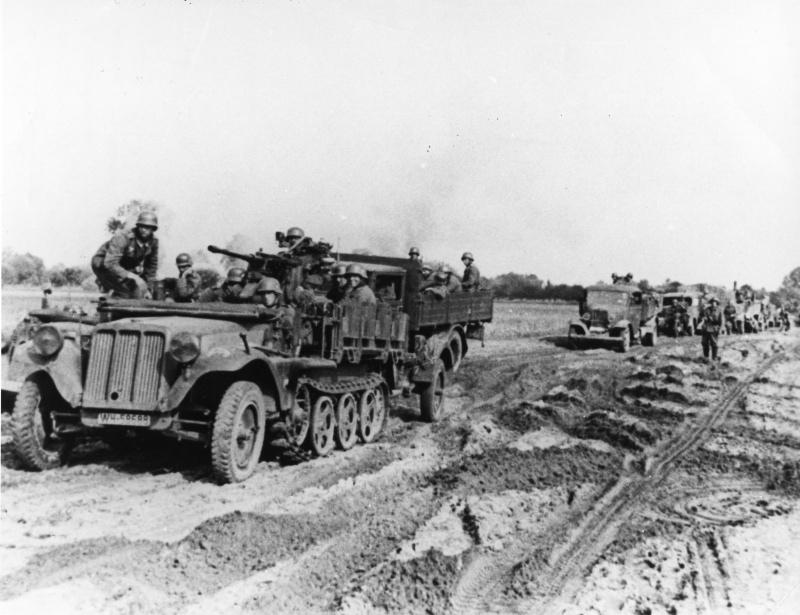
The Battles of Tomaszów Lubelski and Wilno began. The Battle of Tomaszów Lubelski took place from 18 September to 20 September 1939 near the town of Tomaszów Lubelski. It was the second largest battle of the Invasion of Poland (Battle of Bzura was the largest) and also the largest tank battle of the campaign. It resulted in the surrender of Army Kraków on 20 September 1939. In the first phase (also known as the First Battle of Tomaszów Lubelski), Polish forces, composed of Army Lublin and Army Kraków under General Tadeusz Piskor attempted to break through the German positions around Tomaszów towards the Romanian Bridgehead area. Both armies forces on 15 September were in the area southwest of Frampol. Their road towards south was blocked, however, by two German corps – VIII Army Corps (around Biłgoraj), and by XXII Panzer Corps, consisting of 2nd Panzer Division and 4th Light Division (around Hrubieszów, Zamość and Tomaszów Lubelski). Polish forces, concentrated around Frampol, were surrounded by six to seven German divisions.
Since neither Army Kraków, nor Army Lublin had any aircraft, General Antoni Szylling, commander of Army Kraków, decided to risk and attack the Germans, without knowing their real strength. He knew that Panzer forces had already approached Rawa Ruska, and hoped that their units would be stretched along the road from Jarosław to Rawa. Polish forces included one of the largest Polish armored units of that time, the Warsaw Armoured Motorized Brigade, and Szyling, together with General Piskor, decided that the Warsaw Brigade would make a demonstration attack on Tomaszów, drawing the attention of the Germans. Joined Polish forces were made of five infantry divisions – 3rd, 21st, 22nd, 23rd, and 55th. Furthermore, they consisted of 1st Mountain Brigade, Kraków Cavalry Brigade, and Warsaw Armoured Motorized Brigade. However, after days of heavy fighting, Polish units were reduced to 30-50% of their original strength (except for the Armoured Brigade), lacking batteries, antitank ammunition and controllers.
These plans, however, were quickly changed, after the Germans destroyed a key Polish unit, 21st Mountain Division, near the village of Dzikowiec, on 15-16 September, killing General Józef Kustroń. General Piskor, realizing that German forces were stronger than he had thought, decided to act quickly, without waiting for all his divisions to concentrate. On 17 September he ordered Warsaw Armoured Motorized Brigade to attack Tomaszów and keep the town until main forces of Army Kraków joined the brigade. Tomaszów was attacked on 18 September in the morning, and by 1 p.m. half of the town was in Polish hands. Meanwhile, however, the German 4th Light Division joined the battle, striking rear Polish units and forcing them to withdraw. Thus, the attempt to capture Tomaszów in a surprise attack, failed. On the night of 18-19 September Warsaw Brigade, supported by infantry of 23rd and 55th divisions, attacked Tomaszów again, but without success. A third attack took place in the night of 19-20 September, but Polish units were disorganized and demoralized. After a series of chaotic skirmishes, with number of killed and wounded growing, and ammunition shrinking, General Piskor decided to surrender. Some 11,000 Polish soldiers were captured, with small groups managing to hide in forests.
Meanwhile, Operational Group “Boruta” (named after General Mieczysław Boruta-Spiechowicz), which was part of Army Kraków, separated from main Polish forces and marched towards Narol. Surrounded by Germans, Polish units were destroyed one by one. Some managed to reach the area of Rawa Ruska, where 3,000 soldiers surrendered on 20 September, ending this phase of the battle.
The Battle of Wilno (modern Vilnius, Lithuania) was fought by the Polish Army against the Soviet invasion of Poland in 1939, which accompanied the German Invasion of Poland in accordance with Molotov–Ribbentrop Pact. On 18–19 September, Soviet forces took over the city of Wilno. Polish forces, concentrated in the west, were relatively weak in the east. The Polish commanders, unsure whether to actively oppose the Soviet entry into Poland, did not use the full defensive capabilities of the town and nearby fortifications, although the outcome of the battle would not have been likely any different, given the overwhelming Soviet numerical superiority.
On 18 September, at around 17:00, Okulicz-Kozaryn received reports of Soviet forces approaching from Oszmiana (today, Ashmyany). They consisted of armoured scouts which had engaged Polish infantry units on their approach. Okulicz-Kozaryn then ordered all units to fall back toward the Lithuanian border, units of the Border Protection Corps, as the most experienced, were to screen the withdrawal. Podpułkownik (Lieutenant Colonel) Podwysocki was dispatched to inform the Soviets that Polish forces did not intend to defend the city, but he was shot at and returned to the Polish lines. As Okulicz-Kozaryn had already left the city, Podwysocki decided to defend it, even though most of the forces previously in the city had left with Okulicz-Kozaryn.
The first Soviet attack on the evening of 18 September was repulsed by the Polish defenders. Subsequently, the Soviets continued to push into Wilno. By the end of the day the Soviets had secured the airfield and made several thrusts into the city, taking the Rasos Cemetery. By the morning of 19 September, the advanced Soviet armoured units had been reinforced with infantry and cavalry. The Polish defenders delayed the Soviet advance, particularly by holding the bridges, but later that day the poorly coordinated Polish defence collapsed and the Soviets took control of the city. Polish units had either surrendered or withdrawn, disorganized, towards the Lithuanian border or deeper into Poland. The Soviets transferred the city to Lithuania according to the Soviet–Lithuanian Mutual Assistance Treaty. Lithuanian troops entered the city on 27–28 October.
The Battle of Kobryń ended with the withdrawal of the remaining Polish forces. The Battle of Kobryń was fought between 14 and 18 September 1939, between the German XIX Panzer Corps of General Heinz Guderian and the improvised Polish 60th Infantry Division “Kobryn” of Colonel Adam Epler. It was fought concurrently with the Battle of Brześć Litewski. The main battle for Kobryń began on 18 September 1939. Early in the fighting, the Germans managed to capture the Gubernia I and Gubernia II manorial farms, which were protecting the road to Bereza Kartuska and closing the approach to main forces of the Polish division. A counterattack by Polish forces from Kobryń forced the retreat of the Germans from one of the manorial farms, but it was later recaptured. Fierce combat broke out near the Queen Bona Canal. The Germans were unable to seize complete control of Kobryń on September 18 because of Polish army resistance, resulting in an impasse.
During the day, Polish patrols and units of the eastern wing of Independent Operational Group “Polesie” came into contact with advanced units of the Soviet Army 23rd Rifle Corps in the area of Łuniniec. Faced with the knowledge of the broader Soviet Invasion of Poland pouring in from the frontline and specific reports from units of IOG “Polesie” encountering advanced units of Red Army forces, General Franciszek Kleeberg amalgamated all units of IOG “Polesie” under his command with the improvised 60th Infantry Division and withdrew to the South towards the Pinsk Marshes in the area of Dywin. The headquarters of GO “Polesie” was relocated from Pińsk to Lubieszów, at present Lubeshiv in Ukraine. With the withdrawal of Polish forces, the battle for Kobryń came to an end.
The city of Lublin fell to the Germans. The Germans occupied Lublin and immediately began persecuting the city’s Jews. The city held special significance in the anti-Semitic Nazi ideology, as in the early 1930s, a Nazi propagandist had described Lublin as “a bottomless well from which Jews flow to all corners of the globe, the source of the rebirth of world Jewry.” Many were sent to forced labor, some were physically attacked by the Germans, and Jewish property was confiscated. A month later, on the 14 October 1939, the Jewish community in Lublin received an order to pay 300,000 zloty to the German army. In November 1939, Jews were forced to wear the Jewish badge (see also Badge, Jewish), their movement was restricted, and those Jews living on the city’s main street were evicted from their homes. The Germans commenced implementing a grand plan to deport all Jews in Poland and the Reich to the Lublin district. This program, known as the Nisko and Lublin Plan, was ultimately scrapped, however, by February 1940 some 6,300 Jews had been brought to the area.
In January 1940, the Germans instituted a Judenrat in Lublin. The Judenrat set up welfare institutions, soup kitchens, health services, and orphanages. However, when the Germans began arresting Jews for forced labor, the Judenrat was ordered to provide lists of even more Jewish names. The council eventually succumbed to German pressure, horrifying the city’s Jews. In the spring of 1941, the Nazis ordered the establishment of a ghetto in Lublin. In preparation, they thinned out the city’s Jewish population by deporting about 10,000 Jews to nearby towns. The ghetto was instituted in March 1941; housing over 34,000 Jews. The deportation of Jews to the Belzec extermination camp commenced on March 17, 1942. Up to 1,400 Jews were deported daily. This deportation aktion ended on April 20, after 30,000 Jews had been deported to their deaths, leaving 4,000 in the city. Over the next few months the remaining Jews were moved to a Lublin suburb and were subjected to periodic selections. By October, 3,800 Jews had been selected for deportation to Majdanek, near the city. In July 1944, the last Jews from Lublin were murdered by the Germans. The city was liberated that same month.
Soviet forces have advanced 100 km into Poland, meeting little resistance.
The German 3rd and 10th armies begin attacking Warsaw.
A joint German-Soviet military commission agreed provisionally on partition of Poland at Brest Litovsk. A Soviet-German joint victory parade was held in Brest-Litovsk in Eastern Poland.
Much of the Polish government and High Command escaped into exile in France. Polish President Ignacy Mościcki and Commander-in-Chief Edward Rydz-Smigły left Poland for Rumania. They leave behind messages telling their troops to fight on. Rumania promptly interned them under pressure from Germany. The Polish government is interned after attempting to obtain asylum. On the same day, one hundred Polish Air Force planes, as well as 50 civilian aircraft, fly to safety in Rumania; many of the escaping airmen will eventually make their way to Britain to continue the fight.
Large sections of the Polish Army were pouring across the frontier into Rumania early today following the flight of President Ignacy Mościcki and the apparent collapse of the Polish Republic. Mr. Mościcki arrived during the day with Foreign Minister Josef Beck and a government party of fifty-six. Colonel Beck immediately arranged to meet with the heads of diplomatic missions to Poland, now established here, and was expected to tell them that their mission was “now ended.”
The plans of the Polish Government, however, were not immediately clear. There were some reports that it would go on to Bucharest, Rumania’s capital. The Polish soldiers came with arms and equipment and Immediately were disarmed by the Rumanian border patrol. Many of the soldiers declared their intention of joining a foreign legion to continue the fight against Germany.
Polish cipher experts fled to Paris, France with vital knowledge of the German Enigma code which they would later give to the British. Thanks to the Poles, code breaking became a powerful weapon in the Allied armory.
Adolf Hitler arrives in Danzig; he will remain in the region for the next week, staying at the Casino Hotel in Zoppot.
William Joyce began making English-language propaganda broadcasts over German radio to England. “Lord Haw-Haw,” the Irish fascist William Joyce who had fled from Great Britain to Germany at the start of the war, makes his first broadcast German propaganda broadcast on the medium wave station “Radio Hamburg” to Great Britain and by shortwave to the United States.
The Berlin official radio station last evening several times broke into short-wave musical programs to the United States to warn American listeners to avoid entanglement in European quarrels, to distrust “anti-American propaganda” designed to involve the United States and to refrain from financing another war.
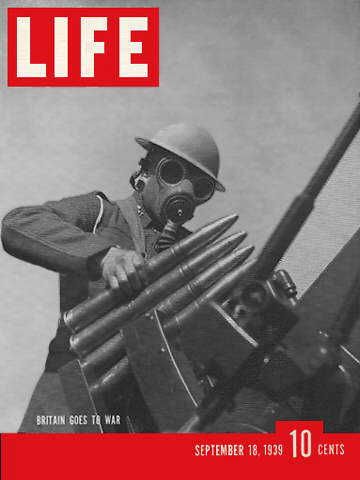
The first official British casualty list was published to the public.
A Czech purge is under way. The Gestapo is terrorizing leftists and intellectuals.
Italy is still wary of taking action, waiting to see if the Balkans, especially Rumania, are under Soviet threat.
A Vatican City paper declares the Russian invasion of Poland a cowardly act under false pretenses. Russia’s invasion of Poland is termed a cowardly act on a false pretext in a strong editorial of condemnation today by the Osservatore Romano. Equally strong is the newspaper’s defense of Poland and its strictures on the menace to Catholicism represented by the war. It is rare, indeed, for the Vatican City newspaper to take such a strong stand. Considering its close connections with the Papal Secretariat of State, one must take this as the nearest thing to a pronouncement of the Holy See’s position that has yet been uttered. It is emphasized by the fact that August Cardinal Hlond, Primate of Poland, arrived in Rome today and will see Pope Plus soon.
The Marynarka Wojenna (Polish Navy) Warszawa-class river monitors ORP Horodyszce, ORP Pinsk, ORP Torun, and ORP Warszawa were scuttled on the Pripyat River to avoid capture. Raised, repaired and put into Soviet service as Bobruysk, Zhitomir, Vinnitsa, and Vitebsk.
The Polish submarine ORP Orzeł escaped from internment at Tallinn and began a perilous 27-day voyage to Scotland. The crew’s navigational charts had been confiscated by Estonian military authorities but someone from the British embassy might have secretly provided them with new charts. The Soviets angrily accused Estonia of helping the Orzeł to escape and threatened to enter Estonian territorial waters to search for the submarine.
The unescorted British steam merchant Kensington Court was stopped by gunfire and after the crew abandoned ship was torpedoed and sunk by the U-32, commanded by Kapitänleutnant Paul Büchel, about 120 miles west of Lands End, England in the eastern Atlantic Ocean. Of the ship’s complement, all 35 survived and were picked up by two Sunderland flying boats. The 4,863-ton Kensington Court was carrying cereals and was bound for Birkenhead, England.
The 326-ton British steam fishing trawler Arlita was sunk by gunfire by the U-35, commanded by Kapitänleutnant Werner Lott, west-northwest of Ireland. Of the ship’s complement, all 11 survived and were picked up by the British steam fishing trawler Nancy Hague.
The 295-ton British steam fishing trawler Lord Minto was sunk by gunfire by the U-35 west-northwest of Ireland. Of the ship’s complement, all 13 survived and were picked up by the British steam fishing trawler Nancy Hague.
Italy organizes the Milizia Fascista Albanese (Albanian Fascist Militia) in occupied Albania.
Italy deploys four Blackshirt divisions to Libya.
U.S. freighter Warrior, detained by British authorities since 7 September, is released after her cargo of phosphates is requisitioned. Freighter Shickshinny, detained since 16 September at Glasgow, Scotland, is permitted to sail without unloading cargo deemed by British authorities to be contraband. Shickshinny, however, is to unload those items at Mersey, England.
U.S. freighter Eglantine is stopped by German submarine, ordered not to use her radio, and to send her papers to the U-boat for examination. The Germans allow Eglantine to proceed, but advise her not to use her radio for three hours.
In simultaneous announcements, Denmark, Finland, Norway, Sweden and Iceland declare that they intend to continue trading with all belligerents to protect their economic existence.
The British and French attitude on the Russian attack upon Poland is anxiously awaited in Turkey. This country not only has commitments with the two Western nations but also desires to remain on the best of terms with Russia.
A new appeal to the governments of belligerent countries to renew their orders prohibiting the practice of bombing civilians in unfortified centers of population from the air was voiced today by President Roosevelt in a message to President Ignacy Mościcki of Poland, which the American Ambassador to Poland is instructed to deliver. The President’s message, made public tonight by the State Department, was in reply to one received at the White House from the Polish Chief Executive, protesting bombings by “German aircraft” of “Polish towns and villages which contain no conceivable military objectives.”
President Roosevelt declared he had been deeply shocked by the information contained in President Mościcki’s message, as well as by reports from United States officials at scenes of hostilities. Without mentioning Germany, Mr. Roosevelt recalled that the belligerent governments had agreed to bomb only military objectives from the air after he had requested this on September 1. He asked the various governments to assure themselves that their air forces are carrying out their pledges not to bomb non-combatants, “in view of the hundreds of thousands of lives that may be at stake.”
President Roosevelt today reinforced his appeal for national unity on foreign policy with invitations to Alfred M. Landon and Frank Knox, as titular leaders of the Republican party, to take part in Wednesday’s pre-session White House conference with leaders of Congress on the arms embargo question. Simultaneously, the administration moved to confine the special session of Congress, opening on Thursday, to consideration of Neutrality Act revision, including repeal of the mandatory arms embargo. From the White House word went to the governmental departments that they were to withhold pet legislative projects until the next regular session so that the neutrality program would not be endangered by extraneous issues.
In announcing the President’s invitation to the Republican candidates for President and Vice President in 1936, Stephen T. Early, White House secretary, said it was Mr. Roosevelt’s request that none of those attending the meeting at the Executive Office should be regarded as either Democrats or Republicans, but as national leaders. This, he said, was in line with the President’s recent plea for an adjournment of partisanship in the interests of American neutrality.
Conspicuously absent from the list, which included Secretary Hull and Representative Carl Mapes, Republican, of Michigan, was the name of former President Herbert Hoover. Asked why Mr. Hoover was not invited, Mr. Early said: “Well, we have invited the two titular heads of the Republican party.” The addition of Mr. Hull to the list occasioned no surprise in capital circles. As for Mr. Mapes, the White House explained that he was the ranking Republican member of the House Rules and Interstate Commerce Committees and had long been interested in the subject of international communications. Mr. Mapes also is an important member of the House Republican board of strategy.
From Senator Borah, meanwhile, came the suggestion that the Administration might scrap all plans for revision of the Neutrality Law and for lifting the arms embargo in favor of outright repeal of the statute and a return to the principles of international law which guided the nation’s neutrality policy prior to enactment of the present legislation. Already committed to a last-ditch fight against revision of the law or repeal of the embargo, the Senator said he had received “reports” that the Administration was becoming less enthusiastic for cash-and-carry legislation, in view of the apparent increasing friendship between Japan and Russia within the last few days.
“I might prefer international law to some of the things that might be offered,” the Idaho Senator said. President Roosevelt himself has more than once declared the Administration’s objective to be a return to the principles of international law. He always indicated, however, that this should be brought about within the framework of the existing neutrality statute through repeal of the embargo and revision otherwise.
Senator William E. Borah today accused Great Britain and France of “pulling their punches” against Germany on the Western front acid asserted that there is something “phoney” about the European war.
A U.S. general declares that the United States is unprepared for defense, saying it is not equipped for modern war.
Poor turnout is likely in the U.S. primary election today. The rank and file of both major parties seem lukewarm about the election.
The automaker Plymouth adds two models for 1940, including a car with folding seats.
Charles M. Schwab, chairman of the board of directors of the Bethlehem Steel Corporation and for half a century one of the country’s leading steel masters, died at 9:30 o’clock tonight at his home in New York. He was 77 years old.
The United States seeks the 1940 Olympics if Finland backs out.
President Roosevelt authorizes Coast Guard to enlist 2,000 additional men and to build two training stations.
The United States liner Washington, bearing the largest number of American citizens to escape from Europe since war was declared, arrived in New York this afternoon.
Under tow in heavy seas with a cargo of granite paving blocks, the 192-foot (59 m), 866-gross register ton American schooner barge Henry Endicott sank in 80 feet (24 m) of water without loss of life 2.25 nautical miles (4.17 km; 2.59 mi) east-southeast of Manomet Point, Plymouth, Massachusetts, at 41°54′30″N 070°29′08″W.
Joe Gordon hits his 25th homer, a three-run shot, and Charlie Keller hits two doubles to lead the New York Yankees to an easy 6–2 win over the last-place St. Louis Browns. Bump Hadley serves up a five-hitter to get his twelth win.
Dutch Leonard gained his nineteenth victory of the season when the Washington Senators defeated the Detroit Tigers today, 4–2. The big knuckleballer allowed seven hits and was never in danger after the fifth inning. In that inning the Tigers scored their second run on a walk and a double by pitcher Tommy Bridges.
Johnny Allen today won his ninth decision of the season, allowing the Philadelphia Athletics ten hits as the Cleveland Indians scored a 9–4 triumph. Allen had a shutout until Dick Seibert doubled with the bases. filled in the eighth to drive in three runs. Roy Weatherly and Ben Chapman each made three of the Tribe’s thirteen hits off Rookie Sam Page. The victory put Cleveland in a tie with the White Sox for third place.
The St. Louis Cardinals split a pair with the New York Giants, losing 7–2 before rallying in the nightcap to win, 15–5. St. Louis remains 3½ games in back of the National League-leading Cincinnati Reds. Johnny Mize has a triple in the first game and is 5-for–5 in game 2, including his 26th homer of the year, as the Cardinals savage Giants’ pitchers for 22 hits.
Cincinnati again was off to a rousing start against the Boston Bees to win the opener of today’s double-header, 4–1, but got snagged on a Barnicle — George Barnicle, that is — in the nightcap for a 5–4 defeat. Whitey Moore hurled a six-hitter for the win in the opener. Ernie Lombardi contributed a triple and two singles for the Reds. Barnicle pitched 4⅓ innings of one-hit relief to end a Reds’ rally and gain the nightcap victory.
The smallest crowd at Forbes Field in years saw Arky Vaughan and Maurice Van Robays hammer home runs today to give the Pittsburgh Pirates a 7–4 victory over the Philadelphia Phillies in the final game of the season between the two teams. Only 688 fans were in the stands. Vaughan and Van Robays accounted for four runs with their homers in the seventh to give the lead to the Pirates, who had been trailing 3–2.
Governor General Lord Tweedsmuir told the Dominion Council of the Canadian Legion today that “we are meeting at a moment as grave as any in the history of the British Empire.” He predicts a long war, and eventually, victory.
U.S. Navy heavy cruiser USS San Francisco (CA-38) arrives at San Juan, Puerto Rico, and reports that Dominican authorities are exercising proper precautions to learn promptly of the entry of any belligerent warship into Semana Bay, Dominican Republic.
Japan warns the United States on its naval policy. The assumption of a watchdog role is really a provocation, newspapers assert. Strikingly similar editorials today in the Asahi, Yomiuri and Miyako Shimbun asserted that the United States is assuming Great Britain’s role of “Far Eastern watchdog” and warned America against provocation of Japan. The Miyako advocated a JapaneseAmerican non-aggression pact and the Asahi said: “The United States is threatening to protect British and French interests in China, thereby increasing the chance of Japanese-American friction.” This paper added that the American naval policy is directed against Japan.
Signs that the Japanese Navy may be seeking increased appropriations in order to meet the United States naval program is seen in the anti-American movement of the Japanese press, which continues today on a more extensive scale as three newspapers publish articles bearing traces of inspiration from a common source. All are intended to reveal how United States naval preparations show an intention to construct a front against Japan in East Asia. Naval estimates now are under discussion behind the scenes and the articles are unmistakably designed to plant the thought that United States naval expansion is becoming dangerous to Japan’s East Asiatic policy.
Asahi finds in the United States naval program eleven positive indications of armament preparation. These range from criticisms of the magnitude of American expenditure to a declaration that the leading officers of the navy, including the new chief of operations, all hold strong views regarding Japan. A similar article appears in this morning’s Nichi Nichi. Yomiuri, approaching the question from a different angle, concludes that the acceleration of American armaments cannot be explained as preparation to join in the European war.
En route toward Changsha, Hunan Province, China, Japanese troops used poison gas against Chinese defensive positions along the Sinchiang River.
Dow Jones Industrial Average: 147.78 (-4.37).
Born:
Jorge Sampaio, Portuguese lawyer and Socialist Party politician (18th President of Portugal, 1996-2006; Mayor of Lisbon, 1990-95), in Lisbon, Portugal (d. 2021).
Bob Whittaker, American politician (Rep-(R)-Kansas, 1979-1991), in Eureka, Kansas.
Jim McMillin, AFL cornerback and safety (Denver Broncos, Oakland Raiders), in Pleasant Hill, California (d. 2023).
Died:
Charles M. Schwab, 77, chairman of Bethlehem Steel Corp.
Stanisław Ignacy Witkiewicz, 54, Polish writer, painter and philosopher (suicide).
Naval Construction:
The U.S. Navy Cimarron-class oiler USS Sabine (AO-25) is laid down by the Bethlehem Steel Corp. (Sparrows Point, Maryland, U.S.A.).
The Royal Navy M 1-class minelayer HMS M 2 is launched by George Philip & Sons Ltd. (Dartmouth, U.K.).
The Royal Canadian Navy training ship HMCS Cartier (Z 02) is recommissioned.
The Royal Canadian Navy examination ship HMCS French (S 01; later Z 23) is commissioned. Her first commanding officer is Lieutenant John Willard Bonner, RCNR
The Royal Canadian Navy examination ship HMCS Nitinat (Z 03) is commissioned.
The Royal Canadian Navy patrol craft HMCS Adversus (J 17) is commissioned. Her first commanding officer is Acting Lieutenant James Philip Fraser, RCNR.
The Royal Canadian Navy patrol craft HMCS Alachasse (Z 18; later J 18) is commissioned.
The Royal Navy armed merchant cruiser HMS Salopian (F 94) is commissioned. Her first commanding officer is Captain (retired) John Phellips Farquharson, DSO, OBE, RN.
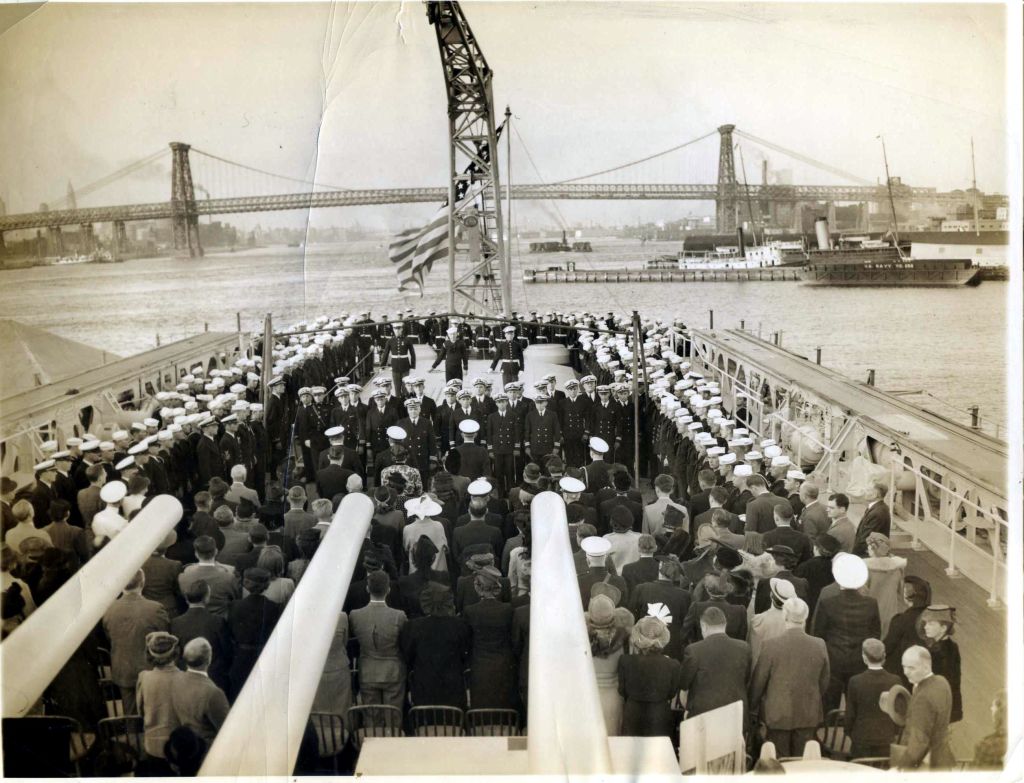
The U.S. Navy St. Louis-class (modified Brooklyn-class) light cruiser USS Helena (CL-50) is commissioned. Her first commander is Captain Max Burke Demott, USN.

 History Diaries