The two U.S. destroyers, USS Edwards and USS Morton, on DeSoto patrol are pursued at night by four unidentified vessels, presumed to be North Vietnamese torpedo boats; the U.S. ships fire over 200 5-inch and 100 3-inch shells, but never see any ships and no torpedoes are detected. On the 19th, McNamara will publicly report the incident, stating that the destroyers were on ‘routine patrol.’ North Vietnam will also report the incident but does not refer to any of its ships being involved, simply accusing the United States of firing offshore. President Johnson does not authorize any retaliatory air raids this time and suspends the DeSoto patrols.
In unofficial conversations, Washington officials said that the two destroyers, on a patrol mission in international waters, had detected by electronic means — but not sighted — what they took to be hostile craft moving into attack positions. Mindful of the two attacks on American destroyers by North Vietnamese patrol boats in the gulf seven weeks ago, the American ships undertook what was described as evasive action. With the craft still in pursuit, the American ships were said to have fired warning shots. When these were ignored, they were said to have opened fire with five‐inch and three‐inch guns. The targets were said to have disappeared. Retracing their paths in the darkness and poor weather, the destroyers could find no trace of the targets.
[Ed: Of course, there almost certainly were no hostile craft. Just spurious radar ghosts of the type that marked the second phase of the original Tonkin Gulf incident. The incident occurred at night and in poor weather. Some sources suggested that this might have made it difficult to sort out the facts, but one official said there had been a communications breakdown.]
North Vietnam charged today that Washington had fabricated the report of a new naval incident as an excuse for striking at North Vietnamese territory. In a statement by the Foreign Ministry, North Vietnam asserted that several United States destroyers engaged yesterday “in activities in waters close to the Democratic Republic of Vietnam.” It added: “At 10 PM on September 18, as two United States destroyers sailed to a point near Nghe An [Province], heavy explosions were heard, and flashes of light and aircraft circling over the spot were seen from the shore.” Deriding a Defense Department statement that another incident had taken place, North Vietnam appealed to the Communist bloc and other nations to “condemn strongly this United States plot and firmly check these dangerous actions of the United States Government.”
South Vietnam claims that two companies from the North Vietnamese Army invade South Vietnam, in Quảng Trị Province, but that they are defeated with heavy casualties. U.S. military advisers will question whether these were North Vietnamese troops, but in fact they are now beginning to infiltrate the South.
Two United States servicemen were wounded in an ambush and four others were injured this week when their helicopter was shot down during stepped‐up operations by the Việt Cộng, a military spokesman reported today. The increased guerrilla activity was apparently a reply to a rebel order for a nationwide offensive to take advantage of the confusion arising from the latest political‐military crisis. The United States military spokesman said the four crewmen were injured when guerrillas shot down an Army Hu-1B turbojet helicopter over Bình Định Province, in the Communist‐ridden highlands about 200 miles north of Saigon. The spokesman added that two American Special Forces soldiers were wounded in a Communist ambush in Quảng Nam Province Wednesday. An Australian enlisted man was also injured there.
Việt Cộng artillery sink two South Vietnamese landing craft attempting an operation on the Mekong River.
In political matters, Major General Dương Văn Minh, chairman of the military triumvirate, said the first steps toward turning control over to a civilian government would be taken next week.
The three Laotian factions agreed today to hold a formal meeting Monday to air their differences. This unexpected turn in their deadlocked Paris conference was announced tonight by Prince Souvanna Phouma, the country’s premier and neutralist leader. The announcement followed his talks with Prince Souphanouvong, leader of the pro‐Communist Pathet Lao, and Prince Boun Oum, the rightist leader. “We have settled nothing so far,” Prince Souvanna Phouma said in reference to the preliminary talks. Prince Souphanouvong, noting the length of his talks with the Premier, said, “We have been better able to understand our respective positions.”
But spokesmen for the pro-Communists emphasized that none of the three factions has changed its position on the key issues. These are a cease‐fire, a withdrawal of the contending forces in the Plaine des Jarres to the positions of June, 1962, and the composition of the tripartite delegation to the proposed 14-power conference on Laos. The ostensible objective of all three factions is a cease‐fire in the Plaine des Jarres and a return to the military situation as it was in June, 1962, when the Government of national unity was formed. Earlier this year, changes in the Government favoring the right‐wing led some neutralist commanders on the Plaine des Jarres to join the pro‐Communist Pathet Lao, which had staged number of successful attacks in the area. The Pathet Lao now controls a number of important military positions there.
Prince Souvanna Phouma informed the French Government of the agreement to begin the formal talks. He also indicated that these might continue in his absence on a ministerial level. Monday’s meeting will be held at the Chateau de la Celle St. Cloud, which was offered to the Princes by President de Gaulle as the site for their formal conference. The Prince plans to leave for Vientiane, the Laotian administrative capital, on Tuesday. He will attend the conference of non‐aligned nations in Cairo starting October 5.
Despite the Soviet veto of a Security Council resolution deploring Indonesian guerrilla attacks against this country, Malaysia believes she has won a substantial victory in the United Nations. Support by nine nations of the 11 on the Security Council was actually more than had been expected here. The Soviet veto had been foreseen, but Malaysian leaders had not hoped to get the unqualified endorsement of Morocco and the Ivory Coast, the current representatives of the African‐Asian bloc in the Council. Malaysia has had difficulty in convincing the African and Asian nations that the new federation of former British territories is not a creation to further Britain’s power in this area, as President‐Sukarno of Indonesia has charged. Malaysia had not expected the Security Council to deter Indonesia in her policy of attempting to break up the federation.
But the support of the African and Asian nations in the Council was believed to be a hopeful sign that President Sukarno, who considers himself the leader of this bloc, no longer had the approval of these former colonial territories in his effort to alter the make‐up of Malaysia through support of guerrilla warfare against her. Deputy Prime Minister Abdul Razak said that Malaysia had “done very well” in the Security Council. Whether the latest raids into the mainland of Malaya by Indonesian special forces and Malaysian dissidents will lead to wider clashes depends on Indonesia, Mr. Razak said. “If they come again, we will fight,” he declared. But he declined to say whether further incursions would result in retaliation by Malaysian or British troops.
British forces are now deployed throughout Malaysia as part of a defense agreement with the country. In the dense jungles northeast of here, security forces spearheaded by British units of Gurkhas, Nepalese tribesmen noted as warriors, were attempting today to close in on the remnants of an Indonesian-based guerrilla band that was air‐dropped into this area September 2. A spokesman for the security forces said that it was now known that at least 100 guerrillas had been dropped near here from two Indonesian transport planes. Original estimates had placed the number at 30 brought in in one aircraft. The spokesman said that 67 had now been accounted for. Eighteen of these have been killed and the rest, including several ethnic Chinese from Malaysia serving as guides, have been captured.
Norway’s representative appealed to the Security Council today to broaden the powers of the United Nations force in Cyprus to make it more effective in ending the danger of war there. The delegate, Sivert A. Nielsen, endorsed the request for such a change made by the Secretary General, U Thant, in his report of September 10. Efforts were under way to find a resolution that could give Mr. Thant the necessary powers and avoid a Soviet veto. The Soviet Union is said to have indicated that it would not support any broadening of the force’s powers. Some text is expected to be presented on Monday. Mr. Nielsen has been working with the other nonpermanent members of the Council on its terms. Mr. Thant asked specifically in his report that power be given to the peace‐keeping force to remove fortifications and other installations that seemed to threaten peace, that the force be given full freedom of movement in the island and that neutral zones patrolled by the United Nations be set up between Greek and Turkish Cypriote areas.
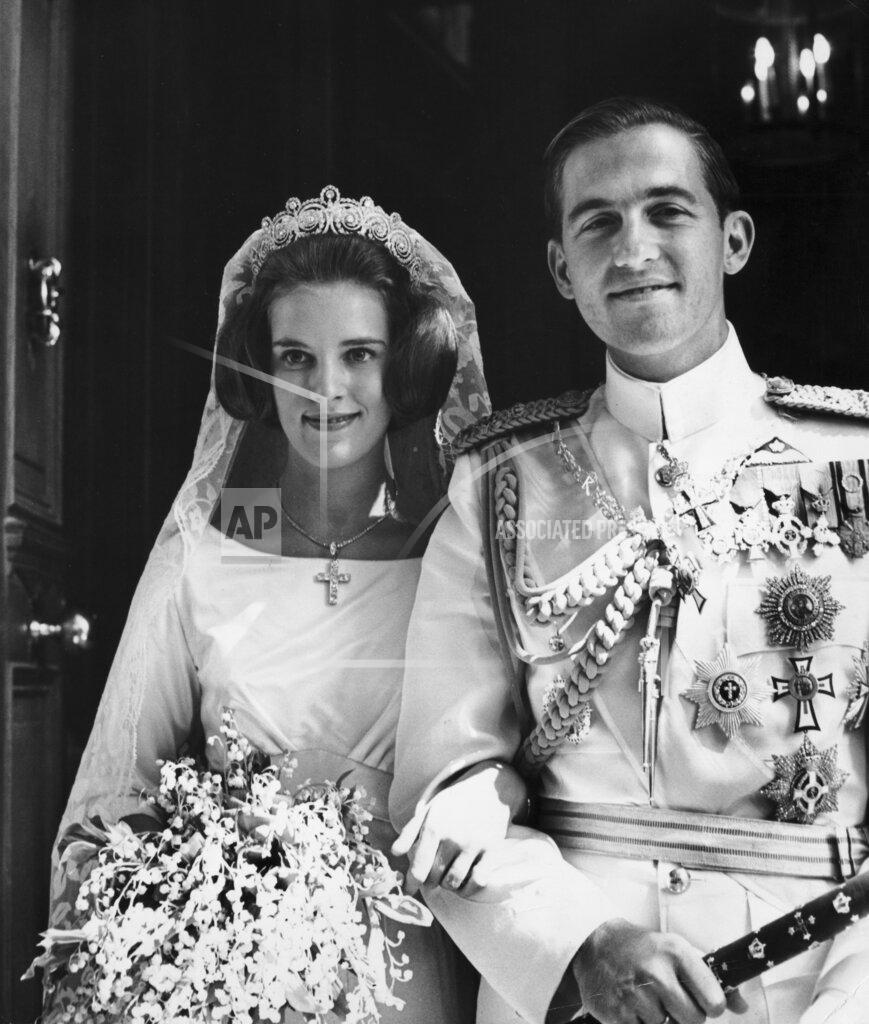
In Athens, King Constantine II married Princess Anne-Marie of Denmark in the last royal wedding in Greece. Only nine days after her 18th birthday, Anne-Marie became Europe’s youngest queen. Guests at the ceremony included eight reigning monarchs.
President Anastas I. Mikoyan of the Soviet Union made a sharp attack today on United States and British policies in Southeast Asia. In a demonstration of solidarity with Asian-African countries, the Soviet chief of state also assailed Western actions in the Congo, Cyprus and the Federation of South Arabia. He reiterated Moscow’s support for a broader representation of new nations in key United Nations bodies. Mr. Mikoyan used a SovietIndian friendship rally in the Great Kremlin Palace for a major speech, regarded here as an authoritative statement of Soviet attitudes in the growing contest between Moscow and Peking for the loyalty of nonaligned countries.
The USSR performs a nuclear test at Novaya Zemlya.
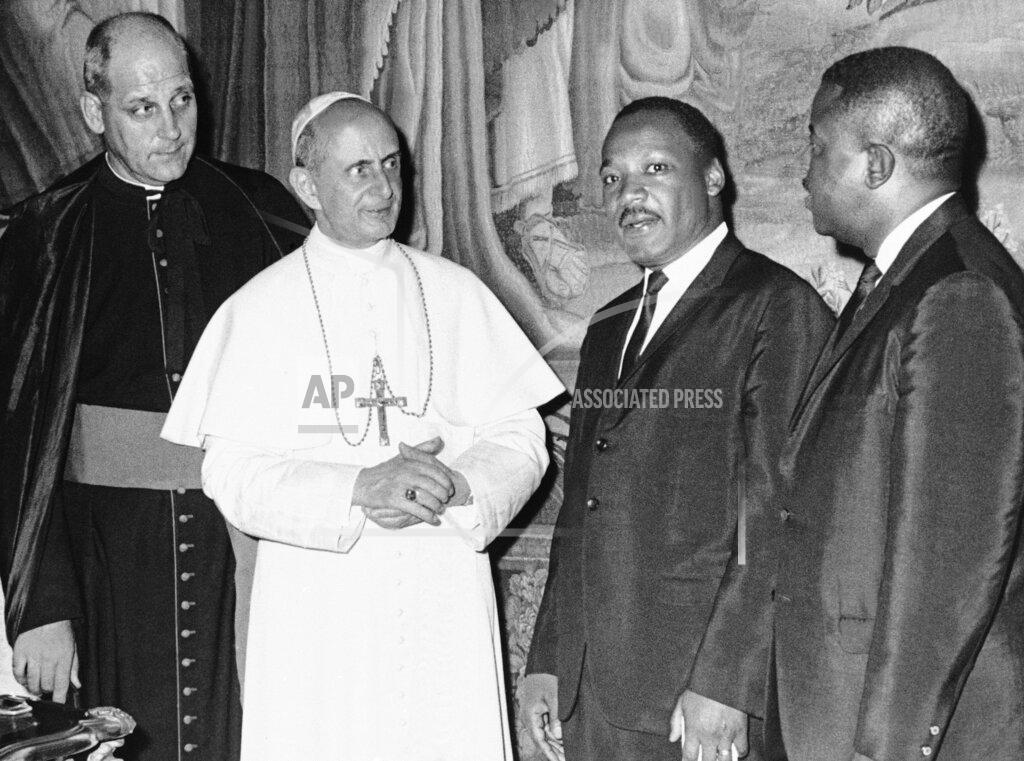
Dr. Martin Luther King, African-American civil rights leader and a minister in the Southern Baptist church, was granted an audience the leader of the Roman Catholic Church, Pope Paul VI at the Vatican. The two religious leaders spoke for 25 minutes. Pope Paul VI received the Rev. Dr. Martin Luther King Jr. this evening. The American civil rights leader said afterwards: “The Pope made it palpably clear that he is a friend of the Negro people, and asked me to tell the American Negroes that he is committed to the cause of civil rights in the United States.” Quoting the Pontiff as advocating nonviolent methods in the struggle for Black rights, Dr. King said he was deeply encouraged by his meeting with Pope Paul. Dr. King, a Baptist minister, said he believed that the United States civil rights movement had received “the endorsement of the most influential religious leader in the world and the head of the largest church in Christendom.”
At least 38 members of the United States Senate chose to stay away from a vote on a remapping of congressional districts. On the first roll call, fewer than 40 members answered the roll call, and the Senate’s Sergeant at Arms, Joseph C. Duke, was ordered to search Washington for missing Senators and, if necessary, arrest them so that a quorum of 51 could be present for a vote to take place. After an hour, Duke was able to bring the number present up to 49, still short of a quorum. At the time, 22 of the U.S. Senators who were campaigning for re-election were believed to have a good reason to be out of town but, as one report noted, “The other 29 absentees had no such excuse.”
The United States has successfully intercepted American satellites orbiting out to distances of several hundred miles, Secretary of Defense Robert S. McNamara said today. Mr. McNamara made the disclosure at a Pentagon news conference in elaborating upon President Johnson’s statement yesterday in Sacramento, California, that the United States had developed two weapons to destroy hostile satellites. One of the systems was developed by the Army, using the Nike Zeus rocket, which was originally developed as a defensive weapon against intercontinental ballistic missiles. The other was developed by the Air Force around the Thor, originally developed as an intermediate range ballistic missile and now widely used for space launchings. “The two systems,” Mr. McNamara declared, “have been effectively tested and have intercepted satellites in space, their missiles passing so close as to be within the destruction radius of their warheads.”
It was understood that the Army system is on Kwajalein Island, the site of its experimental firings of the Nike Zeus against ballistic missiles, and the Air Force system on Johnston Island, where rocket launching pads have quietly been constructed in recent years. The two Pacific islands are strategically located, since most Soviet satellites pass over them within a few orbits after launching. Both systems conducted a successful interception a year after their development was ordered — a relatively quick time for development of a weapon. The Army system was begun in May, 1962, and conducted its first successful intercept of a satellite in May, 1963. The Air Force system, begun early in 1963, successfully intercepted a satellite in May, 1964.
Since then, Mr. McNamara said, the weapons have carried out several successful intercepts “at many altitudes extending up to hundreds of miles.” Presumably the devices could carry either nuclear or conventional warheads. The nuclear explosive would have amuch wider “kill range” with its heat and radiation effects. But with the proximity fuse developed in World War H, it would be possible to use the conventional warhead that would explode near the satellite, sending out fragments or pellets that would puncture or destroy the fast moving satellite. Thus far, according to Mr. McNamara, $80 million has been invested in development and deployment of the two systems. Both were described as being “operational,” under the control of the Continental Air Defense Command in Colorado Springs, Colorado.
Thomas S. Gates, former Secretary of Defense, charges yesterday that his successor, Robert S. McNamara, had been unjustly critical in an assessment of the department’s past operations. In a letter to Mr. McNamara, Mr. Gates said remarks in a statement .by Mr. McNamara before the Democratic Platform Committee last month “were not a true presentation.” Mr. Gates said the McNamara statement had alleged that “the Defense Department under the previous Administration had been operating with a single strategy, “that the planning of the respective military services” was “without coordination,” that the weapons inventory was “completely lacking in certain major elements required for combat readiness,” and “that the nation’s strategic nuclear force was vulnerable to surprise missile attack.” “I submit that these statements are not a true representation of the Department of Defense of which you assumed charge in 1961,” Mr. Gates wrote. He now heads the Morgan Guaranty Trust Company. He said Mr. McNamara had “often given me and the Eisenhower Administration great credit for having provided a proper background and framework for your own policies.”
The Warren Commission, charged with investigating the 1963 assassination of President John F. Kennedy, held its final meeting before the scheduled September 24 submission date of its report to U.S. President Johnson. While the Commission would vote to accept the “single-bullet theory” endorsed by the staff’s investigators (that the bullet from the first gunshot that struck the President also struck Texas Governor John Connally), the majority would turn out later to have been 4 to 3. Earl Warren, Gerald R. Ford, Allen Dulles and John J. McCloy endorsed the conclusion, while Hale Boggs, John Sherman Cooper and Richard Russell Jr. “thought it improbable”.
Senator Barry Goldwater derided the Administration’s antipoverty program today and charged that President Johnson was planning “a great society” in which there would be no penalty for failure and no reward for success. The Republican Presidential candidate chose to make his speech in one of the states of Appalachia, a region that has been the seat of hard‐core, persistent poverty and unemployment in the United States for years. The Charleston Civic Auditorium, with its 6,800 seats, was virtually full for Mr. Goldwater’s speech, and the audience interrupted him with applause about 20 times. But it was usually perfunctory and mild.
Mr. Goldwater, however, drew almost thunderous applause when he departed from his text to say that the philosophy of the Americans for Democratic Action was nothing but a disguised version of the Marxist formula: “From each according to his abilities, to each according to his needs.” Mr. Goldwater said he thought this Russian concept went back to the days of the “apes.” He said he thought that at first apes must have merely piled coconuts on the ground, and allowed any other ape to take what he liked. Then, however, one ape must have “got smart and started the free enterprise system.” He said that under the free enterprise system they “took care of their brothers in need, but not their brothers who refused to work and wanted to live off of them.”
Although he said he believed in a “compassionate society,” Mr. Goldwater did not temper his conservative philosophy for this area. The Arizonan suggested that the President’s antipoverty program was meant to maintain Mr. Johnson in power. “Human misery is not to be trifled with just to get votes in an election,” Mr. Goldwater said. The Senator today was winding up a four‐day campaign swing through the Deep South and the Border States. He campaigned from the piny woods country of east Texas to the Ozarks of Missouri to the Ohio River Valley.
Senator Barry Goldwater said of the crisis in Vietnam tonight that “we hear that Lyndon is in a little more trouble.” Mr. Goldwater had heard reports that there had been some kind of conflict between United States and Communist forces in the Gulf of Tonkin area, with a considerable delay in the making public of details by the White House. He told about 300 persons who greeted him at the airport here that “with the great communications system which [Defense Secretary Robert S.] McNamara is always bragging about, they are waiting for an airmail letter to find out just what did happen.” He said he and his party were “going back to Washington tonight to see if we can help out.”
The United Automobile Workers Union and the Ford Motor Company agreed today on a new contract patterned after last week’s settlement between the union and the Chrysler Corporation. The cost was put at about 63 cents an hour. Union and management negotiators announced the “agreement in principle” in a brief statement issued at 9:05 AM at company headquarters in Dearborn. The announcement came 55 minutes before 130,000 Ford workers were scheduled to strike. Walter P. Reuther, the union president, emerged from the negotiations 15 minutes later and said that the three‐year contract contained the same basic economic benefits as the Chrysler package plus “some very attractive chocolate frosting.” Part of the “frosting” is a Christmas bonus plan that could provide bonuses of $25 to $100 a month by Christmas, 1965, Mr. Reuther said. The new contract will give Ford workers an early retirement incentive, improved pension benefits, higher wages, longer vacations, improved insurance coverage and added relief time for some workers.
The ABC network, which had premiered its television lineup a week before rival networks CBS and NBC, introduced two new shows that would become popular in syndication. “Jonny Quest,” an animated cartoon about a boy who accompanies his scientist father on adventures, made its debut, in color, at 7:30 p.m. Eastern time. Although it would only run one season, its 26 episodes would be seen in reruns for decades. At 8:30, “The Addams Family”, starring John Astin, Carolyn Jones, Jackie Coogan, and Ted Cassidy, a sitcom based on the macabre cartoons of Charles Addams in the magazine The New Yorker, began the first of two seasons and 64 episodes.
Betty Caywood became the first woman in the modern era to broadcast a Major League Baseball game, after being hired by Kansas City Athletics owner Charles O. Finley to provide color commentary for the team’s radio network. Ms. Cawood, a meteorologist for a Chicago TV station, offered insight while Monte Moore and Bill Bryson called the play-by-play in the Athletics’ 6 to 0 loss to the New York Yankees in the Bronx. A researcher would note later that Helen Dettwiler, a champion golfer, had appeared on baseball broadcasts for the General Mills sports network during the 1940s.
The New York Yankees polished off the last-place Kansas City Athletics, 6–0, and left it up to the Baltimore Orioles and Chicago White Sox to worry about catching up. The Yanks have 16 games left to play. They are 3 percentage points ahead of the Baltimore Orioles; who won last night from the Los Angeles Angels, and a game ahead of the Chicago White Sox; who lost to the Washington Senators. Whitey Ford, his bruised right heel apparently healed, gained his 15th victory and his eighth shutout of the season. That equaled the club record for shutouts, set by Russ Ford in 1910. It also left Whitey one short of the American League record for left‐handers — set in 1916 by Babe Ruth. Ford scattered seven hits, walked two, struck out four and allowed only one man to reach third. Tony Kubek provided all the necessary runs with a threerun triple in the second inning. He then scored on a wild pitch, giving the Yanks a 4–0 lead.
Jerry Adair hit a two‐run homer in the seventh inning tonight that snapped an 8–8 tie and pulled the pennant‐contending Baltimore Orioles to a 10–8 victory over the Los Angeles Angels. Adair’s homer was the fourth in consecutive innings for the Orioles, following homers by Luis Aparicio, John Orsino, and Boog Powell as Baltimore, overcame a shaky fifth inning in which the Angels scored six runs — five of them unearned. Brooks Robinson, who was honored before the game with a special night, opened the gates for Los Angeles in the fifth when he muffed Jim Piersall’s leadoff dribbler. Orsino, the catcher, also contributed two errors in the inning. The big hit for the Angels was a threerun homer by Felix Torres. The final Angel run scored as Steve Barber, the fourth Oriole pitcher of the inning, fumbled a potential double‐play ball with the bases filled. Aparício started the Orioles’ homer bombardment with a drive in the fourth that gave the Orioles a 5–2 lead.
The Washington Senators combined an infield single with an error, a passed ball and a sacrifice fly to score a run in the ninth tonight and knock the Chicago White Sox out of a second‐place tie in the American League with a 5–4 victory. John Kennedy started the rally after one out when he beat out a grounder over the pitcher’s mound that Hoyt Wilhelm, off balance, couldn’t field. Mike Brumley was safe at first and Kennedy reached second when Don Buford let Bromley’s grounder go through his legs for an error. Both runners advanced on a passed ball as one of Wilhelm’s knucklers escaped the catcher, J. C. Martin. Dick Phillips, batting for Ron Kline, flied deep to center field to score Kennedy. Wilhelm took the loss, his ninth, although he allowed only the one hit to Kennedy.
Dick Radatz equaled a major league pitching record when he saved Jay Ritchie’s first major league victory as the Boston Red Sox defeated the Minnesota Twins, 7–6, tonight. Radatz entered the game with two out in the ninth inning for his 74th relief assignment of the season. This tied the record for most appearances by a pitcher in a season, which was set in 1950 by Jim Konstanty of the Philadelphia Phillies. Dick Stuart took the American League runs‐batted‐in leadership when he drove in two runs on a ground single over second base during Boston’s three-run, fourth-inning rally. Stuart, who led last year, has 108 and leads Harmon Killebrew by two.
A two‐run homer by Max Alvis in the fifth inning led Cleveland to a 3–1 victory over the Detroit Tigers tonight. The Indians, who have won five in a row, moved one game away from fourth place with the triumph. Cleveland got its third run ini the eighth when Chico Salmon scored from third on Bill Freehan’s wild pickoff throw. The Tigers scored on Dick McAuliffe’s homer in the ninth. Jack Kralick got his 12th pitching victory for Cleveland.
Bart Shirley, a rookie, singled home Tommy Davis with a run in the ninth tonight to give the Los Angeles Dodgers a 4–3 victory over the league-leading‐Philadelphia Phillies. Frank Howard hit his 24th homer, a two-run shot, in the seventh inning.
Don Clendenon singled up the middle to score Roberto Clemente with a run in the eight inning tonight that gave the Pittsburgh Pirates a 4–3 victory over the San Francisco Giants. Clendenon’s hit capped a three‐run rally that offset two homers by Willie Mays. Willie’s two shots accounted for San Francisco’s three runs and tied him with Mel Ott as the only National League batter to hit at least two homers in each of 49 games. The Giants took a 3–1 lead going into the eighth, then blew it as Manager Alvin Dark vainly used two relief hurlers. With one out, Dick Schofield doubled and Bob‐Bailey walked. Dark then removed the rookie starter, Dick Estelle, and sent in Bob Shaw, who was pounded for a run‐scoring double by Clemente.
Under normal conditions a three‐hit performance would result in victory for any pitcher, unless he was toiling for the New York Mets. Alvin Jackson turned in just such a job in the opener of a three‐game series here tonight but came up a 3–2 loser to the Houston Colts because of defensive weaknesses in his outfield. A pop‐fly single by Bob Aspromonte that should have been caught by Larry Elliott, the center fielder, was the only hit in the sixth inning when the Colts .scored twice to overcome an early 2–1 Met lead. Earlier, Joe Christopher had mishandled a “triple” by Rusty Staub in right center that gave the Colts their first run. These misplays, neither of which technically could be ruled an error, deprived Jackson and the Mets of their 51st victory — their entire total of last season in their three‐year existence. They now stand 9–7 with Houston with two games to go.
Dow Jones Industrial Average: 865.12 (-3.55).
Born:
Holly Robinson, American actress (“21 Jump Street”), in Mount Airy, Philadelphia, Pennsylvania.
Dan Murphy, MLB pitcher (San Diego Padres), in Artesia, California.
Died:
Seán O’Casey, 84, Irish playwright (The Plough and the Stars).
Clive Bell, 83, British art critic.





 History Diaries