——————————————————————————–
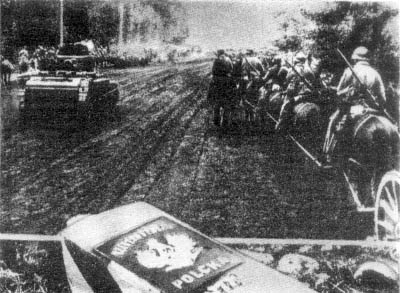
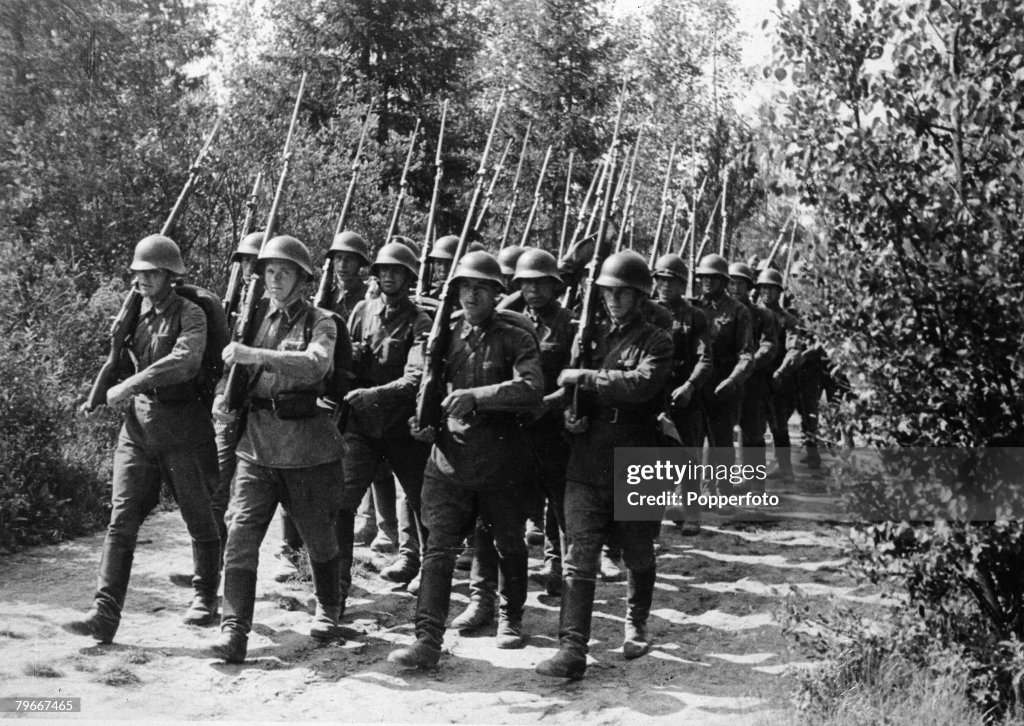
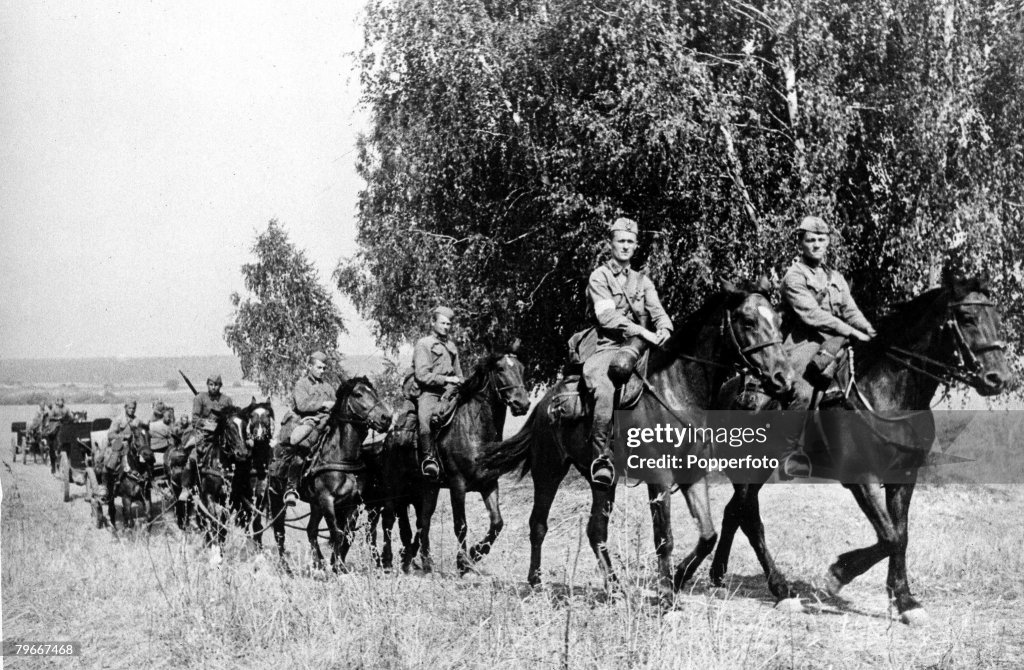
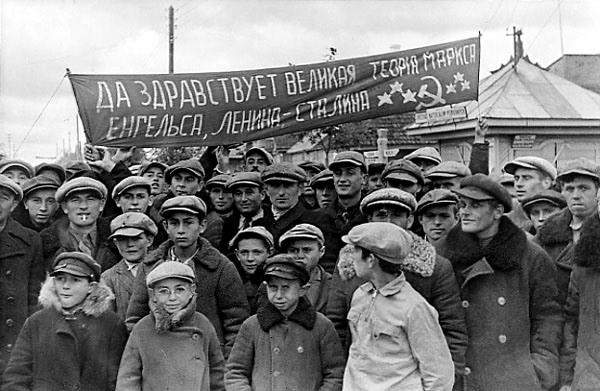
Stalin’s Soviet Red Army invades Poland from the East. The Soviet Red Army crossed the Polish border at 3 AM on the night of September 16–17, 1939, with over 600,000 soldiers, 4,700 tanks, and 3,300 combat planes. The invasion began with attacks on the Border Protection Corps’ watchtowers in Czuryłowo, Szapowały, and Polikszty. The Red Army invaded across the entire 800 mile eastern frontier of Poland. The Poles were surprised and Soviet forces advanced virtually unopposed. Neither England nor France chooses to break diplomatic relations with Moscow or declare war, despite Russia’s obvious aggression. The USSR will occupy the Eastern half of Poland, which was given to it by the secret parts of the German-Soviet treaty. The Soviet invasion led to the collapse of Polish resistance, which effectively ended the fighting in the eastern front for several years.
On 17 September 1939 the Polish Army, although weakened by weeks of fighting, still was a coherent force. Moczulski asserted, that the Polish Army was still bigger than most European armies and strong enough to fight the Wehrmacht for a long time. On the Baranowicze – Łuniniec – Równe line, rail transport of troops from the northeastern corner of the country towards the Romanian Bridgehead resumed day and night (among these troops were the 35th Reserve Infantry Division under Colonel Jarosław Szafran, the so-called “Grodno Group” (“Grupa grodzieńska”) of Colonel Bohdan Hulewicz) and the second largest battle of the September Campaign – the Battle of Tomaszów Lubelski, started on the day of the Soviet invasion. According to Leszek Moczulski, around 250,000 Polish soldiers were fighting in central Poland, 350,000 were getting ready to defend the Romanian Bridgehead, 35,000 were north of Polesie, and 10,000 were fighting on the Baltic coast of Poland, in Hel and in Gdynia. Due to the ongoing battles in the area around Warsaw, Modlin, the Bzura, at Zamość, Lwów and Tomaszów Lubelski, most German divisions had been ordered to fall back towards these locations. The area that remained under control of the Polish authorities encompassed around 140,000 km2 (54,000 sq mi) – approximately 200 km (120 mi) wide and 950 km (590 mi) long – from the Daugava in the north to the Carpathian Mountains in the south. Radio Baranowicze and Radio Wilno ceased to broadcast on 16 September after having been bombed by German Luftwaffe units, while Radio Lwów and Radio Warsaw II still aired as of 17 September.
The Red Army, which vastly outnumbered the Polish defenders, achieved its targets, encountering only limited resistance. Some 320,000 Poles were made prisoners of war. The campaign of mass persecution in the newly acquired areas began immediately. In November 1939 the Soviet government annexed the entire Polish territory under its control. Some 13.5 million Polish citizens who fell under the military occupation were made Soviet subjects following show elections conducted by the NKVD secret police in an atmosphere of terror, the results of which were used to legitimise the use of force. A Soviet campaign of political murders and other forms of repression, targeting Polish figures of authority such as military officers, police and priests, began with a wave of arrests and summary executions. The Soviet NKVD sent hundreds of thousands of people from eastern Poland to Siberia and other remote parts of the Soviet Union in four major waves of deportation between 1939 and 1941. Soviet forces occupied eastern Poland until the summer of 1941 when Germany terminated its earlier pact with the Soviet Union and invaded the Soviet Union under the code name Operation Barbarossa.
National Socialist Germany and Bolshevist Russia today joined hands over the prostrate body of Poland, partitioning territories between them and wiping another State from the European map.
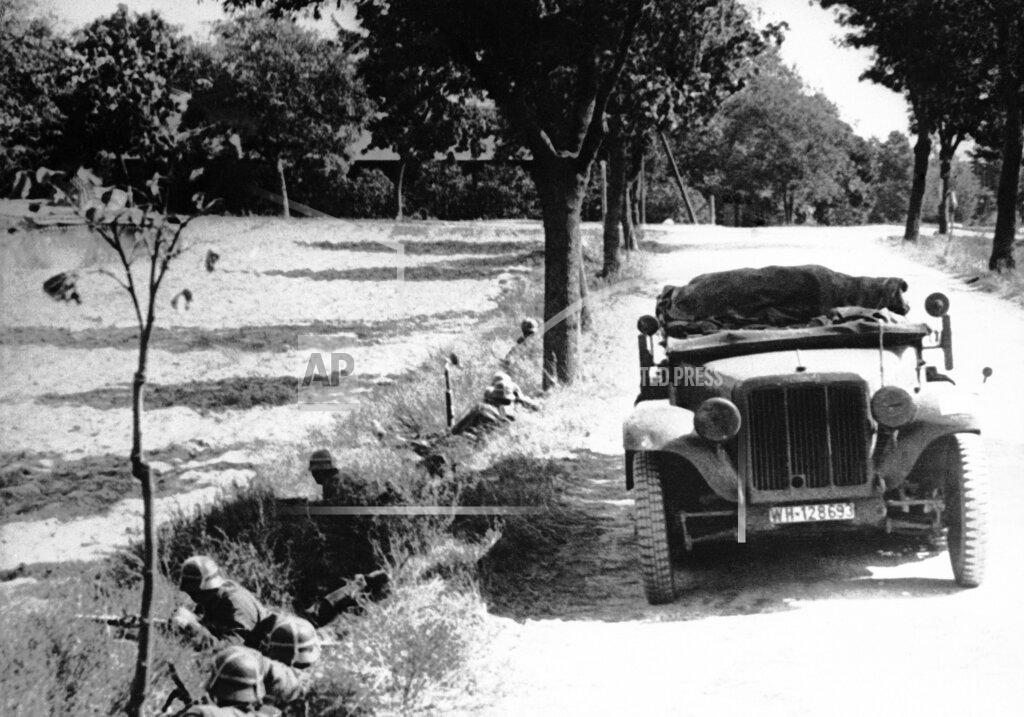
In Poland, German troops capture Kutno, west of Warsaw. East of Warsaw, Heinz Guderian’s XIX Panzerkorps of Army Group North makes contact with XXII Panzerkorps of Army Group South, just to the south of Brest-Litovsk; virtually the whole Polish Army (or what remains of it) is now trapped within a gigantic double pincer.
The Battle of Brześć Litewski ended in German victory. Although the German infantry had been repelled yesterday and the assault of German tanks was stopped by two FT tanks sealing the northern gate of the fortress, by nightfall it had become apparent that the German pressure made the situation very grave. Despite heavy losses, the German 20th Motorized Division and 10th Armoured Division captured the northern part of the citadel. Meanwhile, the combined 3rd Armoured Division and 2nd Armoured Division comprising the XXIInd Armoured Corps entered the area. The Poles were unable to resupply and the casualties rose to almost 40%. At dawn today, General Konstanty Plisowski ordered part of the Polish forces to retreat from the easternmost fortifications and regroup to the other side of the river and southwards. The evacuation was completed by early morning, 17 September when the last unit crossing the bridge blew it up to hinder the Germans. An hour later elements of the German 76th infantry regiment entered the fortress – almost unopposed. Meanwhile, the Red Army crossed the Polish border and started its quick advance westwards. The Soviet 29th tank brigade under Brigadier Semyon Krivoshein reached the area of Brześć later that day and took over the fortress from the Wehrmacht. During that event a joint German-Soviet parade was held in the town, after which the German forces left the area, crossed the Bug River and started their pursuit of the fleeing forces of general Plisowski.
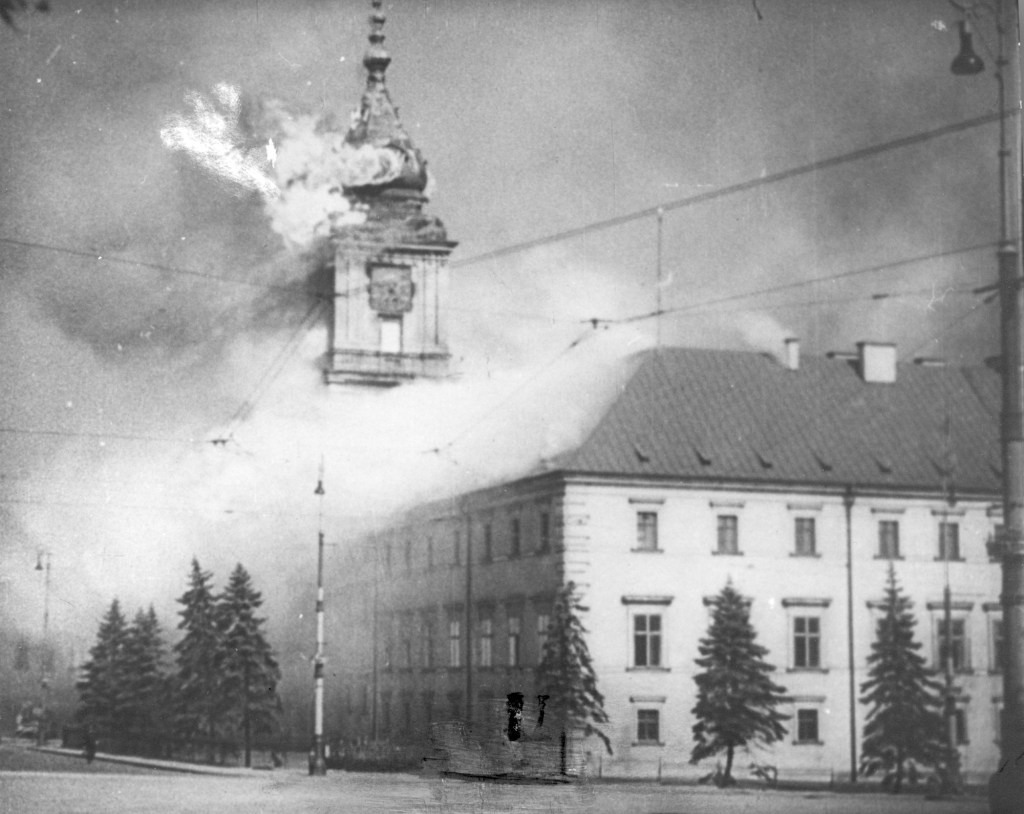
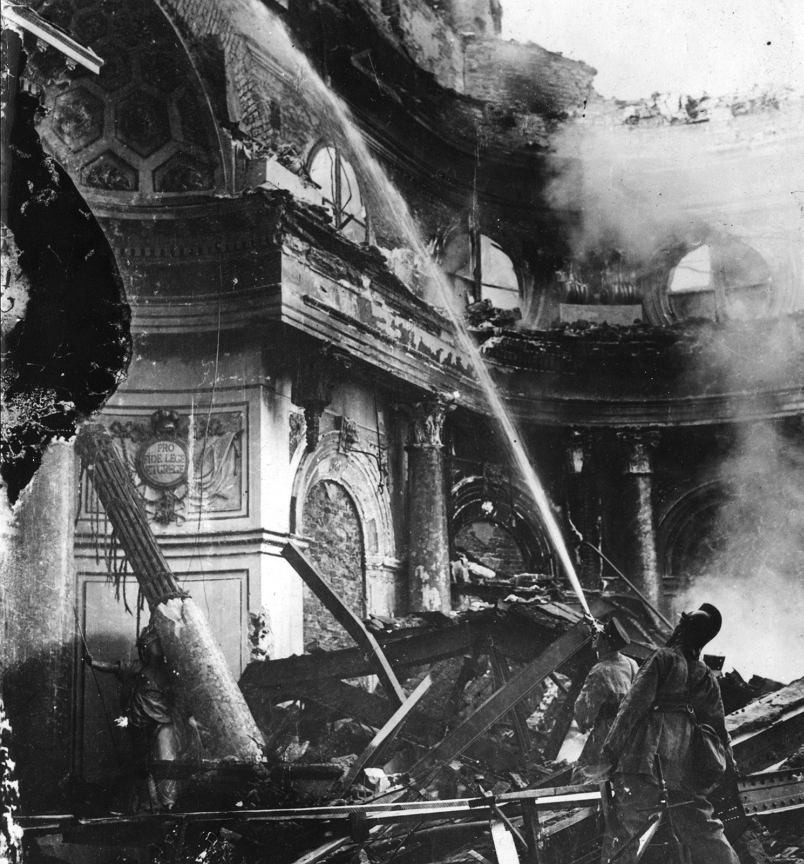
The retreat of the Poles becomes a rout. The Germans now face a mop-up job of its foe, crushed by mechanization and numerical superiority.
Poland’s leaders are reportedly fleeing to Rumania. Poland’s President Ignacy Mościcki and Prime Minister Felicjan Sławoj Składkowski are heading for the Rumanian border.
Reports of Russian troop movements a few miles from the Rumanian border and the consequent possibility of fighting near the frontier caused grave concern in Bucharest today. King Carol was closeted with his close advisers all day. Reports abroad that a Crown Council had been held were denied officially. The public also was apprehensive over Moscow’s statement that Russia would protect her nationals in Poland. About 1,000,000 Russians and Ukrainians live in the Rumanían territory of Bessarabia and Bucovina. Moscow has never recognized Rumania’s annexation of Bessarabia.
At least outwardly optimistic, spokesmen close to the government expressed the belief that Germany as well as Russia would respect the Rumanian frontiers. They emphasized that Rumania’s own attitude was unchanged, namely, that she intended to remain neutral but was ready to defend her borders. It was officially confirmed tonight that Russia had assured Rumania, through the Rumanian Minister in Moscow, that Russia would respect Rumanian neutrality and territory.
In Russia, Joseph Stalin declares that the government of Poland no longer existed, thus all treaties between the two states are no longer valid; Soviet troops pour across the border to join Germany in the invasion, ostensibly to protect Ukrainian and Byelorussian interests from potential German aggression.
The totally unprepared population of the Soviet Union learned through loudspeakers on the streets at 11 o’clock this morning that its government during the night had committed it to the invasion of a neighbor’s territory. Warlike operations, which elsewhere are preceded by parliamentary debates and long newspaper campaigns and even in Germany by a special session of the Reichstag, here were brought to the knowledge of an unprepared people hours after they had begun.
Little wonder that the Moscow population, recalling the reiterated declarations of leaders headed by Joseph Stalin that they did not desire a foot of any one else’s territory, went about today asking: “What has happened now?” “Are we at war; with whom and why?” “What do we want in Poland?” “What has gone wrong with the neutrality pact signed with the express purpose of keeping us from war?”
The Soviet radio declared that special propaganda meetings in every part of the Union today revealed general support “for the noble act of the government.” The only emotion revealed by foreign observers in Moscow was one of utter bewilderment. As the Soviet forces marched into Poland representatives of Britain and France and of countries as far removed from European quarrels as the United States received notes. assuring them that Russia would observe “neutrality” toward them.
Lavrentiy Beria, head of the Soviet NKVD, establishes the Directorate for Prisoners of War and Interned Persons (UPVI), which will run camps for 240,000 Polish prisoners of war in the near future.
Premier Édouard Daladier cuts his trip to the front short, rushing back to Paris to confer on Russia’s invasion of Poland. With the European war spreading to a new front as Russia sent troops into Poland, informed sources said today that France faced the possibility of a state of war with the Soviet. Soviet Russia’s march into Poland caught France unaware. Premier Daladier cut short a weekend inspection tour of the front lines and returned to Paris to assume charge of resulting diplomatic activity. Before the arrival of the Premier, who acts as his own Foreign Minister, Under-Secretary Auguste Champetier de Ribes held a long discussion with United States Ambassador William C. Bullitt. The head of M. Daladier’s secretariat, Robert Coulondre, former French envoy to Berlin, conferred with Polish Ambassador Julius Lukasiewicz.
The French and British Governments were understood to be in almost continuous consultation on the new situation. The Polish Embassy declared the Poles were “resisting the Russian invasion,” but admitted there was no precise indication as yet of the extent of Polish resistance. Informed Frenchmen said that if a major conflict developed between Poland and Russia, France might be faced with a state of war between herself and the Soviet Union since France has pledged to aid Poland against any threat to Polish independence. Invocation of that pact brought France. into war against Germany on September 3.
Havas, the French news agency, which has official connections, declared Russia’s entry into Poland as yet contained no proof it was made in cooperation with Germany. “Despite efforts of German propaganda” to make it appear the Russian advance was by Chancellor Hitler’s agreement, Havas declared, there was no evidence “that the Russian act is entry of the Soviet Union into the war on Germany’s side.”
The formation of a Polish army in France, undertaken under the sponsorship of various Polish organizations here in cooperation with the French Government, is already well under way.
The entry of the Red Army into Polish territory drove home to Britain’s leaders today that the country whose independence and territorial integrity Britain and France guaranteed had just about given its all for the allied cause and was in the process of being divided up. With the Poles attacked from two sides, it was realized that the Eastern Front virtually had disappeared, and that the French and British troops might have to face almost the full force of the Nazi military machine on the Western Front. A full statement of the British Government’s attitude toward the Russian march into Poland is expected when Prime Minister Neville Chamberlain makes his weekly report to Parliament on Wednesday. Not for another twenty-four hours, it was said, would the government’s information on the latest development be adequate for an official statement of its position.
Fascist Italy greeted Russia’s invasion of Poland today with indications that she had dropped her former animosity toward the U.S.S.R. and with signs of solidarity with Germany, her military ally.
News of the Russian invasion of Poland was received with dismay by the Holy See in Rome, it was learned today. Pope Pius, indeed, is said to be horrified at what has happened, although he, like everyone, knew that it was coming.
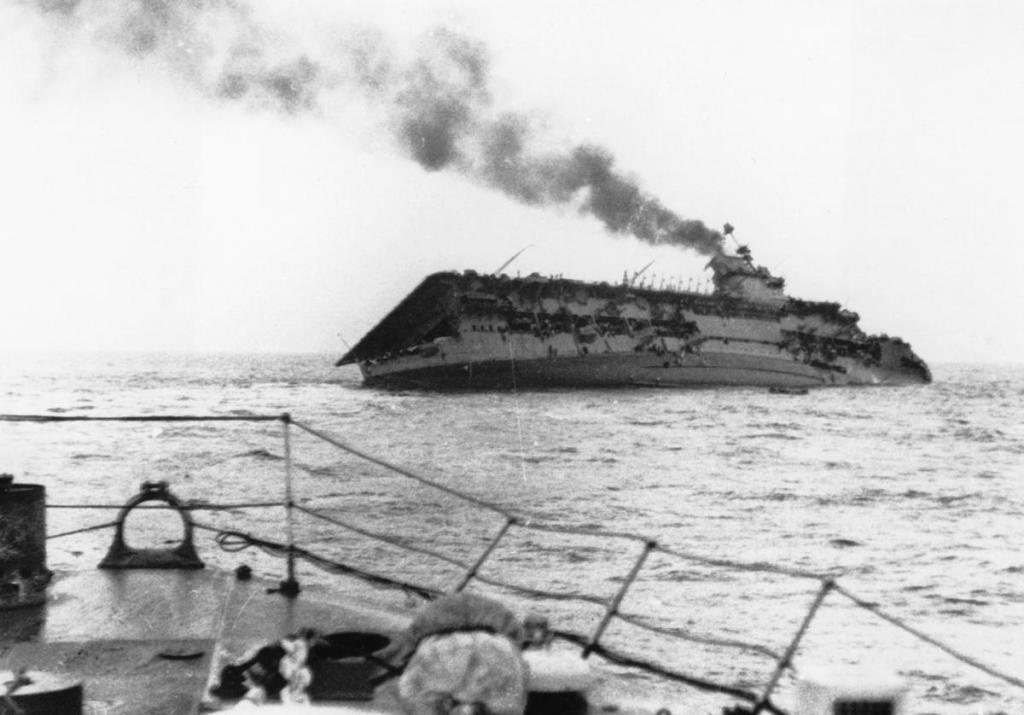
The British aircraft carrier HMS Courageous was sunk off the coast of Ireland by German submarine U-29. British use of Home Fleet aircraft carriers to hunt German submarines, begun on 3 September, ends in disaster after U-29 torpedoes and sinks HMS Courageous southwest of the British Isles, 50°10’N, 14°45’W. Courageous is the first capital ship lost by any of the combatants. “A wonderful success,” the German U-boat High Command War Diary exults, “and confirmation of the fact that the English defense forces are not as effective as they advertise themselves to be.”
Courageous had departed Plymouth on the evening of 3 September 1939 for an anti-submarine patrol in the Western Approaches, escorted by four destroyers. On the evening of 17 September 1939, she was on one such patrol off the coast of Ireland. Two of her four escorting destroyers had been sent to help a merchant ship under attack and all her aircraft had returned from patrols. U-29, commanded by Captain-Lieutenant Otto Schuhart, stalked Courageous for more than two hours. The carrier then turned into the wind to launch her aircraft. This put the ship right across the bow of the submarine, which fired three torpedoes. Two of the torpedoes struck the ship on her port side before any aircraft took off, knocking out all electrical power, and she capsized and sank in 20 minutes with the loss of 519 of her crew, including her captain. The US cargo ship Collinsgworth, Ellerman Lines cargo ship Dido, and Dutch ocean liner Veendam rescued survivors. The two escorting destroyers counterattacked U-29 for four hours, but the submarine escaped.
U.S. freighter Black Condor is detained by British authorities.
U-41 captured Finnish freighters Suomen Poika and Vega.
The unescorted British steam merchant Kafiristan was torpedoed and sunk by the U-53, commanded by Ernst-Günter Heinicke, Ernst-Günter Heinicke, about 350 miles west of Cape Clear, Ireland in the eastern Atlantic Ocean (50°16′N 16°55′W). Of the ship’s complement, 6 died and 29 survivors were picked up by the American merchant American Farmer. The 5,193-ton Kafiristan was carrying sugar and was bound for Liverpool, England.
Polish submarine ORP Orzel escapes Tallinn, where it has been interned. The Soviet Union seizes this incident, as an excuse that proves Estonia is not able to uphold its neutrality.
Taisto Mäki of Finland becomes first man to run 10,000 meters in under 30 minutes, in a time of 29:52.6 in Helsinki.
——————————————————————————–
The situation created by the Soviet invasion of Poland was watched by high U.S. Administration officials today, but there was no public statement. For three and one-half hours Secretary Hull was at the State Department, closeted most of the time with his principal advisers, “keeping abreast of the developments.” These developments were reported to the Secretary in dispatches from foreign capitals, and especially from Laurence A. Steinhardt, the American Ambassador in Моscow.
Although it was understood that Mr. Steinhardt had forwarded texts of the notes sent by Russia to Poland and handed to chiefs of foreign missions in Moscow, the department preferred to keep any discussion in abeyance for a while at least. Whether Mr. Hull will have any public statement concernIng them will not be known until tomorrow. President Roosevelt, who, it was presumed, was kept constantly advised by Mr. Hull, is expected to discuss the move by the Soviet when he talks with Congressional leaders before sending his message on neutrality to Congress next Thursday.
It was understood here that the note sent by the Soviet to the powers proclaimed its neutrality and asserted that its expedition into Poland was to protect minorities where there was no remaining government. How this profession of neutrality will be received in offielal Washington remains to be seen. Officials will study the situation and decide whether the Russian step falls within the scope of neutrality or if it is an act of war. If it is decided that it is an act of war the President may, if he chooses, declare that war exists and the Soviet would be placed in the classification of a warring nation, just as Germany, Britain, France and Poland have been designated. In that event the arms embargo might be extended to the Soviet and the position of this government materially altered in various other ways.
While officials remained silent concerning the Soviet move, there was no question that it was viewed with gravity and that it will have repercussions in the coming neutrality debate in Congress. Congressional comment was cautious pending faller information concerning the situation.
Senator Borah remarked sharply that European boundaries “do not concern me.” Senator Thomas of Utah, another Foreign Relations Committee member, declared the development to be “quite natural.” Senator Borah, in comment today on the Russian-Polish development, declared that it should strengthen this country’s determination to keep out of the conflict in Europe. He added that, to, him, the Soviet invasion of Eastern Poland could mean only that Russia and Germany were operating under an understanding to divide Poland, He voiced the opinion, however, that Russia, once it had reclaimed the Ukrainian and White Russian sections which it held before the World War, would be loathe to fight on the Western front if the collapse of Poland moved the major theater of war there. “It seems to me,” he said, “that each new development in the European situation reveals more and more reasons why we should have nothing to do with it.”
The American people have a big enough job fighting Nazi and Soviet-inspired enemies of democracy in this country without going to the aid of democratic countries of the Old World, Chairman Dies of the House committee Investigating un-American activities said in a National Broadcasting Company network address delivered here tonight. Reviewing testimony given to the committee in recent weeks, Mr. Dies asserted it was proved beyond question that the German-American Bund and the Communist party of the United States are “agents of Hitler and Stalin who are now busy organizing their ideological armies on our own soil — ideological armies which can be turned overnight into armies of sabotage, espionage and civil war.”
It is “natural” that Americans should be interested and partial toward Britain and France despite their “disgraceful” repudiation of debts to this country, he said, but held that American participation in European war would lead to dictatorship and bankruptcy here. Asserting that “the foreign agents of Stalin have been pampered long enough in high government circles, in trade unions and in the camps of the so-called liberals,” and that “the foreign agents of Hitler have been petted long enough by so-called patriotic groups,” the speaker called on all these agencies to purge themselves of such influences.
Senator Hiram W. Johnson of California in a statement made today asserted “a prohibitory embargo against all nations at war” would. be the only means of maintaining American impartiality in the present conflict. The veteran isolationist asserted President Roosevelt three years ago in a speech said, “If we face the choice of profits or peace, the nation will answer — must answer — ‘We choose peace.’ “
The Rev. Charles E. Coughlin asked his followers today to “organize an army of peace” and march on Washington to protest any change in the present neutrality law.
The United States Brewers Association anticipates that beer production will be curtailed because of a shortage of hops.
Normalcy returns to the U.S. wheat market, with supply and demand factors in balance.
The pace accelerates in the U.S. steel industry.
Four battered American survivors of the Norwegian freighter Ronda, sunk by a mine off northern Holland, described graphically today two days and nights without food or water in a tiny lifeboat before they were rescued by an Italian steamer. Seventeen people, including two Americans, died in the sinking.
U.S. National Championship Men’s Tennis, Forest Hills, New York: Reigning Wimbledon champion Bobby Riggs beats fellow American Welby van Horn, 6–4, 6–2, 6–4.
U.S. National Championship Women’s Tennis, Forest Hills, New York: Dual champion Alice Marble beats Helen Jacobs, 6–0, 8–10, 6–4.
American League President Will Harridge overturns umpire Cal Hubbard’s decision to award the Yankees with 9-0 forfeited victory over the Red Sox, ordering the contest to be replayed from the seventh inning. The Red Sox fans, protesting the deliberate outs New York was making to take advantage of the 6:30 Sunday curfew, had thrown a barrage of garbage onto the playing field which made it impossible to continue the Fenway Park contest.
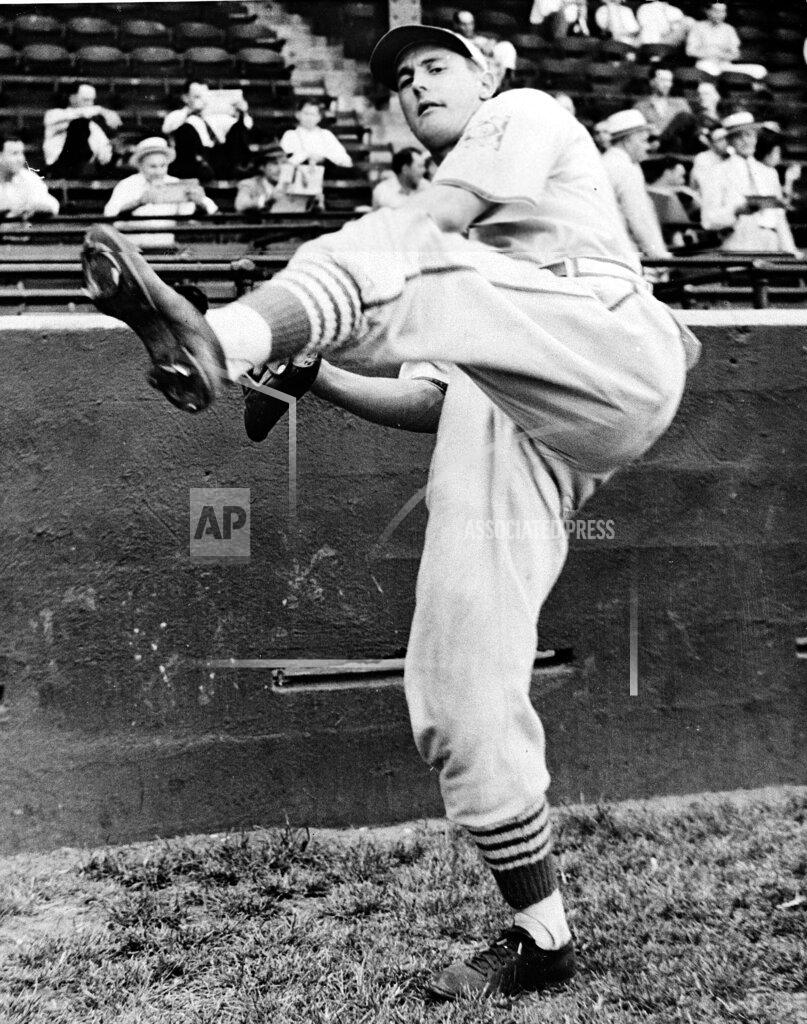
The second-place Boston Red Sox maintained a three-game lead over the third-place Chicago White Sox today as the teams split a double-header in their last meetings this season. Chicago took the first game, 6–1, behind Thornton Lee’s three-hitter; Boston came back to win the nightcap, 11–7, pounding out sixteen hits. Ted Williams hits a home run off Thornton Lee in the opener, one of 31 homers he will hit in his rookie season. Williams will homer off Thornton’s son, Don Lee, 21 years later.
The New York Yankees, who just clinched the American league pennant, got rude treatment by the visiting St. Louis Browns. The Browns proceeded to sweep a doubleheader by scores of 8–4 and 3–1. The opener was won by Jack Kramer; the nightcap was won by Howie Mills. Red Ruffing and Lefty Gomez took the losses. Only a homer by Babe Dahlgren avoided a shutout in the second game.
The Athletics and Indians split a double-header today, Philadelphia winning the first game, 4–2, and dropping the second, 18–5. The opener saw the A’s beat Indians’ ace Bob Feller for the first time this season.
Hank Greenberg’s twenty-ninth home run gave the Detroit Tigers a 3–2 victory over the Washington Senators in an eleven-inning game today before 15,000 fans.
The Cincinnati Reds’ Paul Derringer won his 22nd as the Reds won the opener of a doubleheader with the Boston Bees, 6–5. Derringer won despite 11 Bees hits and six Cincinnati errors that put him in repeated trouble; he struck out seven with no walks. The Bees swarmed back to take the nightcap, 5–3, as Johnny Lanning scattered nine hits.
The Brooklyn Dodgers pull within one game of the 3rd-place Chicago Cubs, taking a pair at Wrigley Field. The yellow-dyed ball is used in the first game, as Brooklyn wins, 10–4, with Hugh Casey winning over Earl Whitehill. In the nitecap, the Dodgers win, 3–2, as Hot Potato Hamlin bests Claude Passeau.
The New York Giants split their doubleheader with the St. Louis Cardinals, winning the first game, 2–1, behind Carl Hubbell’s pitching. The Cardinals won the closer by the same score, 2–1, as Joe Medwick extended his hitting streak to 13 games.
The Philadelphia Phillies and Pittsburgh Pirates also split a doubleheader. The Phillies take game one, 7–3, as the Pirates commit eight errors. The Pirates rout the Phillies in the nightcap, 10–1, as Bobby Klinger tosses a four-hitter and the Pirates pound out 17 hits of their own.
——————————————————————————–
News of Russia’s participation in the war in Poland came as a shock to Ottawa, and although official comment was refused, it was agreed unofficially that on no part of the British Empire, except England and perhaps India, could it have so many repercussions as on Canada.
The Battle of Changsha began in the Second Sino-Japanese War. Japan now drives for a China victory. A peace deal with Chiang Kai-shek is not ruled out. Japan renews attacks on China following the armistice with Russia. The Japanese 101st Division (Lieutenant General Masatoshi Saito) and 106th Division (Lieutenant General Ryotaro Nakai), having recently captured strategic locations in Jiangxi Province, China as a preparation, began marching toward Changsha in the neighboring Hunan Province. Meanwhile, 3rd Division (Lieutenant General Shinichi Fujita), 6th Division (Lieutenant General Shiro Inaba), 13th Division (General Shizuichi Tanaka), and 33rd Division (Lieutenant General Shigetaro Amakasu) attacked targets in northern Hunan Province. In support of this attack, Japanese Navy’s China Area Fleet dispatched 13th Gunboat Unit of 11th Battle Squadron, Shanghai Special Naval Landing Force, and 4th Guard Unit.
Informants close to the War Office in Tokyo said today that “it was natural to assume” that large numbers of Japanese troops were being removed from the Soviet frontiers of Manchukuo to China.
Australians rush to enlist in the army.
——————————————————————————–
Born:
David Souter, American retired 107th Supreme Court Justice (1990-2009), in Melrose, Massachusetts.
Lamonte McLemore, American champagne soul vocalist (5th Dimension, 1966-2006 – “Up, Up and Away”; “Aquarius/Let the Sunshine In”), in St Louis, Missouri.
Shelby Flint, American singer-songwriter (“Angel on My Shoulder”; “Cast Your Fate to the Wind”), in North Hollywood, California.
Carl Bouldin, MLB pitcher (Washington Senators), in Germantown, Kentucky.
Jim Woods, MLB third baseman and pinch hitter (Chicago Cubs, Philadelphia Phillies), in Chicago, Illinois.
Joseph Mosikili, American-born South African broadway actor and singer, in Amarillo, Texas.
——————————————————————————–
Died:
Ethel M. Dell, 58, English author (“Storm Drift”).
——————————————————————————–
Naval Construction:
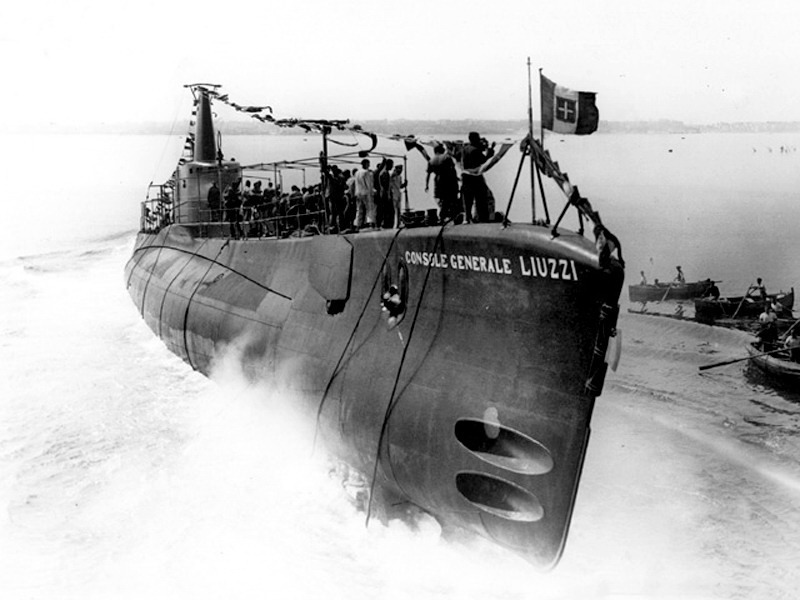
The Regia Marina (Royal Italian Navy) submarine Console Generale Liuzzi, first of her class of 4, is launched by Cantieri navali Tosi di Taranto, Taranto, Italy.
The Kriegsmarine (German Navy) vorpostenboot V 213 Zieten (later V 204 Zieten) is commissioned.
The Kriegsmarine (German Navy) vorpostenboot V 214 Spica (later V 804 Spica) is commissioned.
The Kriegsmarine (German Navy) vorpostenboot V 402 Hans Loh (later V 406 Hans Loh) is commissioned.
The Kriegsmarine (German Navy) vorpostenboot V 403 Germania (later V 410 Germania) is commissioned.
Royal Canadian Navy Fisherman’s Reserve patrol vessel HMCS Capella I (FY 31; ex-halibut boat) is commissioned.
The Вое́нно-морско́й флот СССР (ВМФ) (Soviet Navy) Project 7-class (Gnevny-class) destroyer Gremyashchy (Гремящий, “Thunderous”) is commissioned.
——————————————————————————–
——————————————————————————–
——————————————————————————–
——————————————————————————–
——————————————————————————–
——————————————————————————–
——————————————————————————–
——————————————————————————–
——————————————————————————–
——————————————————————————–
——————————————————————————–
——————————————————————————–
 History Diaries