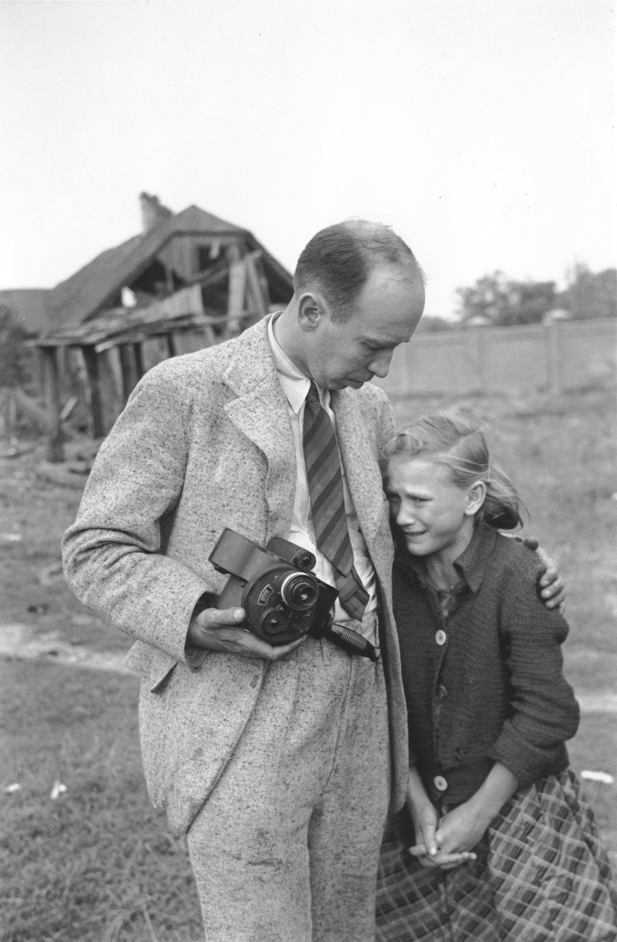
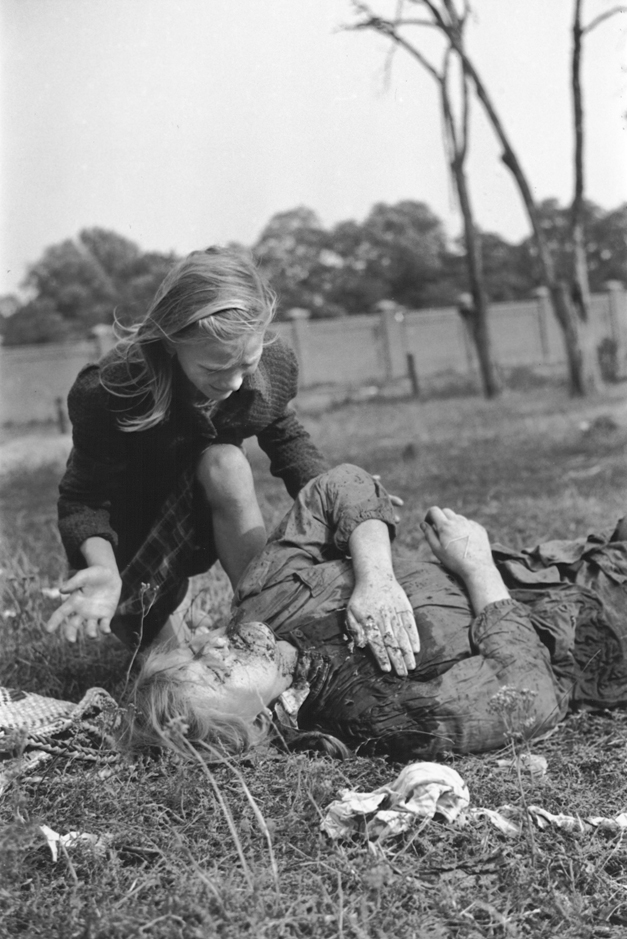
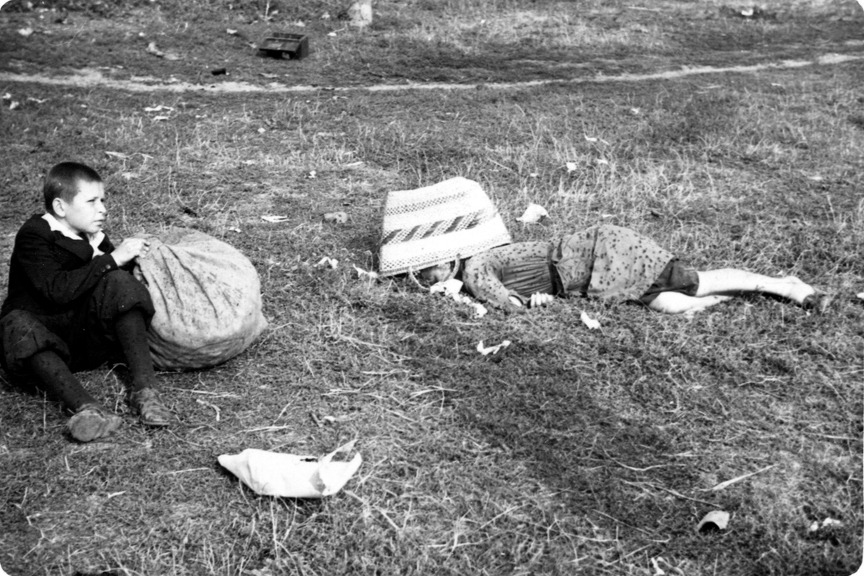
Photographer Julien Bryan described the scene: “As we drove by a small field at the edge of town we were just a few minutes too late to witness a tragic event, the most incredible of all. Seven women had been digging potatoes in a field. There was no flour in their district, and they were desperate for food. Suddenly two German planes appeared from nowhere and dropped two bombs only two hundred yards away on a small home. Two women in the house were killed. The potato diggers dropped flat upon the ground, hoping to be unnoticed. After the bombers had gone, the women returned to their work. They had to have food.
But the Nazi fliers were not satisfied with their work. In a few minutes they came back and swooped down to within two hundred feet of the ground, this time raking the field with machine-gun fire. Two of the seven women were killed. The other five escaped somehow.
While I was photographing the bodies, a little ten-year old girl came running up and stood transfixed by one of the dead. The woman was her older sister. The child had never before seen death and couldn’t understand why her sister would not speak to her…
The child looked at us in bewilderment. I threw my arm about her and held her tightly, trying to comfort her. She cried. So did I and the two Polish officers who were with me…” [Source: Bryan, Julien. “Warsaw: 1939 Siege; 1959 Warsaw Revisited.”]
In September 1959 Julien Bryan wrote more about it in Look magazine:
In the offices of the Express, that child, Kazimiera Mika, now 30, and I were reunited. I asked her if she remembered anything of that tragic day in the potato field. “I should,” she replied quietly. “It was the day I lost my sister, the day I first saw death, and the first time I met a foreigner – you.” Today, Kazimiera is married to a Warsaw streetcar motorman. They have a 12-year-old girl and a boy, 9, and the family lives in a 1 1/2-room apartment, typical of the overcrowded conditions of war-racked Poland. She is a charwoman at a medical school (she told me her biggest regret is that her education ended when the war began), and all of the $75 earned each month by her husband and herself goes for food. Kazimiera and her husband, like most Poles, supplement their income with odd jobs, and are sometimes forced to sell a piece of furniture for extra money. But they celebrated my visit to their home with that rare treat, a dinner with meat.
The war communiqués today, describing continued Polish resistence to the Germans, indicated a stiffened Polish front, but offered little hope that effective resistance in the East can long be continued, in the opinion of military observers in Washington. Before hostilities began, many observers set about six weeks as the length of time it would require the German legions to achieve their aims in Poland. But with the rapid advance of German armies into the heart of Poland, many of these observers have revised their estimates and now believe the Poles will be forced from their traditional main defensive line along the Narew, Bug and Vistula Rivers within one to three weeks more. An even longer, or conceivably a shorter time, may elapse before the bulk of the Polish armies is forced back across the Russian border, into the Pripet Marshes or the Carpathians, or disorganized, destroyed or captured, but regardless of the time element, the point made by most observers in Washington is that the German Army advance has been so rapid, and so much of the vital industrial and mining areas of Poland has passed into German hands, that there seems little chance in the near future of organizing an effective Eastern Front.
The Battle of Modlin began. Modlin Fortress was initially the headquarters of the Modlin Army until its retreat eastwards. From 13 to 29 September 1939, it served as a defensive citadel for Polish forces under the command of General Wiktor Thommée against assaulting German units. The fighting was closely linked with the strategic situation of the Battle of Warsaw. The Polish forces defending the fortress included the armoured train Śmierć (“death”) and the Modlin anti-aircraft battery, which was credited with shooting down more Luftwaffe planes than any other in the entire September campaign. Fortress Modlin capitulated on 29 September, one of the last to lay down its arms in the campaign, and surrendered 24,000 troops.
The Battle of the Bzura River, between the Polish Posnan and Pomorze Armies and Germany’s Army Group South, continues. The Polish offensive towards Łowicz begins as General Tadeusz Kutrzeba learned that units of Army Łódź had retreated to the Modlin Fortress and decided to stop the offensive and instead sought to try to break through Sochaczew and the Kampinos Forest to reach Warsaw. A small German infantry force begins to cross the Vistula just south of Warsaw. The Bzura battles are now going badly for the Polish forces. The heaviest fighting will be over by September 15th but some engagements will continue until the 19th. Although the Germans will take their largest single haul of 150,000 prisoners in this battle, by September 19th, units of two Polish brigades and elements of others will manage to escape to Warsaw.
The 60,000 survivors in the Radom Pocket in Poland surrendered.
German troops enter Gdynia, Poland’s only seaport, after the mayor of the city surrendered to General Magnus Eberhardt.
German troops complete the encirclement of Warsaw.
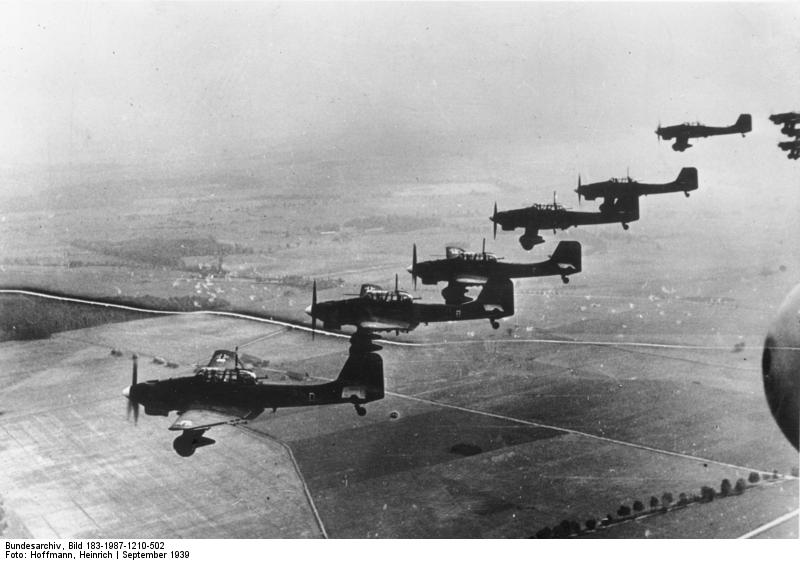
The U.S. ambassador to Poland, Anthony J. Drexel Biddle, Jr., reports that German bombers are attacking the civilian population. He says “they are releasing bombs they carry even when they are in no doubt as to the identity of their objectives.
A picture of Warsaw under land and air bombardment, “which destroyed half of the city,” was given over the Warsaw radio tonight by Captain Wladyslaw Polenski of the Polish Air Corps.
The German Armed Forces High Command (OKW) announced that civilian targets in Poland are being bombed because civilians are involving themselves in the fighting. Infuriated by the growing participation of Poland’s civilian population in guerrilla warfare against the German Army, the movable headquarters of Chancellor Hitler on the German front in Poland today modified Herr Hitler’s pledges to President Roosevelt against bombardment of civilian populations in open towns by issuing the following communiqué:
“There have been increasing instances in recent days in which the Polish Government and Army authorities have called upon the populations of open cities to offer resistance to invading German troops within the environs of cities, market places and villages. In Warsaw, by means of leaflets, the Polish radio and by other proclamations, they have called upon the population to go over to a franc-tireur war. The city itself was bombarded by Polish artillery. The supreme command of the German armed forces announces, therefore, that the great consideration German artillery and fliers have shown for open cities, market places and villages is dependent on the condition that the enemy himself does not convert them into a battlefield. Inasmuch as the Poles, without regard to their own population, repudiate this principle, the German armed forces will from now on break the resistance of such places with all means at their disposal. German air forces will, in cooperation with heavy artillery, carry out such military measures as are suited to demonstrate to such places the futility of their resistance. The responsibility for the consequences to the thoroughly tried population falls wholly on the Polish Government and its incapable and conscienceless army leaders.”
This modification of Herr Hitler’s pledge, which was originally conditioned only on the observance of like restraint by what Germans say is the now almost annihilated Polish air force, followed a two-hour conference between Herr Hitler and Field Marshal Hermann Göring at the Chancellor’s headquarters. Here, according to the official communiqué, Marshal Göring reported, among other things, “on further employment of the air force.” Simultaneously the German press begins to publish more extensive accounts and pictures about the alleged killing, mutilation, torturing, imprisonment and deportation of many Germans in Poland under headlines “horrible extermination of large parts of the German people in Poland.” The press also suggests drastic countermeasures.
With this communiqué and at a time when the Germans say they are certain of military victory in the East, the war begins to enter upon a new phase of “Schrecklichkeit” (frightfulness). It is perhaps significant that in the German press as well as at the foreign press conference, attended today by Dr. Otto Dietrich, Reich press chief who has just returned from Herr Hitler’s headquarters at the front, final responsibility for Polish resistance and its consequences are laid solely at the door of Great Britain. The press, in fact, flatly charges that the sufferings of Germans are due entirely to “the inhuman warfare of the English in Poland.”
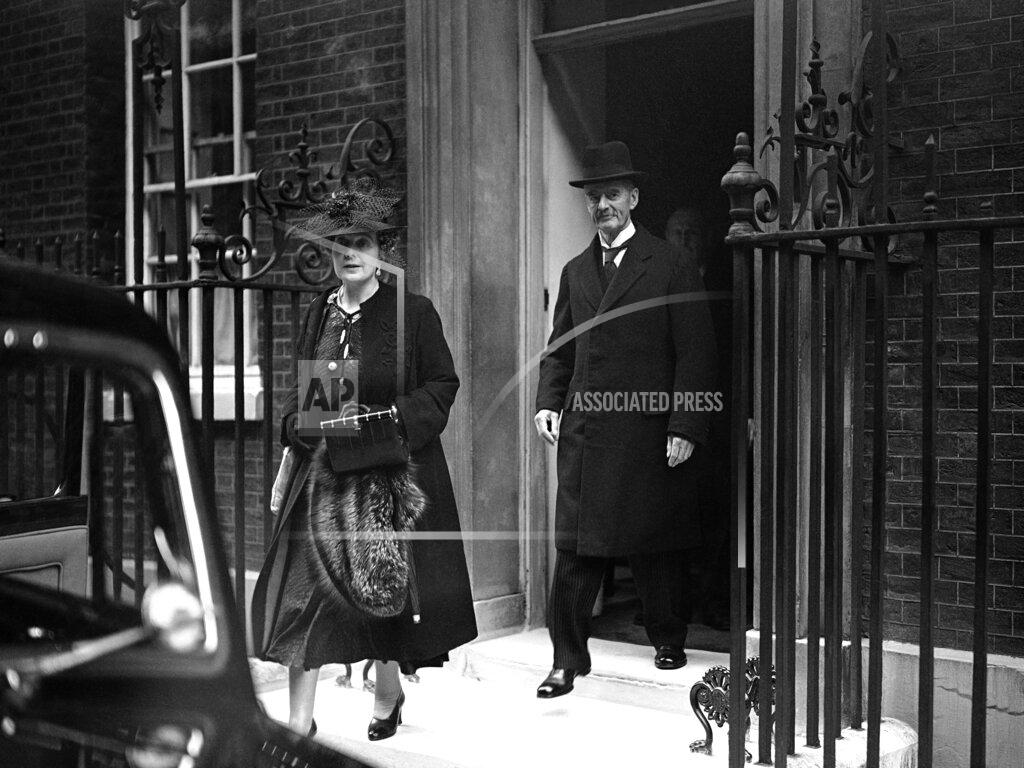
A Commons sitting took place in the British Parliament, where the Prime Minister, Mr. Chamberlain, addressed the war situation. The British war aims were discussed during oral answers to questions in the Commons. Prime Minister Neville Chamberlain, speaking in the House of Commons today, told of his visit to France yesterday to attend the meeting of the Supreme War Council and declared that “the people of France and the people of Great Britain are alike determined not only to honor fully their obligations to Poland but also to put an end once and for all to the intolerable strain of living under the perpetual threat of Nazi aggression.”
“Our French allies are, like ourselves, a peace-loving people,” said the Prime Minister, “but they are no less convinced than are we that there can be no peace unless the menace of Hitlerism has been finally removed.” Mr. Chamberlain’s voice never rang with more determination than when he lapsed into French to add, “Il faut en finir” — “It’s got to be ended.”
Replying to a questioner, the Prime Minister repeated his recent pledge to Edvard Beneš, President of Czecho-Slovakia, that the British Government “looked forward, through the triumph of the principles for which we have taken up arms, to the release of the Czech people from foreign domination.” And his words were underlined later by an official statement of the Ministry of Information, which repeated that Great Britain and France “could only negotiate peace with a government in Germany whose word could be trusted, so that there would be certainty for the future.”
“This could not be expected from Herr Hitler, whose technique of brutal aggression on one non-German country after another is now obvious to all,” the statement said. “Once a trustworthy government is in power in Germany and the wrong done ‘righted, the British Government would no doubt be ready, as it has repeatedly made known, to consider in consultation with its allies and other friendly powers how a just and fair peace could be secured in Europe.”
The Duke and Duchess of Windsor, beaming like a couple on heir honeymoon, arrived at the picture-postcard village of Coleman’s Hatch in Sussex today and convinced a group of unsentimental newspaper men that they were happy and glad to be back in England.
French Premier Edouard Daladier formed a War Cabinet in which he assumed the functions of the Minister of Foreign Affairs and Presidency of Council in Ministry of National Defence and War. The former foreign minister, Georges Bonnet, is appointed Minister of Justice. Raoul Dautry is appointed Minister of Armaments and Georges Pernot is appointed Minister of Blockade, both are new portfolios related to the war effort. Daladier is keen to have a war cabinet that will enable France to put recent divisions aside and fight the war with a spirit of national unity.
The Marine Nationale (French Navy) minelaying cruiser Pluton sank from an accidental explosion while landing the mines at Casablanca, French Morocco. 186 of the Pluton’s crew were killed and 73 crewmen and 47 others were injured and significant damage was caused by flying debris.
The Marine Nationale (French Navy) auxiliary minesweepers Charcot, Chellah and Gosse were damaged beyond repair by the explosion of Pluton at Casablanca, Morocco.
The French trawlers Etoile du Matin, Marie Merveilleuse, and Sultan were sunk by the explosion of Pluton at Casablanca, Morocco.
U.S. freighter Black Osprey, detained at Weymouth, England, by British authorities since 5 September 1939, is released.
Norwegian motor vessel Ronda strikes mine off Terschelling island, Netherlands, 54°10’N, 04°34’E; two U.S. citizens perish. Survivors (including four Americans) are subsequently rescued by Italian freighter Providencia.
The 291-ton British steam trawler Davara was sunk by gunfire by the U-27, commanded by Johannes Franz, northwest of Ireland in the eastern Atlantic Ocean. Of the ship’s complement, all 12 survived and were picked up by the 11 crew members were picked up after five hours by the British steam merchant Willowpool.
The 798-ton British steam tug Neptunia was sunk by gunfire by the U-29, commanded by Kapitänleutnant Otto Schuhart, southwest of Ireland in the eastern Atlantic Ocean. Of the ship’s complement, all 21 survived.
The German trawler Stolp collided with the Kriegsmarine torpedo boat Luchs in the North Sea and sank.
The Greek cargo ship Katingo Hajipatera struck a mine and was grounded off Falsterbo, Sweden. She was refloated later that day and proceeded to Copenhagen, Denmark under escort from a Royal Swedish Navy minesweeper.
A worldwide luxury sports car brand, Ferrari was founded by Enzo Ferrari in Italy.
President Roosevelt summoned Congress today to meet in special session at noon on September 21 to consider lifting the arms embargo and revision of the Neutrality Act otherwise. Telegrams were then sent by the President to House and Senate leaders of both parties and to Vice President Garner and Speaker Bankhead asking them to come to Washington a day ahead of time for a conference with him at the White House.
The special session call was issued by proclamation a few minutes after noon. Neither in the proclamation of the “extraordinary occasion” necessitating his action nor in a brief White House announcement did the President mention the purpose of the special session, although he has said repeatedly that revision of the Neutrality Act would be his only objective. In his messages to House and Senate leaders the President said his decision had been reached only after careful consideration of all factors. The telegrams were not released textually, but their substance was described by Stephen T. Early, White House secretary, after a reading of the proclamation.
The capital tonight was preparing for another long struggle between the President and a determined group in Congress over foreign policy. A group of Senators, banded together in what they term the “peace bloc,” led by Senator Borah, veteran opponent of the Treaty of Versailles, were selecting weapons for a last-ditch fight against any compromise on the automatic arms embargo. Senator Borah in a thirty-minute radio broadcast tomorrow night will lay the groundwork for the opening assault. It was becoming increasingly clear, meanwhile, that the strategy would be to attempt to make a vote for or against lifting the arms embargo tantamount to a vote on the question of America’s active participation in the war.
There seemed little question that the Administration had expected such an effort and was moving to keep Congressional politics out of the debate. The extent to which the issue has cut across party lines is indicated by the fact that the Republican party has taken по stand on the embargo question as such, and is not likely to do so. That the President wanted to remove the question as far as possible from partisan political considerations was reflected in the list of Senators and Representatives whom, in addition to the Vice President and Speaker, he invited to the White House conference on the day before the special session convenes.
First Lady Eleanor Roosevelt reports no subversive gains in the United States. She doubts Communists and fascists have a strong influence on people. The First Lady is, frankly, naïve about the Soviet espionage and subversion threat, as is her husband. There are Communists in the Roosevelt Administration: Laughlin Currie, among others.
Germany will lose the war because she lacks “anti-knock” gasoline for her fighting planes, Dr. Gustav Egloff, director of research of the Universal Oil Products Company, declared in Boston today.
Any expectation that farmers would profit, in the long run, from a major war was rejected today by Secretary of Agriculture Henry Wallace, on the basis of experience showing that temporary profits are invariably wiped out by the costs of realignment of production in peacetime. “The post-war situation for agriculture is straight hell,” he said, in discussing this topic at a press conference. When reporters asked the ordinarily unemotional and soft-spoken Secretary if he meant to be quoted on that sentence, he smiled and said he saw no reason why he should not be.
“The farmer’s attitude against war is traditional,” he went on. “Then, too, his memory is still fresh about what happened to farm profits after the last war. If the memory is not fresh, it should be recalled. The triple A pictures the whole problem and as an example we should keep it as bright and shining as possible.” Mr. Wallace’s remark was made in the midst of a talk in which he expressed the hope that agricultural prices might go higher and more nearly approach parity, but in which he also coupled the hope that rises would be based only on the sound basis of supply and demand and not on speculative possibilities.
The hero of the Athenia disaster, according to the passengers on the City of Flint, was a rough, tough, taciturn New England skipper out of Chelsea, Captain Joseph L. Gainard by name, a man of fifty winters, whose black hair is tinged with gray, who will become wrathful enough to choke upon this accolade, because quite bluntly, “There’s no such thing as a hero. You’re either a man or a bum.”
The City of Flint on the night the Athenia was sunk was off the Hebrides, en route to America with a cargo of English wool and whisky and twenty-nine passengers out of Glasgow, a group of college girls from Texas and the Midwest, and a group of scientists returning from the International Genetics Conference in Edinburgh, Scotland.
The skipper of the City of Flint, when he received the Athenia’s SOS, summoned his passengers and announced: “We’re changing our course. The Athenia’s been torpedoed. I’ve been torpedoed myself three times and I can’t stand by and see people kicking around in the water.”
In less than an hour his ship had been ripped to shreds as professors and college girls yanked out. mattresses, began building stretchers and organized first aid. “I never did see the like of it,” the skipper admitted. “They were a swell bunch. Fact is, they took over practically everything. I didn’t have to do a damn thing but navigate the ship.”
[History is not quite done with Captain Gainard, or the City of Flint. We will see them again, soon.]
Five million Underwood typewriters have now been produced.
The U.S. Navy suspends transfers to the Fleet Reserve after 20 years service and retains men on active duty.
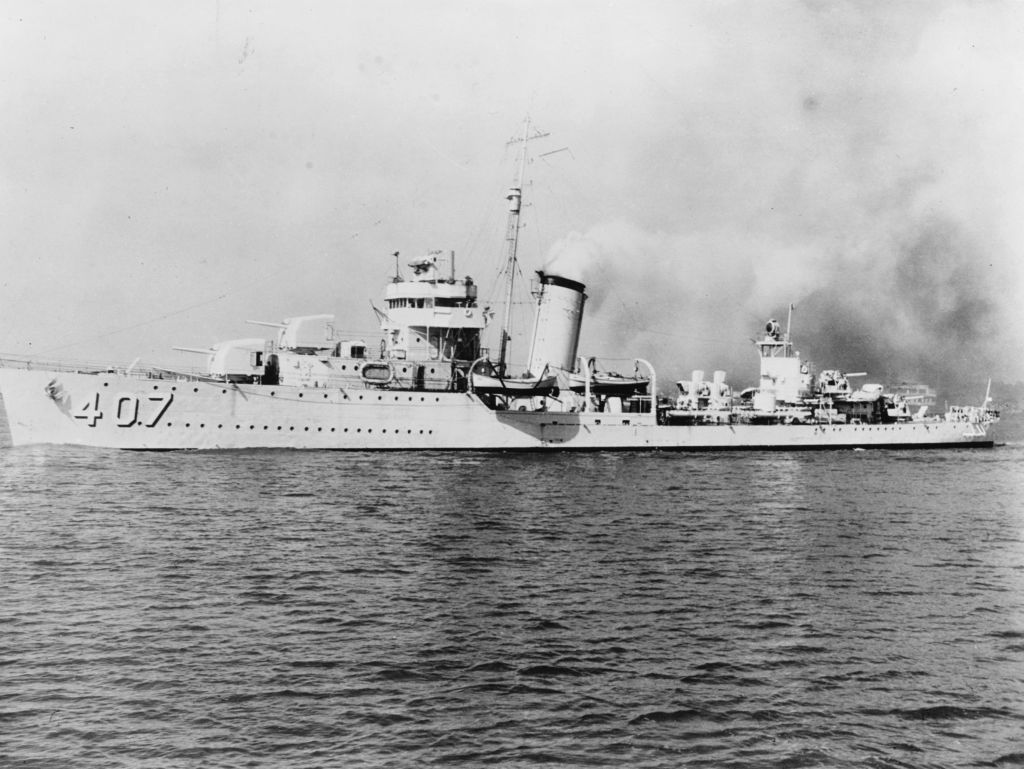
The U.S. Navy ordered the recommission of 40 older destroyers from the reserve fleet.
U.S. freighter Sea Arrow is launched at Oakland, California, the first major ocean-going vessel of that type completed on the west coast since World War I. The ship is later acquired by the Navy on 8 July 1940 and converted to the seaplane tender Tangier (AV-8).
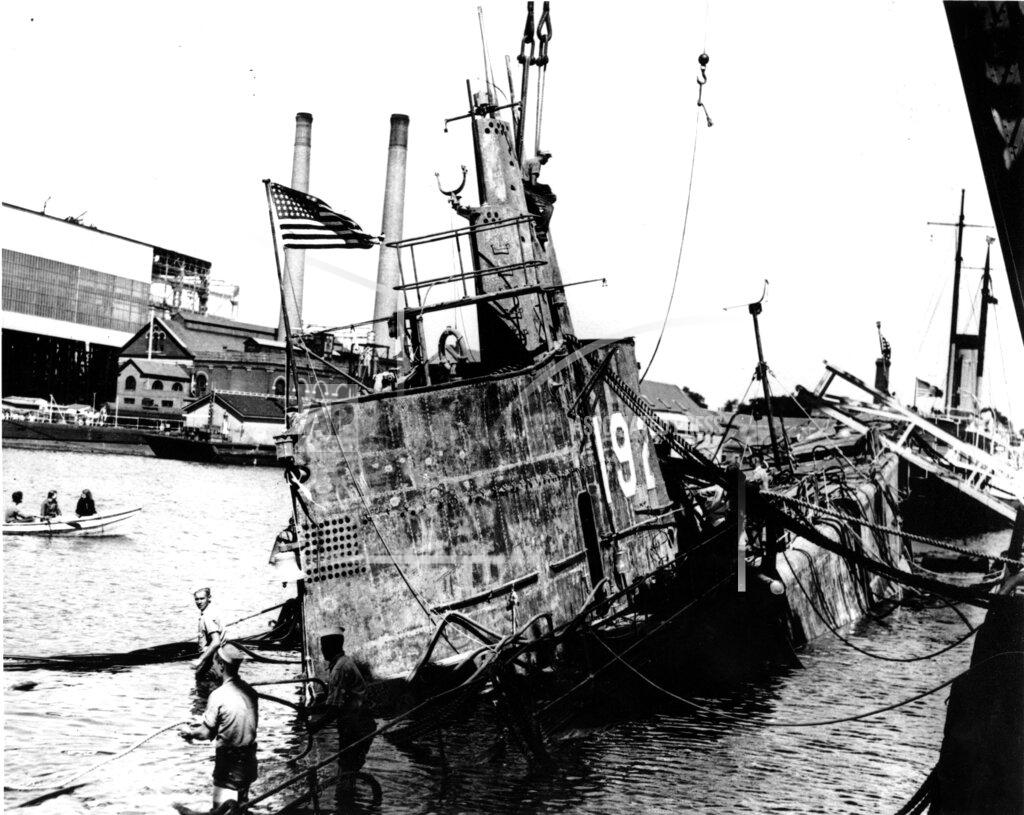
Submarine Squalus (SS-192), which had accidentally sunk off Portsmouth, New Hampshire, on 23 May during a scheduled test dive (of her 59-man crew, 26 men perish and 33 are rescued by McCann Rescue Chamber), arrives under tow at Portsmouth Navy Yard for extensive repairs. She is decommissioned on 15 November 1939, renamed Sailfish (SS-192) on 9 February 1940, and recommissioned on 15 May 1940.
Bob Feller gives up four runs in the ninth, but it doesn’t matter, as the Cleveland Indians rock the New York Yankees, 9–4. Feller had a three-hit shutout through eight innings. Red Ruffing takes the loss. Joe DiMaggio breaks out of a 0-for-14 slump with a single — and gets picked off at first.
The Chicago White Sox took both games of a doubleheader from the Washington Senators today, with a 3–1 victory in the eleven-inning first game and a 4–2 triumph in the second, shortened to eight innings by darkness. Early Wynn made his major league debut for the Senators, pitching the 4–2 complete game loss against the White Sox.
The veteran Lefty Grove turned in his 1939 masterpiece for the Boston Red Sox today by blanking the Detroit Tigers, 1–0, with a sparkling four-hit performance. It was his 14th win of the yera, and his 285th of his storied career. Freddie Hutchinson takes the loss.
The St. Louis Browns routed the Philadelphia A’s, 11–3, pounding three Philly pitchers to the tune of seventeen hits. Catcher Frankie Hayes hit his 19th home run in the losing cause in the eighth inning.
At Crosley Field, Cincinnati Reds’ pitcher Junior Thompson shuts out the Brooklyn Dodgers, 3–0, on 2 hits, a single in the second by Johnny Hudson and a bunt single in the eighth by Dixie Walker. The Reds lead the Cardinals by 3½ games.
Paced by Hank Leiber’s two home runs, the Chicago Cubs went on a hitting spree today and defeated the Boston Bees, 15–4, in the season’s final game between the two teams.
The New York Giants take the opener of a doubleheader from the Pittsburgh Pirates, 2–0, as Harry Gumbert hurls a two-hitter. The Pirates come back to take the nightcap, 7–4, shelling Cliff Melton for ten hits in seven innings and three runs in the second and three more in the six.
For the second straight day the St. Louis Cardinals trailed the Philadelphia Phillies and then nosed them out with a home run today. Joe Medwick’s drive into the bleachers at the 400-foot mark with one man on in the eighth capped the Redbirds’ seventeen-hit attack and gave them the 10–9 victory necessary to keep them in the thick of the pennant scrap with Cincinnati. Trailing by five runs as they entered the seventh, the Phils had staged a brilliant four-run rally and added two more in the eighth to wrest the lead from St. Louis.
Canada’s war Parliament was prorogued today after arming the government with all the powers it needs to carry on the war until the next Parliament meets in January.
The official British belief that Germany may attempt to establish submarine and air bases in South and Central America was expressed tonight.
To the vast relief of Shanghai’s foreign population, the Japanese military, at a conference this morning of the defense commanders of the various nations, did not bring up the question of the evacuation and disarmament of British and French troops here as had been feared. Instead, the Japanese mildly suggested that the time had arrived for revision of the international plans for defense measures in the International Settlement and in the French Concession. The existing plans were framed in 1931 and revised to the present standards in 1934.
The Japanese contention today. was that conditions had so changed that another revision was due. To this stand no opposition was offered. The upshot of the protracted session was a decision that the Chiefs of Staff of all Shanghai’s defense forces would meet at sóme unstated date to draw up revisions, which will be submitted subsequently for the approval of the commanders. It is believed that Secretary of State Cordell Hull’s statement of the United States’ determination to resist further abrogation of United States rights and interests in China caused a last-minute revision of the Japanese proposals.
The United States was represented at the conference by Rear Admiral William A. Glassford, commander of the Yangtze patrol, and Colonel Joseph C. Fegan, commander of the Fourth Marines. Admiral Thomas C. Hart, on the flagship Augusta, is making a special trip from North China waters to Shanghai, arriving at dawn tomorrow. At present the only large American naval unit here is the cruiser Marblehead.
It was revealed that when the Japanese first proposed, through diplomatic representatives, the withdrawal of British and French forces from Shanghai they offered to guarantee the inviolability of defense sectors around the foreign areas, even though they were manned only by policemen. Difficulty arises from the fact that past experiences have often proved that the promises of the government are later flouted by the military. The city has been progressively nervous and apprehensive. Rumor mongers have even set Saturday as the day chosen for a coup, when an anticipated mob of 50,000 Chinese, hired by the Japanese, are due to parade in a demonstration against the continuance of the Settlement concession.
Dow Jones Industrial Average: 154.10 (-1.82).
Born:
Richard Kiel, actor (‘Jaws’- “Moonraker”), in Detroit, Michigan (d. 2014).
Bill Janklow, American politician and four-term Governor of South Dakota (Republican: 1979-1987, 1995-2003), in Chicago, Illinois (d. 2012).
Larry Speakes, Acting White House Press Secretary (1981–1987) under President Ronald Reagan, in Cleveland, Mississippi (d. 2014).
Guntis Ulmanis, 5th President of Latvia (1993-1999), in Riga, Latvia.
Elaine Delmar (neé Hutchinson), British jazz and cabaret singer and stage actress, in Harpenden, Hertfordshire, England, United Kingdom.
Gene Page, American arranger and composer (Righteous Brothers; Marvin Gaye; Whitney Houston), in Los Angeles, California (d. 1998)
Gary Barnes, NFL wide receiver (NFL Champions-Packers, 1962; Green Bay Packers, Dallas Cowboys, Chicago Bears, Atlanta Falcons), in Fairfax, Alabama (d. 2023).
Tom Parsons, MLB pitcher (Pittsburgh Pirates, New York Mets), in Lakeville, Connecticut.
Died:
Eugene Foss, American politician (45th Governor of Massachusetts, 1911-1914).
Naval Construction:
The Royal Canadian Navy Fisherman’s Reserve patrol vessel HMCS Takla (ex fishing vessel) is commissioned; chartered at $240 per month.
[Ed: No Matter how much you hate the Nazis, you can never hate them enough…]
 History Diaries