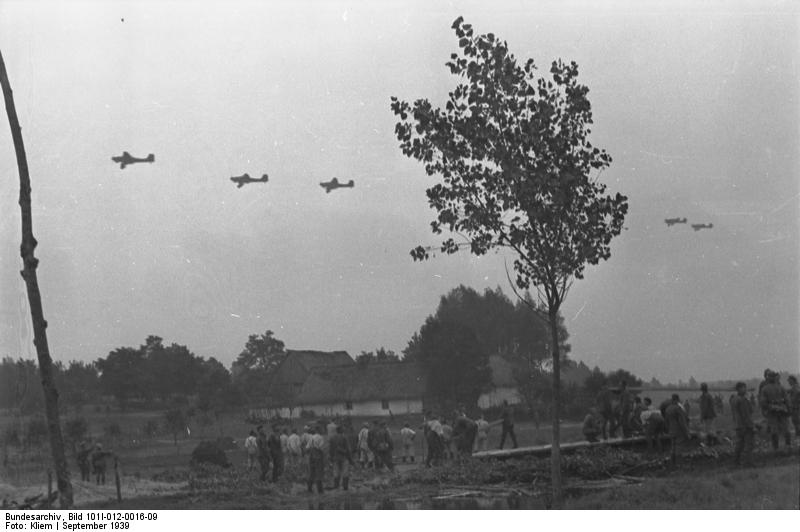
The Battle of Lwów began. Initially, the city was not to be defended, as it was considered to be too deep behind the Polish lines and too important to Polish culture for warfare. However, the speed of the Nazi invasion and the almost-complete disintegration of the Polish reserve Prusy Army after the Battle of Łódź resulted in the city being in danger of a German assault. On September 7, 1939, General Władysław Langner started to organise the defence of the city. Initially, the Polish forces were to defend the Bełżec – Rawa Ruska – Magierów line against the advancing German forces. General Rudolf Prich was given command of the Polish forces in the area, and on September 11, he prepared a plan to defend of the area. The Polish units were to defend the line of the San River, with nests of resistance along the Żółkiew – Rawa Ruska – Janów (also called Yaniv or Ivano-Frankove) to the west of the river Wereszycą – Gródek Jagielloński line.
The following day, the first German motorised units under Colonel Ferdinand Schörner, 1st Mountain Division (Wehrmacht), arrived in the area. After capturing Sambor (66 kilometres from Lwów), Schörner ordered his units to break through the weak Polish defences and to capture the city as soon as possible. The assault group was composed of two motorised infantry companies and a battery of 150 mm guns. The group outflanked the Polish defenders and reached the outskirts of the city but was bloodily repelled by the numerically-inferior Polish defenders. The Polish commander of the sector had only three infantry platoons and two 75 mm guns, but his forces were soon reinforced and held their positions until dawn. The same day, the command of the city’s defence was passed to General Franciszek Sikorski, a veteran of World War I and the Polish–Soviet War.
On September 17, 1939, the Soviet Union declared all pacts with Poland null and void as the Polish state had ceased to exist, and the Soviets joined Nazi Germany in the occupation of Poland. The forces of the 6th Red Army of the Ukrainian Front, under Filipp Golikov, crossed the border just east of Lwów and started a quick march towards the city. The Soviet invasion made all plans to defend the Romanian Bridgehead obsolete, and the Polish commander decided to withdraw all of his units to the close perimeter and to defend only the city itself, instead of the whole area, which strengthened the Polish defences. On September 18, the Luftwaffe dropped thousands of leaflets over the city to urge the Poles to surrender but was ignored. A general assault was started on the city, which was once again repulsed.
Hitler’s evacuation order from September 20 instructed Gerd von Rundstedt to leave the capture of Lwow to the Soviets. The attack planned by XVIII Corps for 21 September was cancelled, and the German corps prepared to move to the west of the Vistula-San River line. The following day, Sikorski decided that the situation of his forces was hopeless. The reserves, human resources and materiel were plentiful, but further defence of the city would be fruitless and result only in more civilian casualties. He decided to start surrender talks with the Red Army.
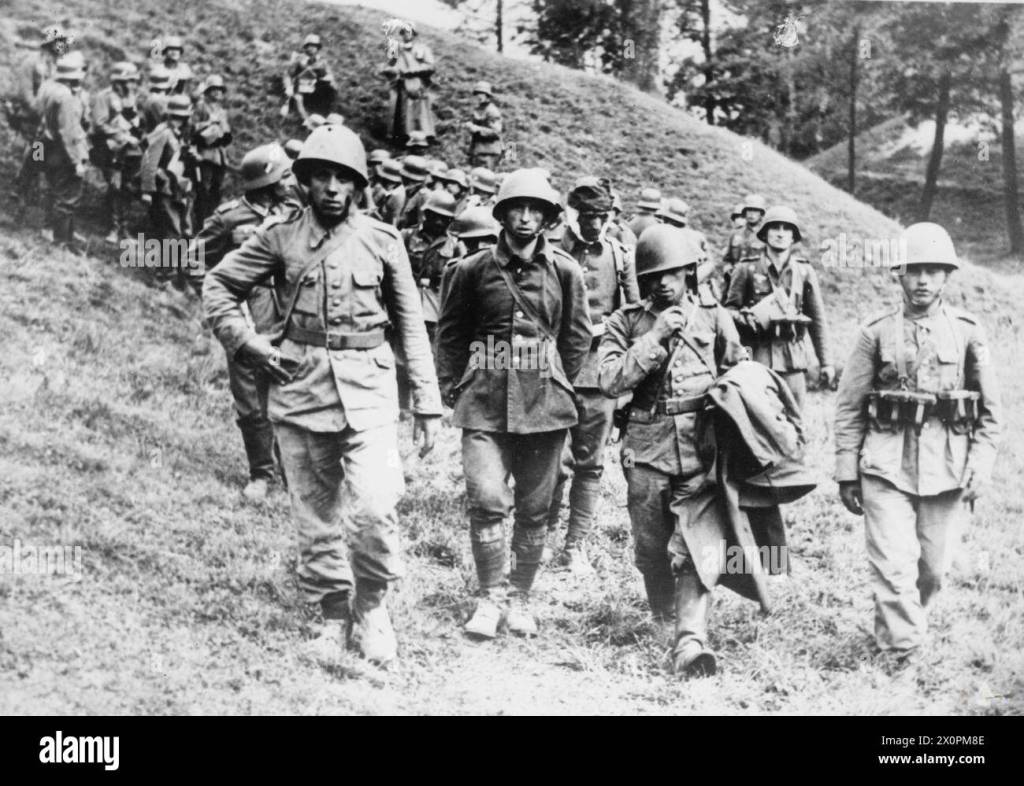
On September 22, 1939, the act of surrender was signed in the suburb of Winniki in the morning. The Red Army accepted all of the conditions proposed by General Władysław Langner. The privates and NCOs were to leave the city, register themselves at the Soviet authorities and be allowed to go home. Officers would be allowed to keep their belongings and leave Poland for whichever country accepted them. The Soviet forces entered the city and the Soviet occupation began. The Soviets broke the terms of surrender shortly after noon when the NKVD began arresting all Polish officers. They were escorted to Tarnopol, where they were sent to various gulags in Russia, mostly to the infamous camp in Starobielsk. Most of them, including General Sikorski himself, would be murdered in what became known as the Katyn Massacre in 1940.
The Battle of Kałuszyn ended with the Poles giving the Germans a bloody nose and withdrawing; but the Germans then occupied Kałuszyn. Most of the substantial Jewish population of the town would be deported by Germans to the Warsaw ghetto or Treblinka extermination camp.
The Battle of the Bzura River, between the Polish Posnan and Pomorze Armies and Germany’s Army Group South, intensifies. Polish troops push the German forces 12 miles south of Kutno and recapture Lowicz. Gdynia is evacuated by the Poles. The Poles reached the line Stryków-Ozorków. That day, General Tadeusz Kutrzeba learned that units of Army Łódź had retreated to the Modlin Fortress and decided to stop the offensive and instead sought to try to break through Sochaczew and the Kampinos Forest to reach Warsaw.
The Luftwaffe bombs Krzemieniec in eastern Poland which had been declared an open village where the diplomatic community from Warsaw has sought refuge.
The New York Times reports:
“First intimations that a “solution of the Jewish problem” in Poland is on the German-Polish agenda are revealed in a “special report” of the official German News Bureau that emanates from Polish territory now occupied by German military, somewhere in East Silesia. In view of the world refugee problem and the individual suffering created in the last six years by Germany’s determination to rid her borders of Jews, the implications of the “solution of the Jewish problem in Poland,” were it carried out on the German model, are ominous. Where Germany and Austria together had a total of 750,000 Jews, the Jewish population of Poland, at about 3,000,000, is the largest of any European nation and the second largest in the world.
“In addition to proposing prevention of a second “invasion” of Polish Jews into Germany, this “special report” contains a “solution of the Jewish problem in Poland that can contribute considerably to create ordered relations between the German and the Polish people.” It was Polish Jews, primarily, after the advent of National Socialism, “who agitated the whole world against Germanism,” the report continues. Then, in explanation of the alleged attack against “Germanism” in Poland — given by Chancellor Hitler as the reason for Germany’s present military activities this “special report” alleges that the “rage” which broke out from time to time in Poland against the Jews extended to “Germanism” because “the Jews, as a result of their knowledge of the German language — paradoxically as it may sound — were regarded by the primitive Polish peasants as unquestioned Germans.”
“As a possible solution of this question, “purge” is indicated by the Official News Bureau, which continues: “Removal of the Polish Jewish population from the European domain would furthermore, in the long view, definitely bring a solution of the Jewish question in Europe nearer. For this is just the Jewry which, through its high birth rate and in spite of all existing differences between the two groups, has continually established the large numbers of Western Jewry, whose birth rate is small.” How, however, the “removal” of Jews from Poland without their extermination can halt the alleged “strengthening” of Western Jewry is not explained.”
History rolled back twenty-one years today when Prime Minister Chamberlain flew to France for an unheralded but momentous meeting of the Supreme Council of the Western Allies. Neville Chamberlain and Édouard Daladier convene an Anglo-French Supreme War Council at Abbeville, France and agree “to give all possible assistance to their Polish ally.” Soon thereafter the French call off their offensive in the Saar region after an advance of only five miles.
The French army now occupies a 15-mile-wide front some five miles inside German territory. Although his forces have met no real opposition to its advance, General Maurice Gamelin halts his army and issues orders to prepare for a rapid retreat at the first sign of strong German opposition (Note: General Gamelin brazenly lies to the beleaguered Poles when they protest the lack of French action; telling them that half of his active divisions are engaged in combat and meeting vigorous German resistance. “I have thus gone beyond my promise to take the offensive with the bulk of my forces by the fifteenth day after mobilization. It has been impossible for me to do more.” Only 9 of France’s 85 divisions on the frontier were employed in the “offensive.”)
German Chancellor Adolf Hitler summons Reichsmarschall and chief of the Luftwaffe Hermann W. Goering, the Commander-in-Chief of the Wehrmacht Heer Colonel General Walther von Brauchitsch, and Chief of the OKW Colonel General Wilhelm Keitel to his train at the Ilnau railway siding in Poland and flatly forbids them to provoke the French in any way.
Admiral Wilhelm Canaris, head of the Abwehr, protests to General Keitel that extensive shootings are planned in Poland, and that the nobility and intelligentsia are to be exterminated. The world, Canaris said, would hold the armed forces responsible.
Nazi Germany issued two decrees virtually prohibiting private automobile use after September 20. Special permits would be required to buy gasoline after that date, and every privately owned rubber tire in the country was declared property of the state.
Dr. Hans Thomsen, charge d’affaires of the German Embassy in Washington, asserted in a radio address tonight that Germany is not striving for world domination and using the Polish Corridor problem “as a pretext in order to bring about by force her supremacy in Europe.”
U.S. freighter Black Eagle is detained by British authorities at the Downs, the roadstead in the English channel off the coast of Kent.
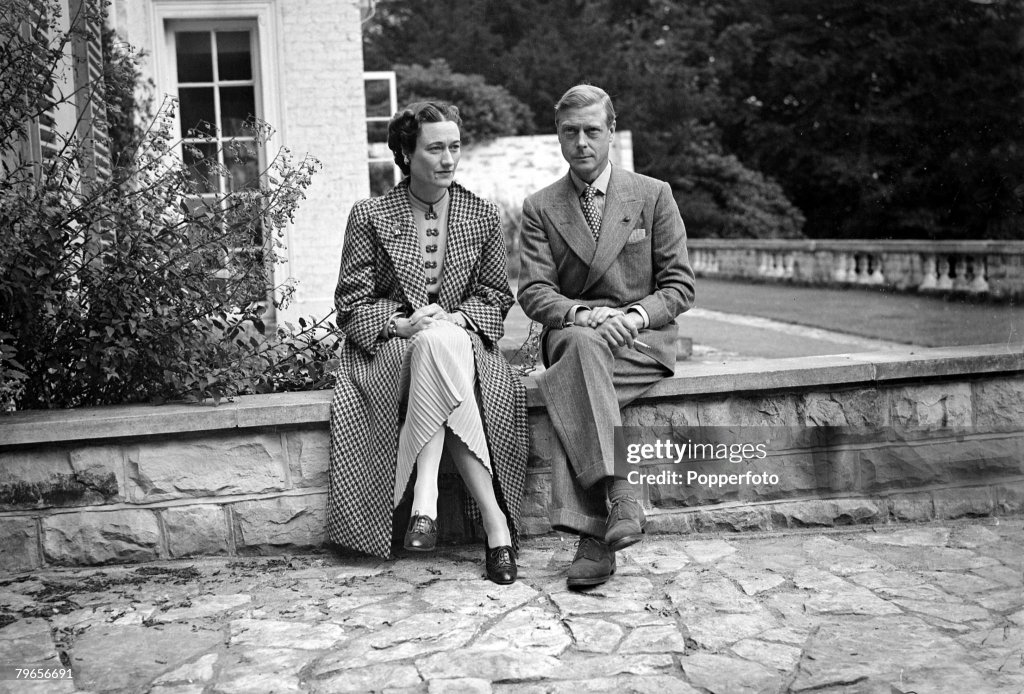
The Duke and Duchess of Windsor returned to England from self-imposed exile in France. For the first time since he abdicated his throne to marry “the woman I love” in December, 1936, the Duke of Windsor and his Duchess, the former Mrs. Simpson, returned to England today, presumably to offer his services to the Empire he once ruled as King Edward VIII.
The British home office opens an inquiry into blackout rules.
The British withhold pressure on Italy. They believe the time is not right to ask for neutrality rather than nonintervention. Great Britain and France will not press Italy for a declaration of neutrality at present, but will accept her present official stand of non-intervention in the European war, according to diplomatic circles here.
A Czech army-in-exile is formed in France.
President Roosevelt disclosed today that he intended to call Congress into special session “soon” to consider revision or repeal of the Neutrality Law. As he revealed this purpose at his press conference this afternoon, thickening clouds around Capitol Hill gave further warning of trouble ahead for the Administration in its effort to change the law, at least to the extent of lifting the automatic arms embargo which the President was compelled to impose against all of the belligerent nations in the European war.
The political weather signs were inherent in statements by Senators Vandenberg and Nye that they would stand against any attempt to repeal the arms embargo. They took positions alongside Senator Borah, who declared yesterday that he would oppose any compromise on the arms embargo mandate. Like Senator Borah, they insisted on the fullest debate on the subject in the special session, indicating their belief that it would be weeks before a revision bill could be brought to a vote. In answer to questions as to the special session, President Roosevelt said an announcement on that subject might be expected “soon” (quotation authorized by the President), but warned against any conclusion as to what he meant by “soon.”
Representative Sabath of Illinois, chairman of the House Rules Committee, who called on the President earlier to find out the approximate date of the session, expressed the belief that Congress would convene by October 1, if not earlier. Mr. Sabath also insisted that Mr. Roosevelt was making a determined effort to eliminate domestic politics from the neutrality question. “The President feels that this is no time to play politics and that Congress should eliminate politics entirely,” he said.
Inferences drawn from the remarks of opponents of changes in the Neutrality Act pointed increasingly to a probable effort on their part to make the arms embargo issue symbolic of the larger question as to whether the United States should go into the European war. Therefore, the first task before the Administration strategists, as they see it, is to prevent a vote on repeal, of the arms embargo from being construed as a vote for or against direct or indirect participation of this country in the war. If the issue were allowed to be so drawn, Mr. Roosevelt might be in for another bitter fight with Congress.
Federal studies of prices of commodities as they reflect the war boom have been extended to non-agricultural products in the Administration’s effort to prevent a recurrence of profiteering such as marked the World War, President Roosevelt said at his press conference today. He added that no steps in addition to the proclamation raising the quotas on imports of sugar were contemplated, but indicated that if conditions arose making them necessary, measures to meet them would receive immediate attention.
This decision appeared to be in line with the belief expressed privately in several official sources that the increases in food prices which marked the beginning of the war in Europe are beginning to level out of their own volition as the public realizes that there are no shortages of essential commodities. These officials likewise watched with gratification an apparent effort by important retail stores to help stop buying waves by excited persons. One chain of stores today published advertisements pledging that no artificial rises would be made in prices and asking the public not to buy beyond normal requirements, lest such purchases upset ordinary inventories.
The President divided a brief discussion of prices into two phases, saying profiteering must be approached from different viewpoints, as between production and retailing. On the basis of current retail prices, he stated, cotton was selling generally at so low a figure that the South would go broke were it not for soil conservation payments and some export subsidies. Wheat prices also were substantially below parity, and an advance of wheat to a parity figure of about $1.15 or $1.20 a bushel would make only an inappreciable difference in the price of bread.
On the other hand, the government was watching closely the price of copper, an important metal from a domestic production standpoint. Plenty of copper could be produced at 12 cents a pound with a fair profit, and the government wanted no repetition of the World War situation in which copper rose to 28 cents a pound, creating profits which eventually had to be borne by taxpayers as a group. When he was asked about the price of steel, the President stated that no question had arisen in that product since no unusual rise had taken place and none was expected.
Secretary of State Cordell Hull expects to make a statement soon on the attitude of the United States toward the blockades and counterblockades that are developing in the European war.
Mrs. Joseph P. Kennedy, with three of her nine Children, Kathleen, Eunice and Bobby, were among 1,800 passengers, mostly Americans, who sailed on board the Washington today from Southampton, ound for New York. It was said to have been the largest passenger list in the Washington’s history.
Assertions that more than $10,000,000 had passed in the last four or five years through forty-three bank accounts maintained by the Communist party, its subsidiaries and affiliated organizations were made today before the House committee investigating un-American activities. The party asserted piously that none of this money came from Moscow.
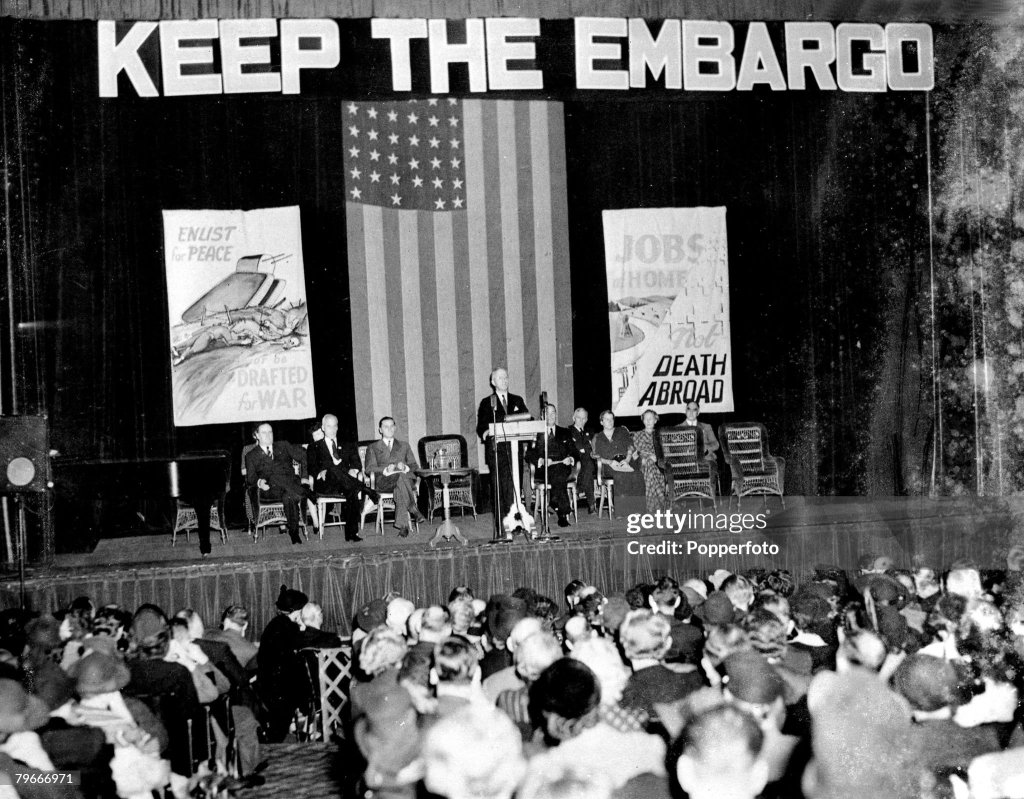
President Roosevelt’s foreign policy will lead us to war and will provide the means of escaping the necessity of solving our economic problems by bringing about a false prosperity, Norman Thomas, Socialist leader, said last night at a rally of the Keep America Out of War Congress at Town Hall.
Instructions to Neutrality Patrol are modified to include covering the approaches to the Gulf of Mexico through the Yucatan Channel and the Straits of Florida.
The USAAC 21st Reconnaissance Squadron (with B-18 Bolo bombers) (Major Howard Craig, USAAC) reports to Commander Atlantic Squadron for duty in connection with the Neutrality Patrol. It is based at Miami, Florida.
Lake Placid weighs a winter Olympics bid, while Canada withdraws from the entire 1940 program. The Adirondack mountain resort considered today, in the light of European war developments, the possibility of staging the 1940 Winter Olympic Games.
The Cleveland Indians edge the New York Yankees, 4–3, in ten innings. Mel Harder outduels Lefty Gomez as both go the distance. Joe DiMaggio, bothered by his eye infection, goes 0-for-5.
The crippled Boston Red Sox, opening a long home stand without Manager Joe Cronin and Jimmy Foxx, defeated the Detroit Tigers, 2–1, behind Denny Galehouse’s five-hit pitching today. Boston collected seven hits off the veteran Tommy Bridges, and Ted Williams was driven in by Bobby Doerr in the fourth and sixth innings for both runs. The Detroit tally was registered in the third frame, which Bill Rogell opened with a single. He rested on first until Barney McCosky tripled to right field with one out. Galehouse had three strikeouts and did not issue a base on balls.
Buster McCrabb, rookie recalled from Williamsport of the Eastern League, started his first big-league game today by limiting the St. Louis Browns to seven hits as the Philadelphia Athletics scored a 9–1 victory. The Athletics jumped on Vernon Kennedy for five hits and three runs in the first inning and added fourteen more singles off the deliveries of George Gill. Wally Moses, Athletics outfielder, had a perfect day at bat with four hits.
Clark Griffith, president of the Washington Senators, said tonight President Will Harridge of the American League had upheld a Washington protest over its game with the Chicago White Sox today, which the Senators lost, 3–2. Griffith said that since the Chicago team would make its last appearance in Washington tomorrow, the game would be replayed as part of a doubleheader. The Washington protest involved a play in the sixth inning. With Johnny Welaj on first base, Taft Wright hit a pop fly to left. Gerald Walker of the White Sox caught the ball, dropped it, picked it up and threw to Shortstop Eric McNair, who tagged out Welaj.
Trailing 2–0 to the visiting Brooklyn Dodgers, the Cincinnati Reds score 2 runs in the 9th on a 2-out home run by Billy Myers off Hot Potato Hamlin to win, 3–2. Frank McCormick’s single in the 10th drives in the winning run.
The St. Louis Cardinals defeated the Philadelphia Phillies, 4–3, in the first game of their final home stand today. Three of the Redbirds’ five hits off Ike Pearson were home runs. The first was by Joe Medwick in the second inning, the second by Johnny Mize in the fifth and the big one by Terry Moore with one on in the seventh. When Moore connected the Phillies were leading, 3–2, having gained the advantage on Joe Marty’s homer with one on. The Phils worked a double steal with runners on first and third to score their first run.
Hank Leiber and Rip Russell hit homers, Leiber with the bases loaded, and Billy Herman stole home today to help Bill Lee score his seventeenth triumph as the Chicago Cubs trounced the Boston Bees, 8 to 3. Leiber’s drive came in the opening inning off Bill Posedel with none out after Stan Hack and Herman had singled and Augie Galan had walked. The Cubs then clouted twelve more hits against Posedel’s successors-Johnny Lanning, George Barnicle and Tom Earley. Herman’s theft of home came in the sixth inning when he and Galan worked a double steal on Barnicle’s prolonged wind-up. Lieber will go 31-for–69 from today to the end of the season, including 9 homers and 31 RBIs.
President Roosevelt, said today that Canada’s declaration of war against Germany did not alter his pledge to the Dominion that the United States would be quick to prevent any attempt at domination of its soil by any non-British foreign power.
Canada introduced its first war budget. Minister of National Revenue James Lorimer Ilsley announced a new 20% surtax on personal income to pay for the war as well as tax increases on alcohol, tea, coffee and cigarettes. A deficit of $156 million was forecast for the fiscal year.
Airlines abroad quit flying to Latin America. The war leaves the United States alone in providing flights there.
An olive branch was extended to the Soviet Union by Japan yesterday, when Lieutenant General Yoshikiro Umezu, newly appointed Commander in Chief of the Japanese forces in Manchukuo, gave his first press interview since he assumed the post a few hours earlier. Speaking to the Tokyo Nichi Nichi correspondent at Hsinking, General Umezu gave a palpable, though informal, invitation to Soviet Russia to begin negotiations for a peaceful settlement of frontier disputes. He specifically mentioned the resumption of work by a Soviet-Japanese boundary demarcation commission as an immediate possibility.
The general tone of his remarks, which emphasized peaceful intentions on the part of Japan toward Russia, seemed to envisage a general settlement of the relations between the two countries. He declared Japan had never provoked the Soviet Union and had never gone to war with it on Japan’s initiative. “The border disputes,” he said, “have arisen from the absence of a definite boundary line. Japan previously proposed the appointment of a frontier delimitation commission and the members were actually being chosen when the Soviet Union abandoned the plan.
“Japan’s basic policy is regulation of relations with the Soviets if that is possible. For some temperamental reason they have not reciprocated. The result is the present deplorable situation. Whether the solution be war or a regulation of relations must be carefully considered from the viewpoint of Japan’s ultimate good.” He added that Japan could not be thinking in terms of money at a time when national prestige was vital.
Dow Jones Industrial Average: 155.92 (+0.80).
Born:
Henry Waxman, American politician (Rep.-D-California, 1975–2015), in Los Angeles, California.
Phillip Ramey, American composer, in Elmhurst, Illinois.
Naval Construction:
The Kriegsmarine (German Navy) vorpostenboot V 206 (later V 209) Gauleiter Telschow is commissioned.
The Royal Navy “J”-class destroyer HMS Jaguar (F 34) is commissioned. Her first commander is Lieutenant Commander John F. W. Hine.

 History Diaries