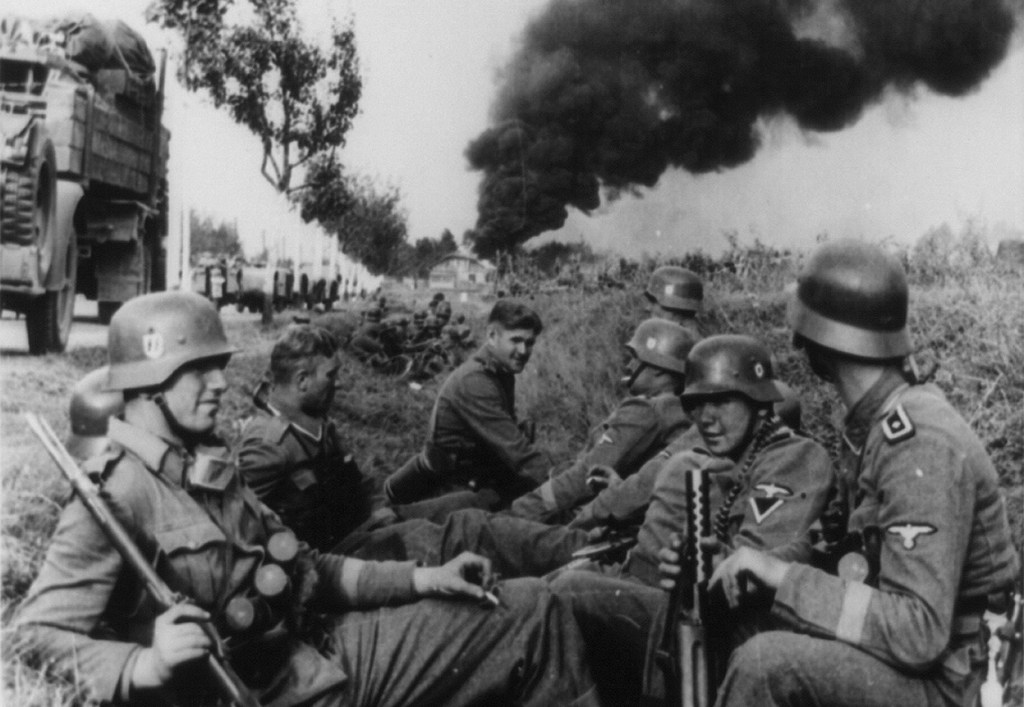
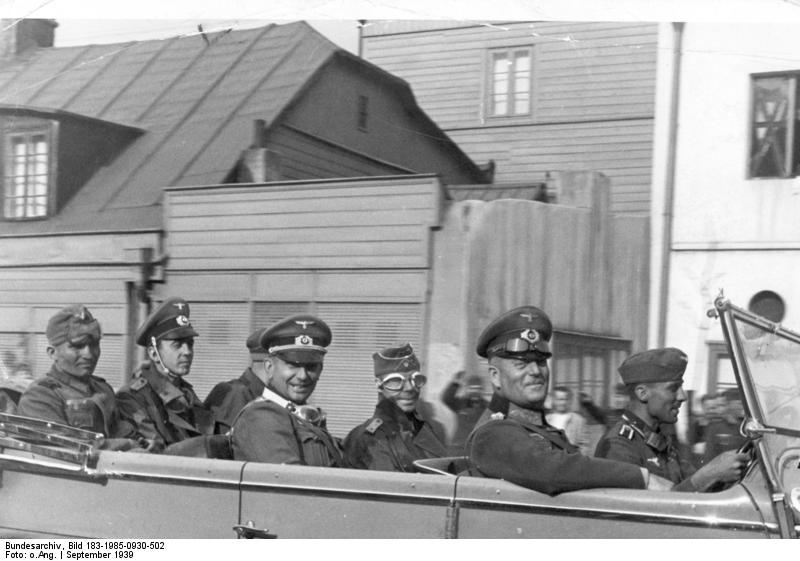
The Battles of Kałuszyn and Przemyśl began. The Battle of Kałuszyn, took place between 11 and 12 September 1939 around the town of Kałuszyn near Mińsk Mazowiecki in Poland. Following the battles of Pułtusk and Różan, the Polish 1st Legions Infantry Division reinforced by the units of the Wyszków Operational Group arrived in the area of Mińsk Mazowiecki. They were overrun by the German forces of the German 11th Infantry Division who managed to take the town and surround the Polish forces. The Polish aim was to retake the town and break through the German encirclement before panzer reinforcements arrived and enemy resistance stiffened. After a short preparation, the battle began overnight with a Polish assault on the villages surrounding the town. The Polish forces managed to break through the positions of the enemy 44th Infantry Regiment, which was disorganized and had underestimated the Polish forces still present in the area.
At one point a Polish commander ordered the 4th squadron of the 11th Uhlans Regiment to advance towards the town itself. The order was mistakenly understood as an order of a cavalry charge and the squadron, numbering 85 men and commanded by Lieutenant Andrzej Żyliński, charged towards the enemy positions with their sabres drawn, breaking through to the town despite suffering significant casualties (33 dead). The Polish infantry followed into the breach in the German defences and by the early morning the town was liberated and the German division sent in retreat. The Poles then continued their retreat; the Germans subsequently occupied the town. Losses on both sides were significant. The commanding officer of 44th regiment, Major Krawutschke, committed suicide. In the course of the heavy fighting, the town was almost completely destroyed. Most of the substantial Jewish population of the town was later deported by Germans to the Warsaw ghetto or Treblinka extermination camp. After the end of the war the battle was one of 24 battles of the Polish Defensive War to be featured at the Tomb of Unknown Soldier in Warsaw.
The Battle of Przemyśl took place between 11 and 14 September 1939. The Polish Army garrison of the former Austrian fortress of Przemyśl managed to halt the advance of the Wehrmacht for three days. The city surrendered on 14 September. On 10 September in the morning, German 4th Light Division reached the San near Radymno, and after a short skirmish with weak Polish forces, crossed the river. Next the Germans captured Jarosław, after a battle which lasted several hours. On 11 September German 2nd Panzer Division reached the area of Przemyśl, chasing Polish 10th Motorized Cavalry Brigade. A motorized column of 4th Light Division attacked Przemyśl, trying to capture the city by surprise. The attackers were repelled by Polish artillery, but the overall situation of Polish forces in the area of the city worsened, as in the south, motorized units of 1st Mountain Division captured Dobromil, and its patrols approached Przemyśl on 11 September but failed to seize the city.
On the night of 11–12 September, upon order of General Jan Chmurowicz, Poles attacked German artillery batteries, which were located in Kosienice. The raid was a failure, as Polish soldiers, facing German machine guns, had to retreat. On 12 September near Bircza, Polish 24th Infantry Division, commanded by Colonel Boleslaw Schwarzenberg-Czerny, was involved in heavy fighting with 2nd Mountain Division. In the evening of that day, the Germans broke through Polish positions, forcing the 24th I.D. to retreat. On 13 September, Polish heavy artillery was taken from Przemyśl to Mostyska, but along the way, the transport was bombed by the Luftwaffe. In the night, units of Polish 11th Infantry Division managed to enter Przemyśl, after heavy fighting with German 45th Infantry. Polish soldiers rested in Przemyśl for a few hours, and in the morning of 14 September marched towards Lwów, leaving behind one infantry battalion with a battery of cannons.
On 14 September, the defenders of Przemyśl consisted of seven infantry battalions, a company of engineers, and six platoons of artillery. Altogether, these forces numbered several thousand soldiers. They came from different units, and in many cases did not know the city they defended. German forces consisted of 7th Infantry Division, and elements of 44th and 45th Infantry Divisions. On 14 September in the morning, the Germans tried to capture the city in a frontal attack, but were halted by machine gun fire and artillery. Main fighting took place in the south, where Germans, after artillery bombardment, crossed the San and attacked the village of Kruhel Maly, which now is a district of Przemyśl. After a Polish counterattack, in which bayonets were used, the situation there stabilized in the evening. In the north, German attacks also failed.
In the evening of 14 September, Colonel J. Matuszek, who commanded the defence of the city after General Jan Chmurowicz, received order of General Kazimierz Sosnkowski, who commanded him to abandon Przemyśl and march eastwards, to Lwów. Polish units retreated towards Mosciska, blowing up bridges behind them. On the next day in the morning Germans entered Przemyśl. The four-day battle was followed by three days of massacres carried out by the German soldiers and police against hundreds of Jews who lived in the city. In total over 500 Jews were murdered in and around the city and the vast majority of the city’s Jewish population was deported across the San River into the portion of Poland that was occupied by the Soviet Union.
The Battle of Jarosław ended with a successful Polish delaying action. Overnight Colonel Maczek had decided that his plan succeeded and further defence of the city could result in his unit being cut out from the rear by the Germans advancing from Radymno. Because of that he moved his unit further eastwards to the Oleszyce-Lubaczów area. Lieutenant-Colonel Wójcik’s forces were to hold the town for as long as possible, and then follow the motorized brigade. The Poles blew up the bridges and left only a token force in the city, while the majority of the men retreated under the cover of darkness. In the early morning of 11 September the Germans resumed their assault, this time with a heavy artillery barrage. However, since most of the Polish units were already miles away, the losses were negligible. Around noon the panzers rolled towards the Polish positions only to discover that the several infantry companies (an infantry battalion under Captain Matheis), until then guarding the Polish positions, were also withdrawn.
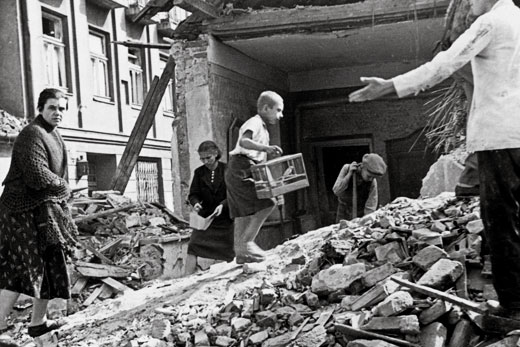
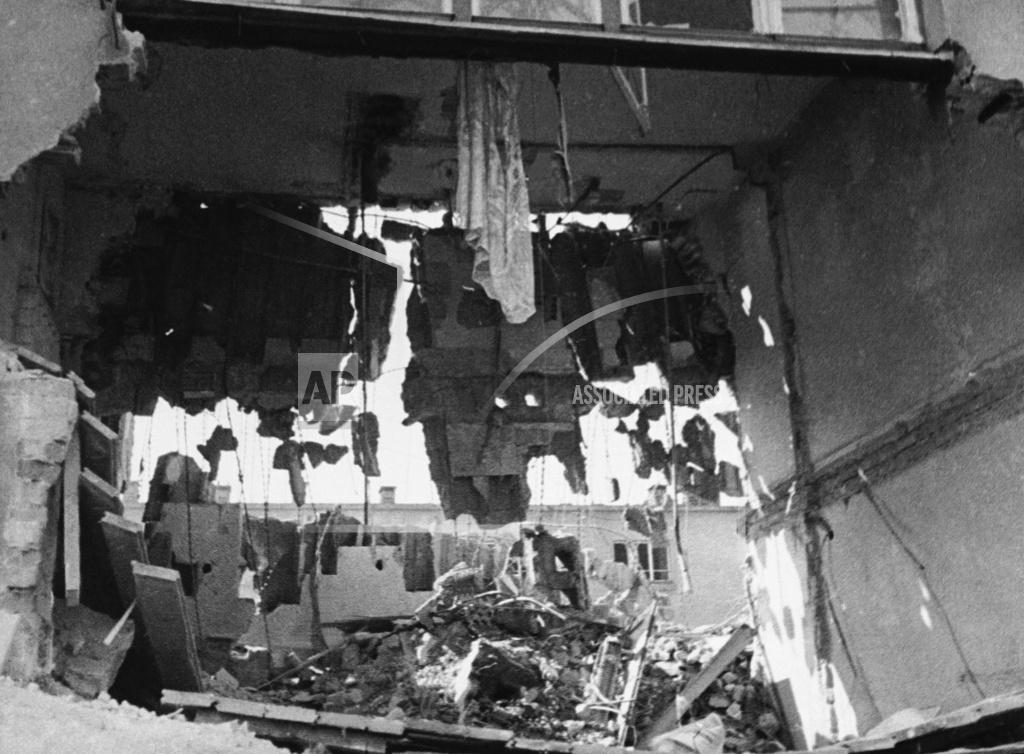
Germany batters Warsaw, subjecting it to all-day shelling and continuous air raids. Foes fight in the streets as women and girls dig trenches. One of the great cities of Eastern Europe is beginning to die, its buildings being crushed and burned by the bombs of the invaders. The German Armies in Poland were reported to have advanced in three regions today — further closing the bottleneck of the great pocket west of Warsaw; pushing eastward on the southernmost front and threatening to encircle Gdynia in the north.
Germany announced a counter blockade against Britain, saying that “in the economic warfare forced on her by Britain Germany is not only able to resist every pressure of blockade and every form of British hunger warfare, but to reply to it with the same methods.”
German cipher (B-dienst) experts crack the British merchant ship code, identifying convoy meeting points.
A man throws hard rubber balls into a London crowd as a peace protest. The crowd thinks they are bombs and panics. The man receives four weeks of hard labor.
Britain rules out peace until Hitler goes, saying it will only deal with a trustworthy government.
Germans evacuate a base on the island of Sylt.
Germany bars Jews on the streets at night. Jews now have an 8 PM curfew in the Reich.
Germany announces it will ration bread, beginning on September 25.
The British Ministry of Information replied tonight to Field Marshal Hermann Göring of Germany that Britain will not conclude peace with any government headed by Adolf Hitler.
U.S. freighter Black Eagle is detained by British authorities at the Downs, the roadstead in the English channel off the coast of Kent.
U.S. tanker R.G. Stewart is stopped by shot fired across her bow by German submarine U 38 about 253 miles west of Ushant, France, 48°17’N, 11°16’W
The unescorted and unarmed British steam merchant Blairlogie was stopped by gunfire and after the crew abandoned ship was torpedoed and sunk by the U-30, commanded by Oberleutnant zur See Fritz-Julius Lemp, about 200 miles west of Ireland in the eastern Atlantic Ocean. Of the ship’s complement, all 30 survived and were picked up by the steam passenger ship American Shipper. The 4,425-ton Blairlogie was carrying scrap iron and steel and was bound for Lands’ End, England.
The unescorted British motor tanker Inverliffey was stopped by gunfire and after the crew abandoned ship was torpedoed and sunk by the U-38, commanded by Kapitänleutnant Heinrich Liebe, southwest of the Scilly Isles in the eastern Atlantic Ocean. Of the ship’s complement, all 49 survived and were picked up by the American steam merchant City of Joliet. The 9,456-ton Inverliffey was carrying gasoline and was bound for Coryton, England.
The unescorted British steam merchant Firby was stopped by gunfire and after the crew abandoned ship was torpedoed and sunk by the U-48, commanded by Kapitänleutnant Herbert Schultze, about 270 miles west of the Hebrides in the northern Atlantic Ocean. Of the ship’s complement, all 34 survived and were picked up by the destroyer HMS Fearless. The 4,869-ton Firby was carrying Ballast and was bound for Port Churchill, Hudson Bay.
The British coaster Brendonia collided with another ship in The Downs, off the east coast of Kent, and sank.
The British Castle-class trawler Wellvale was reported missing on this date. Missing, presumed lost by enemy action off the Hebrides (U-35 being in the vicinity). Skipper and twelve crew lost.
German armored ship Admiral Graf Spee provisions from tanker Altmark; security measure of launching the warship’s Arado AR 196 seaplane pays dividends, as British heavy cruiser HMS Cumberland is spotted closing the area. Admiral Graf Spee and her consort alter course and are thus not sighted.
Air Vice Marshal Arthur Harris assumed command of British Royal Air Force Bomber Command’s Lincolnshire-based No. 5 Group with his headquarters at St. Vincent’s House in Grantham. No. 5 Group was the sole operator of the Handley-Page Hampden bomber with six Hampden squadrons available at the outbreak of war — Nos. 44 and 50 Squadrons based at Waddington, 49 and 83 Squadrons based at Scampton, and 61 and 144 Squadrons at Hemswell. Harris would command the group for fourteen months before being appointed G. O. C. Bomber Command on 22 February 1942.
Rumanian troops were reported to be moving to the Russian frontier tonight and trenches were being dug in the Dniester River area as a result of increases in Soviet frontier defenses.
After a $10 million outlay, Finland suspends work on the 1940 Olympic Games for three months.
Saudi Arabia broke off diplomatic relations with Germany.
The Viceroy of India, Lord Linlithgow, announced to the two houses of the Indian Legislature that due to India’s participation in the war, the plans for the Federation of India under the Government of India Act 1935 would be indefinitely postponed.
U.S. President Franklin Roosevelt wrote to Winston Churchill and Neville Chamberlain, encouraging them to communicate with him personally, i.e., bypass the official diplomatic channels.
Another struggle between President Roosevelt and the Senate bloc opposing repeal or substantial change in the so-called Neutrality Act was foreshadowed today by Senator Borah of Idaho. The veteran “isolationist” declared there would be no compromise, so far as he was concerned, on the question of the arms embargo against belligerents should the President follow out his intention of calling a special session on the subject. The Senator added that he and other Senators would fight to the last ditch any effort to limit debate on neutrality amendments when a special session of Congress convenes.
Mr. Borah reiterated his stand against lifting the arms embargo after a meeting with Senators Vandenberg of Michigan, Nye of North Dakota, Barbour of New Jersey and Townsend of Delaware, all Republicans. Declaring that his sole purpose was to keep this country out of the European conflict, he expressed the belief that repeal of the embargo, coupled with the Administration’s general conduct of foreign relations “will inevitably bring us into the war.”
“Naturally, therefore, I cannot reconcile myself to any kind of compromise,” he said. Senator Nye, principal author of the present Neutrality Act, intimated that he probably would make a statement tomorrow. Meanwhile, both opponents and proponents of changes in the mandatory arms embargo provisions were drawing their lines for a special session which Washington believed would be called soon.
Although the meeting of Senators was confined to Republicans, events emphasized the non-partisan nature of the division over the neutrality question. Simultaneously with Senator Borah’s arrival at his desk after a vacation in Maine, Representative Dudley A. White of Ohio, a member of the House Republican Steering Committee, issued a statement calling for repeal of the arms embargo and substitution of a “cash-and-carry” system for sales to all belligerent nations. The Ohio member opposed giving the President discretionary authority, however, to embargo one group of belligerents while selling to another. “We cannot pursue a sit-in-judgment policy over European nations and discriminate between nations. without sooner or later inviting trouble for our own people,” Mr. White said.
In his first attempt to stem rising food costs President Roosevelt today suspended statutory quotas restricting the importation and domestic marketing of sugar, and explained his action was necessitated by efforts of speculators to capitalize a temporary retail shortage of the staple to “capture windfall profits.”
In an explanatory statement accompanying his proclamation suspending the sugar quotas until further notice, the President pointed to “a great number of complaints within the past few days that the quota restrictions on sugar marketing are making it difficult and costly for housewives and industrial users to get enough sugar to supply domestic needs.”
Mr. Roosevelt acted under authority of the Jones-Costigen Act by which he may suspend the quota restrictions whenever he finds that “an emergency exists with respect to sugar.” Designed to stabilize sugar prices in this country and to bulwark the internal economy of Cuba, Puerto Rico and other offshore sources, the law is an integral part of the Agricultural Adjustment program.
In explanation of his action the President said that “many consumers” presumably have been purchasing sugar with the view of holding it in reserve against the possibility of a long war. The effect of the proclamation was to remove all restrictions on sugar planting and to marketing and to place all producers on notice that so-called benefit payments would not be made so long as the quotas were inoperative.
U.S. shoppers cease panicky buying and hoarding of food. Stocks are replenished and big price upswings are expected.
An agreement to regulate radio coverage of the European war, reached last Thursday in New York among the three major nationwide broadcasting systems, the Columbia Broadcasting System, Mutual Broadcasting System and the National Broadcasting Company, was made public here tonight by Neville Miller, president of the National Association of Broadcasters. It was published after company officials conferred with Chairman Lawrence J. Fly and other officials of the Federal Communications Commission and will be submitted at Wednesday’s meeting of board of directors of the N. A. B. in Chicago, to extend its use, if possible, to all individual stations in this country. Broadcasters pledge themselves to avoid horror, suspense and undue excitement and to make every effort to be temperate, reasonable and responsible.
1939 is a big year for the film industry, with Universal earning nearly $1 million in 39 weeks, compared to a $753,000 loss in 1938
A bumper U.S. tobacco crop yields nearly 1.7 billion pounds.
Mayor Fiorello LaGuardia warns public officials to watch their words. Speeches are analyzed abroad, he says, and conclusions drawn.
The Communist Party was “instrumental to a very large degree” in the establishment of the C.I.O., although the “liberal labor policies of the Administration also played an important part,” the House Committee investigating un-American activities was informed today by witness Ben Gitlow, former Communist Party leader.
Chemists cut the danger of hemorrhage by finding methods to produce ample amounts of vitamin K.
The Maritime Commission asked bids today for the construction of twenty cargo ships of 13,900 tons displacement each for the transocean trade, the bids to be opened September 19.
Admiral William D. Leahy, USN (Ret.), former Chief of Naval Operations (1937-1939), takes office as Governor of Puerto Rico.
In the first redeployment of patrol squadrons on the Neutrality Patrol, VP-33, equipped with Consolidated PBY Catalinas, transferred from the Canal Zone to Guantanamo Bay, Cuba, for operations over the Caribbean. Two days later, the Catalinas of VP-51 arrived at San Juan, P.R., from Norfolk to patrol the southern approaches to the Caribbean through the Lesser Antilles.
Navy charters barkentine Bear of Oakland for operations in the U.S. Antarctic Service and commissions her as auxiliary Bear (AG-29). The U.S. Navy originally acquires Bear, built in Scotland for the sealing trade, to rescue the survivors of the ill-fated Greeley Arctic Expedition in 1884. The Navy transfers the ship to the U.S. Treasury Department in 1885 for deployment in the Revenue Cutter Service (later U.S. Coast Guard). In 1929, the Coast Guard transfers her to private ownership. Rear Admiral Richard E. Byrd, USN (Ret.) acquires Bear in 1932 for use in Antarctic exploration.(The expedition will be under the command of Rear Admiral Richard E. Byrd, USN (Ret.) (Byrd is appointed commanding officer of the expedition on 13 July 1939). Civilian sources provide scientific staff and dog drivers; sailors, marines and soldiers perform the supporting aviation, radio, photography, commissary, carpentry, and mechanical duties, as well as operate tractors and light tanks and the Armour Institute of Technology’s Snow Cruiser, the unique vehicle developed for polar exploration.
Led by third baseman Jim Tabor, who drove in five runs with a homer and triple, the Boston Red Sox made it three straight over the Philadelphia Athletics today, 11–9, in the only American League game scheduled.
The St. Louis Cardinals’ pitching blew up in the late innings and the crippled Pittsburgh Pirates came from behind to whip the Gas House Gang, 8–6, in today’s only National League contest. The result boosted the Cincinnati Reds’ lead over St. Louis to 3 games.
The Japanese bar reporters at Hailar, a Mongol border base. Reporters are ordered to leave for Hsinking, and authorities will give no explanation.
[Ed: The Japanese are loathe to have the world discover just how badly they got their heads handed to them in the Khalkhin Gol (Nomonhan) fighting.
Japanese airplanes devastate the city of Luchow. The bombing leaves the city without medical supplies, the Chinese say. Luchow, a hundred miles west of Chungking and the fourth largest city in Szechuan, was bombed by twenty-seven Japanese planes today. The city was said to have been wiped out when the Japanese unloaded scores of bombs in the main sections, starting huge fires. Casualties are expected to exceed a thousand.
J. M. Endicott, Canadian representative of the British Relief Committee here, flew to Luchow the next morning with a doctor, nurses, funds and supplies. Luchow was known to be virtually without medical supplies. There was not a set of surgical instruments in the entire city of 200,000.
Tokyo now forecasts a long European war, changing its prediction about a quick pace. Japanese military opinion, as presented in a consensus today by the newspaper Asahi, believes that the European struggle is developing into a war of endurance.
Dow Jones Industrial Average: 155.12 (+4.21).
Born:
Charles Geschke, American computer scientist, inventor and businessman (co-founder of Adobe Systems), in Cleveland, Ohio (d. 2021).
Naval Construction:
The Royal Navy Bangor-class minesweepers HMS Bridport (J 50) and HMS Bridlington (J 65) are laid down by William Denny & Brothers (Dumbarton, Scotland); completed by Harland & Wolff Ltd. (Govan, Scotland).
The Вое́нно-морско́й флот СССР (ВМФ) (Soviet Navy) “M” (Malyutka)-class (3rd group, Type XII) submarines M-94 and M-95 are launched by Sudomekh (Leningrad, U.S.S.R.) / Yard 196.
The Royal Canadian Navy gate vessel (ex-Battle-class naval trawler) HMCS Arras is recommissioned.
The Royal Canadian Navy auxilliary minesweeper HMCS Rayon D’Or is commissioned.
The Kriegsmarine (German Navy) minesweeper M 1403 (later M 4414, finally vorpostenboot V 622 Almuth) is commissioned.
The Вое́нно-морско́й флот СССР (ВМФ) (Soviet Navy) “S” (Stalinec)-class (1st group, Type IX) submarine S-1 is commissioned.
 History Diaries