The U.S. ambassadors to Thailand and Laos meet with Ambassador Taylor in Saigon and decide the South Vietnamese Air Force must not participate in the intensified air raids suggested in President Johnson’s memo of 10 September. But T-28s based in Laos and U.S. Air Force and U.S. Navy planes — the Yankee Team — will continue their clandestine operations. And it is agreed that ARVN troops, possibly accompanied by U.S. advisers, will be able to make incursions into Laos up to 20km (12 miles) but that Souvanna Phouma will not be informed (so that he can honestly deny such operations and not weaken his government).
U.S. State Department officials said today that they were not now inviting, planning or expecting any international negotiations on the war in South Vietnam. The department issued no formal clarifying statement because, an aide said, a series of official statements on Vietnam this week had already led to some confusion. Inquiring embassies were given assurances in private conversations, however, that the remarks of neither Secretary of State Dean Rusk nor Ambassador Maxwell D. Taylor should be read as a hint or prelude of a significant change in attitude here.
Mr. Taylor flew back to Saigon last night after four days of consultations with Administration leaders and meetings with members of Congress and the press. Secretary Rusk supplemented the Ambassador’s statements with a long discussion of Vietnam at a news conference yesterday. Some of their comments set off a minor diplomatic flurry because they seemed to suggest a new interest in negotiations over South Vietnam. Both men described the situation there as difficult politically and, at best, unchanged militarily. But on two occasions, Ambassador Taylor went on to parry questions about negotiations by saying that wars were never concluded without negotiations. And Mr. Rusk, though he said he saw no prospects for negotiation at the present time, seemed to suggest that this outlook might change if Southeast Asian Communists permitted some accommodation on Laos.
Administration officials have always been careful to leave open the possibility of negotiations with North Vietnam and even with Communist China if the guerrilla forces in South Vietnam become exhausted or frustrated or if other signs appear that a non‐Communist South Vietnam would be allowed to survive. But Administration officials do not consider such a moment near. The French Government, which has been particularly eager to persuade the United States to negotiate rather than fight its way out of South Vietnam, took a special interest in the comments here. French diplomats conferred with Americans and apparently found little basis for believing that there had been any change in attitude.
In an unusual move, the House Foreign Affairs subcommittee on the Far East, which heard testimony from Mr. Taylor yesterday, made public a one‐page excerpt of the testimony today. Presumably, the Administration wished in this way to reinforce its denials of any policy change. In the excerpt Taylor said that an American withdrawal from South Vietnam “would be a major disaster.” He said: “It would mean, first, that South Vietnam would become Communist almost at once. Second, it will prove that Hồ Chí Minh [North Vietnam’s leader] and Khrushchev were right in believing that they have a new tactic, the war of liberation, which cannot be defeated by the strongest nation in the world. “After Communist success in South Vietnam, the remainder of Southeast Asia would very shortly thereafter go neutralist, possibly eventually Communist. Burma would be affected, India also, Indonesia would soon line up with the Communists. We could be pushed out of the Western Pacific back to Honolulu. That would be the short‐term effect over the next few years.”
Talk of a coup d’état was heard anew in Saigon tonight and, as if in answer, unusual numbers of Government troops and armored cars showed up on the streets. The atmosphere was tense. Widely circulated reports, none confirmed, dealt with a supposed impending effort to unseat Premier Nguyễn Khánh’s United States‐backed Government, or some other political upheaval of unspecified nature.
Americans in several Mekong River delta provinces have been warned by Vietnamese security men to avoid children playing with apparently harmless toy pistols. The toys in some cases may have been rigged by Việt Cộng terrorists to fire poison darts, the security men said.
South Vietnam formally charged today that neighboring Cambodia is fighting in open support of the Việt Cộng guerrillas against forces of the Saigon Government. The Foreign Ministry made the charge in a communiqué warning that South Vietnam “holds the Cambodian Government responsible for the grave consequences which may follow.” It accused Cambodian troops of four attacks in aid of the Communists. It said Cambodian troops opened machine‐gun fire at the Vietnamese border post of Cầu Mường on July 19 while it was under Việt Cộng attack. Cầu Mường post fought off another Việt Cộng attack supported by automatic fire from Cambodian troops. On August 30, the communiqué said, the Cambodian border post of Banteai‐Chakrey opened fire on Vietnamese troops pursuing 200 Communist guerrillas 500 yards from the Cambodian frontier. It also said that on September 12 eight Cambodian river boats fired on Vietnamese troops one mile inside Vietnamese waters. Three Vietnamese Air Force planes drove off the gunboats, the communiqué said, but two Cambodian MIG‐17 jet fighters chased the Vietnamese planes 12 miles into Vietnam.
Britain promised Prince Souvanna Phouma, the neutralist Premier of Laos, increased financial aid today as well as “sympathy and support.” Prince Souvanna Phouma discussed his country’s problems with Foreign Secretary R. A. Butler in a “working luncheon” held during a private visit to Britain by the Prince to see his grandchild. A British statement did not say how much additional aid Britain would contribute. In November, 1962, Britain announced that she was contributing capital aid and technical assistance to Laos that would total £1,350,000 ($3,780,000) over five years.
President Makarios of Cyprus warned tonight that his government would resist any attempt by Turkey to send a ship with food to the village of Kokkina. Turkey has announced she intends to end the economic blockade of Turkish Cypriots in the village on the island’s northern coast. Premier İsmet İnönü said yesterday that food shipments would begin Tuesday under armed convoy. President Makarios said representatives of the United Nations peace‐keeping force in Cyprus had “repeatedly denied” allegations by Turkish Cypriots that “they face death by starvation.” He asserted that the Turkish Government by its “false propaganda’’ was trying to embarrass the Government of Cyprus with allegations of “inhuman measures against the Turks.”
President Makarios said: “I wish to stress most emphatically that if a Turkish boat, under any pretext, should without the permission of the government approach the Cyprus coast, the consequences will be most grave. “We shall not permit any arbitrary action and we are determined to resist with every means any such action on behalf of Turkey. “We shall have no objection if representatives of the United Nations peace‐keeping force, and of the International Red Cross, even accompanied by the Turkish chargé d’affaires, should visit Kokkina in order to verify the existing situation regarding food supplies to the area.”
After Turkish bombings last month, food supplies to Kokkina were rationed by the Greeks. There has been disagreement as to whether an embargo on food to the area has been lifted. When asked whether food supplies are getting through, a United Nations spokesman said they were. He said the normal weekly convoy had arrived. Kokkina and its environs are all that remain of a Turkish Cypriotge beachhead overwhelmed by Greek Cypriotge attack shortly before the Turkish bombings. Its normal population of 300 is now swollen to about 800 by refugees from surrounding villages captured by the Greeks.
At the United Nations, U Thant proposed another three‐month extension for the peacekeeping force on the island.
Turkey adopted today a suggestion of the Greek Government and asked General Kodendera S. Thimaya, commander of the United Nations peacekeeping force in Cyprus to send a committee to investigate food shortage among the Turkish Cypriots in the Kokkina area. A second Greek suggestion accepted by Turkey is that this committee includes the Turkish charge d’affairs in Nicosia and Greek and British representatives. The suggestions were made in Athens by Foreign Minister Stavros Kostopoulos of Greece following Ankara’s declaration that Turkey intended to supply the Turkish Cypriots in the Kokkina area, by force if necesasry. A Government spokesman said that Mr. Kostopoulos also told the Turkish Ambassador that if it were found that the Turkish Cypriots were indeed suffering from lack of food, medicines and other supplies, the Greek Government would intercede with Archbishop Makarios and try to persuade him not to oppose Turkey’s landing of supplies.
The Turkish Government has informed the Greek, British and United States Governments and the Secretaries General of both the United Nations and the North Atlantic Treaty Organization of its request to General Thimaya. Earlier Defense Minister IIhan Sancer indicated what Turkey’s plan may be. He said that “before Tuesday, a first group of relief ships” would be sent to Cyprus with food, medicines, tents, blankets and other necessary supplies for the Turkish Cypriots. The cargo ships would be escorted by Turkish warships and jet fighters until the relief ships reached Cypriot territorial waters. The escort would remain just outside the territorial waters while th? cargos were unloaded on the beaches, “unless it is found necessary to intervene.”
Greece’s future Queen, 18‐year‐old Princess Anne‐Marie of Denmark, arrived in Greece at sunset today. Thousands of Greeks cheered and waved as she drove in state three miles to Athena with 24‐year‐old King Constantine, to whom she will be wed Friday. As the Danish royal yacht Dannebrog steamed into Phaleron Bay, hundreds of flag-bedecked yachts, schooners, and motor boats raced alongside blowing their horns in greeting.
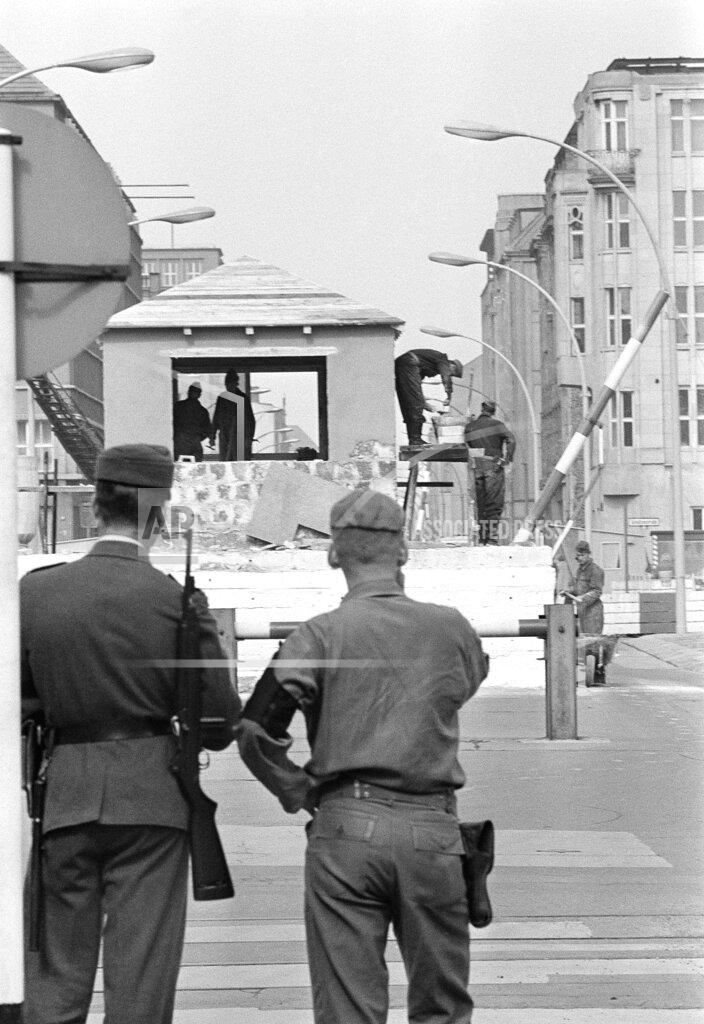
Two East Berliners, 21 and 22 years old, escaped to the United States sector of Berlin before dawn today by crawling under barbed wire. Two other East Germans, both 27, fled to the West at Northeim last night.
The opposition parties opened a parliamentary attack on the Government of Prime Minister Lal Bahadur Shastri today as speeches began in the debate on a no‐confidence motion. N. C. Chatterjee, an independent leftist, started the assault by’ denouncing what he called the “unfortunate policies pursued during the last 17 years” that the Congress party has “been in power and in office.” He said the “process of degeneration is being accelerated.” Mr. Chatterjee accused the Government of “increasing dependence on foreign private capital,” “supine dependence on foreign imports of food,” and “increasing submission to private monopolists, black marketeers and profiteers.”
The Arab League wrapped up its summit in Alexandria. Leaders of thirteen Arab states concluded a conference tonight with approval of a plan to counter Israel’s use of Jordan River waters. The final communiqué of the conference, the second Arab leaders have held, also contained a denunciation of the British position in the Federation of South Arabia. This was coupled with a pledge by Arab states to “offer assistance for the liberation movement in the occupied south,” a reference to the British‐backed federation.
In Barcelona, the Diada was celebrated for the first time since the end of the Spanish Civil War and the beginning of the dictatorship of Francisco Franco in Spain, as about 3,000 Catalan-speaking residents defied a ban against advocating Catalan nationalism. The Diada Nacional de Catalunya memorializes the day in 1714 when Catalonia had lost its independence. The protest was broken up and seven of its organizers were arrested and given heavy fines.
Reino Lehto retired from being Prime Minister of Finland and was replaced by Johannes Virolainen.
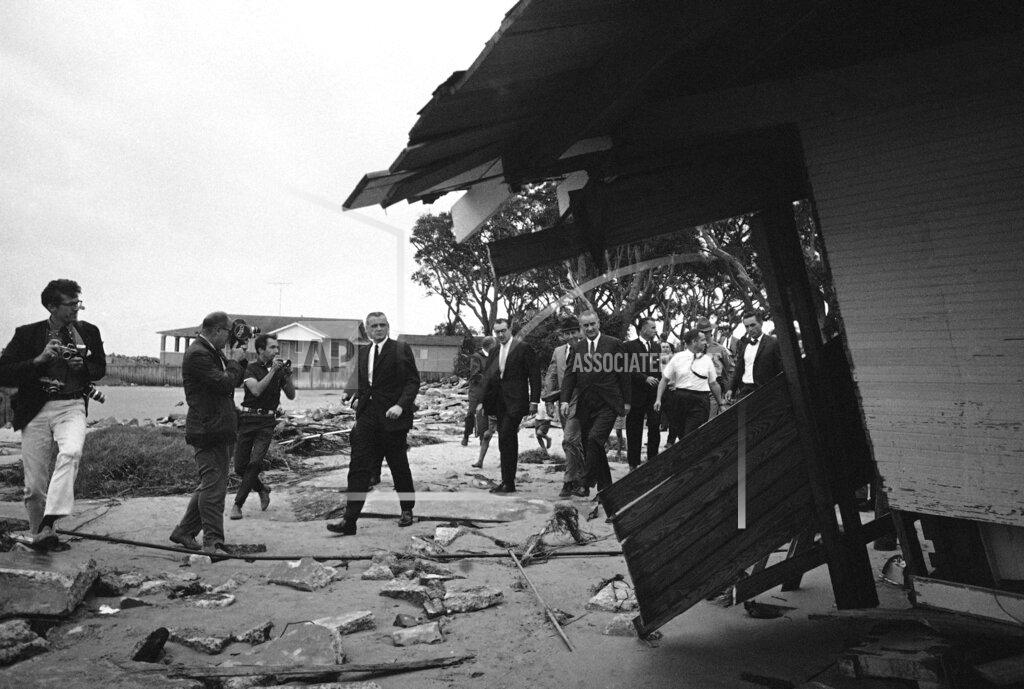
The hurricane‐devastated shore from Jacksonville, Florida, to Brunswick, Georgia, was visited today by President Johnson. The hurriedly assembled inspection party flew into the area early this afternoon before the diminishing winds of the tropical storm called Dora had died away. Mr. Johnson walked through Storm‐sodden resort areas, shaking hands and expressing his concern. Alongside demolished buildings, he talked above the roar of bulldozers to residents trying to salvage soaked and sand‐choked belongings. The President told Edward McDermott, Director of the Office of Emergency Planning, whom he had designated as a special disaster coordinator: “When we get back we are going to put all the facilities of the government at the disposal of these people.”
At Jacksonville Beach, he picked his way carefully through rubble and pools left by receding waters. He told one of his guides, Senator Spessard L. Holland, Democrat of Florida: “Spessard, I believe it’s worse than what you told me.” Flying from Washington, the President’s jet skimmed over the scudding ocean a scant 500 feet above the beach line from Brunswick to St. Augustine. From the starboard side of the plane he could see shore‐front homes, battered by wind and undermined by surf, tumbled into pitiful heaps of debris. The roiled waters of the Atlantic still clawed at seawalls along beaches submerged by high tides. Tons of sand had been swept over what once had been waterfront homes. Most of the damage came from erosion of foundations. Shoreline buildings broke the main force of wind and wave, and buildings inland survived. Even along the beaches, the blow seemed to have fallen with mysterious selectivity. One building, completely shattered, would be flanked by others that appeared untouched, or scarred at most by the scaling off of some of their roof shingles.
After his inspection tour of the hurricane-affected area, President Johnson’s jet transport landed at Andrews Air Force Base at 9:35 PM. He returned to the White House by helicopter.
President Johnson’s effort to resolve the Senate dispute over apportionment of state legislatures ran into a snag today when liberal Democrats opposed a compromise favored by the Administration. The compromise, which will be voted on next Tuesday, is designed to break the deadlock lover an apportionment rider to the foreign aid bill proposed by Senator Everett McKinley Dirksen of Illinois, the minority leader. Mr. Dirksen’s rider would postpone until January 1, 1966, further compliance with the Supreme Court ruling of last June 15 that districts for both houses of state legislatures must be substantially equal in population. It would do this by staying all Federal court proceedings on apportionment.
Mr. Dirksen’s declared purpose is to buy time for ratification of his proposed constitutional amendment to permit one house of a state legislature to be based on factors other than population. A group of Democratic liberals has mounted an extended “education debate” against the Dirksen rider. When Mr. Dirksen tried yesterday to shut off this talk with a closure motion, he was routed by a vote of 63 to 30. At the same time, the liberals do not have the strength to kill the rider by tabling it. A tabling motion yesterday was beaten, 49 to 38.
The Senate Judiciary Committee approved today a proposed “equal rights for women” amendment to the Constitution. It provides that “equality of rights under the law shall not be denied or abridged by the United States or by any state on account of sex.” The committee has favorably reported the proposed amendment in seven previous Congresses, but it never has been passed by both the Senate and the House.
Senator Barry Goldwater, who hopes to be President, deplored today what he called the expansion of Presidential power at the expense of other branches of Government. He said those who hailed the concept of “strong” Presidents had a “totalitarian philosophy that the end justifies the means.”
In a speech to the annual meeting of the American Political Science Association, the Republican Presidential candidate also said that the Supreme Court was the branch of Government least faithful to the principles of the Constitution. The 2,200 members of the association applauded both for and against Mr. Goldwater. For instance, when the association president, C. Herman Pritchett, mentioned President Johnson and Senator Hubert H. Humphrey there was loud applause. Mr. Goldwater, in turn, received a standing ovation from about half his audience. He was interrupted by applause 12 times, but it appeared to be by a distinct minority of his audience. Occasionally, Mr. Goldwater met with derisive skepticism. When he said that, since he was not a lawyer, perhaps he should leave analysis of the Supreme Court to constitutional lawyers, there was a burst of loud applause and laughter.
A minor controversy surrounded the Senator’s appearance. Dr. Herman Finer of the University of Chicago circulated a letter urging members to boycott Mr. Goldwater’s appearance. This led Mr. Pritchctt to make an opening statement pointing out that Mr. Goldwater himself was a member of the association and that Lyndon B. Johnson spoke to the group in 1960 as a Vice‐Presidential candidate. Mr. Goldwater charged that the Supreme Court had abandoned the principle of “judicial restraint, with respect to acts of Congress with which it disagreed but which are founded on legitimate exercise of legislative power.” He said he was weighing his words carefully when he declared that “today’s Supreme Court is the least faithful to the constitutional tradition of limited government” of the three branches of Government.
In particular, Mr. Goldwatcr condemned the school prayer and reapportionment cases. He said that only a “half-hearted” effort had been made to justify the decisions as being “within the intent of the framers of the 14th Amendment to the Constitution.” Rather, he said, they are defended on the grounds that “results are desirable; that it really isn’t good for children to say prayers in school and that it really is desirable to have state legislatures, in their entirety, apportioned on a oneman, one‐vote basis.” This is “raw and naked power,” he said. “The question under our system of government is not simply what decision is right, but also who has the right to decide. Only when the latter question is answered should the former be considered,” he declared.
Senator Pierre Salinger said today that the Republican Presidential nominee, Senator Barry Goldwater, was guilty of the “wildest distortion” in suggesting that the Cuban crisis in 1962 was timed for political reasons. The California Democrat, who was White House press secretary under President Kennedy, spoke in the Senate of Mr. Goldwater’s charge, made in a speech in Seattle, that Mr. Kennedy timed the crisis in Cuba in relation to the 1962 Congressional elections. The speech was Mr. Salinger’s first formal Senate speech since his appointment as successor to the late Senator Clair Engle. “We are all used to some measure of exaggeration in an election year,” Mr. Salinger said, “and in the heat of a campaign, much can be forgiven. But in this case, exaggeration has given way to the wildest distortion. The facts of history have been bent beyond recognition.”
One of organized labor’s top leaders remarked the other day that Senator Barry Goldwater was the “perfect” candidate for unions to oppose. “His record is 100 per cent against labor,” this union official said, “and our people are realizing it.” Nevertheless, there is concern among union leaders that anti‐Negro sentiment stemming from the Civil Rights push and recent riots could result in serious defections in November. Workers in some of the nations’s major industrial centers of the North — in the Midwest and East — made it clear in a series of interviews that the civil rights issue was uppermost in their minds. The overwhelming majority of those interviewed, however, said that they were going to vote for President Johnson anyway.
In Ecorse, Michigan, a stocky, red‐headed man, who was stripped to the waist, stopped pouring cement for his front walk to talk politics for a few minutes.He said that he was a crane “hooker” in a nearby steel mill and quickly made it clear that he approved Senator Goldwater’s vote against the Civil Rights Bill.“But I’m still for Johnson,” he said. “I’m a Democrat and the Democrats are for the working class.”
On the other hand, a lean and tanned truck driver, a member of the International Brotherhood of Teamsters, independent, emphasized his support of Senator Goldwater as he sat in his stocking feet on the front stoop of his Mozart Street home in Chicago. “I like Goldwater because he’s against N—-rs,” the truck driver said. “After his election there’ll only be a few white Democrats left.” Further questioning disclosed, however, that this man had voted for the Republican candidate, Richard M. Nixon, in 1960.
The Democratic and Republican national chairmen signed a pledge today to promote fair play in the campaign. The ceremony promptly erupted into an argument over the fairness of a television advertisement sponsored by the Democratic National Committee. Dean Burch, the Republican chairman, said that the advertisement’s “innuendo” amounted to “libel per se” against the Republican Presidential candidate, Senator Barry Goldwater of Arizona. John M. Bailey, the Democratic chairman, maintained that the complaint was unjustified.
Mr. Burch’s protest was against a television film showing a little girl picking petais from a daisy and counting. Suddenly there is a terrifying nuclear explosion. Then a voice urges the eiection of President Johnson. The implication, Mr. Burch complained, is that Mr. Johnson “is a careful man and Senator Goldwater may somehow cause some sort of atomic conflict because he is a perfectly reckless person” This is not only libelous but it is also “the most violent political lie that can be told,” he said. Mr. Bailey replied: “They (the Republican spokesmen) think we are trying to scare people with the image of Mr. Goldwater. I think any image of Mr. Goldwater has been created by Mr. Goldwater himself.”
Alabama has been warned that it can lose federal funds for highways and may have to return funds it has already received. The warning came from Administrator Rex M. Whitton of the United States Bureau of Public Roads in a letter yesterday to Governor George C. Wallace. The letter said the bureau had information that consulting engineers employed on federal highway projects in Alabama were required to hire friends of the Wallace Administration as agents. This violates Federal regulations. Mr. Whitton told Mr. Wallace he did not want to take any action without first calling the matter to the governor’s attention so an investigation might be made. Governor Wallace promised today to help prosecute any “wrongdoing” found in the handling of the contracts.
The Senate Judiciary Committee approved a bill today to pay $100,000 to Frank B. Rowlett for his work in helping to break the Japanese code in World War II and for his cryptologic inventions. Under the bill, already passed by the House, Mr. Rowlett would not be required to pay any Federal tax on the money. He began his government career in 1930 as a junior cryptanalyst in the Army Signal Corps, and is now special assistant to the director of the National Security Agency. The Department of Defense, in recommending the $100,000 payment, said Mr. Rowlett conceived fundamental principles that assured the high security capability of major cryptographic systems and equipment successfully used by the United [States in World War II.
The Beatles performed for the first time in the “Deep South” when they played a concert in Jacksonville, Florida at the Gator Bowl stadium as part of their 1964 North American tour. When the concert had originally been booked, the stadium had separate sections for whites and blacks (and “Eastern Meadow-Golds” (Asians) were not allowed); the group conditioned their appearance on being able to perform before a desegregated audience (which would become a moot point after the signing of the Civil Rights Act in July).
Beatles guitarist George Harrison forms Mornyork Ltd music publishing company.
“Fight of the Week,” the live boxing program shown on the ABC television network for four seasons, was telecast for the last time, bringing an end the weekly prime time telecast of boxing bouts that had been popular in the United States since the advent of network television in 1946. Fight of the Week had started in 1960 after NBC’s Cavalcade of Sports had ended. The last fight was Dick Tiger defeating Don Fullmer in a bout in Cleveland.
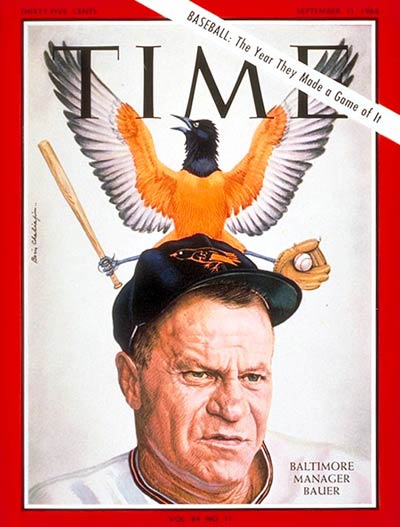
After rookie Wally Bunker (16–4) gives the Baltimore Orioles a 5–2 win over the A’s, Kansas City’s bonus baby Blue Moon Odom stops the O’s, 8–0, on 2 hits. The split shaves the Orioles lead to a half-game over the White Sox. The O’s will get one hit tomorrow.
The Chicago White Sox collected 13 hits and defeated the Cleveland Indians, 7–3, tonight. Gary Peters and Eddie Fisher combined to pitch a six-hitter for the victors.
One-hit relief pitching for 4⅔ innings by Jim Perry stymied the New York Yankees last night in their drive toward the two teams above them in the American League race. Perry’s hurling and home runs by Jim Hall and Don Mincher were the principal factors in the Minnesota Twins’ 5–3 victory before a crowd of 25,295 at Yankee Stadium.
Los Angeles Angels reliever Bob Lee fractures his right hand punching a heckling sailor in Boston. But he is the only Angel connecting as Red Sox pitcher Bill Monbouquette shuts out the Haloes, 3–0.
Don Wert led off the last of the ninth inning with a triple tonight and scored on a wild pitch by Ron Kline to provide the Detroit Tigers with a 5–4 victory over the Washington Senators.
The Philadelphia Phillies’ Dennis Bennett stops the San Francisco Giants, 1–0, defeating Juan Marichal. Bennett, who had lost seven of eight decisions since the All-Star game break, struck out Willie Mays three times in the clutch tonight. Ruben Amaro’s double scores the lone run and keeps the Phillies 6 game ahead of the Cards.
St. Louis ace Bob Gibson holds the Chicago Cubs to 2 hits, and the Cardinals win, 5–0. The triumph was the Cardinals’ fifth in the last six games. Ken Boyer’s 22nd homer starts the Birds’ scoring.
In a pitching duel between the Milwaukee Braves’ Denny Lemaster and the Cincinnati Reds’ Jim Maloney, Milwaukee scores a run in the 8th to win, 1–0. Gene Oliver doubles, the 2nd hit of the game off Maloney, and scores after a double steal and fly out. Leo Cardenas has the only hit off Lemaster.
The New York Mets scored three runs in the sixth inning tonight on four hits and a wild pitch and defeated the Los Angeles Dodgers, 4–2. It was the third victory of the year for the Mets over the Dodgers, the most times they had ever defeated Los Angeles in one season. And it was only their seventh decision in 52 games in the series in three years. To achieve this modest milestone, the Mets had to travel 3,000 miles by jet, take a bus to Dodger Stadium for the opening of an eight‐game Western tour and overcome a 1–0 deficit in the sixth inning. Joe Christopher started the rally in the sixth with a triple off the base of the flagpole in right field, scoring Roy McMillan and tying the game.
Vernon Law continued his mastery over the Houston Colts tonight, pitching the Pittsburgh Pirates to a 3–0 victory with a two-hitter.
Dow Jones Industrial Average: 867.13 (+7.63).
Born:
Ellis Burks, MLB outfielder (MLB All-Star 1990, 1996; Boston Red Sox, Chicago White Sox, Colorado Rockies, San Francisco Giants, Cleveland Indians), in Vicksburg, Mississippi.
Eric Thomas, NFL cornerback (Pro Bowl, 1988; Cincinnati Bengals, New York Jets, Denver Broncos), in Tucson, Arizona.
Troy Stradford, NFL running back (Miami Dolphins, Kansas City Chiefs, Los Angeles Rams, Detroit Lions), in Elizabeth, New Jersey.
Doug Hudson, NFL quarterback (Kansas City Chiefs), in Memphis, Tennessee.
A.J. Wynder, NBA point guard (Boston Celtics), in the Bronx, New York, New York.
Victor Wooten, American Grammy Award-winning jazz-fusion, funk, and bluegrass bass guitarist and producer (Béla Fleck and the Flecktones), in Mountain Home, Idaho.
Mo Abudu, Nigerian talk show host (Moments with Mo) and network executive (Ebony Life Television), described as “Africa’s Most Successful Woman” and “The Oprah Winfrey of Africa”; as Monsunmola Abudu in Lagos
Died:
Gajanan Madhav Muktibodh, 46, Hindi poet, essayist, literary and political critic, and fiction writer



 History Diaries