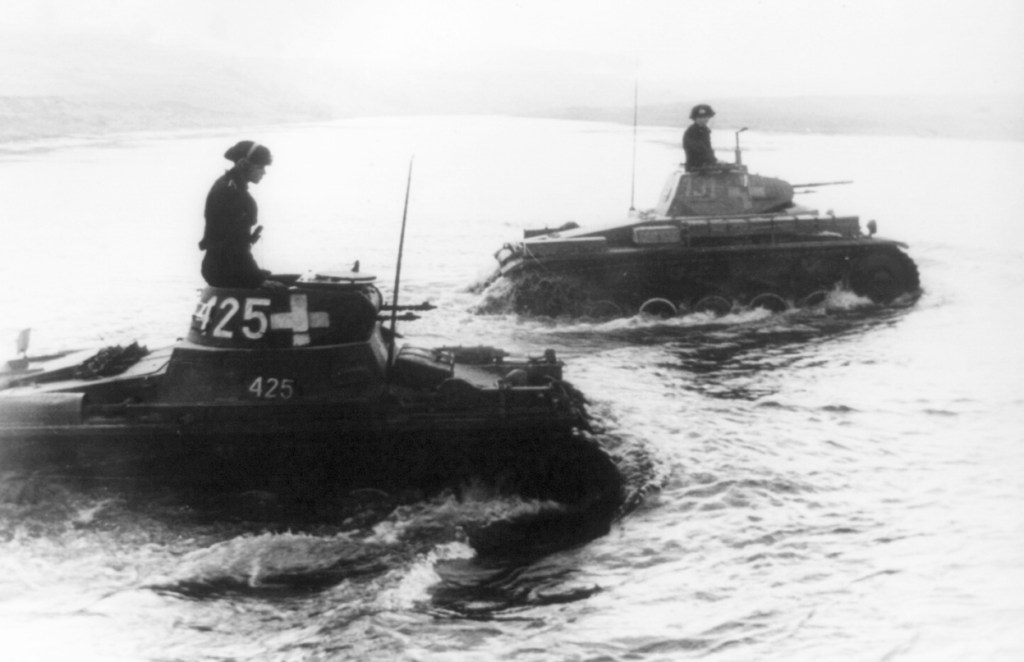
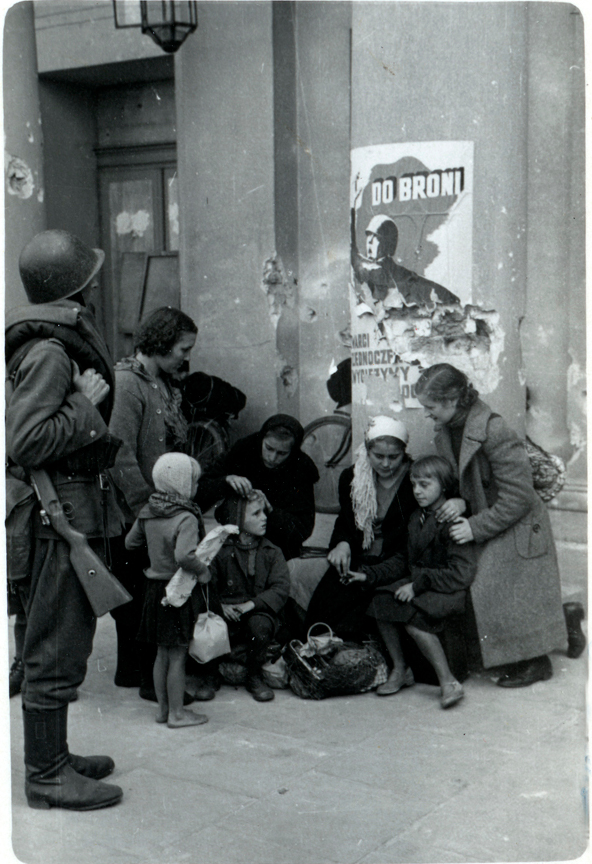
The Battles of Jarosław and Kępa Oksywska began. The Battle of Jarosław (known as the Defence of Jarosław in Polish sources) took place between 10 and 11 September 1939 in the city of Jarosław on the San River. During the battle the Polish forces of General Stanisław Maczek successfully held the river crossings in the town for two days against the Nazi German Wehrmacht, which was enough time for the Polish 10th Motorized Cavalry Brigade to cross the river and retreat further eastwards. On this day, Colonel Maczek arrived at Jarosław. His unit, the Polish 10th Motorized Cavalry Brigade, was one of only two fully motorized Polish units and had been used by the commanding officer of the Kraków Army as an armed firefighter, thrown into battle each time the Germans or Slovaks tried to outflank the – much slower – Polish army. This time his unit formed the rear guard of the army and was to provide cover for the units retreating. Maczek decided to station his brigade around Jarosław and strengthen the Polish defences there.
Around noon the two German divisions arrived near Jarosław and the Polish front guards retreated to the other side of the river, leaving only a token infantry force under Colonel Wójcik at the bridgehead on the western banks. Maczek decided to hold the city for one day in order to provide a safe haven for the slower units following his brigade. After that his unit was to continue its pursuit of his army and organize another delaying action further eastwards, near Lwów (modern Lviv, Ukraine).
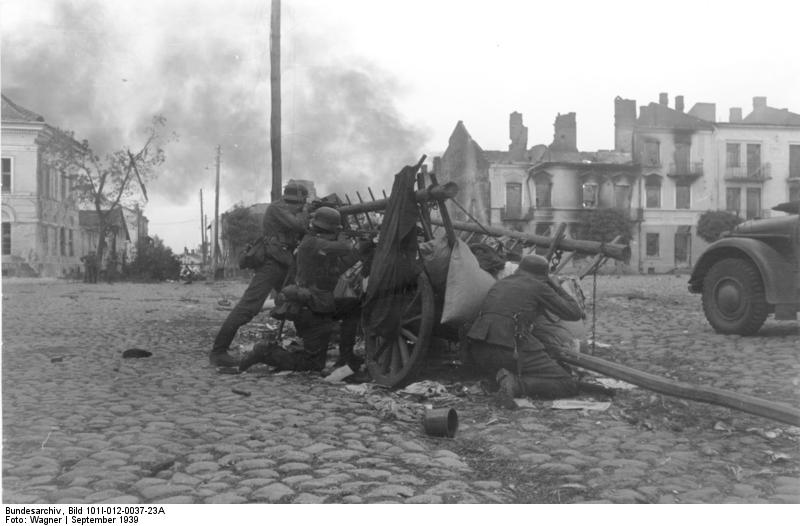
In the early afternoon the Germans started their assault on the city, but were repelled and forced to leave several damaged or destroyed tanks on the battlefield. The repeated assaults later that day were also unsuccessful. Overnight Colonel Maczek decided that his plan succeeded and further defence of the city could result in his unit being cut out from the rear by the Germans advancing from Radymno. Because of that he moved his unit further eastwards to the Oleszyce-Lubaczów area. Lieutenant-Colonel Wójcik’s forces were to hold the town for as long as possible, and then follow the motorized brigade. The Poles blew up the bridges and left only a token force in the city, while the majority of the men retreated under the cover of darkness. In the early morning of 11 September the Germans resumed their assault, this time with a heavy artillery barrage. However, since most of the Polish units were already miles away, the losses were negligible. Around noon the panzers rolled towards the Polish positions only to discover that the several infantry companies (an infantry battalion under Captain Matheis), until then guarding the Polish positions, were also withdrawn.
The Battle of Kępa Oksywska took place in the Oksywie Heights outside the Polish city of Gdynia between 10 and 19 September 1939. The battle, fought by the Polish Army and the German Wehrmacht, was part of the Polish September Campaign during World War II. It was one of the bloodiest battles of the campaign, with Polish KIA losses reaching roughly 14% of all the forces engaged. On 10 September, after a series of skirmishes in the vicinity of Reda at the western outskirts of Gdynia, the Polish commander of the Land Coastal Defence forces, pułkownik Stanisław Dąbek, was in a difficult position. His forces, centred on the port of Gdynia, were forced to wage a two-front war against the German forces advancing both from the west and from the territory of the Free City of Danzig. The main part of his forces was facing the German forces under General der Flieger Leonhard Kaupisch, advancing from the east along the shores of the Gdańsk Bay. At the same time a smaller detachment of the Polish forces prepared a stand in the area of Oksywie, where the German forces managed to cut the Poles out of the nearby Hel Peninsula. Thus Gdynia was besieged.
Constant aerial bombardment and lack of supplies and reinforcements finally forced Colonel Dąbek to order a cease-fire on 19 September. By then the Polish casualties amounted to roughly 2,000 dead and 7,000 wounded, and there were hardly any unwounded soldiers. Col. Dąbek then committed suicide.
The four-day Battle of Łomża ended when the Polish Army withdrew. Despite three days of repeated German attacks and significant losses (roughly 30% in dead and wounded), Polish morale was still high. However, soon after 21:00 Colonel Stefan Kossecki, commanding officer of the 18th Infantry Division, ordered the Łomża position to be abandoned. The reason was that the Germans were victorious in the Battle of Nowogród and the Poles failed to retake the town. Around the time the Germans also broke through at Wizna and the Narew river line was untenable. The 33rd Regiment withdrew towards Bacze Mokre, the last unit crossed the Narew around 22:00. The following day the German forces captured Łomża unopposed and on 29 September the town was handed over to their Soviet allies.
The Germans break through at Wizna and take Nowogród, making the entire Narew River line untenable. It has been a dry summer, making standard defensive river lines less useful as opposing forces can ford the rivers. The Polish high command orders a general retreat to the southeast.
SS-Brigadeführer Wilhelm Fritz von Roettig becomes the first German general to die in World War II when he is killed in Action at Opoczno, Poland at about 1415 hours.
Polish armies are ordered to conduct a general retreat to defensive positions in the southeast.
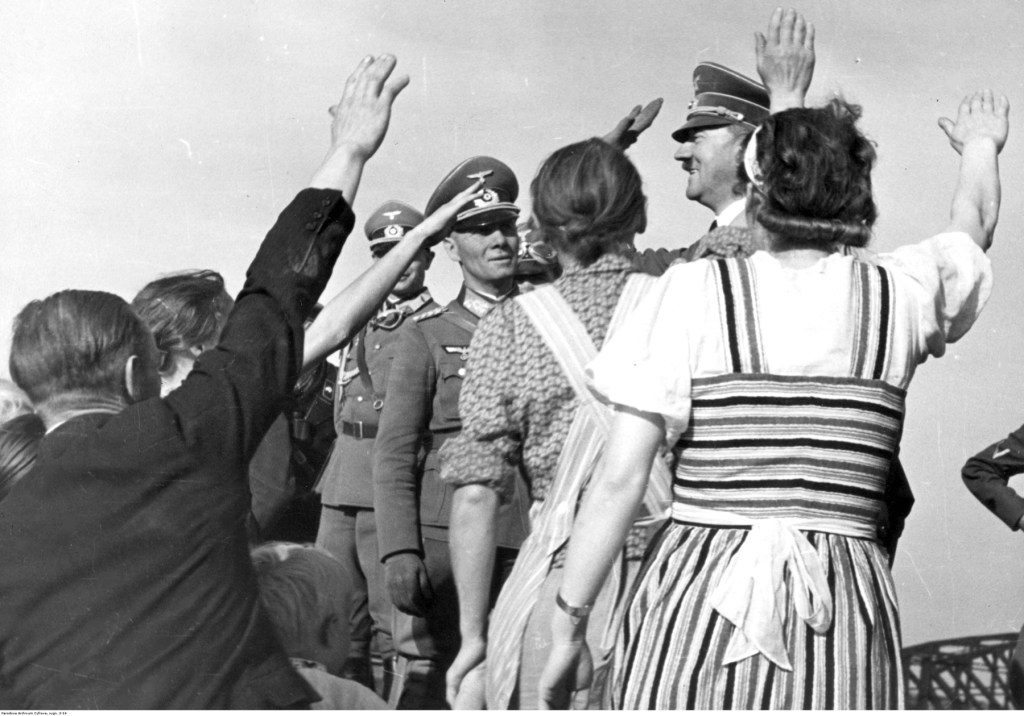
Hitler flies over the eastern front and follows the retreat of Polish troops.
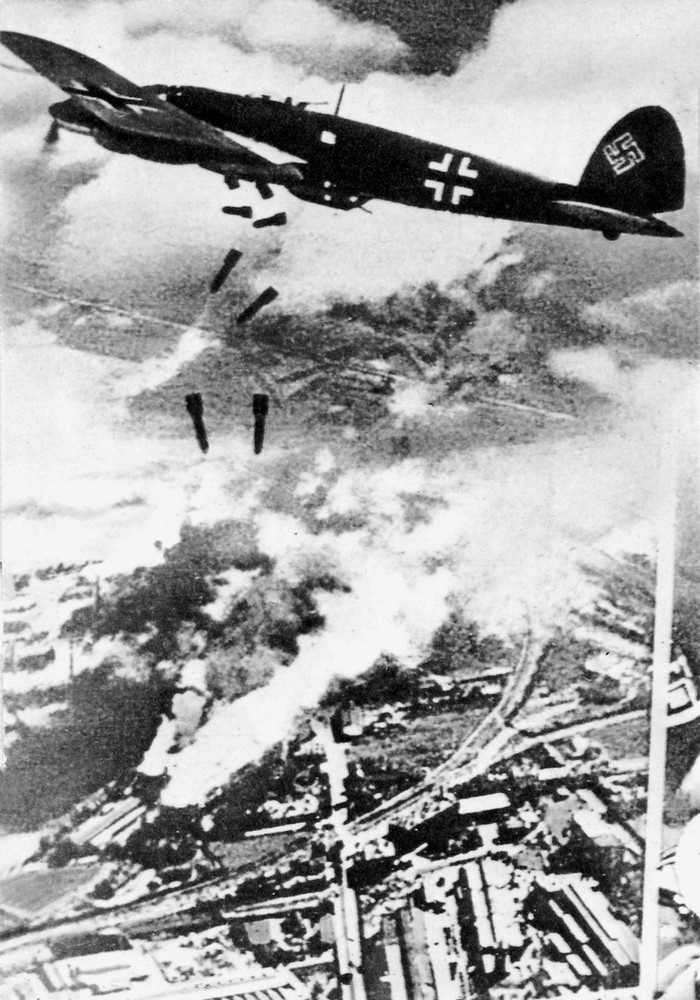
The Luftwaffe conducts 15 air raids on Warsaw.
German forces broadcast a false news bulletin, announcing the fall of the capital on the same wavelength as Radio Warsaw.
Germans warn the Czechs that enlistment in any foreign army is treason.
An official broadcast by the German DNB station in Berlin last night was recorded by The New York Times in New York. It declared that Chancellor Hitler still counted on Premier Mussolini, despite Italian neutrality, “if need be.”
The Reich’s economy is on a full war basis. Wages, prices, costs, and supplies are now controlled by official decree.
In reply to insistent demands by the Polish Commander-in-Chief, Marshal Smigly-Rydz, the French Chief of the General Staff, General Gamelin, announces that more than half of his active divisions are in contact with the enemy on the northeast front and that he can do no more.
The French Army today is rushing reinforcements to the Italo-French border while beginning its offensive against the German Westwall. All over Northern Savoy and around the Modane sector, material and men are being massed.
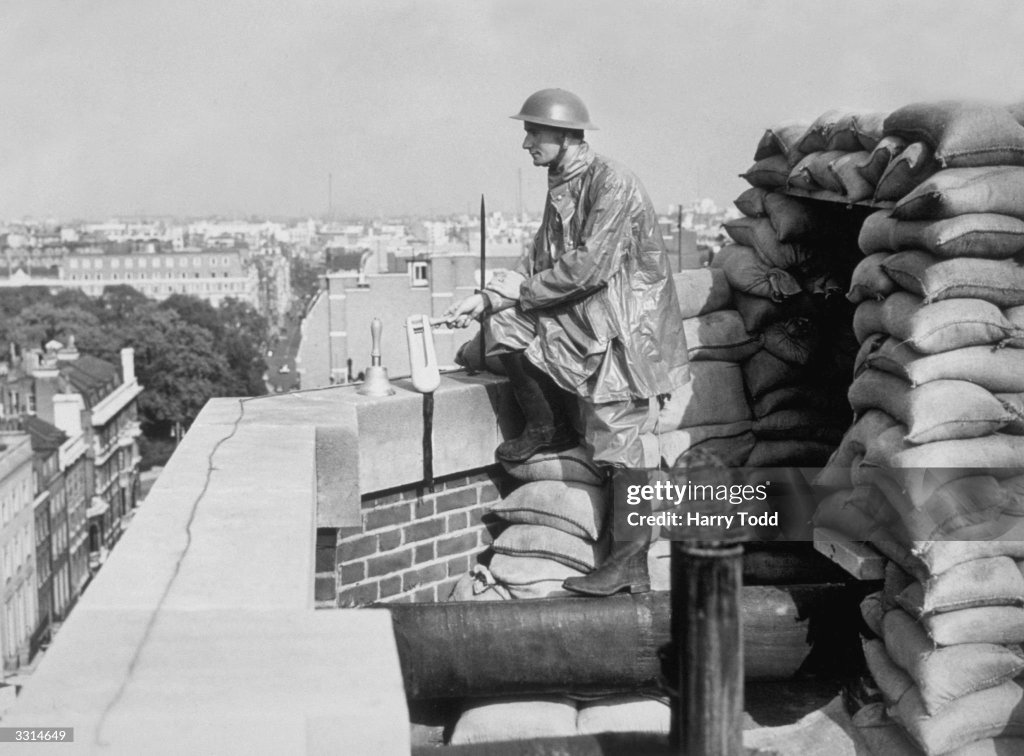
The fact of war falls with brutal impact upon a traveler arriving in England. Cut off from newspapers and radio on board a ship which, under the Stars and Stripes, is a projection of the peaceful United States, the second major war of this century becomes as unreal there as the memory of a dream. Then the landing at a British port brings home with full force the grim reality that Britain’s sons are going to the Continent to fight for King and country, while the rest of the nation waits at home to brave air raids which may come at any moment, bringing them a knowledge that they also must share this struggle.
The landing port is extremely busy with preparations bearing all the outward signs of war. The most depressing of all were ships painted in funereal colors waiting for the grim tasks ahead of them in this movement to smash Hitlerism. Everyone who boards the liner at the customs — immigration men and Intelligence officials — carries a gas mask in a brown pasteboard box slung from the shoulders by a yard of string. These boxes, seen everywhere, make it look as though the entire population of the United Kingdom is heading to some giant picnic.
The Battle of the Atlantic officially begins. On the very same day, the British Admiralty begins organizing a convoy system.
Off the coast of Norway, the British submarine HMS Oxley was mistaken for an enemy by HMS Triton and sunk in the North Sea off Stavanger, Norway (58°30′N 5°30′E). The submarine HMS Triton, commanded by Lieutenant Commander Hugh P. De C. Steele, mistakenly torpedoes and sinks the submarine HMS Oxley, commanded by Lieutenant Commander Harold G. Bowerman, approximately 28 miles south-southwest of Stavanger, Norway. The HMS Triton picks up two survivors. Submarines Oxley and Triton were patrolling off Norway and had been in regular contact when Triton spotted an unidentified submarine off the coast of Norway. Believing it might be Oxley a number of signals of recognition were flashed by Triton. No reply was forthcoming and after several challenges Triton fired two torpedoes that struck the submarine and sent her to the seabed. Triton closed in on the area and found three survivors. A Board of Enquiry finds that Oxley was some way out of position and that Triton had acted correctly and was not culpable for the sinking.
The British steam merchant Magdapur strikes a mine and sinks off Orford Ness in the North Sea (52°11′N 1°43′E). Of the ship’s complement, 6 die and 75 survive. Survivors were rescued by the Aldeburgh lifeboat Abdy Beauclerk ( Royal National Lifeboat Institution) and other vessels. The 8,641-ton Magdapur was carrying ballast and was bound for Southampton, England.
The British steam merchant Goodwood strikes a mine and sinks southeast of Flamborough Head in the North Sea (54°06′N 0°03′W). Of the ship’s complement, 1 dies and 23 survivors are picked up by a fishing boat. The 2,796-ton Goodwood was carrying coal and was bound for Bayonne, France.
The U.S. freighter Hybert is detained for two hours by an unidentified U-boat. The Hybert is released but the Germans warned the merchantman not to use her radio for 24 hours.
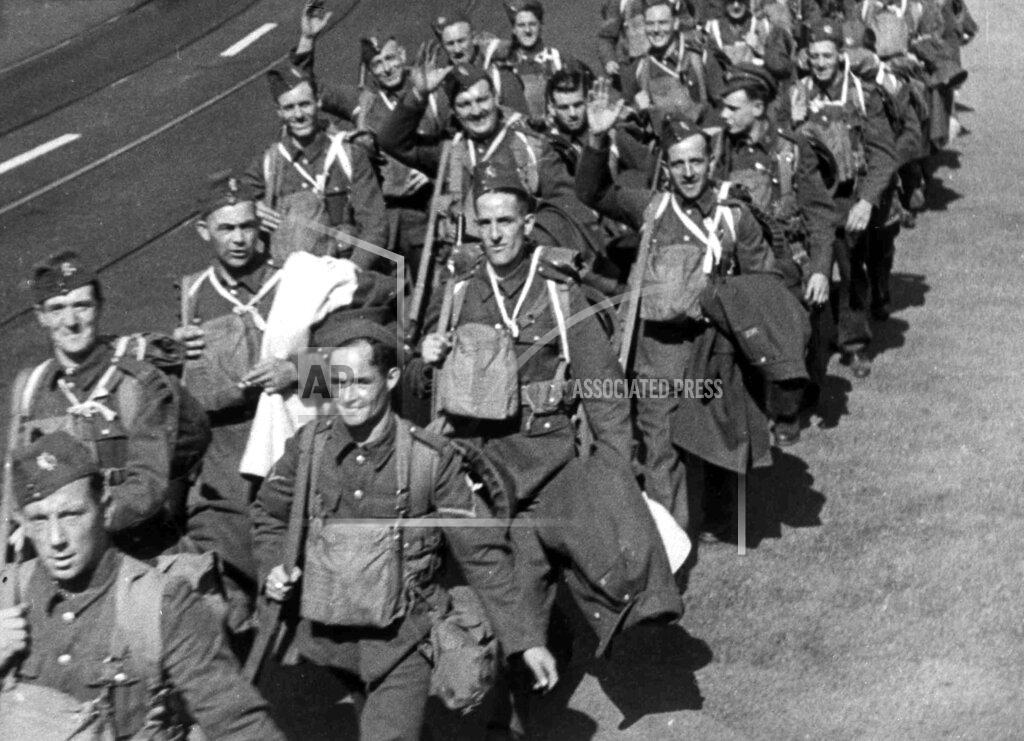
The first major units of the British Expeditionary Force begin to land in France. Field Marshal Lord Gort is in command. Small advance parties have been arriving since 4 September. In the first month 160,000 men, 24,000 vehicles, and 140,000 tons of supplies are sent.
Irish sympathies mainly lie with Britain. Germany is not as popular as in 1914. There is a better feeling toward Great Britain among the Irish people at the outset of this war than there has been since the visit of King Edward VII and Queen Alexandra in April, 1904.
The Franco government and the people of Spain recognize no present obligation to Italy or Germany for the aid rendered the Franco forces during the Civil War and are determined to remain neutral, according to the U.S. Ambassador to Belgium.
Rumania strengthened her defenses tonight against the eventuality of being drawn into the European war.
Soviet ambassador to Poland Nikolai Szaranow is recalled from Warsaw.
The Soviets continue to call up reserves and mass on Poland’s eastern border. Officially they claim it is a “strengthening of defenses” because of the war in Poland.
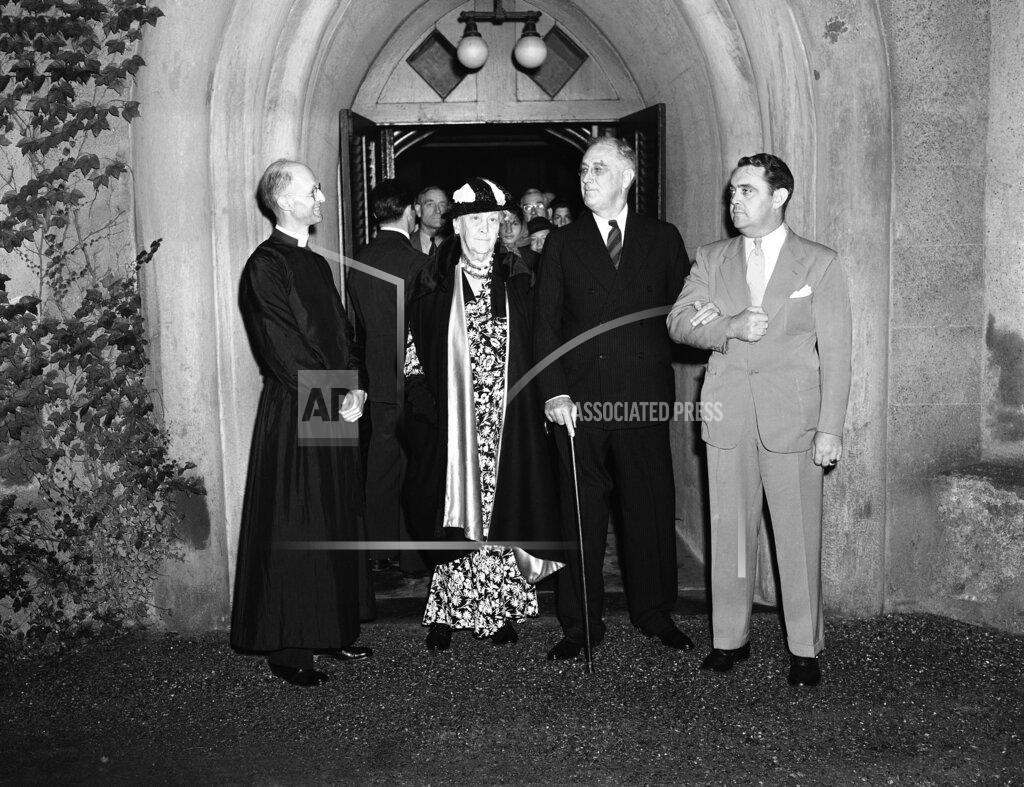
President Roosevelt will probably issue a call for a special session of Congress before the end of the week. He has definitely decided on the extraordinary meeting for the sole purpose of changing the Neutrality Law and will not permit the threat of a filibuster to alter his plans. While Mr. Roosevelt is confident that, with the pledged support of the Republican leadership, Administration forces in the Senate could put through repeal of the arms embargo, he is anxious that protracted debate be prevented. The President is concerned lest opposition speeches by the isolationist group in the Senate might create the impression abroad that the nation is divided on the government’s neutrality policy. The President has expressed the conviction that the refusal of Congress to consider lifting the arms embargo clause at the last regular session encouraged Chancellor Hitler to believe that the United States was deliberately removing itself from a sphere of influence in European affairs and encouraged him to initiate hostilities against Poland.
The President is now concerned over the possibility that isolationist speeches in the Senate might not only give new encouragement to the totalitarian States but might also have an adverse effect on the morale of the Allied powers. If the rule of cloture could be invoked in the Senate and debate limited thereby to an hour’s discussion by each member, the unfortunate effect which a filibuster would produce in foreign capitals could be avoided, observers say. However, the Senate is jealous of its prerogative of unlimited debate and the President, it is believed, would be the last to suggest that the cloture issue be brought to a vote, and this for very practical reasons.
While he has been assured informally of better than a two-thirds vote in the Senate to repeal the mandatory arms embargo features of the Neutrality Law, some of the members who would support the repeal would vote against invoking cloture. The rule can be applied only with the consent of two-thirds of those present at the time a vote is called for. Moreover, the Administration is understood as of this writing not to have considered the possibility of bringing about an agreement between the Democratic and Republican leaders of the Senate whereby debate could be limited as effectively as under cloture through a “gentlemen’s agreement.” There is good reason for believing that this possibility will be explored before the special session is called formally by the President.
President Roosevelt set up an arms embargo against Canada today by proclaiming the neutrality of the United States in the war between that country and Germany. He acted when informed that Canada had declared a state of war existing.
Two proclamations, one proclaiming the neutrality of the United States under international law and the other extending the arms embargo to Canada under the Neutrality Act, had been ready for several days in the expectation that the Ottawa government would take the step it did today. The documents were signed by the President and issued through. the State Department along with supplementary regulations for enforcement of America’s neutrality status. The several steps were similar to those previously taken in the cases of the United Kingdom, Germany, France, Poland, India, Australia, New Zealand, and South Africa.
The effect is to shut off the United States as a source of supply for Canada in respect to arms, ammunition and implements of war. There is no embargo against other materials, such as petroleum, cotton, copper, and other essential supplies for waging war, since these are not covered by the neutrality statute.
While, in case of a long war, the effect embargo on Canada may be considerable, for the present it is slight. A search of the records by the State Department today showed that the only arms, ammunitions. and implements of war that Canada has on order in this country are seven airplanes. They cannot now be shipped. However, it is President Roosevelt’s hope to have Congress revise the neutrality statute to permit the sale of munitions to the belligerents, a circumstance which in view of the control of the seas exercised by Great Britain would mean selling arms to the Allies but not to Germany.
While the proclamation was being issued Secretary Hull, ignoring the Sunday holiday, was in his office studying the latest reports from Europe and considering questions with his advisers. Sumner Welles, Under Secretary of State, assistant secretaries of state and experts of the department were at their offices as on a weekday, due to the war emergency.
Apart from immediate aspects of the war, there were many problems to be studied. The department is engulfed daily with messages from embassies and legations in the belligerent countries reporting on economic, financial, blockade, and other programs these countries are preparing. The reports are being analyzed here and considered in the knowledge that out of the war will emerge many new situations which will affect the economic life of the United States. As promptly as possible safeguarding measures will be taken to meet the problems now being raised.
The Roosevelt administration proposes voluntary military training for the Civilian Conservation Corps. Providing separate units and barring compulsion is expected to allay opposition. Serious consideration is being given by high Administration officials to the possibility of establishing voluntary military training for those members of the Civilian Conservation Corps who wish to obtain a groundwork in military practice.
The American Retail Federation has by resolution pledged every effort of its members to “avoid war profiteering” and sent a letter to President Roosevelt offering all its facilities “in the event of serious crisis.”
The New York waterfront was quiet yesterday, after a busy week in which thousands of Americans returned home and hurried paint jobs were used to make the ships of belligerent nations less conspicuous and the ships of neutral nations more conspicuous. Five new liners are due to arrive today.
North American Aviation begins production on the B-25 Mitchell, a twin-engine, medium-attack bomber. Nearly ten thousand will be built, in various marks, during the war, both in the main North American facility in Inglewood, California, as well as a new factory in Kansas City.
The New York Yankees sweep a doubleheader from the Washington Senators, 4–3 and 6–2. Bill Dickey hits two of the Yankees’ four home runs in the nightcap, his 20th and 21st of the season. Joe DiMaggio goes 0-for-4 in both games.
Detroit’s Bobo Newsom beats the Chicago White Sox, 5–1, and, as noted by historian Lyle Spatz, stops Johnny Rigney’s consecutive win streak of 11 games. Rigney’s mark is a club record that will be tied (Gary Peters, 1963) and finally topped by LaMarr Hoyt (13 in one season) and Wilson Alvarez, both with 15 over 2 seasons. In the second game of their doubleheader, Chicago salvages a split, beating the Tigers, 11–9.
The Boston Red Sox take two from the Philadelphia Athletics, winning 10–7 and 5–1. Rookie Ted William led the Red Sox to twin victories with two homers, two triples, and a single on the afternoon. Williams now has 26 home runs this year.
Myril Hoag, St. Louis Browns outfielder who was fined Friday for “indifferent” playing, belted a home run in each game today as the Browns split a double-header with the Cleveland Indians, winning the nightcap, 5-4, after losing the opener, 15-5.
The Cincinnati Reds’ Paul Derringer wins his 20th, beating the host Chicago Cubs, 7–2. Derringer yields seven hits and strikes out 8. The Cubs lead 2–0 after two innings, but Derringer is in command the rest of the way, and after the Reds score four in the third, the Cubs never really challenge.
The St. Louis Cardinals gained a half-game on the league-leading Cincinnati Reds today by taking both games of a doubleheader from the Pittsburgh Pirates, 9–3 and 11–4. The Cardinals now trail by just 3 games. Both teams have exactly 28 hits for the day, but the Pirates also commit eight errors.
The Brooklyn Dodgers spank the New York Giants, 8–4. Jimmy Ripple — recently acquired by the Dodgers ina trade with the Giants — continues to haunt his former team with two hits today including a 2-RBI triple that erased a 3–2 Giant lead in the fifth.
A special morning edition of the Canada Gazette published the Canadian declaration of war against Germany. Signed by Prime Minister Mackenzie King and bearing the seal of Governor General Lord Tweedsmuir, it did “hereby declare and proclaim that a state of war with the German Reich exists and has existed in our Dominion of Canada as and from the tenth day of September, 1939.” The Governor-General of Canada, Lord Tweedsmuir, announces that the Canadian Parliament has declared war on Germany. “Now Therefore We do hereby Declare and Proclaim that a State of War with the German Reich exists and has existed in Our Dominion of Canada as and from the tenth day of September, 1939.” The Canadians are the last of the great Dominions to declare war on Germany. The few days of hesitation permitted the accelerated delivery from the U.S. of large amounts of war goods which are barred after the declaration of war because of America’s neutrality laws. King notes that there are currently 4,500 soldiers in the Canadian Army (+60,000 reserves); 4,500 in the RCAF; 1,800 in the RCN.
United States neutrality laws are extended to Canada.
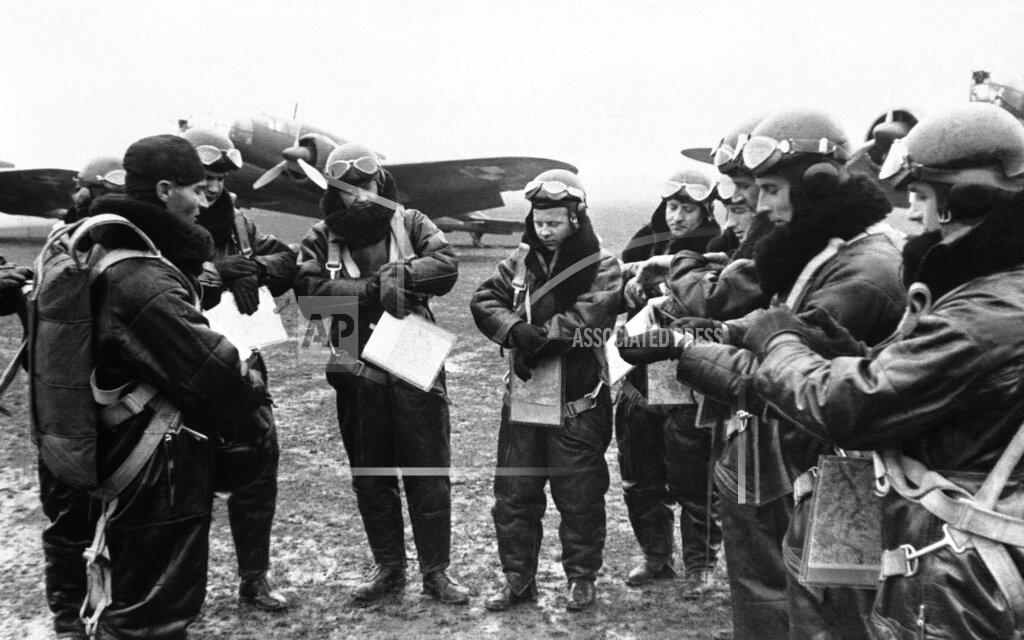
The first mission by the RCAF is carried out by No. 5 (General Reconnaissance) Squadron based at Dartmouth, Nova Scotia. A Supermarine Stranraer biplane seaplane, serial number 908, is dispatched on a reconnaissance patrol of the approaches to Halifax; five vessels are sighted but no enemy activity is seen.
Rising sugar prices lift the feeling of gloom in Puerto Rico, as the island looks forward to a new era of prosperity.
Premier General Nobuyuki Abe warned the Japanese today that the belief that Japan can force western powers to retreat from the Far East because of the European war is a “very dangerous idea.” He also disclosed the government is considering methods of adjusting relations between Japan and the Soviet Union. He said it is considering “the view which prevails in some quarters for the conclusion of a nonaggression pact” with Moscow. General Abe also strongly reiterated Japan’s intention to remain neutral in the European conflict and expressed doubt that the United States would replace Great Britain as the principal nation supporting the regime of Chinese Generalissimo Chiang Kai-shek.
Born:
Junious “Buck” Buchanan, AFL and NFL defensive tackle (Pro Football Hall of Fame, inducted 1990; AFL Champions-Chiefs, 1966, 1969; Super Bowl IV Champions-Chiefs, 1969; AFL All-Star, 1964-1969; NFL Pro Bowl, 1970, 1971; Kansas City Chiefs), in Gainesville, Alabama (d. 1992, of lung cancer).
Dale Evans, AFL halfback (Denver Broncos), in St. Francis, Kansas.
Jim Pappin, Canadian NHL right wing (NHL Champions, Stanley Cup-Toronto, 1964, 1967; NHL All-Star, 1964, 1968, 1973-1975; Toronto Maple Leafs, Columbus Black Hawks, California Golden Seals-Cleveland Barons), in Sudbury, Ontario, Canada (d. 2022).
Cynthia Lennon, first wife of John Lennon, and mother of singer, photographer, activist Julian Lennon, in Blackpool, Lancashire, England, United Kingdom (d. 2015).
Artie Tripp, American rock percussionist (Mothers Of Invention; Captain Beefheart’s Magic Band), and chiropractor, in Athens, Ohio.
Greg Mullavey, American actor (Tom Hartman in “Mary Hartman, Mary Hartman”), in Buffalo, New York.
Died:
Wilhelm Fritz von Roettig, 51, first German general to die in World War II (ambushed by Polish troops near Opoczno).
Naval Construction:
The Royal Canadian Navy Fisherman’s Reserve auxiliary patrol vessel (ex fishing vessel) HMCS Mitchell Bay is commissioned.
The South African Seaward Defence Force minesweeping trawler HMSAS Africana is commissioned.
The Kriegsmarine (German Navy) minesweeping trawler M 1402 (later M 4413, and finally vorpostenboot V 621 Mars), is commissioned.
The Kriegsmarine (German Navy) vorpostenboot V 204 Dorum (later V 407 Dorum) is commissioned.
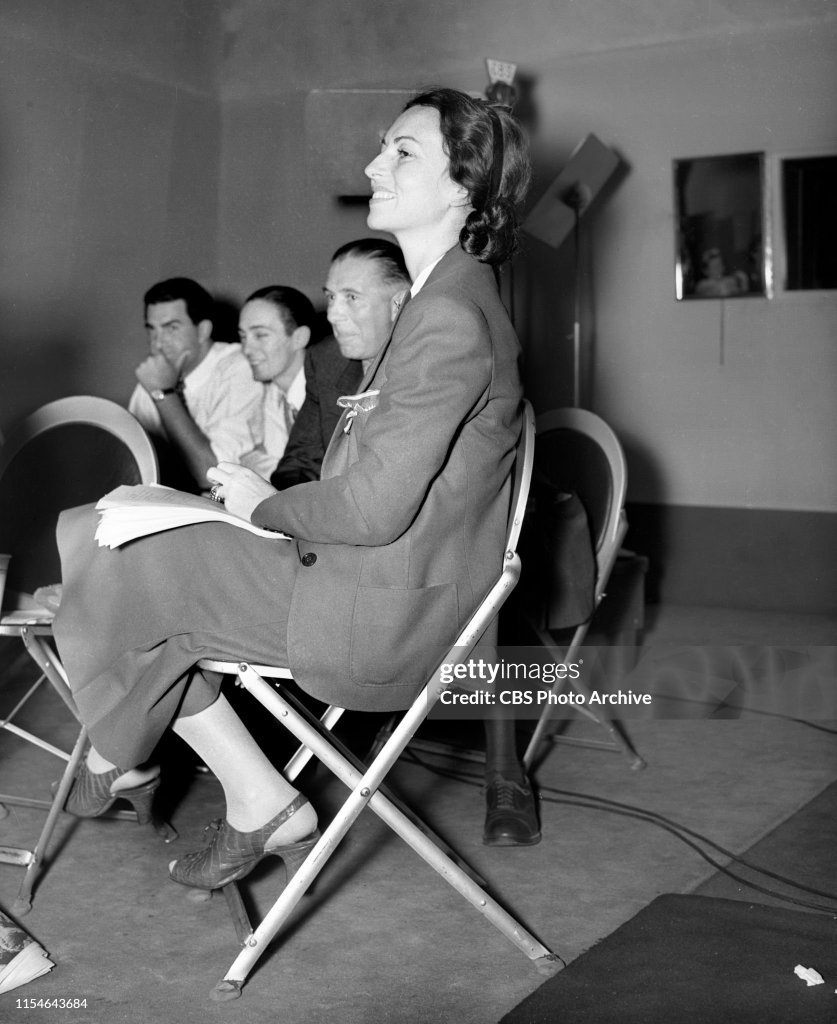
[Ed: A later generation knows Agness as “Endora”. She also played the lady fighting space invaders — with a twist — in one classic Twilight Zone episode with no dialog.]
 History Diaries