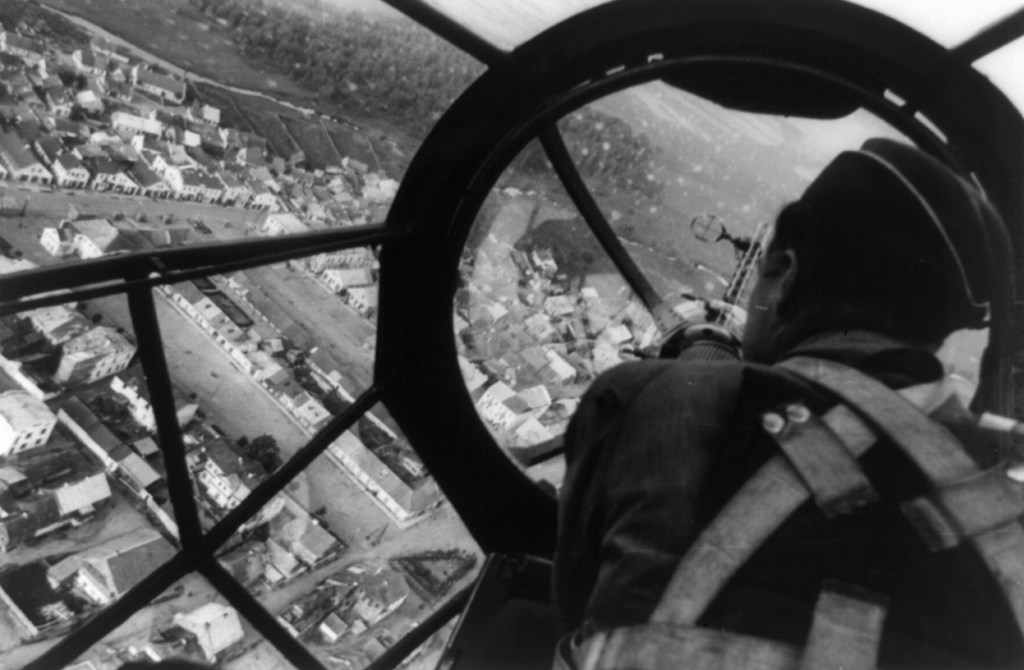
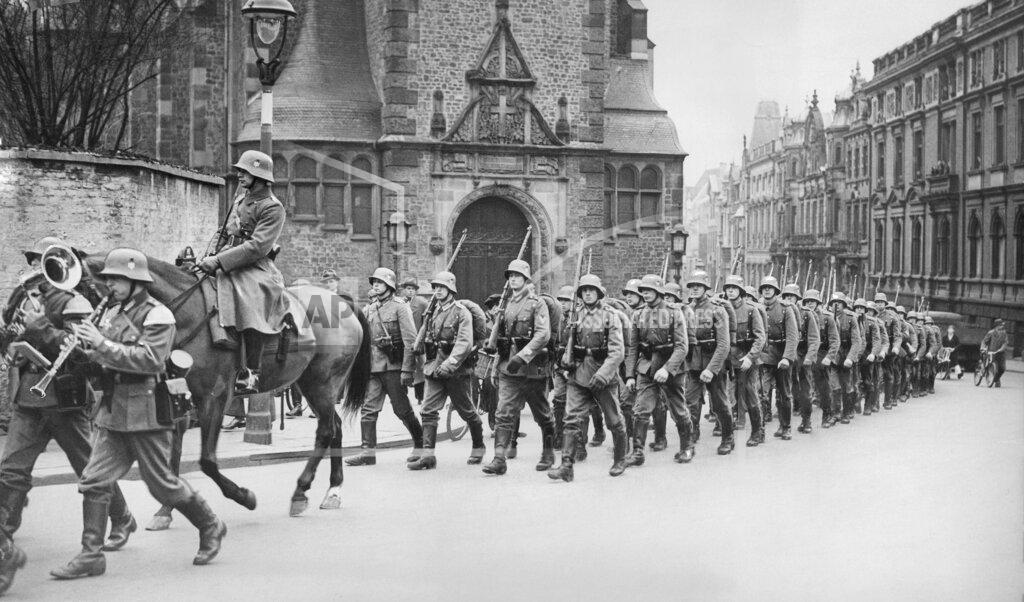
The Siege of Warsaw began. General Von Reichenau’s German 4th Panzer Division, spearheading the German 10th Army, reaches the Warsaw suburb of Ochota. On the morning of September 8, the suburbs of Grójec, Radziejowice, Nadarzyn, Raszyn and Piaseczno were captured by forces of German XVI Panzer Corps. At exactly 5pm the forces of the German 4th Panzer Division attempted an assault on Warsaw’s western borough of Ochota. The assault was repulsed and the German forces suffered heavy casualties with many Panzer I and Panzer II tanks lost. The following day, the 4th Panzer Division was reinforced with artillery and motorised infantry, and began another assault towards Ochota and Wola. The well-placed Polish 75 mm anti-tank guns firing at point-blank range, and the barricades erected on main streets, successfully managed to repel all initiated assaults and unexpected attacks. Despite German radio broadcasts claiming to have captured Warsaw, the initial enemy attack was repelled and soon afterwards Warsaw was placed under siege.
The Battle of Gdynia began. The Germans’ main push towards Gdynia began on 8 September and they captured Gdynia six days later on 14 September. After intense fighting near Puck and Wejherowo (8 September) step by step the Poles were forced back towards the sea. When the Polish positions outside Gdynia were overrun, and in view of the retreat of the Armia Pomorze, on 10 September Colonel Dąbek decided to abandon Gdynia in order to avoid civilian casualties during the city fighting, and thus on 12 September he ordered all Polish units to retreat from Gdynia toward Kępa Oksywska, a fragment of the coast near Puck Bay.
“Polish soldiers fought gallantly, and they did not spare blood. The area of Gdynia and Danzig was defended by the elite of the Polish armed forces. Those were young and inspired units of the navy and army, which fought admirably. On the plateau of Oxhöft we found trenches filled with dead Polish soldiers, who fell by hundreds where they fought, with the rifles still in their hands. It was apparent, that they fought to the bitter end.” — from F. O. Busch, “Unsere Kriegsmarine im Polnischen Feldzug”
The Polish Army conducted a successful delaying action in the Battle of Wola Cyrusowa, near the village of Wola Cyrusowa near Stryków. It was fought between the forces of the Polish Piotrków Operational Group under Gen. Wiktor Thommée and the German 10th Infantry Division. In the effect of a successive delaying action, the Polish forces managed to regroup and withdraw eastwards while at the same time inflicting heavy losses on the opposing unit. However, their victory was only a temporary setback for the Nazi invasion of Poland.
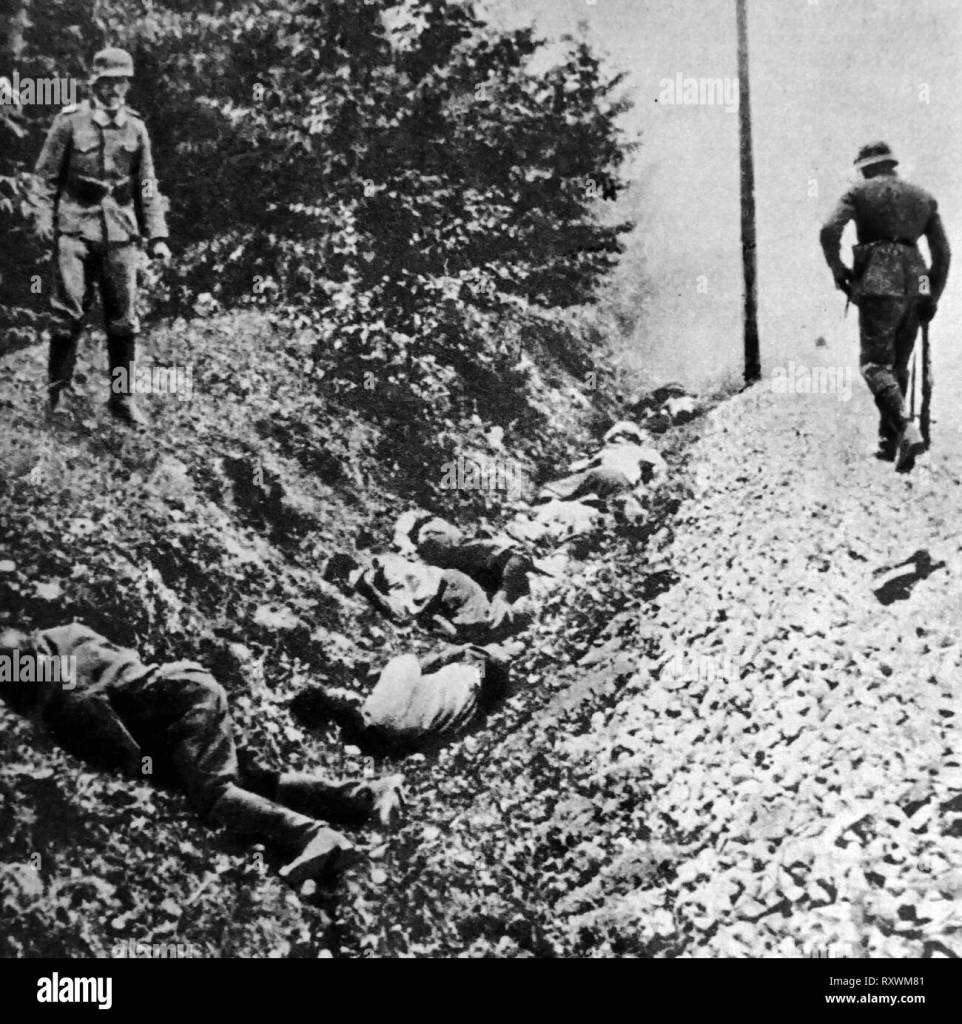
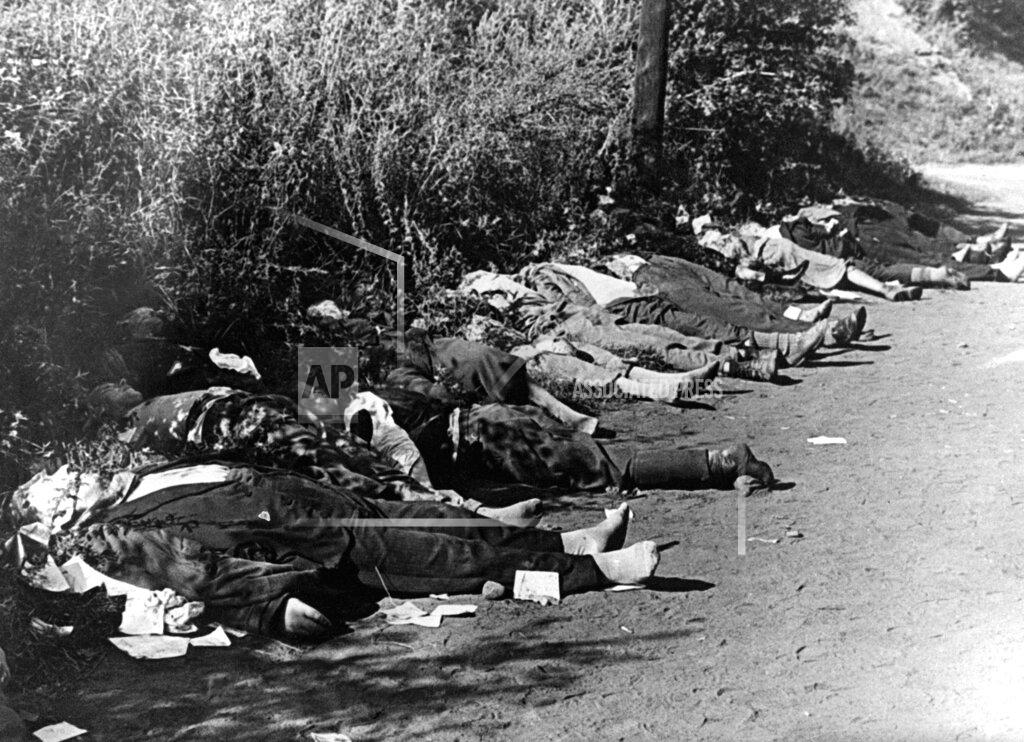
Ciepielów massacre: German soldiers massacred some 300 Polish prisoners of war near the village of Ciepielów. This was one of the largest and most documented war crimes of the Wehrmacht during its invasion of Poland. On that day, the forest near Ciepielów was the site of a mass murder of Polish prisoners of war from the Polish Upper Silesian 74th Infantry Regiment. The massacre was carried out by soldiers from the German Army’s 15th Motorized Infantry Regiment, 29th Motorized Infantry Division, under the command of Colonel Walter Wessel. This event has been described as the “most infamous” war crime committed by Germans during their invasion of Poland. The number of dead has commonly been estimated at 300, although more recent research suggests a revised number of “over 250” instead.
The massacre was documented in photos and memoirs of an anonymous German soldier, who witnessed an engagement in which Polish soldiers ambushed and killed over a dozen German soldiers from the 11th Company of the 15th Regiment, including the company’s commander, Captain Lewinsky. A number of Polish soldiers were then captured, and Oberst (Colonel) Walter Wessel, commander of the German 15th Motorized Infantry Regiment, 29th Motorized Infantry Division, ordered them stripped of their uniforms and declared partisans and had them taken to a secluded location near the village of Dąbrowa (itself near a larger village of Ciepielów), where they were shot. The anonymous author of the memoirs arrived at that location after hearing gunfire, and counted approximately 300 bodies in a roadside ditch. Those documents were received by the Polish Military Mission in Germany in West Berlin in 1950.
German troops burned 200 Jews alive in a synagogue on the night of 8-9 September. On the day of 8 September 1939, two Jews were shot on the street because they dared to raise the price of bread. That night, the Germans surrounded the synagogue and would not let out from the interior the people who had been praying, killing instantly anyone that made their way out. Those who tried to remove the Torah and religious books from the burning synagogue were also shot. Jews captured on the street were forced by the Nazis into barrels filled with tar and set on fire. Jews and Poles were then accused of setting fire to the synagogue. In consequence, a group of 40 Jewish and Polish hostages was shot on 9 September in the courtyard of the district authority office. The operation against Będzin’s Jewish population was commanded by Udo Gustav Wilhelm Egon von Woyrsch – a German general, Commander of the SS and the Police in Upper Silesia who had previously “become famous” in Germany for his participation in the Night of the Long Knives. He was the commander of the Einsatzgruppe zur besonderen Verwendung (Eng. Special Purpose Operational Group). It was this group that was responsible for the pacification of the Polish part of Upper Silesia and pogroms of the Jews.
Werner Mölders crash lands his fighter aircraft after developing engine trouble; his back was injured, which kept him out of action for 11 days.
Arthur Greiser is named the head of the military government in Poland.
Hitler issues an amnesty for Catholic priests accused of minor infractions of German law.
The spiritual directorate of the German Evangelical Church, by the order of Dr. Friedrich Werner, State-appointedhead of the church, has issued a proclamation for prayer calling for support of the actions of Chancellor Hitler and his armed forces in the Polish campaign. The prayer will be read from all pulpits during the campaign prior to the reading of the Lord’s Prayer.
Rye and wheat flour and coffee substitutes were included in the rationing system of Germany today. It was stated that, although the German grain supply was “assured for years to come,” it was necessaray to take measures to insure that flour was not wasted.
The French advance into the heavily mined Warndt Forest, having moved approximately just eight miles into lightly defended German territory.
An official French bulletin says that retreating Germans are blowing up bridges.
Berlin envisions deadlock in the west and counts on a quick capture of Warsaw to checkmate Britain and France.
The Gestapo arrests many former socialists. Czech leaders are also held. Operating under drastic wartime measures, engendered, it was said, by fears of sabotage, the German Gestapo (secret police) was disclosed by reliable sources today to have made many “protective” arrests of former Socialists and trade union chiefs. Most of those arrested were described as permanent leaders of the workers before Adolf Hitler’s rise to power. Some had been held in concentration camps for a time after 1933. Authorities apparently believe that men and women who have already expressed dissatisfaction with the Nazi regime in the past must be segregated from a people which is “united as one.”
This attitude seemed to spring from Increasingly stringent steps being taken in Germany to guard against industrial or other economic sabotage, against cleavage within the nation and from efforts to get everyone to cooperate in defense measures. Reliable sources said that an increasing number of former Socialists and trade union leaders were being arrested, although it was impossible to estimate the total. For example, a former executive of the foreign department of the German Federation of Trade Unions has been arrested, while many former Socialist party deputies also have been taken into custody. A woman once prominent in Socialist women’s work was arrested at the office where she has more recently been employed.
Coincidentally, it was reliably learned in Berlin that many leading citizens of the Czech Protectorate had been arrested by the Gestapo. Since last weekend, in almost every city in the Protectorate, such arrests have been made. Some estimates said the number ran into thousands, but this was impossible. to confirm.
The German coaster Helfrid Bissmark struck a mine and sank in the Skagerrak.
The German coaster Helga Schroder struck a mine and sank in the Baltic Sea.
The British Government announces the reintroduction of the convoy system for merchant ships and a full scale blockade on German shipping in response to what it claimed to be unrestricted submarine warfare by the Germans.
Allies announce a long-range naval blockade of Germany. Britain proclaims a virtual blockade and orders a system of contraband control in retaliation for Reich submarine warfare. The communiqué on contraband control emphasized that “no blockade of Germany in the formal sense of the term has been declared.” Nevertheless, the control measures bore a striking resemblance to those which frankly were called a blockade in the World War. Ships bound for Germany or a neutral country from which goods could be forwarded to Germany were “urgently advised to call voluntarily” at one of the British control bases.
If they fail to do so, British warships may halt them and search them on the high seas, or divert them to a control base where the cargoes, if they are considered contraband, may be seized. One of the control points, Kirkwall, a port in the Orkney Islands, north of Scotland, was the control base for North Sea shipping in the World War. The other bases are at Weymouth, the Downs (North Foreland), Gibraltar and Haifa in Palestine.
It is declared that everything would be done at the contraband control bases to examine ships as rapidly as possible, particularly those which call voluntarily. Neutral vessels were advised that the delay would be reduced to a minimum if they cooperate by having all papers drawn up in the most convenient form and carry copies of the ship’s manifest to be handed over and retained by the examining officer.
Britain prepares the rationing of food but says the move does not indicate a shortage. Rationing of all food will be introduced in the United Kingdom shortly, probably as soon as the national register, on which the system can be based, is compiled. Though this was confirmed today, William S. Morrison, new Minister of Food, said that there was no shortage of food in the United Kingdom.
Britain eases the restrictions on movies and other places of entertainment outside of areas which are belleived to be certain targets of any aerial bombing and where evacuations have been conducted. Cinemas in outlying areas may stay open until 10 PM.
The unescorted British motor merchant Regent Tiger is stopped by gunfire and after the crew abandons ship is torpedoed and sunk by the U-29, commanded by Kapitänleutnant Otto Schuhart, about 250 miles west-southwest of Cape Clear, Ireland in the eastern Atlantic Ocean. Of the ship’s complement, all 44 survive and are picked up by the Belgian steam merchant Jean Jadot. The 10,176-ton Regent Tiger was carrying motor fuel and diesel oil and was bound for Avonmouth, England.
The unescorted British steam tanker Kennebec is stopped by gunfire and after the crew abandons ship is torpedoed and sunk by the U-34, commanded by Kapitänleutnant Wilhelm Rollmann, about 70 miles west by south of the Scilly Isles in the eastern Atlantic Ocean. Of the ship’s complement, all 22 survive and are picked up by the Dutch steam merchant Breedijk. The 5,548-ton Kennebec was carrying fuel oil and was bound for Avonmouth, England.
The unescorted British steam merchant Winkleigh is torpedoed and sunk by the U-48, commanded by Kapitänleutnant Herbert Schultze, southwest of Ireland in the eastern Atlantic Ocean. Of the ship’s complement, all 37 survive and are picked up by the Dutch liner Statendam. The 5,055-ton Winkleigh was carrying grain and lumber and was bound for Manchester, England.
The Admiralty-requisitioned British cargo ship Cape Ortegal was scuttled in Skerry Sound, Scapa Flow as a blockship. She broke up at the beginning of the winter of 1939–1940.
The Dutch Minelayer HNLMS Willem van Ewijck is sunk in the North Sea near Terchelling, Friesland when she runs into her own mine barrage. 33 men are lost.
The Finnish barque Olivebank (2,824 or 2,795 GRT) struck a mine and sank in the North Sea at 55°53′N 5°07′E with the loss of 14 of her 21 crew. The survivors were rescued by the Estonian Tallona.
U.S. freighter SS Saccarappa, which had been detained by the British since 3 September, is released after her cargo of phosphates and cotton are deemed contraband and removed.
Russia is reinforcing her western frontier. A brief statement to this effect issued officially a few days ago is finding increasingly abundant confirmation by reporters in Moscow. Unobstrusively, without summoning any classes to the colors, Russia, it is becoming obvious, is quietly increasing the strength of her forces under arms.
Lavrentiy Beria organizes two NKVD operational groups, to be based in Kiev in Ukraine and Minsk in Byelorussia, for near-future deployment to eastern Poland to arrest resistance elements. The two groups in Ukraine and Byelorussia were led by Ivan Serov and Lavrentiy Tsanava, respectively.
President Roosevelt declared a limited national emergency. Increases were ordered in the enlisted strength of the army, navy and National Guard. President Roosevelt issues Proclamation 2352 proclaiming a “limited national emergency” and orders enlisted strength of all armed forces increased–naval enlisted men from 110,813 to 145,000; Marine Corps from 18,325 to 25,000 — and authorizes recall to active duty of officers, men, and nurses on retired lists of Navy and Marine Corps. Also, a $500,000 fund was allocated to assist in the return of American citizens stranded in war zones.
The unexpected action was announced at the President’s press conference. He cautioned the 200 correspondents present that the expansion of the defense forces did not represent in any sense conversion to a war basis. Only a “limited national emergency” was being declared, he emphasized repeatedly. The Administration wanted to avoid placing the nation on a wartime footing both in its defenses and its internal economy. By separate steps announced at the time, the President proclaimed the neutrality of the United States with the Dominion of South Africa, which, he said, had officially notified this country of its belligerent status. A similar proclamation already had been drafted in relation to Canada, to be issued as soon as the Parliament at Ottawa takes final action on its own status in the war.
Then the President announced that he had decided to call a special session of Congress to propose abandonment of the mandatory arms embargo feature of the Neutrality Act, and that it remained only for the date of the session to be decided upon. It was his plan, he said, to have the extra session terminated as rapidly as possible after action on the neutrality question. He saw no reason why the session should run over into the regular session, opening on January 3.
U.S. President Franklin Roosevelt insists that food is plentiful, and assures people that prices will not skyrocket as in 1917–18. President Roosevelt assured the American people through his press conference today that there was an actual surplus of foodstuffs of every variety and that there was no basis for fears that prices might again “go through the roof” as they did during 1917 and 1918 when the country was at war.
At the same time the President called on the press and the public generally to demonstrate that there was nothing to become alarmed about, since there could be no conceivable shortage of food in view of present inventories. While further advances in prices of some food items might occur, he said, there was no basis for fears that wartime prices would soon become a reality. The President gave his views on the food price situation a few minutes before conferring with Attorney General Murphy on the subject. That Mr. Roosevelt might be more concerned over the trend than his remarks indicated was suggested by the Attorney General on leaving the White House when he stated: “The present anti-profiteering laws are inadequate to do a real job.”
Whether action to remedy the legislative deficiency regarding profiteering control might be sought at the special session of Congress, which the President said he had decided to call, was not indicated by Mr. Murphy, but there were suggestions elsewhere in official circles that the project might be undertaken if it could be done without risk to the neutrality legislation now contemplated.
It is the President’s belief, according to some of his advisers, that business itself should have an opportunity to control the upward trend of retail consumer prices before any attempt is made to legislate such controls. This belief was reflected most recently by Secretary Wallace when on leaving the White House yesterday he expressed confidence that business men themselves would cooperate to prevent undue increases in prices of important staples. Mr. Wallace’s view, apparently shared by the President, is that consumers have no ground for complaint over the present level of retail prices in view of their relation to price levels existing during the past five years or in more normal times prior to the World War.
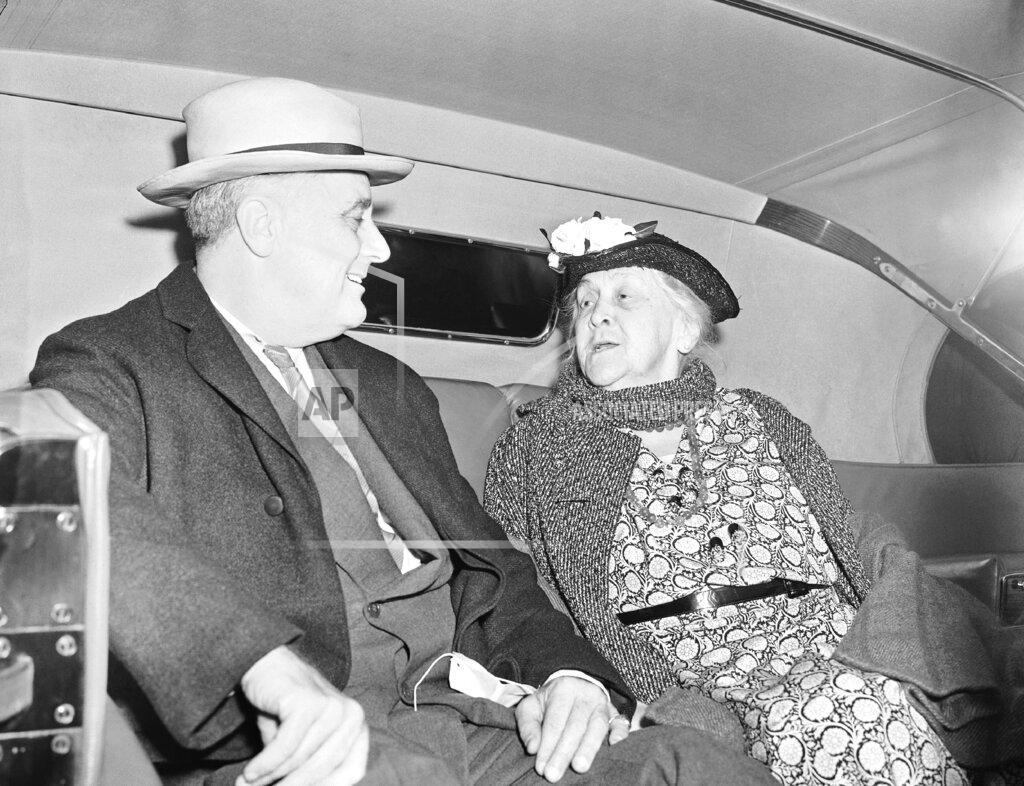
President Roosevelt arrived at Hyde Park, New York tonight for a weekend visit with his mother, his first respite from the strain of official duties since he returned to the White House from his North Atlantic cruise two weeks ago.
The sinking of the Athenia was attributed yesterday to Winston Churchill, First Lord of the British Admiralty, by Fritz Kuhn, national leader of the German-American Bund, who said Mr. Churchill issued the order “in absolute disregard of American lives entrusted to British ships.”
A manufacturer of nurses’ uniforms offers to hold prices steady for the next ninety days, despite the rise in price of cotton.
A former U.S. Communist, Ben Gitlow, says that Stalin seized control of the party in 1929. He testifies that the Soviet chief still dictates to American Communists.
NBC wins a slander case the centered on remarks made by Al Jolson on a radio program.
The president of Notre Dame University seeks better relations with Latin American countries.
Railroad officials will cut rates by 25 percent to aid travel to the World Fair.
Immediately after the President had signed the executive orders increasing the enlisted strength of the armed forces, Secretary Woodring announced today that the army increase would total 17,000 men, raising the enlisted strength to 227,000 men, the figure which, under law, the army would have attained by July 1, 1940.
Since Congress voted the army’s air expansion program, more than 3,000 planes of all military types have been contracted for and are now under construction, Louis Johnson, Assistant Secretary of War, stated tonight in an address over a network of the Mutual Broadcasting Company on “Air Progress in America.”
The Vultee Model 48 Vanguard aircraft makes its first flight.
The Boeing board selects Philip Johnson as company president, so he returns from Canada. Claire Egtvedt becomes chairman of the board.
Undersecretary of State Sumner Welles and British Ambassador to the U.S. Lord Lothian have “off-the-record talk” (at the former’s request) concerning the brief detention of U.S. passenger liner Santa Paula the day before. Lord Lothian is informed that Santa Paula’s captain had been asked “to give formal assurances whether there were any German passengers on board, the implication being that if the captain had not given such assurances, the officers of the cruiser would have boarded [Santa Paula] to search for German passengers and possibly might have taken some off.” Undersecretary Welles goes on to say that “any act by British cruisers affecting American ships in waters so close to the United States involving possible boarding of them and taking off of civilian passengers would create a very highly unfortunate impression upon American public opinion at this time and was something undesirable in itself, since if civilian passengers actually had been taken off, such act would be clearly counter to international law.” Lord Lothian agrees and promises to “take the necessary steps to prevent occurrences of this kind from happening.”
Twenty-year-old Bob Feller becomes the youngest 20th-century pitcher to win 20 games, as the Cleveland Indians beat the St. Louis Browns, 12–1. Feller yields five hits and strikes out five.
At Boston, the New York Yankees take a 4–1 lead into the 7th and beat the Red Sox when the game is stopped because of violent thunder and lightning. Charlie Ruffing gets the win, his 21st. Joe DiMaggio, hitting .409, will develop a painful infection over his right eye that causes swelling and eye problems (as noted by historian Craig Wright). Joe will hit just .233 over his last 73 at bats but will still finish with a league-high .381. He will come to blame manager Joe McCarthy for his missed .400 season, thinking that McCarthy should have rested him.
The Philadelphia Athletics get outhit 13–8, but win anyway, 5–4, over the Washington Senators. Washington leaves 11 men on base.
Bucky Walters held the Pittsburgh Pirates to five hits today and lofted an eighth-inning home run which broke a tie and helped give the Cincinnati Reds a 5–2 victory. The four-game series was evened at two each. It was Walters’ 23rd win of the season and his 26th complete game.
Enos Slaughter and Don Gutteridge batted the St. Louis Cardinals to a 10–3 victory over the Chicago Cubs today, enabling the Cards to stay four-and-a-half games behind the league-leading Reds, who beat the Pirates. Gutteridge sent four runs home on two triples and Slaughter drove in one run and scored three himself on a double and three singles.
The Brooklyn Dodgers sweep a doubleheader from the Philadelphia Phillies, winning 11–2 in the opener, and then 3–1 in a five-inning rain-shortened nitecap.
Canada announces it will defend its own territory and send munitions and airmen to Britain. Prime Minister W. L. Mackenzie King told Canada’s war Parliament today that the Dominion would defend its own territories, furnish a constant supply of munitions to Britain and dispatch trained airmen overseas, but would defer consideration of a general expeditionary force until better able to assess the strength of the enemy and the nature of the conflict. He made it clear that in all it was doing or refraining from doing his government was acting in close consultation with the government of Great Britain. Parliament’s adoption of the Address in reply to the Speech from the Throne would be Canada’s declaration of war, Mr. Mackenzie King explained later this evening while dealing with the vital question of this country’s war status.
The Throne Speech contains the words: “The state of war which now exists.” Canada was actually at war when Britain’s ultimatum to Germany expired but it will be formally and legally at war, according to its Prime Minister, when the Throne Speech debate ends tomorrow night or Monday with the adoption of the Address. He did not declare war on Germany, but he left no doubt in the minds of his hearers that Canada must be prepared to play her full part in a long and terrible struggle whose prize would be the British Empire and particularly Canada herself. If Chancellor Hitler won there would not be a neutral left in Europe, life on this continent would not be worth living, and the doctrine of North American isolation would prove to have been a myth, he said.
Japan is perplexed by the war’s inactivity in the West and asks whether the Reich and foes intend to press hostilities. Japanese public opinion is perplexed by the apparent inaction of Germany as well as of the Allies on the western front and the press is asking whether the Anglo-French coalition and Germany really mean to fight. The slowness of the British and French in getting into action, Germany’s failure to attack them despite its propaganda of “lightning war” and Italy’s “sinister” silence combine to make the situation very mysterious in Japanese eyes.
But German hopes have even infected Tokyo, where the British Ambassador found it necessary to issue a communiqué today denying absolutely that Britain would agree to cessation of hostilities if Poland is conquered. The communiqué adds that even if Poland is conquered, which is by no means a certainty, this would only strengthen British determination that Hitlerism must be destroyed.
The following prognostication finds credence in Japanese circles: Italy, it is said, is neutral presently because any other course would lead to immediate attack on her before Germany could assist. When Poland is defeated and the German Armies are free to move westward, Premier Mussolini will promulgate a peace plan with the implication that its rejection would bring Italy to Germany’s side. The Japanese suppose that Britain and France are aware of this prospect and deduce that they are willing to accept it.
Withdrawal of Britain and France from the Far East provides an opportunity for Japan to dispose of the China incident, says the newspaper Nichi Nichi, and adds: “Germany has a perfect right to continue speaking of the Berlin-Rome-Tokyo axis. Japan sympathizes with Germany’s aims for overthrowing the old order in Europe, but Japan will retain a perfectly free hand.” Asashi refuses to join those who congratulate Japan on the outbreak of war, but agrees that Japan must finish her task in China before the European War ends.
Wang Ching-wei already has formed a shadow Cabinet and Japanese observers declare he is assured of widespread support, even among Chiang Kai-shek’s present adherents. As soon as he forms a government he is prepared to subscribe to peace with Japan. This view is supported by foreign evidence, which at the moment is strongly contrary, but it governs Japan’s policy. Wang Ching-wei, former Premier of China and now closely associated with the Japanese, has revealed that he visited Japan and obtained satisfactory assurances regarding peace terms from Baron Klichiro Hiranuma, former Premier. The understanding then reached will shortly take concrete form, and responsible Japanese now can be found who declare the war in China will be virtually over in six months.
New Zealand enlists 6,600 men for service anywhere in the world.
Dow Jones Industrial Average: 150.04 (+1.72).
Born:
Carsten Keller, German field hockey player (Olympic gold medal, 1972), in Berlin, Germany.
Guitar Shorty [David William Kearney], American blues-rock guitarist, singer and songwriter (“You Don’t Treat Me Right”), in Houston, Texas, or maybe Loughman, Florida (d. 2020).
 History Diaries