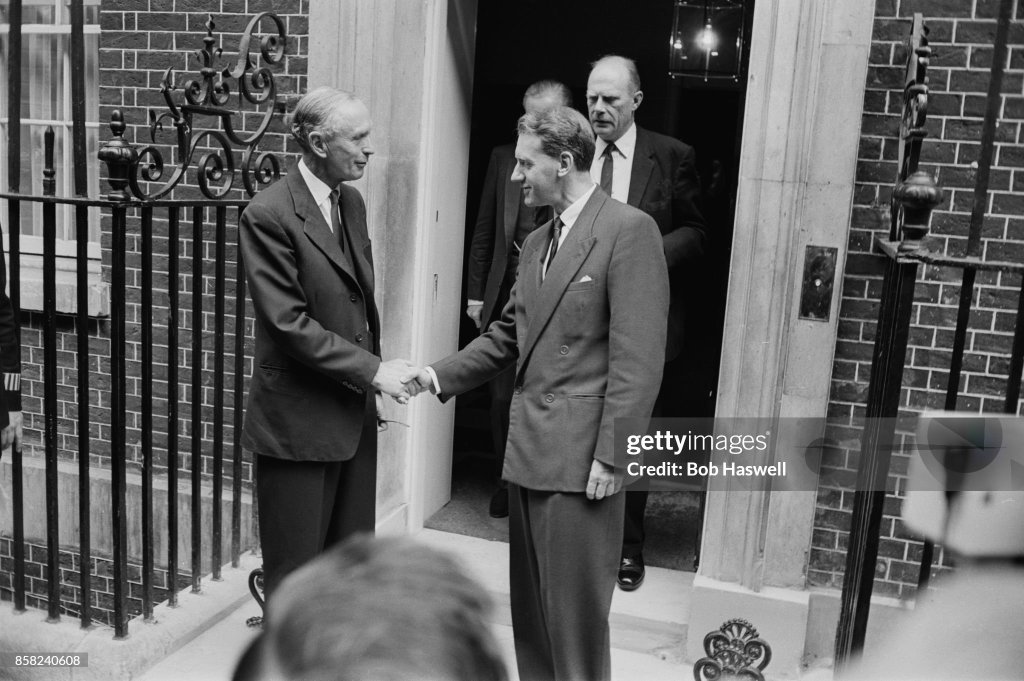
South Vietnamese General Dương Văn Minh is named chairman of the military triumvirant (Khiêm has been allowed to stay on, although in deference to the Buddhists he has resigned as defense minister); Minh will have the duties of chief of state, but the real power is still held by Khánh. He will also be responsible for forming a new High Council of the Nation, which will prepare another Constitution for the country.
Since his return as Premier last week, Major General Nguyễn Khánh has listed three phases for the future Government in South Vietnam. The triumvirate, now termed a transitional Government, is expected to turn its powers over to a so‐called provisional government, perhaps by the end of September. This provisional government, guided by the High Council, will be charged with establishing procedures for national elections to be held next year. In the current transitional period, the triumvirate consists of General Minh, General Khánh, and Lieutenant General Trần Thiện Khiêm, the former Defense Minister.
Speculation has been growing, however, that General Khiêm, who resigned his Cabinet post last week, may soon go abroad. He is unpopular among Buddhists, who suspect that he sympathized with the late President Ngô Đình Diệm, who was overthrown last year.
Premier Khánh has scheduled a news conference tomorrow to discuss the Cabinet changes. Two Cabinet officials, the Ministers of Education and of Social Affairs, resigned today with a statement that they wanted to give General Khanh a free hand in reorganizing his transitional government. An aide said the two were continuing to serve in the Cabinet despite their resignations. “They are both Buddhists, who want to avoid identifying themselves with the present Government in order to save themselves for the future,” the aide said.
General Minh, who led the coup d’état against President Ngô Đình Diệm, served afterward as head of a military junta. In anther coup last Jan. 30 he was replaced by General Khánh, who took the title of Premier but retained General Minh as chief of state. General Khánh removed General Minh from this largely ceremonial post August 18 and made himself President, but protests by students and Buddhists charging “military tyranny” and “one‐man rule” racked the country. The triumvirate was a compromise that grew out of those demonstrations.
A South Vietnamese Government convoy ambushed by Communist guerrillas on a major highway north of Saigon yesterday lost 40 men killed, wounded or missing, a spokesman for the Defense Ministry reported today.
Five U.S. helicopters engage in a lengthy battle with a Việt Cộng machine-gun position but the South Vietnamese forces are unable and unwilling to provide support. Twenty Americans in five helicopters fought a five‐hour battle yesterday with a Việt Cộng machine‐gun crew that was firing one .50-caliber weapon, and failed to put it out of action. The fight typified the frustration in United States efforts to help the South Vietnamese armed forces crush the Communists.
The battle was weighted in the Việt Cộng’s favor because the machine gun was hidden in a line of trees and had a maximum effective range more than double that of the helicopters’ .30‐caliber guns and 2.75inch rockets. Theoretically the battle, 25 miles northeast of Saigon on the edge of a Communist‐infested zone, probably should not have taken place at all. More effective weapons were available in the hands of the South Vietnamese Army and Air Force. But because of red tape and an apparent lack of aggressiveness and over‐centralization of the Vietnamese command, they were not brought to bear when needed.
The duel between the helicopters and the machine gun began at 11:15 AM when three armed UH‐1B’s were looking for a Việt Cộng ambush force just south of Phước Vĩnh. An American machine-gunner spotted activity in the trees and fired a burst from his machine gun. The Communists opened up, sending one slug through the barrel of the gunner’s weapon and another through a rotor blade of his wingman’s craft. The three helicopters made quick firing passes over the tree line and radioed to four A‐1D Skyraiders flying in the area, asking for a napalm and rocket attack. The Skyraider fighter-bombers, flown by Vietnamese pilots, refused to change their mission. That mission was a strike a few miles away in an area that the helicopters patrolled earlier in the day, finding no guerrillas. Under Vietnamese rules, missions can be changed only by orders from Saigon.
The American fliers watched angrily while the four planes expended their explosives in the distance. The helicopters also called for artillery support. Heavy weapons at two points had the Vietcong machine gun within easy range, but no shells were fired. Vietnamese regulations require an artillery spotter plane with a Vietnamese observer to guide all fire missions. The spotter plane and an American pilot were ready, but no Vietnamese observer could be found, so the guns remained silent. By now five armed helicopters of the United States 68th Army Aviation Company were on the scene, refueled and rearmed. Among them they had 96 rockets and 26 light machine guns. As the artillery remained silent and the Vietnamese planes still had not shown up, the helicopters attacked in hope of catching the machine gun before its crew moved. At 4:30 PM, Vietnamese planes finally arrived, hurling rockets, napalm bombs and machine‐gun bullets into the area. When the planes and helicopters left, the Việt Cộng gun was still firing.
United States helicopters in South Vietnam originally were used for ferrying Vietnamese troops into action against the Việt Cộng. Then armed helicopters were sent along as escorts and were to fire if the airborne force was fired upon. It has recently become standard procedure for the American‐manned helicopters to fire on their own initiative at Việt Cộng forces.
In Cambodia, U.S. Air Force jets come to the aid of South Vietnamese planes that report being chased by Cambodian jets, but no fire is exchanged. The Foreign Ministry said today that South Vietnam had decided to protest to the United Nations Security Council about alleged attacks last weekend by Cambodian fighter planes and gunboats. The Cambodian Government charged Sunday that Vietnamese troops had violated its territory.
An important member of the Laotian rightists, speaking also for their neutralist allies, warned today that the leaders of the two factions could not stay in Paris indefinitely. Unless the preparatory talks between them and the pro-Communists lead quickly to a formal conference of the three groups, he said, they will leave their deputies and return here only when the groundwork for the formal parley has been laid. The preliminary talks have been under way for nearly three weeks. The formal conference of the neutralist Premier, Prince Souvanna Phouma; the leftist leader, Prince Souphanouvong, and the rightist representative, Prince Boun Oum, had originally been scheduled to open August 24. At a news conference today, Ngon Sananikone, Minister of Public Works, said that Prince Souvanna Phouma and some of his top aides were planning to participate in the Cairo conference of nonaligned nations opening October 5. He said the Prince would not be able to stay here beyond that point.
The Cyprus Foreign Minister, Spyros Kyprianou, arrived in Athens for talks today with the Greek Premier, George Papandreou. Mr. Kyprianou is leaving for New York tomorrow to attend Friday’s emergency session of the United Nations Security Council called after a Greek complaint against Turkish threats to oust 10,000 Greeks from Istanbul on September 16. The Greek Cypriot Minister said he would probably fly to Moscow from New York to join a Greek Cypriot delegation led by Industry Minister Andreas Araouzos. He is expected there this week to seek Soviet guarantees for help to Cyprus in case of a Turkish attack on the island.
The Greek Government will present the North Atlantic Treaty Organization Council with charges of Turkish provocation and threats arising from Cyprus disputes, qualified sources reported today. The Council, which is the permanent political organ of NATO, met in special session last night to hear Ambassador Nouri Birgi explain Turkey’ case against Greece. He told the Council that Greece had stationed a division of troops armed and equipped with NATO material on Cyprus and that she had also sent troops to demilitarized islands in the Aegean Sea.
United States officials believe that the first step toward settling the Cyprus crisis would be the recognition by Greece of her responsibilities in preventing Cyprus from pursuing policies that may lead to a Mediterranean war. This view of the Cyprus situation, a situation described as “tense and brittle,” was made today by United States officials following a lunchtime conference at the White House between President Johnson and Dean Acheson, who returned Friday from United Nations mediation talks at Geneva. The Administration believes that only if Greece can “defuse” the tensions building up on Cyprus as a result of the moves by Archbishop Makarios, the Cypriot President, will it be possible to resume peacemaking efforts. Specifically, officials said, Greece should use her influence with the Cypriots to bring about the demobilization of the Cyprus National Guard, the raising of the siege of Turkish villages, and the acceptance by Archbishop Makarios of the rights of Turkey to rotate a part of her garrison on the island.
The Administration, it was reported, believes the continued blockade of Turkish villages by Greek Cypriot forces and the refusal by Archbishop Makarios to permit Turkey to land replacements for a third of her 650‐man garrison can quickly lead to a new explosion on Cyprus. Officials indicated their belief that the Turkish Cypriots would fight rather than allow themselves to be starved. The officials are said to believe that Turkey would provide military aid. This situation they say, raises an immediate threat of war in the Mediterranean. The second point of danger, they indicated is the matter of Turkish troop rotation. They disclosed for the first time that when Turkey agreed on August 27 to postpone the rotation, she agreed only to a 15‐day postponement, which will expire September 12. Until now it had been believed that no deadline had been set. Officials feared that unless Archbishop Makarios is persuaded to permit the rotation, Turkey would land troops, also raising the risk of war.
Premier Ismet Inonu ended a two‐day parliamentary debate tonight by informing critical deputies urging changes in Turkey’s foreign relations that the Government intended to retain its position in NATO. “Our Government,” he declared, “has decided to do our utmost to resolve the Cyprus problem without damaging alliances and friendships to which we are attached.” But he said that the Cyprus question was not nearing a solution and again warned that Greece’s attitude on Cyprus was pushing Turkey toward war with Greece.
Several hundred British soldiers assigned to the Army of the Rhine left West Germany by air today for Singapore. A British Army spokesman said the emergency airlift was undertaken as a “precautionary measure” in connection with Britain’s commitment to assist in the defense of Malaysia. The Malaysian federation has accused Indonesia of mounting a commando invasion of the Malay peninsula and of inciting riots between Chinese and Malays in Singapore.
Indonesia has threatened to “crush” the federation, which was formed last year from tho former British colonies of Malaya, Singapore, Sarawak and Sabah (North Borneo). The Indonesians have declared that they regard the federation as a device by which Britain hopes to maintain her influence in Southeast Asia. Troops of the 22nd Light Air Defense Regiment began moving out of a Royal Air Force base at Wildenrath this morning in British transports. The last plane load took off at 11 PM, the army spokesman said.
Todor Zhivkov, leader of the Bulgarian Communist Party and the government of the People’s Republic of Bulgaria, issued the Amnesty Act to provide for amnesty for nearly all political prisoners who had been arrested between 1944 and 1951 during the early days of the Communist takeover. The act had been “passed to coincide with the 20th anniversary of the ‘socialist revolution’ on 9 September 1944.”
The East German government decided to allow its nations pensioners to visit family in West Germany or West Berlin. The East German news agency ADN reported that party secretary Walter Ulbricht had made the decision to allow thousands of elderly East Germans to visit their children and grandchildren in the West, something that previously had been limited to allowing the pensioners an exit visa to leave permanently, and only then if petitioned for by the International Red Cross.
Raman Sankar was forced to resign as Chief Minister of the Indian state of Kerala, after state legislators in the capital at Thiruvananthapuram voted 72 to 50 in favor of a motion of no confidence in Sankar’s government.
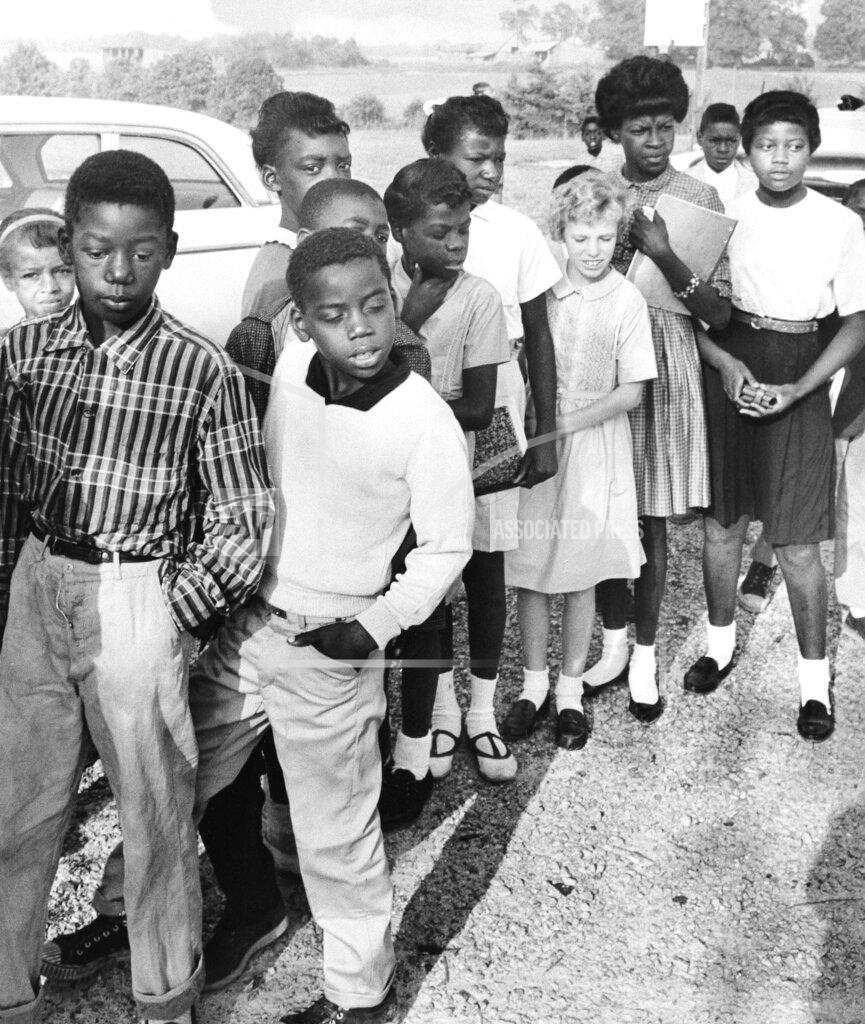
With the day after Labor Day being the opener at the time for most schools in the United States, the first school opening since the passage of the Civil Rights Act of 1964 marked the end of prohibiting American children from attending a particular public school because of their race, although school systems were allowed a time to develop plans for full integration. Desegregation proceeded peacefully in places where it had been fiercely opposed, including Montgomery, Alabama; Gadsden, Alabama; Albany, Georgia; Columbus, Georgia; and Mount Sterling, Kentucky. However, officials in Canton, Mississippi, turned away 13 black students from the town’s all-white high school, and announced they would not allow integration until receiving a formal court order. Civil rights workers there said earlier they would not oppose school officials if the youngsters were turned away, but would follow with court action later.
With Governor George C. Wallace under a Federal court injunction, two more Alabama cities, Montgomery and Gadsden, yielded peacefully today to school desegregation. Union Springs, a small town in the Alabama “black belt,” is expected to enroll three Blacks in Bullock County High School tomorrow without any significant loss of white students. This will bring to 24 the number of formerly all‐white public schools below the college level in the state to accept Black students for the 1964‐65 academic year. Tuskegee Birmingham, Huntsville, Madison County and Mobile carried out desegregation in the last few days without incident. The University of Alabama and Auburn University, both state‐supported institutions, are expected to have several Black students when they open later this month. Although less than 100 Blacks are involved, the peaceful acceptance of integration this year is seen as a significant step in a state that has become the symbol of white resistance.
Last year, after making an unsuccessful school‐door stand at the University of Alabama, Governor Wallace used state troopers and the power of his office to delay court‐ordered integregation in Tuskegee, Birmingham, Huntsville and Mobile. Disorder and violence erupted in Birmingham and, on September 16, a Black church was bombed, killing four young Black girls. In Tuskegee, all whites left the integrated high school and attended a private school or public schools in other towns. Last January Governor Wallace and the State Board of Education closed Tuskegee High because it was empty except for 16 Blacks. A Federal judge ordered the Blacks admitted to white schools near Tuskegee in Shorter and Notasulga. Whites abandoned both those schools, and in the spring the Notasulga school was destroyed by fire. During the summer, Governor Wallace and other state officials were ordered by a Federal court not to interfere with public school desegregation anywhere in the state. The Governor has remained quiet during the opening of schools, and in every district ordered to desegregate local officials have insisted on peaceful compliance.
Public schools reopened in Prince Edward County, Virginia, for the first time in five years, after the county was ordered by a federal court to comply with the desegregation requirements of the Civil Rights Act of 1964. Since 1959, county school officials had taken the unusual step of keeping the white and black schools closed rather than to obey an order to desegregate. On the first day of classes, only seven of the nearly 1,400 students were white, with the rest of the county’s 1,200 white children continuing classes at the county’s private all-white high school.
Twenty‐one Black first‐and second‐graders were admitted without incident today to five formerly all‐white schools in Albany, Georgia, one‐time racial trouble spot. Meanwhile, under a new Federal court order, nine other Black pupils were approved for transfer to white schools on Wednesday.
Two white children enrolled in a previously all‐Black elementary school in Fort Worth today. It was the first voluntary entry of whites in a Black school reported in Texas. Altogether 26 districts were integrated for the first time last week. About 400 school districts, including those in all the big population centers, are already desegregated in Texas.
Robert F. Kennedy declared today that he was opposed to the long‐distance transportation of school children as a remedy for de facto segregation. His comment was similar to one made last Saturday by his Republican opponent for the Senate, Kenneth B. Keating. But Mr. Kennedy qualified his in half a dozen ways, and said he found the whole subject inappropriate to a campaign for federal office. “My feeling is strongly in favor of local control oyer education,” Mr. Kennedy said this morning in Binghamton, New York. “The school boards have had a difficult time dealing with this problem, and I think they deserve our gratitude.” Asked whether he would support a boycott scheduled for next week by two groups of parents in New York City, Mr. Kennedy replied: “I might oppose a particular [integration] plan if my own children were involved, but I would not take part in a boycott.” The parents’ organizations are fighting the Board of Education’s integration program, under which several hundred children would be sent by bus to schools that are relatively short distances outside their neighborhoods.
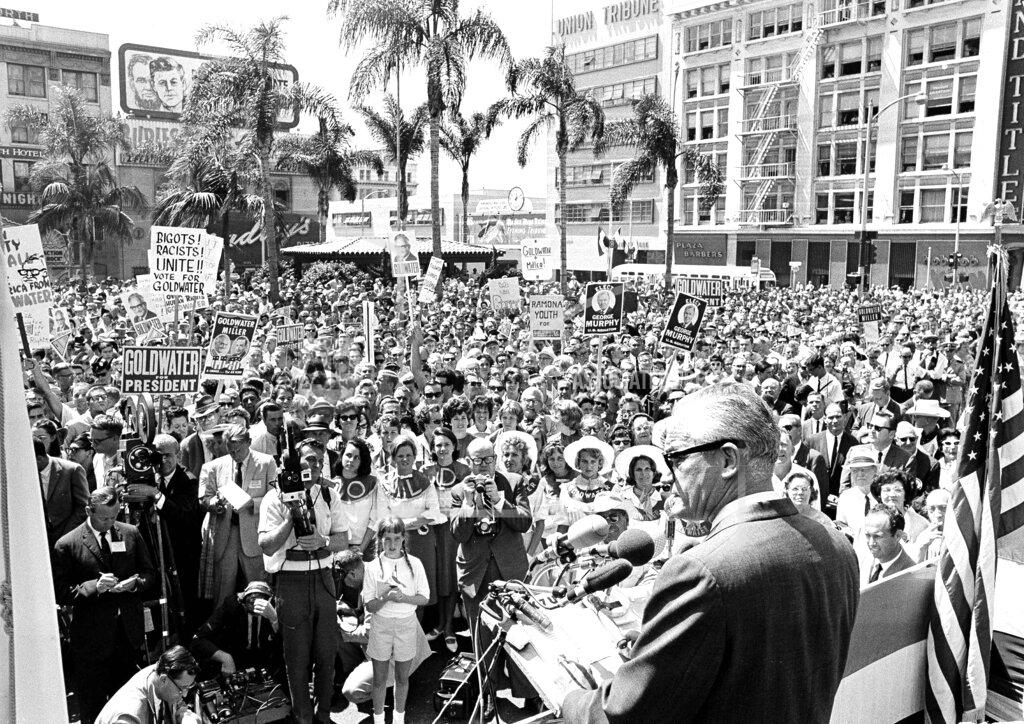
Mr. Kennedy spent an exhausting day stumping through the New York state area known as the Southern Tier, with stops in Binghamton, Johnson City, Endicott, Elmira, Jamestown and Buffalo. Beginning at 7 AM, he made 16 extemporaneous speeches, rode in seven motorcades, and delivered two formal addresses. The crowds were enormous everywhere. The police in Binghamton and Elmira said they could recall no equivalent turnouts for any other political candidate. In Jamestown, where Representative William E. Miller, the Republican Vice-Presidential nominee, drew 250 persons three weeks ago, Mr. Kennedy drew 5,000. The police said only Lucille Ball, the comedienne, had ever attracted a bigger audience there.
A hurricane lashed a long stretch of Florida’s east coast with gales tonight and bore down on Daytona Beach, 60 miles north of Cape Kennedy, with peak winds of 125 miles an hour. Tides of five feet above normal battered Daytona’s beach, and winds of 50 miles an hour struck before midnight. Flooding was reported in St. Augustine. While hurricane warnings on the west coast of Florida remained unchanged — from Sarasota to Tarpon Springs — the Weather Bureau said it appeared that the storm, called Dora, would not swing south as previously expected. This took some of the pressure off the Tampa Bay area.
The storm’s course also seemed likely to take it over the northern edge of the citrus belt, instead of through its middle, as forecast earlier. Thousands of persons fled beachfront homes and hotels from Vero Beach, Florida, 60 miles south of the Cape, to Brunswick, Georgia, 200 miles to the north, as the hurricane churned toward the coast pushing tides as much as 10 feet above normal. Most of the 15,000 persons living on the peninsula part of Daytona Beach left their homes. The Weather Bureau said a 10-foot tide would inundate the peninsula.
Five of six rockets being prepared for launchings this fall were hauled down from their pads at Cape Kennedy, Florida, to escape the perils of an approaching hurricane. The only rocket left standing was the giant of the lot, a 190‐foot Saturn I vehicle. Its gantry, or work platform, consists of semicircular compartments that can close tight around the rocket and make it virtually hurricane‐proof. The ones pulled down and removed to nearby hangers were: A Titan II that is to launch a two‐man Gemini capsule but without crewmen aboard; an Atlas‐Agena that is to send a spacecraft past Mars; a Thor-Delta due to launch an IMP (interplanetary monitoring platform) scientific satellite; an Atlas‐Centaur; and an Atlas fitted out for a re‐entry experiment. The Atlas belongs to the Air Force. The others are National Aeronautics and Space Administration vehicles.
Despite the ferocity of the hurricane, labeled Dora by the weather bureau, officials expected the precautions taken here to avoid any appreciable delays in the launching schedule. First on the schedule was the Saturn firing. The September 17 launching date was being kept firm for the time being. The Saturn vehicle consists of two booster stages topped by a full‐scale model of the Apollo spacecraft. Space agency spokesmen said the hurricane probably would mean a few days’ delay in the IMP launching scheduled late this month and in the Gemini launching now set for November.
A contract settlement between the Chrysler Corporation and the United Automobile Workers appeared to be in the making today as labor negotiators struggled to reach accord by the 10 AM strike deadline tomorrow. Authoritative sources said that encouraging progress had been made in the talks since Saturday, when both sides got down to serious bargaining on basic economic issues. There was no official comment on the outlook of the negotiations because of a news blackout, but a sense of optimism prevailed around the negotiating rooms at Chrysler headquarters.
Sources speculated that a settlement would emerge tomorrow. They expected it to cost Chrysler between 45 and 50 cents an hour over three years, plus a cost‐of‐living adjustment that the company figured would add 10 cents to the total in that period. Such a settlement would be roughly in line with the cost of the agreement reached in 1955. That would make it one of the largest, if not the largest in industry history. Auto workers earn an average basic wage of $3.01 an hour, and overtime pay and fringe benefits increase that amount to around $3.90 to $4.11 an hour. Details of the probable settlement were unclear but, sources said the company had increased pension, pay, vacation and early retirement benefits over its initial offer.
Dr. Glenn T. Seaborg, chairman of the United States Atomic Energy Commission, predicted today that by the end of this century more than half the world’s electric power would be generated by nuclear plants. At the same time he warned that the dream of harnessing the power of the hydrogen bomb might never be fulfilled. It must be pursued, he said, “but we cannot be absolutely sure” that success is possible. Dr. Seaborg gave the summing up lecture to the scientists of almost 70 nations, assembled in Geneva for the third United Nations International Conference on the Peaceful Uses of Atomic Energy.
Mel Stottlmyre pitched the New York Yankees half a game closer to the American League lead tonight by beating the Minnesota Twins, 2–1. Roger Maris, collecting two of the four hits the Yankees made off Camilo Pascual and two less distinguished successors, set up both Yankee runs. Mickey Mantle’s sacrifice fly drove in one in the first and Elston Howard’s single the other in the seventh. Meanwhile, Stottlemyre kept nine Minnesota singles suitably spaced and got better as he went along. This was his fifth victory in seven starts since being brought up from Richmond exactly four weeks ago. After yielding a run in the first inning, he stifled Minnesota’s power. It was New York’s fifth straight victory and 12th in the last 16 games. It left the Yanks one game behind league‐leading Baltimore, which has the same number of defeats but two more victories. In second place are the Chicago White Sox, half a game and one percentage point ahead of the Yankees. The White Sox have won three more than the Yankees, but have lost two more.
The Mets announce the signing of 18 year-old right-hander Bill Denehy. The recent high school graduate, who struck out 151 batters in 81 innings, posted a 10-1 record for Woodrow Wilson High School in Middletown, Connecticut, and won three tournament games en route to leading his team to the state championship.
Jim Brewer, a lefthander who normally is a relief pitcher, became a starter today and pitched the Los Angeles Dodgers to a 3–2 victory over the Philadelphia Phillies. Despite the loss, the Phillies hold a six‐game lead in the National League. It was only the second start of the season for Brewer after 27 relief appearances. The Dodgers staked him to his second victory of the year when they knocked out Art Mahaffey with three runs in the first and turned a pair of Phillie triples into putouts at the plate.
Philadelphia’s first baseman Frank Thomas fractures his right thumb sliding back into first base in the 3–2 loss to the Los Angeles Dodgers. The Phillies are six games ahead, but Thomas’s loss will be felt keenly when the Phils begin to slide. Art Mahaffey takes the loss, lasting just a third of an inning. Thirty-six-year-old Jim Brewer wins his first Major League start.
Dow Jones Industrial Average: 851.91 (+3.60).
Born:
Michael Johns, American conservative commentator and policy analyst, in Allentown, Pennsylvania.
Mitchell Whitfield, American film and TV actor, in Brooklyn, New York, New York.
Jesus C. Diaz, Cuban-American software engineer, in Cienfuegos, Cuba.
Steffan Peters, German-American equestrian dressage competitor (Olympic bronze medal, 1996, 2016, silver medal, 2020), in Wesel, West Germany.
Scott Levy, American professional wrestler and multiple WWE Hardcore Championship titlist, known by his ring name, Raven; in Philadelphia, Pennsylvania.
Tony Colorito, NFL nose tackle (Denver Broncos), in Brooklyn, New York, New York.
Byron Lee, NFL linebacker (Philadelphia Eagles), in Columbus, Ohio.
Junior Thurman, NFL defensive back (New Orleans Saints), in Los Angeles, California.




 History Diaries