
Ambassador Taylor arrives in Washington to brief the administration on the current situation in South Vietnam. He joins President Johnson in a strategy session with top planners of the Vietnam war, including Rusk, McNamara, General Earle Wheeler, McGeorge Bundy and William Bundy. Most of those present reject the schedule of escalation outlined in the McNaughton memo of 3 September among other reasons, Johnson is engaged in a presidential campaign and except for a few minor operations (e.g. resuming the DeSoto patrols) no major decisions are taken. But the consensus is that there will have to be air attacks on North Vietnam sooner or later.
Today’s meeting, which included a working luncheon, was attended by Secretary of State Dean Rusk; Secretary of Defense Robert S. McNamara; the Chairman of the Joint Chiefs of Staff, General Earle G. Wheeler; the special Presidential assistant for international security affairs, McGeorge Bundy, and the Assistant Secretary of State for Far Eastern Affairs, William P. Bundy. It was understood that this session had been devoted mainly to Mr. Taylor’s report on the political and military situation in South Vietnam in the wake of last month’s governmental crisis and to his assessment of immediate and long‐range Communist plans.
Mr. Taylor’s trip to Washington was the first since he went to Saigon as Ambassador two months ago. He said earlier that he would be making periodic consultation visits to Washington, but officials made no attempt to suggest that Mr. Taylor’s presence at this time was a routine matter. It was understood that the talks would cover the three main aspects of the Vietnamese situation: the political conditions in Saigon, the military situation in general and in particular the outlook after the removal of Major General Nguyễn Khánh as President, and finally the United States’ position in the light of these considerations.
South Vietnam makes a new series of charges that Cambodians have been shelling South Vietnam territory to aid the Việt Cộng and that Cambodian planes are violating South Vietnam’s air space. A spokesman for the Defense Ministry said the attack was one of several by Cambodian forces Saturday and yesterday. At least one person was killed by Cambodian artillery fire, he said. Dr. Phan Huy Quát the Foreign Minister, said he had sent officials to investigate the incidents. He said the government would decide tomorrow what course to follow, explaining that one possibility was a protest to the United Nations Security Council. The casualties were reported to have occurred at a post to the south about a mile from the Cambodian border. According to the Defense Ministry, 10 Cambodian gunboats on a Mekong River tributary opened fire on the post, which is defended by 50 men. In addition to the South Vietnamese soldier reported killed, a soldier was said to have been wounded and three civilians killed or wounded.
A South Vietnamese Government unit had routed one of the Communist battalions about 12 miles northwest of Hồng Ngự, a district town near the Cambodian border. To support the Việt Cộng withdrawal, the South Vietnamese contended, Cambodian troops shelled the South Vietnamese Government soldiers with mortars. Throughout both Saturday and yesterday, Cambodian jet fighters were reported to be violating South Vietnam’s airspace to harass South Vietnamese aircraft. The Cambodian Government made similar charges against South Vietnam yesterday, accusing Saigon forces of having begun a “major attack” near the Cambodian border town of Koh Rokar Saturday. It was unclear today whether the South Vietnamese and Cambodian charges concerned the same engagements.
A force of mercenary soldiers threw down its arms and left its American and Australian leaders in the central Vietnamese highlands Saturday, witnesses said today. American sources in Saigon reported that 54 hired soldiers had resigned rather than stay at a remote camp to which they had been billeted with the Americans and 250 soldiers. The 54 were Nungs, Chinese-speaking mountain dwellers reputed to be the toughest fighters in Vietnam. The Nungs, South Vietnamese, nine Americans and two Australians were airlifted into the highlands to set up a counter‐guerrilla camp in a Communist “hidden zone.” Witnesses said the Nungs looked at the campsite and demanded that the helicopters take them out again. They were returned, disarmed and discharged from their mercenary unit, called the Civilian Irregular Defense Group.
A leader of the Laotian leftists said here today that negotiations between the three Laotian factions had made no significant progress since they began late last month. “But we are still optimistic and are continuing to exchange our points of view.” he said at a news conference. The leader, Phoumi Vongvichit, is Information Minister in the Laotian coalition Government. Like all the leftist Cabinet members, he has withdrawn his cooperation from the Government while retaining his post. Mr. Phoumi Vongvichit is secretary general of the Neo Lao Hak Xat, the pro‐Communist political movement. According to informed sources, his power and authority exceed that of the nominal leader, Prince Souphanouvong.
The Information Minister said agreement was being sought on four principal points in the talks between the leftist, neutralist and rightist factions. These are a cease‐fire to halt fighting between the pro‐Communists and the rightist‐neutralist forces, restoration of the tripartite coalition Government, the choice of a demilitarized capital and the convening of a new 14-power conference on Laos. There has been “a certain accord in principle” on the last point, the leftist leader said, but on the first three the leftists on one side and the neutralists and rightists on the other remain far apart. The “certain accord” on the Geneva conference, informed sources said, covered only the principle of a joint Laotian delegation, if such a conference was called. There has been no progress, these sources said, toward removing the “if.” The Geneva conference of 1962, called after fighting among forces of the three factions, agreed on a neutralized Laos ruled by a tripartite coalition Government. The leftists subsequently withdrew from active roles in the Government when their army, the Pathet Lao, resumed warfare.
“We still recognize Prince Souvanna Phouma [the neutralist leader] as Premier,” the Information Minister said, “but only as head of a government of national union. The present Government is no longer a government of national union and we do not recognize it.” This was an allusion to a reshuffle of portfolios last April when a rightist junta seized power and the rightists and the neutralists then joined against the leftists. The Laotian rightists support the United States, the leftists are pro‐Communist. The neutralists shun alignment with either position. Mr. Phoumi Vongvichit devoted much of his news conference to an attack on United States “intervention and aggression” in Laos. In contrast, he congratulated President de Gaulle on France’s “realistic” policy in Southeast Asia. General de Gaulle advocates the neutralization of the countries that formed French Indochina — Laos, Vietnam and and Cambodia.
The pro‐Communist Pathet Lao made public today a letter allegedly written by Lieut. Charles F. Klusmann of Arcadia, Calif., the Navy flier who escaped from a Pathet Lao prison. According to the letter, Lieutenant Klusmann had asked for a “pardon” on the ground that his flight over Laos was a “crime.” The White House announced September 1 that he had escaped to Thailand. He was subsequently flown to a United States Navy hospital in San Diego. The letter, dated July 15, was shown to newsmen here by the pro‐Communist Minister of Information of the Laotian Government, Phoumi Vongvichit. Lieutenant Klusmann allegedly wrote that “it is my opinion that my flight was a crime against the Laotian peopie in that it violated their airspace and sovereignty.” He allegedly wrote that he was being punished for the policies of others.
The Government of Cyprus announced tonight that it was sending a delegation to Moscow this week to discuss the Cyprus situation with the Soviet Union. Informed sources said earlier that Cyprus would seek Soviet military and economic aid, in the event of a Turkish invasion, and would ask for a Moscow pledge guaranteeing the island’s independence and territorial integrity. President Makarios of Cyprus traveled to the United Arab Republic a week ago to seek military aid from President Gamal Abdel Nasser. Tonight’s announcement was a blow to President Makarios’s allies in the Greek Government and to others who had hoped to keep the Soviet hand at a distance in a crisis that affects the North Atlantic Treaty Organization area.
The Cypriot approach to Moscow came at a time when relations between Greece and Turkey, both NATO members, were strained to the limit over the Cyprus issue. Both Athens and Ankara have asked for an urgent meeting of the United Nations Security Council to try to ease the threat of war. The Cypriot Foreign Minister, Spyros Kyprianou, had planned to fly to Moscow last month to discuss details of the military aid the Russians had offered in the event of a Turkish attack. But he postponed the trip after talks in Athens between President Makarios and Premier George Papandreou of Greece, who pledged all‐out Greek aid in the event of an attack. Premier Khrushchev, who refrained from sending military assistance to Cyprus when Turkish planes attacked Greek Cypriot villages last month, has warned Turkey that the Soviet Union would not tolerate aggression near its southern frontier.
Turkish Deputy Nihat Erim, speaking in behalf of the Government in a parliamentary debate on Cyprus today, declared that Turkey would resume air raids on Cyprus if Greek Cypriots attacked Turkish Cypriots. Mr. Erim, who represented Turkey at the Cyprus mediation talks in Geneva, said Turkey was prepared to go to war in the event that President Makarios attempted to declare a union of Cyprus with Greece. He added, however, that Turkey would seek a settlement through peaceful means. Mr. Erim was replying to critics of the government’s policies toward Cyprus, the United States and NATO.
Greece has called on the big powers to work out a truce between Turkey and Cyprus until a permanent solution is found to end the clashes between Greek and Turkish Cypriot communities. Premier Papandreou, in a speech last night in Salonika, urged “those who bear responsibility for world leadership” to induce Turkey to stop her threats of war over Cyprus in return for an agreement to halt all war preparations on the island.
King Constantine II of Greece arrived in Copenhagen today to join in three days of farewell festivities for his future queen, Danish Princess Anne-Marie. They will be married in Athens September 18. The 18-year-old Princess dashed into the King’s arms at the airport and a crowd of 8,000 persons cheered. He kissed her on both cheeks and she then gave him a formal curtsy. The 23-year-old monarch, who wore a Greek Navy uniform, shook hands with Danish King Frederik IX. He hugged Queen Ingrid and Anne‐Marie’s sisters, Crown Princess Margrethe and Princess Benedikte. There was one jarring moment at the airport reception. Two anti‐Greek Danes charged toward Constantine and Anne-Marie with signs reading “Freedom” and “Liberty.” They were quickly taken away by policemen.
Congolese pro‐Communist rebels announced today the formation of a “people’s republic” dedicated to the overthrow of the Government of Premier Moise Tshombe. Mr. Tshombe is in Addis Ababa, the capital of Ethiopia, seeking help from the Organization for African Unity against the rebels, who have spread terror, death and destruction throughout the Congo.
President Tito of Yugoslavia and Gheorghe Gheorghiu‐Dej, Rumania’s chief of state, opened a new chapter in Balkan relations today by inaugurating joint construction of the Iron Gate navigation and power system on the Danube. With crowds totaling l0,000 persons shouting, “Tito‐Dej! Tito‐Dej!” and then, “Dej‐Tito! Dej‐Tito!” they met first in the river village of Sip on the Yugoslav bank, then in the village of Gura Vaii on the Rumanian side. The new project is designed to tame and utilize the violent waters that rush through the narrow two‐mile‐long gap in the Carpathian Mountains known as the Iron Gate.
A new session of the Indian Parliament began today with an Opposition motion of no confidence in the young Government of Prime Minister Lal Bahadur Shastri. Mr. Shastri was the target of barbs that came chiefly from leftists. But he won a tactical victory by insisting that Government‐sponsored debate on the food crisis precede discussion of the no‐confidence motion.
Construction began at the Mururoa atoll in the south Pacific Ocean as the first civilian workers arrived to convert the French Polynesian island into a nuclear test site for France’s Centre d’Experimentations du Pacifique; in all, 57,750 people would work at the Mururoa site between 1964 and 1996.
Edward Du Cann of the British Board of Trade announced the signing of the largest trade deal in the history of British relations with the Soviet Union, with the Soviet purchasing agency Techmashimport and the British conglomerate Polyspinners, Ltd. agreeing for the supply of British textile machinery to a polyester fiber plant being constructed in Krasnoyarsk in Siberia. In all, the United Kingdom agreed to advanced $67 million of credit over a 15-year period.
The National Defense Council of East Germany began a program “unique among the Warsaw Pact countries” allied with the Soviet Union to create a branch of national service composed of “unarmed labor units that required neither military ranks nor oaths of allegiance to the flag” as a response to the resistance of many of the younger males who had refused to participate in compulsory military service.
“The Daisy Ad”, a television commercial and one of the most controversial political advertisements in the history of American presidential campaigns, was aired for the first and last time. U.S. President Johnson had formally opened his campaign for election to a full term, and the one-minute spot appeared during a break from NBC’s showing of the 1951 film David and Bathsheba). The TV spot began with a little girl counting the petals on a daisy; after she had counted to nine, a voiceover gave a countdown from ten and, at zero; the picture of the girl faded and was replaced by a mushroom cloud from a nuclear blast. President Johnson’s voice then closed the ad with the warning “These are the stakes. To make a world in which all of God’s children can live, or to go into the dark. We must either love each other or we must die.” Dean Burch, the Chairman of the Republican National Committee charged that “The only innuendo that can be drawn is that President Johnson is a careful man and that Barry Goldwater is careless and reckless. It is libel per se. It is a violent political lie. It implies that Goldwater is toying with the American people.” At the end of the week, U.S. Senator Everett Dirksen complained to the National Association of Broadcasters that the commercial “is in violation of your widely-heralded code of ethics” and that broadcasters who aired it should face sanctions. One author would later note 50 years later that “it could be argued that today’s gotcha culture, using innuendo-based TV attack ads, began with this ad”, while another would comment that “The year 1964 wintessed the fusion of political strategy and political advertising, and every subsequent race has relied on essentially the same model.”
President Johnson, using a velvet‐glove approach to partisan conflict, opened his campaign here today with a broad appeal for the submergence of “passions” and “conflicting interests” while pursuing “prosperity, justice and peace.” Speaking in Detroit’s thronged Cadillac Square, a favorite launching platform for Democratic Presidential campaigns, the President set out to achieve in his own right the office that he now holds by succession. The President, devoting fully half of his formal speech to the theme of peace, struck a counterblow at Senator Barry Goldwater’s views on “conventional” nuclear weapons and affirmed the inviolability of Presidential control over nuclear arms.
“Make no mistake,” the President declared. “There is no such thing as a conventional nuclear weapon.” Noting that for 19 years no nation had made use of atomic weapons, Mr. Johnson continued: “To do so now is a political decision of the highest order. It would lead us down an uncertain path of blows and counterblows whose outcome none may know. “No President of the United States can divest himself of the responsibility for such a decision.”
The Pentagon, again quick to answer criticism by Barry Goldwater, issued a statement today on the Arizona Senator’s views about the closing of military bases. Mr. Goldwater indicated yesterday that if elected President he might slow down the shutting of defense establishments instituted by Secretary of Defense Robert S. McNamara for economy reasons.
“We believe,” the Defense Department said in reply to the Republican candidate, “that the American people do not intend their Department of Defense to be operated as a W.P.A., but rather to provide all the military strength necessary for security in the most economical manner.” The statement was put out by Nils Lennartson, the Deputy Assistant Secretary of Defense for Public Affairs. “It is true,” Mr. Lennartson said, “that the Department of Defense has closed or curtailed a substantial number of military installations in the past 3½ years. We do not believe that the American people want the Department of Defense to operate installations which have become obsolete or unnecessary. “The Department of Defense operates under instructions oi the President to provide such military forces as are necessary for the security of the nation. The department also operates under the President’s instructions to provide such forces as economically as possible. “Under these instructions we have eliminated some military installations in the past and we expect to eliminate more in the future as it is found they are no longer necessary for our security.”
If elected President, Senator Barry Goldwater would attempt to reduce income taxes by 25 percent over a five‐year period and to stabilize Federal Government expenditures at roughly present levels, a source close to the Republican Presidential candidate said today. Mr. Goldwater, who spent much of the day filming an informal network television show at his home here, will make a major speech on tax policy tomorrow night at Los Angeles. The source also said today that polls showing as many as 27 per cent of Republican voters defecting from Mr. Goldwater in a so‐called “frontlash” might be “accurate at the moment.” However, the source expressed the belief that most dissident Republicans would return to the party as the campaign unfolded. “I think we are going to win in the face of all statistics and polls to the contrary,” he declared.
In a Labor Day address in South Bend, Indiana, the Senator’s running mate, William E. Miller, warned that the policies of the Administration would flood the United States with foreign labor and goods.
Senator Hubert H. Humphrey of Minnesota declared tonight that “while President Johnson wages war on poverty, Senator Goldwater wages war on progress.” Referring to the conservatism of. Senator Barry Goldwater of Arizona, the Republican Presidential candidate, Mr. Humphrey toid a Labor Day rally of 5,000 Democrats at Idora Park that “we don’t intend to let anyone grab the ball from the playing field and run backwards.” Mr. Humphrey, the Democratic Vice‐Presidential candidate, also added a line to his increasingly popular chant — “But not Senator Humphrey” — which challenges Mr. Goldwater’s positions on issues and people.
Mr. Humphrey also expressed confidence today that white resentment against Blacks over civil rights would not be a “significant factor” in the Presidential election. He praised the Civil Rights Act of 1964 at several campaign stops in industrial northeastern Ohio. The Senator discounted reports that union members and industrial workers feared they might lose their jobs to Blacks, and expressed doubt that they would rote for the Republican ticket in protest. When asked at a news conference in Youngstown whether he thought the election of Senator Goldwater might complicate “the evolution of civil rights” and create problems in the enforcement of the new Civil Rights Act, he said: “You asked a frank question, I’ll give you a frank answeryes, because he [Mr. Goldwater] isn’t for it; he denounced it as a police state, which, of course, it is not.”
Malcolm X, a former leader of the Black Muslims, who now heads a Black Nationalist group, has expressed the view that Black Americans would fare better if Senator Barry Goldwater were elected President than if President Johnson should be reelected. Most Black leaders and organizations are committed to President Johnson and have registered strong opposition to Senator Goldwater. Malcolm X, writing in this week’s Saturday Evening Post, said that the two candidates were quite similar, but that with Senator Goldwater “the Black people at least know what they are dealing with.” He said Senator Goldwater was like a “wolf,” and President Johnson was like a “fox.”
“Since these are the choices, the Black man in America, I think, only needs to pick which one he chooses to be eaten by, because both will eat him,” he said. With the Senator, he noted, “they would at least know they were fighting an honestly growling wolf, rather than a fox who could have them in his stomach and have digested them before they even knew what is happening.” If Senator Goldwater became President, according to Malcolm, the Black would know he had to fight harder and would be “more positive in his demands, more aggressive in his protests.”
New Hampshire National Guard troops with fixed bayonets patrolled the seaside resort of Hampton Beach, New Hampshire, today after a night of rioting by students and hoodlums. Only one serious injury was reported. Peter Zamboni, 16 years old, of Everett, Massachusetts, a Boston suburb, was operated upon this morning at the Exeter, New Hampshire, Hospital for an eye injury as a result of a shotgun wound in the face. State policemen said he was shot when he threatened them. It was the fourth consecutive year of rioting at this normally peaceful family vacation spot on the Sunday night before Labor Day. But last night’s uprising was described as the worst yet. Rocks, clubs and beer cans were thrown by the rioters. There were cracked heads and bruises on both sides of the law. But property damage was relatively light. Windows were broken in the Chamber of Commerce information booth on the beach front. A side panel of the door at the police headquarters also was smashed. The rioting started about 8:30 PM last night and continued until almost dawn.
Three predawn bomb blasts damaged a home, a store and a shed in Summit, Mississippi today without injury to anyone. The properties involved are owned by Blacks. The county authorities and the Federal Bureau of Investigation are investigating the blasts, all apparent bombings. The McComb area, which includes Summit, has been the scene of several other bombings. Pike County Sheriff R. R. Warren said one blast blew a hole in the carport roof of the home of the Rev. Hugh Washington, a minister. Mr. Warren said a one‐foot-diameter hole — possibly caused by a stick of dynamite — was blown into the carport. The second blast, according to the Council of Federated Organizations, demolished the front of a store owned by Booker T. Gutter. The council is made up of major civil rights groups in this state. In the third incident a cookout pit under a shed at the residence of a Black school principal was blown up. The owner of the shed was identified as a Mr. Coney, a principal in Magnolia.
President Johnson, who seldom sports his white Texas-style hat in the North, wore it in Detroit today and had to battle a souvenir hunter to keep it. Mr. Johnson waved the five-gallon hat over his head after alighting from his car in the downtown area. A man in the crowd reached out and latched onto the brim. For a few seconds the President and the souvenir hunter engaged in a tugging match for possession of the headgear. Mr. Johnson won.
The 9th place Washington Senators take a pair from the Chicago White Sox, 3–0 and 6–2, and drop the Sox out of first place behind Baltimore and a game ahead of the Yankees. Bennie Daniels checked the White Sox on five hits in the opener for, his seventh victory of the year. Dave Stenhouse blanked Chicago on three hits for eight innings, but needed help in the ninth, when the White Sox broke their scoring famine with the help of a passed ball and a wild pitch. The victory was Stenhouse’s second against nine defeats.
Jim Gentile smashed two homers and drove in four runs today as the Kansas City Athletics won the second game of a double header with Baltimore, 6–1. However, the Orioles regained the American League lead on the strength of their 6–1 opening‐game triumph. The split left the Orioles with a half game lead over the Chicago White Sox, who lost a double‐header to Washington. Wally Bunker posted his 15th victory with a six‐hitter for the Orioles in the opener and Boog Powell hit his 32nd homer.
In a morning game, the New York Yankees beat the Minnesota Twins, 5–4, in 11 innings. The night game is postponed because of rain. Tony Kubek hits a leadoff home run for the 2nd game in a row, and scores the winning run in the 11th. Roger Maris has a 2-run homer and the game-winning RBI on a double down the right field line. Hal Reniff got the win in relief.
The Cleveland Indians defeated the Detroit Tigers today, 7–2, as Sam McDowell struck out eight men and allowed five hits. The Indians scored their first five runs off Dennis McLain, the first of four Tiger hurlers. The second of Woodie Held’s three hits, his 17th homer of the season with a man on base in the fourth, was the big blow off McLain. Cleveland scored three times in the second on successive singles by Dick Howser, Fred Whitfield and Leon Wagner after McDowell had reached base on a force‐out and Tito Francona had walked.
Dean Chance tonight became the first 18-game winner in the American League by hurling the Los Angeles Angels to a 4–1 victory over the Boston Red Sox in the first game of a doubleheader. The Red Sox came within two outs of recording a nohitter and still losing as the Angels failed to get a hit until there was one out in the bottom of the eighth. But Joe Adcock singled and Bob Rodgers hit a two‐run inside‐the-park homer. Rodgers drove in three of the four Angels runs. Los Angeles scored twice in the third without getting a hit as Dave Morehead filled the bases on walks and then gave a fourth walk to Lou Clinton that forced in Paul Schaal. A sacrifice fly by Rodgers brought home Jim Fregosi. In the second game, Boston took as early 3–0 lead but could not hold it, losing 4–3 in 11 innings. Pinch hitter Jack Hiatt, in his first major league at-bat, singled in the winning run to end the game.
Completing a 12–3 home stand, the St. Louis Cardinals sweep a Labor Day doubleheader from the Cincinnati Reds 3–2, 3–2, and move into a 2nd-place tie with Cincinnati. St. Louis and Cincinnati both trail the league‐leading Philadelphia Phils by 6½ games. Tim McCarver, whose single in the ninth won the opener, started the St. Louis rally in the ninth of the second game with another single.
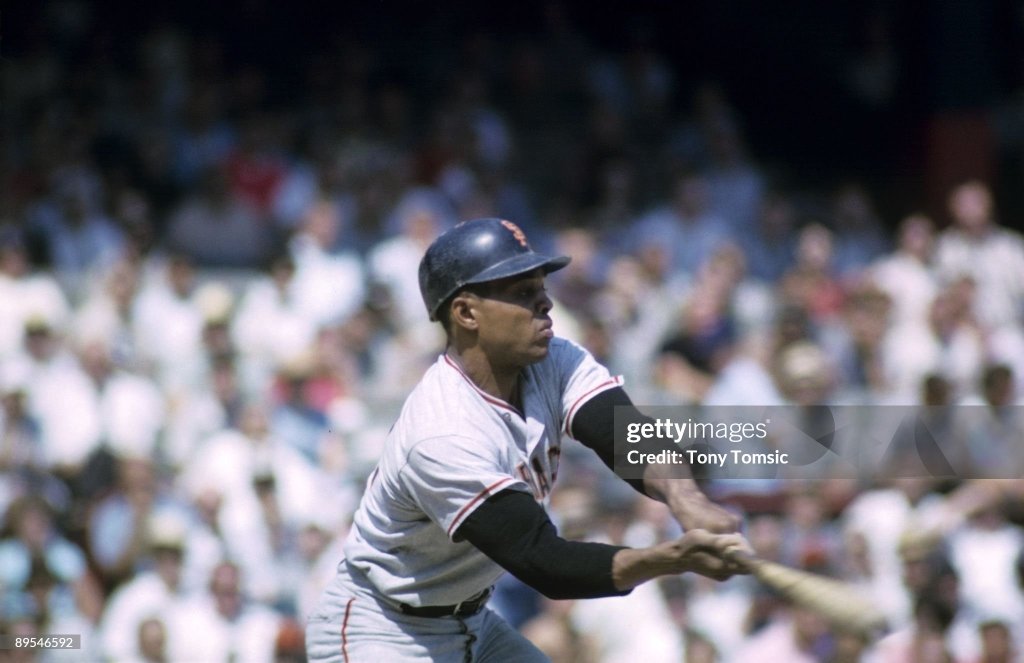
The Pittsburgh Pirates roll out 11 pitchers but still lose two to the San Francisco Giants, 6–4 and 9–6. Willie Mays drove in four runs with his 40th and 41st homers. Mays’s first homer and a homer by Orlando Cepeda in the first inning paced the Giants to victory in the opener. Matty Alou’s bases‐filled single in the sixth was good for two runs and a 5–2 lead. In the second game, Mays pinch hit in the fourth with the Giants losing, 4–2. He slammed one over the scoreboard, scoring behind Jim Hart and Cepeda. Pittsburgh closed the margin to 7–6 in the seventh on Bill Mazeroski’s run‐scoring single. But the Giants added a run in the eighth when Jose Pagan scored on a sacrifice fly by Chuck Hiller. They scored again in the ninth on Jim Hart’s triple and a grounder. Roberto Clemente drove in three runs for the Pirates with a double and a two‐run homer.
The Chicago Cubs’ Ellis Burton hits a pair of homers, one righty and one lefty, accomplishing this for the second time in his career. But it is not enough as the visiting Milwaukee Braves win, 10–9. To add insult to injury, the Braves get another one-run decision in the nitecap of the doubleheader, winning, 8–7. Denny Menke hit two homers and a double in the opener and Joe Torre had a homer and two singles in the second game.
The National League-leading Philadelphia Phillies and the Los Angeles Dodgers split today when Dennis Bennett posted his first victory in two months with a 5–1 decision in the opener and the Dodgers took the nightcap, 3–1, behind Pete Richert, a left‐hander. Richert, recalled from Spokane three days ago, gained his first triumph of the season when the Dodgers scored three runs off Rick Wise, a rookie, in the first inning.
The New York Mets and Houston Colts treated 22,123 Labor Day fans to a kind of cellar World Series at Shea Stadium yesterday, with the Mets marching to a double victory by scores of 7–5 and 6–4. Since the Colts started the day 25½games out of first place and the Mets were 11½ games behind that, the stakes were not especially high. But Al Jackson pitched seven innings in the first game to gain his 10th victory of the year and Jack Fisher pitched seven in the second for his 10th, tying Roger Craig in Met annals for the most victories by a right‐hander.
Born:
Eazy-E [Eric Lynn Wright], American rapper (N.W.A.), in Compton, California (d. 1995).
Andy Hug, Switzerland-born martial artist, 1992 karate World Cup champion and 1996 World Kickboxing Association champion (d. 2000); in Zurich, Switzerland.
Sergio Valdéz, Dominican MLB pitcher (Montreal Expos, Atlanta Braves, Cleveland Indians, Boston Red Sox, San Francisco Giants), in Elias Pina, Dominican Republic.
Jeff Parker, NHL right wing (Buffalo Sabers, Hartford Whalers), in St. Paul, Minnesota (d. 2017, from complications of heart and lung infections and chronic traumatic encephalopathy).
Bert Williams, NFL linebacker (Pittsburgh Steelers), in San Antonio, Texas.
Eric Brown, NFL wide receiver (Kansas City Chiefs), in St. Louis, Missouri.
Sam Johnson, NFL wide receiver and punt returner (Los Angeles Rams), in East Los Angeles, California.
Died:
Walter A. Brown, 59, American sports executive who founded the Boston Celtics and co-founded the Basketball Association of America and helped in the merger that created the National Basketball Association; since 1951, Brown had been owner of both the NBA Celtics and the NHL’s Boston Bruins
Georges Thierry d’Argenlieu, 75, French priest, diplomat, naval officer and admiral
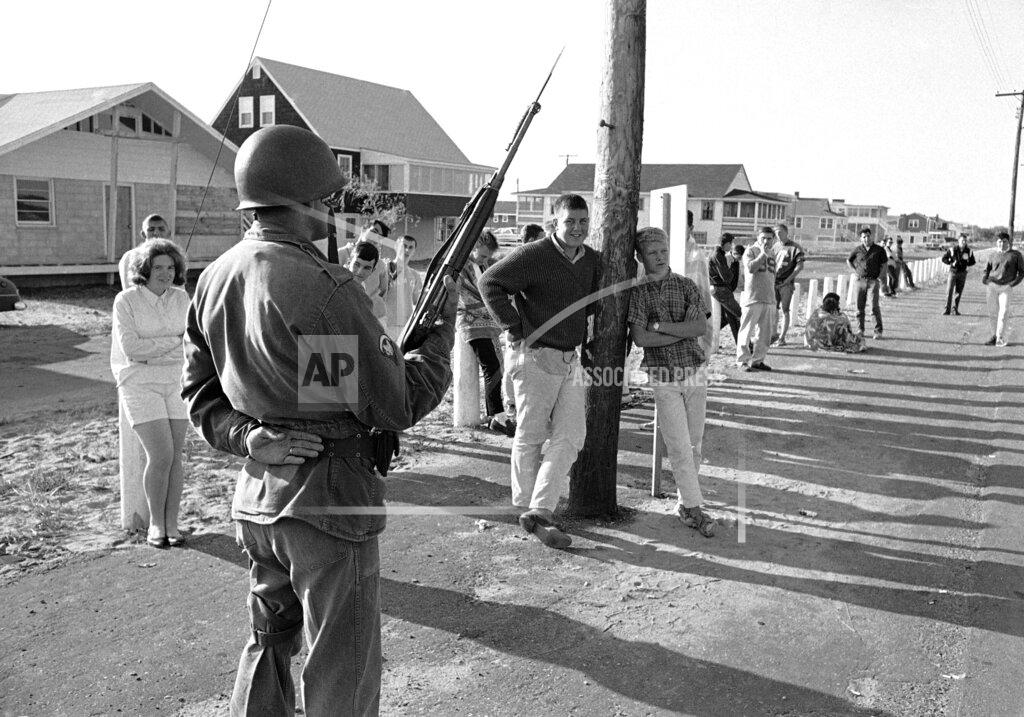
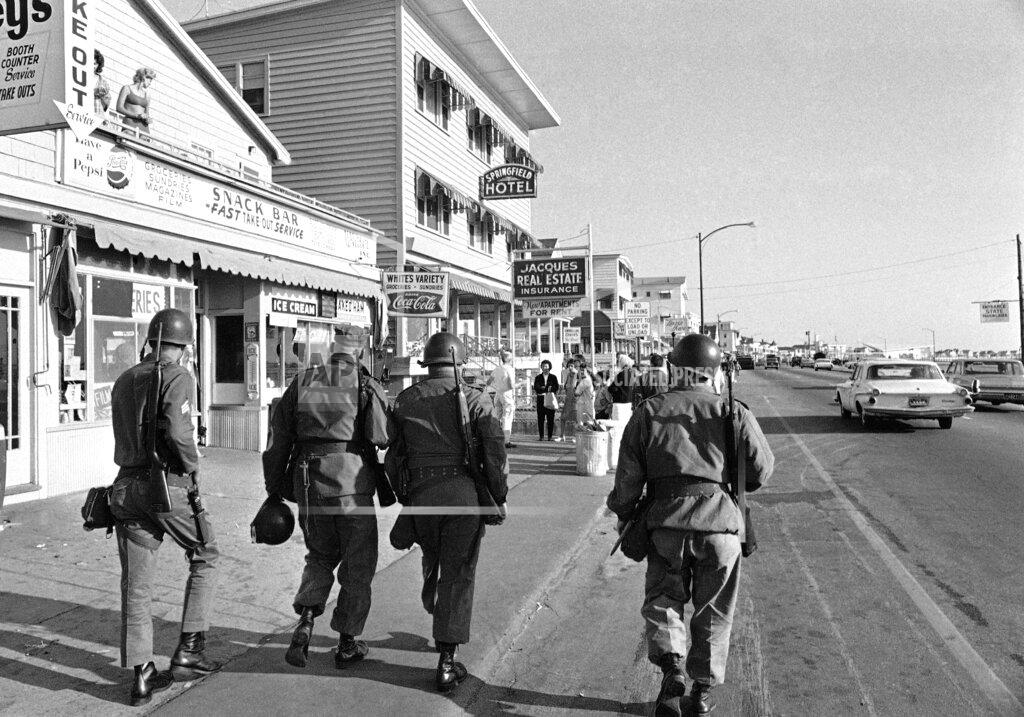
New Hampshire National Guardsmen patrol Hampton Beach early Labor Day morning after a wild night of rioting by between 5,000 and 10,000 teenagers in Hampton Beach, New Hampshire, September 7, 1964. The young crowd went on a wild rampage setting fires, hurling stones and destroying property in general. Near 250 policemen and the National Guard restored order to the resort area in the early morning hours after several arrests. (AP Photo)


 History Diaries