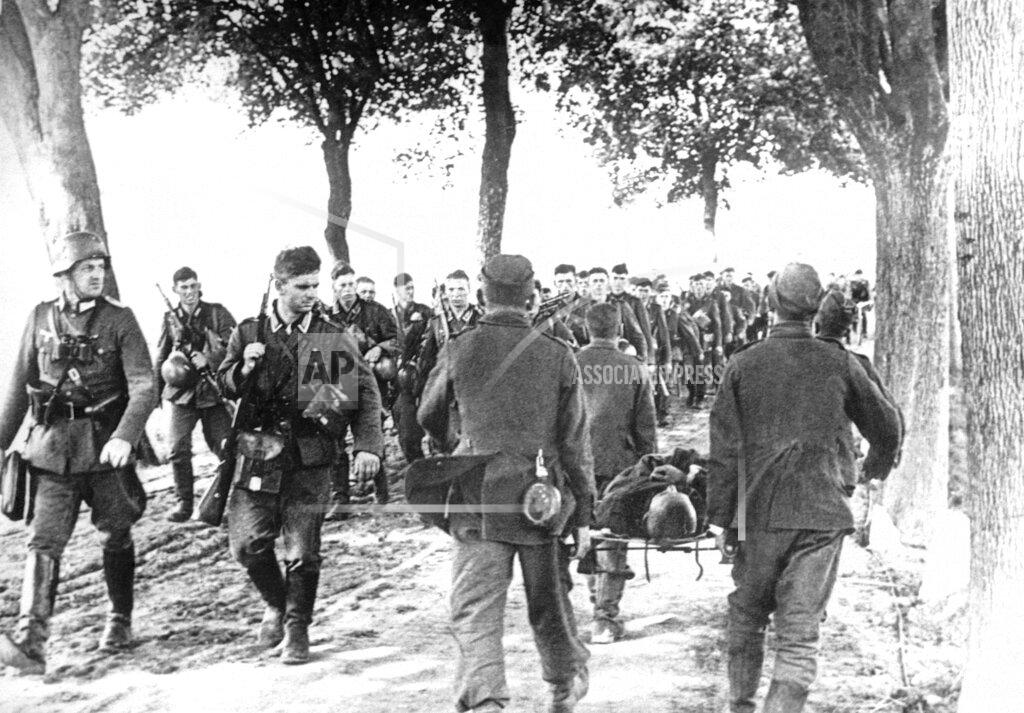
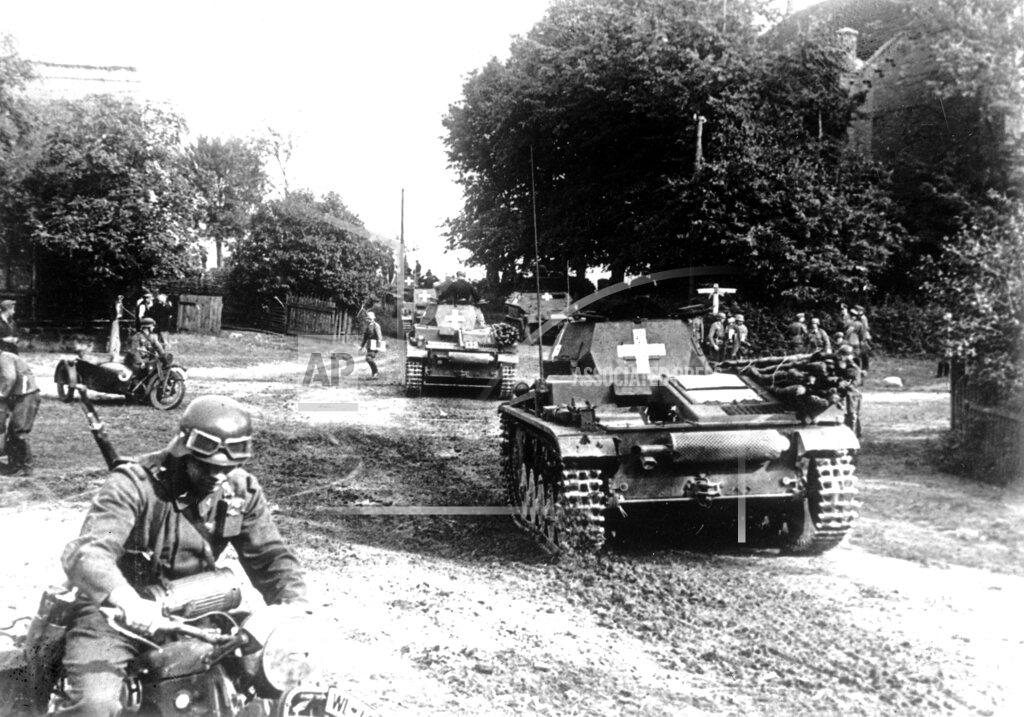
The Battles of Borowa Góra and Różan ended in German victories. The Battle of Borowa Góra took place near the Góry Borowskie hills, southwest from Piotrków Trybunalski and east of Bełchatów. The battle, fought between the Wehrmacht and the Polish Army in the vicinity of Łódź, was a direct consequence of the Battle of the Border, an early part of the German Invasion of Poland. The three hills (278 meters above sea level) formed an important strategic point that the German XVI Army Corps needed to break through in order to advance toward Radomsko, Piotrków Trybunalski and Bełchatów, and further into central Poland. The area was defended by the Polish 2nd Legions’ Infantry Regiment (part of the 2nd Legions Infantry Division), under Col. Ludwik Czyżewski, and the 146th Infantry Regiment (part of the 44th Infantry Division), under Col. Artur Pollak. Both Polish units belonged to Łódź Army. The invading German XVI Army Corps consisted of the 1st Panzer Division, the 4th Panzer Division, the 14th Infantry Division, and the 31st Infantry Division. During the intense fighting, Polish casualties from the 2nd Legions’ Regiment were 663 (including 16 officers and 67 NCOs). There was the usual valiant Polish defense, but by this morning, the last units had to withdraw in the face of enormous German superiority in numbers and materiel.
The Battle of Różan, otherwise known as defence of Różan bridgehead, took place between the 4 and 6 September 1939, in the fields before the town of Różan on the Narew River. A small Polish garrison of three World War I forts (consisting of two infantry battalions) successfully defended the bridgehead against the entire German panzer division for the entire day and night. However, as a result of a misunderstanding of the commander in chief’s orders, the Polish forces were then withdrawn to the other side of the river, and then further eastwards on the 6 September.
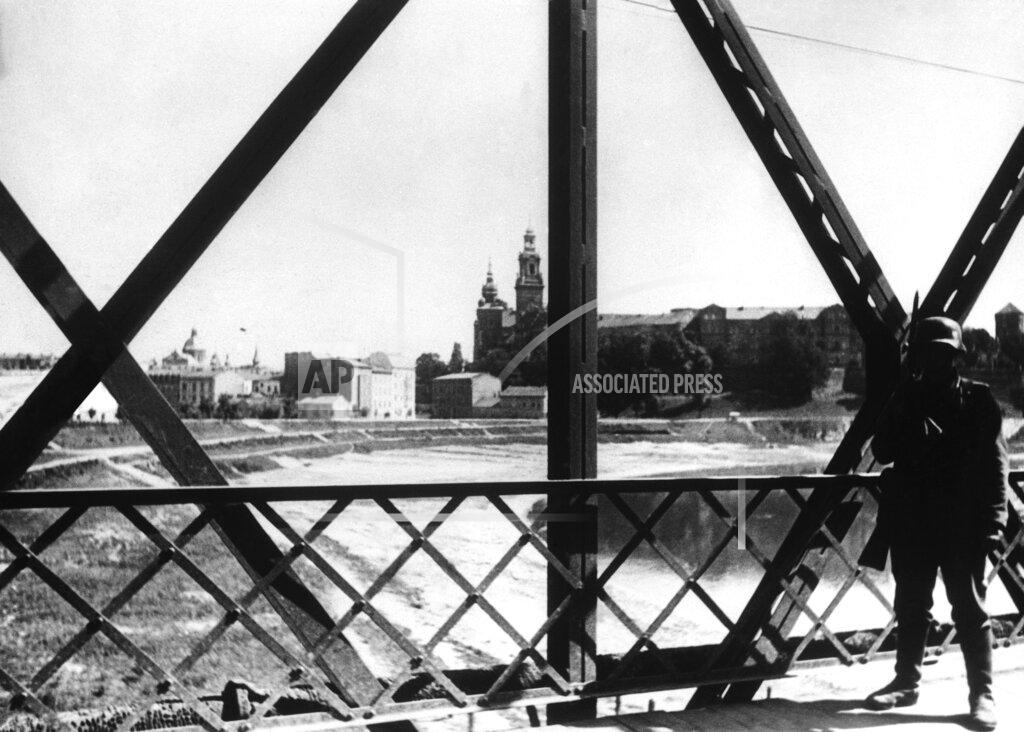
The German Army occupied Kraków. Kraków surrendered to the German armed forces without a fight, and 6 days later it was proclaimed the capital of the General Government — a new territory created and governed by Nazi Germany. One of the main purposes of the General Government’s existence was to be the Third Reich’s supply base for agriculture and light industry, so the Nazi army had no interest in destroying its infrastructure, unlike many other Polish cities. Moreover, Hans Frank, the newly appointed Governor-General, decided to continue some of the pre-war plans for Kraków’s development. In order to justify these plans, the Nazis announced that Kraków was an urdeutsche Stadt (Ancient German City), and even founded a pseudo-scientific institute to prove the city’s German roots through historical research. Nevertheless, the Nazi occupation of Kraków was no different to anywhere else, including the imposition of harsh totalitarian rules, racial and national segregation with the systematic extermination of Jews and Poles of Jewish origin, erasing all remnants of Kraków’s Polish history, and mass theft of works of art.
Generals commanding the German advance into Kraków today went to the tomb of the late Marshal Josef Pilsudski to pay tribute to a leader for whom Chancellor Hitler in the past has expressed his esteem. An honor guard was established at the tomb on orders of Herr Hitler, according to a message by Colonel General Walther von Brauchitsch, Commander-in-Chief of the Germany Army, to the forces in Poland. “With the capture of Kraków, the Germany Army also has taken under its protection the grave of the first Polish Marshal, Pilsudski,” the message said. “His aim was peace with Germany. Disregard of his trust led to war. The German Army esteems and honors this great soldier.”
German troops capture the Upper Silesian industrial area in Poland. Germans report control of Silesia and tell of capturing key industrial cities with works intact.
The Battle of Piotrków Trybunalski ended in a Polish defensive withdrawal.
The outcome of the Battles of the Border is now clear. The Poles have done about as well as could be expected given their numerical and equipment inferiority. They have even briefly held up Hitler’s Panzer Divisions — but not long enough to fully mobilize the last Polish reserves, or fully organize the next defenses.
A small force of Polish soldiers — between 70 and 200 of them — still resisted valiantly in Westerplatte fortress after four days of a fierce siege at Danzig. Machine-gun fire from the Polish garrison shattered completely two German efforts to storm the stronghold. Unofficially it was said that the barricaded Poles have sufficient supplies of ammunition, food and water to enable them to hold out for weeks, if they can withstand heavy bombardment by land, sea and air. The biggest guns of the German naval training ship Schleswig-Holstein, in Danzig harbor, blasted away at Westerplatte all through Friday.
On Saturday twenty-two German bombers dropped at last fifty bombs on the fortress. The bombardment destroyed a few surface stores of ammunition. But each time the German infantry attempted to follow up the bombardment and storm the place, they were repulsed by Polish machine-gun fire that seemed to come from many points of the small peninsula on which Westerplatte fortress is situated.
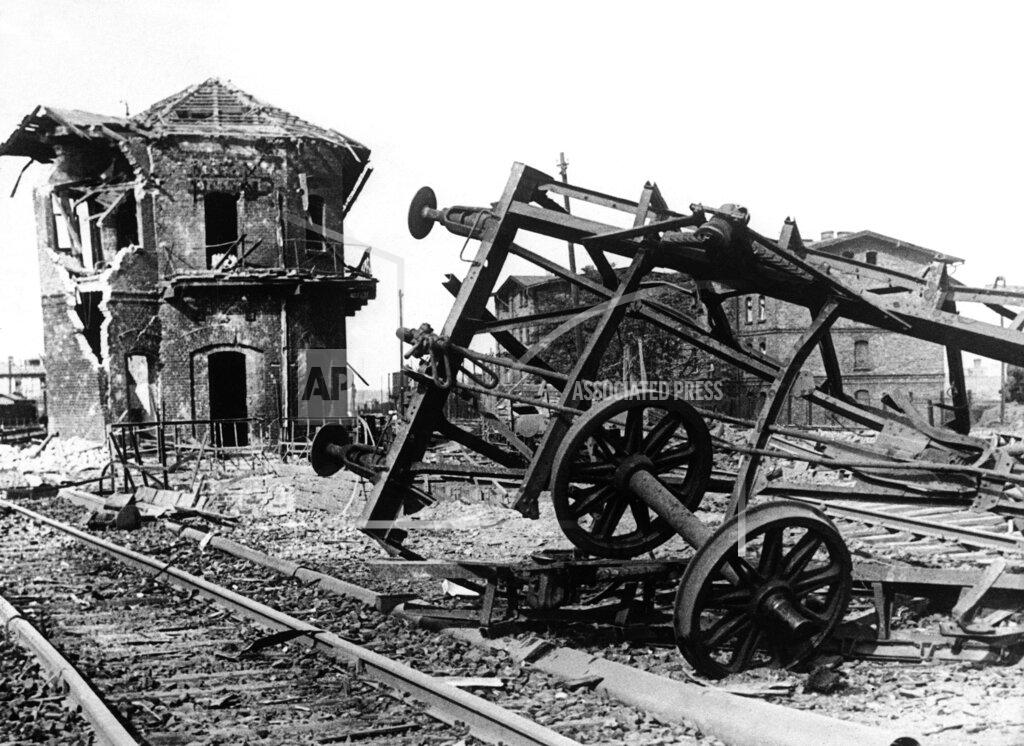
A battle for Warsaw raged thirty miles to the north today, couriers reported, with the “Poles fighting like lions” and holding back the invaders despite repeated tank-led thrusts. The Poles were said to be holding the Germans on a line between Pultusk, thirty miles directly north of Warsaw, and Plonsk, thirty-five miles northwest of the city. It was announced that the Poles had lost Pultusk once in the battle and then had retaken it. Pultusk is about twenty-five miles southeast of Ciechanow, where the right wing of the defenders formerly was pivoted. It was announced in Berlin early today that Pulutak had fallen to the Germans, The United Press reported. German planes raided the north section of Warsaw just before noon. and an official radio announcement later said six planes had been shot down. More than a dozen extremely strong explosions were heard from the direction of the railway bridge across the Vistula and the East Station, which was bombed two days ago.
A ranking staff officer, slightly wounded, who returned briefly from the scene of battle, said the Polish forces were defending themselves stoutly, holding their lines and doggedly beating off thrust after thrust by the Germans. With heavy tanks as a vanguard, the officer said, the Germans succeeded in piercing the Polish line in several places, but the Poles successfully outflanked the penetrating columns and captured and destroyed many of the tanks. The officer assured members of his family here that the situation was favorable for the time being. Defenders of the city were preparing for a desperate defense at the very edge of the city if the battle at Pultusk eventually went against them. The Associated Press reported from Budapest that the Polish radio had interrupted a musical program to appeal to all Warsaw citizens to report to the nearest police station armed with spades to dig trenches around the capital.
After the morning air raid on Warsaw, the Poles began to immediately barricade the streets in the vicinity of the airport.One bomb aimed at the railway station struck the administration building, which normally houses some 2,000 employees.But they were not inside at the time. British and French citizens went by the scores to the United States Embassy, which has taken over British and French interests here.Many appealed for gasoline, still hopeful of being able to leave tonight. A Polish communiqué accused German aviators of “aerial brutality in bombarding towns, railway stations and columns of fleeing refugees on the highways.” It asserted that Polish planes had “bombarded German tank columns” at two points.
In less than a week of war the German war machine has rumbled to the gates of Warsaw in an advance surprising for its speed.
The German command asks the Polish Command to evacuate noncombatants from Warsaw if it intends to defend the city. Poland answers: “Warsaw will be defended, nobody will be evacuated.”
The “Battle of Barking Creek.” RAF No.74 squadron makes the first kills of the Supermarine Spitfire — British Hawker Hurricanes of No.56 squadron, shot down in the infamous Battle of Barking Creek. The incident is blamed on faulty radar. At about the same time, ground anti-aircraft fire brought down a Bristol Blenheim light bomber of 64 Squadron. One pilot was killed. Fratricide or “friendly fire” will plague all combatants throughout the war.
Paris expects U.S. policy to evolve, viewing the neutrality arms embargo as only a present policy. “We are only at the first stage of the attitude of the United States toward European events,” writes Pierre Bernus in the Journal des Débats. Let us not seek to predict what may be exactly the evolution of American policy. All we can assume is that there will certainly be such evolution.”
French troops, aided by large numbers of tanks and planes, have driven into Germany on the western front with a maximum penetration of seven miles in several sectors, it was reported in Paris early today. [Ed: NO, they have not. The offensive, weak and patheitc as it mayy be, does not start until tomorrow. The French are engaged in fantasy. And telling the Poles comforting lies.]
The unescorted British steam merchant Manaar is stopped by gunfire and after the crew abandoned ship is torpedoed and sunk by the U-38, commanded by Kapitänleutnant Heinrich Liebe, about 70 miles southwest of Cape da Roca, Portugal in the eastern Atlantic Ocean. Of the ship’s complement, 7 dies and 63 survivors are picked up by the Dutch merchant Mars, the Portuguese merchant Carvalho Araujo, and the Italian merchant Castelbianco. The 7,242-ton Manaar was carrying general cargo, including agricultural and government stores and was bound for Rangoon, Burma.
The unescorted and unarmed British steam merchant Rio Claro is stopped by gunfire and after the crew abandoned ship is torpedoed and sunk by the U-47, commanded by Kapitänleutnant Günther Prien, northwest of Cape Ortegal, Spain in the eastern Atlantic Ocean. Of the ship’s complement, all 41 survive and are picked up by the Dutch steam merchant Stad Maastricht. The 4,086-ton Rio Claro was carrying coal and was bound for Montevideo, Uruguay.
German liner Bremen breaches the British blockade and puts into Murmansk after a dash from New York. The North German-Lloyd liner Bremen, it was announced late today, had safely reached the neutral port early this morning, after having eluded pursuit from the time she left New York last Wednesday.
French authorities remove two seamen of German nationality from U.S. freighter Exochorda at Marseilles, France
British Northern Patrol (7th and 12th Cruiser Squadrons) commences operation between Shetland and Faeroe Islands, and Iceland. Light cruisers HMS Caledon, HMS Calypso, HMS Diomede, HMS Dragon, HMS Effingham, HMS Emerald, HMS Cardiff and HMS Dunedin are the ships that undertake this work. The patrol stops 108 merchantmen over the next three weeks, ordering 28 into the port of Kirkwall to have their cargoes inspected.
The Union of South Africa declares war on Germany after a tough Cabinet battle.
Congress may be called into special session by President Roosevelt as early as September 15 to act upon revision of the Neutrality Act of 1937, it was disclosed by official sources in close touch with Washington. While the special session has been widely forecast, there was little expectation until yesterday that the President would move so quickly. It was disclosed, however, that he feels that this major shift in the country’s position toward the European conflict is inevitable.
Holding that point of view, it was reported, the President was waiting only for public sentiment in the country to take a more active interest in the European war before launching an effort to permit the sale of munitions and implements of war abroad. As soon as he felt that this sentiment was sufficiently strong to overcome the resistance of recalcitrant members of Congress, it was said, the President would bring the issue to a head. Within the last ten days the President has discussed the calling of a special session with some of his close friends in New York.
In these conversations he has revealed that he considers the abandonment of neutrality restrictions an extremely delicate subject, in view of the widely held belief that the sale of arms abroad would draw this country into war. At the same time he is said to believe that Americans generally will realize soon that the conflict is not as remote as it might appear, and that they have a direct and tangible stake in the outcome. Once the latter idea crystallizes, the President is reported ready to call the special session.
From the current trend of events it is believed that Americans generally would soon be brought to believe that they cannot remain entirely aloof from the war in Europe. The submarine attack last Sunday on the steamship Athenia, which carried many American passengers, was cited as one important event demonstrating this country’s concern with the war. The opinion was advanced that similar incidents would quickly bring America’s reaction to the boiling point. While the President is waiting for this reaction to determine the exact time of the special session, it is generally expected that Congress will be asked to meet not later than the end of this month.
Complaints of profiteering in food as a result of war-inspired operations are coming into the Department of Agriculture, Secretary Henry A. Wallace said today in his first press conference since the outbreak of the European war. These complaints are being turned over to the Department of Justice for investigation. Secretary Wallace insisted that the farmer was not to blame for price rises, reassured the United States that there were abundant supplies for domestic consumption and announced that plans were being made to study developments in the food price situation.
He declined to predict possible action by the department to curb prices, indicating instead that for the time being the Administration was not displeased by price increases, which thus far leave the quotations on most basic commodities considerably below both parity and the values these commodities registered as recently as last year. Many crops, he pointed out, are still below price levels that obtained prior to 1914.
At this stage in the new European war the United States Government is very reluctant to lay down any general rule as to the rights it will insist upon as a neutral, particularly in the matter of the naval blockade that the Allies have started against Germany.
President Roosevelt asks the nation’s law enforcement to help fight espionage and sabotage. Reports are to be given to the FBI.
Roosevelt bars censorship, saying he will ask for no curb on press or radio during peace. President Roosevelt wants no censorship of the press or radio in this country unless and until America goes to war.
The war stimulates U.S. airline travel, as the end of foreign competition brings a heavy demand upon our own industry.
Scientists turn the rabies virus into a vaccine for the disease.
Incident to the European war, the U.S. Naval Observatory is closed to all visitors except those specifically authorized by the Secretary of the Navy.
The Panama Canal Zone was put under military control today with Major General David L. Stone in supreme command.
The U.S. Army formally acquired its Caribbean air base today, with title to the 1,877-acre tract known as Punta Borinquen in Puerto Rico vested in the Secretary of War as the representative of the United States.
U.S. Commander Atlantic Squadron (Rear Admiral Alfred W. Johnson) begins to establish the off-shore Neutrality Patrol.
Rear Admiral Charles E. Courtney relieves Rear Admiral Henry E. Lackey as Commander Squadron 40-T, on board light cruiser Trenton (CL-11), the squadron flagship, at Villefranche-sur-Mer, France. Squadron 40-T had been formed in 1936 to protect American lives and property during the Spanish Civil War; its ships operate directly under the control of the Chief of Naval Operations.
Seaplane tenders Gannet (AVP-8) and Thrush (AVP-3) sail for San Juan, Puerto Rico, to establish a seaplane base there.
The American motor towing vessel Sutwik was destroyed in the Bering Sea off Sedge Island off the west-central coast of the Territory of Alaska by a fire that began when one of her gasoline engines backfired. Her two-man crew jumped overboard and survived.
The New York Yankees, lifted by Joe DiMaggio’s 26th homer in the eighth inning, defeated the Boston Red Sox, 2–1, to increase their American League lead to 15½ games. Lefty Grove (13–4) loses to Lefty Gomez (12–6).
The Washington Senators took the first game of a series with the Philadelphia Athletics, 6–3, today, Jimmy Bloodworth clinching the victory by hitting a home run with one on in the seventh.
Johnny Rigney pitched the Chicago White Sox to a 7–2 win over the St. Louis Browns. Rigney gave up just six hits in winning his 14th of the year.
The Detroit Tigers down the Cleveland Indians, 2–0, on the strength of Rudy York’s two-run homer in the 4th inning.
Recovering from a jittery first game in which they made five errors, the league-leading Cincinnati Reds split a doubleheader with the Pittsburgh Pirates today and increased their margin over the faltering Cardinals to five-and-one-half games. Pittsburgh scored four runs on miscues to win the first contest in eleven innings, 5–4. Cincinnati took the second, 4–3, when Billy Werber’s easy grounder to short took a bad hop in the tenth inning and went for a double, scoring Billy Myers from second.
The Chicago Cubs advanced to within two-and-a-half games of the second-place St. Louis Cardinals today, using four home runs and steady pitching by Larry French to triumph 11–3 over St. Louis in the series opener.
The New York Giants blister the Boston Bees for 17 hits to win, 10–4. Harry Gumbert fell behind 3–0 in the first inning, but steadied the rest of the way to win his 14th.
Luke “Hot Potato” Hamlin scattered eight hits and got his 17th win as the Brooklyn Dodgers downed the Philadelphia Phillies, 2–1.
A Japanese airways official left Newark Airport by plane early this morning carrying newsreels and photographs of the European war and today’s New York newspapers, which he plans to deliver in Tokyo within six days. Japanese sources said the voyage was a “test flight” in preparation for a possible airmail link between the United States and Japan. The Japanese official, Isamu Morimura, a director of the Japanese airlines, has been in this country for the last month seeking arrangements for a connecting link by air between Tokyo and the island of Guam, where the United States clipper ships land on the Pacific Ocean line to China.
It was understood that the United States Navy Department had granted permission for such a link on condition that Japanese airliners did not land at Guam, and that the Post Office Department also had sanctioned the test flight. According to the Japanese plan, airmail carried by clipper ships for Japan would be landed at Guam, and then taken by boat to Saipan Port, a Japanese possession in the Ladrones Islands just north of Guam. The boat trip would require about seven hours. From Saipan, a Japanese flying boat would then carry the mail to Tokyo on a flight of about twelve hours.
Japan is seen as joining the anti-German bloc. A Chinese supporter suggests that Tokyo and Rome may help Britain and France.
Dow Jones Industrial Average: 148.04 (-0.08).
Born:
David Allan Coe, American country musician (“Mona Lisa Lost Her Smile”; Mysterious Rhinestone Cowboy), in Akron, Ohio.
Dan Cragg, American U.S. Army veteran and Science-Fiction author (The Starfist series), in Rochester, New York.
Brigid Berlin, artist, in New York, New York (d. 2020).
Susumu Tonegawa, geneticist and Nobel laureate (Nobel Prize in Physiology or Medicine 1987), in Nagoya, Aichi Prefecture, Japan.
Died:
Arthur Rackham, 71, English book illustrator, of cancer.
Naval Construction:
The Kriegsmarine (German Navy) Type IXB U-boat U-103 is laid down by AG Weser, Bremen (werk 966).
Patrol craft (ex-fishing vessels) HMCS Van Isle & Malaspina commissioned.
The Royal Navy armed merchant cruiser HMS Kanimbla (F 23, later C 78) is commissioned. Later converted to a landing ship infantry for the Royal Australian Navy.
 History Diaries