The United States Ambassador, Maxwell D. Taylor, left Saigon for Washington today to give President Johnson a report on the delicate state of the war effort in South Vietnam. He flew in a special United States Government transport and was due to arrive tomorrow morning for a one‐week visit. Though a routine report has long been scheduled, Mr. Taylor’s trip comes at a moment of flux and uncertainty about the future of the Saigon Government and its American‐supported campaign against the Communist guerrilla movement. ‘Before departing, Mr. Taylor described the Government’s apparent swing toward civilian control as “highly laudable.”
But in qualifying each of his answers, Mr. Taylor reflected the doubts that Americans here harbor about the government’s stability, even though Major General Nguyễn Khánh remains as caretaker Premier. “Khánh is obviously the head of the Government,” Ambassador Taylor said. “I expect him to be busy during the next two months arranging a transition to what he calls the provisional Government.” General Khánh announced yesterday that he would act as Premier for only two months, during which a provisional structure would be set up to govern South Vietnam.
It is too soon, the Ambassador said, to judge the effect of the withdrawal of Vietnam’s leading military commanders from the active governmental role they have played since they overthrew President Ngô Đình Diệm last November 1 and 2. “Obviously the intent is very good indeed,” he said at a news conference, “to give a civilian aspect to this government, which has been under almost entirely military control for some time past.”
He maintained that the war against the Việt Cộng in the countryside had not been “visibly affected” by the turbulence of the last two weeks. In this period mob demonstrations thrust Saigon close to anarchy, General Khánh was forced to resign as President and leave the capital for a few days, and finally the general returned as caretaker Premier with greatly diminished power. It seemed clear from General Khánh’s remarks and Mr. Taylor’s that the next two months might not bring much single-minded effort toward defeating the Việt Cộng under the pacification policy. That policy was approved last March by Secretary of Defense Robert S. McNamara and Mr. Taylor, who as a general was then head of the Joint Chiefs of Staff.
Ambassador Taylor arrived in Honolulu today on the first leg of his journey and remarked that “the situation in Vietnam is pretty quiet right now.” The Ambassador was greeted by Admiral U. S. Grant Sharp Jr., commander of the Pacific fleet. The two men went to nearby Keehi Lagoon for lunch and a swim before Mr. Taylor resumed his flight. Admiral Sharp is also scheduled to fly to the capital tonight for a meeting with the Joint Chiefs of Staff.
The Communist party newspaper Pravda in Moscow accused the United States today of planning to “openly occupy” South Vietnam if Vietnamese leaders could not themselves combat the Communist guerrillas. Pravda also warned of dangers in British‐American negotiations that are reported to envision military bases in the Indian Ocean, east of Africa. The United States, the article said, is giving “its Saigon puppets a last chance to show that they can carry on the war against the forces of national liberation. Otherwise American imperialists will openly occupy South Vietnam.”
Turkey asked the Security Council today to send a fact‐finding mission to the eastern Mediterranean area “without delay’’ to look into “provocative military actions” by Greece. A Turkish note called for an “urgent meeting of the Security Council at an early date” to forestall an immediate danger to peace and security. It also accused the Greek Government of having condoned “massacres” of the Turkish community in Cyprus by Greek Cypriots. The note followed by a day a call for a Security Council meeting filed by Greece. In her note, Greece asked the Council to deal with the “dangerous situation” caused by the expulsion of Greeks from Turkey during the Cyprus crisis. There was no indication of when the Council might meet. Efforts by the Secretariat to reach delegates were complicated by the fact that many were away for the Labor Day weekend.
Consequently, United Nations sources were uncertain whether the Turkish and Greek requests could be merged into one meeting, or whether the charges and‐countercharges would be taken up separately. The Council is scheduled to meet Wednesday on Malaysia’s charge of aggression by Indonesia. Orhan Eralp, Turkey’s representative, made five main accusations against Greece in his letter to Platon D. Morozov of the Soviet Union, President of the Security Council for this month. He said the Greek Government had taken the following steps:
- Concentrated large numbers of troops and large amounts of military equipment on the Dodecanese Islands in violation of a treaty calling for the demilitarization of the islands.
- Concentrated military units on the frontiers of Turkey in “western Thrace.”
- ”Invaded” Cyprus with light and heavy military equipment in disregard of Security Council resolutions.
- Encouraged the Cyprus Government to disregard the island’s Constitution and “to impose a solution by force to the Cyprus problem.” He also charged that Greece had condoned “the massacres committed and inhuman measures of hunger and thirst taken by Greek Cypriots against the Turkish community in Cyprus.”
Finally, Greece was accused in the letter of having acted “in collusion with the unlawful government of Cyprus” to undermine the United Nations mediation effort “with the aim of political aggrandizement and Hellenic expansion.”
Fears that Turkey might expel about 10,000 Greeks from Istanbul and send them to Athens during festivities for the wedding of King Constantine prompted Greece to force the issue before the United Nations Security Council. The celebration of the 24-year-old monarch’s impending marriage to Princess Anne-Marie of Denmark is to begin here Friday. The wedding is set for September 18. The Greek Foreign Minister, Stavros Costopoulos, said today: “We have appealed to the Security Council because of the threatened expulsion of the Istanbul Greeks. It is time for world opinion to learn how Turkey treats the Greek nationals who have settled in Istanbul for generations.” The fresh crisis in Greek-Turkish relations broke out after the United Nations Secretary General, U Thant, failed in a discreet attempt to persuade Turkey to suspend the expulsions.
Foreign Minister Subandrio said today that Indonesia had decided to adopt an “offensive attitude” in her campaign to crush Malaysia. Emerging from an unusual three‐hour meeting of the Supreme Operational Command, Dr. Subandrio said that, under present circumstances, “we are going to enhance our moves offensively, but not in a sense that we become aggressors or expansionists.” Dr. Subandrio, who also is First Deputy Premier, said that, “unlike the past, we are now on the offensive to wipe out the enemy [military] bases.” He added that Indonesia already had the ability to take the offensive. He did not give details of how Indonesia would carry out these offensive measures.
Dr. Subandrio said President Sukarno “thoroughly analyzed the tense situation” in a way “to overcome and even win” the struggle to crush Malaysia. The Foreign Minister said the situation was carefully studied in a series of meetings President Sukarno held with his top military, political and economic advisers during the last three days. Dr. Subandrio did not mention reported Indonesian landings in Malaysia. However, he asserted that Indonesia was threatened by neighboring foreign military bases that he said were jumping‐off places for intrusions into Indonesian territory.
Malaysian security forces killed five Indonesian guerrillas and wounded “several” in a clash in Sabah (formerly North Borneo) yesterday, a military spokesman said today. Four members of the security forces were wounded, the officer added. The clash occurred southwest of Pensiangan, a small town in the interior of Sabah about 10 miles north of the border with Indonesian Borneo. A Malaysian patrol was fired on and returned the fire, the officer said. The Indonesians broke off the action and retreated south over the border, he added.
Racial rioting erupted again in Singapore today. Overnight, Malaysian security forces fought a two‐hour battle against Indonesian invaders in a mangrove swamp on the Malay Peninsula. The police said two Indonesians were wounded and captured as the security forces sought to flush out the remnants of a band of guerrillas who had landed in two areas of the Pontian district of Johore state. In this city, rioting between Chinese and Malays went on for the sixth consecutive day. A Malayan food peddler was fatally stabbed in the back and neck as he worked in the streets during a break in the curfew. His death brought to 12 those slain in rioting. Officials reported 26 separate racial clashes yesterday, despite heavy concentrations of riot police. Eighty‐five persons have been injured and more than 300 arrested.
New Zealand troops yesterday joined Malaysian security forces hunting the Indonesian interlopers. It was the first time that New Zealand forces were used on the Pontian front since the Indonesians landed there August 7. Of about 50 Indonesians who landed, 14 were reported killed and several captured. The New Zealanders replaced Malaysian troops who were rushed from the Pontian area to Singapore for riot duty. In Kuala Lumpur, the Malaysian Prime Minister, Prince Abdul Rahman, accused Indonesia and Communist China of planning to take over Malaysia or to destroy it.
Twenty mercenaries recruited in South Africa returned to Johannesburg by air last night from Kamina camp in the Congo, complaining of “utter chaos” there. They spoke of bad food, inadequate weapons, no contracts, little money, few medical supplies and only one doctor. Also with them came three persons needing medical treatment, according to Patrick O’Malley, the recruiting agent here. He said the mercenaries included Britons, Germans and Italians as well as South Africans.
A ceasefire went into effect in the state of Nagaland between India and the secession leaders of the Federal Government of Nagaland, after being brokered by the Nagaland Baptist Church Council and signed on August 10.
Heinz Barwich, one of the most prominent nuclear physicists in East Germany, defected to the West during the United Nations “Atoms for Peace” Conference in Geneva and was granted political asylum in the United States. Barwich’s wife crossed into West Germany the same day, using forged identity papers, but two of their children were arrested while trying to cross at another checkpoint.
Two youths in a stolen truck crashed through Communist border barriers from Czechoslovakia today and escaped into West Germany. Bursts from Czechslovak guards submachine guns seriously wounded one of the youths. Aged 18 and 14, the boys told the West German police they fled Czechoslovakia because “we didn’t like it there any more.” The elder, who was hit by the guards bullets, is in a hospital here. The flight came at dawn at the Folmava‐Schafberg border checkpoint near this Bavarían town. The Bavarian police said the Czech boys rammed their heavy truck at high speed through steel barriers. They jumped under fire and crawled through a shallow river at the frontier.
The president of the International Bank for Reconstruction and Development said today the “urgent unfinished business” in the world’s efforts to help the poorer countries develop faster was the provision of more development assistance on easy-payment terms. Speaking at the opening here of the annual meeting of the World Bank and the International Monetary Fund, George D. Woods, the bank president, conceded that economic progress in the poorer lands had been “disappointingly slow.” He urged action by both the rich and the poor countries to make it faster.
Mr. Woods’s emphasis on a “substantial and broad‐based improvement in the terms of development assistance” ran counter to a growing trend in the United States Congress toward toughening the terms of development loans, including higher interest rates. The World Bank chief noted a “gratifying tendency toward some overall improvement in the terms of loans offered” by the industrial nations to the less developed countries. But he said this tendency “has been at least partially offset by a countervailing tendency toward a reduction in the ratio of grants to loans.”
In the other major address today, Pierre‐Paul Schweitzer, managing director of the monetary fund, noted a big improvement last year in the export earnings of the poorer countries, partly because of higher prices, for primary commodities. But like Mr. Woods he warned both rich and poor of the growing burden of shortterm debt that threatens many of the less developed lands. On the broader question of international liquidity and possible reform of the international monetary system, Mr. Schweitzer, as expected, said that major innovations were “not a question for decision at this time.” He urged a moderate increase in the member nations’ quotas in the fund, which is expected to be supported in principle here later in the week.
The holiday traffic death toll mounted yesterday at a pace that could set a new Labor Day weekend record. The National Safety Council said last night that fatalities were climbing faster than they did last year, when 557 persons, a record for the Labor Day weekend, died on the nation’s highways. The Associated Press reported early today that 365 persons had died in traffic since 6 PM Friday. In addition, 9 died in boating accidents and 28 drowned.
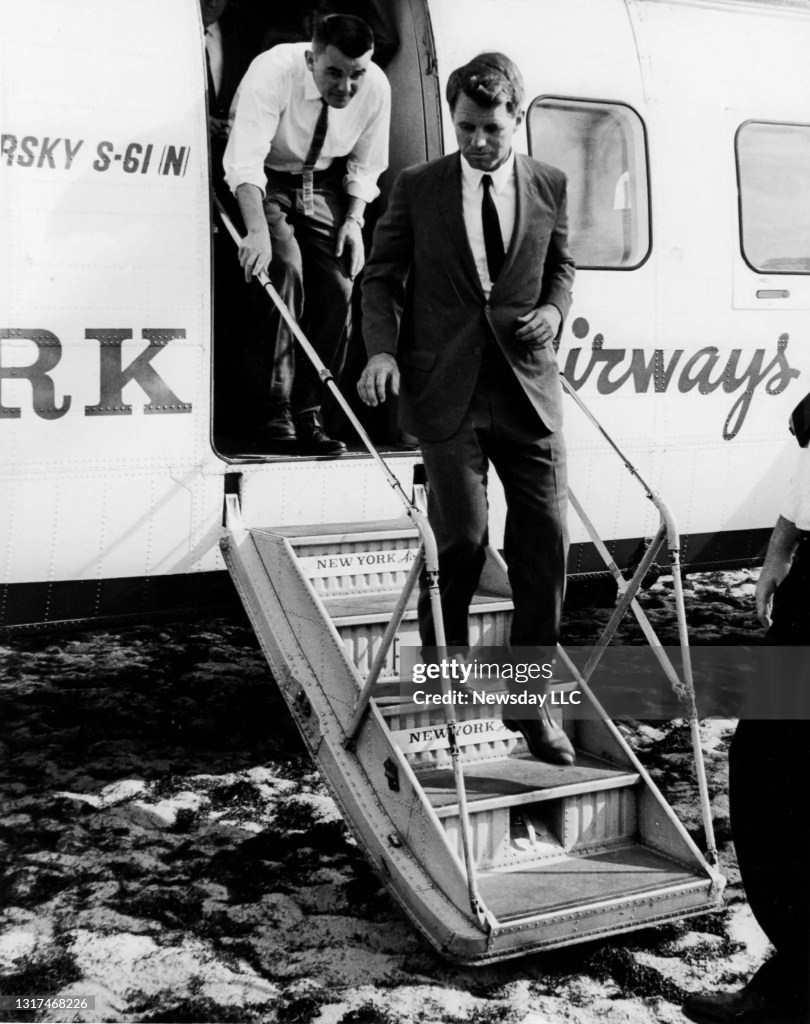
Thousands of sunbathers, many of them almost hysterical in their enthusiasm, swarmed around Robert F. Kennedy today on Nassau and Suffolk County beaches. Mr. Kennedy, the Democratic‐Liberal candidate for the Senate, was forced to abandon plans to walk along the beaches when he was trapped in a friendly mob outside the West Bathhouse at Jones Beach. In closing the first week of his campaign, the former Attorney General stopped at Atlantic Beach, Long Beach, Lido Beach and Jones Beach in Nassau County, and at this Fire Island community in Suffolk.
Although elated by the turnout, Mr. Kennedy was perturbed by the frenzy of the crowds. And his aides were aware that many came to see him because he is a celebrity and not because they planned to vote for him. On a magnificent late summer day, Mr. Kennedy was met by boisterous crowds wherever he went—800 persons at the traffic circle near the Atlantic Beach Bridge, 4,000 on the Long Beach boardwalk, and thousands more along the roads. But nowhere did the crush compare with that at Jones Beach, which was thronged by 160,000 holiday visitors when the candidate arrived a few minutes before 2 PM. Mr. Kennedy climbed to a parapet outside the bathhouse and waved to the crowd below. Then, speaking through an electric megaphone, he declared: “For the past three years, I’ve been working for the New Frontier. Now, and from now on, I’m dedicating my life and my future to the people of the State of New York.”
Senator Kenneth B.. Keating feels that neither Senator Barry Goldwater, the Republican Presidential nominee, nor President Kennedy should constitute issues for the voters to consider in the Senate race. “Barry Goldwater isn’t running for the Senate from New York, I am,” said Mr. Keating, who is running independently of the national ticket. “I don’t think the issue in this campaign is his views, I think it’s my views. So far my opponent has been attacking not my views but Goldwater’s. I’m not responsible for what some other Senator wants.” In a weekend interview in which he discussed what he regarded as the top issues, the Republican candidate said in response to a question that Robert F. Kennedy, his Democratic opponent, might attempt to win the Senate election by invoking the image of the late President.
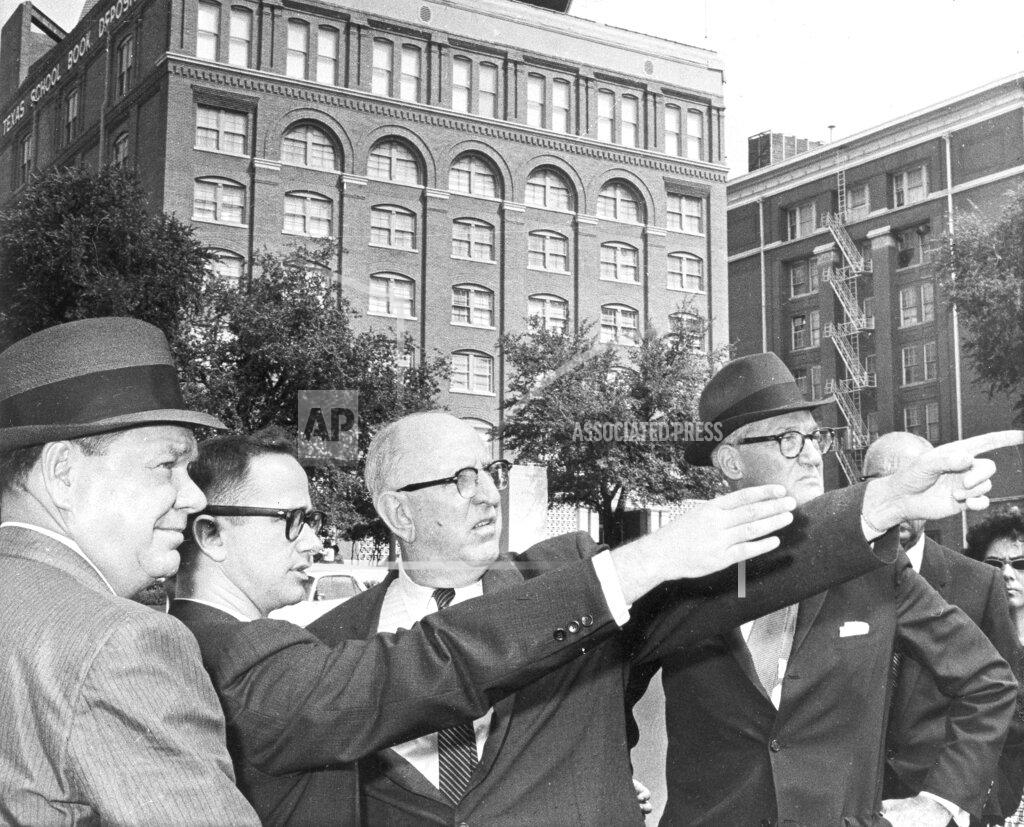
Three members of the Warren Commission visited and studied scenes today connected with the assassination of President Kennedy last November 22. The members were Senator John Sherman Cooper, Republican of Kentucky; Senator Richard B. Russell, Democrat of Georgia, and Representative Hale Boggs, Democrat of Louisana. They were accompanied by J. Lee Rankin, counsel for the commission, and Secret Service agents. The Warren Commission was appointed by President Johnson to investigate the assassination. The commission expects to make its findings public soon. The three commission members mingled with a large crowd during the visit to the sixstory building from which the assassination shots were fired, allegedly by Lee Harvey Oswald.
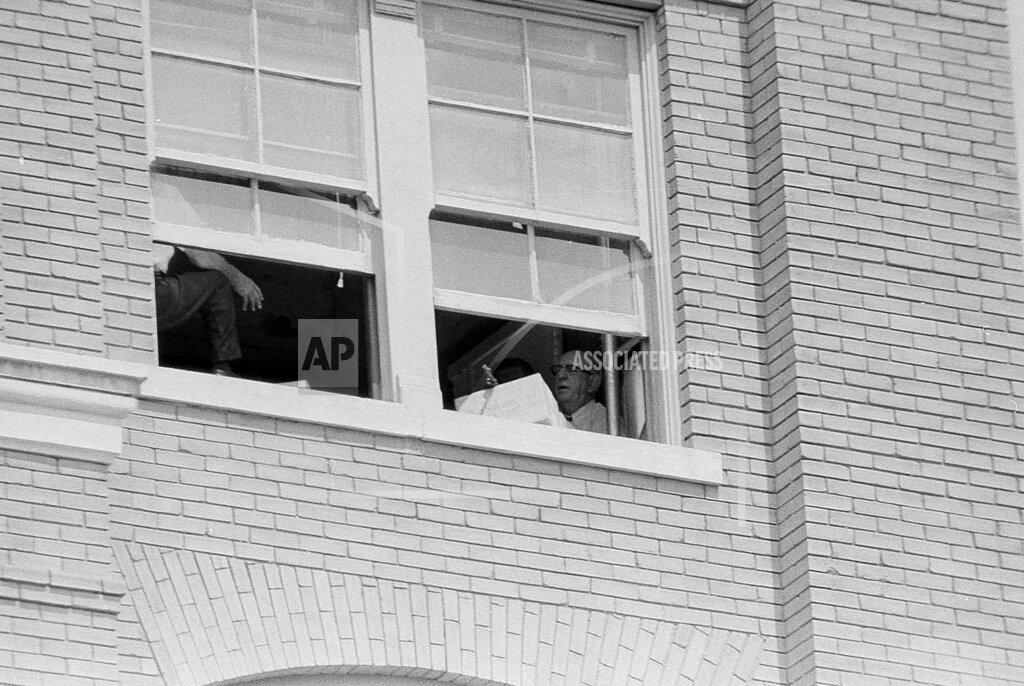
While the group was in the building, the Secret Service agents set up a rifle in the window on the sixth floor, from which the shots were fired. Newsmen on the ground could see several members of the group bending down to look through the gunsights. The commissioners also were driven past the house where Oswald lived and the Texas theater where he was arrested. They visited the spot where Patrolman J. D. Tippit was shot and killed shortly after the assassination, and the home of Jack Ruby, who shot Oswald two days after the assassination. The commission members wound up their visit with a long interview at the Dallas Naval Air Station with Mrs. Marina Oswald, widow of the accused assassin.
A major civil rights leader expressed the fear yesterday that the nation might become a police state if Senator Barry Goldwater won the Presidential election in November. Roy Wilkins, the executive secretary of the National Association for the Advancement of Colored People, said in reply to an interviewer’s question on what he thought of a possible Goldwater victory: “A Goldwater victory — and God forbid — would bring about what they [Goldwater backers] decry in their political campaigning. It would bring about a police state.” Pressed for elaboration, the Black leader restated his view of the effects of a Goldwater victory in these words: “It could lead to a police state.” Mr. Wilkins said he based his statement on what the Republican nominee had said about lawlessness in local communities and his intention to do something about it if elected.
Senator Barry Goldwater’s campaign schedule for most of September is flow complete. It shows that he will make a determined fight for the South. Mr. Goldwater will make 17 appearances in eight Southern states this month. Four will be in President Johnson’s home state of Texas. Meantime, Mr. Goldwater indicated today that if elected he might slow down the closing of military installations and bases for economy purposes, that has been undertaken by Secretary of Defense Robert S. McNamara.
The Arizonan told a Georgia Republican in a telegram that he was “shocked and surprised” at a charge, purportedly made by Representative Carl Vinson, Democrat of Georgia, that Mr. Goldwater’s election would cause the closing of Warner Robbins Air Force Base at Macon, Georgia. “I would remind you that more bases have been closed under Mr. McNamara in four years than during eight years of Eisenhower,” Mr. Goldwater wrote in part. “I am a reserve major general and have devoted over half my life to active and reserve duty and to a study of military affairs,” the Senator said. “I understand the need for a strong Air Force just as well as Mr. Vinson should.”
A dynamite blast ripped through a white‐owned grocery in a Black neighborhood today. Eight sticks of dynamite were found in another store in the neighborhood. No injuries were reported in the explosion. Federal agents investigated the blast in this central Mississippi town, where civil rights leaders say that a Black boycott of downtown merchants has been “85 percent effective.” The explosion in Joe and Barb’s Grocery went off at about 2:35 AM. The store is owned by Joe Ferguson.
George Raymond, Black director of civil rights activities in Canton, said the hull of the concrete block building was left standing but the interior was “extensively damaged.” “All the windows were blown out, and the street was covered with pieces of block, wood and glass,” Mr. Raymond said. He reported much of the merchandise had been destroyed. Mr. Raymond said the Federal Bureau of Investigation and sheriff’s deputies removed eight sticks of unexploded dynamite from under the Washington Grocery after the Black owner, George Washington, saw a cable leading under the building.
After seven seasons, the lead human characters were written off the television series “Lassie.” In the story line, Timmy Martin (Jon Provost) and his adoptive parents Ruth (June Lockhart) and Paul (Hugh Reilly departed for Australia, but Lassie could not go with them because of quarantine laws. In 1957, Tommy Rettig (as Jeff Miller) had departed after four seasons and Provost had become the collie’s new owner. The shows with Provost would be syndicated under the title “Timmy and Lassie,” while those with Rettig were shown as “Jeff’s Collie.”
The Boston Red Sox sell pitcher Wilbur Wood to the Pittsburgh Pirates. The knuckleballer was 0–5 last year and had no decision in 4 appearances this year. The Bucs will pass Wood along to the Chiicago White Sox in 1967 where he’ll blossom.
For the second time in 4 days and the 3rd time in his career, Zoilo Versalles has the only hit for the Minnesota Twins. His 2-run homer in the 6th is the lone hit off Boston’s Bill Monbouquette but it is good enough for a Twins win over the Red Sox, 2–1. It was the second time Versailles had spoiled a pitcher’s bid for a no‐hitter in six days. Last Tuesday night he singled with one out in the eighth inning for the only hit off Milt Pappas of Baltimore.”
Tony Kubek homers for the New York Yankees to lead off the game, and new addition Pedro Ramos gets a ninth inning save in relief as the Yankees beat the Kansas City A’s, 3–2. The Yankees are just 2½ games out of first place with 27 games to play.
At Comiskey Park, pitching is the word of the day. Jack Kralick scatters 4 hits in game 1 as the Cleveland Indians triumph, 2–0. In game 2, Hoyt Wilhelm pitches 6 scoreless innings of relief as the Chicago White Sox rebound for a 3–2 win in 13 innings. When Vic Davilillo is thrown out at home in the 2nd inning of game 2, he becomes the 3rd Cleveland player that inning to make an out on the basepaths. It’ll next be done by the Yankees on August 12, 1975.
Milt Pappas (14–5) pitched his third consecutive shutout today as the Baltimore Orioles beat the Los Angeles Angels, 2–0. Charlie Lau broke up the scoreless game with a two‐out Single in the ninth inning. With Chicago having split a pair, Baltimore trailed the White Sox by half a game in the pennant race. Baltimore was checked on three hits for seven innings by Barry Latman. After he had left for a pinch‐hitter in the eighth, the Orioles put together a walk and Singles by Sam Bowens and Lau for their first run in 18 innings.
The Washington Senators ended their scoreless‐inning streak at 38 with a run in the second inning today, but it was their only consolation in a 9–3 loss to the Detroit Tigers. The defeat was the seventh in a row for the Senators. Don Demeter batted in five runs with a single, double and his 20th home run and George Thomas hit his 12th homer as the Tigers made 13 hits off the loser, Frank Kreutzer, and three other hurlers.
At Philadelphia, San Francisco Giants’ ace Juan Marichal strikes out 13 Phillies, including 7 in a row, to win 4–3. The Phillies lead is cut to 5½ games. Two errors on an attempted pickoff play in the eighth inning enabled Willie Mays to race home from first base with the run that gave the Giants the win. Mays walked with one out. With Jim Hart at bat, Jack Badschun, the pitcher, threw to first several times, the last time past the first baseman, Frank Thomas. As Mays headed for third, Thomas retrieved the ball and threw it over third base and into the stands, Mays scoring the fourth Giant run.
Lou Brock’s bad‐hop single with two out in the 11th inning today scored Tim McCarver with the winning run as the St. Louis Cardinals defeated the Chicago Cubs, 5–4. McCarver opened the 11th with a single and moved around on a sacrifice and an infield out. Brock’s hit bounced over Andre Rodgers’s head. The Cards scored twice in the ninth to tie the score after the three homers had helped Chicago build a 4–2 lead.
Jim Maloney, aiding his own cause with a three‐run homer and getting relief help from Billy McCool, pitched Cincinnati to a 6–3 victory over the Milwaukee Braves today. The victory enabled the second‐place Reds to pull within 5½ games of the first‐place Philadelphia Phillies, who lost to the San Francisco Giants. McCool took over in the seventh and blanked the Braves the rest of the way to preserve Maloney’s sixth straight victory and his 13th of the season against nine losses. Maloney’s homer, his first of the season and the second of his career, capped a four‐run sixth inning that cost the Brave’s hurler, Denny Lemaster, his 11th loss against 13 victories.
The New York Mets finally blanketed the Los Angeles Dodgers’ great running game yesterday, but the Dodgers resorted to distance hitting to score a 4–3 victory and win their 45th game in 51 starts against the Mets in three years. When the Mets began to cut down the Dodger greyhounds on the basepaths, the Dodgers unloaded a triple by John Roseboro and a two‐run homer by Jim Gilliam to do the job for them. When the Mets crept close in the seventh and eighth innings, the Dodger bullpen—which had contributed Ron Perranoski for six sterling innings Saturday — dispatched Bob Miller to end the threat in his 63rd appearance of the year.
Jerry Lynch drove in Bill Virdon with a sacrifice fly in the sixth inning and Vern Law scattered nine hits today as the Pittsburgh Pirates scored their seventh straight victory over the Houston Colts, 1–0. Virdon opened the sixth with a single and advanced to second when the throw from the outfield wasn’t handled cleanly by Nellie Fox. A ground out by Roberto Clemente moved Virdon to third and Lynch followed with his fly to deep center.
Born:
Rosie Perez, American actress (“Do the Right Thing”, “White Men Can’t Jump”), in Brooklyn, New York, New York.
Todd Palin, husband of former Alaska Governor Sarah Palin, in Dillingham, Alaska.
Darryl Holmes, NFL defensive back (New York Jets), in Birmingham, Alabama.
Cedrick Brown, NFL defensive back (Philadelphia Eagles), in Compton, California.
Mike York, MLB pitcher (Pittsburgh Pirates, Cleveland Indians), in Oak Park, Illinois.
Todd Okerlund, NHL right wing (New York Islanders), in Burnsville, Minnesota.
Died:
Checkers, 12, American cocker spaniel referred to in the “Checkers speech” given in 1952 by U.S. Senator and vice-presidential candidate Richard M. Nixon when he was defending himself against accusations of receiving illegal contributions. As part of his speech, Nixon denied receiving anything except for a gift to the family from an admirer who had heard “that our two youngsters would like to have a dog… And our little girl — Tricia, the 6-year-old — named it Checkers. And you know, the kids, like all kids, love the dog and I just want to say this right now, that regardless of what they say about it, we’re gonna keep it.”

 History Diaries