The five-day Battle of Tuchola Forest ended in German victory. The battle occurred from 1 September to 5 September 1939 and resulted in a major German victory. Poor Polish command and control, as well as German numerical and tactical superiority, allowed the Germans to manage to cripple Poland’s Armia Pomorze (Army Pomerania) and, by breaking through the Polish Corridor, to connect mainland Germany with East Prussia. The battle was fought against the judgment of General Władysław Bortnowski, the commander of Army Pomerania, who believed the Corridor to be a very poor defensive position and had repeatedly asked for permission to withdraw his forces from it. German forces in the theater were composed of elements of the 4th German Army under General Günther von Kluge, specifically 19th Panzer Corps (commanded by General Heinz Guderian), and 2nd Army Corps under General Adolf Strauß. Those units were based in Western Pomerania west of the corridor. Polish forces in the theater comprised elements of the Pomeranian Army: 9th Infantry Division under Colonel Józef Werobej, the 27th Infantry Division under General Juliusz Drapella, and Czersk Operational Group under General Stanisław Grzmot-Skotnicki.
By September 3, Guderian had recognized the situation of the Polish forces and began orienting most of his force towards Bydgoszcz, sending only reconnaissance elements onwards to secure Chelmno. Around noon the German Luftwaffe began to launch air attacks on the retreating Polish columns which inflicted heavy losses, including most of the 9th Division’s artillery. Some troops of the 9th and 27th Divisions were caught by the advancing panzers and surrounded near the village of Bukowiec, where 846 Polish troops were captured by the 3rd Panzer Division after a three hour battle. Pressed up against the Vistula with their route to Bydgoszcz cut, 4,000 Polish troops would be captured by the end of the day, with only the 35th Infantry Regiment managing to escape.
In Bydgoszcz, Gen. Bortnowski had at his disposal the 15th infantry division, about ⅓ of the 2nd infantry division, two surviving battalions of the 22nd regiment, and about a quarter of the Pomorska cavalry brigade. Nearly all were disorganized and exhausted. Bortnowski decided to abandon the city and establish a new defensive line on the south bank of the Vistula, but roughly 1,000 German Nazi sympathizers, organized by Abwehr infiltrators and armed by the SS, staged a diversionary uprising, firing from windows and killing 20 Polish troops of the 22nd Infantry Regiment. The 62nd infantry regiment of the 15th division was tasked with restoring order; Polish troops rounded up 600 local Germans and killed 100 others, some in combat and some in summary executions. The next day however, September 4, saw more sniping by local Germans, resulting in retaliation from the Polish troops which killed as many as 150 further fighters and civilians. This event was magnified by German propaganda into the “Bromberg Massacre”, falsely claiming that 5,000 Germans had been killed.
On this day, German troops entered Bydgoszcz, followed by the SS Einzatzgruppen 4 and SS-Standarte-Totenkopf division, which rounded up and killed 192 Poles, including city officials and other political figures, in the first week of the occupation. Prison camps were established in the area which held over 7,000 prisoners by November. The Germans had in large part completed their takeover of the Polish Corridor. At that point some German forces moved to erase isolated pockets of Polish resistance further north in fortified areas on the Baltic Coast, while others continued their push south-east, deeper into Polish territory. About two-thirds of the Polish Armia Pomorze survived the battle, regrouped, and were reconstituted under Armia Poznań (Army Poznań) in time to fight in the Polish counteroffensive at the Battle of the Bzura.
The Battle of Piotrków Trybunalski began. On the previous morning, Erich Hoepner’s XVI Panzer Corps reached Rozprza, just 12km south of Piotrków. It was a defensive position of the “Lodz” army under command of General Wiktor Thommée, defended by an improvised infantry battalion without anti-tank weapons, supported by two artillery pieces. The Germans managed to throw off the defenders and build bridges across the river. In the afternoon a Polish 2nd tank battalion was sent to counterattack but withdrew under artillery fire. In the evening Thommée decided to make another counterattack the next day using the 2nd tank battalion and an infantry battalion from Wolynska Cavalry Brigade. At the same time, Hopener decided to regroup his 1st and 4th Panzer Divisions, and attack Piotrków the next day using the captured bridgeheads. The city was defended by 19th Infantry Division from “Prusy” army. In addition, there was a Wilenska Cavalry Brigade and 29th infantry division nearby, which Biernacki intended to use for a night attack on the armored troops attacking Piotrków. Permission for this attack was given at night and the attack was scheduled for the night of September 5/6.
At dawn on September 5, Hoepner moved north and at 10 AM, 1st Panzer Division attacked Piotrków. This was a surprise to Biernacki who thought that Rozprza was still defended by the “Lodz” army. The attack was repelled with the participation of 2nd tank battalion which counterattacked on the flank. However, the Polish tanks soon began to retreat due to the numerical superiority of the Germans. Hoepner collected more forces and after a strong artillery fire at 2 PM the second attack on the city began. This time, the Polish defensive line was pierced and german tanks began to pour through. The two battalions of the 19 Infantry Division were decimated, having lost more than 80 percent of their personnel and equipment. The Germans occupied the city by evening. At the same time, Biernacki, unaware of the loss of the city due to missing reports, continued to prepare for a night attack. However, 19th Division was badly battered and Wilenska Cavalry Brigade began to retreat to the northeast. Only 29th Division continued the advance by marching into the fighting area. At midnight the Biernacki realized the situation and ordered to recapture the city with the forces of 29th Infantry Division and four battalions from 19th Infantry Division that had not yet taken part in the fighting. The attack, however, was not carried out and the troops withdrew to the north. 29th Division lost two infantry battalions already fighting near Piotrków, which did not receive new orders.
The German 10th and 14th Armies cross the Vistula River within 30 miles of Warsaw.
The Polish government begins to evacuate Warsaw for Lublin, 100 miles southeast of the capitol. The evacuation of bomb-scarred Warsaw was speeded up late tonight while Polish troops stubbornly held back the onrushing German troops only thirty-one miles outside the city, according to official announcement, to protect the flight of civilians. The sounds of heavy fighting to the north could be heard in the city. An official radio announcement said that Polish divisions, rushed up to stem the enemy advance, had halted the Germans along a forty-five-mile front north and northwest of the capital.
At the nearest point the Germans were at Plonsk, thirty-one miles northwest of the city. The announcement said that the Poles had dug in for a “great battle” between Plonsk and Ciechanow, forty-four miles north of the city, for the defense of the capital.
If the Germans break through there the Poles will fall back to their heavily fortified line nine miles outside the city along the Vistula and Bug Rivers. The announcement of the stemming of the German advance restored some amount of optimism in Warsaw, but the people realized that there undoubtedly would be intensified attacks by Nazi planes. Evacuation of civilians, it was said, is more necessary than ever to organize a thorough defense of the capital, and removal of the population will be carried on with greater intensity. The general impression to be gained in Warsaw tonight was that the Polish Army was determined to fight to the death in defense of Warsaw.
France is preparing for a limited offensive at Saarbrücken on the 7th. It will be timidly executed and then abandoned without achieving anything of note.
In a private conversation, Franz Halder and Walther von Brauchitsch both agree that the war against Poland is effectively won.
The National Registration Act was given Royal Assent.
A British doctor isolates the germ responsible for a child-killer disease, rheumatic fever.
An Avro Anson aircraft of No. 500 Squadron RAF make the first attack of the war on an enemy submarine.
German Army units cross the Vistula River in Poland. Meanwhile, Soviet Foreign Minister Vyacheslav Molotov responds to the German invitation to jointly invade Poland in the positive, but notes that the Soviet forces will need several days to prepare; he also warns the Germans not to cross the previously agreed upon line separating German and Soviet spheres of influence.
At a meeting with rocket specialists Walter Dornberger and Karl Becker, German Army Commander-in-Chief Colonel General Walter von Brauchitsch signs an order stating that the “Peenemunde Project (Army Experimental Center, Production Plant and Construction Office) is to be pushed forward with all possible means as particularly urgent for national defense.”
The small steamer Bosnia became the first British freighter lost in the war when it was sunk by U-47. The unescorted British steam merchant Bosnia is stopped by gunfire and after the crew abandoned ship is torpedoed and sunk by the U-47, commanded by Kapitänleutnant Günther Prien, about 120 miles north-northwest of Cape Ortegal, Spain in the eastern Atlantic Ocean. Of the ship’s complement, 1 dies and 32 survivors are picked up by the Norwegian motor tanker Eidanger. The 2,407-ton Bosnia was carrying sulphur and was bound for Manchester, England.
The unescorted British steam merchant Royal Sceptre is sunk by gunfire by the U-48, commanded by Kapitänleutnant Herbert Schultze, about 300 miles northwest of Cape Finisterre off the west coast Spain in the eastern Atlantic Ocean. Of the ship’s complement, 1 dies and 32 survivors are picked up by the British steam merchant Browning. The 4,853-ton Royal Sceptre was carrying wheat and maize and was bound for Belfast, Ireland.
The German cargo ship Inn was captured in the Atlantic Ocean 400 nautical miles (740 km) southwest of the Canary Islands, Spain by the Royal Navy light cruiser HMS Neptune and was scuttled.
The British destroyer HMS Jersey intercepts the German merchantman Johannes Molkenbuhr (5,294 tons), whose crew scuttles the ship off Bergen.
U.S. freighter Black Osprey, bound for Rotterdam, Holland, and Antwerp, Belgium, is stopped by British warship off Lizard Head and ordered into the port of Weymouth, one of the five “contraband control bases” (the others are Ramsgate, Kirkwall, Gibraltar and Haifa) established by the British government.
U.S. Freighter Lehigh, bound for Hamburg, Germany, is detained by the British.
Finland halts work on the Olympics and considers canceling the 1940 events.
General Jan Christian Smuts replaced J. B. M. Hertzog as Prime Minister of South Africa after Parliament rejected Hertzog’s legislation which would have made the dominion neutral in the European War.
Egypt is now on full war footing. Four military districts are set up. Egypt’s commitments to Britain are being scrupulously fulfilled.
Fifty thousand in Palestine volunteer for war. Jews and some Arabs are ready to assist Britain.
The Iraqi government breaks off relations with Germany, and begins deporting Germans citizens.
A diplomatic incident between Britain and the United States occurred at Port Said, Egypt when British authorities removed two German engineers from the Don Isidro, a Philippine motorship under the American flag. The United States claimed the act was a violation of its neutral rights. Philippine motorship Don Isidro, on her maiden voyage en route from her builders’ yard at Kiel, Germany, to Manila, Philippine Islands, clears the Suez Canal; U.S. government immediately protests British authorities having removed, at Port Said, two German engineers (on board “to guarantee construction and demonstrate proper manning” of the new vessel) from Don Isidro (which is under the American flag) as illegal and a violation of the neutral rights of the United States.
The United States officially declared neutrality in the European war. The United States proclaims neutrality in the European war. Under the Neutrality Act of 1937, President Franklin Roosevelt prohibited the export of arms and munitions to the belligerent powers, including Britain and France. The United States today formally proclaimed to the world its neutrality in the European war, and moved simultaneously to implement that declaration by joining efforts with its Pan-American neighbors at an early conference, probably late this month, in Panama, to cushion the Western Hemisphere against the shocks of the catastrophe.
This nation’s individual neutrality was proclaimed in two separate declarations by President Roosevelt. The first, issued shortly after noon under the terms of international law, set forth seventeen separate restrictions, most of them already in the statutes, by which the use of the territory and territorial waters of the United States would be denied to belligerents for warlike purposes.
The other, required by the Neutrality Act of 1937, clamped an immediate embargo on shipments of arms, munitions, airplanes and airplane parts to Germany, Poland, France, the United Kingdom, India, Australia, and New Zealand — the countries between which the President found that “a state of war unhappily exists.” The latter was issued late this afternoon.
Each proclamation was followed by an Executive Order providing for enforcement of its provisions. Canada and South Africa were not listed in the proclamation as among the countries at war. In an explanation of this at his press conference, President Roosevelt cited that the Parliaments of these British dominions had not acted on a war declaration as yet, hence they were not found by him officially to be in a state of war at this time.
Another step in this government’s neutrality program was taken later tonight when new regulations were issued for use of the Panama Canal, similar to those promulgated at the outbreak of the World War in 1914. President Roosevelt intimated this afternoon that still further neutrality moves might be expected in the next few days, among them some means for curbing foreign propaganda in the United States, particularly that aimed at our system of government and glorifying nazism, communis,m or other forms of dictatorship.
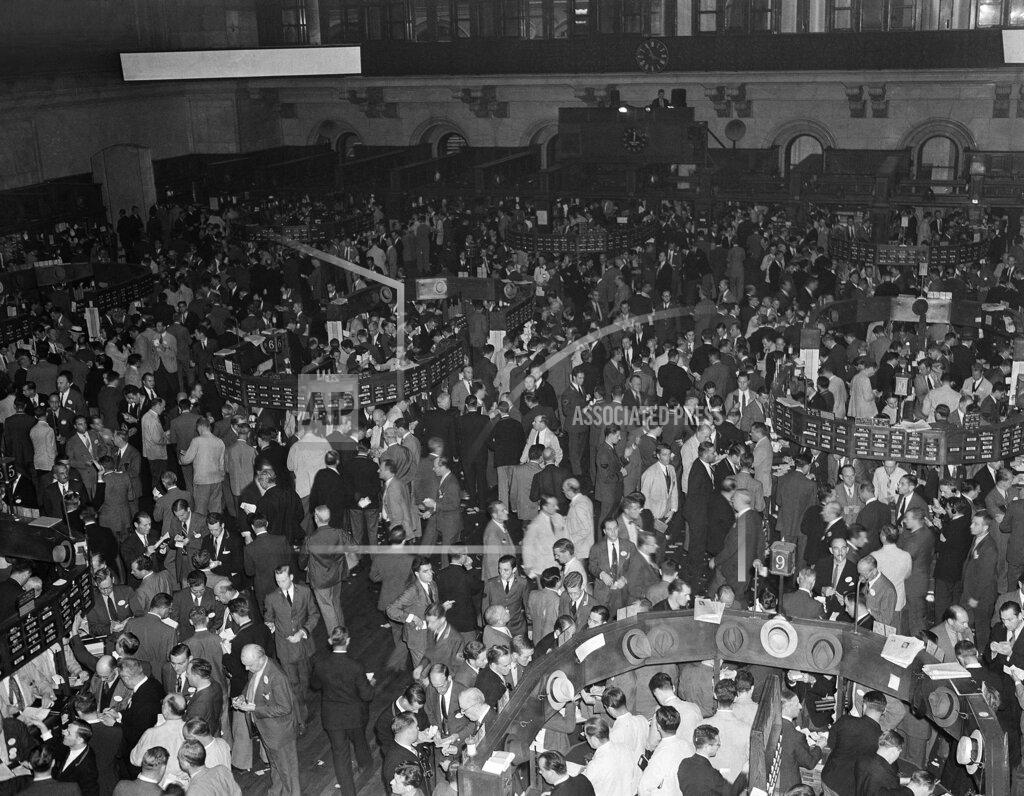
Since Monday was Labor Day, the New York Stock Exchange opened for the first day of trading since Britain and France declared war. Stocks surged almost 10% on speculation of European demand for industrial products. Stock prices raced upward yesterday as investors decided that a European war would help American business. On a turnover of 5,932,150 shares, the heaviest in almost two years, prices on the New York Stock Exchange rose from 5 to more than 20 points under the leadership of steels and other munitions. It was a day of sensations. Bond trading on the Stock Exchange was the heaviest in history, with volume of $59,248,000 in a market which saw further declines of United States Government obligations despite Treasury buying. Essential commodities shot skyward with the opening quotations, many of them to their arbitrary trading limits. Further buying, therefore, became impossible and millions of dollars of orders went unfilled.
Orders for steel pour into America from a flood of foreign companies.
The U.S. Navy is considering the recommissioning of an undisclosed number of destroyers commissioned during the World War, which are held in reserve at San Diego, Philadelphia, and other bases.
U.S. steamship President Roosevelt off-loads British Scott-Paine-type motor torpedo boat PT-9 at New York; PT-9 will be the prototype for the motor torpedo boats constructed by the Electric Boat Company.
Captain Alan G. Kirk, U.S. Naval Attaché, and Commander Norman R. Hitchcock, Assistant Naval Attaché and Assistant Naval Attaché for Air, are flown to Galway, Ireland, where they interview Athenia’s surviving officers and men. The attaché’s investigation concludes that Athenia was torpedoed by a submarine.
Chief of Naval Operations (Admiral Harold R. Stark) directs Commander Atlantic Squadron (Rear Admiral Hayne Ellis) to maintain an offshore patrol to report “in confidential system” the movements of all foreign men-of-war approaching or leaving the east coast of the United States and approaching and entering or leaving the Caribbean. U.S. Navy ships are to avoid making a report of foreign men-of-war or suspicious craft, however, on making contact or when in their vicinity to avoid the performance of unneutral service “or creating the impression that an unneutral service is being performed” (see 9 October). The patrol is to extend about 300 miles off the eastern coastline of the United States and along the eastern boundary of the Caribbean (see 6 September). Furthermore, U.S. naval vessels are to report the presence of foreign warships sighted at sea to the district commandant concerned. Destroyers Davis (DD-395) and Benham (DD-397) (two 327-foot Coast Guard cutters will be assigned later) are designated as the Grand Banks Patrol. They are to render rescue and other neutral assistance in emergencies and to observe and report (“in confidential system”) movements of all foreign warships. They are to patrol across existing steamer lanes to the southward of the Grand Banks and to approximately 50° Maritime Commission (Hydrographic Office Special Warning No. 9) directs that all U.S. merchant ships en route to or from Europe are not to steer a zig zag course, are not to black out at night, and are to paint the U.S. flag on each side of the hull, on hatches fore and aft, and on sun decks of passenger vessels, and to illuminate the colors flying from the flagstaff at night. In Hydrographic Office Special Warning No. 12 (promulgated the same day), U.S. merchant vessels engaged in domestic, “near-by foreign” or transpacific trade are not required to paint the flag on hull, hatches and decks, but otherwise are to follow the other instructions contained in Special Warning No. 9.
International Lawn Tennis Challenge, Haverford, Pennsylvania: John Bromwich beats American Frank Parker 6–0, 6–3, 6–1 to give Australia the title, 3–2.
The Chicago White Sox scored four runs in the first inning today and coasted to a 4-2 triumph over the Cleveland Indians. The victory gave the White Sox a sweep of the two-game series and dropped the Indians three games below their third-place rivals.
The Detroit Tigers downed the St. Louis Browns, 4–2, as Al Bneton hurled a six-hitter and Hank Greenberg hit his third home run in two days.
The hot Cincinnati Reds tacked down another corner of the National League pennant many fans believe they have in the bag by nosing out the second-place St. Louis Cardinals, 3–1, in a ten-inning struggle in St. Louis today. Veteran Bucky Walters got the win, allowing seven hits in ten innings, and singled in the winning run.
The New York Giants romp, shutting out the Philadelphia Phillies, 6–0. The Giants got five runs in the first inning and Cliff Melton blanked the Phillies for his second complete game shutout of the season. Frank Demaree kicked off the first inning onslaught with a two-run home run.
The Brooklyn Dodgers pound out ten hits and defeat the Boston Bees, 6–2, at Ebbets Field. Hugh Casey gives up just six hits and goes the distance for his 11th win of the year. He also added a single and a double. Dolof Camilli had a homer, his 24th, for the Dodgers. Lou Fette lost his sixth straight game for the Bees.
Argentines discard sympathy for the Reich. The press and public are now almost belligerently anti-Hitler.
Gandhi reveals he made a personal plea to Hitler.
The Japanese switch a truck order from the Reich to the United States that totals $10 million.
New Zealand Prime Minister Michael Joseph Savage declares New Zealand’s support for Britain in the war with Germany; Savage famously told the nation “where she goes, we go. Where she stands, we stand.”
Dow Jones Industrial Average: 148.12 (+10.03).
Born:
George Lazenby, actor (“On Her Majesty’s Secret Service”) and model, in Goulburn, New South Wales, Australia.
William Devane, American actor (“Family Plot”, “Missiles of October”), in Albany, New York
Donna Anderson [Knaflich], American actress (“On the Beach”), in Gunnison, Colorado.
John Stewart, American singer (Kingston Trio, 1961-67), and songwriter (“Daydream Believer”), in San Diego, California (d. 2008).
Billy Kilmer, NFL quarterback and halfback (Pro Bowl, 1972; San Francisco 49ers, New Orleans Saints, Washington Redskins), in Topeka, Kansas.
Clay Regazzoni, Formula One racing car driver, in Mendrisio, Switzerland (d. 2006).
Claudette Colvin, American civil rights activist arrested at 15 for refusing to give her seat on a bus to a white woman (nine months before Rosa Parks), in Montgomery, Alabama.
Died:
Cornelis J “Cor” van Ast, Dutch actor and director (“Ghost Hotel”, “Two Boys”).
Naval Construction:
The Koninklijke Marine (Royal Netherlands Navy) De Zeven Provinciën-class light cruiser HrMs (HNMS) De Ruyter (C801) is laid down by Rotterdamsche Droogdok Maatschappij (Rotterdam, Netherlands). Her construction is interrupted by World War II; she will not be completed until 1953.
RCMP vessels Captor, Chaleur, Invader & Acadian transferred to RCN Examination service and recommissioned as HMCS Captor, Chaleur I, Invader & Interceptor respectively.
The Royal Navy ASW trawler HMS Northern Isles (4.25) is commissioned. Her first commanding officer is Lieutenant Derik Sidney Alfred Hewett, RNR.
The Royal Navy ASW trawler HMS Kingston Turquoise (4.91) is commissioned. Her first commanding officer is Lieutenant Leonard Arthur White, RNR.
 History Diaries